International Research Journal of Engineering and Technology (IRJET) e-ISSN: 2395-0056
Volume: 06 Issue: 07 | July 2019 www.irjet.net p-ISSN: 2395-0072
© 2019, IRJET | Impact Factor value: 7.211 | ISO 9001:2008 Certified Journal | Page 209
Comparative Study on the Strength Parameters of Concrete Made using
Natural and Artificial Waste Fibres
Deepika S1, Anupama Natesh2
1M.Tech Student, Department of Civil Engineering, Shree Devi Institute of Technology, VTU, Karnataka, India
2Asst. Professor, Department of Civil Engineering, Shree Devi Institute of Technology, VTU, Karnataka, India
-------------------------------------------------------------------------***-------------------------------------------------------------------------
Abstract - Concrete has several appealing
characteristics that have made it as a widely used
construction material. It is the material of choice where
strength, performance, durability etc., are required and
concrete is undoubtedly most versatile construction
material. Today’s developing world lays high emphasis on
the waste management. Wastes generated through
different source needs to be recycled & reused to convert
them into useful resources & hence need to be treated well.
Construction industries provide a wide platform in reusing
these waste materials as an alternative of some
conventional materials.
Key Words: Natural and Artificial Fibers, Reuse of waste
materials, Strength Parameters…….
1. INTRODUCTION
The Research on study of environmentally friendly,
maintainable and durable materials have increased
significant mindfulness in the development field. The
present Research and Development is centred on the
innovation of alternative materials which can be used in
the concrete. The constituents of the concrete such as
cement and aggregates can be replaced by the
alternative material which can offer a better strength to
concrete in turn this will be a solution for the over
exploitation of the resources for the concrete
manufacturing and the environmental problems.
2. NEED OF THE PROJECT
Studies have been showed that fibre reinforced concrete
(FRC), enhances the strength properties of normal
concrete; for example Split-Tensile Strength, Fatigue
Strength, Compressive Strength, Modulus of Elasticity,
Flexural strength, Toughness and Impact Resistance. It is
also a known fact that the FRC can be used in the
environmental condition where it is susceptible to the
corrosion. Fibres make the structure fail in a ductile
manner so that sudden failure of the structure can be
avoided. Also, the fibres are found to be strong in sealing
the cracks developed in the concrete. In this study an
attempt is made to study the mechanical and workability
properties of the concrete.
3. OBJECTIVES OF THE PROJECT
The project objective is to study the properties of the
concrete made with different types of fibres.
1. To check the strength properties of the concrete
like split tensile strength, compressive strength
and flexural strength with different types of
fibres.
2. To check the durability properties of the fibre by
carbonation test.
3. To check the workability of the concrete made
with natural and artificial fibres.
4. To find the best fibre which gives the better
properties for the concrete.
5. To find the effect of fibre volume in the
properties of the concrete for the different types
of fibres using 0.5 % and 1% of fibre.
4. MATERIALS USED
4.1 Cement
Cement is an extremely fine material with durable
properties and goes about as restricting material in
concrete and contributes solidarity to the concrete. The
characteristic of concrete are fundamentally impacted by
the properties of cement. For the present study
‘Ordinary Portland cement’ of grade 43 in accordance to
IS 8112-1989 is utilized.
a) Specific gravity = 3.15
b) Consistency = 29.2
4.2 Fine Aggregate
The sand which goes throughb4.75 mm and left on 600 µ
sieve is used in study. Basic tests and sieve analysis
were done on fine aggregate to assess the fundamental
properties and to choose the fine aggregate zonings.
a) Specific gravity = 2.58
b) Fineness modulus = 2.85
c) Moisture Content = 0.09%
d) Water Absorption =0.71%
e) Bulk density =1655kg/m3
International Research Journal of Engineering and Technology (IRJET) e-ISSN: 2395-0056
Volume: 06 Issue: 07 | July 2019 www.irjet.net p-ISSN: 2395-0072
© 2019, IRJET | Impact Factor value: 7.211 | ISO 9001:2008 Certified Journal | Page 210
4.3 Course Aggregate
As per ‘IS 383-1970’ the coarse aggregates is defend as
Aggregates, greater share of which is held on 4.75 mm IS
Sieve and having less fine material as permitted for the
dissimilar standard. Coarse aggregate with a max size of
20 mm is used in this study.
a) Specific gravity = 2.62
b) Fineness modulus = 2.74
c) Moisture Content = 0.18%
d) Water Absorption =0.49%
e) Bulk density =1590kg/m3
4.4 Water
As indicated by ‘IS 456: 2000’, water applied for
combination and relieving will be spotless and allowed
from harmful measures of acids, oils, salts, alkalis or
different materials that might be pernicious to cement or
steel. The pH value of 6 is maintained.
4.5 Superplasticizer
Conplast SP430 is a market available retarder
manufactured by the company FOSROC is used in this
study. The properties of it is as given below.
a) Specific gravity = 1.20
b) Chloride Content =Nil
c) Solid Content =40%
d) Recommended Dosage =5ml to 2ml/kg of binder
e) Operating Temperature =10 to 40 degree Celsius
f) Colour =Dark Brown liquid
5. EXPERIMENTAL WORK
This section describes investigation of the fundamental
properties of the materials utilized in this project and
methods used to test the concrete samples at different
stages of curing. Natural and artificial fibres and
materials are collected and tested for their basic
properties of the materials. Then mix design is done for
M40 as per IS 12026-2009. The constituent is mixed in
the specified manner with 0.5% and 1% of fibre. Various
test to access the mechanical properties such has
compression, split tensile and flexural strength were
done. The durability properties such as carbonation test
is also carried out and workability properties also
accessed. The values obtained in the test is compared
with the control mix.
5.1 Mix Proportioning For One Meter Cube of
Concrete
Table-1: Proportion of Mix
Mix Proportion 1:1.65:2.92
W/C ratio 0.4
Cement 400kg
Water 160 kg
Coarse Aggregate 1168 kg
Fine Aggregate 660kg
Superplasticizer 2.4kg
5.2 Batching of Materials
Materials were batched dependent on weight batching
and machine blending was adopted to blend the
ingredients in this work. Gauge batching of every
material made in this examination is appeared in the
Table 1. The percentage replacement of ordinary cement
by addition of different fibres and their material weight
per cubic meter of concrete are given in Table 2. Samples
made are given in Table 3.
Notation Used:
CM- Control Mix
BAG - Bagasse Fibre,
PLA - Plastic Fibre
BAN - Banana Fibre
COR -Coir Fibre
GLA – Glass Fibre
Table-2: Materials Weight
Mix
Designation
Cement Fiber Coarse
Aggregate
Fine
Aggregate
Kg kg Kg kg
CM 400 - 1168 660
BAG1 400 2 1168 660
BAN1 400 2 1168 660
COR1 400 2 1168 660
GLA1 400 2 1168 660
PLA1 400 2 1168 660
SIS1 400 2 1168 660
BAG2 400 4 1168 660
BAN2 400 4 1168 660
COR2 400 4 1168 660
GLA2 400 4 1168 660
PLA2 400 4 1168 660
SIS2 400 4 1168 660
International Research Journal of Engineering and Technology (IRJET) e-ISSN: 2395-0056
Volume: 06 Issue: 07 | July 2019 www.irjet.net p-ISSN: 2395-0072
© 2019, IRJET | Impact Factor value: 7.211 | ISO 9001:2008 Certified Journal | Page 211
Table-3: Samples Made
6. RESULTS AND DISCUSSION
6.1. Fresh Concrete
6.1.1. Workability
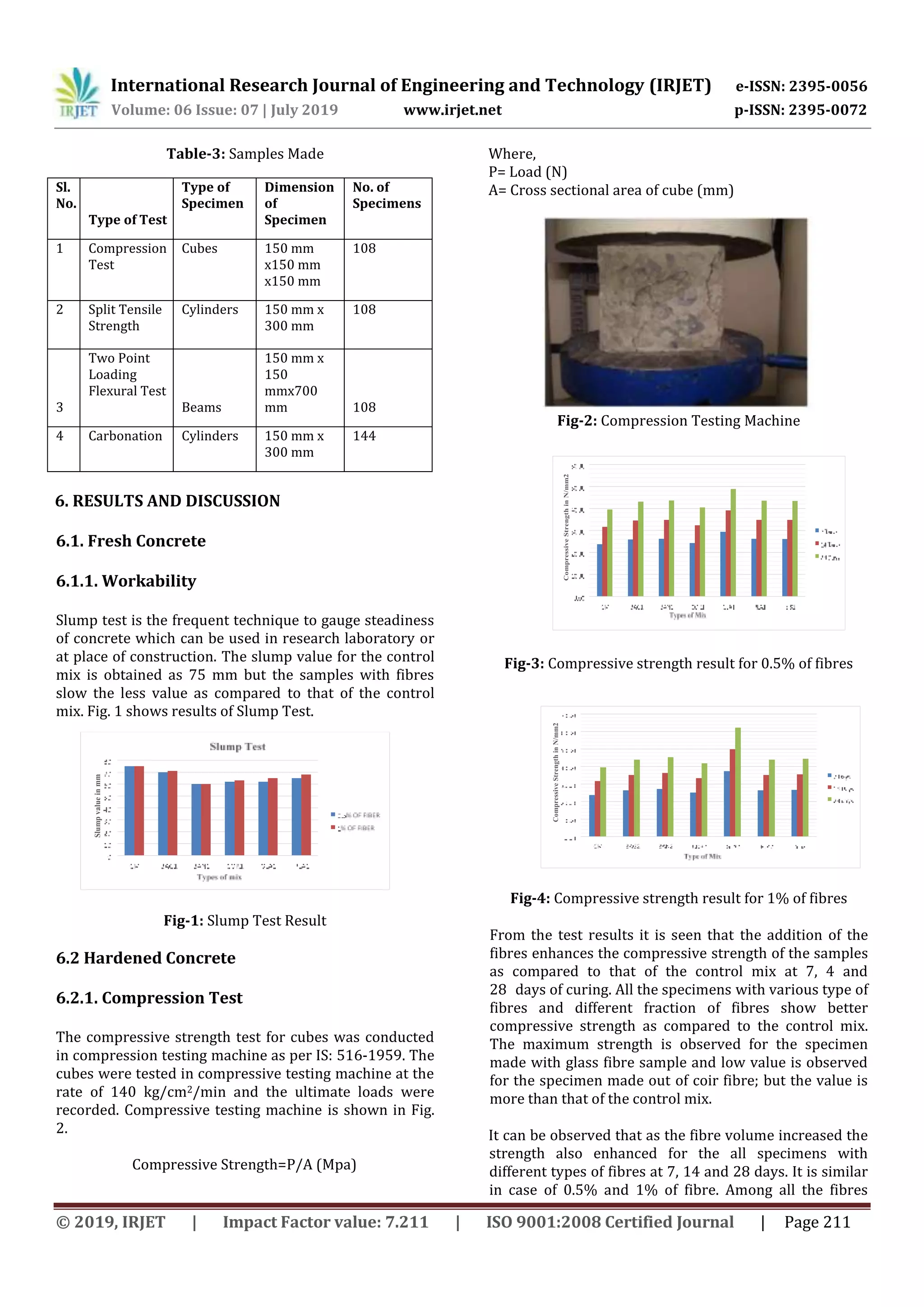
Slump test is the frequent technique to gauge steadiness
of concrete which can be used in research laboratory or
at place of construction. The slump value for the control
mix is obtained as 75 mm but the samples with fibres
slow the less value as compared to that of the control
mix. Fig. 1 shows results of Slump Test.
Fig-1: Slump Test Result
6.2 Hardened Concrete
6.2.1. Compression Test
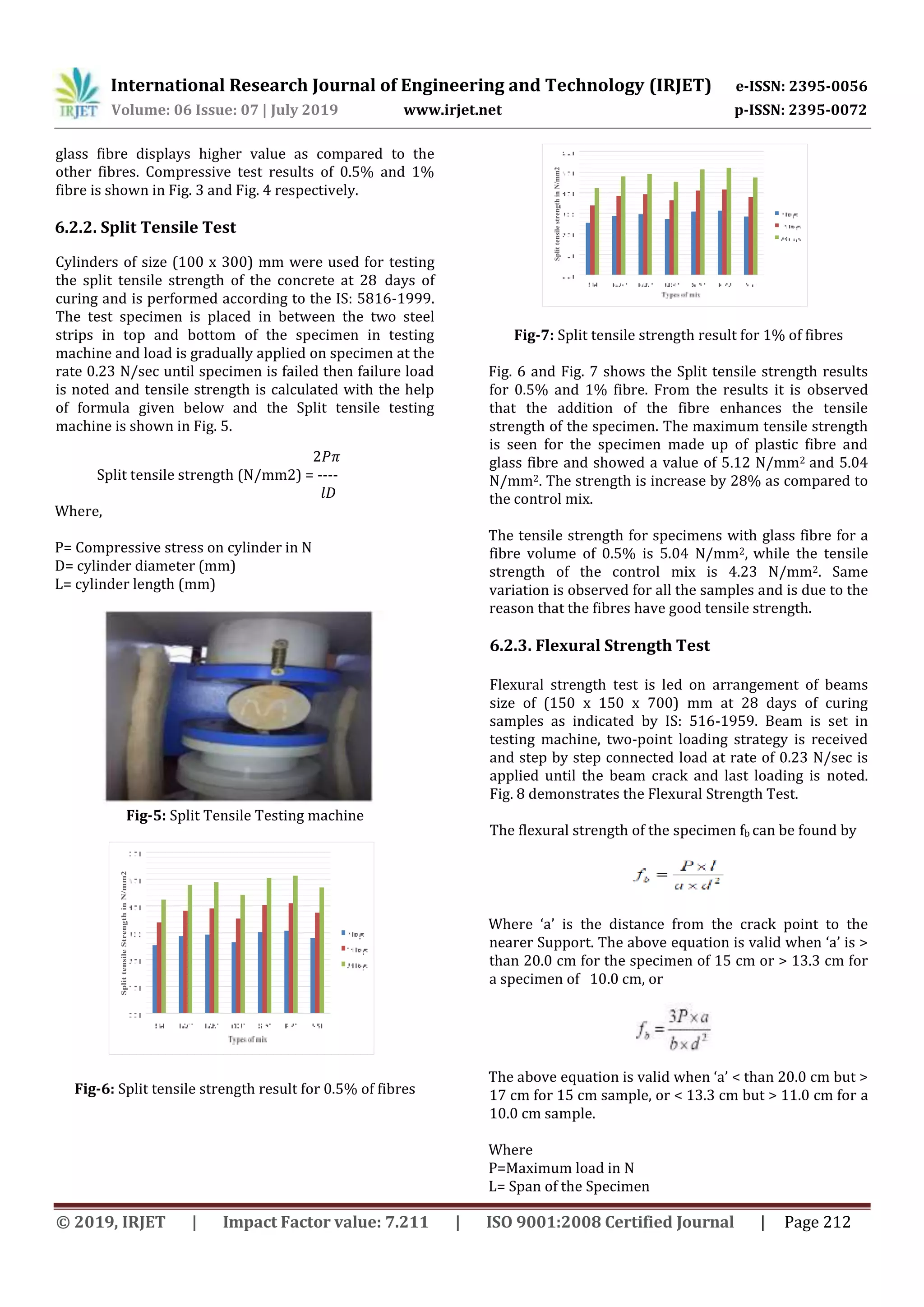
The compressive strength test for cubes was conducted
in compression testing machine as per IS: 516-1959. The
cubes were tested in compressive testing machine at the
rate of 140 kg/cm2/min and the ultimate loads were
recorded. Compressive testing machine is shown in Fig.
2.
Compressive Strength=P/A (Mpa)
Where,
P= Load (N)
A= Cross sectional area of cube (mm)
Fig-2: Compression Testing Machine
Fig-3: Compressive strength result for 0.5% of fibres
Fig-4: Compressive strength result for 1% of fibres
From the test results it is seen that the addition of the
fibres enhances the compressive strength of the samples
as compared to that of the control mix at 7, 4 and
287days of curing. All the specimens with various type of
fibres and different fraction of fibres show better
compressive strength as compared to the control mix.
The maximum strength is observed for the specimen
made with glass fibre sample and low value is observed
for the specimen made out of coir fibre; but the value is
more than that of the control mix.
It can be observed that as the fibre volume increased the
strength also enhanced for the all specimens with
different types of fibres at 7, 14 and 28 days. It is similar
in case of 0.5% and 1% of fibre. Among all the fibres
Sl.
No.
Type of Test
Type of
Specimen
Dimension
of
Specimen
No. of
Specimens
1 Compression
Test
Cubes 150 mm
x150 mm
x150 mm
108
2 Split Tensile
Strength
Cylinders 150 mm x
300 mm
108
3
Two Point
Loading
Flexural Test
Beams
150 mm x
150
mmx700
mm 108
4 Carbonation Cylinders 150 mm x
300 mm
144
International Research Journal of Engineering and Technology (IRJET) e-ISSN: 2395-0056
Volume: 06 Issue: 07 | July 2019 www.irjet.net p-ISSN: 2395-0072
© 2019, IRJET | Impact Factor value: 7.211 | ISO 9001:2008 Certified Journal | Page 212
glass fibre displays higher value as compared to the
other fibres. Compressive test results of 0.5% and 1%
fibre is shown in Fig. 3 and Fig. 4 respectively.
6.2.2. Split Tensile Test
Cylinders of size (100 x 300) mm were used for testing
the split tensile strength of the concrete at 28gdays of
curing and is performed according to the IS: 5816-1999.
The test specimen is placed in between the two steel
strips in top and bottom of the specimen in testing
machine and load is gradually applied on specimen at the
rate 0.23 N/sec until specimen is failed then failure load
is noted and tensile strength is calculated with the help
of formula given below and the Split tensile testing
machine is shown in Fig. 5.
2𝑃𝜋
Split tensile strength (N/mm2) = ----
𝑙𝐷
Where,
P= Compressive stress on cylinder in N
D= cylinder diameter (mm)
L= cylinder length (mm)
Fig-5: Split Tensile Testing machine
Fig-6: Split tensile strength result for 0.5% of fibres
Fig-7: Split tensile strength result for 1% of fibres
Fig. 6 and Fig. 7 shows the Split tensile strength results
for 0.5% and 1% fibre. From the results it is observed
that the addition of the fibre enhances the tensile
strength of the specimen. The maximum tensile strength
is seen for the specimen made up of plastic fibre and
glass fibre and showed a value of 5.12 N/mm2 and 5.04
N/mm2. The strength is increase by 28% as compared to
the control mix.
The tensile strength for specimens with glass fibre for a
fibre volume of 0.5% is 5.04 N/mm2, while the tensile
strength of the control mix is 4.23 N/mm2. Same
variation is observed for all the samples and is due to the
reason that the fibres have good tensile strength.
6.2.3. Flexural Strength Test
Flexural strength test is led on arrangement of beams
size of (150 x 150 x 700) mm at 28 days of curing
samples as indicated by IS: 516-1959. Beam is set in
testing machine, two-point loading strategy is received
and step by step connected load at rate of 0.23 N/sec is
applied until the beam crack and last loading is noted.
Fig. 8 demonstrates the Flexural Strength Test.
The flexural strength of the specimen fb can be found by
Where ‘a’ is the distance from the crack point to the
nearer Support. The above equation is valid when ‘a’ is >
than 20.0 cm for the specimen of 15 cm or > 13.3 cm for
a specimen of 10.0 cm, or
The above equation is valid when ‘a’ < than 20.0 cm but >
17 cm for 15 cm sample, or < 13.3 cm but > 11.0 cm for a
10.0 cm sample.
Where
P=Maximum load in N
L= Span of the Specimen
International Research Journal of Engineering and Technology (IRJET) e-ISSN: 2395-0056
Volume: 06 Issue: 07 | July 2019 www.irjet.net p-ISSN: 2395-0072
© 2019, IRJET | Impact Factor value: 7.211 | ISO 9001:2008 Certified Journal | Page 213
d= Depth of Specimen
b= Width in cm of Specimen
Fig-8: Flexural Test
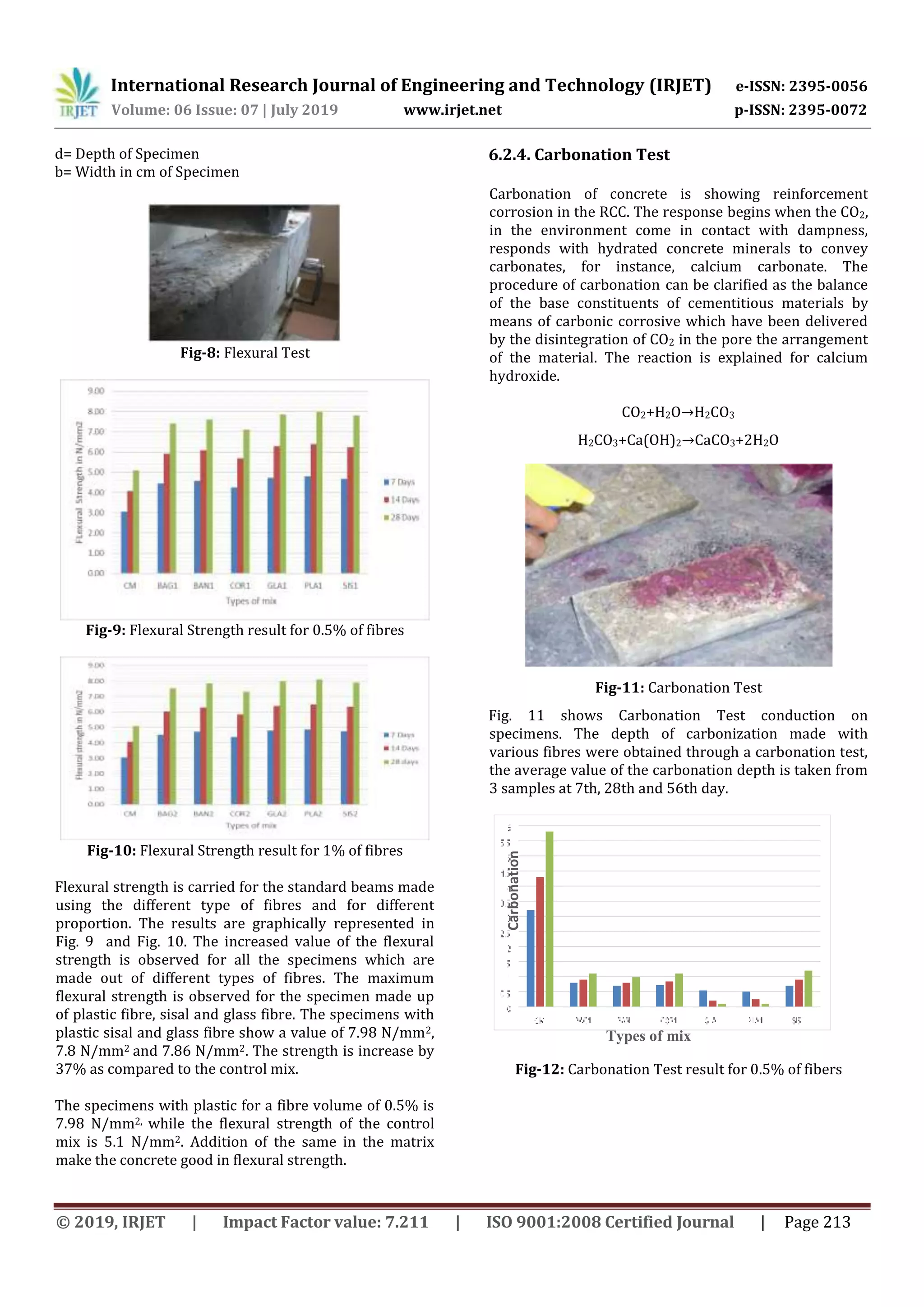
Fig-9: Flexural Strength result for 0.5% of fibres
Fig-10: Flexural Strength result for 1% of fibres
Flexural strength is carried for the standard beams made
using the different type of fibres and for different
proportion. The results are graphically represented in
Fig. 9 and Fig. 10. The increased value of the flexural
strength is observed for all the specimens which are
made out of different types of fibres. The maximum
flexural strength is observed for the specimen made up
of plastic fibre, sisal and glass fibre. The specimens with
plastic sisal and glass fibre show a value of 7.98 N/mm2,
7.8 N/mm2 and 7.86 N/mm2. The strength is increase by
37% as compared to the control mix.
The specimens with plastic for a fibre volume of 0.5% is
7.98 N/mm2, while the flexural strength of the control
mix is 5.1 N/mm2. Addition of the same in the matrix
make the concrete good in flexural strength.
6.2.4. Carbonation Test
Carbonation of concrete is showing reinforcement
corrosion in the RCC. The response begins when the CO2,
in the environment come in contact with dampness,
responds with hydrated concrete minerals to convey
carbonates, for instance, calcium carbonate. The
procedure of carbonation can be clarified as the balance
of the base constituents of cementitious materials by
means of carbonic corrosive which have been delivered
by the disintegration of CO2 in the pore the arrangement
of the material. The reaction is explained for calcium
hydroxide.
CO2+H2O H2CO3
H2CO3+Ca(OH)2 CaCO3+2H2O
Fig-11: Carbonation Test
Fig. 11 shows Carbonation Test conduction on
specimens. The depth of carbonization made with
various fibres were obtained through a carbonation test,
the average value of the carbonation depth is taken from
3 samples at 7th, 28th and 56th day.
Fig-12: Carbonation Test result for 0.5% of fibers
Types of mix
International Research Journal of Engineering and Technology (IRJET) e-ISSN: 2395-0056
Volume: 06 Issue: 07 | July 2019 www.irjet.net p-ISSN: 2395-0072
© 2019, IRJET | Impact Factor value: 7.211 | ISO 9001:2008 Certified Journal | Page 214
Fig-13: Carbonation Test result for 1% of fibers
Fig. 12 and Fig. 13 shows carbonation test results of
0.5% and 1% fibre. From the results it can be seen that
carbonation depth of concrete increased with age.
Control mix exhibited poor carbonation resistance
because connected pores existed inside the concrete
matrix. The addition of fibres prevented the
development of cracks. The fibres filled up the pores,
thus enhancing the carbonation resistance of concrete.
7. CONCLUSIONS
In this study an attempt is made to study the effect of
different types of fibre in the properties of concrete. The
basic constituent of the concrete is collected and test are
conducted to check the properties of the materials. Then
mix design is done for the M40 grade of concrete.
Different specimens were made with fibres such as coir,
banana, sisal, plastic, glass fibre and bagasse fibres. The
fibre volume is changed between 0.5% to 1%. After the
specified days of the curing, the test are conduct to study
the strength and durability properties of the concrete.
The important conclusion of the study is given in this
particular section.
1. Highest Compressive Strength of 62.2 N/mm2 is
obtained in case of addition of Glass fibers.
2. Split tensile strength and Flexural strength was
found to be highest by 5.21N/mm2 and 8.10
N/mm2 in case of Plastic Fiber.
3. Durability aspect also enhanced and is due to
the fact that fibers arrests the cracks, and
carbonation amount is reduced. It is only
0.3N/mm2 when Glass fiber is used in mix.
4. Workability properties of concrete is reduced
due to addition of fibers, which makes the mix
harsh. Increased volume of fiber reduces the
slump values. Least slump value obtained is
60mm for 1% addition of Banana Fiber.
5. The addition of higher fiber volume of 1%
enhances the mechanical and durability
properties.
6. The fibers are the better solution to resist the
cracking of the concrete which leads to the
sustainable development.
ACKNOWLEDGMENT
I express my sincere gratitude for the valuable guidance
and constant encouragement given by my project guide
and coordinator Mrs. Anupama Natesh, Assistant
Professor, Department of Civil Engineering, SDIT, who
showed great interest in project and gave guidance for
the proceedings to handle this project in a systematic
manner.
REFERENCES
[1] Anush K Chandrappa and Krishna Prapoorna
Bilgiri, “Flexural-fatigue characteristics of
pervious concrete: Statistical distributions and
model development”, Construction and Building
Materials Volume 153, Pages 1-15, 30 October
2017.
[2] Balte Sanjaykumar, and Prof. S. N. Daule, “Use of
Plastic Fiber in the Concrete”, SSRG
International Journal of Civil Engineering, pp 4-
7, 4.11(2017).
[3] Chouw et al, Majid Ali, Anthony Liu, Hou Sou,
“Mechanical and dynamic properties of coconut
fibre reinforced concrete”, Construction and
Building Materials, pp 814– 825, 30 (2012).
[4] Dang Hanh Nguyen, Nasim Sebaibi, “A modified
method for the design of pervious concrete mix”,
Construction and Building Materials, Volume 73
Pages 271-278, 30 October 2014.
[5] Dhawal Desai, “Pervious concrete – Effect of
material proportion on porosity”, International
journal of engineering and science ,Volume -
2,Issue-3,April 2010.
[6] Gaurav Uttam Shinde, Dr S.S Valunjkar,“An
experimental study on compressive strength,
void ratio and infiltration rate of pervious
concrete” ,International journal of Engineering
Research and technology ,Volume-4,Issue-
4,April 2015.
[7] Marwan Mostafa, Nasim Uddin, “Experimental
analysis of compressed Earth Block (CEB) with
Banana fibres resisting flexural and
compression forces”, Department of civil,
Construction and Enviornmental Engineering
University of Alabama at Birmingham.26 July
2016.
[8] Nalini Thakre,” Comparative Study on Strength
and Permeability of Pervious Concrete by Using
Nylon and Polypropylene Fibre”, IJCAT
International Journal of Computing and
Technology, Volume 1, Issue 4,ISSN : 2348 –
6090, May 2014.
Types of mix
International Research Journal of Engineering and Technology (IRJET) e-ISSN: 2395-0056
Volume: 06 Issue: 07 | July 2019 www.irjet.net p-ISSN: 2395-0072
© 2019, IRJET | Impact Factor value: 7.211 | ISO 9001:2008 Certified Journal | Page 215
[9] Rui Zhong,Kay Wille, “ Compression response of
normal and high strength pervious concrete”,
construction and building materials, Volume
109 ,15 April 2016.
[10] S. Suresh, M. Sai Charan, “Strength and
behaviour of concrete by using natural and
artificial fibre combinations”, International
Journal of Civil Engineering and Technology
(IJCIET), Volume 8, Issue 4, pp. 1652–1658 April
2017.

IRJET- Comparative Study on the Strength Parameters of Concrete Made using Natural and Artificial Waste Fibres

  • 1.
    International Research Journalof Engineering and Technology (IRJET) e-ISSN: 2395-0056 Volume: 06 Issue: 07 | July 2019 www.irjet.net p-ISSN: 2395-0072 © 2019, IRJET | Impact Factor value: 7.211 | ISO 9001:2008 Certified Journal | Page 209 Comparative Study on the Strength Parameters of Concrete Made using Natural and Artificial Waste Fibres Deepika S1, Anupama Natesh2 1M.Tech Student, Department of Civil Engineering, Shree Devi Institute of Technology, VTU, Karnataka, India 2Asst. Professor, Department of Civil Engineering, Shree Devi Institute of Technology, VTU, Karnataka, India -------------------------------------------------------------------------***------------------------------------------------------------------------- Abstract - Concrete has several appealing characteristics that have made it as a widely used construction material. It is the material of choice where strength, performance, durability etc., are required and concrete is undoubtedly most versatile construction material. Today’s developing world lays high emphasis on the waste management. Wastes generated through different source needs to be recycled & reused to convert them into useful resources & hence need to be treated well. Construction industries provide a wide platform in reusing these waste materials as an alternative of some conventional materials. Key Words: Natural and Artificial Fibers, Reuse of waste materials, Strength Parameters……. 1. INTRODUCTION The Research on study of environmentally friendly, maintainable and durable materials have increased significant mindfulness in the development field. The present Research and Development is centred on the innovation of alternative materials which can be used in the concrete. The constituents of the concrete such as cement and aggregates can be replaced by the alternative material which can offer a better strength to concrete in turn this will be a solution for the over exploitation of the resources for the concrete manufacturing and the environmental problems. 2. NEED OF THE PROJECT Studies have been showed that fibre reinforced concrete (FRC), enhances the strength properties of normal concrete; for example Split-Tensile Strength, Fatigue Strength, Compressive Strength, Modulus of Elasticity, Flexural strength, Toughness and Impact Resistance. It is also a known fact that the FRC can be used in the environmental condition where it is susceptible to the corrosion. Fibres make the structure fail in a ductile manner so that sudden failure of the structure can be avoided. Also, the fibres are found to be strong in sealing the cracks developed in the concrete. In this study an attempt is made to study the mechanical and workability properties of the concrete. 3. OBJECTIVES OF THE PROJECT The project objective is to study the properties of the concrete made with different types of fibres. 1. To check the strength properties of the concrete like split tensile strength, compressive strength and flexural strength with different types of fibres. 2. To check the durability properties of the fibre by carbonation test. 3. To check the workability of the concrete made with natural and artificial fibres. 4. To find the best fibre which gives the better properties for the concrete. 5. To find the effect of fibre volume in the properties of the concrete for the different types of fibres using 0.5 % and 1% of fibre. 4. MATERIALS USED 4.1 Cement Cement is an extremely fine material with durable properties and goes about as restricting material in concrete and contributes solidarity to the concrete. The characteristic of concrete are fundamentally impacted by the properties of cement. For the present study ‘Ordinary Portland cement’ of grade 43 in accordance to IS 8112-1989 is utilized. a) Specific gravity = 3.15 b) Consistency = 29.2 4.2 Fine Aggregate The sand which goes throughb4.75 mm and left on 600 µ sieve is used in study. Basic tests and sieve analysis were done on fine aggregate to assess the fundamental properties and to choose the fine aggregate zonings. a) Specific gravity = 2.58 b) Fineness modulus = 2.85 c) Moisture Content = 0.09% d) Water Absorption =0.71% e) Bulk density =1655kg/m3
  • 2.
    International Research Journalof Engineering and Technology (IRJET) e-ISSN: 2395-0056 Volume: 06 Issue: 07 | July 2019 www.irjet.net p-ISSN: 2395-0072 © 2019, IRJET | Impact Factor value: 7.211 | ISO 9001:2008 Certified Journal | Page 210 4.3 Course Aggregate As per ‘IS 383-1970’ the coarse aggregates is defend as Aggregates, greater share of which is held on 4.75 mm IS Sieve and having less fine material as permitted for the dissimilar standard. Coarse aggregate with a max size of 20 mm is used in this study. a) Specific gravity = 2.62 b) Fineness modulus = 2.74 c) Moisture Content = 0.18% d) Water Absorption =0.49% e) Bulk density =1590kg/m3 4.4 Water As indicated by ‘IS 456: 2000’, water applied for combination and relieving will be spotless and allowed from harmful measures of acids, oils, salts, alkalis or different materials that might be pernicious to cement or steel. The pH value of 6 is maintained. 4.5 Superplasticizer Conplast SP430 is a market available retarder manufactured by the company FOSROC is used in this study. The properties of it is as given below. a) Specific gravity = 1.20 b) Chloride Content =Nil c) Solid Content =40% d) Recommended Dosage =5ml to 2ml/kg of binder e) Operating Temperature =10 to 40 degree Celsius f) Colour =Dark Brown liquid 5. EXPERIMENTAL WORK This section describes investigation of the fundamental properties of the materials utilized in this project and methods used to test the concrete samples at different stages of curing. Natural and artificial fibres and materials are collected and tested for their basic properties of the materials. Then mix design is done for M40 as per IS 12026-2009. The constituent is mixed in the specified manner with 0.5% and 1% of fibre. Various test to access the mechanical properties such has compression, split tensile and flexural strength were done. The durability properties such as carbonation test is also carried out and workability properties also accessed. The values obtained in the test is compared with the control mix. 5.1 Mix Proportioning For One Meter Cube of Concrete Table-1: Proportion of Mix Mix Proportion 1:1.65:2.92 W/C ratio 0.4 Cement 400kg Water 160 kg Coarse Aggregate 1168 kg Fine Aggregate 660kg Superplasticizer 2.4kg 5.2 Batching of Materials Materials were batched dependent on weight batching and machine blending was adopted to blend the ingredients in this work. Gauge batching of every material made in this examination is appeared in the Table 1. The percentage replacement of ordinary cement by addition of different fibres and their material weight per cubic meter of concrete are given in Table 2. Samples made are given in Table 3. Notation Used: CM- Control Mix BAG - Bagasse Fibre, PLA - Plastic Fibre BAN - Banana Fibre COR -Coir Fibre GLA – Glass Fibre Table-2: Materials Weight Mix Designation Cement Fiber Coarse Aggregate Fine Aggregate Kg kg Kg kg CM 400 - 1168 660 BAG1 400 2 1168 660 BAN1 400 2 1168 660 COR1 400 2 1168 660 GLA1 400 2 1168 660 PLA1 400 2 1168 660 SIS1 400 2 1168 660 BAG2 400 4 1168 660 BAN2 400 4 1168 660 COR2 400 4 1168 660 GLA2 400 4 1168 660 PLA2 400 4 1168 660 SIS2 400 4 1168 660
  • 3.
    International Research Journalof Engineering and Technology (IRJET) e-ISSN: 2395-0056 Volume: 06 Issue: 07 | July 2019 www.irjet.net p-ISSN: 2395-0072 © 2019, IRJET | Impact Factor value: 7.211 | ISO 9001:2008 Certified Journal | Page 211 Table-3: Samples Made 6. RESULTS AND DISCUSSION 6.1. Fresh Concrete 6.1.1. Workability Slump test is the frequent technique to gauge steadiness of concrete which can be used in research laboratory or at place of construction. The slump value for the control mix is obtained as 75 mm but the samples with fibres slow the less value as compared to that of the control mix. Fig. 1 shows results of Slump Test. Fig-1: Slump Test Result 6.2 Hardened Concrete 6.2.1. Compression Test The compressive strength test for cubes was conducted in compression testing machine as per IS: 516-1959. The cubes were tested in compressive testing machine at the rate of 140 kg/cm2/min and the ultimate loads were recorded. Compressive testing machine is shown in Fig. 2. Compressive Strength=P/A (Mpa) Where, P= Load (N) A= Cross sectional area of cube (mm) Fig-2: Compression Testing Machine Fig-3: Compressive strength result for 0.5% of fibres Fig-4: Compressive strength result for 1% of fibres From the test results it is seen that the addition of the fibres enhances the compressive strength of the samples as compared to that of the control mix at 7, 4 and 287days of curing. All the specimens with various type of fibres and different fraction of fibres show better compressive strength as compared to the control mix. The maximum strength is observed for the specimen made with glass fibre sample and low value is observed for the specimen made out of coir fibre; but the value is more than that of the control mix. It can be observed that as the fibre volume increased the strength also enhanced for the all specimens with different types of fibres at 7, 14 and 28 days. It is similar in case of 0.5% and 1% of fibre. Among all the fibres Sl. No. Type of Test Type of Specimen Dimension of Specimen No. of Specimens 1 Compression Test Cubes 150 mm x150 mm x150 mm 108 2 Split Tensile Strength Cylinders 150 mm x 300 mm 108 3 Two Point Loading Flexural Test Beams 150 mm x 150 mmx700 mm 108 4 Carbonation Cylinders 150 mm x 300 mm 144
  • 4.
    International Research Journalof Engineering and Technology (IRJET) e-ISSN: 2395-0056 Volume: 06 Issue: 07 | July 2019 www.irjet.net p-ISSN: 2395-0072 © 2019, IRJET | Impact Factor value: 7.211 | ISO 9001:2008 Certified Journal | Page 212 glass fibre displays higher value as compared to the other fibres. Compressive test results of 0.5% and 1% fibre is shown in Fig. 3 and Fig. 4 respectively. 6.2.2. Split Tensile Test Cylinders of size (100 x 300) mm were used for testing the split tensile strength of the concrete at 28gdays of curing and is performed according to the IS: 5816-1999. The test specimen is placed in between the two steel strips in top and bottom of the specimen in testing machine and load is gradually applied on specimen at the rate 0.23 N/sec until specimen is failed then failure load is noted and tensile strength is calculated with the help of formula given below and the Split tensile testing machine is shown in Fig. 5. 2𝑃𝜋 Split tensile strength (N/mm2) = ---- 𝑙𝐷 Where, P= Compressive stress on cylinder in N D= cylinder diameter (mm) L= cylinder length (mm) Fig-5: Split Tensile Testing machine Fig-6: Split tensile strength result for 0.5% of fibres Fig-7: Split tensile strength result for 1% of fibres Fig. 6 and Fig. 7 shows the Split tensile strength results for 0.5% and 1% fibre. From the results it is observed that the addition of the fibre enhances the tensile strength of the specimen. The maximum tensile strength is seen for the specimen made up of plastic fibre and glass fibre and showed a value of 5.12 N/mm2 and 5.04 N/mm2. The strength is increase by 28% as compared to the control mix. The tensile strength for specimens with glass fibre for a fibre volume of 0.5% is 5.04 N/mm2, while the tensile strength of the control mix is 4.23 N/mm2. Same variation is observed for all the samples and is due to the reason that the fibres have good tensile strength. 6.2.3. Flexural Strength Test Flexural strength test is led on arrangement of beams size of (150 x 150 x 700) mm at 28 days of curing samples as indicated by IS: 516-1959. Beam is set in testing machine, two-point loading strategy is received and step by step connected load at rate of 0.23 N/sec is applied until the beam crack and last loading is noted. Fig. 8 demonstrates the Flexural Strength Test. The flexural strength of the specimen fb can be found by Where ‘a’ is the distance from the crack point to the nearer Support. The above equation is valid when ‘a’ is > than 20.0 cm for the specimen of 15 cm or > 13.3 cm for a specimen of 10.0 cm, or The above equation is valid when ‘a’ < than 20.0 cm but > 17 cm for 15 cm sample, or < 13.3 cm but > 11.0 cm for a 10.0 cm sample. Where P=Maximum load in N L= Span of the Specimen
  • 5.
    International Research Journalof Engineering and Technology (IRJET) e-ISSN: 2395-0056 Volume: 06 Issue: 07 | July 2019 www.irjet.net p-ISSN: 2395-0072 © 2019, IRJET | Impact Factor value: 7.211 | ISO 9001:2008 Certified Journal | Page 213 d= Depth of Specimen b= Width in cm of Specimen Fig-8: Flexural Test Fig-9: Flexural Strength result for 0.5% of fibres Fig-10: Flexural Strength result for 1% of fibres Flexural strength is carried for the standard beams made using the different type of fibres and for different proportion. The results are graphically represented in Fig. 9 and Fig. 10. The increased value of the flexural strength is observed for all the specimens which are made out of different types of fibres. The maximum flexural strength is observed for the specimen made up of plastic fibre, sisal and glass fibre. The specimens with plastic sisal and glass fibre show a value of 7.98 N/mm2, 7.8 N/mm2 and 7.86 N/mm2. The strength is increase by 37% as compared to the control mix. The specimens with plastic for a fibre volume of 0.5% is 7.98 N/mm2, while the flexural strength of the control mix is 5.1 N/mm2. Addition of the same in the matrix make the concrete good in flexural strength. 6.2.4. Carbonation Test Carbonation of concrete is showing reinforcement corrosion in the RCC. The response begins when the CO2, in the environment come in contact with dampness, responds with hydrated concrete minerals to convey carbonates, for instance, calcium carbonate. The procedure of carbonation can be clarified as the balance of the base constituents of cementitious materials by means of carbonic corrosive which have been delivered by the disintegration of CO2 in the pore the arrangement of the material. The reaction is explained for calcium hydroxide. CO2+H2O H2CO3 H2CO3+Ca(OH)2 CaCO3+2H2O Fig-11: Carbonation Test Fig. 11 shows Carbonation Test conduction on specimens. The depth of carbonization made with various fibres were obtained through a carbonation test, the average value of the carbonation depth is taken from 3 samples at 7th, 28th and 56th day. Fig-12: Carbonation Test result for 0.5% of fibers Types of mix
  • 6.
    International Research Journalof Engineering and Technology (IRJET) e-ISSN: 2395-0056 Volume: 06 Issue: 07 | July 2019 www.irjet.net p-ISSN: 2395-0072 © 2019, IRJET | Impact Factor value: 7.211 | ISO 9001:2008 Certified Journal | Page 214 Fig-13: Carbonation Test result for 1% of fibers Fig. 12 and Fig. 13 shows carbonation test results of 0.5% and 1% fibre. From the results it can be seen that carbonation depth of concrete increased with age. Control mix exhibited poor carbonation resistance because connected pores existed inside the concrete matrix. The addition of fibres prevented the development of cracks. The fibres filled up the pores, thus enhancing the carbonation resistance of concrete. 7. CONCLUSIONS In this study an attempt is made to study the effect of different types of fibre in the properties of concrete. The basic constituent of the concrete is collected and test are conducted to check the properties of the materials. Then mix design is done for the M40 grade of concrete. Different specimens were made with fibres such as coir, banana, sisal, plastic, glass fibre and bagasse fibres. The fibre volume is changed between 0.5% to 1%. After the specified days of the curing, the test are conduct to study the strength and durability properties of the concrete. The important conclusion of the study is given in this particular section. 1. Highest Compressive Strength of 62.2 N/mm2 is obtained in case of addition of Glass fibers. 2. Split tensile strength and Flexural strength was found to be highest by 5.21N/mm2 and 8.10 N/mm2 in case of Plastic Fiber. 3. Durability aspect also enhanced and is due to the fact that fibers arrests the cracks, and carbonation amount is reduced. It is only 0.3N/mm2 when Glass fiber is used in mix. 4. Workability properties of concrete is reduced due to addition of fibers, which makes the mix harsh. Increased volume of fiber reduces the slump values. Least slump value obtained is 60mm for 1% addition of Banana Fiber. 5. The addition of higher fiber volume of 1% enhances the mechanical and durability properties. 6. The fibers are the better solution to resist the cracking of the concrete which leads to the sustainable development. ACKNOWLEDGMENT I express my sincere gratitude for the valuable guidance and constant encouragement given by my project guide and coordinator Mrs. Anupama Natesh, Assistant Professor, Department of Civil Engineering, SDIT, who showed great interest in project and gave guidance for the proceedings to handle this project in a systematic manner. REFERENCES [1] Anush K Chandrappa and Krishna Prapoorna Bilgiri, “Flexural-fatigue characteristics of pervious concrete: Statistical distributions and model development”, Construction and Building Materials Volume 153, Pages 1-15, 30 October 2017. [2] Balte Sanjaykumar, and Prof. S. N. Daule, “Use of Plastic Fiber in the Concrete”, SSRG International Journal of Civil Engineering, pp 4- 7, 4.11(2017). [3] Chouw et al, Majid Ali, Anthony Liu, Hou Sou, “Mechanical and dynamic properties of coconut fibre reinforced concrete”, Construction and Building Materials, pp 814– 825, 30 (2012). [4] Dang Hanh Nguyen, Nasim Sebaibi, “A modified method for the design of pervious concrete mix”, Construction and Building Materials, Volume 73 Pages 271-278, 30 October 2014. [5] Dhawal Desai, “Pervious concrete – Effect of material proportion on porosity”, International journal of engineering and science ,Volume - 2,Issue-3,April 2010. [6] Gaurav Uttam Shinde, Dr S.S Valunjkar,“An experimental study on compressive strength, void ratio and infiltration rate of pervious concrete” ,International journal of Engineering Research and technology ,Volume-4,Issue- 4,April 2015. [7] Marwan Mostafa, Nasim Uddin, “Experimental analysis of compressed Earth Block (CEB) with Banana fibres resisting flexural and compression forces”, Department of civil, Construction and Enviornmental Engineering University of Alabama at Birmingham.26 July 2016. [8] Nalini Thakre,” Comparative Study on Strength and Permeability of Pervious Concrete by Using Nylon and Polypropylene Fibre”, IJCAT International Journal of Computing and Technology, Volume 1, Issue 4,ISSN : 2348 – 6090, May 2014. Types of mix
  • 7.
    International Research Journalof Engineering and Technology (IRJET) e-ISSN: 2395-0056 Volume: 06 Issue: 07 | July 2019 www.irjet.net p-ISSN: 2395-0072 © 2019, IRJET | Impact Factor value: 7.211 | ISO 9001:2008 Certified Journal | Page 215 [9] Rui Zhong,Kay Wille, “ Compression response of normal and high strength pervious concrete”, construction and building materials, Volume 109 ,15 April 2016. [10] S. Suresh, M. Sai Charan, “Strength and behaviour of concrete by using natural and artificial fibre combinations”, International Journal of Civil Engineering and Technology (IJCIET), Volume 8, Issue 4, pp. 1652–1658 April 2017.