KUNSAN NATIONAL UNIVERSITY
Prof. Park Dae-Wook
Vo Viet Hai
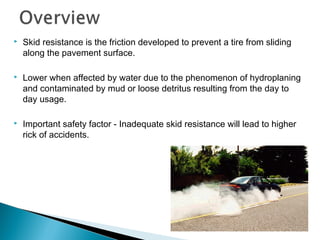
 Skid resistance is the friction developed to prevent a tire from sliding
along the pavement surface.
 Lower when affected by water due to the phenomenon of hydroplaning
and contaminated by mud or loose detritus resulting from the day to
day usage.
 Important safety factor - Inadequate skid resistance will lead to higher
rick of accidents.
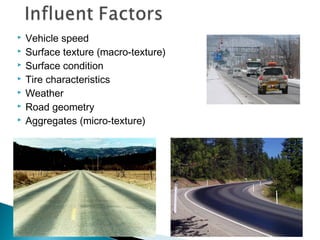
 Vehicle speed
 Surface texture (macro-texture)
 Surface condition
 Tire characteristics
 Weather
 Road geometry
 Aggregates (micro-texture)
 According to BS 812
 The Polished Stone Value of aggregate gives a measure
of resistance to the polishing action of vehicle tires under
conditions similar to those occurring on the surface of a
road.
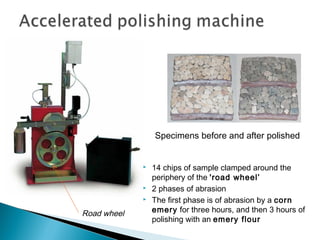
 The samples are first polished by the Accelerated
Polishing Machine. Then the British Pendulum tester is
use to measure the PSV.
Specimens before and after polished
 14 chips of sample clamped around the
periphery of the 'road wheel’
 2 phases of abrasion
 The first phase is of abrasion by a corn
emery for three hours, and then 3 hours of
polishing with an emery flour
Road wheel
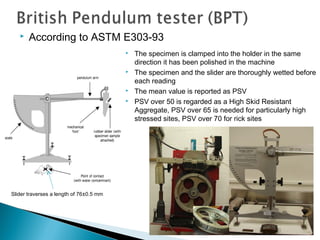
 According to ASTM E303-93
 The specimen is clamped into the holder in the same
direction it has been polished in the machine
 The specimen and the slider are thoroughly wetted before
each reading
 The mean value is reported as PSV
 PSV over 50 is regarded as a High Skid Resistant
Aggregate, PSV over 65 is needed for particularly high
stressed sites, PSV over 70 for rick sites
Slider traverses a length of 76±0.5 mm
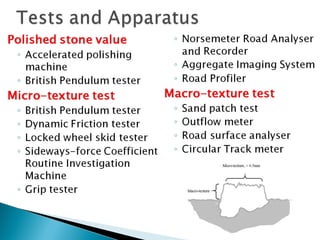
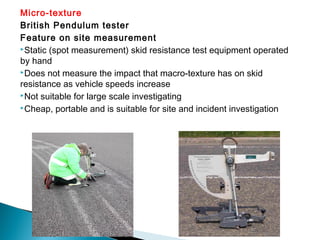
Micro-texture
British Pendulum tester
Feature on site measurement
Static (spot measurement) skid resistance test equipment operated
by hand
Does not measure the impact that macro-texture has on skid
resistance as vehicle speeds increase
Not suitable for large scale investigating
Cheap, portable and is suitable for site and incident investigation
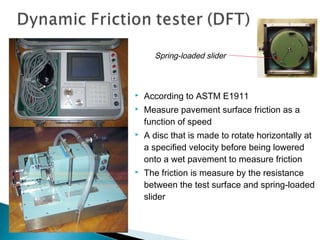
 According to ASTM E1911
 Measure pavement surface friction as a
function of speed
 A disc that is made to rotate horizontally at
a specified velocity before being lowered
onto a wet pavement to measure friction
 The friction is measure by the resistance
between the test surface and spring-loaded
slider
Spring-loaded slider
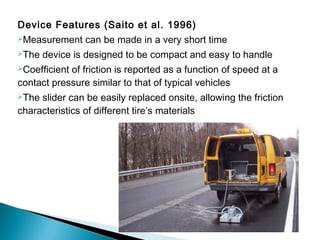
Device Features (Saito et al. 1996)
Measurement can be made in a very short time
The device is designed to be compact and easy to handle
Coefficient of friction is reported as a function of speed at a
contact pressure similar to that of typical vehicles
The slider can be easily replaced onsite, allowing the friction
characteristics of different tire’s materials
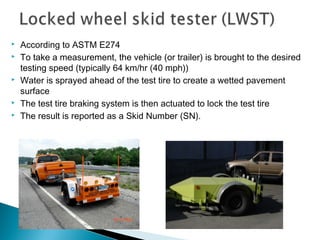
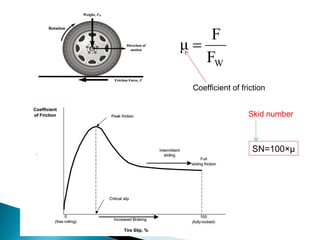
 According to ASTM E274
 To take a measurement, the vehicle (or trailer) is brought to the desired
testing speed (typically 64 km/hr (40 mph))
 Water is sprayed ahead of the test tire to create a wetted pavement
surface
 The test tire braking system is then actuated to lock the test tire
 The result is reported as a Skid Number (SN).
Coefficient of friction
SN=100×µ
Skid number
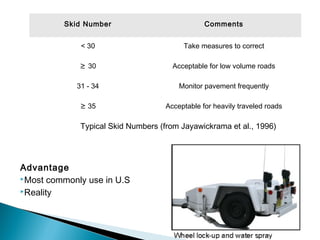
Skid Number Comments
< 30 Take measures to correct
≥ 30 Acceptable for low volume roads
31 - 34 Monitor pavement frequently
≥ 35 Acceptable for heavily traveled roads
Advantage
Most commonly use in U.S
Reality
Typical Skid Numbers (from Jayawickrama et al., 1996)
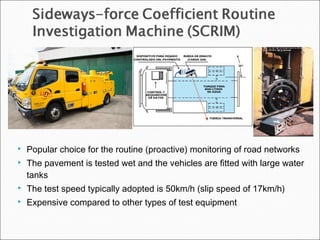
 Popular choice for the routine (proactive) monitoring of road networks
 The pavement is tested wet and the vehicles are fitted with large water
tanks
 The test speed typically adopted is 50km/h (slip speed of 17km/h)
 Expensive compared to other types of test equipment
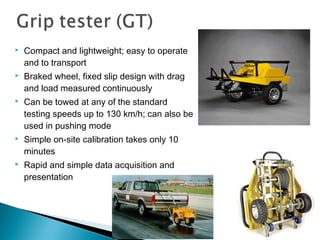
 Compact and lightweight; easy to operate
and to transport
 Braked wheel, fixed slip design with drag
and load measured continuously
 Can be towed at any of the standard
testing speeds up to 130 km/h; can also be
used in pushing mode
 Simple on-site calibration takes only 10
minutes
 Rapid and simple data acquisition and
presentation
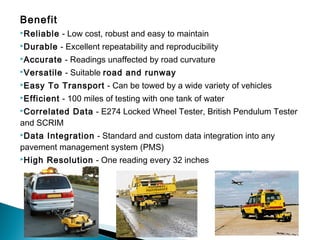
Benefit
Reliable - Low cost, robust and easy to maintain
Durable - Excellent repeatability and reproducibility
Accurate - Readings unaffected by road curvature
Versatile - Suitable road and runway
Easy To Transport - Can be towed by a wide variety of vehicles
Efficient - 100 miles of testing with one tank of water
Correlated Data - E274 Locked Wheel Tester, British Pendulum Tester
and SCRIM
Data Integration - Standard and custom data integration into any
pavement management system (PMS)
High Resolution - One reading every 32 inches
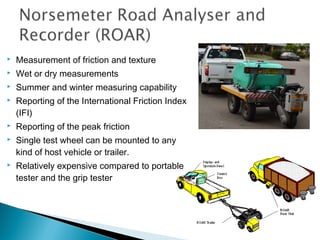
 Measurement of friction and texture
 Wet or dry measurements
 Summer and winter measuring capability
 Reporting of the International Friction Index
(IFI)
 Reporting of the peak friction
 Single test wheel can be mounted to any
kind of host vehicle or trailer.
 Relatively expensive compared to portable
tester and the grip tester
 This methodology offers several
advantages over current methods
used in the practice
 The aggregates on the sample tray
with marked grid points
 The images of each sample are
automatically captured for the
analysis of angularity and texture
 The results are showed on the
computer
(Masad, 2003)
Sample tray
Advantages
Analyze the shape of a wide range of aggregate types and sizes
Combining both the coarse and fine aggregate analysis into one
system
Distinct difference between angularity and texture; these properties
have different effects on performance
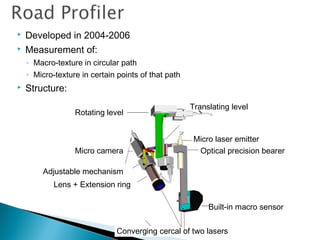
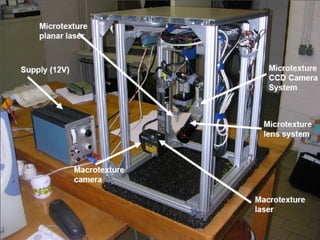
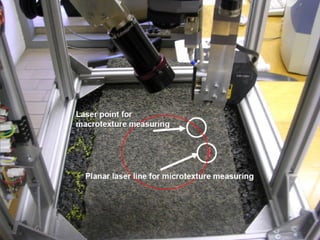
 Developed in 2004-2006
 Measurement of:
◦ Macro-texture in circular path
◦ Micro-texture in certain points of that path
 Structure:
Rotating level
Micro camera
Adjustable mechanism
Lens + Extension ring
Converging cercal of two lasers
Built-in macro sensor
Optical precision bearer
Micro laser emitter
Translating level
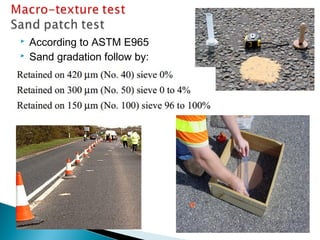
 According to ASTM E965
 Sand gradation follow by:
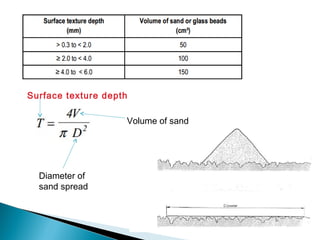
Surface texture depth
Volume of sand
Diameter of
sand spread
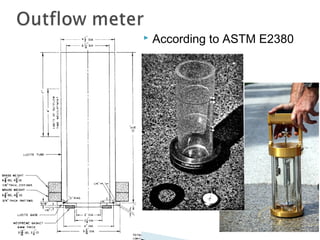
 According to ASTM E2380
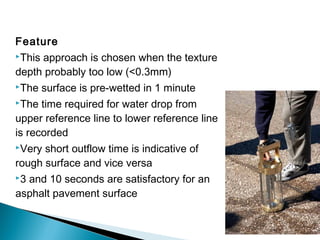
Feature
This approach is chosen when the texture
depth probably too low (<0.3mm)
The surface is pre-wetted in 1 minute
The time required for water drop from
upper reference line to lower reference line
is recorded
Very short outflow time is indicative of
rough surface and vice versa
3 and 10 seconds are satisfactory for an
asphalt pavement surface
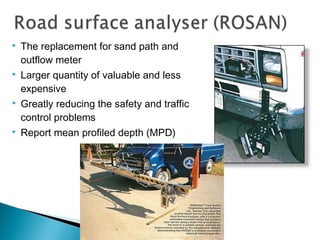
 The replacement for sand path and
outflow meter
 Larger quantity of valuable and less
expensive
 Greatly reducing the safety and traffic
control problems
 Report mean profiled depth (MPD)
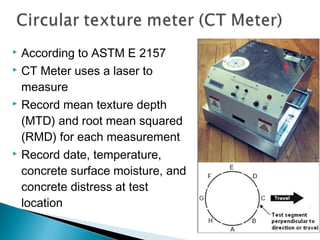
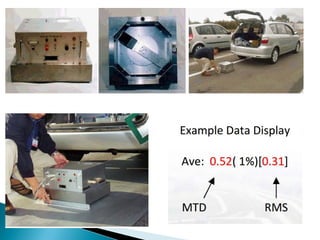
 According to ASTM E 2157
 CT Meter uses a laser to
measure
 Record mean texture depth
(MTD) and root mean squared
(RMD) for each measurement
 Record date, temperature,
concrete surface moisture, and
concrete distress at test
location
 IFI is a harmonized value of Friction index to convert all
skid and texture measurement to a common scale.
 Developed by PIARC
 According to ASTM E1960
 IFI consists of two parameters:
◦ F60 – the coefficient of Friction at slip speed at 60km/h (Skid)
◦ Sp - the speed constant related to the surface texture depth
(Texture)
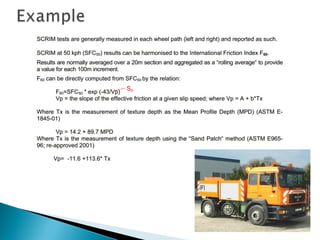
 F(s) is the measurement of skid resistance made by any
piece of equipment, operating with slip speed
 A and B are constants, the values of which were
determined for each piece of skid resistance measuring
equipment
 S = a slip speed
60
60 ( ) exp
P
S
F A B F s
S
 −
= + × ×  ÷
 
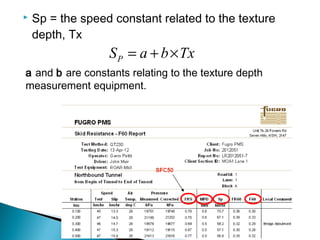
 Sp = the speed constant related to the texture
depth, Tx
PS a b Tx= + ×
a and b are constants relating to the texture depth
measurement equipment.
SP
Design
◦Choose aggregate gradation (SMA or porous)
◦Reduce asphalt binder content
Maintain
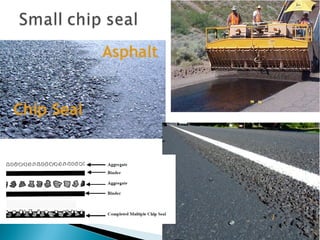
◦Small chip seal (with high PSV aggregate)
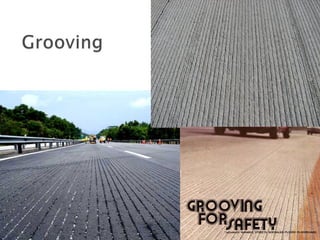
◦Grooving
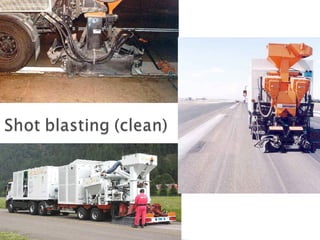
◦Shot-blasting
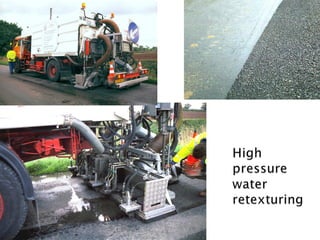
◦High velocity water retexturing
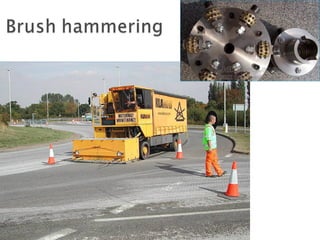
◦Bush hammering
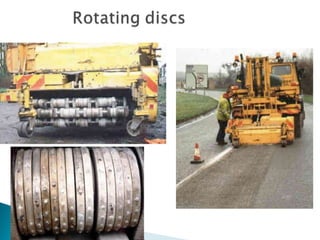
◦Rotating discs
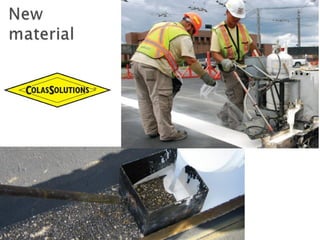
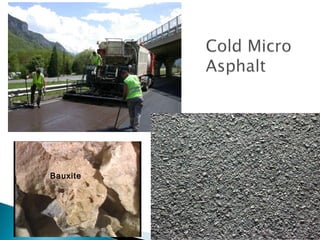
◦New materials
Bauxite
Pavement skid resistance

Pavement skid resistance

  • 1.
    KUNSAN NATIONAL UNIVERSITY Prof.Park Dae-Wook Vo Viet Hai
  • 3.
     Skid resistanceis the friction developed to prevent a tire from sliding along the pavement surface.  Lower when affected by water due to the phenomenon of hydroplaning and contaminated by mud or loose detritus resulting from the day to day usage.  Important safety factor - Inadequate skid resistance will lead to higher rick of accidents.
  • 4.
     Vehicle speed Surface texture (macro-texture)  Surface condition  Tire characteristics  Weather  Road geometry  Aggregates (micro-texture)
  • 6.
     According toBS 812  The Polished Stone Value of aggregate gives a measure of resistance to the polishing action of vehicle tires under conditions similar to those occurring on the surface of a road.  The samples are first polished by the Accelerated Polishing Machine. Then the British Pendulum tester is use to measure the PSV.
  • 7.
    Specimens before andafter polished  14 chips of sample clamped around the periphery of the 'road wheel’  2 phases of abrasion  The first phase is of abrasion by a corn emery for three hours, and then 3 hours of polishing with an emery flour Road wheel
  • 8.
     According toASTM E303-93  The specimen is clamped into the holder in the same direction it has been polished in the machine  The specimen and the slider are thoroughly wetted before each reading  The mean value is reported as PSV  PSV over 50 is regarded as a High Skid Resistant Aggregate, PSV over 65 is needed for particularly high stressed sites, PSV over 70 for rick sites Slider traverses a length of 76±0.5 mm
  • 9.
    Micro-texture British Pendulum tester Featureon site measurement Static (spot measurement) skid resistance test equipment operated by hand Does not measure the impact that macro-texture has on skid resistance as vehicle speeds increase Not suitable for large scale investigating Cheap, portable and is suitable for site and incident investigation
  • 10.
     According toASTM E1911  Measure pavement surface friction as a function of speed  A disc that is made to rotate horizontally at a specified velocity before being lowered onto a wet pavement to measure friction  The friction is measure by the resistance between the test surface and spring-loaded slider Spring-loaded slider
  • 11.
    Device Features (Saitoet al. 1996) Measurement can be made in a very short time The device is designed to be compact and easy to handle Coefficient of friction is reported as a function of speed at a contact pressure similar to that of typical vehicles The slider can be easily replaced onsite, allowing the friction characteristics of different tire’s materials
  • 12.
     According toASTM E274  To take a measurement, the vehicle (or trailer) is brought to the desired testing speed (typically 64 km/hr (40 mph))  Water is sprayed ahead of the test tire to create a wetted pavement surface  The test tire braking system is then actuated to lock the test tire  The result is reported as a Skid Number (SN).
  • 13.
  • 14.
    Skid Number Comments <30 Take measures to correct ≥ 30 Acceptable for low volume roads 31 - 34 Monitor pavement frequently ≥ 35 Acceptable for heavily traveled roads Advantage Most commonly use in U.S Reality Typical Skid Numbers (from Jayawickrama et al., 1996)
  • 15.
     Popular choicefor the routine (proactive) monitoring of road networks  The pavement is tested wet and the vehicles are fitted with large water tanks  The test speed typically adopted is 50km/h (slip speed of 17km/h)  Expensive compared to other types of test equipment
  • 16.
     Compact andlightweight; easy to operate and to transport  Braked wheel, fixed slip design with drag and load measured continuously  Can be towed at any of the standard testing speeds up to 130 km/h; can also be used in pushing mode  Simple on-site calibration takes only 10 minutes  Rapid and simple data acquisition and presentation
  • 17.
    Benefit Reliable - Low cost,robust and easy to maintain Durable - Excellent repeatability and reproducibility Accurate - Readings unaffected by road curvature Versatile - Suitable road and runway Easy To Transport - Can be towed by a wide variety of vehicles Efficient - 100 miles of testing with one tank of water Correlated Data - E274 Locked Wheel Tester, British Pendulum Tester and SCRIM Data Integration - Standard and custom data integration into any pavement management system (PMS) High Resolution - One reading every 32 inches
  • 18.
     Measurement offriction and texture  Wet or dry measurements  Summer and winter measuring capability  Reporting of the International Friction Index (IFI)  Reporting of the peak friction  Single test wheel can be mounted to any kind of host vehicle or trailer.  Relatively expensive compared to portable tester and the grip tester
  • 19.
     This methodologyoffers several advantages over current methods used in the practice  The aggregates on the sample tray with marked grid points  The images of each sample are automatically captured for the analysis of angularity and texture  The results are showed on the computer (Masad, 2003) Sample tray
  • 20.
    Advantages Analyze the shapeof a wide range of aggregate types and sizes Combining both the coarse and fine aggregate analysis into one system Distinct difference between angularity and texture; these properties have different effects on performance
  • 21.
     Developed in2004-2006  Measurement of: ◦ Macro-texture in circular path ◦ Micro-texture in certain points of that path  Structure: Rotating level Micro camera Adjustable mechanism Lens + Extension ring Converging cercal of two lasers Built-in macro sensor Optical precision bearer Micro laser emitter Translating level
  • 24.
     According toASTM E965  Sand gradation follow by:
  • 25.
    Surface texture depth Volumeof sand Diameter of sand spread
  • 26.
     According toASTM E2380
  • 27.
    Feature This approach ischosen when the texture depth probably too low (<0.3mm) The surface is pre-wetted in 1 minute The time required for water drop from upper reference line to lower reference line is recorded Very short outflow time is indicative of rough surface and vice versa 3 and 10 seconds are satisfactory for an asphalt pavement surface
  • 28.
     The replacementfor sand path and outflow meter  Larger quantity of valuable and less expensive  Greatly reducing the safety and traffic control problems  Report mean profiled depth (MPD)
  • 29.
     According toASTM E 2157  CT Meter uses a laser to measure  Record mean texture depth (MTD) and root mean squared (RMD) for each measurement  Record date, temperature, concrete surface moisture, and concrete distress at test location
  • 31.
     IFI isa harmonized value of Friction index to convert all skid and texture measurement to a common scale.  Developed by PIARC  According to ASTM E1960  IFI consists of two parameters: ◦ F60 – the coefficient of Friction at slip speed at 60km/h (Skid) ◦ Sp - the speed constant related to the surface texture depth (Texture)
  • 32.
     F(s) isthe measurement of skid resistance made by any piece of equipment, operating with slip speed  A and B are constants, the values of which were determined for each piece of skid resistance measuring equipment  S = a slip speed 60 60 ( ) exp P S F A B F s S  − = + × ×  ÷  
  • 33.
     Sp =the speed constant related to the texture depth, Tx PS a b Tx= + × a and b are constants relating to the texture depth measurement equipment.
  • 34.
  • 35.
    Design ◦Choose aggregate gradation(SMA or porous) ◦Reduce asphalt binder content Maintain ◦Small chip seal (with high PSV aggregate) ◦Grooving ◦Shot-blasting ◦High velocity water retexturing ◦Bush hammering ◦Rotating discs ◦New materials
  • 43.