ELECTRONICALLY
CONTROLLED
SUSPENSION SYSTEMS
By
ME23B1001
DIWAAKAR JAYAPRAKASH
INTRODUCTION
ECSS use sensors, actuators, and
control algorithms to provide a
smooth, responsive, and unique
ride experience. These systems
continuously monitor road
conditions and vehicle dynamics,
making real-time adjustments to
optimize ride quality and handling.
2
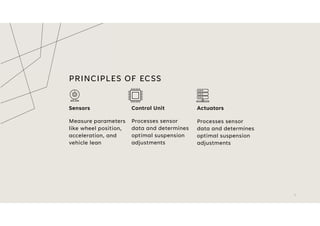
PRINCIPLES OF ECSS
Sensors
Measure parameters
like wheel position,
acceleration, and
vehicle lean
Actuators
Control Unit
Processes sensor
data and determines
optimal suspension
adjustments
Processes sensor
data and determines
optimal suspension
adjustments
3
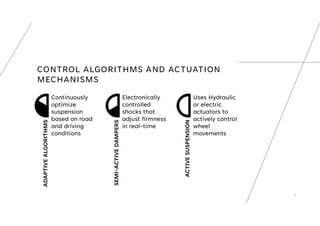
CONTROL ALGORITHMS AND ACTUATION
MECHANISMS
ADAPTIVE
ALGORITHMS
Continuously
optimize
suspension
based on road
and driving
conditions
SEMI-ACTIVE
DAMPERS
Electronically
controlled
shocks that
adjust firmness
in real-time
ACTIVE
SUSPENSION
Uses Hydraulic
or electric
actuators to
actively control
wheel
movements
4
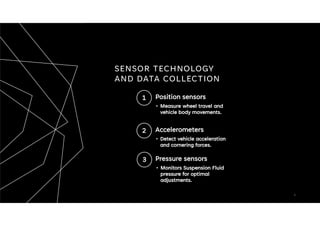
SENSOR TECHNOLOGY
AND DATA COLLECTION
5
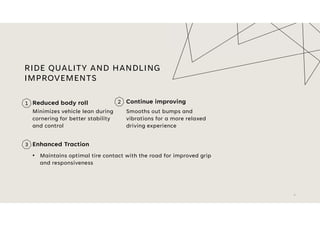
RIDE QUALITY AND HANDLING
IMPROVEMENTS
Reduced body roll
• Maintains optimal tire contact with the road for improved grip
and responsiveness
Continue improving
Minimizes vehicle lean during
cornering for better stability
and control
Smooths out bumps and
vibrations for a more relaxed
driving experience
Enhanced Traction
1
3
2
6
WORLD APPLICATIONS
Perfomance
Vehicles
Off-Road
Vehicles
Luxury
Passenger
Vehicles
Enhances handling
and responsiveness
for a thrilling driving
experience
Provides a smooth
controlled rider over
uneven terrain
Delivers a refined
comfortable ride for a
premium driving
experience
7
RESEARCH PAPER HIGHLIGHTS
Paper 1 (Sun et al., 2019 from Sciencedirect):
This research investigates the potential of using machine
learning algorithms to optimize ECSS behavior in real-time. This
could lead to even more dynamic and adaptable suspension
systems that perfectly adjust to various driving conditions.
Paper 2 (Savaresi et al., 2012 from springerlink):
This paper explores the concept of a holistic vehicle
dynamics management system where ECSS is integrated with other
vehicle systems like active steering and traction control. This
integrated approach could create a more coordinated and efficient
overall vehicle performance.
By understanding these research advancements, we can gain
valuable insights into the future development of ECSS technology.
8
FUTURE
DEVELOPMENTS
Self-Learning ECS:
Imagine your suspension automatically
adjusting for a perfect ride, thanks to machine learning
(inspired by Sun et al., 2019).
Teamwork Makes the Dream Work:
Future ECS might work seamlessly with other
car systems like steering and traction control, creating
a unified system for optimal performance (as discussed
by Savaresi et al., 2012).
Comfort & Efficiency:
The future of ECS focuses on balancing a
smooth ride with better fuel economy by optimizing
suspension settings for different driving situations.
CONCLUSION
ECSS have become a game-changer in
vehicle dynamics, offering superior ride
quality, stability, and handling compared to
traditional passive suspensions.

Electronically Controlled suspensions system .pdf

  • 1.
  • 2.
    INTRODUCTION ECSS use sensors,actuators, and control algorithms to provide a smooth, responsive, and unique ride experience. These systems continuously monitor road conditions and vehicle dynamics, making real-time adjustments to optimize ride quality and handling. 2
  • 3.
    PRINCIPLES OF ECSS Sensors Measureparameters like wheel position, acceleration, and vehicle lean Actuators Control Unit Processes sensor data and determines optimal suspension adjustments Processes sensor data and determines optimal suspension adjustments 3
  • 4.
    CONTROL ALGORITHMS ANDACTUATION MECHANISMS ADAPTIVE ALGORITHMS Continuously optimize suspension based on road and driving conditions SEMI-ACTIVE DAMPERS Electronically controlled shocks that adjust firmness in real-time ACTIVE SUSPENSION Uses Hydraulic or electric actuators to actively control wheel movements 4
  • 5.
  • 6.
    RIDE QUALITY ANDHANDLING IMPROVEMENTS Reduced body roll • Maintains optimal tire contact with the road for improved grip and responsiveness Continue improving Minimizes vehicle lean during cornering for better stability and control Smooths out bumps and vibrations for a more relaxed driving experience Enhanced Traction 1 3 2 6
  • 7.
    WORLD APPLICATIONS Perfomance Vehicles Off-Road Vehicles Luxury Passenger Vehicles Enhances handling andresponsiveness for a thrilling driving experience Provides a smooth controlled rider over uneven terrain Delivers a refined comfortable ride for a premium driving experience 7
  • 8.
    RESEARCH PAPER HIGHLIGHTS Paper1 (Sun et al., 2019 from Sciencedirect): This research investigates the potential of using machine learning algorithms to optimize ECSS behavior in real-time. This could lead to even more dynamic and adaptable suspension systems that perfectly adjust to various driving conditions. Paper 2 (Savaresi et al., 2012 from springerlink): This paper explores the concept of a holistic vehicle dynamics management system where ECSS is integrated with other vehicle systems like active steering and traction control. This integrated approach could create a more coordinated and efficient overall vehicle performance. By understanding these research advancements, we can gain valuable insights into the future development of ECSS technology. 8
  • 9.
    FUTURE DEVELOPMENTS Self-Learning ECS: Imagine yoursuspension automatically adjusting for a perfect ride, thanks to machine learning (inspired by Sun et al., 2019). Teamwork Makes the Dream Work: Future ECS might work seamlessly with other car systems like steering and traction control, creating a unified system for optimal performance (as discussed by Savaresi et al., 2012). Comfort & Efficiency: The future of ECS focuses on balancing a smooth ride with better fuel economy by optimizing suspension settings for different driving situations.
  • 10.
    CONCLUSION ECSS have becomea game-changer in vehicle dynamics, offering superior ride quality, stability, and handling compared to traditional passive suspensions.