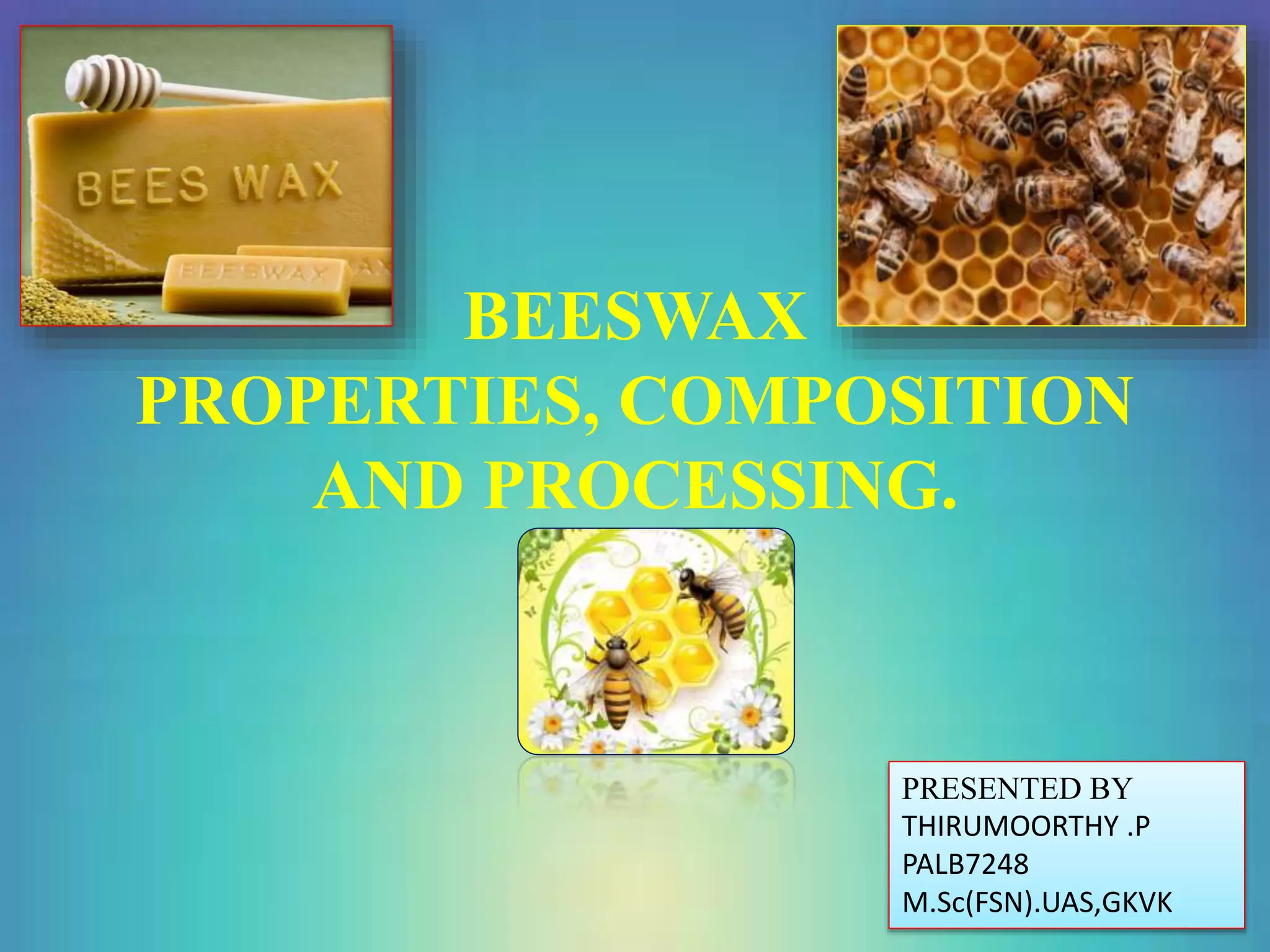

BEESWAX
PROPERTIES, COMPOSITION
AND PROCESSING.
PRESENTED BY
THIRUMOORTHY .P
PALB7248
M.Sc(FSN).UAS,GKVK
CONTENTS
• BEES WAX
• PROPERTIES
• COMPOSITION
• PROCESSING
• STORAGE
• USES AND APPLICATION
• SUMMARY AND
CONCLUSION
• REFERENCE
BEES PRODUCE WAX
• Bees need wax as construction material for their
combs.
• Beeswax is a true wax secreted as liquid but solidifies
when exposed to air and scales are formed is secreted
by the four pairs of wax glands on the ventral side of
the abdomen present in worker bees of age 14-18
days.
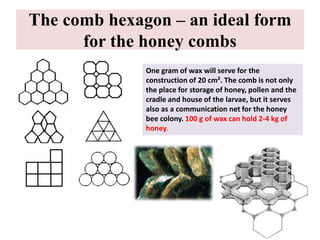
The comb hexagon – an ideal form
for the honey combs
One gram of wax will serve for the
construction of 20 cm². The comb is not only
the place for storage of honey, pollen and the
cradle and house of the larvae, but it serves
also as a communication net for the honey
bee colony. 100 g of wax can hold 2-4 kg of
honey.
WAX PRODUCTION AND COMB CONSTRUCTION
DETERMINED BY FOLLOWING FACTORS
• Nectar Flow
• Brood Rearing (Egg Laying)
• The Presence of a Queen
• Temperature
• The Presence of Pollen as a Protein Source
PHYSICAL PROPERTIES OF BEES WAX
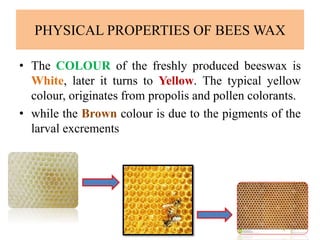
• The COLOUR of the freshly produced beeswax is
White, later it turns to Yellow. The typical yellow
colour, originates from propolis and pollen colorants.
• while the Brown colour is due to the pigments of the
larval excrements
 STRUCTURE of beeswax is crystalline. The crystallisation of
beeswax depends on the storage. The crystallisation process
increases upon storage of wax until 3-4 months. While at the same
time, its stiffness and elasticity increases. Specific gravity 0.95.
 The hardness of beeswax is an important quality factor the harder
the wax, the better the wax quality.
 TEMPERATURE At 30-35 °C it becomes plastic, at 46-47°C the
structure of a hard body is destroyed, at 60 to 70°C it begins to
melt. Heating to 95-105° C leads to formation of surface foam.
 SOLUBILIZATION Beeswax is also insoluble in water and
resistant to many acids. It is soluble in most organic solvents such
as acetone, ether, benzene, xylol, toluene, benzene, chloroform,
tetrachlormethane
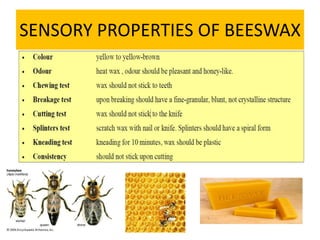
SENSORY PROPERTIES OF BEESWAX
 Pure beeswax from Apis mellifera consists of at least 284
different compounds. Not all have been completely
identified but over 111 are volatile.
 At least 48 compounds were found to contribute to the aroma
of beeswax. Quantitatively, the major .compounds are
saturated and unsaturated monoesters, diesters, saturated and
unsaturated hydrocarbons, free acids and hydroxy polyesters.
 The composition of wax from Asian honeybee species is
much simpler and contains fewer compounds in different
proportions (Phadke et al., 1969, 1971; Phadke and Nair,
1970, 1973 and Narayana, 1970).
COMPOSITION OF BEESWAX
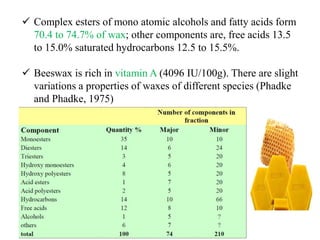
 Complex esters of mono atomic alcohols and fatty acids form
70.4 to 74.7% of wax; other components are, free acids 13.5
to 15.0% saturated hydrocarbons 12.5 to 15.5%.
 Beeswax is rich in vitamin A (4096 IU/100g). There are slight
variations a properties of waxes of different species (Phadke
and Phadke, 1975)
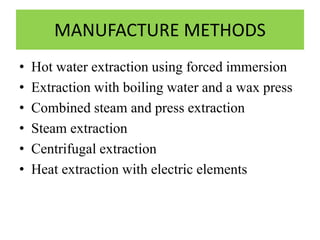
MANUFACTURE METHODS
• Hot water extraction using forced immersion
• Extraction with boiling water and a wax press
• Combined steam and press extraction
• Steam extraction
• Centrifugal extraction
• Heat extraction with electric elements
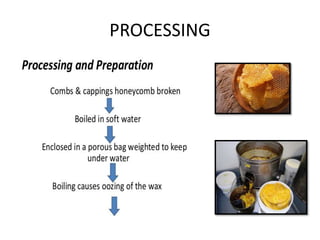
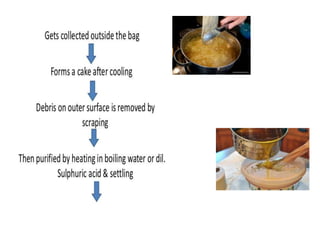
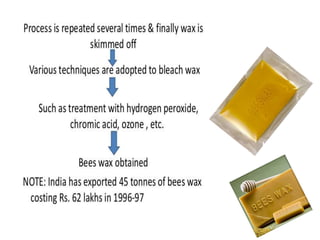
PROCESSING
STORAGE
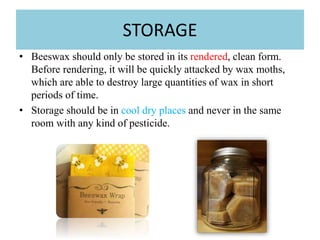
• Beeswax should only be stored in its rendered, clean form.
Before rendering, it will be quickly attacked by wax moths,
which are able to destroy large quantities of wax in short
periods of time.
• Storage should be in cool dry places and never in the same
room with any kind of pesticide.
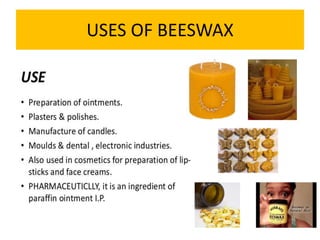
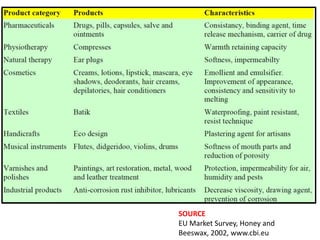
USES OF BEESWAX
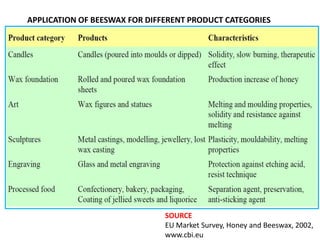
APPLICATION OF BEESWAX FOR DIFFERENT PRODUCT CATEGORIES
SOURCE
EU Market Survey, Honey and Beeswax, 2002,
www.cbi.eu
Ancient Indonesian batik
SOURCE
EU Market Survey, Honey and
Beeswax, 2002, www.cbi.eu
SUMMARY
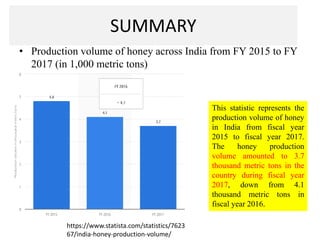
• Production volume of honey across India from FY 2015 to FY
2017 (in 1,000 metric tons)
This statistic represents the
production volume of honey
in India from fiscal year
2015 to fiscal year 2017.
The honey production
volume amounted to 3.7
thousand metric tons in the
country during fiscal year
2017, down from 4.1
thousand metric tons in
fiscal year 2016.
https://www.statista.com/statistics/7623
67/india-honey-production-volume/
REFERENCE
• Bee Product Science, www.bee-hexagon.net ,
April 2016.
• ABROL,D.P. Bee keeping a compressive
guide to bees and beekeeping. scientific
publishers (India).
• STEFAN BOGDANOV Beeswax: History,
Uses and Trade. Bee Product Science,
www.bee-hexagon.net April 2016.
• Google images.com

Beeswax properties and composition

  • 1.
    BEESWAX PROPERTIES, COMPOSITION AND PROCESSING. PRESENTEDBY THIRUMOORTHY .P PALB7248 M.Sc(FSN).UAS,GKVK
  • 2.
    CONTENTS • BEES WAX •PROPERTIES • COMPOSITION • PROCESSING • STORAGE • USES AND APPLICATION • SUMMARY AND CONCLUSION • REFERENCE
  • 3.
    BEES PRODUCE WAX •Bees need wax as construction material for their combs. • Beeswax is a true wax secreted as liquid but solidifies when exposed to air and scales are formed is secreted by the four pairs of wax glands on the ventral side of the abdomen present in worker bees of age 14-18 days.
  • 4.
    The comb hexagon– an ideal form for the honey combs One gram of wax will serve for the construction of 20 cm². The comb is not only the place for storage of honey, pollen and the cradle and house of the larvae, but it serves also as a communication net for the honey bee colony. 100 g of wax can hold 2-4 kg of honey.
  • 5.
    WAX PRODUCTION ANDCOMB CONSTRUCTION DETERMINED BY FOLLOWING FACTORS • Nectar Flow • Brood Rearing (Egg Laying) • The Presence of a Queen • Temperature • The Presence of Pollen as a Protein Source
  • 6.
    PHYSICAL PROPERTIES OFBEES WAX • The COLOUR of the freshly produced beeswax is White, later it turns to Yellow. The typical yellow colour, originates from propolis and pollen colorants. • while the Brown colour is due to the pigments of the larval excrements
  • 7.
     STRUCTURE ofbeeswax is crystalline. The crystallisation of beeswax depends on the storage. The crystallisation process increases upon storage of wax until 3-4 months. While at the same time, its stiffness and elasticity increases. Specific gravity 0.95.  The hardness of beeswax is an important quality factor the harder the wax, the better the wax quality.  TEMPERATURE At 30-35 °C it becomes plastic, at 46-47°C the structure of a hard body is destroyed, at 60 to 70°C it begins to melt. Heating to 95-105° C leads to formation of surface foam.  SOLUBILIZATION Beeswax is also insoluble in water and resistant to many acids. It is soluble in most organic solvents such as acetone, ether, benzene, xylol, toluene, benzene, chloroform, tetrachlormethane
  • 8.
  • 9.
     Pure beeswaxfrom Apis mellifera consists of at least 284 different compounds. Not all have been completely identified but over 111 are volatile.  At least 48 compounds were found to contribute to the aroma of beeswax. Quantitatively, the major .compounds are saturated and unsaturated monoesters, diesters, saturated and unsaturated hydrocarbons, free acids and hydroxy polyesters.  The composition of wax from Asian honeybee species is much simpler and contains fewer compounds in different proportions (Phadke et al., 1969, 1971; Phadke and Nair, 1970, 1973 and Narayana, 1970). COMPOSITION OF BEESWAX
  • 10.
     Complex estersof mono atomic alcohols and fatty acids form 70.4 to 74.7% of wax; other components are, free acids 13.5 to 15.0% saturated hydrocarbons 12.5 to 15.5%.  Beeswax is rich in vitamin A (4096 IU/100g). There are slight variations a properties of waxes of different species (Phadke and Phadke, 1975)
  • 11.
    MANUFACTURE METHODS • Hotwater extraction using forced immersion • Extraction with boiling water and a wax press • Combined steam and press extraction • Steam extraction • Centrifugal extraction • Heat extraction with electric elements
  • 12.
  • 15.
    STORAGE • Beeswax shouldonly be stored in its rendered, clean form. Before rendering, it will be quickly attacked by wax moths, which are able to destroy large quantities of wax in short periods of time. • Storage should be in cool dry places and never in the same room with any kind of pesticide.
  • 16.
  • 17.
    APPLICATION OF BEESWAXFOR DIFFERENT PRODUCT CATEGORIES SOURCE EU Market Survey, Honey and Beeswax, 2002, www.cbi.eu
  • 18.
  • 19.
    SOURCE EU Market Survey,Honey and Beeswax, 2002, www.cbi.eu
  • 20.
    SUMMARY • Production volumeof honey across India from FY 2015 to FY 2017 (in 1,000 metric tons) This statistic represents the production volume of honey in India from fiscal year 2015 to fiscal year 2017. The honey production volume amounted to 3.7 thousand metric tons in the country during fiscal year 2017, down from 4.1 thousand metric tons in fiscal year 2016. https://www.statista.com/statistics/7623 67/india-honey-production-volume/
  • 21.
    REFERENCE • Bee ProductScience, www.bee-hexagon.net , April 2016. • ABROL,D.P. Bee keeping a compressive guide to bees and beekeeping. scientific publishers (India). • STEFAN BOGDANOV Beeswax: History, Uses and Trade. Bee Product Science, www.bee-hexagon.net April 2016. • Google images.com