The central theme as
throughout the book, is the
creation of learning
environment informed by
communal constructivist
theory
Therefore e-learning enable learners to
construct their own knowledge and
understanding in a computer-based
environment that allows continual
reconstruction and reshaping as their learning
development.
The role of any tutor proposing to enable their
students to engage In such e-learning
activities begin with;
Planning
phase
Post-delivery
review and
quality check
activity
ļ‚ž Audience
ļ‚ž Resource needs
ļ‚ž Proposed learning outcomes
ļ‚ž Assessment needs and methods
The tutors must know their audience. They
need to have carried out in analysis of the
target group’s learning.
They needs covering questions such as;
ļ‚ž What prior learning relevant to the learning
proposed, in in place?
ļ‚ž Are any special competence needed?
Resource needs
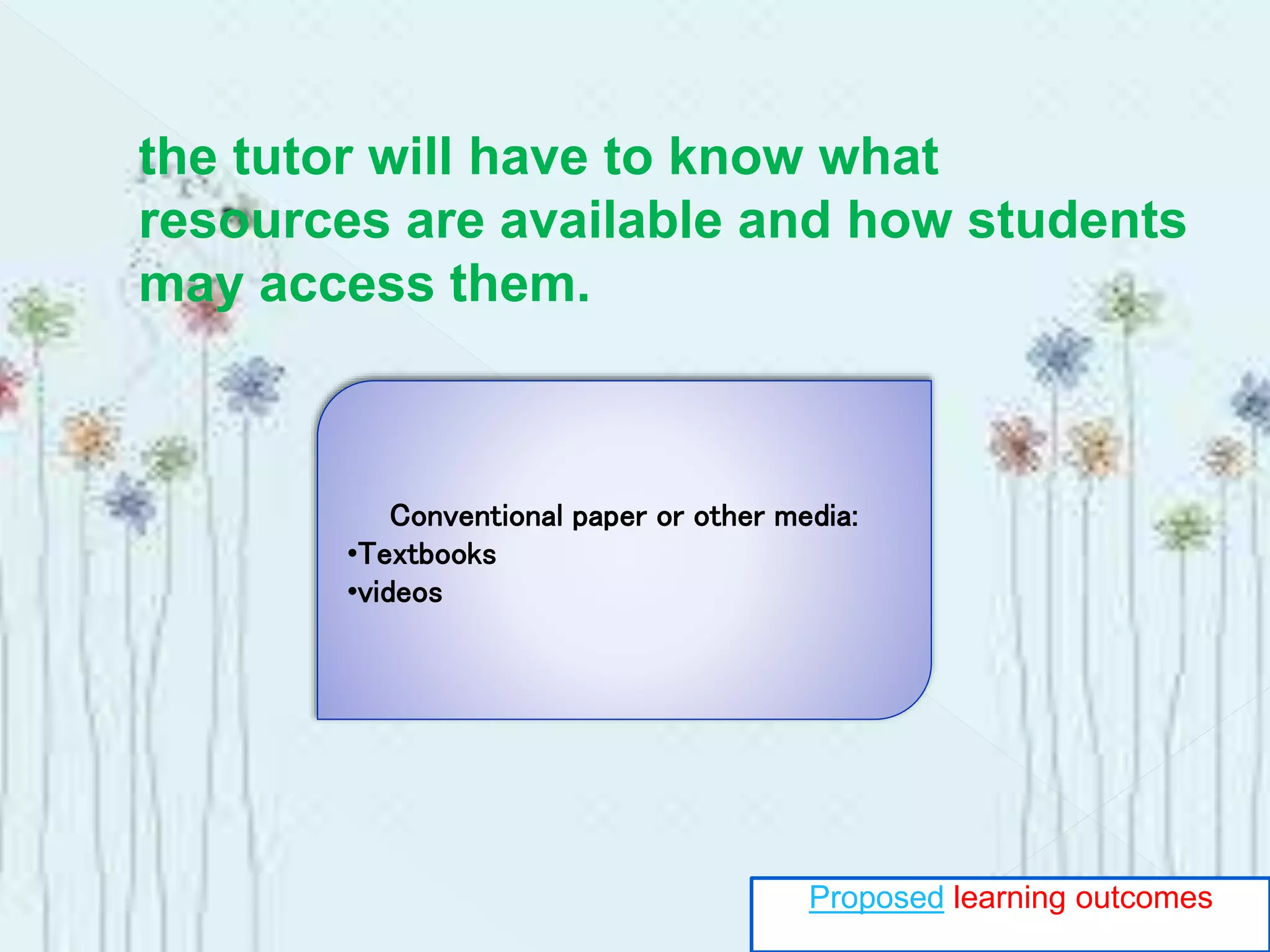
the tutor will have to know what
resources are available and how students
may access them.
Conventional paper or other media:
•Textbooks
•videos
Proposed learning outcomes
the learners will specific in nature, requiring
students to master a particular mathematical
concept .
For instance:
demonstrating an emphatic understanding of
the circumstance surrounding.
Assessment needs and
methods
if the e-learning course has to be assessed,
e.g. for reporting or accreditation purpose,
the tutor should consider how best
assessment can be made online.
the are two ways to assess
1. subjective
2. objective
Rememb
er!!
Information and communication technologies allow
people to develop their thoughts and share them
with other in a variety of ways including chat
rooms, bulletin boards and weblogs.
According to Murphy (1997), the best of such
environment are constructivist in design and
ethos, were:
ļ‚ž Goals and objective are derived by the students or in
negotiation with the teacher, or system.
ļ‚ž Teacher serve in the role of guides, monitor, coaches, tutors
and facilitators.
ļ‚ž Knowledge construction and not reproduction is
emphasized.
ļ‚ž This construction takes place in individual context.
ļ‚ž Collaborative and cooperative learning
ļ‚ž Scaffolding is facilitated to help the students perform just
beyond the limit of their ability.
ļ‚ž Assessment is authentic and interwoven teaching.
Is a theory that attempt to bring tacit processes out in
the open. It assumes that people learn from one
another, through observation, imitation and modeling.
Collin et al. (1991) argue that the traditional model of
apprenticeship comprises four processes;
 Modeling
 Scaffolding
 Fading
 Coaching
1) Modeling
is a practical activity such as fashioning
2) Scaffolding
is a process in which learners are reach new
level of knowledge, skill or understanding
ā€œScaffold enable a person to stretch and climb to
places that would otherwise beyond their reachā€
The analogy
(3) Fading
the expert begins to transfer responsibility to
them by ā€˜fading’ into background. The
disengagement is slow and never complete, that
is, the apprentices continue to the progress at
their own pace but remind also to call upon the
expert if needed.
expert progressively take more of ā€˜watching
brief’. Judging when the intervention might be
helpful without undermining the apprentice
confident.
(4) Coaching
coaching pervades all the processes, with the
expert continually prompting the apprentice by
ā€œchoosing tasks, providing hints and scaffolding,
evaluating the activities and diagnosing the kinds
of problem they are having, challenging them and
offering encouragement, giving feedback,
structuring the ways to do things, working on
particular weaknesses ā€
Any successful learning environment will
be characterized by a number of features
relating to how the learners engage with
their learning and how it is supported by
the tutor.
These are crucially important in any learning context
• learners searching for information
• analyzing information
• Solving problem by combination
• Applying ideas and information creatively
• Generalizing from specific cases
• Hypothesizing and testing
• Planning and strategizing
• Evaluating and critiquing ideas and knowledge
• Reaching reasoned conclusions
e-learning system , which promote self-
assessment and reflection, should ensure that
they have key elements of the interaction geared
toward guiding the learners to undertaken
evaluation of their own and planning their next
steps.
Learners will manifest different levels and types of motivation, ranging
from the intrinsic and extrinsic.
derives from internalized factor such as the pleasure of
learning itself or the sense of achievement.
generally comprise external factor such as the approval
of tutor and the esteem in which the learners feel they are held by their
peers.
Intrinsic
extrinsic
Generating curiosity on the part of a
learner can be key ingredient In fostering
learning, through not required in every
instance of course, and e-learning
approaches can harness it quite effectively.
Most e-learning system will take time at the
outset to provide details of the learning goal they
address, from the specific.
Recognizing is a key motivational issue that implies that
feedback must be sensitive and constructive for those
who do not have the skills or intellectual wherewithal to
make a bigger impact.
Ensuring recognition of all levels of achievement is
often considered to be relatively easy in a computer-
based environment.
As we outlined earlier, this process is often described as
ā€˜scaffolding’, the construction of a frame of knowledge
development by a tutor, and partially by the learner, in
which the learner’s progress to higher levels is
accomplished by their own ā€˜climbing’ or with the helping
hand of a tutor or peer.
He proposed a combination of seven
intelligences, later increased to nine (Kearsley,
2003), that embody the various abilities of any
individual-each ability manifesting itself at
different levels in each individual. The nine
intelligences comprise such as spatial, linguistic
, musical and logical-mathematical, and more
novel intelligence such as bodily kinaesthetic,
naturalist, interpersonal, intrapersonal and
existential.
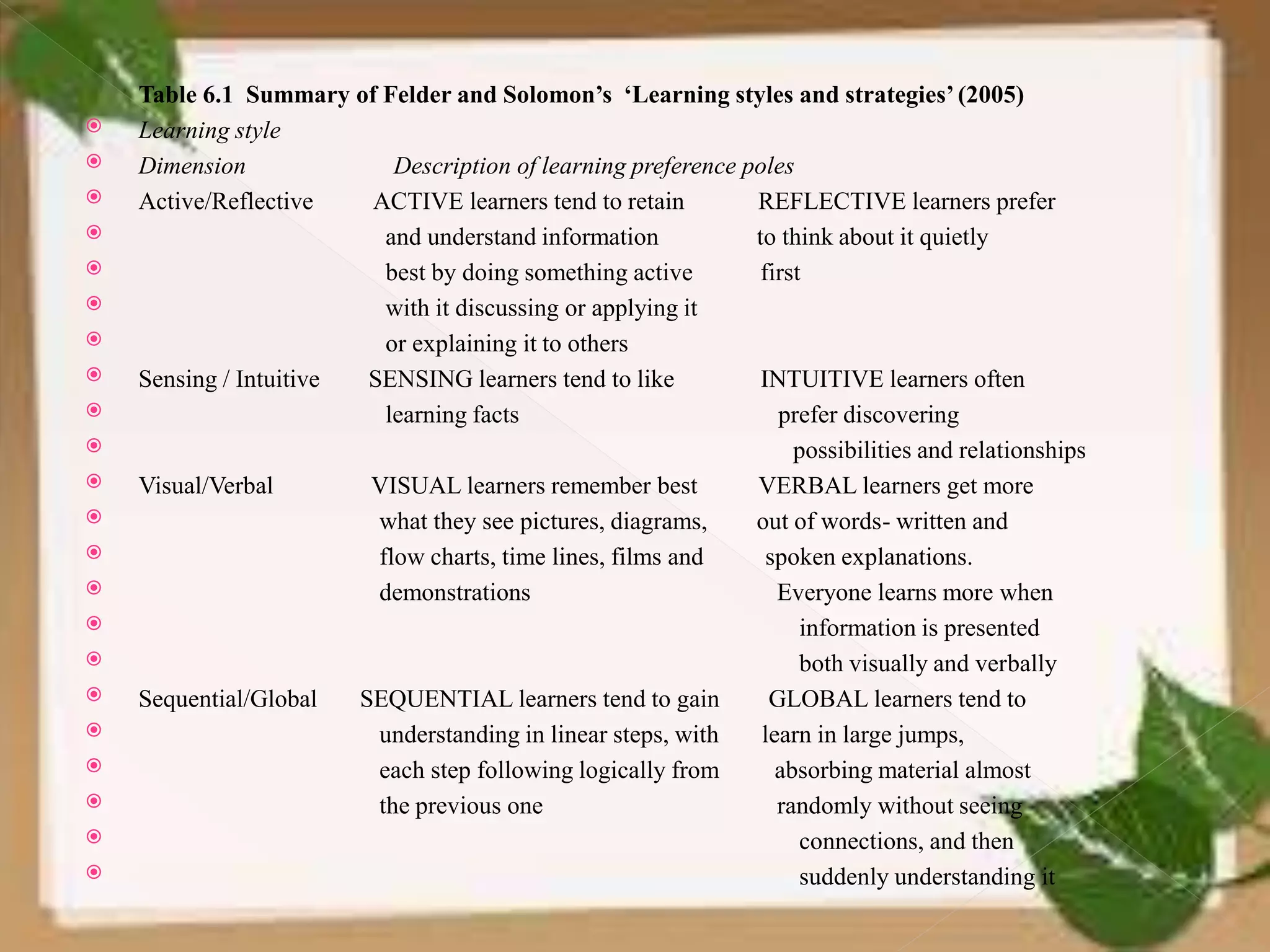
Table 6.1 Summary of Felder and Solomon’s ā€˜Learning styles and strategies’(2005)
ļ‚ž Learning style
ļ‚ž Dimension Description of learning preference poles
ļ‚ž Active/Reflective ACTIVE learners tend to retain REFLECTIVE learners prefer
ļ‚ž and understand information to think about it quietly
ļ‚ž best by doing something active first
ļ‚ž with it discussing or applying it
ļ‚ž or explaining it to others
ļ‚ž Sensing / Intuitive SENSING learners tend to like INTUITIVE learners often
ļ‚ž learning facts prefer discovering
ļ‚ž possibilities and relationships
ļ‚ž Visual/Verbal VISUAL learners remember best VERBAL learners get more
ļ‚ž what they see pictures, diagrams, out of words- written and
ļ‚ž flow charts, time lines, films and spoken explanations.
ļ‚ž demonstrations Everyone learns more when
ļ‚ž information is presented
ļ‚ž both visually and verbally
ļ‚ž Sequential/Global SEQUENTIAL learners tend to gain GLOBAL learners tend to
ļ‚ž understanding in linear steps, with learn in large jumps,
ļ‚ž each step following logically from absorbing material almost
ļ‚ž the previous one randomly without seeing
ļ‚ž connections, and then
ļ‚ž suddenly understanding it
E-learning environments
will enable a broader
learners engagement
through a demand for
creative responses or the
completion of tasks
requiring the searching for
and analysing of
information
Interaction with peers and
tutors in a social learning
context online will ensure
a degree of higher-order
skills activity, including
the sharing of ideas and
formulation of questions
With the benefits of multimedia, animation and advanced
communication facilities, e-learning can place the learner
in a simulated ā€˜virtual’ environment approximating to the
ā€˜real’ thing, or can engage them through webcam, Internet
telephony and whiteboard technologies, for example with
distant laboratories, field trips or events
Online e-Learning environments almost always
have an element of social interaction to support
learning, through asynchronous email
communications at the least, but increasingly
more often through synchronous text, audio and
video communication.
- Virtual case studies, fieldwork and experimental
laboratories
- Online problem-based learning
- Online simulations and gaming
The programmes focus on the virtual boardroom ,
creating a business decision-making environment in
much the same manner as an actual case study in a
university classroom.
Virtual fieldwork environments and experimental
laboratories also cover many of the key pedagogical
aspirations and come in, two main variants:
The students control a real situation remotely and those
which simulate an experimental context and which allow
students to learn from the manipulation of real data
The site uses a problem solving template which
asks the students to:
ļ‚Ÿ ļ‚ŸRead and analyse the problem scenario
ļ‚Ÿ ļ‚Ÿ list what is known
ļ‚Ÿ ļ‚Ÿ develop a problem statement
ļ‚Ÿ ļ‚Ÿlist what is needed
ļ‚Ÿ ļ‚Ÿlist possible actions
ļ‚Ÿ ļ‚Ÿ analyse information
ļ‚Ÿ ļ‚Ÿ present findings
E-learning environments, which capitalize on a
simulation approach , can allow the learner to
interact with a system that is based on the
steps needed to be taken to solve a type of
given problem.
Gaming environments are often similar to
simulations but tend to involve a level of
competition and are generally used to increase
motivation for simulations
The benefits of both approaches any such blended course will
require:
ļ‚Ÿ ļ‚Ÿ As producers and not just consumers of information
ļ‚Ÿ ļ‚Ÿ A process of constructing knowledge
ļ‚Ÿ ļ‚Ÿ to be trained in the various technologies
ļ‚Ÿ ļ‚Ÿ authentic coursework to be built in
ļ‚Ÿ ļ‚Ÿ presentation to peers to be a fundamental part of the
communication activities
ļ‚Ÿ ļ‚Ÿ active collaboration by all students in both the preparation and
the presentation
ļ‚Ÿ ļ‚Ÿ use to be made of group work and project- based learning
pedagogies
ļ‚Ÿ ļ‚Ÿ appropriate assessment techniques
ļ‚Ÿ ļ‚Ÿ resources to be presented in good time
ļ‚Ÿ ļ‚Ÿ use to be made of peer tutoring and mentoring
ļ‚Ÿ ļ‚Ÿ students to take on responsibilities
Design concept and consideration

Design concept and consideration

  • 2.
    The central themeas throughout the book, is the creation of learning environment informed by communal constructivist theory Therefore e-learning enable learners to construct their own knowledge and understanding in a computer-based environment that allows continual reconstruction and reshaping as their learning development.
  • 3.
    The role ofany tutor proposing to enable their students to engage In such e-learning activities begin with; Planning phase Post-delivery review and quality check activity
  • 4.
    ļ‚ž Audience ļ‚ž Resourceneeds ļ‚ž Proposed learning outcomes ļ‚ž Assessment needs and methods
  • 5.
    The tutors mustknow their audience. They need to have carried out in analysis of the target group’s learning. They needs covering questions such as; ļ‚ž What prior learning relevant to the learning proposed, in in place? ļ‚ž Are any special competence needed? Resource needs
  • 6.
    the tutor willhave to know what resources are available and how students may access them. Conventional paper or other media: •Textbooks •videos Proposed learning outcomes
  • 7.
    the learners willspecific in nature, requiring students to master a particular mathematical concept . For instance: demonstrating an emphatic understanding of the circumstance surrounding. Assessment needs and methods
  • 8.
    if the e-learningcourse has to be assessed, e.g. for reporting or accreditation purpose, the tutor should consider how best assessment can be made online. the are two ways to assess 1. subjective 2. objective Rememb er!!
  • 9.
    Information and communicationtechnologies allow people to develop their thoughts and share them with other in a variety of ways including chat rooms, bulletin boards and weblogs. According to Murphy (1997), the best of such environment are constructivist in design and ethos, were:
  • 10.
    ļ‚ž Goals andobjective are derived by the students or in negotiation with the teacher, or system. ļ‚ž Teacher serve in the role of guides, monitor, coaches, tutors and facilitators. ļ‚ž Knowledge construction and not reproduction is emphasized. ļ‚ž This construction takes place in individual context. ļ‚ž Collaborative and cooperative learning ļ‚ž Scaffolding is facilitated to help the students perform just beyond the limit of their ability. ļ‚ž Assessment is authentic and interwoven teaching.
  • 11.
    Is a theorythat attempt to bring tacit processes out in the open. It assumes that people learn from one another, through observation, imitation and modeling. Collin et al. (1991) argue that the traditional model of apprenticeship comprises four processes;  Modeling  Scaffolding  Fading  Coaching
  • 12.
    1) Modeling is apractical activity such as fashioning 2) Scaffolding is a process in which learners are reach new level of knowledge, skill or understanding ā€œScaffold enable a person to stretch and climb to places that would otherwise beyond their reachā€ The analogy
  • 13.
    (3) Fading the expertbegins to transfer responsibility to them by ā€˜fading’ into background. The disengagement is slow and never complete, that is, the apprentices continue to the progress at their own pace but remind also to call upon the expert if needed. expert progressively take more of ā€˜watching brief’. Judging when the intervention might be helpful without undermining the apprentice confident.
  • 14.
    (4) Coaching coaching pervadesall the processes, with the expert continually prompting the apprentice by ā€œchoosing tasks, providing hints and scaffolding, evaluating the activities and diagnosing the kinds of problem they are having, challenging them and offering encouragement, giving feedback, structuring the ways to do things, working on particular weaknesses ā€
  • 15.
    Any successful learningenvironment will be characterized by a number of features relating to how the learners engage with their learning and how it is supported by the tutor.
  • 16.
    These are cruciallyimportant in any learning context • learners searching for information • analyzing information • Solving problem by combination • Applying ideas and information creatively • Generalizing from specific cases • Hypothesizing and testing • Planning and strategizing • Evaluating and critiquing ideas and knowledge • Reaching reasoned conclusions
  • 17.
    e-learning system ,which promote self- assessment and reflection, should ensure that they have key elements of the interaction geared toward guiding the learners to undertaken evaluation of their own and planning their next steps.
  • 18.
    Learners will manifestdifferent levels and types of motivation, ranging from the intrinsic and extrinsic. derives from internalized factor such as the pleasure of learning itself or the sense of achievement. generally comprise external factor such as the approval of tutor and the esteem in which the learners feel they are held by their peers. Intrinsic extrinsic
  • 19.
    Generating curiosity onthe part of a learner can be key ingredient In fostering learning, through not required in every instance of course, and e-learning approaches can harness it quite effectively.
  • 20.
    Most e-learning systemwill take time at the outset to provide details of the learning goal they address, from the specific.
  • 21.
    Recognizing is akey motivational issue that implies that feedback must be sensitive and constructive for those who do not have the skills or intellectual wherewithal to make a bigger impact. Ensuring recognition of all levels of achievement is often considered to be relatively easy in a computer- based environment.
  • 22.
    As we outlinedearlier, this process is often described as ā€˜scaffolding’, the construction of a frame of knowledge development by a tutor, and partially by the learner, in which the learner’s progress to higher levels is accomplished by their own ā€˜climbing’ or with the helping hand of a tutor or peer.
  • 23.
    He proposed acombination of seven intelligences, later increased to nine (Kearsley, 2003), that embody the various abilities of any individual-each ability manifesting itself at different levels in each individual. The nine intelligences comprise such as spatial, linguistic , musical and logical-mathematical, and more novel intelligence such as bodily kinaesthetic, naturalist, interpersonal, intrapersonal and existential.
  • 24.
    Table 6.1 Summaryof Felder and Solomon’s ā€˜Learning styles and strategies’(2005) ļ‚ž Learning style ļ‚ž Dimension Description of learning preference poles ļ‚ž Active/Reflective ACTIVE learners tend to retain REFLECTIVE learners prefer ļ‚ž and understand information to think about it quietly ļ‚ž best by doing something active first ļ‚ž with it discussing or applying it ļ‚ž or explaining it to others ļ‚ž Sensing / Intuitive SENSING learners tend to like INTUITIVE learners often ļ‚ž learning facts prefer discovering ļ‚ž possibilities and relationships ļ‚ž Visual/Verbal VISUAL learners remember best VERBAL learners get more ļ‚ž what they see pictures, diagrams, out of words- written and ļ‚ž flow charts, time lines, films and spoken explanations. ļ‚ž demonstrations Everyone learns more when ļ‚ž information is presented ļ‚ž both visually and verbally ļ‚ž Sequential/Global SEQUENTIAL learners tend to gain GLOBAL learners tend to ļ‚ž understanding in linear steps, with learn in large jumps, ļ‚ž each step following logically from absorbing material almost ļ‚ž the previous one randomly without seeing ļ‚ž connections, and then ļ‚ž suddenly understanding it
  • 25.
    E-learning environments will enablea broader learners engagement through a demand for creative responses or the completion of tasks requiring the searching for and analysing of information Interaction with peers and tutors in a social learning context online will ensure a degree of higher-order skills activity, including the sharing of ideas and formulation of questions
  • 26.
    With the benefitsof multimedia, animation and advanced communication facilities, e-learning can place the learner in a simulated ā€˜virtual’ environment approximating to the ā€˜real’ thing, or can engage them through webcam, Internet telephony and whiteboard technologies, for example with distant laboratories, field trips or events
  • 27.
    Online e-Learning environmentsalmost always have an element of social interaction to support learning, through asynchronous email communications at the least, but increasingly more often through synchronous text, audio and video communication.
  • 28.
    - Virtual casestudies, fieldwork and experimental laboratories - Online problem-based learning - Online simulations and gaming
  • 29.
    The programmes focuson the virtual boardroom , creating a business decision-making environment in much the same manner as an actual case study in a university classroom. Virtual fieldwork environments and experimental laboratories also cover many of the key pedagogical aspirations and come in, two main variants: The students control a real situation remotely and those which simulate an experimental context and which allow students to learn from the manipulation of real data
  • 30.
    The site usesa problem solving template which asks the students to: ļ‚Ÿ ļ‚ŸRead and analyse the problem scenario ļ‚Ÿ ļ‚Ÿ list what is known ļ‚Ÿ ļ‚Ÿ develop a problem statement ļ‚Ÿ ļ‚Ÿlist what is needed ļ‚Ÿ ļ‚Ÿlist possible actions ļ‚Ÿ ļ‚Ÿ analyse information ļ‚Ÿ ļ‚Ÿ present findings
  • 31.
    E-learning environments, whichcapitalize on a simulation approach , can allow the learner to interact with a system that is based on the steps needed to be taken to solve a type of given problem. Gaming environments are often similar to simulations but tend to involve a level of competition and are generally used to increase motivation for simulations
  • 32.
    The benefits ofboth approaches any such blended course will require: ļ‚Ÿ ļ‚Ÿ As producers and not just consumers of information ļ‚Ÿ ļ‚Ÿ A process of constructing knowledge ļ‚Ÿ ļ‚Ÿ to be trained in the various technologies ļ‚Ÿ ļ‚Ÿ authentic coursework to be built in ļ‚Ÿ ļ‚Ÿ presentation to peers to be a fundamental part of the communication activities ļ‚Ÿ ļ‚Ÿ active collaboration by all students in both the preparation and the presentation ļ‚Ÿ ļ‚Ÿ use to be made of group work and project- based learning pedagogies ļ‚Ÿ ļ‚Ÿ appropriate assessment techniques ļ‚Ÿ ļ‚Ÿ resources to be presented in good time ļ‚Ÿ ļ‚Ÿ use to be made of peer tutoring and mentoring ļ‚Ÿ ļ‚Ÿ students to take on responsibilities