New Teacher Training
Amanda Edwards
May 18, 2015
CUR/532
Welcome
• Today we are going to start on our 3 day training on what do you do now that you
have a teaching job.
• We will go over issues such as
• Attendance procedure
• Money and receipt
• Entering grades
• Just to name a few
• So sit back and lets get the show on the road.
Hi my name is Amanda Edwards
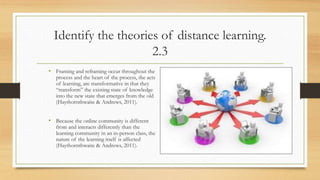
• I will be with you over the next 3 days to help you better understand your
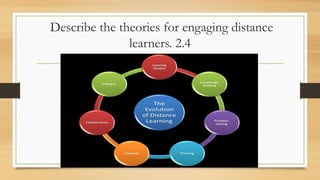
role in your new teaching environment here at Edwards Elementary.
• I am here for you so if you need to reach me at any time feel free
to contact me @
Cell Phone : (334) 557-8467 Call or text
Email : edwardselementary@mysite.com
Part 1 – Vital Information in the Facilitator Training
Facilitator Training Program
Asynchronous 3 – day Module
Module 1
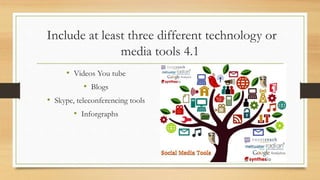
• 1.1 Training audience
• 1.2 Program Goals
• 1.3 Program Objectives
• 1.4 Summative Assessment
Training Program Audience
1.1
• Our audience today are the newest hires of Edwards Elementary
• These hires range from new collage graduates
• Master degree holders
• Teachers with years of experience
current skill sets will vary
current experiences
0 to 20 years
level of current knowledge
Varies
Training program goals
1.2
• The key skills to be successful are:
• Communication
• Productivity
• Creativity
• Guidance
1.2 Training Program Goals
1. Proficient with using online tools
2. Maintain online presence
3. Encourage an online learning community
4. Acquire engagement techniques
Training Program Objectives
1.3
Module 1
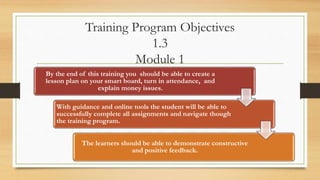
By the end of this training you should be able to create a
lesson plan on your smart board, turn in attendance, and
explain money issues.
With guidance and online tools the student will be able to
successfully complete all assignments and navigate though
the training program.
The learners should be able to demonstrate constructive
and positive feedback.
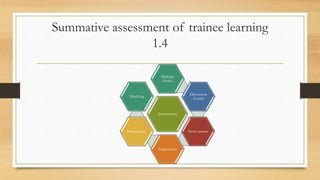
Summative assessment of trainee learning
1.4
Assessments
Multiple
choice
Discussion
boards
Short answer
Assignments
Presentation
Matching
Summative Assessment
1.4
• At the end of each module students will be able to complete an in formal
assessment graded with a rubric.
• By the end of the training course the trainees will be able to understand all
objectives through an assignment
• New knowledge will be shone through discussion boards, multiple choice
questions, and assignments
Part II – Facilitator Skills and Instructional
Materials
Facilitator Training Program
Asynchronous 3 – day Module
Module 1
• 2.1 Training Materials
• 2.2 Describe the phases of
development
• 2.3 Identify the theories of distance
learning.
• 2.4 Describe the theories for
engaging distance learners.
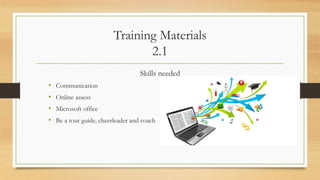
Training Materials
2.1
Skills needed
• Communication
• Online assess
• Microsoft office
• Be a tour guide, cheerleader and coach
Describe the phases of development
2.2
Five stages
• Visitor – basic starter turning in work by e mail
• Novice – Have used some technology for online courses
• Apprentice – New online teacher someone that has taught for one to two years
• Insider – Taught more than two years and have mastered the technology required to
teach online
• Master – Taught for many years and feel right at home in the online classroom
Identify the theories of distance learning.
2.3
• Framing and reframing occur throughout the
process and the heart of the process, the acts
of learning, are transformative in that they
“transform” the existing state of knowledge
into the new state that emerges from the old
(Haythornthwaite & Andrews, 2011).
• Because the online community is different
from and interacts differently than the
learning community in an in-person class, the
nature of the learning itself is affected
(Haythornthwaite & Andrews, 2011).
Describe the theories for engaging distance
learners. 2.4
2.4
Describe the theories for engaging distance
learners.
2.4
• Student-centric – responsibility lies on the students
• Communal – working with others and sharing experiences
• Transactional distance - attending at different times
• Multi-modal – lots of different media to use
One example is communication is not instant it could be days or hours before
you get a response.
Part III – Management and Technology
Tools
Facilitator Training Program
Asynchronous 3 – day Module
Module 2
• 3.1 Mentoring program for faculty
• 3.2 Management and evaluation
programs for facilitators
• 3.3 Learning platform
• 3.4 Include at least three different
technology or media tools
Mentoring program for faculty
3.1
• Mentoring programs work in “providing visions for technology use,
individualizing technology support, breaking down hierarchical structure,
establishing open dialogue and collaborative relationships; providing mutual
benefits for mentors and mentees; and emphasizing the creation of a
learning community for those participating in the program” (Palloff & Pratt,
2011, p. 65).
Mentoring program for faculty
3.1
• How many years has he/she been in distance education?
One year
• How many classes have been taught successfully?
Two classes
• What is his/her criteria of success? 45% after course
surveys
The performance status of the mentor
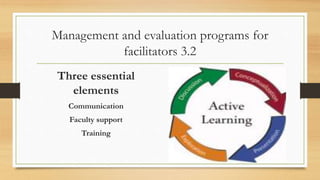
Management and evaluation programs for
facilitators 3.2
Three essential
elements
Communication
Faculty support
Training
Learning platform
3.3
LMS is “a software application that automates the administration, tracking, and
reporting of training events” (Ellis, 2009, p. 1).
• Present lectures or videos
• class discussions
• Receive assignments
• Provide assignment feedback and grades
Include at least three different technology or
media tools 3.4
• Skype
• Blogs
• Inforgraphs
• Videos
Part IV – Issues and Classroom
Management
Facilitator Training Program
Asynchronous 3 – day Module
Module 1
• 4.1 Include at least three different
technology or media tools
• 4.2 A description of the different
distance learners
• 4.3 Differences between
synchronous and asynchronous
facilitation
• 4.4 Classroom management
Include at least three different technology or
media tools 4.1
• Videos You tube
• Blogs
• Skype, teleconferencing tools
• Inforgraphs
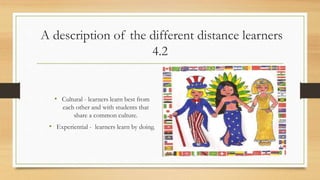
A description of the different distance learners
4.2
• Cultural - learners learn best from
each other and with students that
share a common culture.
• Experiential - learners learn by doing.
Differences between synchronous and
asynchronous facilitation skills 4.3
Asynchronous
Asynchronous learning allows students
access to classroom material, interact
with their peers, and ask questions
without the fear of being ridiculed, since
online.
(University of Phoenix )
Synchronous
Synchronous facility focuses more on
class attendance and participation in real
life time. Often used in traditional
classroom settings requiring lecturing and
quizzing strategies to assess the student’s
progress within the classroom setting.
(University of Phoenix)
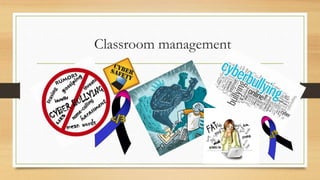
Classroom management
Classroom management issues and
resolutions4.4
Learner feedback
• text messages, e-mail, comments on
projects, and comments on
discussion
• You always need to be consistent
and in a timely manner
Challenging behaviors
• Cyber-bullying - Set behavioral ground rules
• Inappropriate posts - intervene promptly and
address the conflict directly (Kelly, 2013).
• Lack of participation or engagement - Support
and engage
• Misunderstanding - Acknowledge the human
tendency to stereotype and request students to
attempt to resist this tendency. (Kelly, 2013)
References
• (Ellis, R. (2009). Field guide to learning management systems. Learning Circuits (ASTD),
retrieved from http://www.astd.org/~/media/Files/Publications/LMS_fieldguide_20091
• Haythornthwaite, C., & Andrews, R. (2011). E-learning theory and practice. Los Angeles, CA:
Sage.
• Kelly, R. (March 19, 2013). Managing controversy in the online classroom, Faculty Focus,
retrieved from http://www.facultyfocus.com/articles/online-education/managing-
controversy-in-the-online-classroom/
• Palloff, R. M., & Pratt, K. (2011). The excellent online instructor: Strategies for professional
development. San Francisco, CA: Jossey-Bass.
• University of Phoenix - AET 531 - Technology for the Adult Learner

Asynchronous 3 module model

  • 1.
    New Teacher Training AmandaEdwards May 18, 2015 CUR/532
  • 2.
    Welcome • Today weare going to start on our 3 day training on what do you do now that you have a teaching job. • We will go over issues such as • Attendance procedure • Money and receipt • Entering grades • Just to name a few • So sit back and lets get the show on the road.
  • 3.
    Hi my nameis Amanda Edwards • I will be with you over the next 3 days to help you better understand your role in your new teaching environment here at Edwards Elementary. • I am here for you so if you need to reach me at any time feel free to contact me @ Cell Phone : (334) 557-8467 Call or text Email : edwardselementary@mysite.com
  • 4.
    Part 1 –Vital Information in the Facilitator Training Facilitator Training Program Asynchronous 3 – day Module Module 1 • 1.1 Training audience • 1.2 Program Goals • 1.3 Program Objectives • 1.4 Summative Assessment
  • 5.
    Training Program Audience 1.1 •Our audience today are the newest hires of Edwards Elementary • These hires range from new collage graduates • Master degree holders • Teachers with years of experience current skill sets will vary current experiences 0 to 20 years level of current knowledge Varies
  • 6.
    Training program goals 1.2 •The key skills to be successful are: • Communication • Productivity • Creativity • Guidance
  • 7.
    1.2 Training ProgramGoals 1. Proficient with using online tools 2. Maintain online presence 3. Encourage an online learning community 4. Acquire engagement techniques
  • 8.
    Training Program Objectives 1.3 Module1 By the end of this training you should be able to create a lesson plan on your smart board, turn in attendance, and explain money issues. With guidance and online tools the student will be able to successfully complete all assignments and navigate though the training program. The learners should be able to demonstrate constructive and positive feedback.
  • 9.
    Summative assessment oftrainee learning 1.4 Assessments Multiple choice Discussion boards Short answer Assignments Presentation Matching
  • 10.
    Summative Assessment 1.4 • Atthe end of each module students will be able to complete an in formal assessment graded with a rubric. • By the end of the training course the trainees will be able to understand all objectives through an assignment • New knowledge will be shone through discussion boards, multiple choice questions, and assignments
  • 11.
    Part II –Facilitator Skills and Instructional Materials Facilitator Training Program Asynchronous 3 – day Module Module 1 • 2.1 Training Materials • 2.2 Describe the phases of development • 2.3 Identify the theories of distance learning. • 2.4 Describe the theories for engaging distance learners.
  • 12.
    Training Materials 2.1 Skills needed •Communication • Online assess • Microsoft office • Be a tour guide, cheerleader and coach
  • 13.
    Describe the phasesof development 2.2 Five stages • Visitor – basic starter turning in work by e mail • Novice – Have used some technology for online courses • Apprentice – New online teacher someone that has taught for one to two years • Insider – Taught more than two years and have mastered the technology required to teach online • Master – Taught for many years and feel right at home in the online classroom
  • 14.
    Identify the theoriesof distance learning. 2.3 • Framing and reframing occur throughout the process and the heart of the process, the acts of learning, are transformative in that they “transform” the existing state of knowledge into the new state that emerges from the old (Haythornthwaite & Andrews, 2011). • Because the online community is different from and interacts differently than the learning community in an in-person class, the nature of the learning itself is affected (Haythornthwaite & Andrews, 2011).
  • 15.
    Describe the theoriesfor engaging distance learners. 2.4 2.4
  • 16.
    Describe the theoriesfor engaging distance learners. 2.4 • Student-centric – responsibility lies on the students • Communal – working with others and sharing experiences • Transactional distance - attending at different times • Multi-modal – lots of different media to use One example is communication is not instant it could be days or hours before you get a response.
  • 17.
    Part III –Management and Technology Tools Facilitator Training Program Asynchronous 3 – day Module Module 2 • 3.1 Mentoring program for faculty • 3.2 Management and evaluation programs for facilitators • 3.3 Learning platform • 3.4 Include at least three different technology or media tools
  • 18.
    Mentoring program forfaculty 3.1 • Mentoring programs work in “providing visions for technology use, individualizing technology support, breaking down hierarchical structure, establishing open dialogue and collaborative relationships; providing mutual benefits for mentors and mentees; and emphasizing the creation of a learning community for those participating in the program” (Palloff & Pratt, 2011, p. 65).
  • 19.
    Mentoring program forfaculty 3.1 • How many years has he/she been in distance education? One year • How many classes have been taught successfully? Two classes • What is his/her criteria of success? 45% after course surveys The performance status of the mentor
  • 20.
    Management and evaluationprograms for facilitators 3.2 Three essential elements Communication Faculty support Training
  • 21.
    Learning platform 3.3 LMS is“a software application that automates the administration, tracking, and reporting of training events” (Ellis, 2009, p. 1). • Present lectures or videos • class discussions • Receive assignments • Provide assignment feedback and grades
  • 22.
    Include at leastthree different technology or media tools 3.4 • Skype • Blogs • Inforgraphs • Videos
  • 23.
    Part IV –Issues and Classroom Management Facilitator Training Program Asynchronous 3 – day Module Module 1 • 4.1 Include at least three different technology or media tools • 4.2 A description of the different distance learners • 4.3 Differences between synchronous and asynchronous facilitation • 4.4 Classroom management
  • 24.
    Include at leastthree different technology or media tools 4.1 • Videos You tube • Blogs • Skype, teleconferencing tools • Inforgraphs
  • 25.
    A description ofthe different distance learners 4.2 • Cultural - learners learn best from each other and with students that share a common culture. • Experiential - learners learn by doing.
  • 26.
    Differences between synchronousand asynchronous facilitation skills 4.3 Asynchronous Asynchronous learning allows students access to classroom material, interact with their peers, and ask questions without the fear of being ridiculed, since online. (University of Phoenix ) Synchronous Synchronous facility focuses more on class attendance and participation in real life time. Often used in traditional classroom settings requiring lecturing and quizzing strategies to assess the student’s progress within the classroom setting. (University of Phoenix)
  • 27.
  • 28.
    Classroom management issuesand resolutions4.4 Learner feedback • text messages, e-mail, comments on projects, and comments on discussion • You always need to be consistent and in a timely manner Challenging behaviors • Cyber-bullying - Set behavioral ground rules • Inappropriate posts - intervene promptly and address the conflict directly (Kelly, 2013). • Lack of participation or engagement - Support and engage • Misunderstanding - Acknowledge the human tendency to stereotype and request students to attempt to resist this tendency. (Kelly, 2013)
  • 29.
    References • (Ellis, R.(2009). Field guide to learning management systems. Learning Circuits (ASTD), retrieved from http://www.astd.org/~/media/Files/Publications/LMS_fieldguide_20091 • Haythornthwaite, C., & Andrews, R. (2011). E-learning theory and practice. Los Angeles, CA: Sage. • Kelly, R. (March 19, 2013). Managing controversy in the online classroom, Faculty Focus, retrieved from http://www.facultyfocus.com/articles/online-education/managing- controversy-in-the-online-classroom/ • Palloff, R. M., & Pratt, K. (2011). The excellent online instructor: Strategies for professional development. San Francisco, CA: Jossey-Bass. • University of Phoenix - AET 531 - Technology for the Adult Learner