






Basics of Instructional Design
‫د‬.‫منى‬‫يونس‬
‫أغسطس‬2020
Mona Younes
Dec 2020
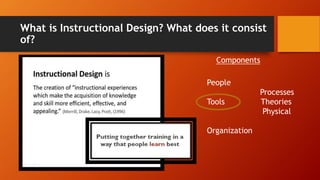
What is Instructional Design? What does it consist
of?
Components
People
Processes
Tools Theories
Physical
Organization
Please, think about…..
What are the additional things instructional designers do, to
make their training (instruction) more effective?
What are the different things (actions, tools, processes) if in
place, you would say “ WOW that was a good training, it was
meaningful, I learnt, benefited and it was constructive (i.e. it
added to my knowledge”
How to make your instructional design
more effective?
• Having a clear structure
• Providing sufficient relevant examples
• Demonstrating good facilitation skills
• Engaging participants
• Incuing practical
(applicable/reflective) activities
• Providing helpful resources (handouts,
readings, tutorials…etc.)
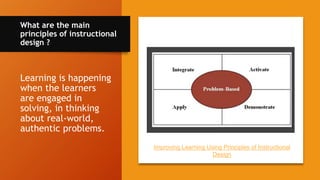
What are the main
principles of instructional
design ?
Learning is happening
when the learners
are engaged in
solving, in thinking
about real-world,
authentic problems.
Improving Learning Using Principles of Instructional
Design
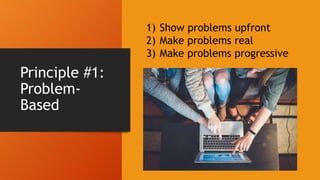
Principle #1:
Problem-
Based
1) Show problems upfront
2) Make problems real
3) Make problems progressive
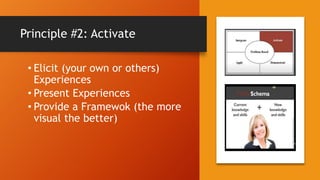
Principle #2: Activate
• Elicit (your own or others)
Experiences
• Present Experiences
• Provide a Framewok (the more
visual the better)
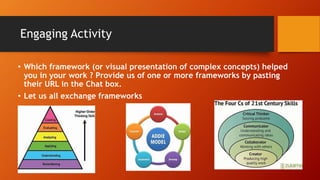
Engaging Activity
• Which framework (or visual presentation of complex concepts) helped
you in your work ? Provide us of one or more frameworks by pasting
their URL in the Chat box.
• Let us all exchange frameworks
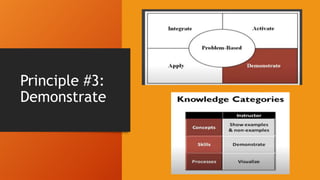
Principle #3:
Demonstrate
Principle
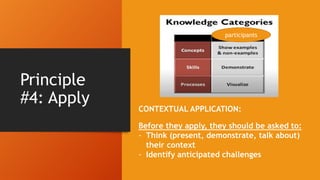
#4: Apply
participants
Principle
#4: Apply
participants
CONTEXTUAL APPLICATION:
Before they apply, they should be asked to:
- Think (present, demonstrate, talk about)
their context
- Identify anticipated challenges
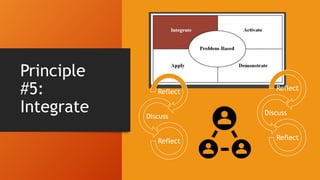
Principle
#5:
Integrate
Reflect
Discuss
Reflect
Reflect
Discuss
Reflect
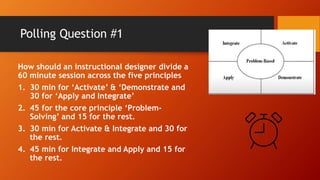
Polling Question #1
How should an instructional designer divide a
60 minute session across the five principles
1. 30 min for ‘Activate’ & ‘Demonstrate and
30 for ‘Apply and Integrate’
2. 45 for the core principle ‘Problem-
Solving’ and 15 for the rest.
3. 30 min for Activate & Integrate and 30 for
the rest.
4. 45 min for Integrate and Apply and 15 for
the rest.
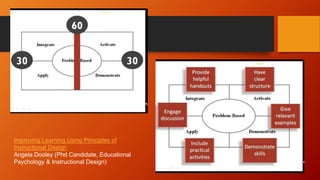
Improving Learning Using Principles of
Instructional Design
Angela Dooley (Phd Candidate, Educational
Psychology & Instructional Design)
Why to integrate ‘Reflection’?
“We don’t learn from experience. We learn from reflecting
on experience.”
John Dewey
The learning process consists of as “Input-Process-Output-
Reflect” because without reflection, it is very difficult to
have genuine learning.
Dr. Bobb Darnell
Polling Questions #2
QUESTION1:
Which of the following is the best reflective activity in an online
meeting?(Select all that apply)
1- Asking participants to discuss an issue or problem.
2- Asking them to provide examples from their context (reflect on their
situation)
3- Asking them to write a reflective journal about the concept at hand.
4- Provide a space for knowledge exchange.
5- All of the above
How to integrate reflective activities?
ONE RULE ONLY
Make reflection, and peer-to-peer idea, knowledge, experience exchange
an integral part of your online communication.
JUST PLAN FOR IT….
Examples:
What if questions?
Did you ever….?
What would you do…?
Remember:
It is not about the
content.
It is not about you.
IT IS ABOUT THEM
How to integrate reflective activities?
My Courses:
• Introduction
• Exploration (Concept
Demonstration)
• Application
• Reflection
• Extension
Reflect
Integrate
Apply
What are “Contextual Instructional Design
Strategies”?
Contextualized instructional strategies link the learning of
basic skills with academic or occupational content by focusing
directly on concrete applications in a specific career context
that is of interest to students.
Please, provide an example of …..
two example of NON-CONTEXTUALIZED ID, e.g. a lesson,
lecture, training or presentation that you could totally
NOT RELATE TO.
Recall your feelings during and after that experience.
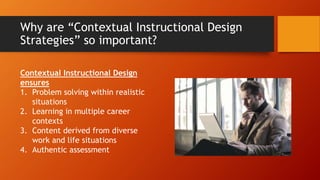
Why are “Contextual Instructional Design
Strategies” so important?
Contextual Instructional Design
ensures
1. Problem solving within realistic
situations
2. Learning in multiple career
contexts
3. Content derived from diverse
work and life situations
4. Authentic assessment
How to apply “Contextual Instructional
Design Strategies”?
An ID using this approach is not simply teaching, training or presenting some
required content, but rather
asking the question of how, or in what context, will the participants
apply the content, AND designing authentic activities that mimic an
occupational application.
Polling Question #3
Which part of this presentation did you find most useful?
(Select all that apply)
1- The five principles of Instructional Design
2- The concept of Reflection
3- The concept of Contextualization
Polling Question #4
What would you anticipate to be the most difficult to
implement? (Select all that apply)
1- Problem-solving activities
2- Activating, demonstrating new concepts
3- Applying new knowledge & skills
4- Integrating new knowledge & skills
5- Designing reflective activities
6- Integrating contextualized activities
Question Time
Dr. Mona Younes
monayegy@yahoo.com
Skype: monayegy1964
Website: monayounes.com
Blog: monayounes.blogspot.com

Basics of instructional design

  • 1.
    Basics of InstructionalDesign ‫د‬.‫منى‬‫يونس‬ ‫أغسطس‬2020 Mona Younes Dec 2020
  • 2.
    What is InstructionalDesign? What does it consist of? Components People Processes Tools Theories Physical Organization
  • 3.
    Please, think about….. Whatare the additional things instructional designers do, to make their training (instruction) more effective? What are the different things (actions, tools, processes) if in place, you would say “ WOW that was a good training, it was meaningful, I learnt, benefited and it was constructive (i.e. it added to my knowledge”
  • 4.
    How to makeyour instructional design more effective? • Having a clear structure • Providing sufficient relevant examples • Demonstrating good facilitation skills • Engaging participants • Incuing practical (applicable/reflective) activities • Providing helpful resources (handouts, readings, tutorials…etc.)
  • 5.
    What are themain principles of instructional design ? Learning is happening when the learners are engaged in solving, in thinking about real-world, authentic problems. Improving Learning Using Principles of Instructional Design
  • 6.
    Principle #1: Problem- Based 1) Showproblems upfront 2) Make problems real 3) Make problems progressive
  • 7.
    Principle #2: Activate •Elicit (your own or others) Experiences • Present Experiences • Provide a Framewok (the more visual the better)
  • 8.
    Engaging Activity • Whichframework (or visual presentation of complex concepts) helped you in your work ? Provide us of one or more frameworks by pasting their URL in the Chat box. • Let us all exchange frameworks
  • 9.
  • 10.
  • 11.
    Principle #4: Apply participants CONTEXTUAL APPLICATION: Beforethey apply, they should be asked to: - Think (present, demonstrate, talk about) their context - Identify anticipated challenges
  • 12.
  • 13.
    Polling Question #1 Howshould an instructional designer divide a 60 minute session across the five principles 1. 30 min for ‘Activate’ & ‘Demonstrate and 30 for ‘Apply and Integrate’ 2. 45 for the core principle ‘Problem- Solving’ and 15 for the rest. 3. 30 min for Activate & Integrate and 30 for the rest. 4. 45 min for Integrate and Apply and 15 for the rest.
  • 14.
    Improving Learning UsingPrinciples of Instructional Design Angela Dooley (Phd Candidate, Educational Psychology & Instructional Design)
  • 15.
    Why to integrate‘Reflection’? “We don’t learn from experience. We learn from reflecting on experience.” John Dewey The learning process consists of as “Input-Process-Output- Reflect” because without reflection, it is very difficult to have genuine learning. Dr. Bobb Darnell
  • 16.
    Polling Questions #2 QUESTION1: Whichof the following is the best reflective activity in an online meeting?(Select all that apply) 1- Asking participants to discuss an issue or problem. 2- Asking them to provide examples from their context (reflect on their situation) 3- Asking them to write a reflective journal about the concept at hand. 4- Provide a space for knowledge exchange. 5- All of the above
  • 17.
    How to integratereflective activities? ONE RULE ONLY Make reflection, and peer-to-peer idea, knowledge, experience exchange an integral part of your online communication. JUST PLAN FOR IT…. Examples: What if questions? Did you ever….? What would you do…? Remember: It is not about the content. It is not about you. IT IS ABOUT THEM
  • 18.
    How to integratereflective activities? My Courses: • Introduction • Exploration (Concept Demonstration) • Application • Reflection • Extension Reflect Integrate Apply
  • 19.
    What are “ContextualInstructional Design Strategies”? Contextualized instructional strategies link the learning of basic skills with academic or occupational content by focusing directly on concrete applications in a specific career context that is of interest to students.
  • 20.
    Please, provide anexample of ….. two example of NON-CONTEXTUALIZED ID, e.g. a lesson, lecture, training or presentation that you could totally NOT RELATE TO. Recall your feelings during and after that experience.
  • 21.
    Why are “ContextualInstructional Design Strategies” so important? Contextual Instructional Design ensures 1. Problem solving within realistic situations 2. Learning in multiple career contexts 3. Content derived from diverse work and life situations 4. Authentic assessment
  • 22.
    How to apply“Contextual Instructional Design Strategies”? An ID using this approach is not simply teaching, training or presenting some required content, but rather asking the question of how, or in what context, will the participants apply the content, AND designing authentic activities that mimic an occupational application.
  • 23.
    Polling Question #3 Whichpart of this presentation did you find most useful? (Select all that apply) 1- The five principles of Instructional Design 2- The concept of Reflection 3- The concept of Contextualization
  • 24.
    Polling Question #4 Whatwould you anticipate to be the most difficult to implement? (Select all that apply) 1- Problem-solving activities 2- Activating, demonstrating new concepts 3- Applying new knowledge & skills 4- Integrating new knowledge & skills 5- Designing reflective activities 6- Integrating contextualized activities
  • 25.
    Question Time Dr. MonaYounes monayegy@yahoo.com Skype: monayegy1964 Website: monayounes.com Blog: monayounes.blogspot.com