WORD
SCRAMBLE
TARHE
_ _ _ _ _
EARTH
SHPEREMOTA
_ _ _ _ _ _ _ _ _ _
ATMOSPHERE
LKEINC
_ _ _ _ _ _
NICKEL
PETAL TCEONTICS
P_ _ _ _ T _ _ _ _ _ _ _ _
PLATE TECTONICS
CVONCEITON
_ _ _ _ _ _ _ _ _ _
CONVECTION
RECO
_ _ _ _
CORE
TRUSC
_ _ _ _ _
CRUST
PETAL MMEVOTENT
P_ _ _ _ M_ _ _ _ _ _ _
PLATE MOVEMENT
TYPES OF
FAULTS
Fault
terminology:-
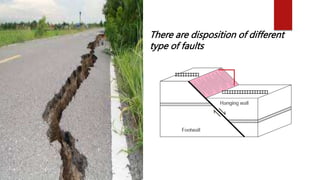
There are disposition of different
type of faults
Causes of faults
• Faults are essentially the shear or sliding failures, resulting
from tensional, compressional, rotational stress acting the
crustal rock masses.
• They may be due to the shrinking Earth; or due to the
convection currents produced in the Earth.
• The faults occur in volcanic areas and mountain zones, they
are found in plains and plateaus.
 Epicenter
Point directly above the focus
 Hypocenter Focus
The source from which the energy is released radiating from all
directions.
 Earthquake
It is a shaking of the surface of the earth resulting from a
sudde release of energy in the lithosphere.
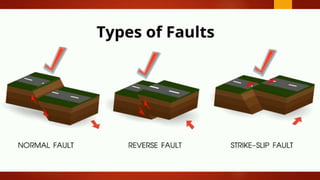
3 TYPES OF FAULTS
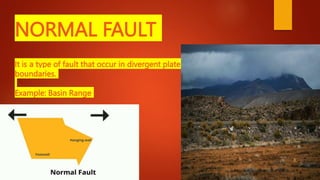
NORMAL FAULT
It is a type of fault that occur in divergent plate
boundaries.
Example: Basin Range
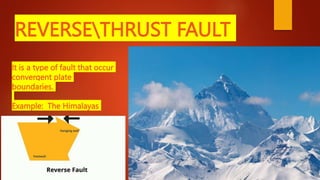
REVERSETHRUST FAULT
It is a type of fault that occur
convergent plate
boundaries.
Example: The Himalayas
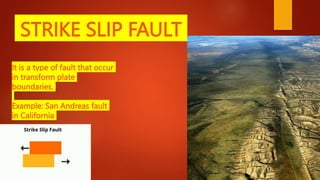
STRIKE SLIP FAULT
It is a type of fault that occur
in transform plate
boundaries.
Example: San Andreas fault
in California
ACTIVITY:
 Activity No. 2
 WHERE DOES AN EARTHQUAKE START?
 After performing this activity, you should be able to:
 Differentiate focus and epicenter; and
 Demonstrate how movement along faults affect the surroundings.
 Materials Needed:
 fault model scissors paste
 Procedure:
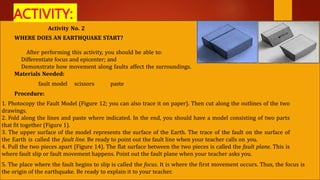
1. Photocopy the Fault Model (Figure 12; you can also trace it on paper). Then cut along the outlines of the two
drawings.
2. Fold along the lines and paste where indicated. In the end, you should have a model consisting of two parts
that fit together (Figure 1).
3. The upper surface of the model represents the surface of the Earth. The trace of the fault on the surface of
the Earth is called the fault line. Be ready to point out the fault line when your teacher calls on you.
4. Pull the two pieces apart (Figure 14). The flat surface between the two pieces is called the fault plane. This is
where fault slip or fault movement happens. Point out the fault plane when your teacher asks you.
5. The place where the fault begins to slip is called the focus. It is where the first movement occurs. Thus, the focus is
the origin of the earthquake. Be ready to explain it to your teacher.

FAULTS and ITS TYPES - ENHANCED SCIENCE GRADE 7 (4TH QUARTER)

  • 2.
  • 3.
    TARHE _ _ __ _ EARTH
  • 4.
    SHPEREMOTA _ _ __ _ _ _ _ _ _ ATMOSPHERE
  • 5.
    LKEINC _ _ __ _ _ NICKEL
  • 7.
    PETAL TCEONTICS P_ __ _ T _ _ _ _ _ _ _ _ PLATE TECTONICS
  • 8.
    CVONCEITON _ _ __ _ _ _ _ _ _ CONVECTION
  • 9.
    RECO _ _ __ CORE
  • 12.
    TRUSC _ _ __ _ CRUST
  • 13.
    PETAL MMEVOTENT P_ __ _ M_ _ _ _ _ _ _ PLATE MOVEMENT
  • 14.
  • 15.
  • 16.
    Causes of faults •Faults are essentially the shear or sliding failures, resulting from tensional, compressional, rotational stress acting the crustal rock masses. • They may be due to the shrinking Earth; or due to the convection currents produced in the Earth. • The faults occur in volcanic areas and mountain zones, they are found in plains and plateaus.
  • 17.
     Epicenter Point directlyabove the focus  Hypocenter Focus The source from which the energy is released radiating from all directions.  Earthquake It is a shaking of the surface of the earth resulting from a sudde release of energy in the lithosphere.
  • 18.
    3 TYPES OFFAULTS
  • 19.
    NORMAL FAULT It isa type of fault that occur in divergent plate boundaries. Example: Basin Range
  • 20.
    REVERSETHRUST FAULT It isa type of fault that occur convergent plate boundaries. Example: The Himalayas
  • 21.
    STRIKE SLIP FAULT Itis a type of fault that occur in transform plate boundaries. Example: San Andreas fault in California
  • 23.
    ACTIVITY:  Activity No.2  WHERE DOES AN EARTHQUAKE START?  After performing this activity, you should be able to:  Differentiate focus and epicenter; and  Demonstrate how movement along faults affect the surroundings.  Materials Needed:  fault model scissors paste  Procedure: 1. Photocopy the Fault Model (Figure 12; you can also trace it on paper). Then cut along the outlines of the two drawings. 2. Fold along the lines and paste where indicated. In the end, you should have a model consisting of two parts that fit together (Figure 1). 3. The upper surface of the model represents the surface of the Earth. The trace of the fault on the surface of the Earth is called the fault line. Be ready to point out the fault line when your teacher calls on you. 4. Pull the two pieces apart (Figure 14). The flat surface between the two pieces is called the fault plane. This is where fault slip or fault movement happens. Point out the fault plane when your teacher asks you. 5. The place where the fault begins to slip is called the focus. It is where the first movement occurs. Thus, the focus is the origin of the earthquake. Be ready to explain it to your teacher.

Editor's Notes

  • #17 Hanging wall movement determines the geometric classification of faulting Footwall-
  • #21 Ex. Basin range
  • #22 Ex. THE HIMALAYAS
  • #23 Ex. THE SAN ANDREAS FAULT