Superficial andSuperficial and
CutaneousCutaneous
MycosesMycoses
Name- MadhubalanName- Madhubalan
Group-27Group-27
Superficial MycosesSuperficial Mycoses
• Limited to the outermost layer of the
skin
• 4 Infections
– 1.Pityriasis versicolor
– 2.Tinea nigra
– 3. Black piedra
– 4. White piedra
SuperficialSuperficial
• Do not elicit immune response
• No discomfort
• Cosmetic problems
• Limited to stratum corneum
Pityriasis VersicolorPityriasis Versicolor
• Malassezia furfur (Pityrosporum
orbiculare)
• Lipophilic yeast like organism
• Rich in sebaceous glands
• Media is supplemented with fatty
acids
• Exist in budding yeast,occasionally
hyphal
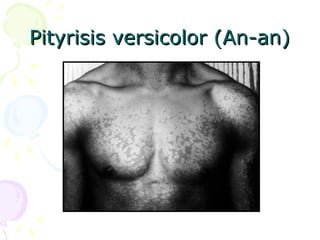
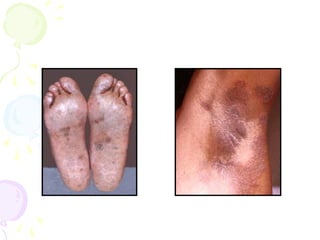
Pityrisis versicolor (An-an)Pityrisis versicolor (An-an)
PityriasisPityriasis
• Lesions are found in torso, arms
and abdomen
• Scale very easily chalky
appearance
• Rarely, papular or grow like
folliculitis
PityriasisPityriasis
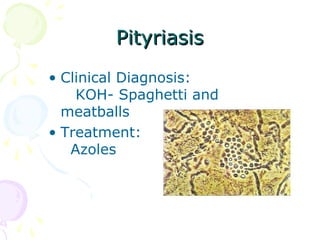
• Clinical Diagnosis:
KOH- Spaghetti and
meatballs
• Treatment:
Azoles
Tinea NigraTinea Nigra
• Exophiala werneckii
• Produce melanin black or brown
color
• Grows as yeast  Older hyphae with
mycelia and conidia
Tinea nigraTinea nigra
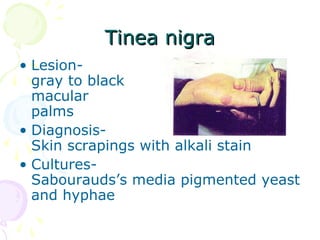
• Lesion-
gray to black
macular
palms
• Diagnosis-
Skin scrapings with alkali stain
• Cultures-
Sabourauds’s media pigmented yeast
and hyphae
Black PiedraBlack Piedra
• Piedraia hortae- exist in teleomorphic
state
• Cultures – asexual state
- older cultures
teleomorphic (asci ,which contain
spindle shaped ascospores)
Black piedraBlack piedra
• Clinical feature:
presence of hard nodules found
along the infected hair shaft
• Nodules contain asci
White PiedraWhite Piedra
• Trichosporon beigelii
• Grows in media without
cyclohexamide
• Cultures are pasty and white
developed deep radiating furrows
and become yellow and creamy
White PiedraWhite Piedra
• Microscopic examination
septate hypae that develops into
arthroconidia
• Hair- soft ,pasty,cream colored
growth
TreatmentTreatment
• Skin
removal of the organism by:
1.Selenium sulfide
2.Thiosulfate
3.Salicylic acid
4.Hyposulfite
inhibition of ergosterol by:
1.miconazole
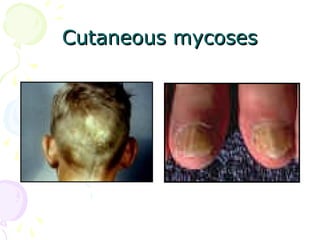
Cutaneous mycosesCutaneous mycoses
• Skin
• Hair
• Nails
• Evoke cellular immune response
• Dermatophytes
• Clinical
manifestationsringworm or
tinea
Cutaneous mycosesCutaneous mycoses
• Etiology
Microsporum
Trichophyton
Epidermophyton
Cutaneous mycosesCutaneous mycoses
• Classifications:
Anatomic location
Tinea pedis Tinea capitis
Tinea corporis
Tinea cruris
Ecologic location
Geophilic
Zoophilic
Anthrophilic
Cutaneous mycosesCutaneous mycoses
• Keratophilic – use keratin as
subject to live ( parasites)
• Keratinases- invade only
keratinized layers
• 2 basic types of dermatophytic infection:
1. The acute or inflammatory type of
infection, which is associated with CMI to
the fungus, generally heals spontaneously
or responds nicely to treatment.
2. The chronic or non-inflammatory types
of infection, which is associated with a
failure to express CMI to the fungus at the
site of infection, is relapsing and responds
poorly to treatment.
Cutaneous mycosesCutaneous mycoses
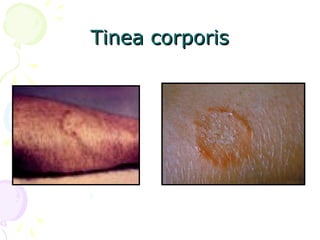
Tinea corporisTinea corporis
Cutaneous mycosesCutaneous mycoses
• THE IDENTIFICATION REACTION(ID)
• Patients infected with a dermatophyte may show
a lesion, often on the hands, from which no fungi
can be recovered or demonstrated.
• It is believed that these lesions, which often occur
on the dominant hand (i.e. right-handed or left-
handed), are secondary to immunological
sensitization to a primary (and often unnoticed)
infection located somewhere else (e.g. feet).
• These secondary lesions will not respond to
topical treatment but will resolve if the primary
infection is successfully treated.
Cutaneous mycosesCutaneous mycoses
• Laboratory diagnosis:
scrapings from clinical specimens
• Hair – endothrix (spores inside the hair
shaft)
-ectothrix
- exception: T.schoenleinii
Disease-favus-waxy
mass of hyphal elements (scutulum)
microscopic –degenerated hyphal
elements
Cutaneous mycosesCutaneous mycoses
• Cultures
• Selective media – containing
cycloheximide and
chlorampenicolincubate at 25 C.
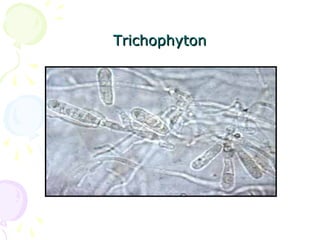
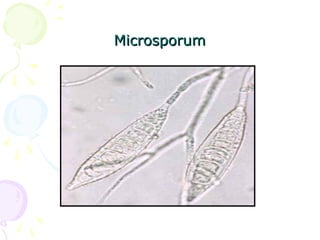
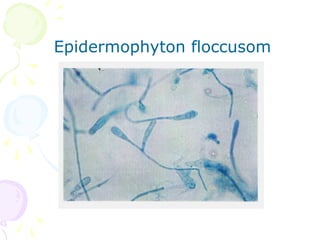
• Identification based on the conidia
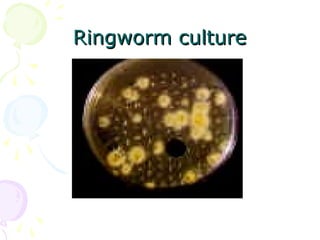
Ringworm cultureRingworm culture
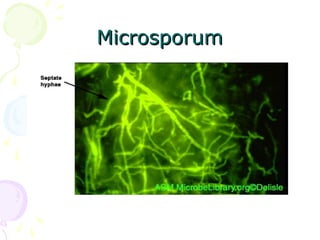
MicrosporumMicrosporum
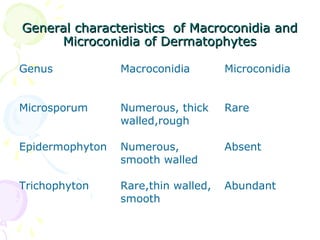
General characteristics of Macroconidia andGeneral characteristics of Macroconidia and
Microconidia of DermatophytesMicroconidia of Dermatophytes
Genus Macroconidia Microconidia
Microsporum Numerous, thick
walled,rough
Rare
Epidermophyton Numerous,
smooth walled
Absent
Trichophyton Rare,thin walled,
smooth
Abundant
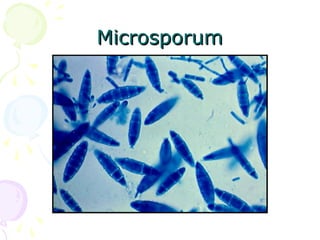
MicrosporumMicrosporum
TrichophytonTrichophyton
MicrosporumMicrosporum
Epidermophyton floccusom
DiagnosisDiagnosis
• Diagnosis is based upon:
1. Anatomical site infected
2. Type of lesion
3. Examination with a Woods lamp (366
A°)
4. Examination of KOH-treated skin
scales from the infected area
5. Culture of the organism (not too
important)
Differential diagnosisDifferential diagnosis
• In a differential diagnosis you must consider:
1. Leprosy
2. Secondary syphilis
3. Pityriasis rosea
4. Psoriasis
5. Nummular eczema
6. Lichen planus
7. Alopecia areata
8. Trichotillomania
9. Dyshidrosis
10. Contact dermatitis.
TreatmentTreatment
• Skin – azoles,inhibits cytochrome
450 dependent enzyme systems at
the demethylation step from
lanosterol to ergosterol
• Hair- Griseofulvin, oral , affects
microtubular system
Thank you very
much!!!

Dermatology(mycoses)