To
streptococcal scarlet fever
presenter: abdullah raafic
Streptococcal scarlet fever
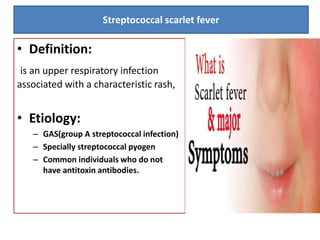
• Definition:
is an upper respiratory infection
associated with a characteristic rash,
• Etiology:
– GAS(group A streptococcal infection)
– Specially streptococcal pyogen
– Common individuals who do not
have antitoxin antibodies.
• Epidemiology:
common in children aged 4-8years .
common in late winter & early spring ,
Has 3-6 day Incubation period.
males & females are affected equally.
• Transmission:
– Highly contagious
– streptococcal bacteria can spread from
person to person by breathing in
airborne droplet from infected person’s
coughing or sneezing .
– contact of sharing contaminated
Streptococcal scarlet fever
• Pathogenesis :
 Adherence to epithelial cells.
Erythrogenic toxin,
Streptokinase
Hyaluronidase
M protein
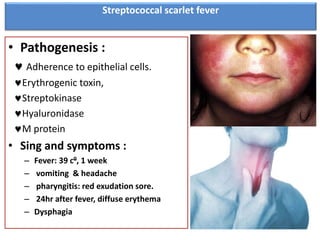
• Sing and symptoms :
– Fever: 39 c0, 1 week
– vomiting & headache
– pharyngitis: red exudation sore.
– 24hr after fever, diffuse erythema
– Dysphagia
Streptococcal scarlet fever
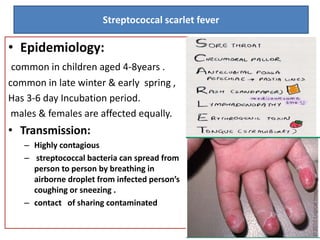
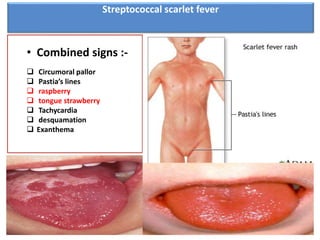
• Combined signs :-
 Circumoral pallor
 Pastia’s lines
 raspberry
 tongue strawberry
 Tachycardia
 desquamation
 Exanthema
Streptococcal scarlet fever
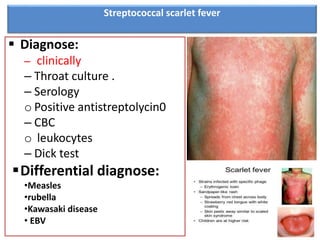
 Diagnose:
– clinically
– Throat culture .
– Serology
o Positive antistreptolycin0
– CBC
o leukocytes
– Dick test
Differential diagnose:
•Measles
•rubella
•Kawasaki disease
• EBV
Streptococcal scarlet fever
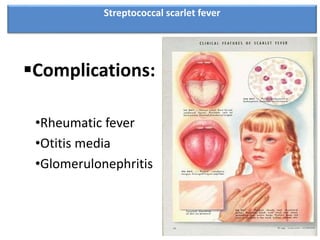
Complications:
•Rheumatic fever
•Otitis media
•Glomerulonephritis
Streptococcal scarlet fever
Scarlet fever
Scarlet fever

Scarlet fever

Editor's Notes