




Depression
What we are expected to know…
1.4 Ensure that you appropriately explore both physical and psychological symptoms, family,
social and cultural factors, in an integrated manner
1.5 Understand the place of instruments in case-finding for depression (the Whooley
questions) and for assessment of severity of symptoms (GAD-72 for anxiety and PHQ-93 for
depression)
1.6 Understand the primary care management of patients with common mental health
problems
1.9 Understand SIGN or NICE guidelines
1.13 Understand how to access local health and social care organisations, both statutory and
third sector, that are an essential component of managing people with mental health problems
2.5 Understand the range of psychological therapies available
3.2 Understand the difference between depression and emotional distress, and avoid
medicalising distress
In Plain English…
Understand significance of Whooley Screening questions
Explore the Biological, Psychological, Social, Family and Cultural factors
(BPS tool to assess severity)
Put into practice different appropriate management options for
depression
Those with co-morbid chronic illness have subtle screening &
management differences
Understand the place of different “talking therapies”
Be aware of/utilize different local agencies that can offer support
Be able to distinguish emotional distress from depression
Video
Symptoms of depression
“Medical” things that supported her
“Social” things that supported her
Empowering the patient to help/educate themselves
Screening for Depression
'During the last month have you often been bothered by feeling
down, depressed or hopeless?'
'During the last month have you been bothered by having little
interest or pleasure in doing things?
NB: If patient has a chronic health problem must also ask about
Worthlessness, Concentration and Thoughts of death
If any positive responses then go on to take a formal
assessment/history
Whooley
Questions
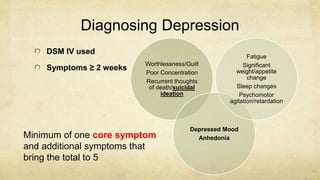
Diagnosing Depression
DSM IV used
Symptoms ≥ 2 weeks
Worthlessness/Guilt
Poor Concentration
Recurrent thoughts
of death/suicidal
ideation
Depressed Mood
Anhedonia
Fatigue
Significant
weight/appetite
change
Sleep changes
Psychomotor
agitation/retardation
Minimum of one core symptom
and additional symptoms that
bring the total to 5
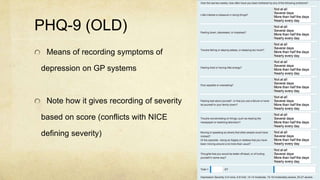
PHQ-9 (OLD)
Means of recording symptoms of
depression on GP systems
Note how it gives recording of severity
based on score (conflicts with NICE
defining severity)
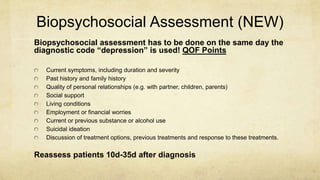
Biopsychosocial Assessment (NEW)
Biopsychosocial assessment has to be done on the same day the
diagnostic code “depression” is used! QOF Points
Current symptoms, including duration and severity
Past history and family history
Quality of personal relationships (e.g. with partner, children, parents)
Social support
Living conditions
Employment or financial worries
Current or previous substance or alcohol use
Suicidal ideation
Discussion of treatment options, previous treatments and response to these treatments.
Reassess patients 10d-35d after diagnosis
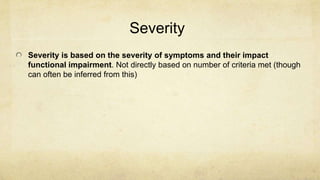
Severity
Severity is based on the severity of symptoms and their impact
functional impairment. Not directly based on number of criteria met (though
can often be inferred from this)
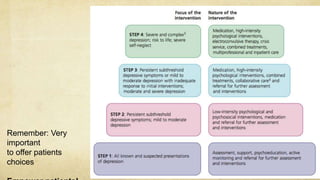
Management
Remember: Very
important
to offer patients
choices
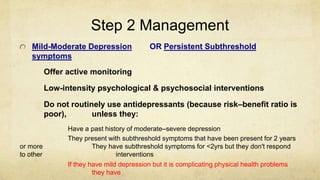
Step 2 Management
Mild-Moderate Depression OR Persistent Subthreshold
symptoms
Offer active monitoring
Low-intensity psychological & psychosocial interventions
Do not routinely use antidepressants (because risk–benefit ratio is
poor), unless they:
.
Have a past history of moderate–severe depression
They present with subthreshold symptoms that have been present for 2 years
or more They have subthreshold symptoms for <2yrs but they don't respond
to other interventions
If they have mild depression but it is complicating physical health problems
they have
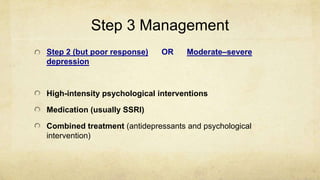
Step 3 Management
Step 2 (but poor response) OR Moderate–severe
depression
High-intensity psychological interventions
Medication (usually SSRI)
Combined treatment (antidepressants and psychological
intervention)
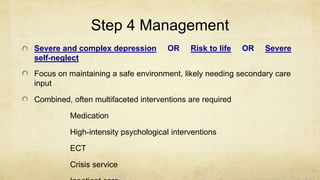
Step 4 Management
Severe and complex depression OR Risk to life OR Severe
self-neglect
Focus on maintaining a safe environment, likely needing secondary care
input
Combined, often multifaceted interventions are required
Medication
High-intensity psychological interventions
ECT
Crisis service
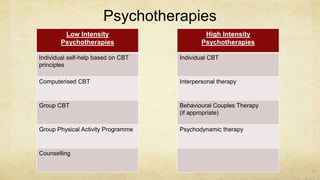
Low Intensity
Psychotherapies
Individual self-help based on CBT
principles
Computerised CBT
Group CBT
Group Physical Activity Programme
Counselling
High Intensity
Psychotherapies
Individual CBT
Interpersonal therapy
Behavioural Couples Therapy
(if appropriate)
Psychodynamic therapy
Psychotherapies
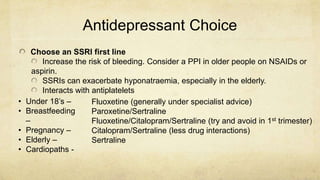
Antidepressant Choice
Choose an SSRI first line
Increase the risk of bleeding. Consider a PPI in older people on NSAIDs or
aspirin.
SSRIs can exacerbate hyponatraemia, especially in the elderly.
Interacts with antiplatelets
• Under 18’s –
• Breastfeeding
–
• Pregnancy –
• Elderly –
• Cardiopaths -
Fluoxetine (generally under specialist advice)
Paroxetine/Sertraline
Fluoxetine/Citalopram/Sertraline (try and avoid in 1st trimester)
Citalopram/Sertraline (less drug interactions)
Sertraline
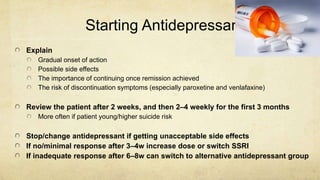
Starting Antidepressants
Explain
Gradual onset of action
Possible side effects
The importance of continuing once remission achieved
The risk of discontinuation symptoms (especially paroxetine and venlafaxine)
Review the patient after 2 weeks, and then 2–4 weekly for the first 3 months
More often if patient young/higher suicide risk
Stop/change antidepressant if getting unacceptable side effects
If no/minimal response after 3–4w increase dose or switch SSRI
If inadequate response after 6–8w can switch to alternative antidepressant group
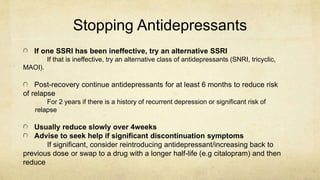
Stopping Antidepressants
If one SSRI has been ineffective, try an alternative SSRI
If that is ineffective, try an alternative class of antidepressants (SNRI, tricyclic,
MAOI).
Post-recovery continue antidepressants for at least 6 months to reduce risk
of relapse
For 2 years if there is a history of recurrent depression or significant risk of
relapse
Usually reduce slowly over 4weeks
Advise to seek help if significant discontinuation symptoms
If significant, consider reintroducing antidepressant/increasing back to
previous dose or swap to a drug with a longer half-life (e.g citalopram) and then
reduce
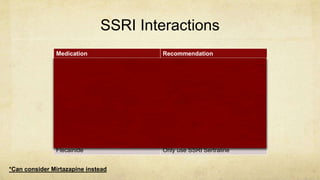
SSRI Interactions
Medication Recommendation
NSAIDS/Aspirin *Avoid this combo, but if are using
together then also prescribe PPI
Warfarin/Heparin *Avoid SSRI use
Triptans *Avoid SSRI use
Tamoxifen Avoid Paroxetine and Fluoxetine
(inhibit CYP2D6 and therefore pro-
drug conversion of tamoxifen)
MAO-B Inhibitors (e.g Selegiline) *Avoid SSRI use
Clozapine/theophylline/Methadone Only use SSRI Sertraline or
Citalopram
Flecainide Only use SSRI Sertraline
*Can consider Mirtazapine instead
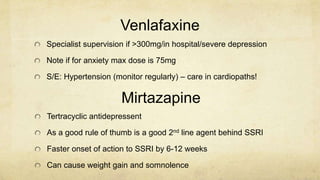
Venlafaxine
Specialist supervision if >300mg/in hospital/severe depression
Note if for anxiety max dose is 75mg
S/E: Hypertension (monitor regularly) – care in cardiopaths!
Mirtazapine
Tertracyclic antidepressent
As a good rule of thumb is a good 2nd line agent behind SSRI
Faster onset of action to SSRI by 6-12 weeks
Can cause weight gain and somnolence
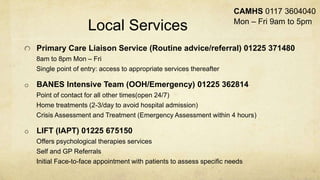
Local Services
Primary Care Liaison Service (Routine advice/referral) 01225 371480
8am to 8pm Mon – Fri
Single point of entry: access to appropriate services thereafter
o BANES Intensive Team (OOH/Emergency) 01225 362814
Point of contact for all other times(open 24/7)
Home treatments (2-3/day to avoid hospital admission)
Crisis Assessment and Treatment (Emergency Assessment within 4 hours)
o LIFT (IAPT) 01225 675150
Offers psychological therapies services
Self and GP Referrals
Initial Face-to-face appointment with patients to assess specific needs
CAMHS 0117 3604040
Mon – Fri 9am to 5pm
Support Groups (for Mental Health)
Mindfulness group
Central Bath Music Therapy Group
Kitchen Creations
Sing and Smile
Writing Space
5-a-side indoor football
The HOPE guide
BANES for contact details and descriptions
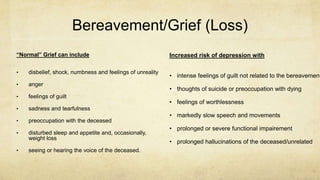
Bereavement/Grief (Loss)
“Normal” Grief can include
• disbelief, shock, numbness and feelings of unreality
• anger
• feelings of guilt
• sadness and tearfulness
• preoccupation with the deceased
• disturbed sleep and appetite and, occasionally,
weight loss
• seeing or hearing the voice of the deceased.
Increased risk of depression with
• intense feelings of guilt not related to the bereavement
• thoughts of suicide or preoccupation with dying
• feelings of worthlessness
• markedly slow speech and movements
• prolonged or severe functional impairement
• prolonged hallucinations of the deceased/unrelated
Key Points
Whooley Screening questions for diabetes (+ extra if chronic illnesses)
Diagnosis = at least 1 core and 4 other symptoms
Formal BioPsychoSocial Assessment
Stepwise management of treatment
SSRI choice and commonest risks/side effects/interactions
As well as “medical” and “talking” therapies, think of the “social” therapies
also
Know about the local organisations that can help
Don’t over-medicalise simple emotional distress (therapeutic consultation
and active monitoring may be enough)
Online Resource
http://nsashley.coursesites.com
Online downloadable powerpoint presentation
NICE guidance
Post tutorial quiz
Other depression resources (eg HOPE Guide)
Thanks!
Any Questions?

Depression in Primary Care

  • 1.
  • 2.
    What we areexpected to know… 1.4 Ensure that you appropriately explore both physical and psychological symptoms, family, social and cultural factors, in an integrated manner 1.5 Understand the place of instruments in case-finding for depression (the Whooley questions) and for assessment of severity of symptoms (GAD-72 for anxiety and PHQ-93 for depression) 1.6 Understand the primary care management of patients with common mental health problems 1.9 Understand SIGN or NICE guidelines 1.13 Understand how to access local health and social care organisations, both statutory and third sector, that are an essential component of managing people with mental health problems 2.5 Understand the range of psychological therapies available 3.2 Understand the difference between depression and emotional distress, and avoid medicalising distress
  • 3.
    In Plain English… Understandsignificance of Whooley Screening questions Explore the Biological, Psychological, Social, Family and Cultural factors (BPS tool to assess severity) Put into practice different appropriate management options for depression Those with co-morbid chronic illness have subtle screening & management differences Understand the place of different “talking therapies” Be aware of/utilize different local agencies that can offer support Be able to distinguish emotional distress from depression
  • 4.
    Video Symptoms of depression “Medical”things that supported her “Social” things that supported her Empowering the patient to help/educate themselves
  • 5.
    Screening for Depression 'Duringthe last month have you often been bothered by feeling down, depressed or hopeless?' 'During the last month have you been bothered by having little interest or pleasure in doing things? NB: If patient has a chronic health problem must also ask about Worthlessness, Concentration and Thoughts of death If any positive responses then go on to take a formal assessment/history Whooley Questions
  • 6.
    Diagnosing Depression DSM IVused Symptoms ≥ 2 weeks Worthlessness/Guilt Poor Concentration Recurrent thoughts of death/suicidal ideation Depressed Mood Anhedonia Fatigue Significant weight/appetite change Sleep changes Psychomotor agitation/retardation Minimum of one core symptom and additional symptoms that bring the total to 5
  • 7.
    PHQ-9 (OLD) Means ofrecording symptoms of depression on GP systems Note how it gives recording of severity based on score (conflicts with NICE defining severity)
  • 8.
    Biopsychosocial Assessment (NEW) Biopsychosocialassessment has to be done on the same day the diagnostic code “depression” is used! QOF Points Current symptoms, including duration and severity Past history and family history Quality of personal relationships (e.g. with partner, children, parents) Social support Living conditions Employment or financial worries Current or previous substance or alcohol use Suicidal ideation Discussion of treatment options, previous treatments and response to these treatments. Reassess patients 10d-35d after diagnosis
  • 9.
    Severity Severity is basedon the severity of symptoms and their impact functional impairment. Not directly based on number of criteria met (though can often be inferred from this)
  • 10.
  • 11.
    Step 2 Management Mild-ModerateDepression OR Persistent Subthreshold symptoms Offer active monitoring Low-intensity psychological & psychosocial interventions Do not routinely use antidepressants (because risk–benefit ratio is poor), unless they: . Have a past history of moderate–severe depression They present with subthreshold symptoms that have been present for 2 years or more They have subthreshold symptoms for <2yrs but they don't respond to other interventions If they have mild depression but it is complicating physical health problems they have
  • 13.
    Step 3 Management Step2 (but poor response) OR Moderate–severe depression High-intensity psychological interventions Medication (usually SSRI) Combined treatment (antidepressants and psychological intervention)
  • 14.
    Step 4 Management Severeand complex depression OR Risk to life OR Severe self-neglect Focus on maintaining a safe environment, likely needing secondary care input Combined, often multifaceted interventions are required Medication High-intensity psychological interventions ECT Crisis service
  • 15.
    Low Intensity Psychotherapies Individual self-helpbased on CBT principles Computerised CBT Group CBT Group Physical Activity Programme Counselling High Intensity Psychotherapies Individual CBT Interpersonal therapy Behavioural Couples Therapy (if appropriate) Psychodynamic therapy Psychotherapies
  • 16.
    Antidepressant Choice Choose anSSRI first line Increase the risk of bleeding. Consider a PPI in older people on NSAIDs or aspirin. SSRIs can exacerbate hyponatraemia, especially in the elderly. Interacts with antiplatelets • Under 18’s – • Breastfeeding – • Pregnancy – • Elderly – • Cardiopaths - Fluoxetine (generally under specialist advice) Paroxetine/Sertraline Fluoxetine/Citalopram/Sertraline (try and avoid in 1st trimester) Citalopram/Sertraline (less drug interactions) Sertraline
  • 17.
    Starting Antidepressants Explain Gradual onsetof action Possible side effects The importance of continuing once remission achieved The risk of discontinuation symptoms (especially paroxetine and venlafaxine) Review the patient after 2 weeks, and then 2–4 weekly for the first 3 months More often if patient young/higher suicide risk Stop/change antidepressant if getting unacceptable side effects If no/minimal response after 3–4w increase dose or switch SSRI If inadequate response after 6–8w can switch to alternative antidepressant group
  • 18.
    Stopping Antidepressants If oneSSRI has been ineffective, try an alternative SSRI If that is ineffective, try an alternative class of antidepressants (SNRI, tricyclic, MAOI). Post-recovery continue antidepressants for at least 6 months to reduce risk of relapse For 2 years if there is a history of recurrent depression or significant risk of relapse Usually reduce slowly over 4weeks Advise to seek help if significant discontinuation symptoms If significant, consider reintroducing antidepressant/increasing back to previous dose or swap to a drug with a longer half-life (e.g citalopram) and then reduce
  • 19.
    SSRI Interactions Medication Recommendation NSAIDS/Aspirin*Avoid this combo, but if are using together then also prescribe PPI Warfarin/Heparin *Avoid SSRI use Triptans *Avoid SSRI use Tamoxifen Avoid Paroxetine and Fluoxetine (inhibit CYP2D6 and therefore pro- drug conversion of tamoxifen) MAO-B Inhibitors (e.g Selegiline) *Avoid SSRI use Clozapine/theophylline/Methadone Only use SSRI Sertraline or Citalopram Flecainide Only use SSRI Sertraline *Can consider Mirtazapine instead
  • 20.
    Venlafaxine Specialist supervision if>300mg/in hospital/severe depression Note if for anxiety max dose is 75mg S/E: Hypertension (monitor regularly) – care in cardiopaths! Mirtazapine Tertracyclic antidepressent As a good rule of thumb is a good 2nd line agent behind SSRI Faster onset of action to SSRI by 6-12 weeks Can cause weight gain and somnolence
  • 21.
    Local Services Primary CareLiaison Service (Routine advice/referral) 01225 371480 8am to 8pm Mon – Fri Single point of entry: access to appropriate services thereafter o BANES Intensive Team (OOH/Emergency) 01225 362814 Point of contact for all other times(open 24/7) Home treatments (2-3/day to avoid hospital admission) Crisis Assessment and Treatment (Emergency Assessment within 4 hours) o LIFT (IAPT) 01225 675150 Offers psychological therapies services Self and GP Referrals Initial Face-to-face appointment with patients to assess specific needs CAMHS 0117 3604040 Mon – Fri 9am to 5pm
  • 22.
    Support Groups (forMental Health) Mindfulness group Central Bath Music Therapy Group Kitchen Creations Sing and Smile Writing Space 5-a-side indoor football The HOPE guide BANES for contact details and descriptions
  • 23.
    Bereavement/Grief (Loss) “Normal” Griefcan include • disbelief, shock, numbness and feelings of unreality • anger • feelings of guilt • sadness and tearfulness • preoccupation with the deceased • disturbed sleep and appetite and, occasionally, weight loss • seeing or hearing the voice of the deceased. Increased risk of depression with • intense feelings of guilt not related to the bereavement • thoughts of suicide or preoccupation with dying • feelings of worthlessness • markedly slow speech and movements • prolonged or severe functional impairement • prolonged hallucinations of the deceased/unrelated
  • 24.
    Key Points Whooley Screeningquestions for diabetes (+ extra if chronic illnesses) Diagnosis = at least 1 core and 4 other symptoms Formal BioPsychoSocial Assessment Stepwise management of treatment SSRI choice and commonest risks/side effects/interactions As well as “medical” and “talking” therapies, think of the “social” therapies also Know about the local organisations that can help Don’t over-medicalise simple emotional distress (therapeutic consultation and active monitoring may be enough)
  • 25.
    Online Resource http://nsashley.coursesites.com Online downloadablepowerpoint presentation NICE guidance Post tutorial quiz Other depression resources (eg HOPE Guide)
  • 26.

Editor's Notes

  • #9 Thinks its used as it helps orchastrate a much more comprehensive management plan and triggers clinicans to think more about the patient as a whole Can be quite time consuming though!
  • #23 EXERCISE FRIENDSHIP GROUPS/social help ADDRESS UNEMPLOYMENT (RCGP) Citizens advice beaurae Job centre