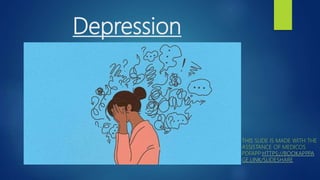
Depression
THIS SLIDE IS MADE WITH THE
ASSISTANCE OF MEDICOS
PDFAPP:HTTPS://BOOKAPP
.PA
GE.LINK/SLIDESHARE
Background
Pathophysiology
 The monoamine theory of depression is that it results from a central
deficit in the monoamine neurotransmitters serotonin (5-HT) and
norepinephrine.
 Other reported physiological features include ↑cortisol and a blunted
TSH response.
 However, there is no widely accepted and definitively proven biological
model of depression.
Epidemiology
 Time course: for most it is an episodic illness, but for other it follows a
more chronic course.
 Incidence: 5% annual risk, 20% lifetime risk.
Presentation
DSM and NICE criteria
These are based on DSM-4, though DSM-5 does not significantly differ.
Major depressive disorder is ≥2 weeks of low mood and/or anhedonia,
and at least 4 symptoms out of:
 ↓Energy or fatigue.
 ↓Concentration
 ↓Weight/appetite.
 Disturbed sleep, which commonly includes early waking. Diurnal pattern
to symptoms also seen, with symptoms often worse in the morning.
DSM and NICE criteria
 Slowing of thought and movements (psychomotor slowing)
or agitation.
 Ideas of worthlessness or guilt.
 Recurrent thoughts of death or suicide.
 All but the last 2 are considered 'biological' symptoms.
DSM and NICE criteria
Severity:
 Subthreshold depression:
 Mild depression: just the 5 minimum symptoms required for
diagnosis, and minimal functional impairment.
 Moderate depression: anything between mild and severe.
 Severe depression: most symptoms are present, with
significant functional impairment.
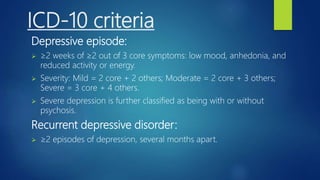
ICD-10 criteria
Depressive episode:
 ≥2 weeks of ≥2 out of 3 core symptoms: low mood, anhedonia, and
reduced activity or energy.
 Severity: Mild = 2 core + 2 others; Moderate = 2 core + 3 others;
Severe = 3 core + 4 others.
 Severe depression is further classified as being with or without
psychosis.
Recurrent depressive disorder:
 ≥2 episodes of depression, several months apart.
Other features
Psychosis in depression:
 Auditory hallucinations.
 Delusions of guilt, inadequacy, or disease/hypochondriasis. Sometimes
collectively referred to as nihilistic delusions, though this term is usually
reserved for the belief that they or the world don't exist.
 Cotard delusion is the belief they are dead.
In older people:
 Less sadness and more apathy.
 More somatic complaints including constipation, pseudodementia
(subjective memory loss), and psychomotor agitation or slowing.
Other features
In older people:
 May be triggered by underlying disease such as Parkinson's.
 Higher suicide rates.
 Slower response to treatment.
Co-morbid disorders:
 Anxiety disorder: lifetime risk >50% in those with depression. Treat
whichever is most prominent first.
 Depression is often secondary to a chronic physical illness.
History
NICE screening questions:
 "In the past month, have you felt down, depressed, or
hopeless?"
 "In the past month, have you had little interest or pleasure
in doing things?"
 If either positive, proceed to a full history and MSE.
History of presenting complaint
1. Core symptoms:
 Low mood, energy, and enjoyment.
2. Other key features, SAFER:
 Sleep
 Appetite
 Focus
 Effects on work, hobbies, and relationships (functional
impairment).
History of presenting complaint
2. Other key features, SAFER:
 Risk assessment.
3. Co-morbid features (now or in the past):
 Highs (mania), suggesting bipolar.
 Psychosis
 Anxiety
Risk factors
AFFECT:
 Anxious/neurotic personality.
 Female. True at any point, but especially after pregnancy.
 Family history.
 Major life Events: bereavement, job loss, or relationship ending. Risk is
highest in the following months. In DSM-4, patients meeting
depression criteria shortly after bereavement were excluded from
diagnosis. In DSM-5, however, this exclusion has been removed,
allowing clinician judgement over whether symptoms exceed those
characteristic of bereavement and represent a newly-triggered major
depressive episode.
 Chronic physical illness.
 Traumatic childhood e.g. parental loss, sexual abuse.
DDx: Low mood
 Major depressive episode/disorder.
 Dysthymia (aka persistent depressive disorder): chronic
low mood which doesn't meet criteria for depression.
 Schizoaffective disorder: schizophrenia and mood
disorder occur during the same episode.
 Premenstrual dysphoric disorder: disabling symptoms of
low mood preceding menstruation.
 Organic disease: hypothyroidism, Cushing's, Addison's,
dementia, Parkinson's.
 Drugs: alcohol, corticosteroids, propranolol, interferon.
Investigations
 Diagnostic instruments (optional):
 Patient Health Questionnaire (PHQ-9). Can be used for
diagnosis and ongoing monitoring.
 Geriatric Depression Scale.
 Edinburgh Postnatal Depression Scale: can be used 4-6
weeks post-delivery.
 Hospital Anxiety and Depression (HAD) scale.
Investigations
 Investigate organic causes or co-morbidities based
on clinical judgement:
 Bloods: TSH (hypothyroidism) and FBC (anaemia)
are commonly done. Also: U+E, LFT, glucose, CRP
.
 Drug screen, usually urinary.
 Neuroimaging: MRI, CT.
Management
Psychological
As a first step, offer psychoeducation and continued
monitoring and support to all.
Low-intensity psychological intervention:
 Suitable for mild-to-moderate depression.
 3 months duration.
 Options: CBT-based self help with 6-8 brief individual
sessions, computerised CBT, or structured group physical
activity.
Psychological
Low-intensity psychological intervention:
 Group-based CBT if other options declined.
 For those with a physical illness, peer support from those
with the same illness is another option.
 2 weeks watchful waiting is another option if the clinician or
patient doesn't think psychological therapy is appropriate.
Psychological
High-intensity psychological intervention:
 Suitable for moderate-to-severe depression, along with an
antidepressant.
 20 sessions of individual CBT or interpersonal therapy over 4
months. Psychodynamic therapy if both declined.
Long-term relapse prevention:
 Individual CBT: offer if at high risk of relapse i.e. previous relapse
despite antidepressants or don't want to continue
antidepressants.
 Mindfulness-based CBT: offer if well but have had ≥3 previous
episodes.
Biological: antidepressants
Indications:
 Recommended for moderate-to-severe depression,
ideally in combination with psychological therapy.
 Not first line for mild-to-moderate depression, where
there is little evidence of efficacy, unless it has run a
chronic course or psychological therapy has failed.
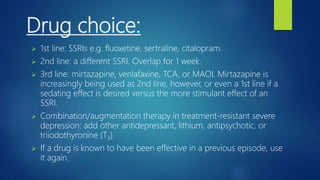
Drug choice:
 1st line: SSRIs e.g. fluoxetine, sertraline, citalopram.
 2nd line: a different SSRI. Overlap for 1 week.
 3rd line: mirtazapine, venlafaxine, TCA, or MAOI. Mirtazapine is
increasingly being used as 2nd line, however, or even a 1st line if a
sedating effect is desired versus the more stimulant effect of an
SSRI.
 Combination/augmentation therapy in treatment-resistant severe
depression: add other antidepressant, lithium, antipsychotic, or
triiodothyronine (T3).
 If a drug is known to have been effective in a previous episode, use
it again.
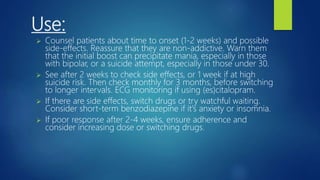
Use:
 Counsel patients about time to onset (1-2 weeks) and possible
side-effects. Reassure that they are non-addictive. Warn them
that the initial boost can precipitate mania, especially in those
with bipolar, or a suicide attempt, especially in those under 30.
 See after 2 weeks to check side effects, or 1 week if at high
suicide risk. Then check monthly for 3 months, before switching
to longer intervals. ECG monitoring if using (es)citalopram.
 If there are side effects, switch drugs or try watchful waiting.
Consider short-term benzodiazepine if it's anxiety or insomnia.
 If poor response after 2-4 weeks, ensure adherence and
consider increasing dose or switching drugs.
Use:
 If found to be beneficial, continue for ≥6 months after a first
episode. Continue for ≥2 years after 2nd episode or if there is
high risk of relapse.
 Anti-depressants are not usually recommended in pregnancy, but
do a risk-benefit analysis. In general SSRIs are OK, especially in the
2nd and 3rd trimester.
Stopping:
 Gradually reduce dose over 4 weeks.
 Discontinuation symptoms are usually mild and last around 1
week. If severe, consider re-introducing and weaning more
gradually.
Other options:
 ECT can be used in treatment-resistant or life-threatening severe
depression.
 Do not prescribe or advise St John's wort due to uncertainty over its
dosing and duration, and warn about its interaction with other drugs.
Social
 Think about the family: assess needs of carers, and ensure that children
of patients are not at risk of neglect.
 Refer for suitable help if the illness has effect on work and income.
 Give advice on sleep hygiene: regular bed times, minimize stimulation
before bed.
Complications and prognosis
 Mild episodes usually last 1-6 months, and severe episodes 6-12 months.
 Episodes usually recur: 50% after 1 episode, 70% after 2 episodes, 80%
after 3 episodes. Higher risk if residual symptoms after the episode.
Typical number is 4 over lifetime, with tendency for time gap between
them to narrow as they get older.
 5-10% die from suicide.
 Poor prognostic factors: socially isolated, psychiatric co-morbidities.
Psychological therapy
Cognitive behavioural
therapy (CBT)
 The essence of CBT is to identify harmful thoughts (cognitions)
and behaviours, and to replace them with helpful ones. This often
involves setting goals and doing 'homework' between sessions.
 In contrast to traditional psychotherapy, which focuses on
traumatic experiences in an individual's past, CBT focuses on the
harmful thoughts and behaviours which the individual
is currently experiencing. In some respects, it reverses the notion
that harmful thoughts and behaviour result from psychological
distress, and instead suggests that the thoughts and behaviours –
at least in part – cause the distress.
Cognitive behavioural
therapy (CBT)
 There are many variants of CBT, with some putting more
emphasis on thoughts, and others more on behaviours.
 It can be delivered to individuals or groups, and come directly
from a therapist or come in the form of written or computer
materials with guidance.
 'Low intensity' therapy typically involves less than 10 hours of
therapist treatment per patient. For this reason, group sessions,
self-help, and computerised CBT are all considered low-
intensity.
 'High intensity' therapy typically involves 10-20, hour-long,
weekly sessions.
Other psychological therapies
 Interpersonal therapy: based on the idea that distress is rooted in
our response to difficult relationships. It aims to improve people's
ability to engage more healthily with others.
 Psychodynamic therapy: based in part on traditional psychoanalysis.
Involves exploring emotions, beliefs, and early-life experiences, to
uncover and remedy the unconscious thoughts which lie behind
mental illness.
Selective serotonin reuptake
inhibitors (SSRIs)
Drugs
 Fluoxetine. Often first line, though has more interactions
than some others. The only SSRI licensed in children.
 Citalopram and its enantiomer escitalopram.
 Sertraline. Often the most cost effective.
 Paroxetine
Mechanism
 Increase the availability of 5-HT at the synaptic cleft.
 1-2 weeks to take effect.
Side effects
 GI: nausea, vomiting, dyspepsia, GI bleeds (rare),
constipation, diarrhoea.
 Anxiety, agitation, shakiness.
 Headache, dizziness.
 Sexual dysfunction: ↓libido, anorgasmia, erectile dysfunction.
 ↓Na+ in elderly (SIADH).
 (Es)citalopram causes long QT. ECG monitoring if using.
 Paroxetine is not usually recommended as it can lead to
withdrawal syndrome on cessation: nausea, headache, light-
headedness, nightmares, insomnia.
Advantages
 Less sedating than other antidepressants, as there are no
anti-histamine effects.
 No anticholinergic side effects.
Interactions
 NSAIDS, ASA, or warfarin: avoid if possible due to GI
bleeding risk, but give a PPI if using. Mirtazapine is a suitable
alternative to an SSRI in those who need to be on these
drugs.
 MAOIs: risk of serotonin syndrome.
 In general, citalopram and sertraline have fewer interactions,
so are a good choice for those with physical health problems
requiring multiple medications.
Serotonin and noradrenaline
reuptake inhibitors (SNRIs)
Drugs
 Venlafaxine. Noradrenaline effects only come at higher doses, so
effectively just an SSRI at doses of
 Duloxetine
Side effects
 Toxic in overdose.
 ↑BP at high doses. Monitor every 3-6 months.
 Sexual dysfunction.
 Withdrawal effects with venlafaxine: nausea, headache, light-
headedness, nightmares, insomnia.
Advantages
 Non-sedating.
Noradrenergic and specific serotonergic
antidepressants (NaSSAs)
Drugs
 Mirtazapine.
Side effects
Anti-histamine effects:
 ↑Weight
 Sedation, which is worse at lower doses.
Advantages
 Relatively safe in overdose.
Tricyclic antidepressants (TCAs)
Drugs
 Amitriptyline
 Lofepramine
 Clomipramine
 Dosulepin
Mechanism
 Blocks noradrenaline and 5-HT reuptake, like SNRIs.
 2 weeks to take effect.
Contraindications
 Cardiac patients due to cardiotoxicity, especially
dosulepin. Lofepramine is safest.
 Elderly or young.
 Suicidal patients, as easy to overdose on
(see tricyclic antidepressant (TCA) poisoning).
 Drivers, as it causes sedation.
Side effects
 These have rapid onset, unlike the therapeutic
effect.
 Anticholinergic effects: dry mouth, blurred vision,
constipation, retention, cognitive impairment.
 Antihistamine effects: sedation, ↑weight.
 Postural ↓BP
.
 ↓Na+ in elderly (SIADH).
Monoamine oxidase inhibitors
(MAOIs)
Drugs
 Phenelzine
 Tranylcypromine
 Moclobemide is a reversible MAOI.
Mechanism
 Increases the availability of monoamines – serotonin,
noradrenaline – by preventing their breakdown.
Side effects
 Hypertensive crisis, especially if they eat dietary
tyramines e.g. cheese, alcohol.
 Serotonin syndrome if taken with SSRIs: fever,
confusion, tremor, clonus, hyperreflexia,
hypertensive crisis. Management: cool them and
stop drug.
 Moclobemide has fewer side effects.
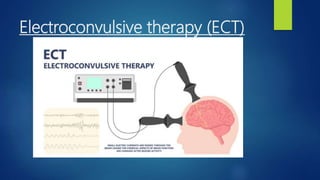
Electroconvulsive therapy (ECT)
Indications
 Severe depression i.e. depression with psychosis, severe suicidality,
or severe psychomotor symptoms causing severe self-neglect.
 Treatment-resistant mania.
 Catatonic schizophrenia.
Procedure
 Electrical current applied externally to the head to induce a
seizure.
 Performed under general anaesthesia.
 Bilateral ECT is more effective than unilateral ECT, but causes
more cognitive impairment.
Side effects
 These usually don't last beyond 6 weeks.
 Memory loss.
 Headache
 Myalgia
 Risks of anaesthesia.
Consent
 As with any treatment, informed consent should be
obtained.
 If informed consent is not possible, ECT can be given
provided it doesn't contradict an advanced directive. In an
emergency, however, an advanced directive may be
overridden.
THANK YOU
Thank you for visiting this slide. Keep supporting
Medicos PDF. Medical students can download any
books from Medicos PDF website as well as we can
upload our own slides for free. Visit website
from:https://bookapp.page.link/slideshare

Depression

  • 1.
    Depression THIS SLIDE ISMADE WITH THE ASSISTANCE OF MEDICOS PDFAPP:HTTPS://BOOKAPP .PA GE.LINK/SLIDESHARE
  • 2.
    Background Pathophysiology  The monoaminetheory of depression is that it results from a central deficit in the monoamine neurotransmitters serotonin (5-HT) and norepinephrine.  Other reported physiological features include ↑cortisol and a blunted TSH response.  However, there is no widely accepted and definitively proven biological model of depression. Epidemiology  Time course: for most it is an episodic illness, but for other it follows a more chronic course.  Incidence: 5% annual risk, 20% lifetime risk.
  • 3.
    Presentation DSM and NICEcriteria These are based on DSM-4, though DSM-5 does not significantly differ. Major depressive disorder is ≥2 weeks of low mood and/or anhedonia, and at least 4 symptoms out of:  ↓Energy or fatigue.  ↓Concentration  ↓Weight/appetite.  Disturbed sleep, which commonly includes early waking. Diurnal pattern to symptoms also seen, with symptoms often worse in the morning.
  • 4.
    DSM and NICEcriteria  Slowing of thought and movements (psychomotor slowing) or agitation.  Ideas of worthlessness or guilt.  Recurrent thoughts of death or suicide.  All but the last 2 are considered 'biological' symptoms.
  • 5.
    DSM and NICEcriteria Severity:  Subthreshold depression:  Mild depression: just the 5 minimum symptoms required for diagnosis, and minimal functional impairment.  Moderate depression: anything between mild and severe.  Severe depression: most symptoms are present, with significant functional impairment.
  • 6.
    ICD-10 criteria Depressive episode: ≥2 weeks of ≥2 out of 3 core symptoms: low mood, anhedonia, and reduced activity or energy.  Severity: Mild = 2 core + 2 others; Moderate = 2 core + 3 others; Severe = 3 core + 4 others.  Severe depression is further classified as being with or without psychosis. Recurrent depressive disorder:  ≥2 episodes of depression, several months apart.
  • 7.
    Other features Psychosis indepression:  Auditory hallucinations.  Delusions of guilt, inadequacy, or disease/hypochondriasis. Sometimes collectively referred to as nihilistic delusions, though this term is usually reserved for the belief that they or the world don't exist.  Cotard delusion is the belief they are dead. In older people:  Less sadness and more apathy.  More somatic complaints including constipation, pseudodementia (subjective memory loss), and psychomotor agitation or slowing.
  • 8.
    Other features In olderpeople:  May be triggered by underlying disease such as Parkinson's.  Higher suicide rates.  Slower response to treatment. Co-morbid disorders:  Anxiety disorder: lifetime risk >50% in those with depression. Treat whichever is most prominent first.  Depression is often secondary to a chronic physical illness.
  • 9.
    History NICE screening questions: "In the past month, have you felt down, depressed, or hopeless?"  "In the past month, have you had little interest or pleasure in doing things?"  If either positive, proceed to a full history and MSE.
  • 10.
    History of presentingcomplaint 1. Core symptoms:  Low mood, energy, and enjoyment. 2. Other key features, SAFER:  Sleep  Appetite  Focus  Effects on work, hobbies, and relationships (functional impairment).
  • 11.
    History of presentingcomplaint 2. Other key features, SAFER:  Risk assessment. 3. Co-morbid features (now or in the past):  Highs (mania), suggesting bipolar.  Psychosis  Anxiety
  • 12.
    Risk factors AFFECT:  Anxious/neuroticpersonality.  Female. True at any point, but especially after pregnancy.  Family history.  Major life Events: bereavement, job loss, or relationship ending. Risk is highest in the following months. In DSM-4, patients meeting depression criteria shortly after bereavement were excluded from diagnosis. In DSM-5, however, this exclusion has been removed, allowing clinician judgement over whether symptoms exceed those characteristic of bereavement and represent a newly-triggered major depressive episode.  Chronic physical illness.  Traumatic childhood e.g. parental loss, sexual abuse.
  • 13.
    DDx: Low mood Major depressive episode/disorder.  Dysthymia (aka persistent depressive disorder): chronic low mood which doesn't meet criteria for depression.  Schizoaffective disorder: schizophrenia and mood disorder occur during the same episode.  Premenstrual dysphoric disorder: disabling symptoms of low mood preceding menstruation.  Organic disease: hypothyroidism, Cushing's, Addison's, dementia, Parkinson's.  Drugs: alcohol, corticosteroids, propranolol, interferon.
  • 14.
    Investigations  Diagnostic instruments(optional):  Patient Health Questionnaire (PHQ-9). Can be used for diagnosis and ongoing monitoring.  Geriatric Depression Scale.  Edinburgh Postnatal Depression Scale: can be used 4-6 weeks post-delivery.  Hospital Anxiety and Depression (HAD) scale.
  • 15.
    Investigations  Investigate organiccauses or co-morbidities based on clinical judgement:  Bloods: TSH (hypothyroidism) and FBC (anaemia) are commonly done. Also: U+E, LFT, glucose, CRP .  Drug screen, usually urinary.  Neuroimaging: MRI, CT.
  • 16.
    Management Psychological As a firststep, offer psychoeducation and continued monitoring and support to all. Low-intensity psychological intervention:  Suitable for mild-to-moderate depression.  3 months duration.  Options: CBT-based self help with 6-8 brief individual sessions, computerised CBT, or structured group physical activity.
  • 17.
    Psychological Low-intensity psychological intervention: Group-based CBT if other options declined.  For those with a physical illness, peer support from those with the same illness is another option.  2 weeks watchful waiting is another option if the clinician or patient doesn't think psychological therapy is appropriate.
  • 18.
    Psychological High-intensity psychological intervention: Suitable for moderate-to-severe depression, along with an antidepressant.  20 sessions of individual CBT or interpersonal therapy over 4 months. Psychodynamic therapy if both declined. Long-term relapse prevention:  Individual CBT: offer if at high risk of relapse i.e. previous relapse despite antidepressants or don't want to continue antidepressants.  Mindfulness-based CBT: offer if well but have had ≥3 previous episodes.
  • 19.
    Biological: antidepressants Indications:  Recommendedfor moderate-to-severe depression, ideally in combination with psychological therapy.  Not first line for mild-to-moderate depression, where there is little evidence of efficacy, unless it has run a chronic course or psychological therapy has failed.
  • 20.
    Drug choice:  1stline: SSRIs e.g. fluoxetine, sertraline, citalopram.  2nd line: a different SSRI. Overlap for 1 week.  3rd line: mirtazapine, venlafaxine, TCA, or MAOI. Mirtazapine is increasingly being used as 2nd line, however, or even a 1st line if a sedating effect is desired versus the more stimulant effect of an SSRI.  Combination/augmentation therapy in treatment-resistant severe depression: add other antidepressant, lithium, antipsychotic, or triiodothyronine (T3).  If a drug is known to have been effective in a previous episode, use it again.
  • 21.
    Use:  Counsel patientsabout time to onset (1-2 weeks) and possible side-effects. Reassure that they are non-addictive. Warn them that the initial boost can precipitate mania, especially in those with bipolar, or a suicide attempt, especially in those under 30.  See after 2 weeks to check side effects, or 1 week if at high suicide risk. Then check monthly for 3 months, before switching to longer intervals. ECG monitoring if using (es)citalopram.  If there are side effects, switch drugs or try watchful waiting. Consider short-term benzodiazepine if it's anxiety or insomnia.  If poor response after 2-4 weeks, ensure adherence and consider increasing dose or switching drugs.
  • 22.
    Use:  If foundto be beneficial, continue for ≥6 months after a first episode. Continue for ≥2 years after 2nd episode or if there is high risk of relapse.  Anti-depressants are not usually recommended in pregnancy, but do a risk-benefit analysis. In general SSRIs are OK, especially in the 2nd and 3rd trimester. Stopping:  Gradually reduce dose over 4 weeks.  Discontinuation symptoms are usually mild and last around 1 week. If severe, consider re-introducing and weaning more gradually.
  • 23.
    Other options:  ECTcan be used in treatment-resistant or life-threatening severe depression.  Do not prescribe or advise St John's wort due to uncertainty over its dosing and duration, and warn about its interaction with other drugs. Social  Think about the family: assess needs of carers, and ensure that children of patients are not at risk of neglect.  Refer for suitable help if the illness has effect on work and income.  Give advice on sleep hygiene: regular bed times, minimize stimulation before bed.
  • 24.
    Complications and prognosis Mild episodes usually last 1-6 months, and severe episodes 6-12 months.  Episodes usually recur: 50% after 1 episode, 70% after 2 episodes, 80% after 3 episodes. Higher risk if residual symptoms after the episode. Typical number is 4 over lifetime, with tendency for time gap between them to narrow as they get older.  5-10% die from suicide.  Poor prognostic factors: socially isolated, psychiatric co-morbidities.
  • 25.
  • 26.
    Cognitive behavioural therapy (CBT) The essence of CBT is to identify harmful thoughts (cognitions) and behaviours, and to replace them with helpful ones. This often involves setting goals and doing 'homework' between sessions.  In contrast to traditional psychotherapy, which focuses on traumatic experiences in an individual's past, CBT focuses on the harmful thoughts and behaviours which the individual is currently experiencing. In some respects, it reverses the notion that harmful thoughts and behaviour result from psychological distress, and instead suggests that the thoughts and behaviours – at least in part – cause the distress.
  • 27.
    Cognitive behavioural therapy (CBT) There are many variants of CBT, with some putting more emphasis on thoughts, and others more on behaviours.  It can be delivered to individuals or groups, and come directly from a therapist or come in the form of written or computer materials with guidance.  'Low intensity' therapy typically involves less than 10 hours of therapist treatment per patient. For this reason, group sessions, self-help, and computerised CBT are all considered low- intensity.  'High intensity' therapy typically involves 10-20, hour-long, weekly sessions.
  • 28.
    Other psychological therapies Interpersonal therapy: based on the idea that distress is rooted in our response to difficult relationships. It aims to improve people's ability to engage more healthily with others.  Psychodynamic therapy: based in part on traditional psychoanalysis. Involves exploring emotions, beliefs, and early-life experiences, to uncover and remedy the unconscious thoughts which lie behind mental illness.
  • 29.
  • 30.
    Drugs  Fluoxetine. Oftenfirst line, though has more interactions than some others. The only SSRI licensed in children.  Citalopram and its enantiomer escitalopram.  Sertraline. Often the most cost effective.  Paroxetine Mechanism  Increase the availability of 5-HT at the synaptic cleft.  1-2 weeks to take effect.
  • 31.
    Side effects  GI:nausea, vomiting, dyspepsia, GI bleeds (rare), constipation, diarrhoea.  Anxiety, agitation, shakiness.  Headache, dizziness.  Sexual dysfunction: ↓libido, anorgasmia, erectile dysfunction.  ↓Na+ in elderly (SIADH).  (Es)citalopram causes long QT. ECG monitoring if using.  Paroxetine is not usually recommended as it can lead to withdrawal syndrome on cessation: nausea, headache, light- headedness, nightmares, insomnia.
  • 32.
    Advantages  Less sedatingthan other antidepressants, as there are no anti-histamine effects.  No anticholinergic side effects. Interactions  NSAIDS, ASA, or warfarin: avoid if possible due to GI bleeding risk, but give a PPI if using. Mirtazapine is a suitable alternative to an SSRI in those who need to be on these drugs.  MAOIs: risk of serotonin syndrome.  In general, citalopram and sertraline have fewer interactions, so are a good choice for those with physical health problems requiring multiple medications.
  • 33.
    Serotonin and noradrenaline reuptakeinhibitors (SNRIs) Drugs  Venlafaxine. Noradrenaline effects only come at higher doses, so effectively just an SSRI at doses of  Duloxetine Side effects  Toxic in overdose.  ↑BP at high doses. Monitor every 3-6 months.  Sexual dysfunction.  Withdrawal effects with venlafaxine: nausea, headache, light- headedness, nightmares, insomnia. Advantages  Non-sedating.
  • 34.
    Noradrenergic and specificserotonergic antidepressants (NaSSAs)
  • 35.
    Drugs  Mirtazapine. Side effects Anti-histamineeffects:  ↑Weight  Sedation, which is worse at lower doses. Advantages  Relatively safe in overdose.
  • 36.
    Tricyclic antidepressants (TCAs) Drugs Amitriptyline  Lofepramine  Clomipramine  Dosulepin Mechanism  Blocks noradrenaline and 5-HT reuptake, like SNRIs.  2 weeks to take effect.
  • 37.
    Contraindications  Cardiac patientsdue to cardiotoxicity, especially dosulepin. Lofepramine is safest.  Elderly or young.  Suicidal patients, as easy to overdose on (see tricyclic antidepressant (TCA) poisoning).  Drivers, as it causes sedation.
  • 38.
    Side effects  Thesehave rapid onset, unlike the therapeutic effect.  Anticholinergic effects: dry mouth, blurred vision, constipation, retention, cognitive impairment.  Antihistamine effects: sedation, ↑weight.  Postural ↓BP .  ↓Na+ in elderly (SIADH).
  • 39.
  • 40.
    Drugs  Phenelzine  Tranylcypromine Moclobemide is a reversible MAOI. Mechanism  Increases the availability of monoamines – serotonin, noradrenaline – by preventing their breakdown.
  • 41.
    Side effects  Hypertensivecrisis, especially if they eat dietary tyramines e.g. cheese, alcohol.  Serotonin syndrome if taken with SSRIs: fever, confusion, tremor, clonus, hyperreflexia, hypertensive crisis. Management: cool them and stop drug.  Moclobemide has fewer side effects.
  • 42.
  • 43.
    Electroconvulsive therapy (ECT) Indications Severe depression i.e. depression with psychosis, severe suicidality, or severe psychomotor symptoms causing severe self-neglect.  Treatment-resistant mania.  Catatonic schizophrenia. Procedure  Electrical current applied externally to the head to induce a seizure.  Performed under general anaesthesia.  Bilateral ECT is more effective than unilateral ECT, but causes more cognitive impairment.
  • 44.
    Side effects  Theseusually don't last beyond 6 weeks.  Memory loss.  Headache  Myalgia  Risks of anaesthesia. Consent  As with any treatment, informed consent should be obtained.  If informed consent is not possible, ECT can be given provided it doesn't contradict an advanced directive. In an emergency, however, an advanced directive may be overridden.
  • 45.
    THANK YOU Thank youfor visiting this slide. Keep supporting Medicos PDF. Medical students can download any books from Medicos PDF website as well as we can upload our own slides for free. Visit website from:https://bookapp.page.link/slideshare