Dr Pradip Mate 
(Masters In Pharmaceutical Medicine)
• Depressive disorders are common mental disorders that occur in people 
of all ages across all world regions 
• Depressive disorders are common mental disorders, occurring as early 
as 3 years of age and across all world regions 
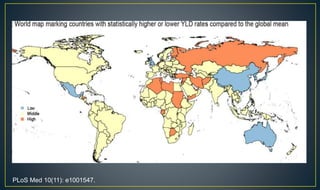
• Global Burden of Disease (GBD) 2010 identified depressive 
disorders as a leading cause of burden. 
• MDD was also a contributor of burden allocated to suicide and ischemic 
heart disease. 
• These findings emphasize the importance of including depressive 
disorders as a public-health priority and implementing cost-effective 
interventions to reduce its burden. 
PLoS Med 10(11): e1001547.
• Depressive disorders were the second leading cause of YLDs in 2010. 
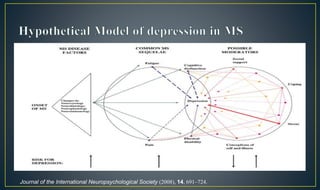
• MDD accounted for 8.2% (5.9%–10.8%) of global YLDs and dysthymia for 
1.4% (0.9%–2.0%). 
• There was more regional variation in burden for MDD than for dysthymia; 
with higher estimates in females, and adults of working age. 
• Whilst burden increased by 37.5% between 1990 and 2010 
• MDD explained 16 million suicide DALYs and almost 4 million 
ischemic heart disease DALYs. 
• This attributable burden would increase the overall burden of depressive 
disorders from 3.0% (2.2%–3.8%) to 3.8% (3.0%–4.7%) of global DALYs. 
PLoS Med 10(11): e1001547.
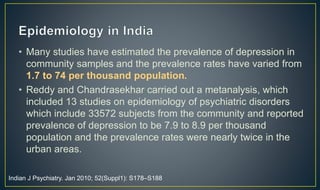
• Many studies have estimated the prevalence of depression in 
community samples and the prevalence rates have varied from 
1.7 to 74 per thousand population. 
• Reddy and Chandrasekhar carried out a metanalysis, which 
included 13 studies on epidemiology of psychiatric disorders 
which include 33572 subjects from the community and reported 
prevalence of depression to be 7.9 to 8.9 per thousand 
population and the prevalence rates were nearly twice in the 
urban areas. 
Indian J Psychiatry. Jan 2010; 52(Suppl1): S178–S188
• large population-based study from South India, which screened more 
than 24,000 subjects in Chennai using Patient Health Questionnaire 
(PHQ)-12 reported overall prevalence of depression to be 15.1% after 
adjusting for age using the 2001 census data 
• Studies done in primary care clinics/center have estimated a prevalence 
rate of 21-40.45%. 
• Studies done in hospitals have shown that 5 to 26.7% of cases attending 
the psychiatric outpatient clinics have depression 
Indian J Psychiatry. Jan 2010; 52(Suppl1): S178–S188
• Studies on the elderly population, either in the community, inpatient, 
outpatient and old age homes have shown that depression is the 
commonest mental illness in elderly subjects. 
• An epidemiological study from rural Uttar Pradesh showed that 
psychiatric morbidity in the geriatric group (43.32%) was higher than in 
the nongeriatric group (4.66%) and most common psychiatric morbidity 
was neurotic depression, followed by manic-depressive psychosis 
depression, and anxiety state. 
Indian J Psychiatry. Jan 2010; 52(Suppl1): S178–S188
Indian J Psychol Med. 2010 Jan-Jun; 32(1): 1–2.
• Depression is associated with high suicidality. 
• About 50% of individuals who have committed suicide carried a primary 
diagnosis of depression. 
• Because mood disorders underlie 50-70% of all suicides, effective 
treatment of these disorders on a national level should, in principle, 
drastically reduce this major complication of mood disorders. 
Indian J Psychol Med. 2010 Jan-Jun; 32(1): 1–2.
• Indian union health ministry estimates state that 120,000 people commit 
suicide every year in India. 
• Also over 400,000 people attempt suicide. 
• A significant percentage of people who commit suicide in India (37.8%) 
are below 30 years of age. 
• Ministry officials state that majority of those committing suicide 
suffer from depression or mental disorder 
Indian J Psychol Med. 2010 Jan-Jun; 32(1): 1–2.
• The pooled relative risk of developing IHD in those with major 
depression was 1.56 (95% CI 1.30 to 1.87). 
• Globally there were almost 4 million estimated IHD disability-adjusted 
life years (DALYs), which can be attributed to major 
depression in 2010; 3.5 million years of life lost and 250,000 
years of life lived with a disability. 
• Major depression may be responsible for approximately 
3% of global IHD DALYs warrants assessment for 
depression in patients at high risk of developing IHD or at 
risk of a repeat IHD event 
Charlson et al. BMC Medicine 2013, 11:250
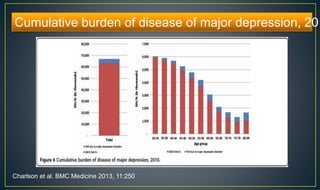
Cumulative burden of disease of major depression, 2010. 
Charlson et al. BMC Medicine 2013, 11:250
● Studies have found high rates of depression in neurological disorders. 
● Prevalence of depression after stroke range from 20% to 72% 
● In Parkinson’s disease 40-50% 
● In Multiple sclerosis 19-54% 
● In epilepsy, up to 55% 
J Neurol Neurosurg Psychiatry 2011;82:914e923.
Journal of the International Neuropsychological Society (2008), 14, 691–724.
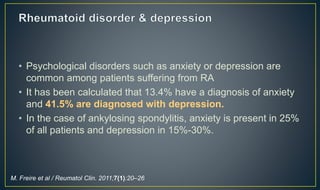
• Psychological disorders such as anxiety or depression are 
common among patients suffering from RA 
• It has been calculated that 13.4% have a diagnosis of anxiety 
and 41.5% are diagnosed with depression. 
• In the case of ankylosing spondylitis, anxiety is present in 25% 
of all patients and depression in 15%-30%. 
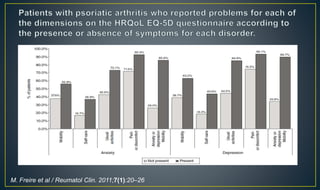
M. Freire et al / Reumatol Clin. 2011;7(1):20–26
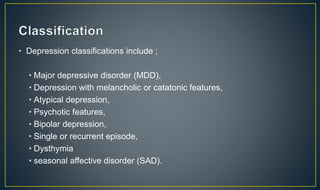
• Depression classifications include ; 
• Major depressive disorder (MDD), 
• Depression with melancholic or catatonic features, 
• Atypical depression, 
• Psychotic features, 
• Bipolar depression, 
• Single or recurrent episode, 
• Dysthymia 
• seasonal affective disorder (SAD).
• Clinical and preclinical trials suggest a disturbance in central nervous system 
serotonin (5-HT) activity as an important factor. 
• Other neurotransmitters implicated include norepinephrine (NE), dopamine (DA), 
glutamate, and brain-derived neurotrophic factor (BDNF). 
• Functional neuroimaging studies support the hypothesis that the depressed state 
is associated with decreased metabolic activity in neocortical structures and 
increased metabolic activity in limbic structures. 
• Serotonergic neurons implicated in affective disorders are found in the dorsal 
raphe nucleus, the limbic system, and the left prefrontal cortex.
• Although major depressive disorder can arise without any precipitating 
stressors, stress and interpersonal losses certainly increase risk. 
• Chronic pain, medical illness, and psychosocial stress 
• Older adults may find medical illness psychologically distressing, and these 
illnesses may lead to increased disability, decreased independence, and 
disruption of social networks. 
• Chronic aversive symptoms such as pain associated with chronic medical 
illness may disrupt sleep and other biorhythms leading to depression
• Impaired social supports 
• Caregiver burden 
• Loneliness 
• Bereavement 
• Negative life events
• In addition to older age and male sex, risk factors for suicide include 
the following : 
• Diagnosis of major depression 
• Previous history of suicide attempts 
• Depressive symptoms with agitation or distress 
• Burden of medical disease and the presence of a current serious medical condition 
• Recent stressful life events, especially family discord 
• Lack of social support 
• Being widowed or divorced 
• Unexplained weight loss 
• High levels of anxiety 
• Lack of a reason not to commit suicide 
• Presence of a specific plan that can be carried out 
• Rehearsal of the plan
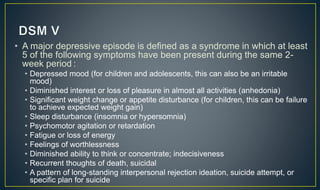
• A major depressive episode is defined as a syndrome in which at least 
5 of the following symptoms have been present during the same 2- 
week period : 
• Depressed mood (for children and adolescents, this can also be an irritable 
mood) 
• Diminished interest or loss of pleasure in almost all activities (anhedonia) 
• Significant weight change or appetite disturbance (for children, this can be failure 
to achieve expected weight gain) 
• Sleep disturbance (insomnia or hypersomnia) 
• Psychomotor agitation or retardation 
• Fatigue or loss of energy 
• Feelings of worthlessness 
• Diminished ability to think or concentrate; indecisiveness 
• Recurrent thoughts of death, suicidal 
• A pattern of long-standing interpersonal rejection ideation, suicide attempt, or 
specific plan for suicide
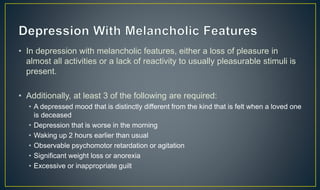
• In depression with melancholic features, either a loss of pleasure in 
almost all activities or a lack of reactivity to usually pleasurable stimuli is 
present. 
• Additionally, at least 3 of the following are required: 
• A depressed mood that is distinctly different from the kind that is felt when a loved one 
is deceased 
• Depression that is worse in the morning 
• Waking up 2 hours earlier than usual 
• Observable psychomotor retardation or agitation 
• Significant weight loss or anorexia 
• Excessive or inappropriate guilt
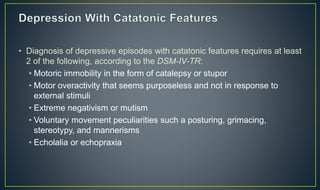
• Diagnosis of depressive episodes with catatonic features requires at least 
2 of the following, according to the DSM-IV-TR: 
• Motoric immobility in the form of catalepsy or stupor 
• Motor overactivity that seems purposeless and not in response to 
external stimuli 
• Extreme negativism or mutism 
• Voluntary movement peculiarities such a posturing, grimacing, 
stereotypy, and mannerisms 
• Echolalia or echopraxia
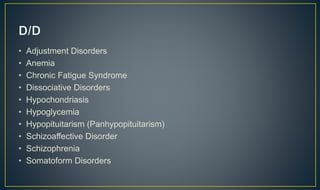
• Adjustment Disorders 
• Anemia 
• Chronic Fatigue Syndrome 
• Dissociative Disorders 
• Hypochondriasis 
• Hypoglycemia 
• Hypopituitarism (Panhypopituitarism) 
• Schizoaffective Disorder 
• Schizophrenia 
• Somatoform Disorders
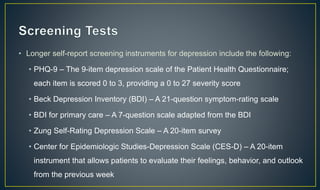
• Longer self-report screening instruments for depression include the following: 
• PHQ-9 – The 9-item depression scale of the Patient Health Questionnaire; 
each item is scored 0 to 3, providing a 0 to 27 severity score 
• Beck Depression Inventory (BDI) – A 21-question symptom-rating scale 
• BDI for primary care – A 7-question scale adapted from the BDI 
• Zung Self-Rating Depression Scale – A 20-item survey 
• Center for Epidemiologic Studies-Depression Scale (CES-D) – A 20-item 
instrument that allows patients to evaluate their feelings, behavior, and outlook 
from the previous week
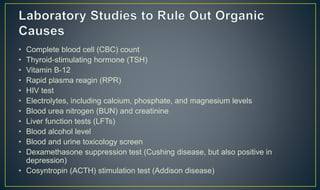
• Complete blood cell (CBC) count 
• Thyroid-stimulating hormone (TSH) 
• Vitamin B-12 
• Rapid plasma reagin (RPR) 
• HIV test 
• Electrolytes, including calcium, phosphate, and magnesium levels 
• Blood urea nitrogen (BUN) and creatinine 
• Liver function tests (LFTs) 
• Blood alcohol level 
• Blood and urine toxicology screen 
• Dexamethasone suppression test (Cushing disease, but also positive in 
depression) 
• Cosyntropin (ACTH) stimulation test (Addison disease)
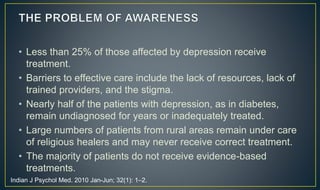
• Less than 25% of those affected by depression receive 
treatment. 
• Barriers to effective care include the lack of resources, lack of 
trained providers, and the stigma. 
• Nearly half of the patients with depression, as in diabetes, 
remain undiagnosed for years or inadequately treated. 
• Large numbers of patients from rural areas remain under care 
of religious healers and may never receive correct treatment. 
• The majority of patients do not receive evidence-based 
treatments. 
Indian J Psychol Med. 2010 Jan-Jun; 32(1): 1–2.
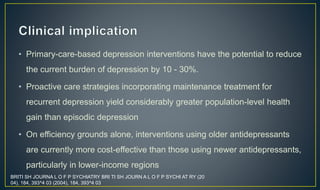
• Primary-care-based depression interventions have the potential to reduce 
the current burden of depression by 10 - 30%. 
• Proactive care strategies incorporating maintenance treatment for 
recurrent depression yield considerably greater population-level health 
gain than episodic depression 
• On efficiency grounds alone, interventions using older antidepressants 
are currently more cost-effective than those using newer antidepressants, 
particularly in lower-income regions 
BRITI SH JOURNA L O F P SYCHIATRY BRI TI SH JOURN A L O F P SYCHI AT RY (20 
04), 184, 393^4 03 (2004), 184, 393^4 03

Depression in community

  • 1.
    Dr Pradip Mate (Masters In Pharmaceutical Medicine)
  • 2.
    • Depressive disordersare common mental disorders that occur in people of all ages across all world regions • Depressive disorders are common mental disorders, occurring as early as 3 years of age and across all world regions • Global Burden of Disease (GBD) 2010 identified depressive disorders as a leading cause of burden. • MDD was also a contributor of burden allocated to suicide and ischemic heart disease. • These findings emphasize the importance of including depressive disorders as a public-health priority and implementing cost-effective interventions to reduce its burden. PLoS Med 10(11): e1001547.
  • 3.
    • Depressive disorderswere the second leading cause of YLDs in 2010. • MDD accounted for 8.2% (5.9%–10.8%) of global YLDs and dysthymia for 1.4% (0.9%–2.0%). • There was more regional variation in burden for MDD than for dysthymia; with higher estimates in females, and adults of working age. • Whilst burden increased by 37.5% between 1990 and 2010 • MDD explained 16 million suicide DALYs and almost 4 million ischemic heart disease DALYs. • This attributable burden would increase the overall burden of depressive disorders from 3.0% (2.2%–3.8%) to 3.8% (3.0%–4.7%) of global DALYs. PLoS Med 10(11): e1001547.
  • 4.
  • 7.
    • Many studieshave estimated the prevalence of depression in community samples and the prevalence rates have varied from 1.7 to 74 per thousand population. • Reddy and Chandrasekhar carried out a metanalysis, which included 13 studies on epidemiology of psychiatric disorders which include 33572 subjects from the community and reported prevalence of depression to be 7.9 to 8.9 per thousand population and the prevalence rates were nearly twice in the urban areas. Indian J Psychiatry. Jan 2010; 52(Suppl1): S178–S188
  • 8.
    • large population-basedstudy from South India, which screened more than 24,000 subjects in Chennai using Patient Health Questionnaire (PHQ)-12 reported overall prevalence of depression to be 15.1% after adjusting for age using the 2001 census data • Studies done in primary care clinics/center have estimated a prevalence rate of 21-40.45%. • Studies done in hospitals have shown that 5 to 26.7% of cases attending the psychiatric outpatient clinics have depression Indian J Psychiatry. Jan 2010; 52(Suppl1): S178–S188
  • 9.
    • Studies onthe elderly population, either in the community, inpatient, outpatient and old age homes have shown that depression is the commonest mental illness in elderly subjects. • An epidemiological study from rural Uttar Pradesh showed that psychiatric morbidity in the geriatric group (43.32%) was higher than in the nongeriatric group (4.66%) and most common psychiatric morbidity was neurotic depression, followed by manic-depressive psychosis depression, and anxiety state. Indian J Psychiatry. Jan 2010; 52(Suppl1): S178–S188
  • 10.
    Indian J PsycholMed. 2010 Jan-Jun; 32(1): 1–2.
  • 11.
    • Depression isassociated with high suicidality. • About 50% of individuals who have committed suicide carried a primary diagnosis of depression. • Because mood disorders underlie 50-70% of all suicides, effective treatment of these disorders on a national level should, in principle, drastically reduce this major complication of mood disorders. Indian J Psychol Med. 2010 Jan-Jun; 32(1): 1–2.
  • 12.
    • Indian unionhealth ministry estimates state that 120,000 people commit suicide every year in India. • Also over 400,000 people attempt suicide. • A significant percentage of people who commit suicide in India (37.8%) are below 30 years of age. • Ministry officials state that majority of those committing suicide suffer from depression or mental disorder Indian J Psychol Med. 2010 Jan-Jun; 32(1): 1–2.
  • 13.
    • The pooledrelative risk of developing IHD in those with major depression was 1.56 (95% CI 1.30 to 1.87). • Globally there were almost 4 million estimated IHD disability-adjusted life years (DALYs), which can be attributed to major depression in 2010; 3.5 million years of life lost and 250,000 years of life lived with a disability. • Major depression may be responsible for approximately 3% of global IHD DALYs warrants assessment for depression in patients at high risk of developing IHD or at risk of a repeat IHD event Charlson et al. BMC Medicine 2013, 11:250
  • 14.
    Cumulative burden ofdisease of major depression, 2010. Charlson et al. BMC Medicine 2013, 11:250
  • 15.
    ● Studies havefound high rates of depression in neurological disorders. ● Prevalence of depression after stroke range from 20% to 72% ● In Parkinson’s disease 40-50% ● In Multiple sclerosis 19-54% ● In epilepsy, up to 55% J Neurol Neurosurg Psychiatry 2011;82:914e923.
  • 16.
    Journal of theInternational Neuropsychological Society (2008), 14, 691–724.
  • 17.
    • Psychological disorderssuch as anxiety or depression are common among patients suffering from RA • It has been calculated that 13.4% have a diagnosis of anxiety and 41.5% are diagnosed with depression. • In the case of ankylosing spondylitis, anxiety is present in 25% of all patients and depression in 15%-30%. M. Freire et al / Reumatol Clin. 2011;7(1):20–26
  • 18.
    M. Freire etal / Reumatol Clin. 2011;7(1):20–26
  • 19.
    • Depression classificationsinclude ; • Major depressive disorder (MDD), • Depression with melancholic or catatonic features, • Atypical depression, • Psychotic features, • Bipolar depression, • Single or recurrent episode, • Dysthymia • seasonal affective disorder (SAD).
  • 20.
    • Clinical andpreclinical trials suggest a disturbance in central nervous system serotonin (5-HT) activity as an important factor. • Other neurotransmitters implicated include norepinephrine (NE), dopamine (DA), glutamate, and brain-derived neurotrophic factor (BDNF). • Functional neuroimaging studies support the hypothesis that the depressed state is associated with decreased metabolic activity in neocortical structures and increased metabolic activity in limbic structures. • Serotonergic neurons implicated in affective disorders are found in the dorsal raphe nucleus, the limbic system, and the left prefrontal cortex.
  • 21.
    • Although majordepressive disorder can arise without any precipitating stressors, stress and interpersonal losses certainly increase risk. • Chronic pain, medical illness, and psychosocial stress • Older adults may find medical illness psychologically distressing, and these illnesses may lead to increased disability, decreased independence, and disruption of social networks. • Chronic aversive symptoms such as pain associated with chronic medical illness may disrupt sleep and other biorhythms leading to depression
  • 22.
    • Impaired socialsupports • Caregiver burden • Loneliness • Bereavement • Negative life events
  • 23.
    • In additionto older age and male sex, risk factors for suicide include the following : • Diagnosis of major depression • Previous history of suicide attempts • Depressive symptoms with agitation or distress • Burden of medical disease and the presence of a current serious medical condition • Recent stressful life events, especially family discord • Lack of social support • Being widowed or divorced • Unexplained weight loss • High levels of anxiety • Lack of a reason not to commit suicide • Presence of a specific plan that can be carried out • Rehearsal of the plan
  • 24.
    • A majordepressive episode is defined as a syndrome in which at least 5 of the following symptoms have been present during the same 2- week period : • Depressed mood (for children and adolescents, this can also be an irritable mood) • Diminished interest or loss of pleasure in almost all activities (anhedonia) • Significant weight change or appetite disturbance (for children, this can be failure to achieve expected weight gain) • Sleep disturbance (insomnia or hypersomnia) • Psychomotor agitation or retardation • Fatigue or loss of energy • Feelings of worthlessness • Diminished ability to think or concentrate; indecisiveness • Recurrent thoughts of death, suicidal • A pattern of long-standing interpersonal rejection ideation, suicide attempt, or specific plan for suicide
  • 25.
    • In depressionwith melancholic features, either a loss of pleasure in almost all activities or a lack of reactivity to usually pleasurable stimuli is present. • Additionally, at least 3 of the following are required: • A depressed mood that is distinctly different from the kind that is felt when a loved one is deceased • Depression that is worse in the morning • Waking up 2 hours earlier than usual • Observable psychomotor retardation or agitation • Significant weight loss or anorexia • Excessive or inappropriate guilt
  • 26.
    • Diagnosis ofdepressive episodes with catatonic features requires at least 2 of the following, according to the DSM-IV-TR: • Motoric immobility in the form of catalepsy or stupor • Motor overactivity that seems purposeless and not in response to external stimuli • Extreme negativism or mutism • Voluntary movement peculiarities such a posturing, grimacing, stereotypy, and mannerisms • Echolalia or echopraxia
  • 27.
    • Adjustment Disorders • Anemia • Chronic Fatigue Syndrome • Dissociative Disorders • Hypochondriasis • Hypoglycemia • Hypopituitarism (Panhypopituitarism) • Schizoaffective Disorder • Schizophrenia • Somatoform Disorders
  • 28.
    • Longer self-reportscreening instruments for depression include the following: • PHQ-9 – The 9-item depression scale of the Patient Health Questionnaire; each item is scored 0 to 3, providing a 0 to 27 severity score • Beck Depression Inventory (BDI) – A 21-question symptom-rating scale • BDI for primary care – A 7-question scale adapted from the BDI • Zung Self-Rating Depression Scale – A 20-item survey • Center for Epidemiologic Studies-Depression Scale (CES-D) – A 20-item instrument that allows patients to evaluate their feelings, behavior, and outlook from the previous week
  • 29.
    • Complete bloodcell (CBC) count • Thyroid-stimulating hormone (TSH) • Vitamin B-12 • Rapid plasma reagin (RPR) • HIV test • Electrolytes, including calcium, phosphate, and magnesium levels • Blood urea nitrogen (BUN) and creatinine • Liver function tests (LFTs) • Blood alcohol level • Blood and urine toxicology screen • Dexamethasone suppression test (Cushing disease, but also positive in depression) • Cosyntropin (ACTH) stimulation test (Addison disease)
  • 30.
    • Less than25% of those affected by depression receive treatment. • Barriers to effective care include the lack of resources, lack of trained providers, and the stigma. • Nearly half of the patients with depression, as in diabetes, remain undiagnosed for years or inadequately treated. • Large numbers of patients from rural areas remain under care of religious healers and may never receive correct treatment. • The majority of patients do not receive evidence-based treatments. Indian J Psychol Med. 2010 Jan-Jun; 32(1): 1–2.
  • 31.
    • Primary-care-based depressioninterventions have the potential to reduce the current burden of depression by 10 - 30%. • Proactive care strategies incorporating maintenance treatment for recurrent depression yield considerably greater population-level health gain than episodic depression • On efficiency grounds alone, interventions using older antidepressants are currently more cost-effective than those using newer antidepressants, particularly in lower-income regions BRITI SH JOURNA L O F P SYCHIATRY BRI TI SH JOURN A L O F P SYCHI AT RY (20 04), 184, 393^4 03 (2004), 184, 393^4 03

Editor's Notes

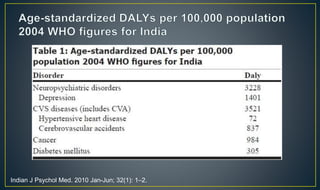
  • #11 disability due to depression exceeds disability due to all forms of cancer and diabetes mellitus combined, as well as exceeding the disability due to strokes and hypertensive heart diseases.