COMBINATION THERAPY
IN THE MANAGEMENT OF
HYPERTENSION
NOWADAYS: WHEN AND
HOW?
• The concept of initial
combination therapy is not new
because one of the first large
clinical trials published in the late
1960s, the Veteran Affairs
Cooperative Study, showed
reduced morbidity with improved
BP control using triple therapy
combinations.
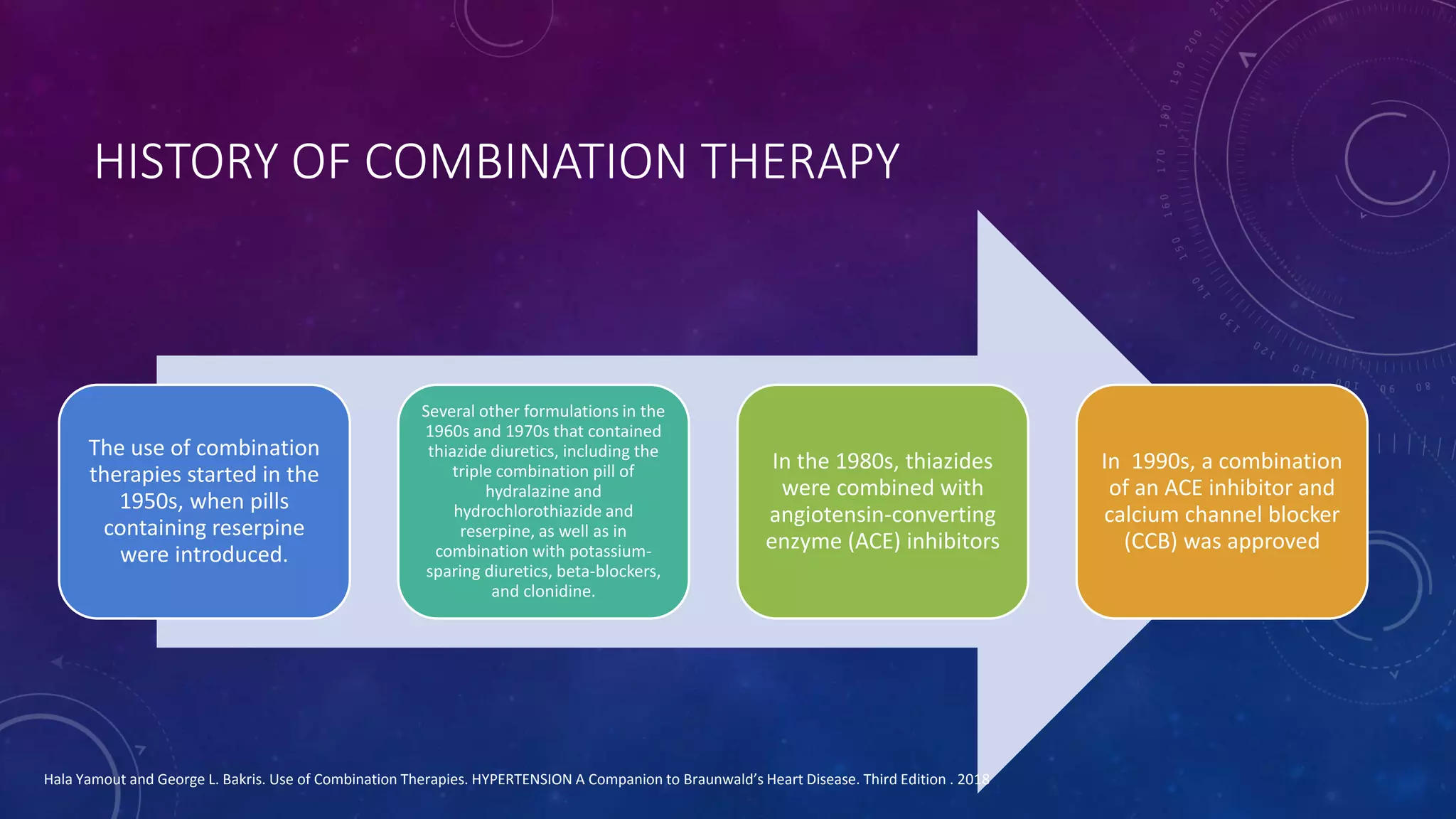
HISTORY OF COMBINATION THERAPY
The use of combination
therapies started in the
1950s, when pills
containing reserpine
were introduced.
Several other formulations in the
1960s and 1970s that contained
thiazide diuretics, including the
triple combination pill of
hydralazine and
hydrochlorothiazide and
reserpine, as well as in
combination with potassium-
sparing diuretics, beta-blockers,
and clonidine.
In the 1980s, thiazides
were combined with
angiotensin-converting
enzyme (ACE) inhibitors
In 1990s, a combination
of an ACE inhibitor and
calcium channel blocker
(CCB) was approved
Hala Yamout and George L. Bakris. Use of Combination Therapies. HYPERTENSION A Companion to Braunwald’s Heart Disease. Third Edition . 2018
RATIONALE FOR INITIAL COMBINATION
THERAPY : GUIDELINE INERTIA
• Although combination BP lowering therapy was available and proven to reduce BP and
mortality in clinical trials, the control of BP with stepwise management was advocated
by early guidelines
• The first report favoring combination therapy as an initial approach was seen in 1997
by the JNC VI panel.
• Since this report, it is clear that initial use of single pill combination therapy is superior
to a stepwise approach in controlling hypertension, with 12% more patients at their
target BP.
Hala Yamout and George L. Bakris. Use of Combination Therapies. HYPERTENSION A Companion to Braunwald’s Heart Disease. Third Edition . 2018
RATIONALE FOR INITIAL COMBINATION
THERAPY : MULTIFACTORIAL CAUSES OF BP
• Multiple systems that regulate BP ; sympathetic nervous system (SNS), renin-angiotensin
system (RAS), and volume modulators from the kidney and heart like natriuretic peptides.
• It is difficult to determine with certainty which system is dominant in a particular patient
• Use of different classes of medications will increase the chance of controlling BP faster and
more effectively.
• An increase dose of a single agent is less likely to achieve BP control than adding lower doses
of a second agent.
Hala Yamout and George L. Bakris. Use of Combination Therapies. HYPERTENSION A Companion to Braunwald’s Heart Disease. Third Edition . 2018
RATIONALE FOR INITIAL
COMBINATION
THERAPY : EFFECTIVE BP CONTROL
• Addition of an antihypertensive
agent from a different class is five
times more effective in improving
BP control than doubling the dose
of a single drug.
• Improvement in BP control occurs
when even half the dose of the
individual drugs are used in a
combination pill compared with full
doses of each as monotherapy
Comparison of observed versus
expected effects of a single pill
combination versus doubling the dose of
an antihypertensive medication.
Hala Yamout and George L. Bakris. Use of Combination Therapies. HYPERTENSION A Companion to Braunwald’s Heart Disease. Third Edition . 2018
RATIONALE FOR INITIAL COMBINATION
THERAPY : COUNTER REGULATORY MECHANISM
Diuretics used alone can
result in relative volume
depletion and activate
the RAS and to a lesser
extent the SNS.
The use of agents that
block these systems,
such as ACE inhibitors or
beta-blockers, counteract
the body’s response to
diuretics and are
complementary to
diuretic action to low BP.
To offset the
body’s counter-
regulatory
mechanisms to a
particular agent
Hala Yamout and George L. Bakris. Use of Combination Therapies. HYPERTENSION A Companion to Braunwald’s Heart Disease. Third Edition . 2018
CV RISK REDUCTION
Every 20 mmHg increase in systolic blood
pressure, there is an approximate doubling
of cardiovascular (CV) risk, by use of
combination therapy there is better
achievement of target BP goals thereby
reduction in CV risk.
Monotherapy especially with beta blockers
results in variability in visit to visit BP
recordings which is a strong predictor of
both stroke and myocardial infarction this
effect is reduced with combination drug
therapy
AU Mahajan, Zohaib Shaikh. Combination Drug Therapy in Hypertension . Medicine update . 2017
Illustration of various drug class combinations to lower
blood pressure and CV event
Solid black lines
demonstrate
additive effects
on blood
pressure (BP)
lowering;
Orange lines
demonstrate
outcome
based
reduction in
either
cardiovascular
events or
kidney disease
progression
Hala Yamout and George L. Bakris. Use of Combination Therapies. HYPERTENSION A Companion to Braunwald’s Heart Disease. Third Edition . 2018
IMPROVE PATIENT
ADHERENCE
• Even when the same two
drugs are given as
individual pills, adherence
rates with combination
therapy are significantly
higher and can reduce
nonadherence by up to
24%
Adherence with single pill combinations
compared with free-drug combinations
Hala Yamout and George L. Bakris. Use of Combination Therapies. HYPERTENSION A Companion to Braunwald’s Heart Disease. Third Edition . 2018
Forest plot for medication persistence.
Meta- analysis confirmed that FDC
therapy, compared with free-
equivalent combinations, was
associated with better medication
adherence or persistence for patients
with hypertension.
It can be reasonable for physicians,
to facilitate the use of FDCs for
patients who need to take two or
more antihypertensive drugs
COMPARISON BETWEEN DIFFERENT HYPERTENSION
MANAGEMENT STRATEGIES
AMERICAN SOCIETY
OF HYPERTENSION
EVIDENCED-
BASED FIXED-DOSE
ANTIHYPERTENSIVE
COMBINATIONS
Hala Yamout and George L. Bakris. Use of Combination Therapies. HYPERTENSION A Companion to Braunwald’s Heart Disease. Third Edition . 2018
Williams, Mancia et al., J Hypertens 2018 and Eur Heart J 2018, in press
Hypertension drug treatment strategies
Increasing dose of initial monotherapy (side
effects/ineffective)
Substitution with another monotherapy ( time consuming/low
adherence/ineffective)
Stepped-case approach,i.e.monotherapy with sequential addition of
other drugs (therapeutic inertia)
Williams, Mancia et al., J Hypertens 2018 and Eur Heart J 2018, in press
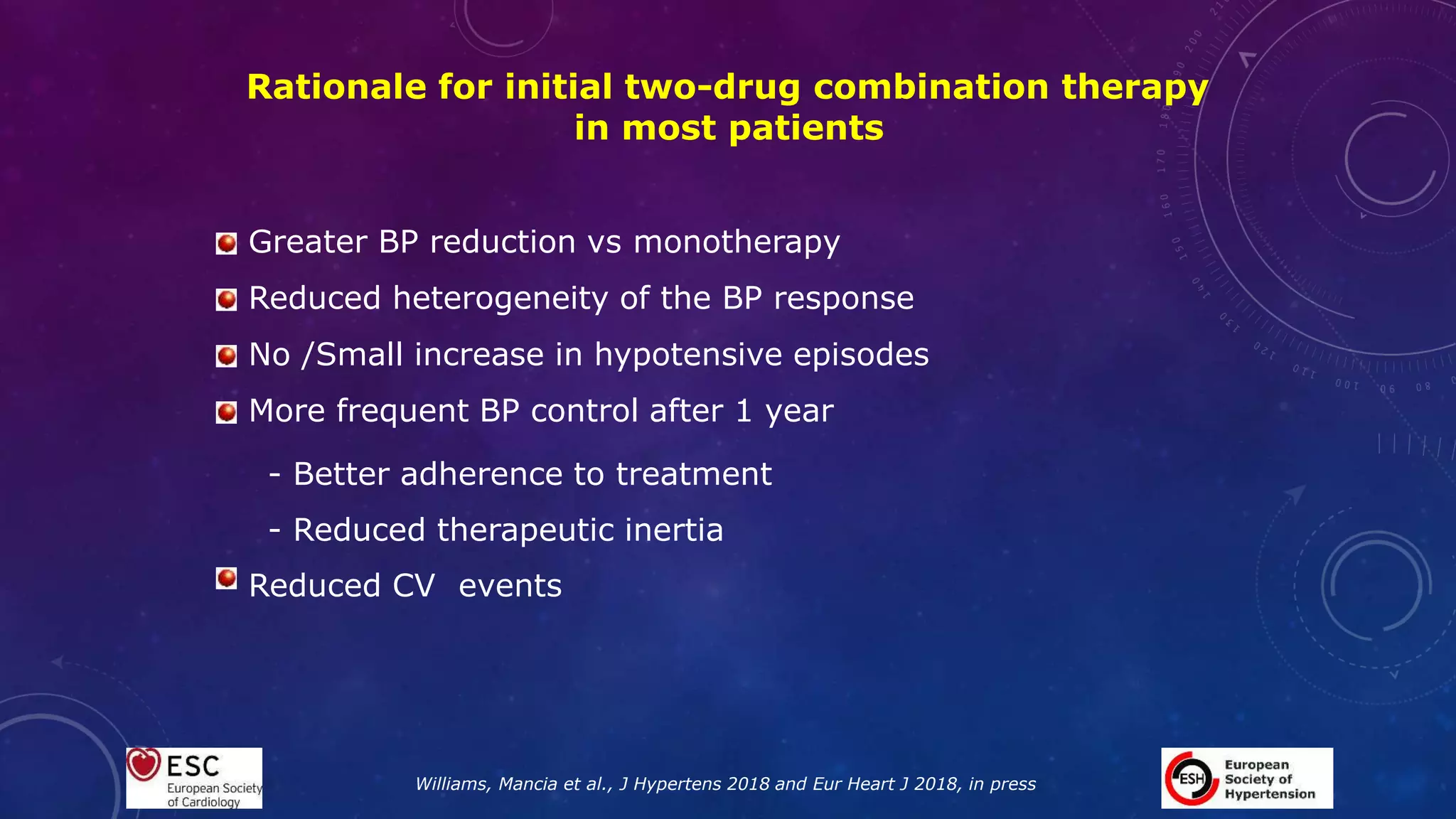
Rationale for initial two-drug combination therapy
in most patients
Greater BP reduction vs monotherapy
Reduced heterogeneity of the BP response
No /Small increase in hypotensive episodes
More frequent BP control after 1 year
- Better adherence to treatment
- Reduced therapeutic inertia
Reduced CV events
• Faster reduction of BP
• Greater possibility of achieving target BP
• Neutralization of the counterregulatory pathway
activated by monotherapies
• Improved tolerability
• Decreased side effects than up- titrating single
agents
Cardiac Failure Review 2017;3(1):40–5
Single Pill Combinations
Williams, Mancia et al., J Hypertens 2018 and Eur Heart J 2018, in press
The recommended treatment
strategy (evidence-based) to improve BP control
Initial combination treatment, especially useful in the
context of lower BP targets
Single-pill-based combination therapy, to improve
adherence to treatment
To be used in most patients
Initial monotherapy reserved to BP in the high-normal
range/very old patients/ frail older patients)
J Clin Pharmacol. 1998;38(6):477–491.
J Clin Pharmacol. 1995;35(11):1060–1066. Am J
Cardiol. 1995;76(8):595–597.
ESC/ ESH 2018
HYPERTENSION GUIDELINE
RECOMMENDS DUAL
COMBINATION THERAPY AS
A INITIAL THERAPY
First look at the new 2018 European Guidelines for the treatment ofhigh blood pressure. 2018 ESC and ESH joint guidelines for
themanagement of arterial hypertension. Available from URL:http://www.eshonline.org/esh-annual-meeting/
TRIPLE DRUG COMBINATION
• About 24% to 32% of patients with HTN will require more than two
drugs to achieve their BP target.
• A rational combination in this setting would be an RAAS inhibitor, a
CCB, and a diuretic6.
Single-pill triple combinations of different classes of drugs with complementary
mechanisms of action help to treat patients to goal with improved efficacy and better
adherence to treatment
Journal of Human Hypertension (2017) 31, 501–510;
Triple drug fixed dose combination of Telmisartan, Amlodipine and hydrochlorothiazide
was found to be effective and safe option for the optimal management of hypertension.
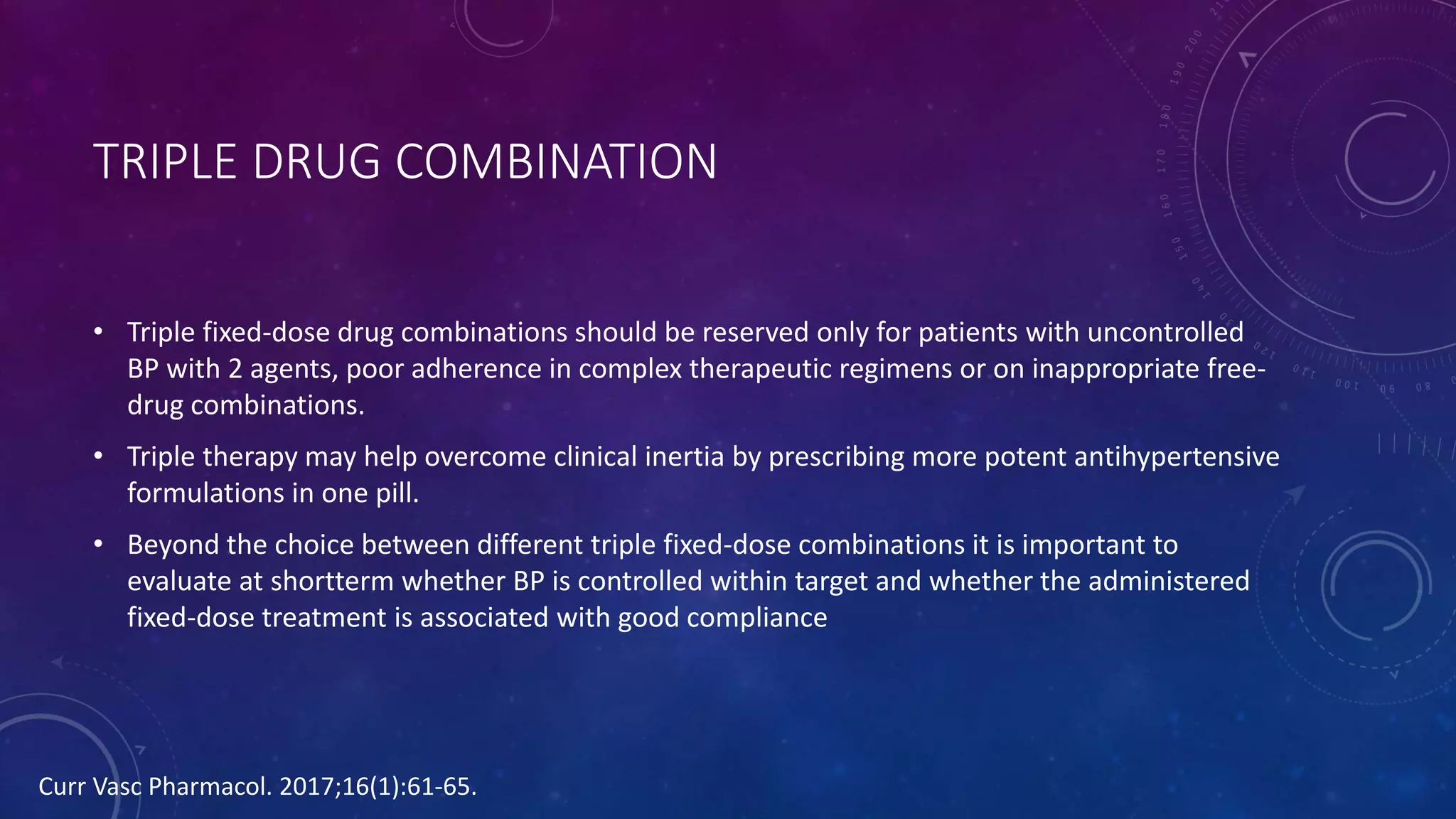
TRIPLE DRUG COMBINATION
• Triple fixed-dose drug combinations should be reserved only for patients with uncontrolled
BP with 2 agents, poor adherence in complex therapeutic regimens or on inappropriate free-
drug combinations.
• Triple therapy may help overcome clinical inertia by prescribing more potent antihypertensive
formulations in one pill.
• Beyond the choice between different triple fixed-dose combinations it is important to
evaluate at shortterm whether BP is controlled within target and whether the administered
fixed-dose treatment is associated with good compliance
Curr Vasc Pharmacol. 2017;16(1):61-65.
How to build up appropriate triple drug combinations.
Curr Vasc Pharmacol. 2017;16(1):61-65.
ESC/ ESH 2018 HYPERTENSION
GUIDELINE RECOMMENDS
TRIPLE COMBINATION THERAPY
IF BP NOT CONTROLLED BY
DUAL THERAPY
First look at the new 2018 European Guidelines for the treatment ofhigh blood pressure. 2018 ESC and ESH joint guidelines for
themanagement of arterial hypertension. Available from URL:http://www.eshonline.org/esh-annual-meeting/
CHANGING TRENDS IN PHARMACOTHERAPY FOR
HYPERTENSION IN INDIA
47
53
0
10
20
30
40
50
60
70
Mono Combo
Malhotra et al. Eur J Clin Pharm.
2001;57:535
N=1076
Sreedharan et al. Int J Clin Pharm Ther.
2011;49:277
49
51
0
10
20
30
40
50
60
70
Mono Combo
N=2100
27
73
0
10
20
30
40
50
60
70
Mono Combo
Gupta R, et al.
2018. Unpublished.
N=3073
Combination therapy to achieve target blood pressure goals

Combination therapy to achieve target blood pressure goals

  • 1.
    COMBINATION THERAPY IN THEMANAGEMENT OF HYPERTENSION NOWADAYS: WHEN AND HOW?
  • 2.
    • The conceptof initial combination therapy is not new because one of the first large clinical trials published in the late 1960s, the Veteran Affairs Cooperative Study, showed reduced morbidity with improved BP control using triple therapy combinations.
  • 3.
    HISTORY OF COMBINATIONTHERAPY The use of combination therapies started in the 1950s, when pills containing reserpine were introduced. Several other formulations in the 1960s and 1970s that contained thiazide diuretics, including the triple combination pill of hydralazine and hydrochlorothiazide and reserpine, as well as in combination with potassium- sparing diuretics, beta-blockers, and clonidine. In the 1980s, thiazides were combined with angiotensin-converting enzyme (ACE) inhibitors In 1990s, a combination of an ACE inhibitor and calcium channel blocker (CCB) was approved Hala Yamout and George L. Bakris. Use of Combination Therapies. HYPERTENSION A Companion to Braunwald’s Heart Disease. Third Edition . 2018
  • 5.
    RATIONALE FOR INITIALCOMBINATION THERAPY : GUIDELINE INERTIA • Although combination BP lowering therapy was available and proven to reduce BP and mortality in clinical trials, the control of BP with stepwise management was advocated by early guidelines • The first report favoring combination therapy as an initial approach was seen in 1997 by the JNC VI panel. • Since this report, it is clear that initial use of single pill combination therapy is superior to a stepwise approach in controlling hypertension, with 12% more patients at their target BP. Hala Yamout and George L. Bakris. Use of Combination Therapies. HYPERTENSION A Companion to Braunwald’s Heart Disease. Third Edition . 2018
  • 6.
    RATIONALE FOR INITIALCOMBINATION THERAPY : MULTIFACTORIAL CAUSES OF BP • Multiple systems that regulate BP ; sympathetic nervous system (SNS), renin-angiotensin system (RAS), and volume modulators from the kidney and heart like natriuretic peptides. • It is difficult to determine with certainty which system is dominant in a particular patient • Use of different classes of medications will increase the chance of controlling BP faster and more effectively. • An increase dose of a single agent is less likely to achieve BP control than adding lower doses of a second agent. Hala Yamout and George L. Bakris. Use of Combination Therapies. HYPERTENSION A Companion to Braunwald’s Heart Disease. Third Edition . 2018
  • 7.
    RATIONALE FOR INITIAL COMBINATION THERAPY: EFFECTIVE BP CONTROL • Addition of an antihypertensive agent from a different class is five times more effective in improving BP control than doubling the dose of a single drug. • Improvement in BP control occurs when even half the dose of the individual drugs are used in a combination pill compared with full doses of each as monotherapy Comparison of observed versus expected effects of a single pill combination versus doubling the dose of an antihypertensive medication. Hala Yamout and George L. Bakris. Use of Combination Therapies. HYPERTENSION A Companion to Braunwald’s Heart Disease. Third Edition . 2018
  • 8.
    RATIONALE FOR INITIALCOMBINATION THERAPY : COUNTER REGULATORY MECHANISM Diuretics used alone can result in relative volume depletion and activate the RAS and to a lesser extent the SNS. The use of agents that block these systems, such as ACE inhibitors or beta-blockers, counteract the body’s response to diuretics and are complementary to diuretic action to low BP. To offset the body’s counter- regulatory mechanisms to a particular agent Hala Yamout and George L. Bakris. Use of Combination Therapies. HYPERTENSION A Companion to Braunwald’s Heart Disease. Third Edition . 2018
  • 9.
    CV RISK REDUCTION Every20 mmHg increase in systolic blood pressure, there is an approximate doubling of cardiovascular (CV) risk, by use of combination therapy there is better achievement of target BP goals thereby reduction in CV risk. Monotherapy especially with beta blockers results in variability in visit to visit BP recordings which is a strong predictor of both stroke and myocardial infarction this effect is reduced with combination drug therapy AU Mahajan, Zohaib Shaikh. Combination Drug Therapy in Hypertension . Medicine update . 2017
  • 10.
    Illustration of variousdrug class combinations to lower blood pressure and CV event Solid black lines demonstrate additive effects on blood pressure (BP) lowering; Orange lines demonstrate outcome based reduction in either cardiovascular events or kidney disease progression Hala Yamout and George L. Bakris. Use of Combination Therapies. HYPERTENSION A Companion to Braunwald’s Heart Disease. Third Edition . 2018
  • 11.
    IMPROVE PATIENT ADHERENCE • Evenwhen the same two drugs are given as individual pills, adherence rates with combination therapy are significantly higher and can reduce nonadherence by up to 24% Adherence with single pill combinations compared with free-drug combinations Hala Yamout and George L. Bakris. Use of Combination Therapies. HYPERTENSION A Companion to Braunwald’s Heart Disease. Third Edition . 2018
  • 12.
    Forest plot formedication persistence. Meta- analysis confirmed that FDC therapy, compared with free- equivalent combinations, was associated with better medication adherence or persistence for patients with hypertension. It can be reasonable for physicians, to facilitate the use of FDCs for patients who need to take two or more antihypertensive drugs
  • 13.
    COMPARISON BETWEEN DIFFERENTHYPERTENSION MANAGEMENT STRATEGIES
  • 14.
    AMERICAN SOCIETY OF HYPERTENSION EVIDENCED- BASEDFIXED-DOSE ANTIHYPERTENSIVE COMBINATIONS Hala Yamout and George L. Bakris. Use of Combination Therapies. HYPERTENSION A Companion to Braunwald’s Heart Disease. Third Edition . 2018
  • 15.
    Williams, Mancia etal., J Hypertens 2018 and Eur Heart J 2018, in press Hypertension drug treatment strategies Increasing dose of initial monotherapy (side effects/ineffective) Substitution with another monotherapy ( time consuming/low adherence/ineffective) Stepped-case approach,i.e.monotherapy with sequential addition of other drugs (therapeutic inertia)
  • 16.
    Williams, Mancia etal., J Hypertens 2018 and Eur Heart J 2018, in press Rationale for initial two-drug combination therapy in most patients Greater BP reduction vs monotherapy Reduced heterogeneity of the BP response No /Small increase in hypotensive episodes More frequent BP control after 1 year - Better adherence to treatment - Reduced therapeutic inertia Reduced CV events
  • 17.
    • Faster reductionof BP • Greater possibility of achieving target BP • Neutralization of the counterregulatory pathway activated by monotherapies • Improved tolerability • Decreased side effects than up- titrating single agents Cardiac Failure Review 2017;3(1):40–5 Single Pill Combinations
  • 18.
    Williams, Mancia etal., J Hypertens 2018 and Eur Heart J 2018, in press The recommended treatment strategy (evidence-based) to improve BP control Initial combination treatment, especially useful in the context of lower BP targets Single-pill-based combination therapy, to improve adherence to treatment To be used in most patients Initial monotherapy reserved to BP in the high-normal range/very old patients/ frail older patients)
  • 19.
    J Clin Pharmacol.1998;38(6):477–491. J Clin Pharmacol. 1995;35(11):1060–1066. Am J Cardiol. 1995;76(8):595–597.
  • 21.
    ESC/ ESH 2018 HYPERTENSIONGUIDELINE RECOMMENDS DUAL COMBINATION THERAPY AS A INITIAL THERAPY First look at the new 2018 European Guidelines for the treatment ofhigh blood pressure. 2018 ESC and ESH joint guidelines for themanagement of arterial hypertension. Available from URL:http://www.eshonline.org/esh-annual-meeting/
  • 22.
    TRIPLE DRUG COMBINATION •About 24% to 32% of patients with HTN will require more than two drugs to achieve their BP target. • A rational combination in this setting would be an RAAS inhibitor, a CCB, and a diuretic6.
  • 23.
    Single-pill triple combinationsof different classes of drugs with complementary mechanisms of action help to treat patients to goal with improved efficacy and better adherence to treatment Journal of Human Hypertension (2017) 31, 501–510; Triple drug fixed dose combination of Telmisartan, Amlodipine and hydrochlorothiazide was found to be effective and safe option for the optimal management of hypertension.
  • 24.
    TRIPLE DRUG COMBINATION •Triple fixed-dose drug combinations should be reserved only for patients with uncontrolled BP with 2 agents, poor adherence in complex therapeutic regimens or on inappropriate free- drug combinations. • Triple therapy may help overcome clinical inertia by prescribing more potent antihypertensive formulations in one pill. • Beyond the choice between different triple fixed-dose combinations it is important to evaluate at shortterm whether BP is controlled within target and whether the administered fixed-dose treatment is associated with good compliance Curr Vasc Pharmacol. 2017;16(1):61-65.
  • 25.
    Curr Vasc Pharmacol.2017;16(1):61-65.
  • 26.
    How to buildup appropriate triple drug combinations. Curr Vasc Pharmacol. 2017;16(1):61-65.
  • 27.
    ESC/ ESH 2018HYPERTENSION GUIDELINE RECOMMENDS TRIPLE COMBINATION THERAPY IF BP NOT CONTROLLED BY DUAL THERAPY First look at the new 2018 European Guidelines for the treatment ofhigh blood pressure. 2018 ESC and ESH joint guidelines for themanagement of arterial hypertension. Available from URL:http://www.eshonline.org/esh-annual-meeting/
  • 28.
    CHANGING TRENDS INPHARMACOTHERAPY FOR HYPERTENSION IN INDIA 47 53 0 10 20 30 40 50 60 70 Mono Combo Malhotra et al. Eur J Clin Pharm. 2001;57:535 N=1076 Sreedharan et al. Int J Clin Pharm Ther. 2011;49:277 49 51 0 10 20 30 40 50 60 70 Mono Combo N=2100 27 73 0 10 20 30 40 50 60 70 Mono Combo Gupta R, et al. 2018. Unpublished. N=3073