Different faces of
Depression
Dr Rakesh Mehta
INTRODUCTION
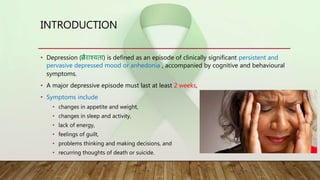
• Depression (
नैराश्यता) is defined as an episode of clinically significant persistent and
pervasive depressed mood or anhedonia , accompanied by cognitive and behavioural
symptoms.
• A major depressive episode must last at least 2 weeks,
• Symptoms include
• changes in appetite and weight,
• changes in sleep and activity,
• lack of energy,
• feelings of guilt,
• problems thinking and making decisions, and
• recurring thoughts of death or suicide.
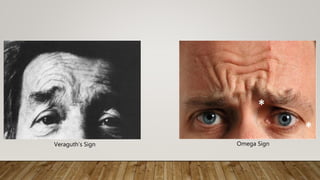
Veraguth’s Sign Omega Sign
EPIDEMOLODY
• Depressive disorder has the highest lifetime prevalence of 5-17 % of any
psychiatric disorder.
• According to WHO (2019) depression is a common illness worldwide, with an
estimated 3.8% of the population affected,
• including 5.0% among adults and 5.7% among adults older than 60 years
• Approximately 280 million people in the world are said to have depression.
CORRELATES OF DEPRESSION
• Two fold greater in women than in men.
• people younger than 45 years.
• without close interpersonal relationships and in those who are divorced or
separated.
• More common in Urban residents
• More common in Unemployement
• Spring and fall season
• Common in chronic diseases
AETIOLOGY
Genetic Factor
• If one parent has a mood disorder, a child will have a risk
of 10 - 25 % for mood disorder,
• If both parents are affected, this risk roughly doubles.
• Mood disorder if present, occurs 70-90% in monozygotic
twins compared with the same-sex dizygotic (DZ) twins of
16-35%
AETIOLOGY
Biological Factors
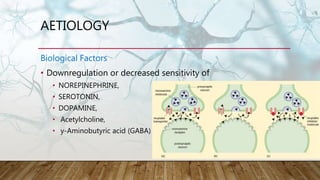
• Downregulation or decreased sensitivity of
• NOREPINEPHRINE,
• SEROTONIN,
• DOPAMINE,
• Acetylcholine,
• y-Aminobutyric acid (GABA)
AETIOLOGY
Biological Factors
• Elevated basal Thyroid Stimulating Hormone (TSH)
• Elevated Hypothalamic Pituitary Axis (HPA) activity
• Cushing syndrome
• Addison's Disease
• Alteration in sleep neurophysiology
AETIOLOGY
Psychosocial factors
• Life events and environmental stress.
• Death of loved ones, unemployement,
• Personality factors.
• Anankastic, histrionic, and borderline at more risk
DIAGNOSTIC CRITERIA
WHO ( World Health Organization) - ICD-10 (Internation Classification of Disease)
APA( American Psychiatric Association - DSM -V (Diagnostic & Statistical
Manual)
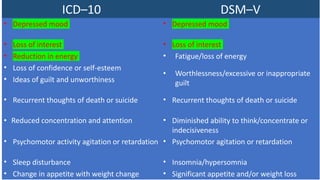
ICD–10 DSM–V
• Depressed mood • Depressed mood
• Loss of interest • Loss of interest
• Reduction in energy • Fatigue/loss of energy
• Loss of confidence or self-esteem
• Worthlessness/excessive or inappropriate
guilt
• Ideas of guilt and unworthiness
• Recurrent thoughts of death or suicide • Recurrent thoughts of death or suicide
• Reduced concentration and attention • Diminished ability to think/concentrate or
indecisiveness
• Psychomotor activity agitation or retardation • Psychomotor agitation or retardation
• Sleep disturbance • Insomnia/hypersomnia
• Change in appetite with weight change • Significant appetite and/or weight loss
MILD at least 2 of the core symptoms
(Depressed mood, Loss of interest,
Reduction in energy) plus 2 other
symptoms.
MODERATE at least 2 of the core symptoms plus
3/4 other symptoms.
SEVERE all 3 core symptoms plus 4 other
symptoms, some of which should be
of severe intensity.
TYPES OF DEPRESSION
• Mild Depressive Disorder
• Moderate Depressive Disorder
• Severe Depressive Disorder
• without psychotic symtoms
• with psychotic symtoms
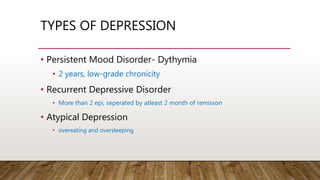
TYPES OF DEPRESSION
• Persistent Mood Disorder- Dythymia
• 2 years, low-grade chronicity
• Recurrent Depressive Disorder
• More than 2 epi, seperated by atleast 2 month of remisson
• Atypical Depression
• overeating and oversleeping
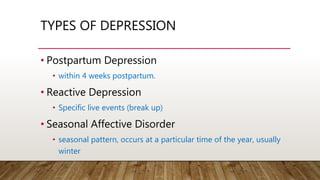
TYPES OF DEPRESSION
• Postpartum Depression
• within 4 weeks postpartum.
• Reactive Depression
• Specific live events (break up)
• Seasonal Affective Disorder
• seasonal pattern, occurs at a particular time of the year, usually
winter
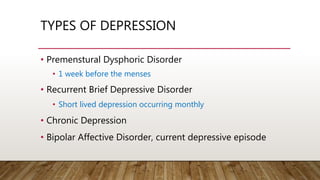
TYPES OF DEPRESSION
• Premenstural Dysphoric Disorder
• 1 week before the menses
• Recurrent Brief Depressive Disorder
• Short lived depression occurring monthly
• Chronic Depression
• Bipolar Affective Disorder, current depressive episode
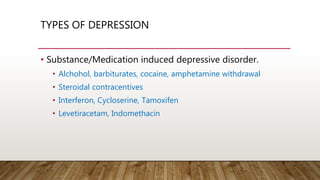
TYPES OF DEPRESSION
• Substance/Medication induced depressive disorder.
• Alchohol, barbiturates, cocaine, amphetamine withdrawal
• Steroidal contracentives
• Interferon, Cycloserine, Tamoxifen
• Levetiracetam, Indomethacin
DEPRESSION IN SPECIAL POPULATION
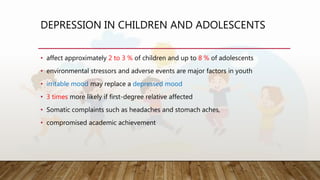
DEPRESSION IN CHILDREN AND ADOLESCENTS
• affect approximately 2 to 3 % of children and up to 8 % of adolescents
• environmental stressors and adverse events are major factors in youth
• irritable mood may replace a depressed mood
• 3 times more likely if first-degree relative affected
• Somatic complaints such as headaches and stomach aches,
• compromised academic achievement
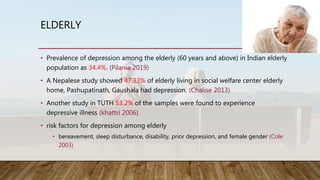
ELDERLY
• Prevalence of depression among the elderly (60 years and above) in Indian elderly
population as 34.4%. (Pilania 2019)
• A Nepalese study showed 47.33% of elderly living in social welfare center elderly
home, Pashupatinath, Gaushala had depression. (Chalise 2013)
• Another study in TUTH 53.2% of the samples were found to experience
depressive illness (khattri 2006)
• risk factors for depression among elderly
• bereavement, sleep disturbance, disability, prior depression, and female gender (Cole
2003)
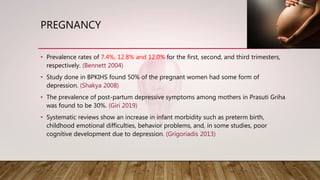
PREGNANCY
• Prevalence rates of 7.4%, 12.8% and 12.0% for the first, second, and third trimesters,
respectively. (Bennett 2004)
• Study done in BPKIHS found 50% of the pregnant women had some form of
depression. (Shakya 2008)
• The prevalence of post-partum depressive symptoms among mothers in Prasuti Griha
was found to be 30%. (Giri 2019)
• Systematic reviews show an increase in infant morbidity such as preterm birth,
childhood emotional difficulties, behavior problems, and, in some studies, poor
cognitive development due to depression. (Grigoriadis 2013)
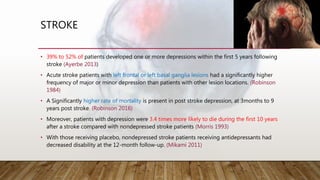
STROKE
• 39% to 52% of patients developed one or more depressions within the first 5 years following
stroke (Ayerbe 2013)
• Acute stroke patients with left frontal or left basal ganglia lesions had a significantly higher
frequency of major or minor depression than patients with other lesion locations. (Robinson
1984)
• A Significantly higher rate of mortality is present in post stroke depression, at 3months to 9
years post stroke. (Robinson 2016)
• Moreover, patients with depression were 3.4 times more likely to die during the first 10 years
after a stroke compared with nondepressed stroke patients (Morris 1993)
• With those receiving placebo, nondepressed stroke patients receiving antidepressants had
decreased disability at the 12-month follow-up. (Mikami 2011)
DIABETES
• The overall prevalence of depression was found to be 22% in people with Type 1
diabetes and 19% in people with Type 2 diabetes. (Farooqi 2021)
• A Study conducted in TUTH, NMC , Om hospital found 40.3% of Type 2-DM patients
had depression. (Niraula 2013)
• Depression is significantly associated with a variety of diabetes complications (diabetic
retinopathy, nephropathy, neuropathy, macrovascular complications, and sexual
dysfunction)
• This may be associated with adverse outcomes, including impaired functioning and
quality of life, poorer adherence to medical treatment and glycemic control. (De Groot
2001)
CORONARY HEART DISEASE
• 1.5-2 times risk of MI and cardiac related mortality in Depression
• Major cardiac events like recurrent infraction, sudden cardiac death has
been associated with depression.
• Increased in Revascularization procedure for unstable angina has been
reported.
• Mechanism:
• Poor Life style
• Sympathetic System and HPA disregulation
• Disordered platetlet aggregation
EPILEPSY
• Around 400 B.C., Hippocrates wrote, “Melancholics ordinarily become epileptics, and
epileptics, melancholics”
• The prevalence of active depression in epilepsy across the 9 studies reporting on
29,891 persons ranged from 13.2% to 36.5%. (Fiest 2013)
• The prevalence of depression was found to be 31% at Nepal Epilepsy Center,
Lazimpat, Kathmandu, Nepal. (Shah 2011)
• Untreated depression leads to worsening of seizure, noncompliance, distress,
disability, loss of quality of life and suicide. (McConnell 1998)
• Drugs like : Levetrecetam , carbazipine
CANCER
• Depression has been found to be prevalent in 50% of the cancer patients.
• Tumor in diencephalon and temporal region likely to be associated with
depressive symptoms
• High rates of depression in Ca Pancreatic head and neck , breast and lungs.
• Depression is risk for sucide in ca patients. 12.6 times risky in 1st week and 3
times in 1st year
• Drugs: Tamoxifen , Interferon, Corticosteroids may cause depressive symptoms.
• Parkinson's disease
• Prevalence rates ranged from 20% to 40%.
• COPD
• 25-50% prevalence of depression
• Cystic Fibrosis
• 13-29% adults with CF reports symptoms of depression
TREATMENT
• Psychotherapy
• Cognitive Behaviour Therapy (CBT)
• Interpersonal Therapy
• Insight Oriented Therapy
• Family and Group Therapy
TREATMENT
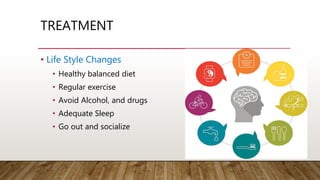
• Life Style Changes
• Healthy balanced diet
• Regular exercise
• Avoid Alcohol, and drugs
• Adequate Sleep
• Go out and socialize
TREATMENT
• Pharmacotherapy
• SSRI : Fluoxetine, Parxetine, Ecitalopram, Sertaline
• SNRI : Duloxetine, Venlafaxine
• TCA : Imipramine, Amitriptyline, Nortriptyline
• MAO Inhibitors : Isocarboxazide, Phenelzine, Moclobemide
• Atypical Antidepressants : Mirtazipine, Trazodone
• ECT
CONCLUSION
• Depression is a mental disorder that is common in the word and affects all of us.
• Reluctant to discuss or seek treatment for depression due to social stigma about
the condition, or due to ignorance of diagnosis is much common.
• Depression has been assocatied with poor treatment adherance.
• Increased health care cost
• Decreased quality of life, Increase general medical condition complications.
• High suicide rates.
CONCLUSION
• Cost effective treatment are available to improve lives of
millions of people around the world
• On an individual, community and national level, it is time
to educate ourselves about depression and support those
who are suffering from this mental disorder.
References
1. Cole MG, Dendukuri N. Risk factors for depression among elderly community subjects: a systematic review and
meta-analysis. American journal of psychiatry. 2003 Jun 1;160(6):1147-56.
2. Chalise HN. Depression among elderly living in Briddashram (old age home). Advances in Aging Research. 2014
Feb 6;2014.
3. Khattri JB. Study of depression among geriatric population in Nepal. Nepal Med Coll J. 2006 Dec 1;8(4):220-3.
4. Robinson RG, Kubos KL, Starr LB, et al: Mood disorders in stroke patients: importance of location of lesion. Brain
1984; 107:81–93
5. Robinson RG, Jorge RE. Post-stroke depression: a review. American Journal of Psychiatry. 2016 Mar
1;173(3):221-31.
6. Mikami K, Jorge RE, Adams HP Jr, et al: Effect of antidepressants on the course of disability following stroke. Am
J Geriatr Psychiatry 2011; 19:1007–1015
7. Ayerbe L, Ayis S, Wolfe CD, et al: Natural history, predictors and outcomes of depression after stroke: systematic
review and metaanalysis. Br J Psychiatry 2013; 202:14–21
8. Morris PL, Robinson RG, Samuels J. Depression, introversion and mortality following stroke. Aust N Z J
Psychiatry. 1993;27(3):443–449.
9. Farooqi A, Gillies C, Sathanapally H, Abner S, Seidu S, Davies MJ, Polonsky WH, Khunti K. A systematic review
and meta-analysis to compare the prevalence of depression between people with and without Type 1 and Type
2 diabetes. Primary Care Diabetes. 2021 Nov 19.’
10. Niraula K, Kohrt BA, Flora MS, Thapa N, Mumu SJ, Pathak R, Stray-Pedersen B, Ghimire P, Regmi B, MacFarlane
EK, Shrestha R. Prevalence of depression and associated risk factors among persons with type-2 diabetes
mellitus without a prior psychiatric history: a cross-sectional study in clinical settings in urban Nepal. BMC
psychiatry. 2013 Dec;13(1):1-2.
References
11. De Groot M, Anderson R, Freedland KE, Clouse RE, Lustman PJ. Association of depression and diabetes complications:
a meta-analysis. Psychosomatic medicine. 2001 Jul 1;63(4):619-30.
12. Shakya R, Sitaula S, Shyangwa PM. Depression during pregnancy in a tertiary care center of eastern Nepal. Journal of
Nepal Medical Association. 2008 Jul 1;47(171).
13. Giri RK, Khatri RB, Mishra SR, Khanal V, Sharma VD, Gartoula RP. Prevalence and factors associated with depressive
symptoms among post-partum mothers in Nepal. BMC research notes. 2015 Dec;8(1):1-7.
14. Bennett HA, Einarson A, Taddio A, Koren G, Einarson TR. Prevalence of depression during pregnancy: systematic review.
Obstetrics & Gynecology. 2004 Apr 1;103(4):698-709.
15. Grigoriadis S, VonderPorten EH, Mamisashvili L, et al. The impact of maternal depression during pregnancy on perinatal
outcomes: a systematic review and meta-analysis. J Clin Psychiatry 2013;74:e321-41. doi:10.4088/JCP.12r07968
pmid:23656857.
16. Fiest KM, Dykeman J, Patten SB, Wiebe S, Kaplan GG, Maxwell CJ, Bulloch AG, Jette N. Depression in epilepsy: a
systematic review and meta-analysis. Neurology. 2013 Feb 5;80(6):590-9.
17. Sah SK, Rai N, Sah MK, Timalsena M, Oli G, Katuwal N, Rajbhandari H. Comorbid depression and its associated factors in
patients with epilepsy treated with single and multiple drug therapy: A cross-sectional study from Himalayan country.
Epilepsy & Behavior. 2020 Nov 1;112:107455.
18. McConnell HW, Snyder PJ. Psychiatric comorbidity in epilepsy. In: Basic mechanismsDiagnosis and treatment. Washington
DC: American Psychiatric Press, 1998.
19. van der Hoek TC, Bus BA, Matui P, van der Marck MA, Esselink RA, Tendolkar I. Prevalence of depression in Parkinson's
disease: effects of disease stage, motor subtype and gender. Journal of the neurological sciences. 2011 Nov 15;310(1-
2):220-4.
THANK YOU

Different faces of depression

  • 1.
  • 2.
    INTRODUCTION • Depression ( नैराश्यता)is defined as an episode of clinically significant persistent and pervasive depressed mood or anhedonia , accompanied by cognitive and behavioural symptoms. • A major depressive episode must last at least 2 weeks, • Symptoms include • changes in appetite and weight, • changes in sleep and activity, • lack of energy, • feelings of guilt, • problems thinking and making decisions, and • recurring thoughts of death or suicide.
  • 3.
  • 4.
    EPIDEMOLODY • Depressive disorderhas the highest lifetime prevalence of 5-17 % of any psychiatric disorder. • According to WHO (2019) depression is a common illness worldwide, with an estimated 3.8% of the population affected, • including 5.0% among adults and 5.7% among adults older than 60 years • Approximately 280 million people in the world are said to have depression.
  • 5.
    CORRELATES OF DEPRESSION •Two fold greater in women than in men. • people younger than 45 years. • without close interpersonal relationships and in those who are divorced or separated. • More common in Urban residents • More common in Unemployement • Spring and fall season • Common in chronic diseases
  • 6.
    AETIOLOGY Genetic Factor • Ifone parent has a mood disorder, a child will have a risk of 10 - 25 % for mood disorder, • If both parents are affected, this risk roughly doubles. • Mood disorder if present, occurs 70-90% in monozygotic twins compared with the same-sex dizygotic (DZ) twins of 16-35%
  • 7.
    AETIOLOGY Biological Factors • Downregulationor decreased sensitivity of • NOREPINEPHRINE, • SEROTONIN, • DOPAMINE, • Acetylcholine, • y-Aminobutyric acid (GABA)
  • 8.
    AETIOLOGY Biological Factors • Elevatedbasal Thyroid Stimulating Hormone (TSH) • Elevated Hypothalamic Pituitary Axis (HPA) activity • Cushing syndrome • Addison's Disease • Alteration in sleep neurophysiology
  • 9.
    AETIOLOGY Psychosocial factors • Lifeevents and environmental stress. • Death of loved ones, unemployement, • Personality factors. • Anankastic, histrionic, and borderline at more risk
  • 10.
    DIAGNOSTIC CRITERIA WHO (World Health Organization) - ICD-10 (Internation Classification of Disease) APA( American Psychiatric Association - DSM -V (Diagnostic & Statistical Manual)
  • 11.
    ICD–10 DSM–V • Depressedmood • Depressed mood • Loss of interest • Loss of interest • Reduction in energy • Fatigue/loss of energy • Loss of confidence or self-esteem • Worthlessness/excessive or inappropriate guilt • Ideas of guilt and unworthiness • Recurrent thoughts of death or suicide • Recurrent thoughts of death or suicide • Reduced concentration and attention • Diminished ability to think/concentrate or indecisiveness • Psychomotor activity agitation or retardation • Psychomotor agitation or retardation • Sleep disturbance • Insomnia/hypersomnia • Change in appetite with weight change • Significant appetite and/or weight loss
  • 12.
    MILD at least2 of the core symptoms (Depressed mood, Loss of interest, Reduction in energy) plus 2 other symptoms. MODERATE at least 2 of the core symptoms plus 3/4 other symptoms. SEVERE all 3 core symptoms plus 4 other symptoms, some of which should be of severe intensity.
  • 13.
    TYPES OF DEPRESSION •Mild Depressive Disorder • Moderate Depressive Disorder • Severe Depressive Disorder • without psychotic symtoms • with psychotic symtoms
  • 14.
    TYPES OF DEPRESSION •Persistent Mood Disorder- Dythymia • 2 years, low-grade chronicity • Recurrent Depressive Disorder • More than 2 epi, seperated by atleast 2 month of remisson • Atypical Depression • overeating and oversleeping
  • 15.
    TYPES OF DEPRESSION •Postpartum Depression • within 4 weeks postpartum. • Reactive Depression • Specific live events (break up) • Seasonal Affective Disorder • seasonal pattern, occurs at a particular time of the year, usually winter
  • 16.
    TYPES OF DEPRESSION •Premenstural Dysphoric Disorder • 1 week before the menses • Recurrent Brief Depressive Disorder • Short lived depression occurring monthly • Chronic Depression • Bipolar Affective Disorder, current depressive episode
  • 17.
    TYPES OF DEPRESSION •Substance/Medication induced depressive disorder. • Alchohol, barbiturates, cocaine, amphetamine withdrawal • Steroidal contracentives • Interferon, Cycloserine, Tamoxifen • Levetiracetam, Indomethacin
  • 18.
  • 19.
    DEPRESSION IN CHILDRENAND ADOLESCENTS • affect approximately 2 to 3 % of children and up to 8 % of adolescents • environmental stressors and adverse events are major factors in youth • irritable mood may replace a depressed mood • 3 times more likely if first-degree relative affected • Somatic complaints such as headaches and stomach aches, • compromised academic achievement
  • 20.
    ELDERLY • Prevalence ofdepression among the elderly (60 years and above) in Indian elderly population as 34.4%. (Pilania 2019) • A Nepalese study showed 47.33% of elderly living in social welfare center elderly home, Pashupatinath, Gaushala had depression. (Chalise 2013) • Another study in TUTH 53.2% of the samples were found to experience depressive illness (khattri 2006) • risk factors for depression among elderly • bereavement, sleep disturbance, disability, prior depression, and female gender (Cole 2003)
  • 21.
    PREGNANCY • Prevalence ratesof 7.4%, 12.8% and 12.0% for the first, second, and third trimesters, respectively. (Bennett 2004) • Study done in BPKIHS found 50% of the pregnant women had some form of depression. (Shakya 2008) • The prevalence of post-partum depressive symptoms among mothers in Prasuti Griha was found to be 30%. (Giri 2019) • Systematic reviews show an increase in infant morbidity such as preterm birth, childhood emotional difficulties, behavior problems, and, in some studies, poor cognitive development due to depression. (Grigoriadis 2013)
  • 22.
    STROKE • 39% to52% of patients developed one or more depressions within the first 5 years following stroke (Ayerbe 2013) • Acute stroke patients with left frontal or left basal ganglia lesions had a significantly higher frequency of major or minor depression than patients with other lesion locations. (Robinson 1984) • A Significantly higher rate of mortality is present in post stroke depression, at 3months to 9 years post stroke. (Robinson 2016) • Moreover, patients with depression were 3.4 times more likely to die during the first 10 years after a stroke compared with nondepressed stroke patients (Morris 1993) • With those receiving placebo, nondepressed stroke patients receiving antidepressants had decreased disability at the 12-month follow-up. (Mikami 2011)
  • 23.
    DIABETES • The overallprevalence of depression was found to be 22% in people with Type 1 diabetes and 19% in people with Type 2 diabetes. (Farooqi 2021) • A Study conducted in TUTH, NMC , Om hospital found 40.3% of Type 2-DM patients had depression. (Niraula 2013) • Depression is significantly associated with a variety of diabetes complications (diabetic retinopathy, nephropathy, neuropathy, macrovascular complications, and sexual dysfunction) • This may be associated with adverse outcomes, including impaired functioning and quality of life, poorer adherence to medical treatment and glycemic control. (De Groot 2001)
  • 24.
    CORONARY HEART DISEASE •1.5-2 times risk of MI and cardiac related mortality in Depression • Major cardiac events like recurrent infraction, sudden cardiac death has been associated with depression. • Increased in Revascularization procedure for unstable angina has been reported. • Mechanism: • Poor Life style • Sympathetic System and HPA disregulation • Disordered platetlet aggregation
  • 25.
    EPILEPSY • Around 400B.C., Hippocrates wrote, “Melancholics ordinarily become epileptics, and epileptics, melancholics” • The prevalence of active depression in epilepsy across the 9 studies reporting on 29,891 persons ranged from 13.2% to 36.5%. (Fiest 2013) • The prevalence of depression was found to be 31% at Nepal Epilepsy Center, Lazimpat, Kathmandu, Nepal. (Shah 2011) • Untreated depression leads to worsening of seizure, noncompliance, distress, disability, loss of quality of life and suicide. (McConnell 1998) • Drugs like : Levetrecetam , carbazipine
  • 26.
    CANCER • Depression hasbeen found to be prevalent in 50% of the cancer patients. • Tumor in diencephalon and temporal region likely to be associated with depressive symptoms • High rates of depression in Ca Pancreatic head and neck , breast and lungs. • Depression is risk for sucide in ca patients. 12.6 times risky in 1st week and 3 times in 1st year • Drugs: Tamoxifen , Interferon, Corticosteroids may cause depressive symptoms.
  • 27.
    • Parkinson's disease •Prevalence rates ranged from 20% to 40%. • COPD • 25-50% prevalence of depression • Cystic Fibrosis • 13-29% adults with CF reports symptoms of depression
  • 28.
    TREATMENT • Psychotherapy • CognitiveBehaviour Therapy (CBT) • Interpersonal Therapy • Insight Oriented Therapy • Family and Group Therapy
  • 29.
    TREATMENT • Life StyleChanges • Healthy balanced diet • Regular exercise • Avoid Alcohol, and drugs • Adequate Sleep • Go out and socialize
  • 30.
    TREATMENT • Pharmacotherapy • SSRI: Fluoxetine, Parxetine, Ecitalopram, Sertaline • SNRI : Duloxetine, Venlafaxine • TCA : Imipramine, Amitriptyline, Nortriptyline • MAO Inhibitors : Isocarboxazide, Phenelzine, Moclobemide • Atypical Antidepressants : Mirtazipine, Trazodone • ECT
  • 31.
    CONCLUSION • Depression isa mental disorder that is common in the word and affects all of us. • Reluctant to discuss or seek treatment for depression due to social stigma about the condition, or due to ignorance of diagnosis is much common. • Depression has been assocatied with poor treatment adherance. • Increased health care cost • Decreased quality of life, Increase general medical condition complications. • High suicide rates.
  • 32.
    CONCLUSION • Cost effectivetreatment are available to improve lives of millions of people around the world • On an individual, community and national level, it is time to educate ourselves about depression and support those who are suffering from this mental disorder.
  • 33.
    References 1. Cole MG,Dendukuri N. Risk factors for depression among elderly community subjects: a systematic review and meta-analysis. American journal of psychiatry. 2003 Jun 1;160(6):1147-56. 2. Chalise HN. Depression among elderly living in Briddashram (old age home). Advances in Aging Research. 2014 Feb 6;2014. 3. Khattri JB. Study of depression among geriatric population in Nepal. Nepal Med Coll J. 2006 Dec 1;8(4):220-3. 4. Robinson RG, Kubos KL, Starr LB, et al: Mood disorders in stroke patients: importance of location of lesion. Brain 1984; 107:81–93 5. Robinson RG, Jorge RE. Post-stroke depression: a review. American Journal of Psychiatry. 2016 Mar 1;173(3):221-31. 6. Mikami K, Jorge RE, Adams HP Jr, et al: Effect of antidepressants on the course of disability following stroke. Am J Geriatr Psychiatry 2011; 19:1007–1015 7. Ayerbe L, Ayis S, Wolfe CD, et al: Natural history, predictors and outcomes of depression after stroke: systematic review and metaanalysis. Br J Psychiatry 2013; 202:14–21 8. Morris PL, Robinson RG, Samuels J. Depression, introversion and mortality following stroke. Aust N Z J Psychiatry. 1993;27(3):443–449. 9. Farooqi A, Gillies C, Sathanapally H, Abner S, Seidu S, Davies MJ, Polonsky WH, Khunti K. A systematic review and meta-analysis to compare the prevalence of depression between people with and without Type 1 and Type 2 diabetes. Primary Care Diabetes. 2021 Nov 19.’ 10. Niraula K, Kohrt BA, Flora MS, Thapa N, Mumu SJ, Pathak R, Stray-Pedersen B, Ghimire P, Regmi B, MacFarlane EK, Shrestha R. Prevalence of depression and associated risk factors among persons with type-2 diabetes mellitus without a prior psychiatric history: a cross-sectional study in clinical settings in urban Nepal. BMC psychiatry. 2013 Dec;13(1):1-2.
  • 34.
    References 11. De GrootM, Anderson R, Freedland KE, Clouse RE, Lustman PJ. Association of depression and diabetes complications: a meta-analysis. Psychosomatic medicine. 2001 Jul 1;63(4):619-30. 12. Shakya R, Sitaula S, Shyangwa PM. Depression during pregnancy in a tertiary care center of eastern Nepal. Journal of Nepal Medical Association. 2008 Jul 1;47(171). 13. Giri RK, Khatri RB, Mishra SR, Khanal V, Sharma VD, Gartoula RP. Prevalence and factors associated with depressive symptoms among post-partum mothers in Nepal. BMC research notes. 2015 Dec;8(1):1-7. 14. Bennett HA, Einarson A, Taddio A, Koren G, Einarson TR. Prevalence of depression during pregnancy: systematic review. Obstetrics & Gynecology. 2004 Apr 1;103(4):698-709. 15. Grigoriadis S, VonderPorten EH, Mamisashvili L, et al. The impact of maternal depression during pregnancy on perinatal outcomes: a systematic review and meta-analysis. J Clin Psychiatry 2013;74:e321-41. doi:10.4088/JCP.12r07968 pmid:23656857. 16. Fiest KM, Dykeman J, Patten SB, Wiebe S, Kaplan GG, Maxwell CJ, Bulloch AG, Jette N. Depression in epilepsy: a systematic review and meta-analysis. Neurology. 2013 Feb 5;80(6):590-9. 17. Sah SK, Rai N, Sah MK, Timalsena M, Oli G, Katuwal N, Rajbhandari H. Comorbid depression and its associated factors in patients with epilepsy treated with single and multiple drug therapy: A cross-sectional study from Himalayan country. Epilepsy & Behavior. 2020 Nov 1;112:107455. 18. McConnell HW, Snyder PJ. Psychiatric comorbidity in epilepsy. In: Basic mechanismsDiagnosis and treatment. Washington DC: American Psychiatric Press, 1998. 19. van der Hoek TC, Bus BA, Matui P, van der Marck MA, Esselink RA, Tendolkar I. Prevalence of depression in Parkinson's disease: effects of disease stage, motor subtype and gender. Journal of the neurological sciences. 2011 Nov 15;310(1- 2):220-4.
  • 35.