CHAPTER : DEPRECIATION
BY: Dr.Amit Parihast
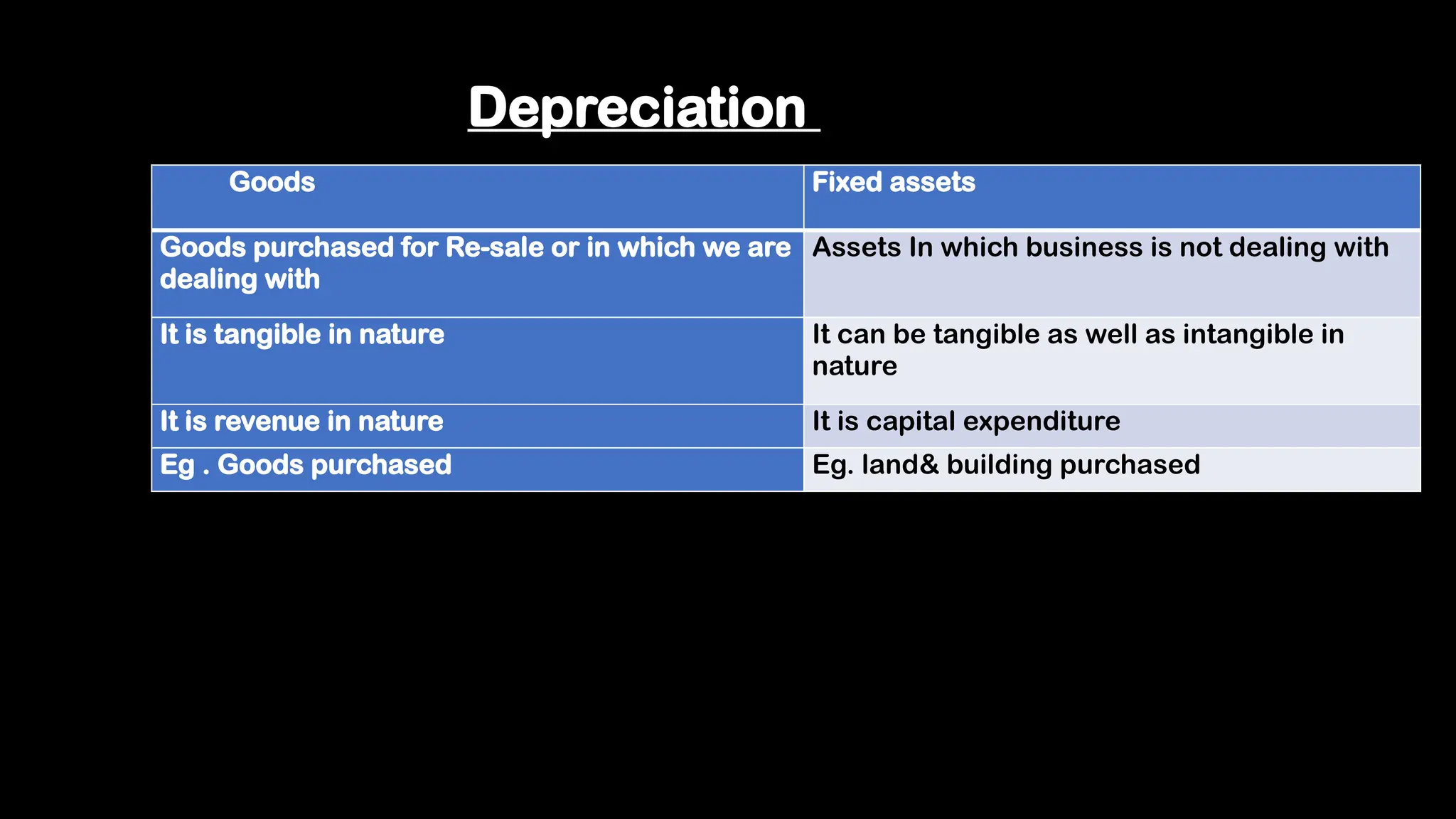
Depreciation
Goods Fixed assets
Goods purchased for Re-sale or in which we are
dealing with
Assets In which business is not dealing with
It is tangible in nature It can be tangible as well as intangible in
nature
It is revenue in nature It is capital expenditure
Eg . Goods purchased Eg. land& building purchased
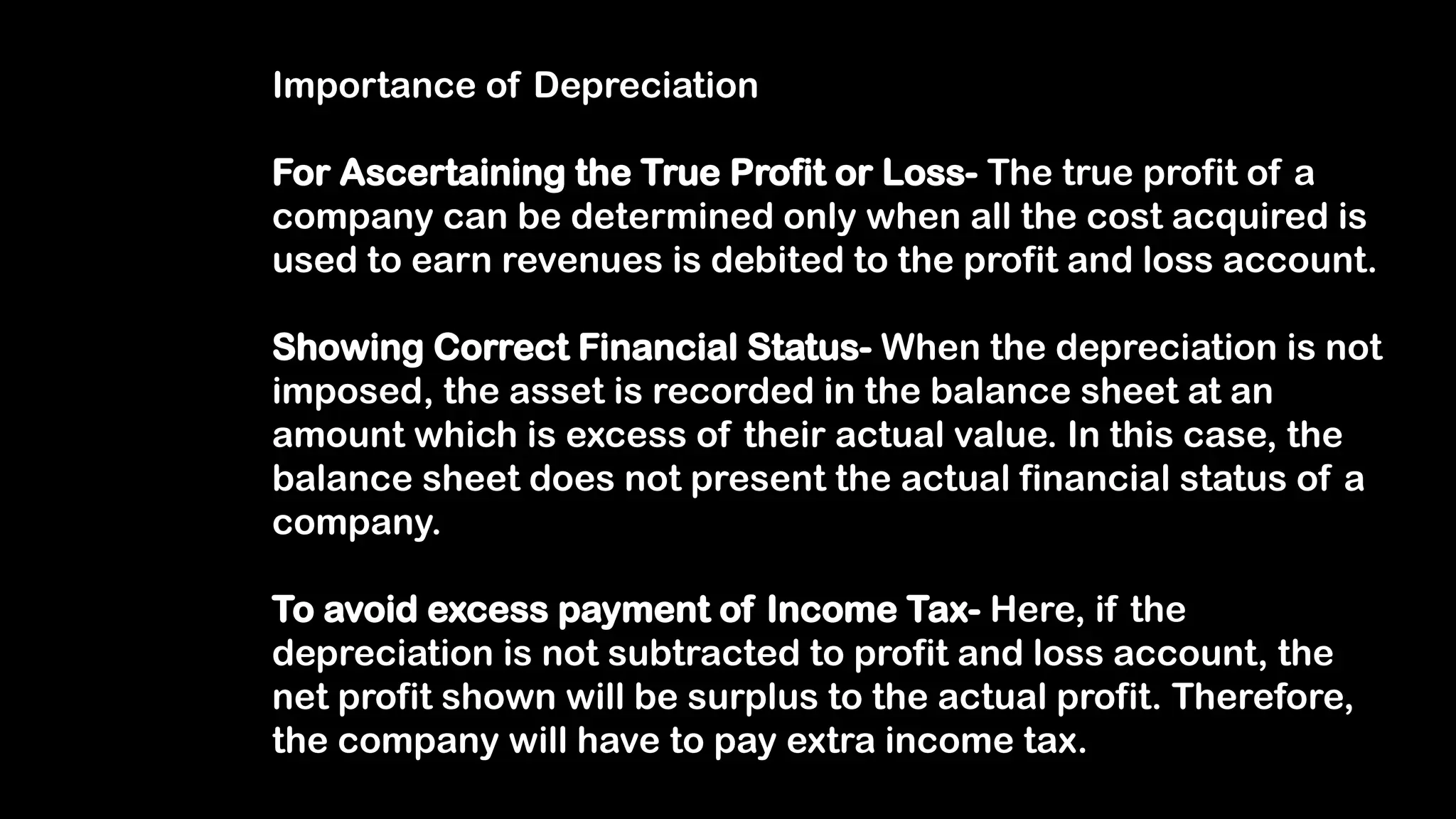
Importance of Depreciation
For Ascertaining the True Profit or Loss- The true profit of a
company can be determined only when all the cost acquired is
used to earn revenues is debited to the profit and loss account.
Showing Correct Financial Status- When the depreciation is not
imposed, the asset is recorded in the balance sheet at an
amount which is excess of their actual value. In this case, the
balance sheet does not present the actual financial status of a
company.
To avoid excess payment of Income Tax- Here, if the
depreciation is not subtracted to profit and loss account, the
net profit shown will be surplus to the actual profit. Therefore,
the company will have to pay extra income tax.
Depreciation : It is a reduction in the price or value of an
assets due to internal and external changes .
Causes of depreciation :
(1) internal changes
A. Wear &tear
B. Passage of time
(2) external changes
A. Technological advancement
B. Change in fashion
Methods of charging depreciation
(1) straight line method
(2) written down value method
1. Straight line method/original cost value method/equal instalment
method /fixed Instalment method :
Under this method the amount of depreciation is calculated on the
original cost of assets from the beginning to end .
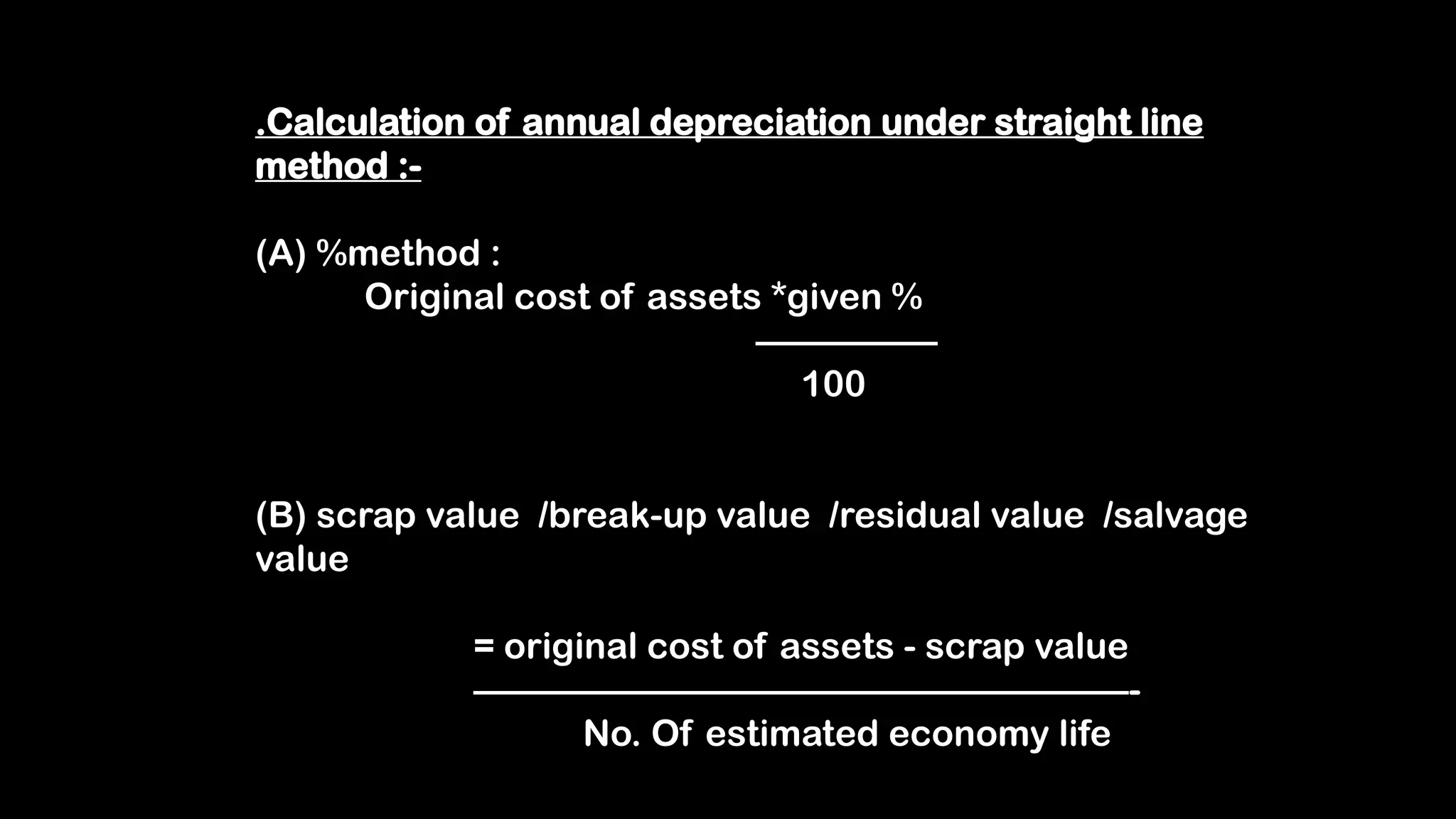
.Calculation of annual depreciation under straight line
method :-
(A) %method :
Original cost of assets *given %
—————
100
(B) scrap value /break-up value /residual value /salvage
value
= original cost of assets - scrap value
——————————————————-
No. Of estimated economy life
2. Written down value method / diminishing balance method
/fixed instalment method :
Under this method the amount of depreciation we charge on
the reducing balance of assets after ist year .
2. Calculation of annual depreciation under written down value
method
=original cost of assets *given %
—————
100
[****original cost method= cost os assets
purchased+additional expenditure till installation]
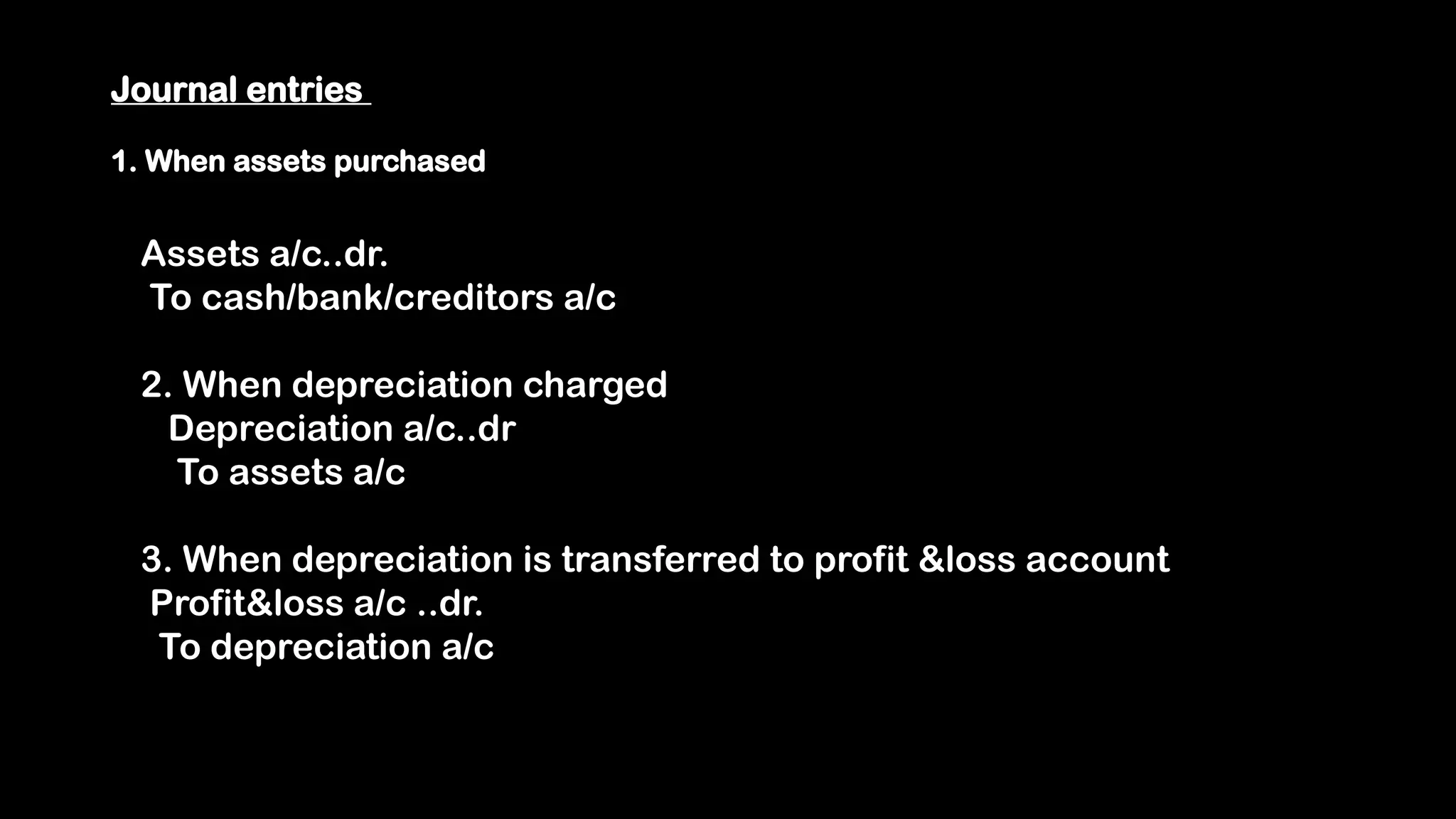
Journal entries
1. When assets purchased
Assets a/c..dr.
To cash/bank/creditors a/c
2. When depreciation charged
Depreciation a/c..dr
To assets a/c
3. When depreciation is transferred to profit &loss account
Profit&loss a/c ..dr.
To depreciation a/c
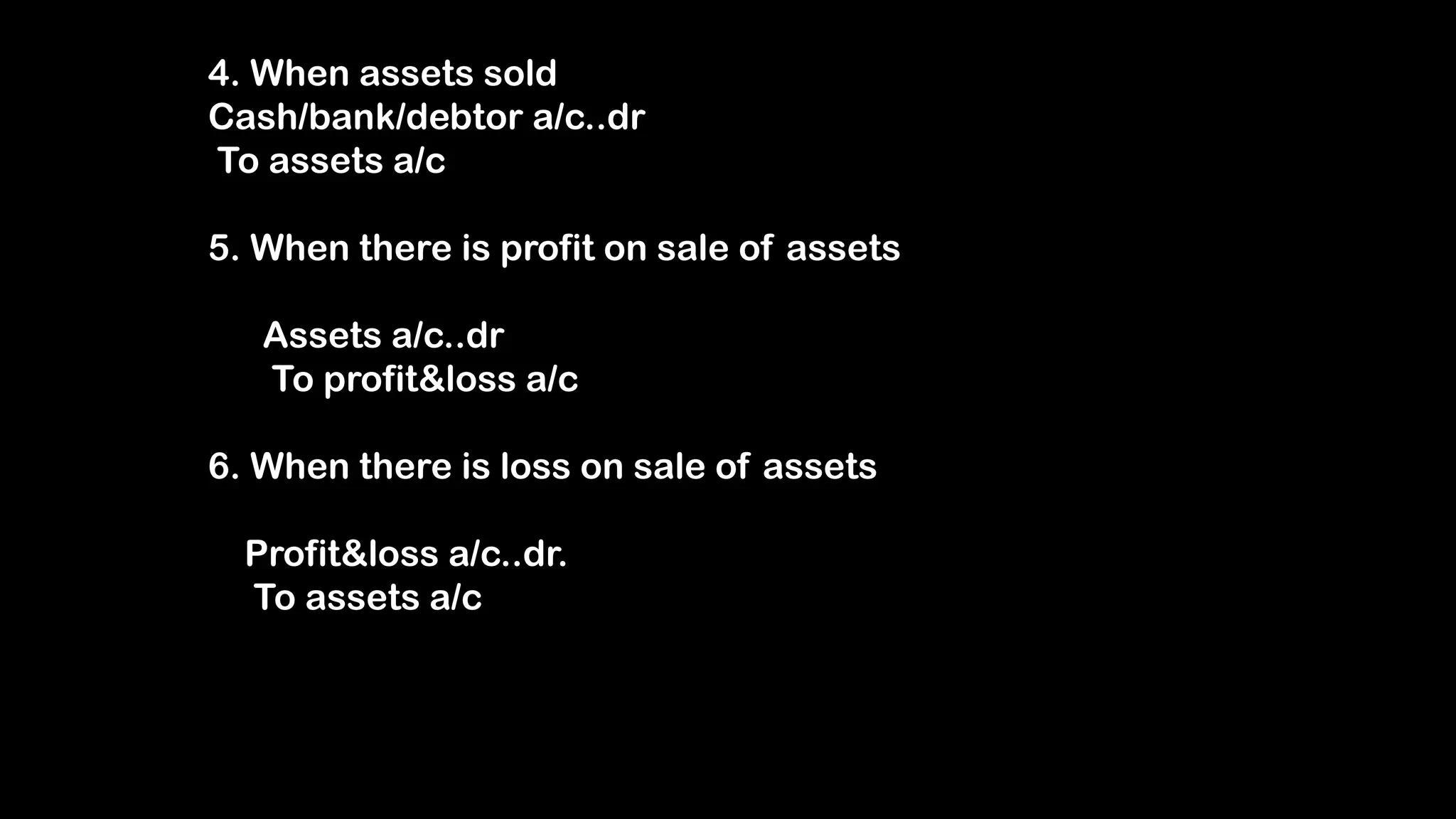
4. When assets sold
Cash/bank/debtor a/c..dr
To assets a/c
5. When there is profit on sale of assets
Assets a/c..dr
To profit&loss a/c
6. When there is loss on sale of assets
Profit&loss a/c..dr.
To assets a/c
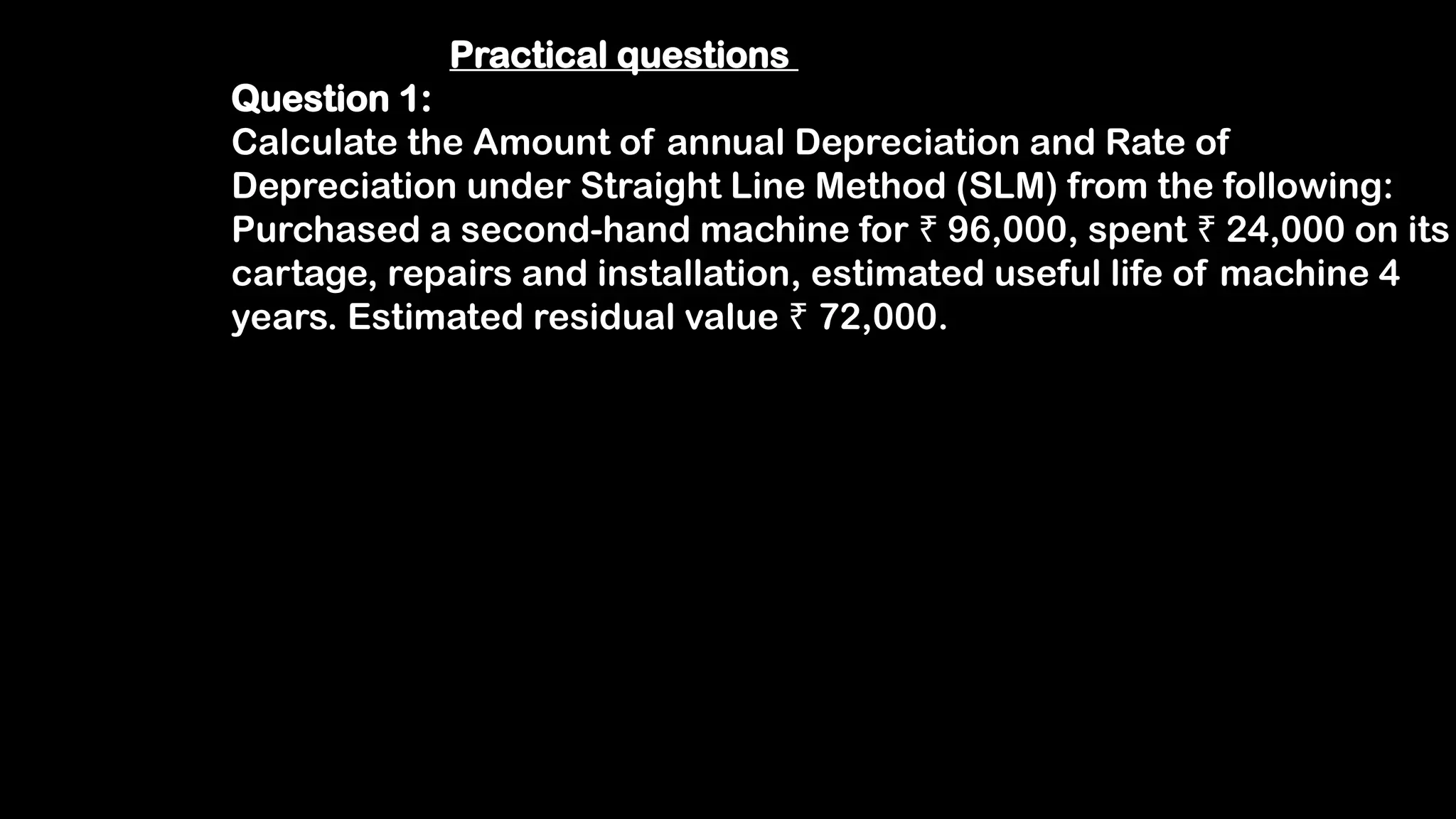
Practical questions
Question 1:
Calculate the Amount of annual Depreciation and Rate of
Depreciation under Straight Line Method (SLM) from the following:
Purchased a second-hand machine for 96,000, spent 24,000 on its
₹ ₹
cartage, repairs and installation, estimated useful life of machine 4
years. Estimated residual value 72,000.
₹
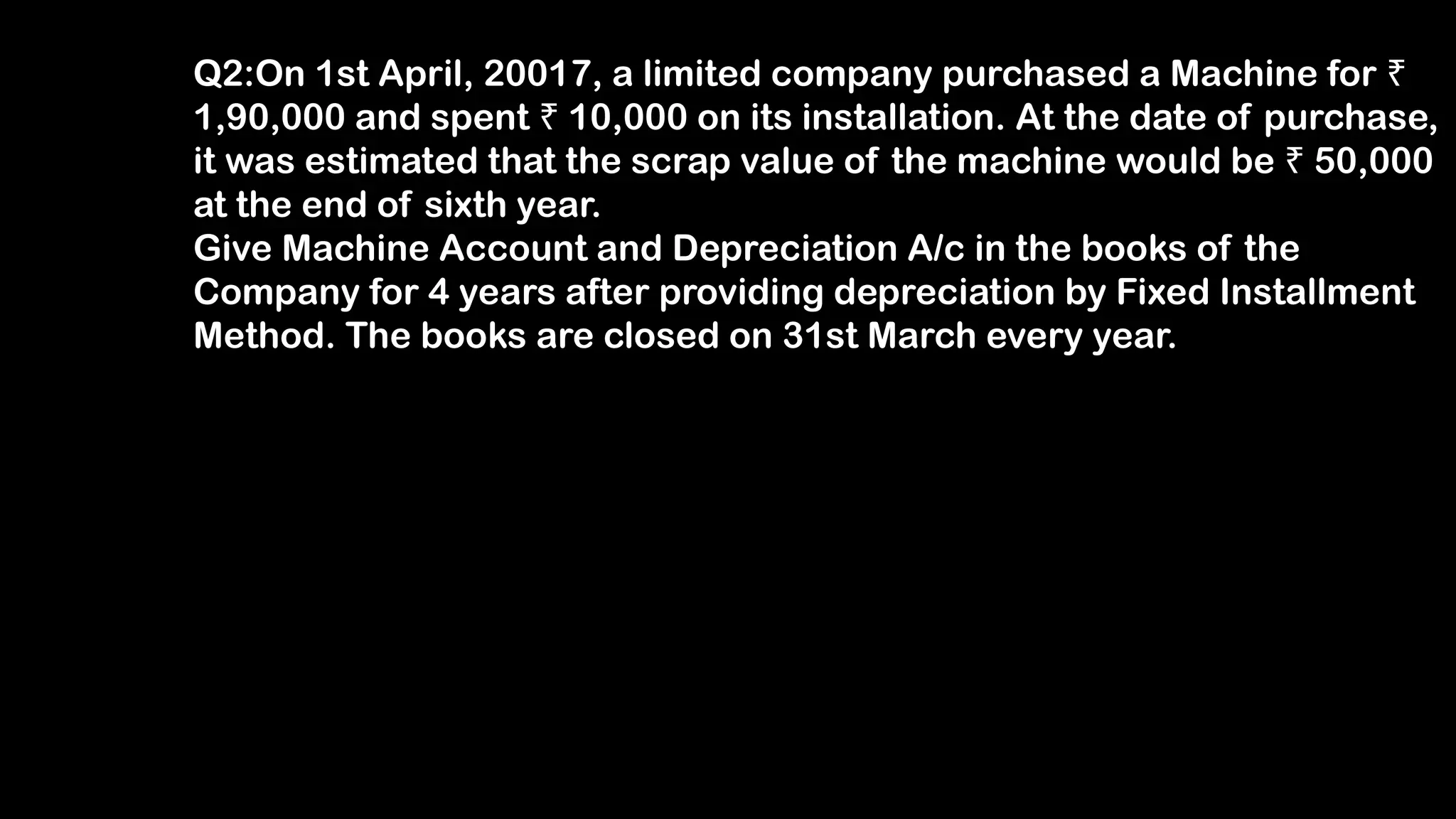
Q2:On 1st April, 20017, a limited company purchased a Machine for ₹
1,90,000 and spent 10,000 on its installation. At the date of purchase,
₹
it was estimated that the scrap value of the machine would be 50,000
₹
at the end of sixth year.
Give Machine Account and Depreciation A/c in the books of the
Company for 4 years after providing depreciation by Fixed Installment
Method. The books are closed on 31st March every year.
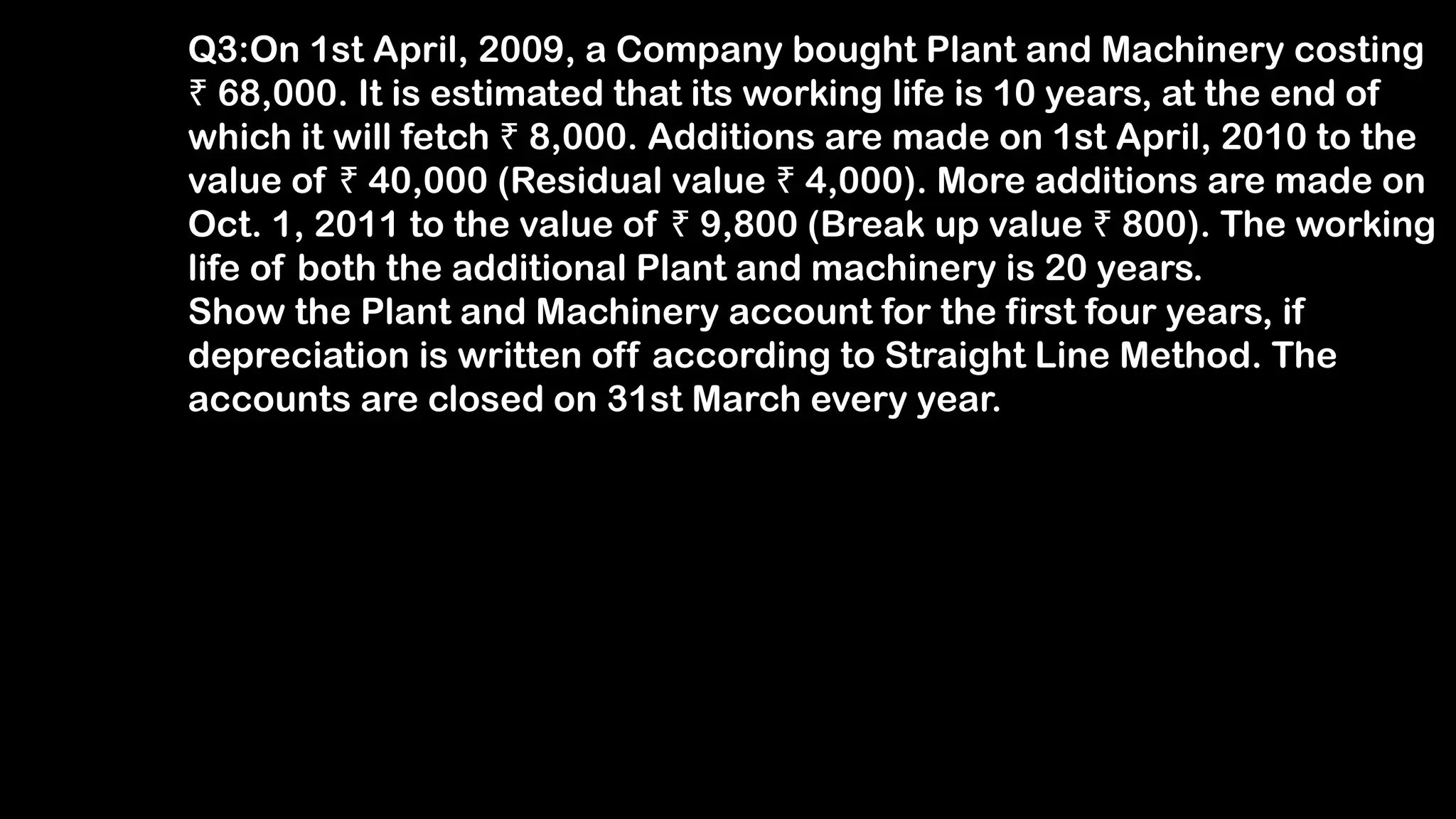
Q3:On 1st April, 2009, a Company bought Plant and Machinery costing
₹ 68,000. It is estimated that its working life is 10 years, at the end of
which it will fetch ₹ 8,000. Additions are made on 1st April, 2010 to the
value of ₹ 40,000 (Residual value ₹ 4,000). More additions are made on
Oct. 1, 2011 to the value of ₹ 9,800 (Break up value ₹ 800). The working
life of both the additional Plant and machinery is 20 years.
Show the Plant and Machinery account for the first four years, if
depreciation is written off according to Straight Line Method. The
accounts are closed on 31st March every year.
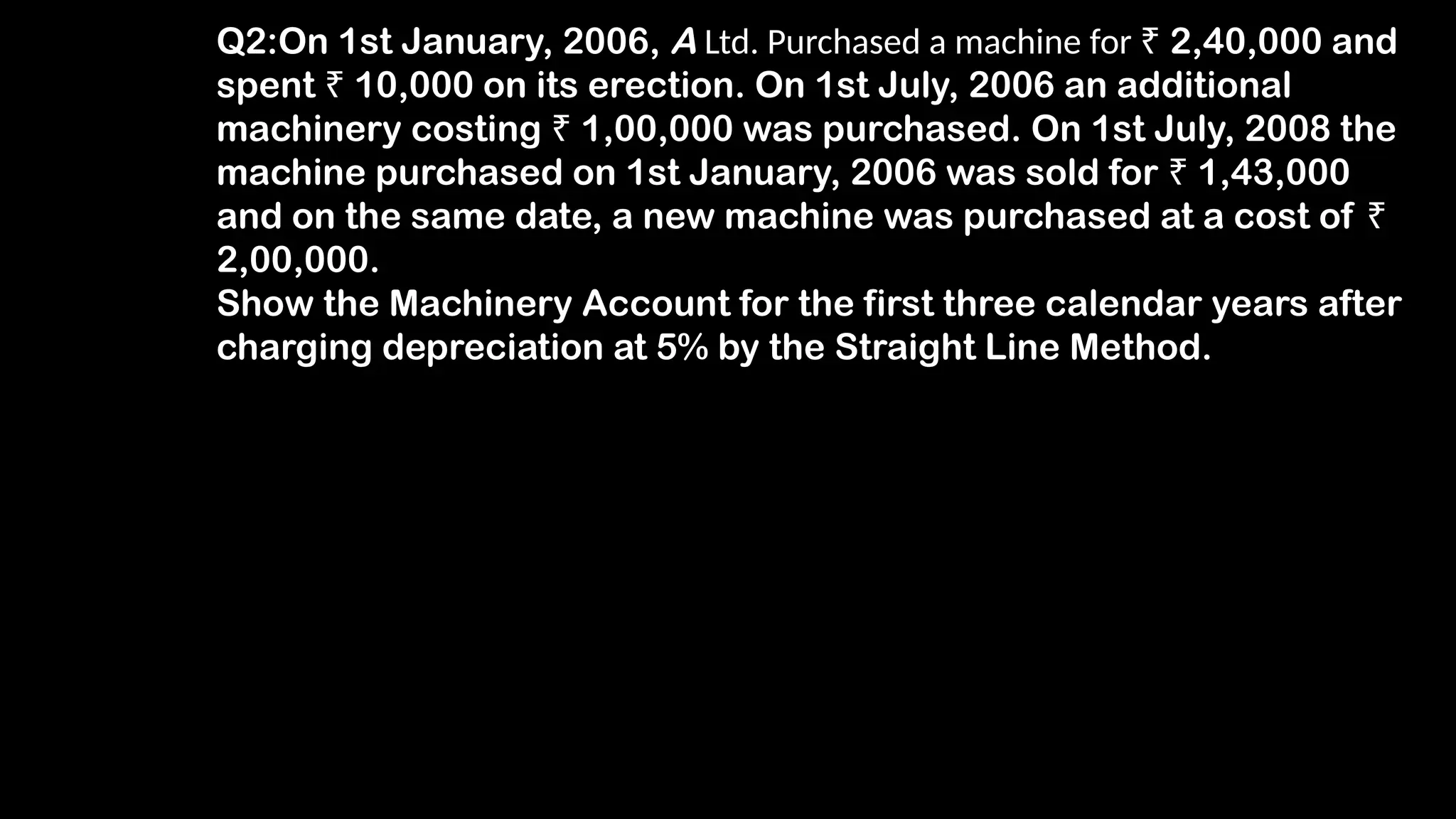
Q2:On 1st January, 2006, A Ltd. Purchased a machine for ₹ 2,40,000 and
spent ₹ 10,000 on its erection. On 1st July, 2006 an additional
machinery costing ₹ 1,00,000 was purchased. On 1st July, 2008 the
machine purchased on 1st January, 2006 was sold for ₹ 1,43,000
and on the same date, a new machine was purchased at a cost of ₹
2,00,000.
Show the Machinery Account for the first three calendar years after
charging depreciation at 5% by the Straight Line Method.
Thank you

Presentation.pptxd ddddddddddddddddddddddddddddddddd

  • 1.
  • 2.
    Depreciation Goods Fixed assets Goodspurchased for Re-sale or in which we are dealing with Assets In which business is not dealing with It is tangible in nature It can be tangible as well as intangible in nature It is revenue in nature It is capital expenditure Eg . Goods purchased Eg. land& building purchased
  • 3.
    Importance of Depreciation ForAscertaining the True Profit or Loss- The true profit of a company can be determined only when all the cost acquired is used to earn revenues is debited to the profit and loss account. Showing Correct Financial Status- When the depreciation is not imposed, the asset is recorded in the balance sheet at an amount which is excess of their actual value. In this case, the balance sheet does not present the actual financial status of a company. To avoid excess payment of Income Tax- Here, if the depreciation is not subtracted to profit and loss account, the net profit shown will be surplus to the actual profit. Therefore, the company will have to pay extra income tax.
  • 4.
    Depreciation : Itis a reduction in the price or value of an assets due to internal and external changes . Causes of depreciation : (1) internal changes A. Wear &tear B. Passage of time (2) external changes A. Technological advancement B. Change in fashion
  • 5.
    Methods of chargingdepreciation (1) straight line method (2) written down value method 1. Straight line method/original cost value method/equal instalment method /fixed Instalment method : Under this method the amount of depreciation is calculated on the original cost of assets from the beginning to end .
  • 6.
    .Calculation of annualdepreciation under straight line method :- (A) %method : Original cost of assets *given % ————— 100 (B) scrap value /break-up value /residual value /salvage value = original cost of assets - scrap value ——————————————————- No. Of estimated economy life
  • 7.
    2. Written downvalue method / diminishing balance method /fixed instalment method : Under this method the amount of depreciation we charge on the reducing balance of assets after ist year . 2. Calculation of annual depreciation under written down value method =original cost of assets *given % ————— 100 [****original cost method= cost os assets purchased+additional expenditure till installation]
  • 8.
    Journal entries 1. Whenassets purchased Assets a/c..dr. To cash/bank/creditors a/c 2. When depreciation charged Depreciation a/c..dr To assets a/c 3. When depreciation is transferred to profit &loss account Profit&loss a/c ..dr. To depreciation a/c
  • 9.
    4. When assetssold Cash/bank/debtor a/c..dr To assets a/c 5. When there is profit on sale of assets Assets a/c..dr To profit&loss a/c 6. When there is loss on sale of assets Profit&loss a/c..dr. To assets a/c
  • 10.
    Practical questions Question 1: Calculatethe Amount of annual Depreciation and Rate of Depreciation under Straight Line Method (SLM) from the following: Purchased a second-hand machine for 96,000, spent 24,000 on its ₹ ₹ cartage, repairs and installation, estimated useful life of machine 4 years. Estimated residual value 72,000. ₹
  • 11.
    Q2:On 1st April,20017, a limited company purchased a Machine for ₹ 1,90,000 and spent 10,000 on its installation. At the date of purchase, ₹ it was estimated that the scrap value of the machine would be 50,000 ₹ at the end of sixth year. Give Machine Account and Depreciation A/c in the books of the Company for 4 years after providing depreciation by Fixed Installment Method. The books are closed on 31st March every year.
  • 13.
    Q3:On 1st April,2009, a Company bought Plant and Machinery costing ₹ 68,000. It is estimated that its working life is 10 years, at the end of which it will fetch ₹ 8,000. Additions are made on 1st April, 2010 to the value of ₹ 40,000 (Residual value ₹ 4,000). More additions are made on Oct. 1, 2011 to the value of ₹ 9,800 (Break up value ₹ 800). The working life of both the additional Plant and machinery is 20 years. Show the Plant and Machinery account for the first four years, if depreciation is written off according to Straight Line Method. The accounts are closed on 31st March every year.
  • 14.
    Q2:On 1st January,2006, A Ltd. Purchased a machine for ₹ 2,40,000 and spent ₹ 10,000 on its erection. On 1st July, 2006 an additional machinery costing ₹ 1,00,000 was purchased. On 1st July, 2008 the machine purchased on 1st January, 2006 was sold for ₹ 1,43,000 and on the same date, a new machine was purchased at a cost of ₹ 2,00,000. Show the Machinery Account for the first three calendar years after charging depreciation at 5% by the Straight Line Method.
  • 15.