DEFINITION
HKSSAP defines depreciation as the
‘allocation of the depreciable
amount of an asset over its
estimated life’.
THE OBJECTIVE OF DEPRECIATION
 According to the matching concept, revenues should be
matched with expenses in order to determine the accounting
profit.
 The cost of the asset purchased should be spread over the
periods in which the asset will benefit a company.
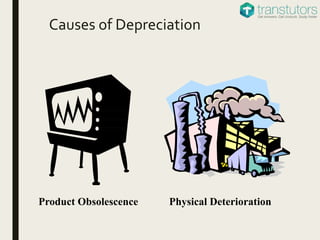
Causes of Depreciation
Product Obsolescence Physical Deterioration
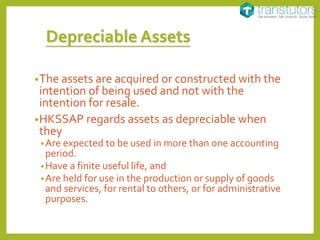
Depreciable Assets
•The assets are acquired or constructed with the
intention of being used and not with the
intention for resale.
•HKSSAP regards assets as depreciable when
they
•Are expected to be used in more than one accounting
period.
•Have a finite useful life, and
•Are held for use in the production or supply of goods
and services, for rental to others, or for administrative
purposes.
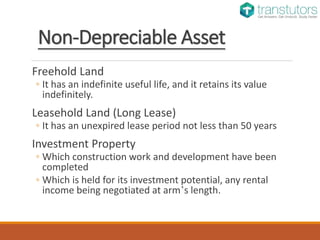
Non-Depreciable Asset
Freehold Land
◦ It has an indefinite useful life, and it retains its value
indefinitely.
Leasehold Land (Long Lease)
◦ It has an unexpired lease period not less than 50 years
Investment Property
◦ Which construction work and development have been
completed
◦ Which is held for its investment potential, any rental
income being negotiated at arm’s length.
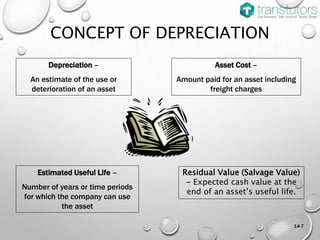
Estimated Useful Life –
Number of years or time periods
for which the company can use
the asset
Depreciation –
An estimate of the use or
deterioration of an asset
Asset Cost –
Amount paid for an asset including
freight charges
CONCEPT OF DEPRECIATION
Residual Value (Salvage Value)
- Expected cash value at the
end of an asset’s useful life.
14-7
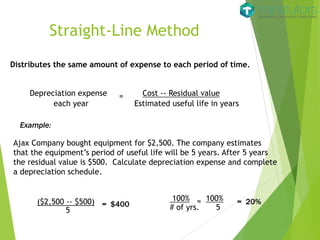
Straight-Line Method
Distributes the same amount of expense to each period of time.
Depreciation expense = Cost -- Residual value
each year Estimated useful life in years
Ajax Company bought equipment for $2,500. The company estimates
that the equipment’s period of useful life will be 5 years. After 5 years
the residual value is $500. Calculate depreciation expense and complete
a depreciation schedule.
($2,500 -- $500)
5
100% = 100%
# of yrs. 5= $400 = 20%
Example:
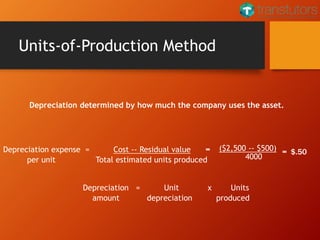
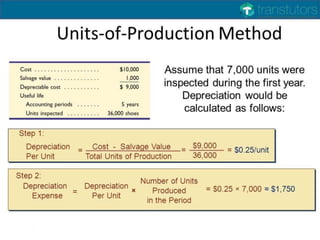
Units-of-Production Method
Depreciation determined by how much the company uses the asset.
Depreciation expense = Cost -- Residual value
per unit Total estimated units produced
Depreciation = Unit x Units
amount depreciation produced
($2,500 -- $500)
4000
= $.50=
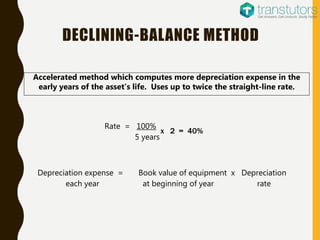
Depreciation expense = Book value of equipment x Depreciation
each year at beginning of year rate
Accelerated method which computes more depreciation expense in the
early years of the asset’s life. Uses up to twice the straight-line rate.
DECLINING-BALANCE METHOD
Rate = 100%
5 years
x 2 = 40%
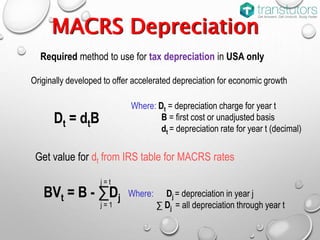
MACRS Depreciation
Required method to use for tax depreciation in USA only
Originally developed to offer accelerated depreciation for economic growth
Dt = dtB
Where: Dt = depreciation charge for year t
B = first cost or unadjusted basis
dt = depreciation rate for year t (decimal)
Where: Dj = depreciation in year j
∑ Dj = all depreciation through year t
BVt = B - ∑Dj
j = 1
j = t
Get value for dt from IRS table for MACRS rates
Hey Friend
This was just a summary on Depreciation. For more
detailed information on this topic, please type the link given
below or copy it from the description of this PPT and open
it in a new browser window.
www.transtutors.com/homework-help/accounting/depreciation.aspx

Depreciation | Accounting

  • 2.
    DEFINITION HKSSAP defines depreciationas the ‘allocation of the depreciable amount of an asset over its estimated life’.
  • 3.
    THE OBJECTIVE OFDEPRECIATION  According to the matching concept, revenues should be matched with expenses in order to determine the accounting profit.  The cost of the asset purchased should be spread over the periods in which the asset will benefit a company.
  • 4.
    Causes of Depreciation ProductObsolescence Physical Deterioration
  • 5.
    Depreciable Assets •The assetsare acquired or constructed with the intention of being used and not with the intention for resale. •HKSSAP regards assets as depreciable when they •Are expected to be used in more than one accounting period. •Have a finite useful life, and •Are held for use in the production or supply of goods and services, for rental to others, or for administrative purposes.
  • 6.
    Non-Depreciable Asset Freehold Land ◦It has an indefinite useful life, and it retains its value indefinitely. Leasehold Land (Long Lease) ◦ It has an unexpired lease period not less than 50 years Investment Property ◦ Which construction work and development have been completed ◦ Which is held for its investment potential, any rental income being negotiated at arm’s length.
  • 7.
    Estimated Useful Life– Number of years or time periods for which the company can use the asset Depreciation – An estimate of the use or deterioration of an asset Asset Cost – Amount paid for an asset including freight charges CONCEPT OF DEPRECIATION Residual Value (Salvage Value) - Expected cash value at the end of an asset’s useful life. 14-7
  • 8.
    Straight-Line Method Distributes thesame amount of expense to each period of time. Depreciation expense = Cost -- Residual value each year Estimated useful life in years Ajax Company bought equipment for $2,500. The company estimates that the equipment’s period of useful life will be 5 years. After 5 years the residual value is $500. Calculate depreciation expense and complete a depreciation schedule. ($2,500 -- $500) 5 100% = 100% # of yrs. 5= $400 = 20% Example:
  • 9.
    Units-of-Production Method Depreciation determinedby how much the company uses the asset. Depreciation expense = Cost -- Residual value per unit Total estimated units produced Depreciation = Unit x Units amount depreciation produced ($2,500 -- $500) 4000 = $.50=
  • 12.
    Depreciation expense =Book value of equipment x Depreciation each year at beginning of year rate Accelerated method which computes more depreciation expense in the early years of the asset’s life. Uses up to twice the straight-line rate. DECLINING-BALANCE METHOD Rate = 100% 5 years x 2 = 40%
  • 13.
    MACRS Depreciation Required methodto use for tax depreciation in USA only Originally developed to offer accelerated depreciation for economic growth Dt = dtB Where: Dt = depreciation charge for year t B = first cost or unadjusted basis dt = depreciation rate for year t (decimal) Where: Dj = depreciation in year j ∑ Dj = all depreciation through year t BVt = B - ∑Dj j = 1 j = t Get value for dt from IRS table for MACRS rates
  • 14.
    Hey Friend This wasjust a summary on Depreciation. For more detailed information on this topic, please type the link given below or copy it from the description of this PPT and open it in a new browser window. www.transtutors.com/homework-help/accounting/depreciation.aspx