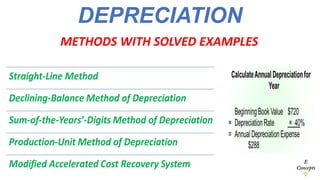
DEPRECIATION
METHODS WITH SOLVED EXAMPLES
A permanent fall in the value of fixed assets arising through wear and tear from the use of those assets in
business.
To calculate the proper profit.
To show the asset at its reasonable value or true financial position.
To provide replacement of an asset.
To correct cost of Production.
Depreciation is permitted to be deducted from profit for tax purposes.
DEPRECIATION
Objectives - Depreciation:
Internal causes:
Wear & tear, disuse, maintenance,
change & restriction in production,
reduced demand, technical progress,
and depletion.
External causes:
Obsolescence and effluxion of time
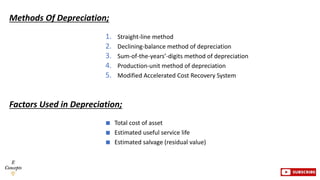
■ Total cost of asset
■ Estimated useful service life
■ Estimated salvage (residual value)
Factors Used in Depreciation;
1. Straight-line method
2. Declining-balance method of depreciation
3. Sum-of-the-years’-digits method of depreciation
4. Production-unit method of depreciation
5. Modified Accelerated Cost Recovery System
Methods Of Depreciation;
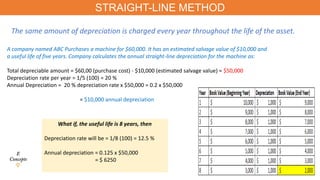
The same amount of depreciation is charged every year throughout the life of the asset.
STRAIGHT-LINE METHOD
A company named ABC Purchases a machine for $60,000. It has an estimated salvage value of $10,000 and
a useful life of five years. Company calculates the annual straight-line depreciation for the machine as:
Total depreciable amount = $60,00 (purchase cost) - $10,000 (estimated salvage value) = $50,000
Depreciation rate per year = 1/5 (100) = 20 %
Annual Depreciation = 20 % depreciation rate x $50,000 = 0.2 x $50,000
= $10,000 annual depreciation
What if, the useful life is 8 years, then
Depreciation rate will be = 1/8 (100) = 12.5 %
Annual depreciation = 0.125 x $50,000
= $ 6250
 Many plant assets depreciate more in the early years of useful life than in the later years. Charging more
depreciation expense in the early years may be more accurate than charging the same amount each year.
 Multiplying the book value at the end of each fiscal period by a constant depreciation rate is called the
declining-balance method of depreciation.
DECLINING-BALANCE METHOD OF DEPRECIATION
▪ The declining-balance depreciation rate is based on the straight-line rate. It is twice the straight-line rate
(called the double declining-balance method).
Remember: Do not use salvage value in computing the book value.
DECLINING-BALANCE METHOD OF DEPRECIATION
ABC Purchased a computer for $2,000 on January 1st. The computer has a useful life of 5 years and an estimated
salvage value of $175
A plant asset is never depreciated below its estimated
salvage value.
Calculate the declining-balance rate:
Estimated Useful life = 5 years
Straight-line rate = 1/5 (100) = 20 %
Double this rate for declining balance method
so,
Declining balance rate = 40 %
Calculate the annual depreciation for year 1
Beginning Book Value = $2000
Depreciation Rate = 40 %
Annual depreciation expense = 0.4 x $2000 = $800 $259 x 0.4
=
$103.68
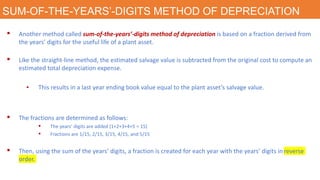
SUM-OF-THE-YEARS’-DIGITS METHOD OF DEPRECIATION
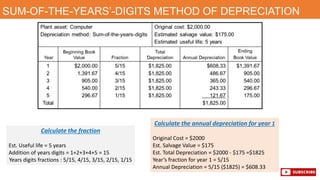
▪ Another method called sum-of-the-years’-digits method of depreciation is based on a fraction derived from
the years’ digits for the useful life of a plant asset.
▪ Like the straight-line method, the estimated salvage value is subtracted from the original cost to compute an
estimated total depreciation expense.
▪ This results in a last year ending book value equal to the plant asset’s salvage value.
▪ The fractions are determined as follows:
▪ The years’ digits are added (1+2+3+4+5 = 15)
▪ Fractions are 1/15, 2/15, 3/15, 4/15, and 5/15
▪ Then, using the sum of the years’ digits, a fraction is created for each year with the years’ digits in reverse
order.
SUM-OF-THE-YEARS’-DIGITS METHOD OF DEPRECIATION
Calculate the annual depreciation for year 1
Original Cost = $2000
Est. Salvage Value = $175
Est. Total Depreciation = $2000 - $175 =$1825
Year’s fraction for year 1 = 5/15
Annual Depreciation = 5/15 ($1825) = $608.33
Calculate the fraction
Est. Useful life = 5 years
Addition of years digits = 1+2+3+4+5 = 15
Years digits fractions : 5/15, 4/15, 3/15, 2/15, 1/15
COMPARISON OF THREE METHODS OF DEPRECIATION
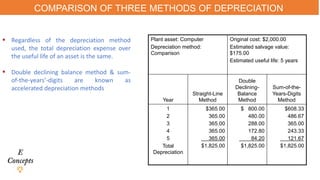
▪ Regardless of the depreciation method
used, the total depreciation expense over
the useful life of an asset is the same.
▪ Double declining balance method & sum-
of-the-years’-digits are known as
accelerated depreciation methods
Plant asset: Computer
Depreciation method:
Comparison
Original cost: $2,000.00
Estimated salvage value:
$175.00
Estimated useful life: 5 years
Year
Straight-Line
Method
Double
Declining-
Balance
Method
Sum-of-the-
Years-Digits
Method
1
2
3
4
5
Total
Depreciation
$365.00
365.00
365.00
365.00
365.00
$1,825.00
$ 800.00
480.00
288.00
172.80
84.20
$1,825.00
$608.33
486.67
365.00
243.33
121.67
$1,825.00
PRODUCTION-UNIT METHOD OF DEPRECIATION
▪ Sometimes the useful life of a plant asset depends on how much the asset is used.
▪ Ex. Automobile will wear out faster if it is driven 80,000 miles a year rather than 60,000 miles.
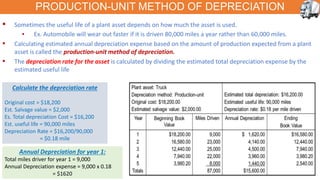
▪ Calculating estimated annual depreciation expense based on the amount of production expected from a plant
asset is called the production-unit method of depreciation.
▪ The depreciation rate for the asset is calculated by dividing the estimated total depreciation expense by the
estimated useful life
Calculate the depreciation rate
Original cost = $18,200
Est. Salvage value = $2,000
Es. Total depreciation Cost = $16,200
Est. useful life = 90,000 miles
Depreciation Rate = $16,200/90,000
= $0.18 mile
Annual Depreciation for year 1:
Total miles driver for year 1 = 9,000
Annual Depreciation expense = 9,000 x 0.18
= $1620
Modified Accelerated Cost Recovery
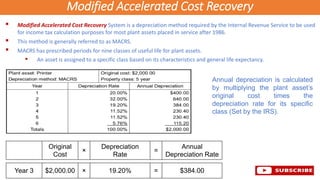
▪ Modified Accelerated Cost Recovery System is a depreciation method required by the Internal Revenue Service to be used
for income tax calculation purposes for most plant assets placed in service after 1986.
▪ This method is generally referred to as MACRS.
▪ MACRS has prescribed periods for nine classes of useful life for plant assets.
▪ An asset is assigned to a specific class based on its characteristics and general life expectancy.
Annual depreciation is calculated
by multiplying the plant asset’s
original cost times the
depreciation rate for its specific
class (Set by the IRS).
Original
Cost
×
Depreciation
Rate
=
Annual
Depreciation Rate
Year 3 $2,000.00 × 19.20% = $384.00
For Video explanation, click below links:
https://youtu.be/tGUvgiaA9DU
https://youtu.be/1FhzM4wwhuI
English
Hindi / Urdu

Depreciation and its Methods.pptx

  • 1.
  • 2.
    A permanent fallin the value of fixed assets arising through wear and tear from the use of those assets in business. To calculate the proper profit. To show the asset at its reasonable value or true financial position. To provide replacement of an asset. To correct cost of Production. Depreciation is permitted to be deducted from profit for tax purposes. DEPRECIATION Objectives - Depreciation: Internal causes: Wear & tear, disuse, maintenance, change & restriction in production, reduced demand, technical progress, and depletion. External causes: Obsolescence and effluxion of time
  • 3.
    ■ Total costof asset ■ Estimated useful service life ■ Estimated salvage (residual value) Factors Used in Depreciation; 1. Straight-line method 2. Declining-balance method of depreciation 3. Sum-of-the-years’-digits method of depreciation 4. Production-unit method of depreciation 5. Modified Accelerated Cost Recovery System Methods Of Depreciation;
  • 4.
    The same amountof depreciation is charged every year throughout the life of the asset. STRAIGHT-LINE METHOD A company named ABC Purchases a machine for $60,000. It has an estimated salvage value of $10,000 and a useful life of five years. Company calculates the annual straight-line depreciation for the machine as: Total depreciable amount = $60,00 (purchase cost) - $10,000 (estimated salvage value) = $50,000 Depreciation rate per year = 1/5 (100) = 20 % Annual Depreciation = 20 % depreciation rate x $50,000 = 0.2 x $50,000 = $10,000 annual depreciation What if, the useful life is 8 years, then Depreciation rate will be = 1/8 (100) = 12.5 % Annual depreciation = 0.125 x $50,000 = $ 6250
  • 5.
     Many plantassets depreciate more in the early years of useful life than in the later years. Charging more depreciation expense in the early years may be more accurate than charging the same amount each year.  Multiplying the book value at the end of each fiscal period by a constant depreciation rate is called the declining-balance method of depreciation. DECLINING-BALANCE METHOD OF DEPRECIATION ▪ The declining-balance depreciation rate is based on the straight-line rate. It is twice the straight-line rate (called the double declining-balance method). Remember: Do not use salvage value in computing the book value.
  • 6.
    DECLINING-BALANCE METHOD OFDEPRECIATION ABC Purchased a computer for $2,000 on January 1st. The computer has a useful life of 5 years and an estimated salvage value of $175 A plant asset is never depreciated below its estimated salvage value. Calculate the declining-balance rate: Estimated Useful life = 5 years Straight-line rate = 1/5 (100) = 20 % Double this rate for declining balance method so, Declining balance rate = 40 % Calculate the annual depreciation for year 1 Beginning Book Value = $2000 Depreciation Rate = 40 % Annual depreciation expense = 0.4 x $2000 = $800 $259 x 0.4 = $103.68
  • 7.
    SUM-OF-THE-YEARS’-DIGITS METHOD OFDEPRECIATION ▪ Another method called sum-of-the-years’-digits method of depreciation is based on a fraction derived from the years’ digits for the useful life of a plant asset. ▪ Like the straight-line method, the estimated salvage value is subtracted from the original cost to compute an estimated total depreciation expense. ▪ This results in a last year ending book value equal to the plant asset’s salvage value. ▪ The fractions are determined as follows: ▪ The years’ digits are added (1+2+3+4+5 = 15) ▪ Fractions are 1/15, 2/15, 3/15, 4/15, and 5/15 ▪ Then, using the sum of the years’ digits, a fraction is created for each year with the years’ digits in reverse order.
  • 8.
    SUM-OF-THE-YEARS’-DIGITS METHOD OFDEPRECIATION Calculate the annual depreciation for year 1 Original Cost = $2000 Est. Salvage Value = $175 Est. Total Depreciation = $2000 - $175 =$1825 Year’s fraction for year 1 = 5/15 Annual Depreciation = 5/15 ($1825) = $608.33 Calculate the fraction Est. Useful life = 5 years Addition of years digits = 1+2+3+4+5 = 15 Years digits fractions : 5/15, 4/15, 3/15, 2/15, 1/15
  • 9.
    COMPARISON OF THREEMETHODS OF DEPRECIATION ▪ Regardless of the depreciation method used, the total depreciation expense over the useful life of an asset is the same. ▪ Double declining balance method & sum- of-the-years’-digits are known as accelerated depreciation methods Plant asset: Computer Depreciation method: Comparison Original cost: $2,000.00 Estimated salvage value: $175.00 Estimated useful life: 5 years Year Straight-Line Method Double Declining- Balance Method Sum-of-the- Years-Digits Method 1 2 3 4 5 Total Depreciation $365.00 365.00 365.00 365.00 365.00 $1,825.00 $ 800.00 480.00 288.00 172.80 84.20 $1,825.00 $608.33 486.67 365.00 243.33 121.67 $1,825.00
  • 10.
    PRODUCTION-UNIT METHOD OFDEPRECIATION ▪ Sometimes the useful life of a plant asset depends on how much the asset is used. ▪ Ex. Automobile will wear out faster if it is driven 80,000 miles a year rather than 60,000 miles. ▪ Calculating estimated annual depreciation expense based on the amount of production expected from a plant asset is called the production-unit method of depreciation. ▪ The depreciation rate for the asset is calculated by dividing the estimated total depreciation expense by the estimated useful life Calculate the depreciation rate Original cost = $18,200 Est. Salvage value = $2,000 Es. Total depreciation Cost = $16,200 Est. useful life = 90,000 miles Depreciation Rate = $16,200/90,000 = $0.18 mile Annual Depreciation for year 1: Total miles driver for year 1 = 9,000 Annual Depreciation expense = 9,000 x 0.18 = $1620
  • 11.
    Modified Accelerated CostRecovery ▪ Modified Accelerated Cost Recovery System is a depreciation method required by the Internal Revenue Service to be used for income tax calculation purposes for most plant assets placed in service after 1986. ▪ This method is generally referred to as MACRS. ▪ MACRS has prescribed periods for nine classes of useful life for plant assets. ▪ An asset is assigned to a specific class based on its characteristics and general life expectancy. Annual depreciation is calculated by multiplying the plant asset’s original cost times the depreciation rate for its specific class (Set by the IRS). Original Cost × Depreciation Rate = Annual Depreciation Rate Year 3 $2,000.00 × 19.20% = $384.00
  • 12.
    For Video explanation,click below links: https://youtu.be/tGUvgiaA9DU https://youtu.be/1FhzM4wwhuI English Hindi / Urdu