THE SYSTEM OF ACCOUNTING
WRITTEN BY:
SYED AQEEL RAZA
MASTER OF COMMERCE & POLITICS
DEPRECIATION
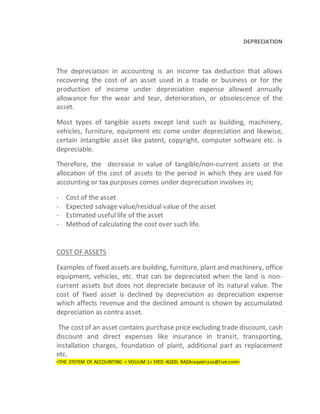
The depreciation in accounting is an income tax deduction that allows
recovering the cost of an asset used in a trade or business or for the
production of income under depreciation expense allowed annually
allowance for the wear and tear, deterioration, or obsolescence of the
asset.
Most types of tangible assets except land such as building, machinery,
vehicles, furniture, equipment etc come under depreciation and likewise,
certain intangible asset like patent, copyright, computer software etc. is
depreciable.
Therefore, the decrease in value of tangible/non-current assets or the
allocation of the cost of assets to the period in which they are used for
accounting or tax purposes comes under depreciation involves in;
- Cost of the asset
- Expected salvage value/residual value of the asset
- Estimated useful life of the asset
- Method of calculating the cost over such life.
COST OF ASSETS
Examples of fixed assets are building, furniture, plant and machinery, office
equipment, vehicles, etc. that can be depreciated when the land is non-
current assets but does not depreciate because of its natural value. The
cost of fixed asset is declined by depreciation as depreciation expense
which affects revenue and the declined amount is shown by accumulated
depreciation as contra asset.
The costof an asset contains purchase price excluding trade discount, cash
discount and direct expenses like insurance in transit, transporting,
installation charges, foundation of plant, additional part as replacement
etc.
<THE SYSTEM OF ACCOUNTING < VOLIUM 1< SYED AQEEL RAZA<aqeelraza@live.com>
DEPRECIATION
SALVAE VALUE/RESIDUAL VALUE OF THE ASSET
When the estimated life of an asset is timed out, the company disposes of
and sells it for some reduced amount which is salvage value based on asset
cost, less any estimated salvage value and if the salvage value is expected
to be quite small, it is generally ignored for the purpose of calculating
depreciation.
ESTIMATED USEFUL LIFE OF THE ASSETS
The depreciation is recognized over the estimated useful life of an asset
and the estimated useful life of an asset is expected to be productive and
on ending useful life of the asset is expected to be disposed off.
THE METHOD OF COMPUTING DEPRECIATION
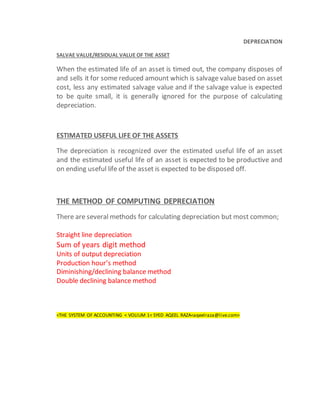
There are several methods for calculating depreciation but most common;
Straight line depreciation
Sum of years digit method
Units of output depreciation
Production hour’s method
Diminishing/declining balance method
Double declining balance method
<THE SYSTEM OF ACCOUNTING < VOLIUM 1< SYED AQEEL RAZA<aqeelraza@live.com>
DEPRECIATION
STRAIGHT LINE DEPRECIATION
The straight line depreciation method is the simples method used widely. In
this method an equal portion of the cost of an asset is allocated to each
year or month and may call it constant annual depreciation.
The annual depreciation according to this method is calculated as under;
Depreciation = cost - Salvage/Residual value / useful life.
Or depreciation = cost-salvage/residual value
Useful life
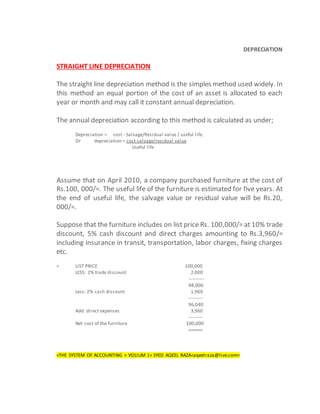
Assume that on April 2010, a company purchased furniture at the cost of
Rs.100, 000/=. The useful life of the furniture is estimated for five years. At
the end of useful life, the salvage value or residual value will be Rs.20,
000/=.
Suppose that the furniture includes on list price Rs. 100,000/= at 10% trade
discount, 5% cash discount and direct charges amounting to Rs.3,960/=
including insurance in transit, transportation, labor charges, fixing charges
etc.
= LIST PRICE 100,000
LESS: 2% trade discount 2,000
----------
98,000
Less: 2% cash discount 1,960
---------
96,040
Add: direct expenses 3,960
---------
Net cost of the furniture 100,000
======
<THE SYSTEM OF ACCOUNTING < VOLIUM 1< SYED AQEEL RAZA<aqeelraza@live.com>
DEPRECIATION
STRAIGHT LINE DEPRECIATION CALCULATION
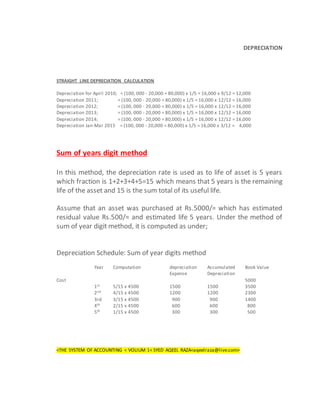
Depreciation for April 2010; = (100, 000 - 20,000 = 80,000) x 1/5 = 16,000 x 9/12 = 12,000
Depreciation 2011; = (100, 000 - 20,000 = 80,000) x 1/5 = 16,000 x 12/12 = 16,000
Depreciation 2012; = (100, 000 - 20,000 = 80,000) x 1/5 = 16,000 x 12/12 = 16,000
Depreciation 2013; = (100, 000 - 20,000 = 80,000) x 1/5 = 16,000 x 12/12 = 16,000
Depreciation 2014; = (100, 000 - 20,000 = 80,000) x 1/5 = 16,000 x 12/12 = 16,000
Depreciation Jan-Mar 2015 = (100, 000 - 20,000 = 80,000) x 1/5 = 16,000 x 3/12 = 4,000
Sum of years digit method
In this method, the depreciation rate is used as to life of asset is 5 years
which fraction is 1+2+3+4+5=15 which means that 5 years is the remaining
life of the asset and 15 is the sum total of its useful life.
Assume that an asset was purchased at Rs.5000/= which has estimated
residual value Rs.500/= and estimated life 5 years. Under the method of
sum of year digit method, it is computed as under;
Depreciation Schedule: Sum of year digits method
Year Computation depreciation Accumulated Book Value
Expense Depreciation
Cost 5000
1st 5/15 x 4500 1500 1500 3500
2nd 4/15 x 4500 1200 1200 2300
3rd 3/15 x 4500 900 900 1400
4th 2/15 x 4500 600 600 800
5th 1/15 x 4500 300 300 500
<THE SYSTEM OF ACCOUNTING < VOLIUM 1< SYED AQEEL RAZA<aqeelraza@live.com>
DEPRECIATION
Units of output depreciation
In this method, a more equitable distribution of the cost of some assets can be obtained by dividing the
original depreciation cost with the estimated life in units rather than year of useful life. This method
states the capacity of machinery to produce units.
Suppose that a machine was purchased at Rs.100,000 when its residual value is estimated by Rs.10,000
and production capacity by 100,000 units with normal repair and maintenance. In this method, the
depreciation can be made as;
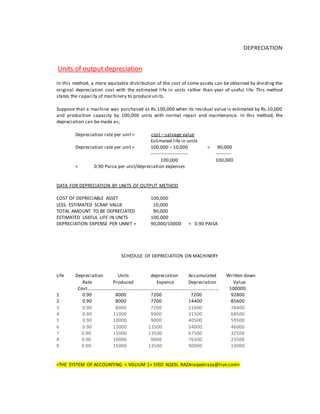
Depreciation rate per unit= cost – salvage value
Estimated life in units
Depreciation rate per unit = 100,000 – 10,000 = 90,000
------------------------ ----------
100,000 100,000
= 0.90 Paisa per unit/depreciation expenses
DATA FOR DEPRECIATION BY UNITS OF OUTPUT METHOD
COST OF DEPRECIABLE ASSET 100,000
LESS: ESTIMATED SCRAP VALUE 10,000
TOTAL AMOUNT TO BE DEPRECIATED 90,000
ESTIMATED USEFUL LIFE IN UNITS 100,000
DEPRECIATION EXPENSE PER UNNIT = 90,000/10000 = 0.90 PAISA
SCHEDULE OF DEPRECIATION ON MACHINERY
Life Depreciation Units depreciation Accumulated Written down
Rate Produced Expense Depreciation Value
Cost………………………………………………………………………………………………… 100000
1 0.90 8000 7200 7200 92800
2 0.90 8000 7200 14400 85600
3 0.90 8000 7200 21600 78400
4 0.90 11000 9900 31500 68500
5 0.90 10000 9000 40500 59500
6 0.90 15000 13500 54000 46000
7 0.90 15000 13500 67500 32500
8 0.90 10000 9000 76500 23500
9 0.90 15000 13500 90000 10000
<THE SYSTEM OF ACCOUNTING < VOLIUM 1< SYED AQEEL RAZA<aqeelraza@live.com>
DEPRECIATION
PRODUCTION HOURS METHOD
In this method, plant or machinery is depreciated by hourly under
estimated life in hours.
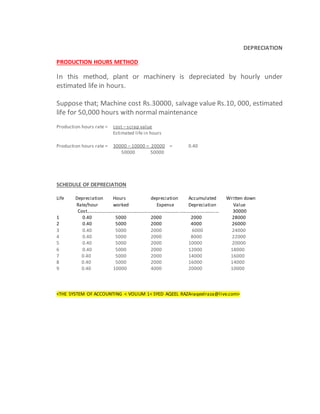
Suppose that; Machine cost Rs.30000, salvage value Rs.10, 000, estimated
life for 50,000 hours with normal maintenance
Production hours rate = cost – scrap value
Estimated life in hours
Production hours rate = 30000 – 10000 = 20000 = 0.40
50000 50000
SCHEDULE OF DEPRECIATION
Life Depreciation Hours depreciation Accumulated Written down
Rate/hour worked Expense Depreciation Value
Cost………………………………………………………………………………………………… 30000
1 0.40 5000 2000 2000 28000
2 0.40 5000 2000 4000 26000
3 0.40 5000 2000 6000 24000
4 0.40 5000 2000 8000 22000
5 0.40 5000 2000 10000 20000
6 0.40 5000 2000 12000 18000
7 0.40 5000 2000 14000 16000
8 0.40 5000 2000 16000 14000
9 0.40 10000 4000 20000 10000
<THE SYSTEM OF ACCOUNTING < VOLIUM 1< SYED AQEEL RAZA<aqeelraza@live.com>
DEPRECIATION
DIMINISHING/DELINING BALNACE METHOD
In this method a certain percentage is determined to fix rate of calculating
the depreciation on any asset which applied to the total cost of asset of the
amount kept in balance year wise or in other words the rate will be applied
to the total cost of asset and in second year the same rate will be applied to
the total cot minis the first year depreciation and so on.
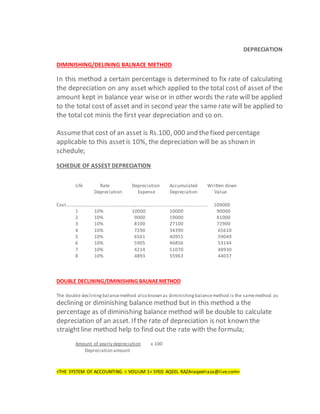
Assumethat cost of an asset is Rs.100, 000 and thefixed percentage
applicable to this assetis 10%, the depreciation will be as shown in
schedule;
SCHEDUE OF ASSEST DEPRECIATION
Life Rate Depreciation Accumulated Written down
Depreciation Expense Depreciation Value
Cost………………………………………………………………………………………………………… 100000
1 10% 10000 10000 90000
2 10% 9000 19000 81000
3 10% 8100 27100 72900
4 10% 7290 34390 65610
5 10% 6561 40951 59049
6 10% 5905 46856 53144
7 10% 4214 51070 48930
8 10% 4893 55963 44037
DOUBLE DECLINING/DMINISHING BALNAEMETHOD
The double declining balancemethod also known as diminishing balancemethod is the samemethod as
declining or diminishing balance method but in this method a the
percentage as of diminishing balance method will be double to calculate
depreciation of an asset. If the rate of depreciation is not known the
straightline method help to find out the rate with the formula;
Amount of yearly depreciation x 100
Depreciation amount
<THE SYSTEM OF ACCOUNTING < VOLIUM 1< SYED AQEEL RAZA<aqeelraza@live.com>
DEPRECIATION
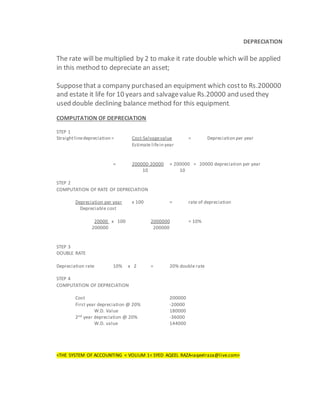
The rate will be multiplied by 2 to make it rate double which will be applied
in this method to depreciate an asset;
Supposethat a company purchased an equipment which costto Rs.200000
and estate it life for 10 years and salvagevalue Rs.20000 and used they
used double declining balance method for this equipment.
COMPUTATION OF DEPRECIATION
STEP 1
Straightlinedepreciation = Cost-Salvagevalue = Depreciation per year
Estimate lifein year
= 200000-20000 = 200000 = 20000 depreciation per year
10 10
STEP 2
COMPUTATION OF RATE OF DEPRECIATION
Depreciation per year x 100 = rate of depreciation
Depreciable cost
20000 x 100 2000000 = 10%
200000 200000
STEP 3
DOUBLE RATE
Depreciation rate 10% x 2 = 20% double rate
STEP 4
COMPUTATION OF DEPRECIATION
Cost 200000
First year depreciation @ 20% -20000
W.D. Value 180000
2nd year depreciation @ 20% -36000
W.D. value 144000
<THE SYSTEM OF ACCOUNTING < VOLIUM 1< SYED AQEEL RAZA<aqeelraza@live.com>
DEPRECIATION
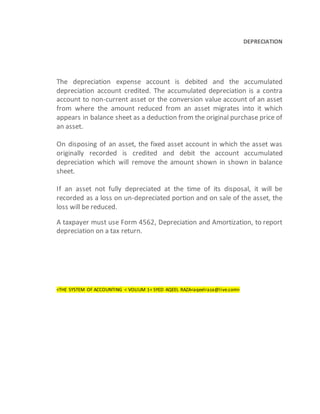
The depreciation expense account is debited and the accumulated
depreciation account credited. The accumulated depreciation is a contra
account to non-current asset or the conversion value account of an asset
from where the amount reduced from an asset migrates into it which
appears in balance sheet as a deduction from the original purchase price of
an asset.
On disposing of an asset, the fixed asset account in which the asset was
originally recorded is credited and debit the account accumulated
depreciation which will remove the amount shown in shown in balance
sheet.
If an asset not fully depreciated at the time of its disposal, it will be
recorded as a loss on un-depreciated portion and on sale of the asset, the
loss will be reduced.
A taxpayer must use Form 4562, Depreciation and Amortization, to report
depreciation on a tax return.
<THE SYSTEM OF ACCOUNTING < VOLIUM 1< SYED AQEEL RAZA<aqeelraza@live.com>
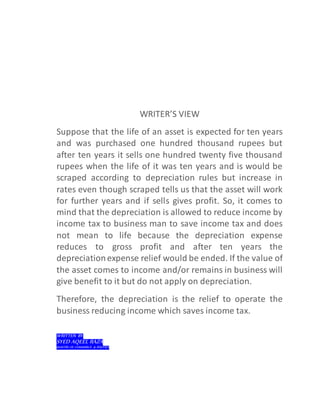
WRITER’S VIEW
Suppose that the life of an asset is expected for ten years
and was purchased one hundred thousand rupees but
after ten years it sells one hundred twenty five thousand
rupees when the life of it was ten years and is would be
scraped according to depreciation rules but increase in
rates even though scraped tells us that the asset will work
for further years and if sells gives profit. So, it comes to
mind that the depreciation is allowed to reduce income by
income tax to business man to save income tax and does
not mean to life because the depreciation expense
reduces to gross profit and after ten years the
depreciationexpense relief would be ended. If the value of
the asset comes to income and/or remains in business will
give benefit to it but do not apply on depreciation.
Therefore, the depreciation is the relief to operate the
business reducing income which saves income tax.
WRITTEN BY:
SYED AQEEL RAZA
MASTER OF COMMERCE & POLITICS

Accounting for depreciation

  • 1.
    THE SYSTEM OFACCOUNTING WRITTEN BY: SYED AQEEL RAZA MASTER OF COMMERCE & POLITICS
  • 2.
    DEPRECIATION The depreciation inaccounting is an income tax deduction that allows recovering the cost of an asset used in a trade or business or for the production of income under depreciation expense allowed annually allowance for the wear and tear, deterioration, or obsolescence of the asset. Most types of tangible assets except land such as building, machinery, vehicles, furniture, equipment etc come under depreciation and likewise, certain intangible asset like patent, copyright, computer software etc. is depreciable. Therefore, the decrease in value of tangible/non-current assets or the allocation of the cost of assets to the period in which they are used for accounting or tax purposes comes under depreciation involves in; - Cost of the asset - Expected salvage value/residual value of the asset - Estimated useful life of the asset - Method of calculating the cost over such life. COST OF ASSETS Examples of fixed assets are building, furniture, plant and machinery, office equipment, vehicles, etc. that can be depreciated when the land is non- current assets but does not depreciate because of its natural value. The cost of fixed asset is declined by depreciation as depreciation expense which affects revenue and the declined amount is shown by accumulated depreciation as contra asset. The costof an asset contains purchase price excluding trade discount, cash discount and direct expenses like insurance in transit, transporting, installation charges, foundation of plant, additional part as replacement etc. <THE SYSTEM OF ACCOUNTING < VOLIUM 1< SYED AQEEL RAZA<aqeelraza@live.com>
  • 3.
    DEPRECIATION SALVAE VALUE/RESIDUAL VALUEOF THE ASSET When the estimated life of an asset is timed out, the company disposes of and sells it for some reduced amount which is salvage value based on asset cost, less any estimated salvage value and if the salvage value is expected to be quite small, it is generally ignored for the purpose of calculating depreciation. ESTIMATED USEFUL LIFE OF THE ASSETS The depreciation is recognized over the estimated useful life of an asset and the estimated useful life of an asset is expected to be productive and on ending useful life of the asset is expected to be disposed off. THE METHOD OF COMPUTING DEPRECIATION There are several methods for calculating depreciation but most common; Straight line depreciation Sum of years digit method Units of output depreciation Production hour’s method Diminishing/declining balance method Double declining balance method <THE SYSTEM OF ACCOUNTING < VOLIUM 1< SYED AQEEL RAZA<aqeelraza@live.com>
  • 4.
    DEPRECIATION STRAIGHT LINE DEPRECIATION Thestraight line depreciation method is the simples method used widely. In this method an equal portion of the cost of an asset is allocated to each year or month and may call it constant annual depreciation. The annual depreciation according to this method is calculated as under; Depreciation = cost - Salvage/Residual value / useful life. Or depreciation = cost-salvage/residual value Useful life Assume that on April 2010, a company purchased furniture at the cost of Rs.100, 000/=. The useful life of the furniture is estimated for five years. At the end of useful life, the salvage value or residual value will be Rs.20, 000/=. Suppose that the furniture includes on list price Rs. 100,000/= at 10% trade discount, 5% cash discount and direct charges amounting to Rs.3,960/= including insurance in transit, transportation, labor charges, fixing charges etc. = LIST PRICE 100,000 LESS: 2% trade discount 2,000 ---------- 98,000 Less: 2% cash discount 1,960 --------- 96,040 Add: direct expenses 3,960 --------- Net cost of the furniture 100,000 ====== <THE SYSTEM OF ACCOUNTING < VOLIUM 1< SYED AQEEL RAZA<aqeelraza@live.com>
  • 5.
    DEPRECIATION STRAIGHT LINE DEPRECIATIONCALCULATION Depreciation for April 2010; = (100, 000 - 20,000 = 80,000) x 1/5 = 16,000 x 9/12 = 12,000 Depreciation 2011; = (100, 000 - 20,000 = 80,000) x 1/5 = 16,000 x 12/12 = 16,000 Depreciation 2012; = (100, 000 - 20,000 = 80,000) x 1/5 = 16,000 x 12/12 = 16,000 Depreciation 2013; = (100, 000 - 20,000 = 80,000) x 1/5 = 16,000 x 12/12 = 16,000 Depreciation 2014; = (100, 000 - 20,000 = 80,000) x 1/5 = 16,000 x 12/12 = 16,000 Depreciation Jan-Mar 2015 = (100, 000 - 20,000 = 80,000) x 1/5 = 16,000 x 3/12 = 4,000 Sum of years digit method In this method, the depreciation rate is used as to life of asset is 5 years which fraction is 1+2+3+4+5=15 which means that 5 years is the remaining life of the asset and 15 is the sum total of its useful life. Assume that an asset was purchased at Rs.5000/= which has estimated residual value Rs.500/= and estimated life 5 years. Under the method of sum of year digit method, it is computed as under; Depreciation Schedule: Sum of year digits method Year Computation depreciation Accumulated Book Value Expense Depreciation Cost 5000 1st 5/15 x 4500 1500 1500 3500 2nd 4/15 x 4500 1200 1200 2300 3rd 3/15 x 4500 900 900 1400 4th 2/15 x 4500 600 600 800 5th 1/15 x 4500 300 300 500 <THE SYSTEM OF ACCOUNTING < VOLIUM 1< SYED AQEEL RAZA<aqeelraza@live.com>
  • 6.
    DEPRECIATION Units of outputdepreciation In this method, a more equitable distribution of the cost of some assets can be obtained by dividing the original depreciation cost with the estimated life in units rather than year of useful life. This method states the capacity of machinery to produce units. Suppose that a machine was purchased at Rs.100,000 when its residual value is estimated by Rs.10,000 and production capacity by 100,000 units with normal repair and maintenance. In this method, the depreciation can be made as; Depreciation rate per unit= cost – salvage value Estimated life in units Depreciation rate per unit = 100,000 – 10,000 = 90,000 ------------------------ ---------- 100,000 100,000 = 0.90 Paisa per unit/depreciation expenses DATA FOR DEPRECIATION BY UNITS OF OUTPUT METHOD COST OF DEPRECIABLE ASSET 100,000 LESS: ESTIMATED SCRAP VALUE 10,000 TOTAL AMOUNT TO BE DEPRECIATED 90,000 ESTIMATED USEFUL LIFE IN UNITS 100,000 DEPRECIATION EXPENSE PER UNNIT = 90,000/10000 = 0.90 PAISA SCHEDULE OF DEPRECIATION ON MACHINERY Life Depreciation Units depreciation Accumulated Written down Rate Produced Expense Depreciation Value Cost………………………………………………………………………………………………… 100000 1 0.90 8000 7200 7200 92800 2 0.90 8000 7200 14400 85600 3 0.90 8000 7200 21600 78400 4 0.90 11000 9900 31500 68500 5 0.90 10000 9000 40500 59500 6 0.90 15000 13500 54000 46000 7 0.90 15000 13500 67500 32500 8 0.90 10000 9000 76500 23500 9 0.90 15000 13500 90000 10000 <THE SYSTEM OF ACCOUNTING < VOLIUM 1< SYED AQEEL RAZA<aqeelraza@live.com>
  • 7.
    DEPRECIATION PRODUCTION HOURS METHOD Inthis method, plant or machinery is depreciated by hourly under estimated life in hours. Suppose that; Machine cost Rs.30000, salvage value Rs.10, 000, estimated life for 50,000 hours with normal maintenance Production hours rate = cost – scrap value Estimated life in hours Production hours rate = 30000 – 10000 = 20000 = 0.40 50000 50000 SCHEDULE OF DEPRECIATION Life Depreciation Hours depreciation Accumulated Written down Rate/hour worked Expense Depreciation Value Cost………………………………………………………………………………………………… 30000 1 0.40 5000 2000 2000 28000 2 0.40 5000 2000 4000 26000 3 0.40 5000 2000 6000 24000 4 0.40 5000 2000 8000 22000 5 0.40 5000 2000 10000 20000 6 0.40 5000 2000 12000 18000 7 0.40 5000 2000 14000 16000 8 0.40 5000 2000 16000 14000 9 0.40 10000 4000 20000 10000 <THE SYSTEM OF ACCOUNTING < VOLIUM 1< SYED AQEEL RAZA<aqeelraza@live.com>
  • 8.
    DEPRECIATION DIMINISHING/DELINING BALNACE METHOD Inthis method a certain percentage is determined to fix rate of calculating the depreciation on any asset which applied to the total cost of asset of the amount kept in balance year wise or in other words the rate will be applied to the total cost of asset and in second year the same rate will be applied to the total cot minis the first year depreciation and so on. Assumethat cost of an asset is Rs.100, 000 and thefixed percentage applicable to this assetis 10%, the depreciation will be as shown in schedule; SCHEDUE OF ASSEST DEPRECIATION Life Rate Depreciation Accumulated Written down Depreciation Expense Depreciation Value Cost………………………………………………………………………………………………………… 100000 1 10% 10000 10000 90000 2 10% 9000 19000 81000 3 10% 8100 27100 72900 4 10% 7290 34390 65610 5 10% 6561 40951 59049 6 10% 5905 46856 53144 7 10% 4214 51070 48930 8 10% 4893 55963 44037 DOUBLE DECLINING/DMINISHING BALNAEMETHOD The double declining balancemethod also known as diminishing balancemethod is the samemethod as declining or diminishing balance method but in this method a the percentage as of diminishing balance method will be double to calculate depreciation of an asset. If the rate of depreciation is not known the straightline method help to find out the rate with the formula; Amount of yearly depreciation x 100 Depreciation amount <THE SYSTEM OF ACCOUNTING < VOLIUM 1< SYED AQEEL RAZA<aqeelraza@live.com>
  • 9.
    DEPRECIATION The rate willbe multiplied by 2 to make it rate double which will be applied in this method to depreciate an asset; Supposethat a company purchased an equipment which costto Rs.200000 and estate it life for 10 years and salvagevalue Rs.20000 and used they used double declining balance method for this equipment. COMPUTATION OF DEPRECIATION STEP 1 Straightlinedepreciation = Cost-Salvagevalue = Depreciation per year Estimate lifein year = 200000-20000 = 200000 = 20000 depreciation per year 10 10 STEP 2 COMPUTATION OF RATE OF DEPRECIATION Depreciation per year x 100 = rate of depreciation Depreciable cost 20000 x 100 2000000 = 10% 200000 200000 STEP 3 DOUBLE RATE Depreciation rate 10% x 2 = 20% double rate STEP 4 COMPUTATION OF DEPRECIATION Cost 200000 First year depreciation @ 20% -20000 W.D. Value 180000 2nd year depreciation @ 20% -36000 W.D. value 144000 <THE SYSTEM OF ACCOUNTING < VOLIUM 1< SYED AQEEL RAZA<aqeelraza@live.com>
  • 10.
    DEPRECIATION The depreciation expenseaccount is debited and the accumulated depreciation account credited. The accumulated depreciation is a contra account to non-current asset or the conversion value account of an asset from where the amount reduced from an asset migrates into it which appears in balance sheet as a deduction from the original purchase price of an asset. On disposing of an asset, the fixed asset account in which the asset was originally recorded is credited and debit the account accumulated depreciation which will remove the amount shown in shown in balance sheet. If an asset not fully depreciated at the time of its disposal, it will be recorded as a loss on un-depreciated portion and on sale of the asset, the loss will be reduced. A taxpayer must use Form 4562, Depreciation and Amortization, to report depreciation on a tax return. <THE SYSTEM OF ACCOUNTING < VOLIUM 1< SYED AQEEL RAZA<aqeelraza@live.com>
  • 11.
    WRITER’S VIEW Suppose thatthe life of an asset is expected for ten years and was purchased one hundred thousand rupees but after ten years it sells one hundred twenty five thousand rupees when the life of it was ten years and is would be scraped according to depreciation rules but increase in rates even though scraped tells us that the asset will work for further years and if sells gives profit. So, it comes to mind that the depreciation is allowed to reduce income by income tax to business man to save income tax and does not mean to life because the depreciation expense reduces to gross profit and after ten years the depreciationexpense relief would be ended. If the value of the asset comes to income and/or remains in business will give benefit to it but do not apply on depreciation. Therefore, the depreciation is the relief to operate the business reducing income which saves income tax. WRITTEN BY: SYED AQEEL RAZA MASTER OF COMMERCE & POLITICS