BY:
Kritika Sarkar
 American society for testing
and materials specification D
907.
 Buonocore reported in 1955
that acid, could be used to
alter the surface of enamel to
’ render it more receptive to
adhesion."1 He had
discovered that acrylic resin
could be bonded to human
enamel after conditioning
with 85% phosphoric acid.
 Buonocore accurately
predicted several potential
uses for this new technique,
including Class III and Class
V restorations and pit and
fissure sealants.
Bonding sytem for restorative materials by Edward J Swift DMD, MS
 Dentin bonding agent
A thin layer of resin between conditioned dentin
& the resin matrix of composite.
 Dentin bonding:
The process of bonding a resin to conditioned
dentin.
Phillip’s science of dental materials (11th edition)
 The word adhesion comes from the latin
“adhaerere” (to stick to).
 It is defined as the state in which 2 surfaces
are held together by interfacial forces which
may consist of valence/ interlocking forces
or both.
Sturdevant’s art and science of operative dentistry (5th edition)
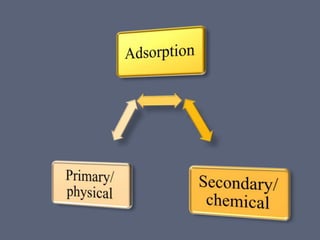
 Chemical bonding between the adhesive
and the adherent
Adhesive
Adherend
Van der waal’s interactions-attraction between
opposite charges on ions and dipoles
Dispersion forces- interaction of induced
dipoles
 Hydrogen bonds-it is particularly strong bond
and can be included among physical forces
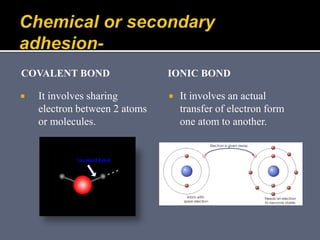
COVALENT BOND
 It involves sharing
electron between 2 atoms
or molecules.
IONIC BOND
 It involves an actual
transfer of electron form
one atom to another.
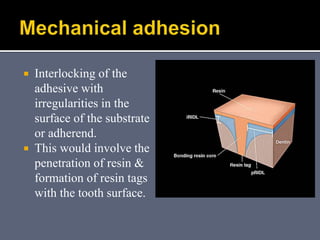
 Interlocking of the
adhesive with
irregularities in the
surface of the substrate
or adherend.
 This would involve the
penetration of resin &
formation of resin tags
with the tooth surface.
 Interlocking between mobile molecules such as the
adhesion of two polymers through diffusion of
polymer chain ends across an interface.
 This would involve the precipitation of substances
on the tooth surfaces to which resin monomers can
bond mechanically or chemically.
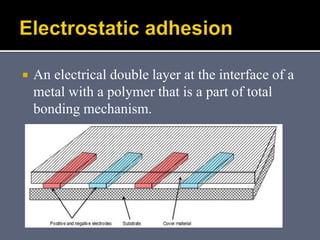
 An electrical double layer at the interface of a
metal with a polymer that is a part of total
bonding mechanism.
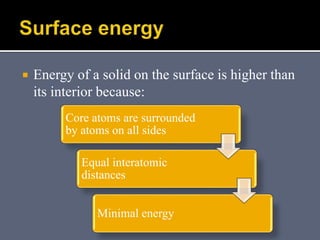
 Energy of a solid on the surface is higher than
its interior because:
Core atoms are surrounded
by atoms on all sides
Equal interatomic
distances
Minimal energy
•But the surface atoms are unequally distributed
and hence have more energy.
•So the surface atoms get attracted towards the
core resulting in surface tension.
•Due to this substances on the surfaces get
attracted to the substrate.
•Harder the surface, higher the surface energy &
higher the adhesive properties.
 When a film of water in
introduced between two
glass slides the
adhesion properties are
better illustrated . This
is called wetting.
 Surface energy and
cleanliness of the
adherend influences the
wetting.
 It is the measure of wettability & is the angle
formed by the adhesive with the adherend at
the interface.
 Smaller the contact angle greater the
wettability.
 Low viscosity of the adhesive is required to
allow its easy flow on the surface of the
adherent. This increases the strength of
adhesion
 This prevents the liquid adhesive from
completely wetting the adherent due to the
presence of air pockets. This decreases the
strength of adhesion.
 Any debris on the surface will prevent direct
contact between the adhesive and the
adherend. This decreases the strength of
adhesive.
 The thinner the adhesive film, the lesser the
air voids and the stronger the strength of
adhesion.
 Liquid adhesive undergo contraction during
setting (polymerization shrinkage). This
contraction results in the reaction of stresses at
the interface that severely decreases the
strength of adhesion.
 No doubt that primary bonds between
adhesive and adherent produce stronger
adhesion than if secondary bonds are formed.
 The mineral content increases in different
situations, which include:
Aged dentin
Dentin beneath carious lesion
Exposed dentin
 In all the above mentioned situation the dentinal
tubules become obliterated with tricalcium
phosphate crystals.
 There are compositional changes in sclerotic
dentin, which is much more resistant to acid
etching than normal dentin.
 Consequently, the penetration of a dentin
adhesive is limited.
Sclerotic dentin
 Composite resins do not show an intimate
microscopic contact with dentin when placed
directly into the cavity.
 In order to overcome this, an intervening layer of
fluid is used, which fills in the microscopic space,
polymerizes & combines with the composite
resin & components of dentin.
 The adhesive molecule is bifunctional & a part of
which (X) enters into chemical union with the
tooth structure, & the other part (M)
copolymerizes to the resin through the double the
double bond of methacrylate.
CH3
CH
2
C
C
O
O R X
Methacrylate group
Spacer
Reactive group capable
of bonding to dentin
•The spacer group (R) is responsible for making the
molecules large enough to keep the methacrylate groups
spatially located for optimal chemical reaction with
composite
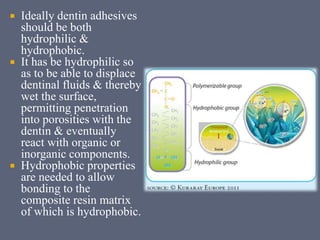
 Ideally dentin adhesives
should be both
hydrophilic &
hydrophobic.
 It has be hydrophilic so
as to be able to displace
dentinal fluids & thereby
wet the surface,
permitting penetration
into porosities with the
dentin & eventually
react with organic or
inorganic components.
 Hydrophobic properties
are needed to allow
bonding to the
composite resin matrix
of which is hydrophobic.
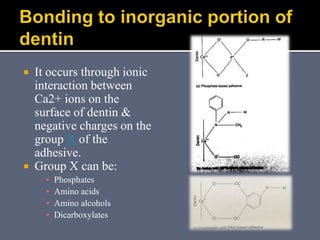
 It occurs through ionic
interaction between
Ca2+ ions on the
surface of dentin &
negative charges on the
group X of the
adhesive.
 Group X can be:
▪ Phosphates
▪ Amino acids
▪ Amino alcohols
▪ Dicarboxylates
 This involves interaction with the following
components present in the collagen of dentin:
 Amino (-NH)
 Amido (-CONH)
 Hydroxyl (-OH)
 Carboxylate (-COOH)
 Removal of hydrogen from any of these
groups allows combination with chemicals
present in the dentin bonding agent.
 Compounds that are
capable of reacting
with one or more
groups of collagen are:
isocynates
carboxylic acid chlorides
carboxylic acid
anhydrides
aldehydes.
 Egs: Dentin Adhesit
(isocynate based),
Gluma (aldehyde
based)
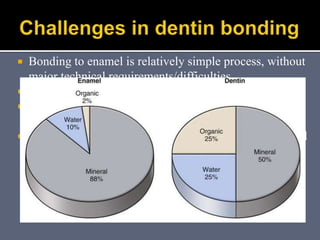
 Bonding to enamel is relatively simple process, without
major technical requirements/difficulties.
 Bonding to dentin presents a much greater challenge.
 Several factors account for this difference between
enamel and dentin.
 Although enamel is highly mineralized tissue composed
of more than 90% (by volume) hydroxyappetite, dentin
contains substantial proportion of water and organic
material, primarily type 1 collagen.
 Dentin also contains a
dense network of tubules
that connect the pulp with
the dentinoenamel junction
(DEJ).
 A cuff of hypermineralized
dentin called peritubular
dentin lines the tubules.
 The less mineralized
intertubuler dentin contains
collagen fibrils with the
characteristic collagen
banding.
 Dentin is intrinsically a
hydrated tissue.
 Adhesion can be affected by
the “remaining dentin
thickness” after tooth
preparation.
 Bond strengths are generally
less in deep dentin than in
superficial dentin.
 Whenever tooth structure is
prepared with a bur or an
instrument, residual organic
& inorganic components
form a “smear-layer” of
debris on the surface.
 The smear layer fills the
orifices of the dentinal
tubules, forming “smear-
plugs”
Based on :
Generation
Mode of application
Number of steps
Etching pattern
 These products ignored the smear layer.
 They included NPG-GMA (N-phenylglycine glycidyl
methacrylate), the polyurethanes, and cyanoacrylates.
 An example of an NPG-GMA bonding agent was S.S.
White's Cervident which became available in 1965.
 The bond strength of this first-generation dentin
bonding agent was on the order of 2 to 3 MPa.
 6 Clinical trials of these products were largely
disappointing; 7th one 6-month study reported a failure
rate of 50%.
 Additional problems with them included loss in bond
strength over time and a lack of stability of individual
components during storage.
 These systems leave the smear layer largely, if not
wholly, intact when used.
 Although second generation bonding agents
produced variable results, they generally performed
better than first-generation bonding agents.
 They routinely produced bond strengths that
ranged from
 approximately 4.5 to 6 MPa10,11 and exhibited
clinical failure
 rates of 30% at one year.
 Many of these products were developed and
marketed in the late 1970s and early 1980s.
 There were three types of second-generation
products:
1. Etched tubule dentin bonding agents
2. Phosphate ester dentin bonding agents
3. Polyurethane dentin bonding agents
 These attempted to achieve retention to dentin
by etching the tubules with 25% citric acid
and employing ethylmethacrylate to
mechanically interlock with the etched tubules
representative brand: Dentin Bonding System
(Den-Mat)
▪ These used analogs of BIS-GMA with attached phosphate esters the
phosphate group of the dentin bonding agent apparently bonded with
calcium in the tooth structure and the methacrylate end of the molecule
bonded to the composite resin.
 Most systems of this type employed a mild cleanser to modify the smear
layer bond strengths were approximately 10% to 30% as strong as etched
enamel to resin bonds representative brands: Bondlite (SDS/Kerr),
Creation Bond (Den-Mat), Prisma Universal Bond (Caulk), and
Scotchbond(3M)
 These were based on the isocyanate group of the
polyurethane polymer that bonds to various groups in
dentin including carboxyl, amino, and hydroxy groups.
 Most used diisocyanates which simultaneously bonded
to both the dentin and composite resin.
 The polyurethane's setting reaction was unaffected by
the presence of fluid in the dentin tubules or smear layer.
 Most of these systems left the smear layer intact,
however some employed hydrogen peroxide for
cleansing.
 Representative brand: Dentin-Adhesit (Ivoclar Vivadent)
 These systems alter or remove the smear layer
prior to bonding and produce bond strengths
ranging from 16 to 26 Mpa.
 Some of the products produce bond strengths
approaching those formed to enamel. Clinical
retention rates of 100% at 2 years have been
reported.
 Most products use a three-component system
consisting of a:
1. Conditioner
2. Primer
3. Adhesive.
 It is usually a weak organic acid (e.g., maleic
acid), a low concentration of a stronger inorganic
acid (e.g., phosphoric or nitric acid), or a
chelating agent (e.g., EDTA).
 Main Actions:
▪ Heavily alters or removes the smear layer
▪ Demineralizes peritubular and intertubular surface dentin and,
thereby, exposes collagen fibrils
▪ Demineralizes up to a depth of 7.5 microns (depth of
demineralization depends on type of acid, its concentration,
and etching time). More mineralized peritubular dentin is
etched more deeply than the intertubular dentin
▪ Increases dentin permeability by 4 to 9 times.
 It is usually a bifunctional monomer in a volatile
solvent such as acetone or alcohol.
 A bifunctional monomer is one that has a
hydrophilic end (i.e., one with an affinity for
water) and a hydrophobic end (one lacking an
affinity for water).
 Examples of bifunctional monomers include
HEMA (hydroxyethyl methacrylate), NMSA (N-
methacryloyl-5-aminosalicylic acid), NPG (N-
phenylglycine), PMDM (pyromellitic
diethylmethacrylate), and 4-META (4-
methacryloxyethyl trimellitate anhydride).
 Main Actions:
▪ Links the hydrophilic dentin to the hydrophobic adhesive
resin; is able to do this because of its bifunctional nature
(i.e., primer's hydrophilic end bonds to the wet dentin and
its hydrophobic end bonds to the adhesive resin).
▪ Promotes infiltration of demineralized peritubular and
intertubular dentin by its own monomers and those of the
adhesive resin.
▪ Increases wettability of the conditioned dentin surface
and increases contact between the dentin and resin.
 It is an unfilled or partially-filled resin; may
contain some component of the primer (e.g.,
HEMA) in an attempt to promote increased bond
strength.
 Main Actions:
▪ Combines with the primer s monomers to form a resin-reinforced
hybrid layer ( resin-dentin interdiffusion zone ) from 1 to 5 microns
thick.
▪ Forms resin tags to seal the dentin tubules.
▪ Provides methacrylate groups to bond with the subsequently placed
resin composite.
 The next generation of dentin bonding systems
appeared in the early 1990s and is still widely used.
 Most of these systems are based on the "total-etch"
technique, or simultaneous etching of enamel and
dentin, typically with phosphoric acid. Improvement in
dentin bond strengths by etching was first
demonstrated by Fusayamain 1979 but the concept of
total-etching only recently gained acceptance in the
United States.
 Etching of dentin traditionally was discouraged
because data from early studies seemed to indicate that
phos-
Dentin bonding agents

Dentin bonding agents

  • 1.
  • 2.
     American societyfor testing and materials specification D 907.  Buonocore reported in 1955 that acid, could be used to alter the surface of enamel to ’ render it more receptive to adhesion."1 He had discovered that acrylic resin could be bonded to human enamel after conditioning with 85% phosphoric acid.  Buonocore accurately predicted several potential uses for this new technique, including Class III and Class V restorations and pit and fissure sealants. Bonding sytem for restorative materials by Edward J Swift DMD, MS
  • 3.
     Dentin bondingagent A thin layer of resin between conditioned dentin & the resin matrix of composite.  Dentin bonding: The process of bonding a resin to conditioned dentin. Phillip’s science of dental materials (11th edition)
  • 4.
     The wordadhesion comes from the latin “adhaerere” (to stick to).  It is defined as the state in which 2 surfaces are held together by interfacial forces which may consist of valence/ interlocking forces or both. Sturdevant’s art and science of operative dentistry (5th edition)
  • 6.
     Chemical bondingbetween the adhesive and the adherent Adhesive Adherend
  • 8.
    Van der waal’sinteractions-attraction between opposite charges on ions and dipoles
  • 9.
  • 10.
     Hydrogen bonds-itis particularly strong bond and can be included among physical forces
  • 11.
    COVALENT BOND  Itinvolves sharing electron between 2 atoms or molecules. IONIC BOND  It involves an actual transfer of electron form one atom to another.
  • 12.
     Interlocking ofthe adhesive with irregularities in the surface of the substrate or adherend.  This would involve the penetration of resin & formation of resin tags with the tooth surface.
  • 13.
     Interlocking betweenmobile molecules such as the adhesion of two polymers through diffusion of polymer chain ends across an interface.  This would involve the precipitation of substances on the tooth surfaces to which resin monomers can bond mechanically or chemically.
  • 14.
     An electricaldouble layer at the interface of a metal with a polymer that is a part of total bonding mechanism.
  • 16.
     Energy ofa solid on the surface is higher than its interior because: Core atoms are surrounded by atoms on all sides Equal interatomic distances Minimal energy
  • 17.
    •But the surfaceatoms are unequally distributed and hence have more energy. •So the surface atoms get attracted towards the core resulting in surface tension. •Due to this substances on the surfaces get attracted to the substrate. •Harder the surface, higher the surface energy & higher the adhesive properties.
  • 18.
     When afilm of water in introduced between two glass slides the adhesion properties are better illustrated . This is called wetting.  Surface energy and cleanliness of the adherend influences the wetting.
  • 19.
     It isthe measure of wettability & is the angle formed by the adhesive with the adherend at the interface.  Smaller the contact angle greater the wettability.
  • 20.
     Low viscosityof the adhesive is required to allow its easy flow on the surface of the adherent. This increases the strength of adhesion
  • 21.
     This preventsthe liquid adhesive from completely wetting the adherent due to the presence of air pockets. This decreases the strength of adhesion.
  • 22.
     Any debrison the surface will prevent direct contact between the adhesive and the adherend. This decreases the strength of adhesive.
  • 23.
     The thinnerthe adhesive film, the lesser the air voids and the stronger the strength of adhesion.
  • 24.
     Liquid adhesiveundergo contraction during setting (polymerization shrinkage). This contraction results in the reaction of stresses at the interface that severely decreases the strength of adhesion.
  • 25.
     No doubtthat primary bonds between adhesive and adherent produce stronger adhesion than if secondary bonds are formed.
  • 26.
     The mineralcontent increases in different situations, which include: Aged dentin Dentin beneath carious lesion Exposed dentin  In all the above mentioned situation the dentinal tubules become obliterated with tricalcium phosphate crystals.  There are compositional changes in sclerotic dentin, which is much more resistant to acid etching than normal dentin.  Consequently, the penetration of a dentin adhesive is limited. Sclerotic dentin
  • 28.
     Composite resinsdo not show an intimate microscopic contact with dentin when placed directly into the cavity.  In order to overcome this, an intervening layer of fluid is used, which fills in the microscopic space, polymerizes & combines with the composite resin & components of dentin.  The adhesive molecule is bifunctional & a part of which (X) enters into chemical union with the tooth structure, & the other part (M) copolymerizes to the resin through the double the double bond of methacrylate.
  • 29.
    CH3 CH 2 C C O O R X Methacrylategroup Spacer Reactive group capable of bonding to dentin •The spacer group (R) is responsible for making the molecules large enough to keep the methacrylate groups spatially located for optimal chemical reaction with composite
  • 30.
     Ideally dentinadhesives should be both hydrophilic & hydrophobic.  It has be hydrophilic so as to be able to displace dentinal fluids & thereby wet the surface, permitting penetration into porosities with the dentin & eventually react with organic or inorganic components.  Hydrophobic properties are needed to allow bonding to the composite resin matrix of which is hydrophobic.
  • 31.
     It occursthrough ionic interaction between Ca2+ ions on the surface of dentin & negative charges on the group X of the adhesive.  Group X can be: ▪ Phosphates ▪ Amino acids ▪ Amino alcohols ▪ Dicarboxylates
  • 32.
     This involvesinteraction with the following components present in the collagen of dentin:  Amino (-NH)  Amido (-CONH)  Hydroxyl (-OH)  Carboxylate (-COOH)  Removal of hydrogen from any of these groups allows combination with chemicals present in the dentin bonding agent.
  • 33.
     Compounds thatare capable of reacting with one or more groups of collagen are: isocynates carboxylic acid chlorides carboxylic acid anhydrides aldehydes.  Egs: Dentin Adhesit (isocynate based), Gluma (aldehyde based)
  • 34.
     Bonding toenamel is relatively simple process, without major technical requirements/difficulties.  Bonding to dentin presents a much greater challenge.  Several factors account for this difference between enamel and dentin.  Although enamel is highly mineralized tissue composed of more than 90% (by volume) hydroxyappetite, dentin contains substantial proportion of water and organic material, primarily type 1 collagen.
  • 35.
     Dentin alsocontains a dense network of tubules that connect the pulp with the dentinoenamel junction (DEJ).  A cuff of hypermineralized dentin called peritubular dentin lines the tubules.  The less mineralized intertubuler dentin contains collagen fibrils with the characteristic collagen banding.  Dentin is intrinsically a hydrated tissue.
  • 36.
     Adhesion canbe affected by the “remaining dentin thickness” after tooth preparation.  Bond strengths are generally less in deep dentin than in superficial dentin.  Whenever tooth structure is prepared with a bur or an instrument, residual organic & inorganic components form a “smear-layer” of debris on the surface.  The smear layer fills the orifices of the dentinal tubules, forming “smear- plugs”
  • 37.
    Based on : Generation Modeof application Number of steps Etching pattern
  • 39.
     These productsignored the smear layer.  They included NPG-GMA (N-phenylglycine glycidyl methacrylate), the polyurethanes, and cyanoacrylates.  An example of an NPG-GMA bonding agent was S.S. White's Cervident which became available in 1965.  The bond strength of this first-generation dentin bonding agent was on the order of 2 to 3 MPa.  6 Clinical trials of these products were largely disappointing; 7th one 6-month study reported a failure rate of 50%.  Additional problems with them included loss in bond strength over time and a lack of stability of individual components during storage.
  • 40.
     These systemsleave the smear layer largely, if not wholly, intact when used.  Although second generation bonding agents produced variable results, they generally performed better than first-generation bonding agents.  They routinely produced bond strengths that ranged from  approximately 4.5 to 6 MPa10,11 and exhibited clinical failure  rates of 30% at one year.  Many of these products were developed and marketed in the late 1970s and early 1980s.
  • 41.
     There werethree types of second-generation products: 1. Etched tubule dentin bonding agents 2. Phosphate ester dentin bonding agents 3. Polyurethane dentin bonding agents
  • 42.
     These attemptedto achieve retention to dentin by etching the tubules with 25% citric acid and employing ethylmethacrylate to mechanically interlock with the etched tubules representative brand: Dentin Bonding System (Den-Mat)
  • 43.
    ▪ These usedanalogs of BIS-GMA with attached phosphate esters the phosphate group of the dentin bonding agent apparently bonded with calcium in the tooth structure and the methacrylate end of the molecule bonded to the composite resin.  Most systems of this type employed a mild cleanser to modify the smear layer bond strengths were approximately 10% to 30% as strong as etched enamel to resin bonds representative brands: Bondlite (SDS/Kerr), Creation Bond (Den-Mat), Prisma Universal Bond (Caulk), and Scotchbond(3M)
  • 44.
     These werebased on the isocyanate group of the polyurethane polymer that bonds to various groups in dentin including carboxyl, amino, and hydroxy groups.  Most used diisocyanates which simultaneously bonded to both the dentin and composite resin.  The polyurethane's setting reaction was unaffected by the presence of fluid in the dentin tubules or smear layer.  Most of these systems left the smear layer intact, however some employed hydrogen peroxide for cleansing.  Representative brand: Dentin-Adhesit (Ivoclar Vivadent)
  • 45.
     These systemsalter or remove the smear layer prior to bonding and produce bond strengths ranging from 16 to 26 Mpa.  Some of the products produce bond strengths approaching those formed to enamel. Clinical retention rates of 100% at 2 years have been reported.  Most products use a three-component system consisting of a: 1. Conditioner 2. Primer 3. Adhesive.
  • 46.
     It isusually a weak organic acid (e.g., maleic acid), a low concentration of a stronger inorganic acid (e.g., phosphoric or nitric acid), or a chelating agent (e.g., EDTA).  Main Actions: ▪ Heavily alters or removes the smear layer ▪ Demineralizes peritubular and intertubular surface dentin and, thereby, exposes collagen fibrils ▪ Demineralizes up to a depth of 7.5 microns (depth of demineralization depends on type of acid, its concentration, and etching time). More mineralized peritubular dentin is etched more deeply than the intertubular dentin ▪ Increases dentin permeability by 4 to 9 times.
  • 47.
     It isusually a bifunctional monomer in a volatile solvent such as acetone or alcohol.  A bifunctional monomer is one that has a hydrophilic end (i.e., one with an affinity for water) and a hydrophobic end (one lacking an affinity for water).  Examples of bifunctional monomers include HEMA (hydroxyethyl methacrylate), NMSA (N- methacryloyl-5-aminosalicylic acid), NPG (N- phenylglycine), PMDM (pyromellitic diethylmethacrylate), and 4-META (4- methacryloxyethyl trimellitate anhydride).
  • 48.
     Main Actions: ▪Links the hydrophilic dentin to the hydrophobic adhesive resin; is able to do this because of its bifunctional nature (i.e., primer's hydrophilic end bonds to the wet dentin and its hydrophobic end bonds to the adhesive resin). ▪ Promotes infiltration of demineralized peritubular and intertubular dentin by its own monomers and those of the adhesive resin. ▪ Increases wettability of the conditioned dentin surface and increases contact between the dentin and resin.
  • 49.
     It isan unfilled or partially-filled resin; may contain some component of the primer (e.g., HEMA) in an attempt to promote increased bond strength.  Main Actions: ▪ Combines with the primer s monomers to form a resin-reinforced hybrid layer ( resin-dentin interdiffusion zone ) from 1 to 5 microns thick. ▪ Forms resin tags to seal the dentin tubules. ▪ Provides methacrylate groups to bond with the subsequently placed resin composite.
  • 50.
     The nextgeneration of dentin bonding systems appeared in the early 1990s and is still widely used.  Most of these systems are based on the "total-etch" technique, or simultaneous etching of enamel and dentin, typically with phosphoric acid. Improvement in dentin bond strengths by etching was first demonstrated by Fusayamain 1979 but the concept of total-etching only recently gained acceptance in the United States.  Etching of dentin traditionally was discouraged because data from early studies seemed to indicate that phos-

Editor's Notes

  • #5 Sturdevant’s art and science of operative dentistry (5th edition)
  • #6 Sturdevant’s art and science of operative dentistry (5th edition)
  • #7 Sturdevant’s art and science of operative dentistry (5th edition), Textbook of operative dentistry by Dr Nisha Garg & Dr Amit Garg
  • #8 Sturdevant’s art and science of operative dentistry (5th edition)
  • #9 Sturdevant’s art and science of operative dentistry (5th edition), Textbook of operative dentistry by Dr Nisha Garg & Dr Amit Garg
  • #10 Sturdevant’s art and science of operative dentistry (5th edition), Textbook of operative dentistry by Dr Nisha Garg & Dr Amit Garg
  • #11 Sturdevant’s art and science of operative dentistry (5th edition), Textbook of operative dentistry by Dr Nisha Garg & Dr Amit Garg
  • #12 Sturdevant’s art and science of operative dentistry (5th edition), Textbook of operative dentistry by Dr Nisha Garg & Dr Amit Garg
  • #13 Sturdevant’s art and science of operative dentistry (5th edition) Textbook of operative dentistry by Dr Nisha Garg & Dr Amit Garg
  • #14 Textbook of operative dentistry by Dr Nisha Garg & Dr Amit Garg
  • #17 Textbook of operative dentistry by Dr Vimal K Sikri
  • #18 Textbook of operative dentistry by Dr Vimal K Sikri
  • #19 Textbook of operative dentistry by Dr Vimal K Sikri
  • #20 Textbook of operative dentistry by Dr Vimal K Sikri
  • #21 Surface properties and adhesion. By: Dr. Waseem Bahjat Mushtaha
  • #22 Surface properties and adhesion. By: Dr. Waseem Bahjat Mushtaha
  • #23 Surface properties and adhesion. By: Dr. Waseem Bahjat Mushtaha
  • #24 Surface properties and adhesion. By: Dr. Waseem Bahjat Mushtaha
  • #25 Surface properties and adhesion. By: Dr. Waseem Bahjat Mushtaha
  • #26 Surface properties and adhesion. By: Dr. Waseem Bahjat Mushtaha
  • #27 Sturdevant’s art and science of operative dentistry (5th edition)
  • #28 www.google.co.in
  • #29 Textbook of operative dentistry by Dr Vimal K Sikri
  • #30 Textbook of operative dentistry by Dr Vimal K Sikri
  • #31 Textbook of operative dentistry by Dr Vimal K Sikri
  • #32 Textbook of operative dentistry by Dr Vimal K Sikri
  • #33 Textbook of operative dentistry by Dr Vimal K Sikri
  • #34 Textbook of operative dentistry by Dr Vimal K Sikri
  • #35 Sturdevant’s art and science of operative dentistry (5th edition)
  • #36 Sturdevant’s art and science of operative dentistry (5th edition)
  • #37 Sturdevant’s art and science of operative dentistry (5th edition)
  • #40 Bonding sytem for restorative materials by Edward J Swift DMD, MS
  • #41 Bonding sytem for restorative materials by Edward J Swift DMD, MS
  • #42 Bonding sytem for restorative materials by Edward J Swift DMD, MS
  • #43 Bonding sytem for restorative materials by Edward J Swift DMD, MS
  • #44 Bonding sytem for restorative materials by Edward J Swift DMD, MS
  • #45 Bonding sytem for restorative materials by Edward J Swift DMD, MS
  • #46 Bonding sytem for restorative materials by Edward J Swift DMD, MS
  • #47 Bonding sytem for restorative materials by Edward J Swift DMD, MS
  • #48 Bonding sytem for restorative materials by Edward J Swift DMD, MS
  • #49 Bonding sytem for restorative materials by Edward J Swift DMD, MS
  • #50 Bonding sytem for restorative materials by Edward J Swift DMD, MS
  • #51 Bonding sytem for restorative materials by Edward J Swift DMD, MS