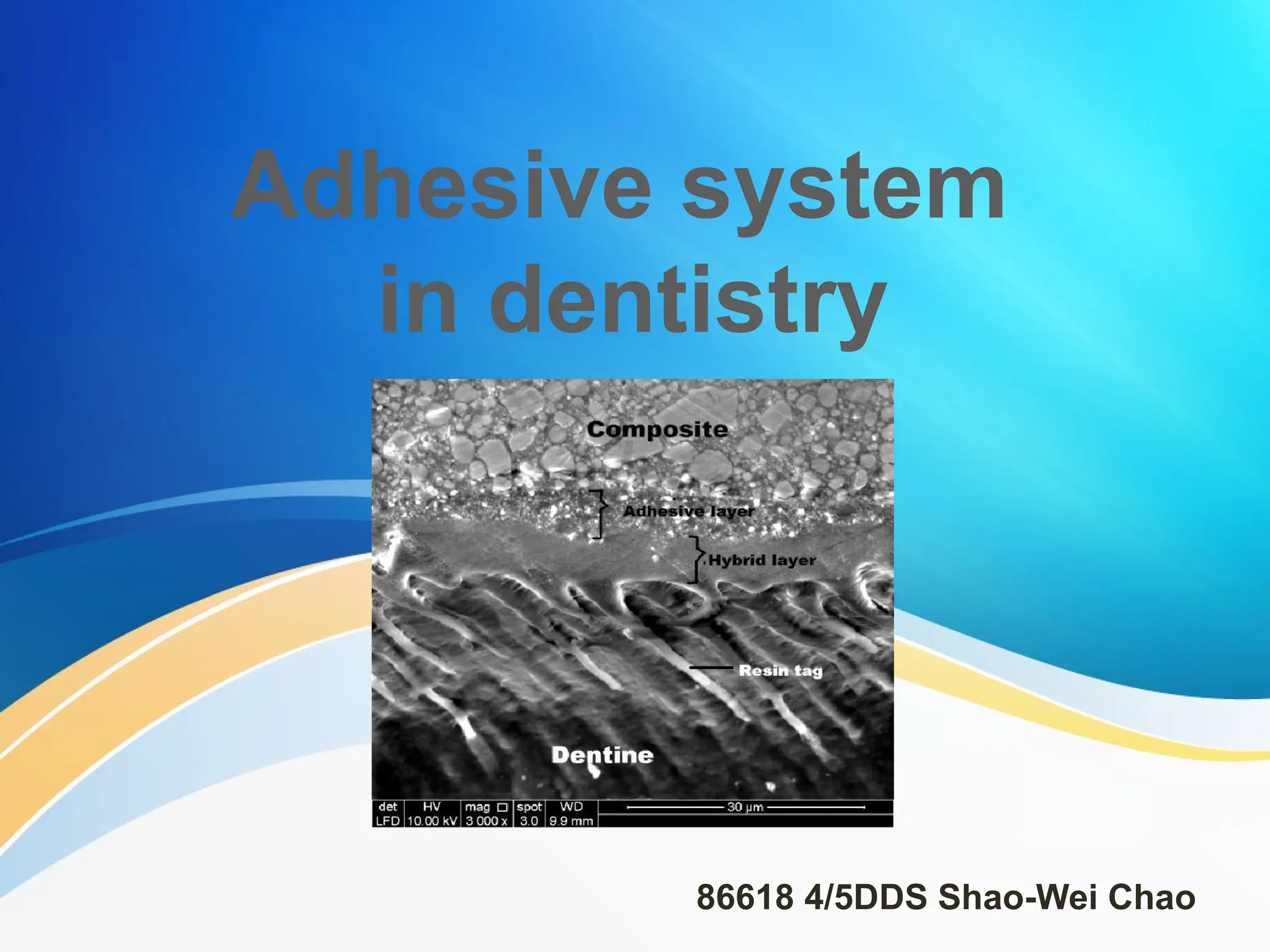
Adhesive system
in dentistry
86618 4/5DDS Shao-Wei Chao
CONTENTS
1. Basic concepts of adhesion
2. Enamel adhesion
3. Mechanism of etching and etch patterns
4. Dentin adhesion
5. Generations of dentin bonding agents
6. Conclusion
7. Bibliography
BASIC CONCEPTS OF ADHESION
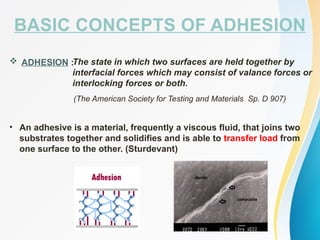
The state in which two surfaces are held together by
interfacial forces which may consist of valance forces or
interlocking forces or both.
 ADHESION :
(The American Society for Testing and Materials Sp. D 907)
• An adhesive is a material, frequently a viscous fluid, that joins two
substrates together and solidifies and is able to transfer load from
one surface to the other. (Sturdevant)
 ADHESIVE : this refers to the bonding agent that when
applied to the surfaces or substances, can join them
together, resist separation and transmit loads across the
bond.
 ADHEREND : this refers to the surface or substrate that
is adhered to.
MECHANISMS OF ADHESIONS :
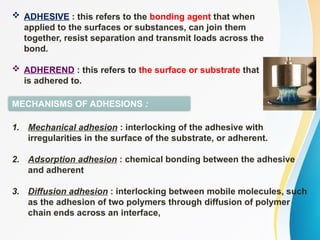
1. Mechanical adhesion : interlocking of the adhesive with
irregularities in the surface of the substrate, or adherent.
2. Adsorption adhesion : chemical bonding between the adhesive
and adherent
3. Diffusion adhesion : interlocking between mobile molecules, such
as the adhesion of two polymers through diffusion of polymer
chain ends across an interface,
In dentistry bonding of resins to the tooth structure is a result of four
possible mechanisms, as follows :
4. Electrostatic adhesion : an electrical double layer at the interface of
a metal with a polymer that is part of the total bonding mechanism
1. Mechanical : penetration of resin and formation of resin tags within
the tooth surface.
2. Adsorption : chemical bonding to the inorganic component
(hydroxyapatite) or organic components (mainly type I collagen) of
tooth structure
3. Diffusion : precipitation of substances on the tooth surfaces to
which resin monomers can bond mechanically or chemically.
4. A combination of the previous three mechanisms
ENAMEL ADHESION
• Buonocore in 1955 introduced the acid-etch technique for the
adhesion of resin to the tooth.
• He envisioned the use of acids to etch enamel for sealing pits and
fissures.
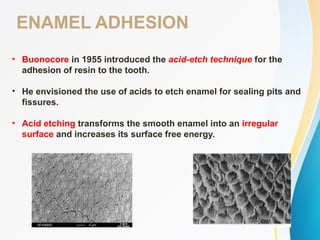
• Acid etching transforms the smooth enamel into an irregular
surface and increases its surface free energy.
• When a fluid resin-based material is applied to the irregular etched
surface, the resin penetrates into the surface, aided by capillary action.
• Monomers undergo polymerization and the material becomes
interlocked with the enamel surface.
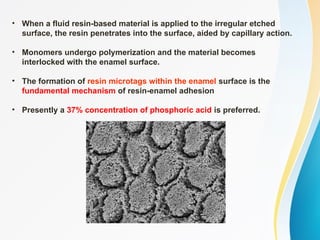
• The formation of resin microtags within the enamel surface is the
fundamental mechanism of resin-enamel adhesion
• Presently a 37% concentration of phosphoric acid is preferred.
MECHANISM OF ETCHING AND ETCH PATTERNS
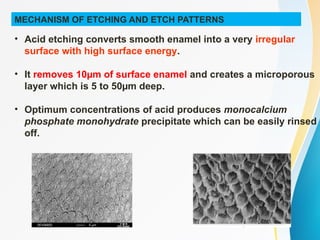
• Acid etching converts smooth enamel into a very irregular
surface with high surface energy.
• It removes 10µm of surface enamel and creates a microporous
layer which is 5 to 50µm deep.
• Optimum concentrations of acid produces monocalcium
phosphate monohydrate precipitate which can be easily rinsed
off.
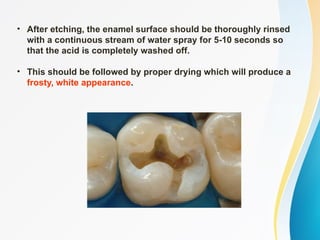
• After etching, the enamel surface should be thoroughly rinsed
with a continuous stream of water spray for 5-10 seconds so
that the acid is completely washed off.
• This should be followed by proper drying which will produce a
frosty, white appearance.
ENAMEL BONDING AGENTS
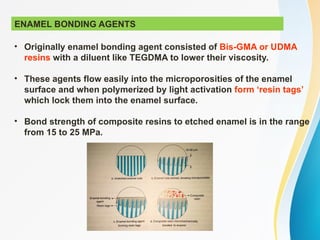
• Originally enamel bonding agent consisted of Bis-GMA or UDMA
resins with a diluent like TEGDMA to lower their viscosity.
• These agents flow easily into the microporosities of the enamel
surface and when polymerized by light activation form ‘resin tags’
which lock them into the enamel surface.
• Bond strength of composite resins to etched enamel is in the range
from 15 to 25 MPa.
DENTIN ADHESION
• The classic concepts of operative dentistry were challenged in the
1980-90s by the introduction of new adhesive techniques to dentin
as well as to the enamel.
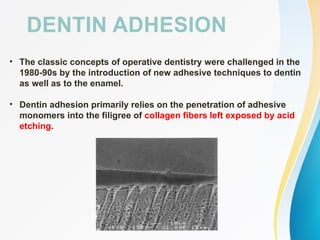
• Dentin adhesion primarily relies on the penetration of adhesive
monomers into the filigree of collagen fibers left exposed by acid
etching.
• Dentin is an intrinsically hydrated tissue, penetrated by a maze of 1-
2.5µm-diameter- fluid filled dentinal tubules.
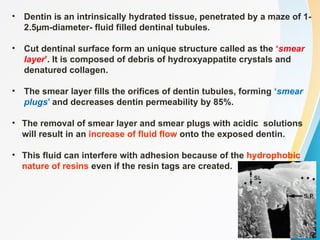
• Cut dentinal surface form an unique structure called as the ‘smear
layer’. It is composed of debris of hydroxyappatite crystals and
denatured collagen.
• The smear layer fills the orifices of dentin tubules, forming ‘smear
plugs’ and decreases dentin permeability by 85%.
• The removal of smear layer and smear plugs with acidic solutions
will result in an increase of fluid flow onto the exposed dentin.
• This fluid can interfere with adhesion because of the hydrophobic
nature of resins even if the resin tags are created.
FIRST GENERATION
• NPG-GMA(N-phenyl glycine glycidyl methacrylate), a surface active
comonomer is considered as the first generation dentin bonding
system.
• Both Invitro and invivo clinical study results were discouraging.
• Theoretically, the comonomer could chelate with calcium on the
tooth surface to generate water-resistant chemical bonds of resin
to dentin.
• Based on C-13 nuclear magnetic resonance analysis, It seems that
no ionic bonding develops between NPG-GMA and hydroxyapatite.
• Example : Cervident
DENTIN BONDING AGENTS
SECOND GENERATION
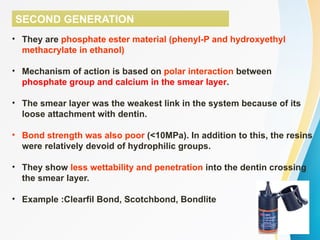
• They are phosphate ester material (phenyl-P and hydroxyethyl
methacrylate in ethanol)
• Mechanism of action is based on polar interaction between
phosphate group and calcium in the smear layer.
• The smear layer was the weakest link in the system because of its
loose attachment with dentin.
• Bond strength was also poor (<10MPa). In addition to this, the resins
were relatively devoid of hydrophilic groups.
• They show less wettability and penetration into the dentin crossing
the smear layer.
• Example :Clearfil Bond, Scotchbond, Bondlite
THIRD GENERATION
• The third generation dentinal adhesives attempted to deal smear
layer in two ways.
• Either by modification of the smear layer to improve its properties
or by the removal of the smear layer by keeping the smear plugs
intact.
• Fusayama et al in 1979 introduced the concept of phosphoric acid
etching of dentin prior to the use of phosphate-ester type bonding
agent.
• Materials like phenyl-P or PENTA was used to achieve smear layer
modification by penetration of acidic monomers.
• Treatment of smear layer using acid primers were also attempted.
2.5% maleic acid, 55% HEMA, and traces of methacrylic acid were
used for this.
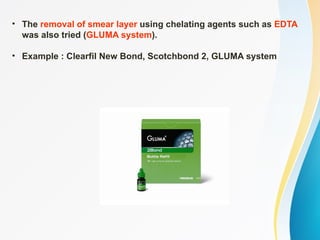
• The removal of smear layer using chelating agents such as EDTA
was also tried (GLUMA system).
• Example : Clearfil New Bond, Scotchbond 2, GLUMA system
FOURTH GENERATION
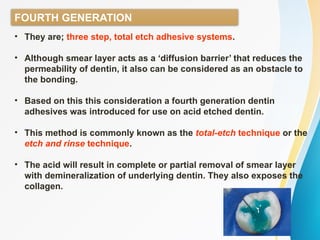
• They are; three step, total etch adhesive systems.
• Although smear layer acts as a ‘diffusion barrier’ that reduces the
permeability of dentin, it also can be considered as an obstacle to
the bonding.
• Based on this this consideration a fourth generation dentin
adhesives was introduced for use on acid etched dentin.
• This method is commonly known as the total-etch technique or the
etch and rinse technique.
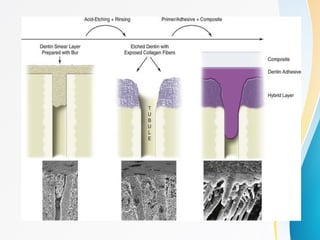
• The acid will result in complete or partial removal of smear layer
with demineralization of underlying dentin. They also exposes the
collagen.
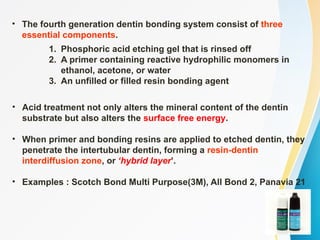
• The fourth generation dentin bonding system consist of three
essential components.
1. Phosphoric acid etching gel that is rinsed off
2. A primer containing reactive hydrophilic monomers in
ethanol, acetone, or water
3. An unfilled or filled resin bonding agent
• Acid treatment not only alters the mineral content of the dentin
substrate but also alters the surface free energy.
• When primer and bonding resins are applied to etched dentin, they
penetrate the intertubular dentin, forming a resin-dentin
interdiffusion zone, or ‘hybrid layer’.
• Examples : Scotch Bond Multi Purpose(3M), All Bond 2, Panavia 21
FIFTH GENERATION
• These adhesives are a simplified version of the fourth generation
adhesives. Also known as ‘one bottle’ system.
• The primer and adhesive is combined in one bottle. A separate
etching step is still required.
• Though they require fewer steps to achieve dentin bonding, these
agents are inferior to the fourth generation bonding agents in
terms of bond strength.
• Example : Single Bond(3M), One-Step, Gluma Comfort Bond.
SIXTH GENERATION
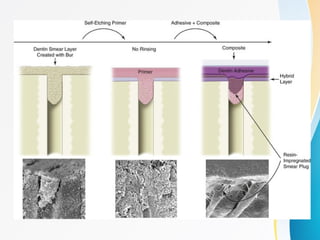
• Sixth generation dentin boding systems try to further simplify the
process of dentin adhesion by minimizing the clinical steps.
• Acids of lower concentration are generally used :10% Phosphoric,
2.5%nitric, 10% citric, 10% maleic acids.
• They are also known as SEP – Self Etching Primers.
• Commercially they are available in two forms :
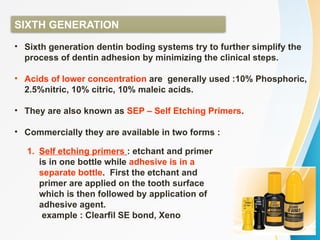
1. Self etching primers : etchant and primer
is in one bottle while adhesive is in a
separate bottle. First the etchant and
primer are applied on the tooth surface
which is then followed by application of
adhesive agent.
example : Clearfil SE bond, Xeno
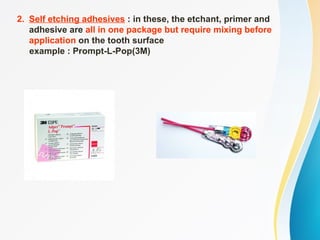
2. Self etching adhesives : in these, the etchant, primer and
adhesive are all in one package but require mixing before
application on the tooth surface
example : Prompt-L-Pop(3M)
SEVENTH GENERATION
• Also known as All-in-one adhesive system.
• They combine etchant, primer, and adhesive in one bottle. They do
not require any mixing prior to application.
• Primarily these agents are intricate mixes of hydrophilic and
hydrophobic components in one bottle.
• Their bond strength is less than fourth and fifth generation
adhesives.
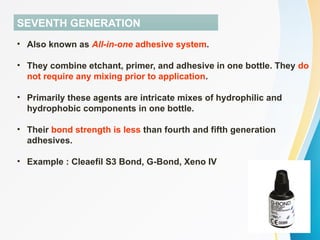
• Example : Cleaefil S3 Bond, G-Bond, Xeno IV
EIGHTH GENERATION
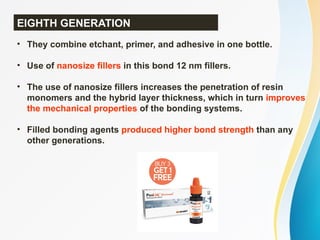
• They combine etchant, primer, and adhesive in one bottle.
• Use of nanosize fillers in this bond 12 nm fillers.
• The use of nanosize fillers increases the penetration of resin
monomers and the hybrid layer thickness, which in turn improves
the mechanical properties of the bonding systems.
• Filled bonding agents produced higher bond strength than any
other generations.
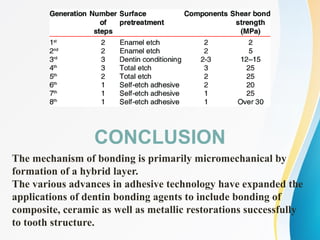
CONCLUSION
The mechanism of bonding is primarily micromechanical by
formation of a hybrid layer.
The various advances in adhesive technology have expanded the
applications of dentin bonding agents to include bonding of
composite, ceramic as well as metallic restorations successfully
to tooth structure.
BIBLIOGRAPHY
 Sturdevant’s Art and Science of Operative Dentistry
 Grover, Vishakha & Kumar, Ashish & Jain, Ashish & Chatterjee,
Anirban & Grover, Harpreet & Pandit, Nymphea. (2022). ISP Good
Clinical Practice Recommendations for the management of Dentin
Hypersensitivity. Journal of Indian Society of Periodontology. 26.
307-33. 10.4103/jisp.jisp_233_22.
 SH, Ku & Tan, Yee Shin & Yahya, Noor. (2014). The Effect of Different
Dental Adhesive Systems on Hybrid Layer Qualities. Annals of
Dentistry. 21. 29-37. 10.22452/adum.vol21no1.5.
Adhesive system in dentistry, bachelor level

Adhesive system in dentistry, bachelor level

  • 1.
  • 2.
    CONTENTS 1. Basic conceptsof adhesion 2. Enamel adhesion 3. Mechanism of etching and etch patterns 4. Dentin adhesion 5. Generations of dentin bonding agents 6. Conclusion 7. Bibliography
  • 3.
    BASIC CONCEPTS OFADHESION The state in which two surfaces are held together by interfacial forces which may consist of valance forces or interlocking forces or both.  ADHESION : (The American Society for Testing and Materials Sp. D 907) • An adhesive is a material, frequently a viscous fluid, that joins two substrates together and solidifies and is able to transfer load from one surface to the other. (Sturdevant)
  • 4.
     ADHESIVE :this refers to the bonding agent that when applied to the surfaces or substances, can join them together, resist separation and transmit loads across the bond.  ADHEREND : this refers to the surface or substrate that is adhered to. MECHANISMS OF ADHESIONS : 1. Mechanical adhesion : interlocking of the adhesive with irregularities in the surface of the substrate, or adherent. 2. Adsorption adhesion : chemical bonding between the adhesive and adherent 3. Diffusion adhesion : interlocking between mobile molecules, such as the adhesion of two polymers through diffusion of polymer chain ends across an interface,
  • 5.
    In dentistry bondingof resins to the tooth structure is a result of four possible mechanisms, as follows : 4. Electrostatic adhesion : an electrical double layer at the interface of a metal with a polymer that is part of the total bonding mechanism 1. Mechanical : penetration of resin and formation of resin tags within the tooth surface. 2. Adsorption : chemical bonding to the inorganic component (hydroxyapatite) or organic components (mainly type I collagen) of tooth structure 3. Diffusion : precipitation of substances on the tooth surfaces to which resin monomers can bond mechanically or chemically. 4. A combination of the previous three mechanisms
  • 6.
    ENAMEL ADHESION • Buonocorein 1955 introduced the acid-etch technique for the adhesion of resin to the tooth. • He envisioned the use of acids to etch enamel for sealing pits and fissures. • Acid etching transforms the smooth enamel into an irregular surface and increases its surface free energy.
  • 7.
    • When afluid resin-based material is applied to the irregular etched surface, the resin penetrates into the surface, aided by capillary action. • Monomers undergo polymerization and the material becomes interlocked with the enamel surface. • The formation of resin microtags within the enamel surface is the fundamental mechanism of resin-enamel adhesion • Presently a 37% concentration of phosphoric acid is preferred.
  • 8.
    MECHANISM OF ETCHINGAND ETCH PATTERNS • Acid etching converts smooth enamel into a very irregular surface with high surface energy. • It removes 10µm of surface enamel and creates a microporous layer which is 5 to 50µm deep. • Optimum concentrations of acid produces monocalcium phosphate monohydrate precipitate which can be easily rinsed off.
  • 9.
    • After etching,the enamel surface should be thoroughly rinsed with a continuous stream of water spray for 5-10 seconds so that the acid is completely washed off. • This should be followed by proper drying which will produce a frosty, white appearance.
  • 10.
    ENAMEL BONDING AGENTS •Originally enamel bonding agent consisted of Bis-GMA or UDMA resins with a diluent like TEGDMA to lower their viscosity. • These agents flow easily into the microporosities of the enamel surface and when polymerized by light activation form ‘resin tags’ which lock them into the enamel surface. • Bond strength of composite resins to etched enamel is in the range from 15 to 25 MPa.
  • 11.
    DENTIN ADHESION • Theclassic concepts of operative dentistry were challenged in the 1980-90s by the introduction of new adhesive techniques to dentin as well as to the enamel. • Dentin adhesion primarily relies on the penetration of adhesive monomers into the filigree of collagen fibers left exposed by acid etching.
  • 12.
    • Dentin isan intrinsically hydrated tissue, penetrated by a maze of 1- 2.5µm-diameter- fluid filled dentinal tubules. • Cut dentinal surface form an unique structure called as the ‘smear layer’. It is composed of debris of hydroxyappatite crystals and denatured collagen. • The smear layer fills the orifices of dentin tubules, forming ‘smear plugs’ and decreases dentin permeability by 85%. • The removal of smear layer and smear plugs with acidic solutions will result in an increase of fluid flow onto the exposed dentin. • This fluid can interfere with adhesion because of the hydrophobic nature of resins even if the resin tags are created.
  • 13.
    FIRST GENERATION • NPG-GMA(N-phenylglycine glycidyl methacrylate), a surface active comonomer is considered as the first generation dentin bonding system. • Both Invitro and invivo clinical study results were discouraging. • Theoretically, the comonomer could chelate with calcium on the tooth surface to generate water-resistant chemical bonds of resin to dentin. • Based on C-13 nuclear magnetic resonance analysis, It seems that no ionic bonding develops between NPG-GMA and hydroxyapatite. • Example : Cervident DENTIN BONDING AGENTS
  • 14.
    SECOND GENERATION • Theyare phosphate ester material (phenyl-P and hydroxyethyl methacrylate in ethanol) • Mechanism of action is based on polar interaction between phosphate group and calcium in the smear layer. • The smear layer was the weakest link in the system because of its loose attachment with dentin. • Bond strength was also poor (<10MPa). In addition to this, the resins were relatively devoid of hydrophilic groups. • They show less wettability and penetration into the dentin crossing the smear layer. • Example :Clearfil Bond, Scotchbond, Bondlite
  • 15.
    THIRD GENERATION • Thethird generation dentinal adhesives attempted to deal smear layer in two ways. • Either by modification of the smear layer to improve its properties or by the removal of the smear layer by keeping the smear plugs intact. • Fusayama et al in 1979 introduced the concept of phosphoric acid etching of dentin prior to the use of phosphate-ester type bonding agent. • Materials like phenyl-P or PENTA was used to achieve smear layer modification by penetration of acidic monomers. • Treatment of smear layer using acid primers were also attempted. 2.5% maleic acid, 55% HEMA, and traces of methacrylic acid were used for this.
  • 16.
    • The removalof smear layer using chelating agents such as EDTA was also tried (GLUMA system). • Example : Clearfil New Bond, Scotchbond 2, GLUMA system
  • 17.
    FOURTH GENERATION • Theyare; three step, total etch adhesive systems. • Although smear layer acts as a ‘diffusion barrier’ that reduces the permeability of dentin, it also can be considered as an obstacle to the bonding. • Based on this this consideration a fourth generation dentin adhesives was introduced for use on acid etched dentin. • This method is commonly known as the total-etch technique or the etch and rinse technique. • The acid will result in complete or partial removal of smear layer with demineralization of underlying dentin. They also exposes the collagen.
  • 18.
    • The fourthgeneration dentin bonding system consist of three essential components. 1. Phosphoric acid etching gel that is rinsed off 2. A primer containing reactive hydrophilic monomers in ethanol, acetone, or water 3. An unfilled or filled resin bonding agent • Acid treatment not only alters the mineral content of the dentin substrate but also alters the surface free energy. • When primer and bonding resins are applied to etched dentin, they penetrate the intertubular dentin, forming a resin-dentin interdiffusion zone, or ‘hybrid layer’. • Examples : Scotch Bond Multi Purpose(3M), All Bond 2, Panavia 21
  • 20.
    FIFTH GENERATION • Theseadhesives are a simplified version of the fourth generation adhesives. Also known as ‘one bottle’ system. • The primer and adhesive is combined in one bottle. A separate etching step is still required. • Though they require fewer steps to achieve dentin bonding, these agents are inferior to the fourth generation bonding agents in terms of bond strength. • Example : Single Bond(3M), One-Step, Gluma Comfort Bond.
  • 21.
    SIXTH GENERATION • Sixthgeneration dentin boding systems try to further simplify the process of dentin adhesion by minimizing the clinical steps. • Acids of lower concentration are generally used :10% Phosphoric, 2.5%nitric, 10% citric, 10% maleic acids. • They are also known as SEP – Self Etching Primers. • Commercially they are available in two forms : 1. Self etching primers : etchant and primer is in one bottle while adhesive is in a separate bottle. First the etchant and primer are applied on the tooth surface which is then followed by application of adhesive agent. example : Clearfil SE bond, Xeno
  • 22.
    2. Self etchingadhesives : in these, the etchant, primer and adhesive are all in one package but require mixing before application on the tooth surface example : Prompt-L-Pop(3M)
  • 24.
    SEVENTH GENERATION • Alsoknown as All-in-one adhesive system. • They combine etchant, primer, and adhesive in one bottle. They do not require any mixing prior to application. • Primarily these agents are intricate mixes of hydrophilic and hydrophobic components in one bottle. • Their bond strength is less than fourth and fifth generation adhesives. • Example : Cleaefil S3 Bond, G-Bond, Xeno IV
  • 25.
    EIGHTH GENERATION • Theycombine etchant, primer, and adhesive in one bottle. • Use of nanosize fillers in this bond 12 nm fillers. • The use of nanosize fillers increases the penetration of resin monomers and the hybrid layer thickness, which in turn improves the mechanical properties of the bonding systems. • Filled bonding agents produced higher bond strength than any other generations.
  • 26.
    CONCLUSION The mechanism ofbonding is primarily micromechanical by formation of a hybrid layer. The various advances in adhesive technology have expanded the applications of dentin bonding agents to include bonding of composite, ceramic as well as metallic restorations successfully to tooth structure.
  • 27.
    BIBLIOGRAPHY  Sturdevant’s Artand Science of Operative Dentistry  Grover, Vishakha & Kumar, Ashish & Jain, Ashish & Chatterjee, Anirban & Grover, Harpreet & Pandit, Nymphea. (2022). ISP Good Clinical Practice Recommendations for the management of Dentin Hypersensitivity. Journal of Indian Society of Periodontology. 26. 307-33. 10.4103/jisp.jisp_233_22.  SH, Ku & Tan, Yee Shin & Yahya, Noor. (2014). The Effect of Different Dental Adhesive Systems on Hybrid Layer Qualities. Annals of Dentistry. 21. 29-37. 10.22452/adum.vol21no1.5.