1
Dental VENEERS
Presented by: Dr Abhisek Guria
Dept. of Conservative Dentistry & Endodontics
2
2
CONTENTS
 Introduction
 History
 Definition
 Laminates vs veneer
 Smile design
 Indications
 Contraindications
 Classification (sturdevant)
 Indirect method
 Direct method
 Partial veneer:
 Full veneer with window preparation
 Full veneer with incisal lapping preparation
2
5/11/2020 VENEERS
3
VENEERS
 Treatment planning
 Composite resin systems
 Premise indirect
 Sinfony
 Gc gradia
 Tescera atl
 Signum
 Ceramage shofu
 Anterior composite resin laminate veneers
 Prefabricated composite resin laminate veneers
 Componeers
 Edelweiss composite laminate veneers
 Porcelain laminate veneers
 Composition
5/11/2020
4
VENEERS
 Basic laboratory techniques
1. Platinum foil backing,
2. Refractory casts,
3. Direct castings,
4. Cad-cam machining
 Advantages
 Disadvantages
 Indications
 Contraindications
 Tooth Preparation
 Static Area Of Visibility Versus Dynamic Area Of Visibility
 Tooth Preparation For Porcelain Veneer
 Armamentarium
 Facial Reduction
 Proximal Reduction
 Magne & Douglas Classification
5/11/2020
5
VENEERS
 Incisal Reduction
 Lingual Reduction
 Gingival Finish Line
 Single-tooth provisionalization
 Multi-tooth provisionalization
 Laboratory communications
 Try in considerations
 Cementation
 Finishing and polishing
 No- prep veneers
 Lumineers
 Failures
 Esthetic failures
 Mechanical problems
 Adhesive problems
5/11/2020
6
VENEERS
 Failures Due to Internal or External Forces
 Color Change
 Aging
 Micro leakage
 Lack of Marginal Fit
 Incomplete Polymerization
 Biological Failures
 Improper Finishing
 Occlusal Failures
 Conclusion
 References
5/11/2020
7
7
Introduction
 A nice smile, that reflects self confidence and self esteem, is
an important part of the face beauty.
 The beauty of the teeth, that show when laughing, through
their
 - shape.
 - color.
 - Position and alignment.
is an essential part of the smile.
7
5/11/2020 VENEERS
8
8
History
 1930s: Charles Pincus- Thin porcelain veneers
 1968 - McCulloch …first described the use of castable glass-
ceramic facing.
 Horn and Calamia… reported first porcelain facing technique.
 2nd evolution- Preformed veneers/crowns
 1970s- introduction of visible light cured composites  direct
composite laminate veneers.
 Faunce described a one piece acrylic resin prefabricated veneer.
 1981- Ronk L. Sterling described a direct laboratory technique
for fabricating dental laminate restorations.
8
5/11/2020 VENEERS
9
9
Definitions
 A layer of tooth colored material that is applied to a
tooth to restore a localized or generalized defect and
intrinsic discoloration (Sturdevant)
 Constructing a veneer and bonding it to tooth
structure is referred to as laminating
9
5/11/2020 VENEERS
10
10
Laminates vs veneer
 Mayekar (2001)
 Laminate maintains colour. Usually requires no Tooth Prep.
 Veneer- change in colour, requires Prep. (endodontically
treated teeth and tetracycline stained teeth)
10
5/11/2020 VENEERS
11
Smile design
12
12
Shape or form
 Masculine smile
 More closed and
 prominent incisal angles
 Feminine smile
 Rounded incisal angles,
 Open incisal and facial embrasures and
 softened facial line angles
12
5/11/2020 VENEERS
13
13
Sex, Personality and the Age (SPA)
Factor
13
5/11/2020 VENEERS
14
14
Lip line
14
5/11/2020 VENEERS
15
15
Mid-line
Ideally, the papilla between the maxillary central incisors
coincides with the mid-line of the face.
15
5/11/2020 VENEERS
16
16
Incisal Length
 To correct incisal wear, inadequate tooth display, or a
displeasing tooth or crown proportion.
16
5/11/2020 VENEERS
17
17
Incisal visibility
17
5/11/2020 VENEERS
18
18
Zenith Points
 The most apical points of the clinical crowns; which are the
height of contour.
 They are usually placed distally, when viewed from the
facial aspect.
 in the laterals, they are placed centrally.
18
5/11/2020 VENEERS
19
VENEERS
 When closing diastemas,
the zenith points should be
repositioned to avoid a
mesially tilted appearance
5/11/2020
20
VENEERS
 where the tooth needs to be shown longer or more
tapered at the gingival 1 /3rd, the zenith points can be
moved apically
5/11/2020
21
21
Gingival Levels and Harmony
 The tips of the papilla gradually follow a pattern in the
apical direction, when proceeding from the anterior
towards the posterior dentition, thus the volume of the
gingival embrasures is getting smaller.
21
5/11/2020 VENEERS
22
22
Tooth Axis
 In comparison to central incisors, the laterals exhibit a
more distal inclination towards the apex.
22
5/11/2020 VENEERS
23
23
Interdental Contact Areas (ICA)
and Points (ICP)
23
5/11/2020 VENEERS
24
24
Incisal Embrasures
 It is smallest and sharpest in the central incisors.
 posteriorly, the embrasures become larger and wider.
24
5/11/2020 VENEERS
25
25
25
5/11/2020 VENEERS
26
26
Golden Proportion
 It is a mathematical theorem concerning the proportions of the
dentition. It is considered as the only mathematical tool for
determining dominance and proportion in the arrangement of
the maxillary teeth from the frontal view
 Lombardi was the first actually to apply this equation to
dentistry
 Levin developed the principles of visual perception and their
application to dental esthetics
26
5/11/2020 VENEERS
27
27
27
5/11/2020 VENEERS
28
28
28
5/11/2020 VENEERS
29
29
recurring esthetic dental (RED)
proportion
29
5/11/2020 VENEERS
30
30
Tooth Character
Surface Texture and Contour
30
5/11/2020 VENEERS
31
31
Illusions
 Certain conditions may alter the perception of teeth by
creating illusions in the oral environment
 1. Depth can be created with shadows.
 2. Prominence can be increased with light.
 3. Length can be emphasized with vertical lines.
 4. Width can be emphasized with horizontal lines.
31
5/11/2020 VENEERS
32
32
Indications - Marzouk
 Single or multiple discolored
teeth
 Presence of diastema
 Fractures
32
5/11/2020 VENEERS
33
VENEERS
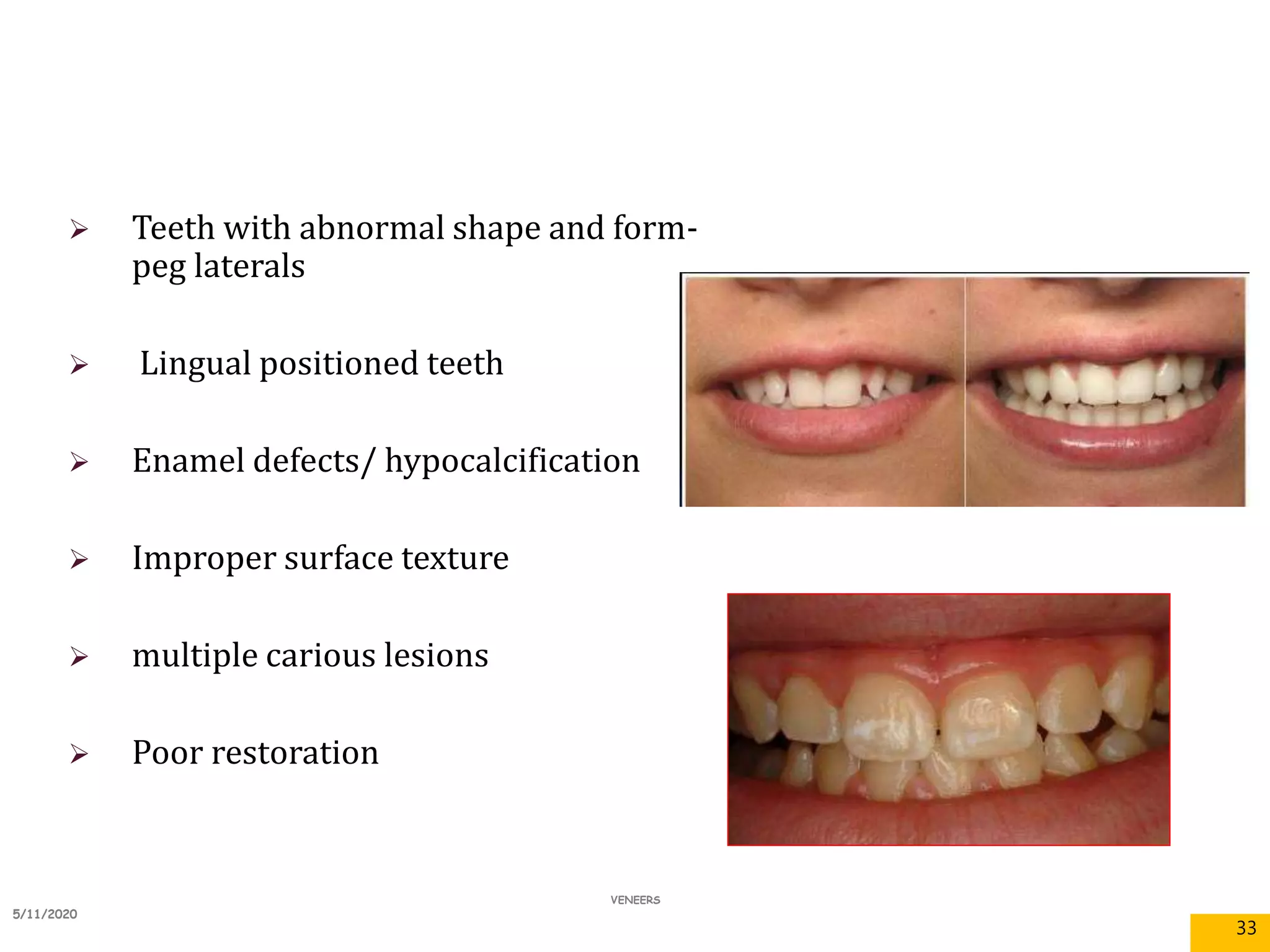
 Teeth with abnormal shape and form-
peg laterals
 Lingual positioned teeth
 Enamel defects/ hypocalcification
 Improper surface texture
 multiple carious lesions
 Poor restoration
5/11/2020
34
VENEERS
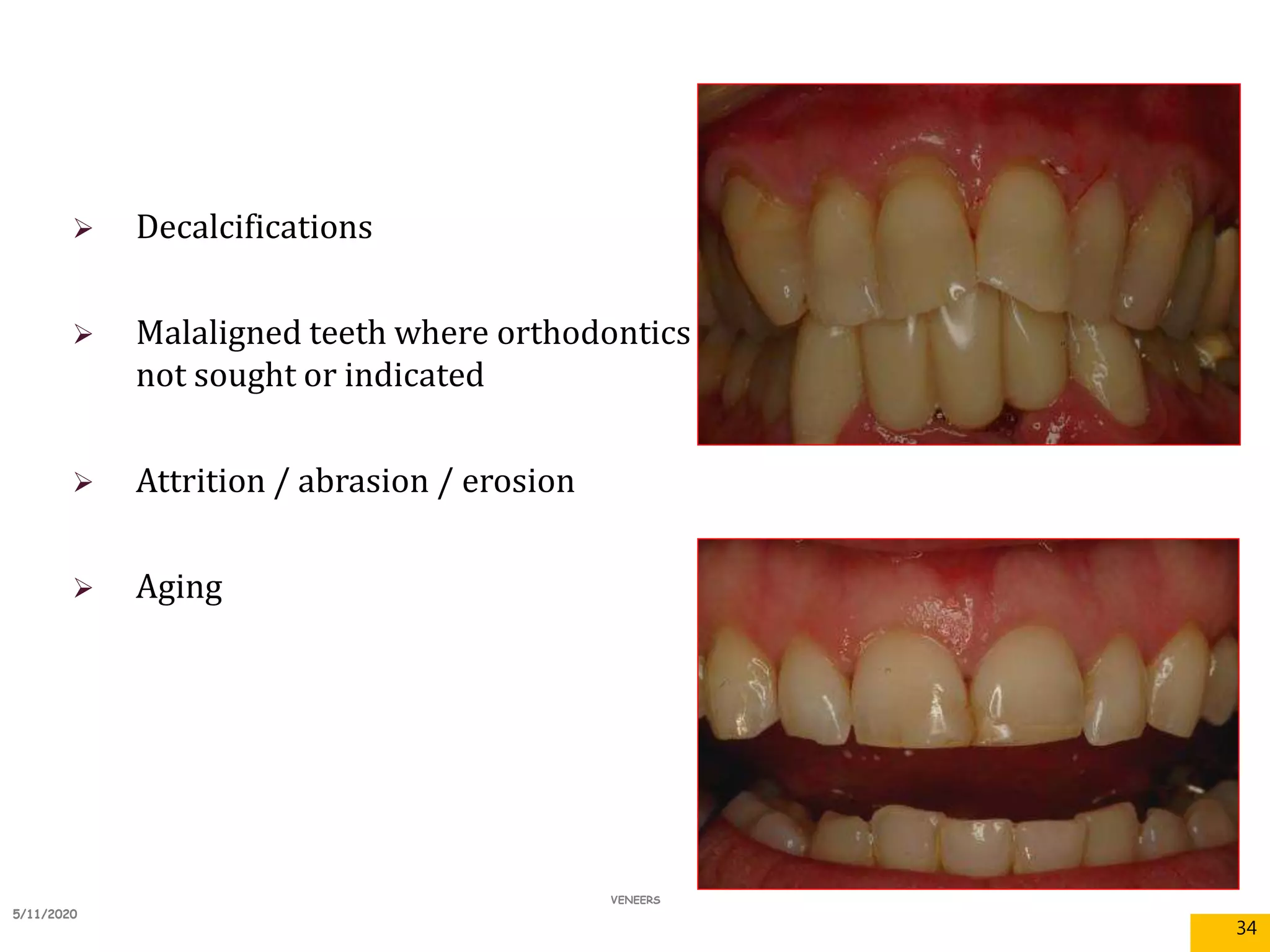
 Decalcifications
 Malaligned teeth where orthodontics is
not sought or indicated
 Attrition / abrasion / erosion
 Aging
5/11/2020
35
35
Contraindications
 Teeth with defective enamel formation
insufficient crown material (E for bonding)
 Young permanent teeth
 Severe periodontal involvement
 severe crowding
 Poor oral hygiene
 Labial version
 Excessive interdental spacing
 Teeth exhibiting severe occlusal wear
patterns, due to Para-functional habits
35
5/11/2020 VENEERS
36
36
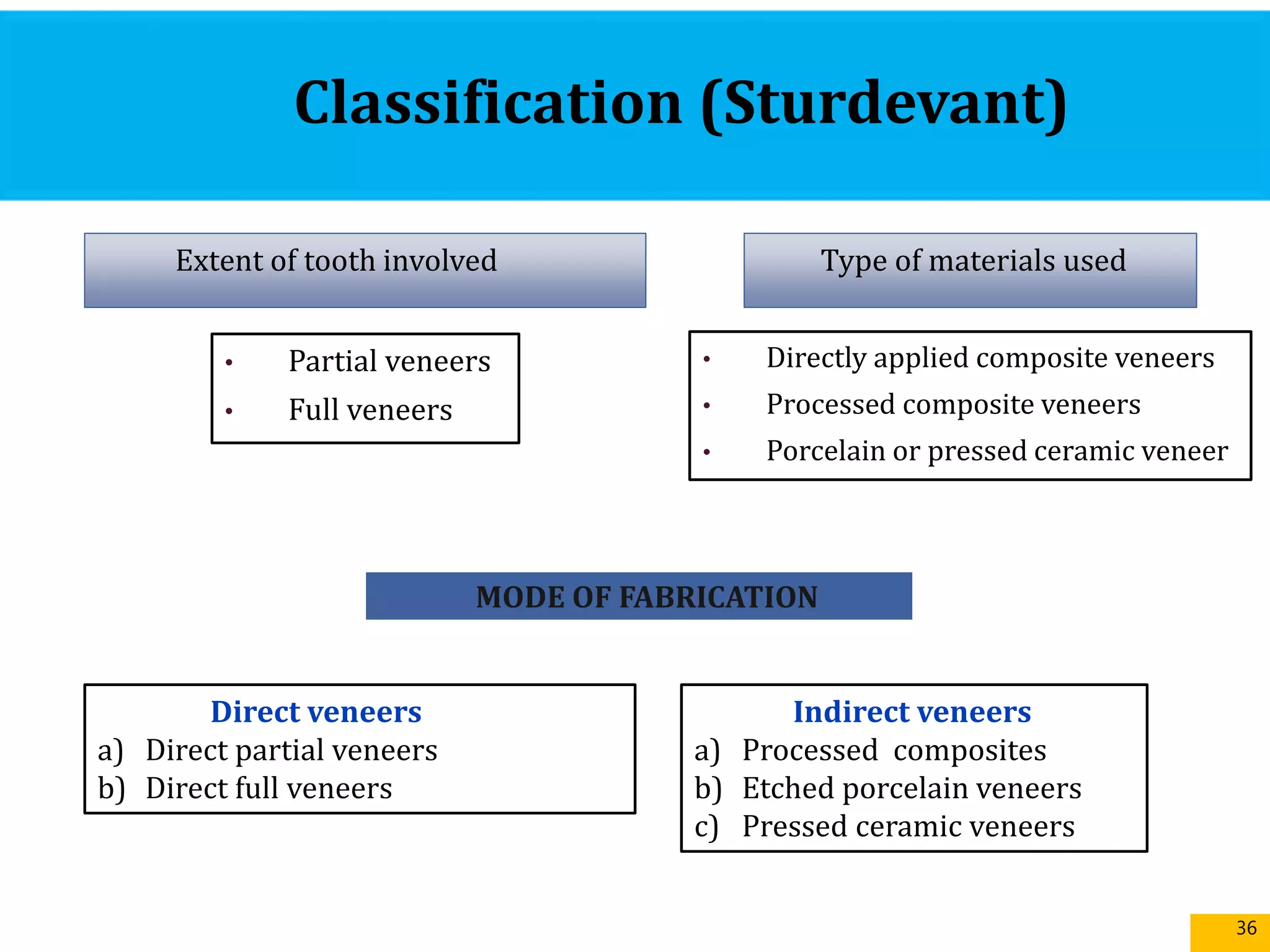
• Partial veneers
• Full veneers
Extent of tooth involved Type of materials used
• Directly applied composite veneers
• Processed composite veneers
• Porcelain or pressed ceramic veneer
MODE OF FABRICATION
Direct veneers
a) Direct partial veneers
b) Direct full veneers
Indirect veneers
a) Processed composites
b) Etched porcelain veneers
c) Pressed ceramic veneers
Classification (Sturdevant)
37
37
I. Based on use of material:
1. Composite veneer
2. Porcelain veneer
II. Based on the fabrication technique:
I. Directly fabricated veneers:
Direct composite veneers
II. Indirectly fabricated veneer
a) Composite.
b) Etched porcelain
According to Marzouk
38
Indirect method:
Composites
1) Microhybrid composite
2) Filled resins.
3) Prefabricated resin shells.
Porcelain:
Feldspathic porcelain
Castable glass ceramic
Heat pressed ceramic
CAD/CAM ceramic
Based on coverage of tooth.
1. Partial veneers: - localized defects
2. Full veneers: - generalized defects
39
1) Conventional powder-slurry ceramic (feldspathic porcelain).
This type of porcelain is layered on the refractory die in the lab
2) Heat-pressed ceramic.
These products are melted at high temperatures and pressed into a
mould created using the lost-wax technique
(e.g., IPS Empress 1 and 2, OPC).
3) Machineable (CAD/CAM) ceramics
(e.g., CEREC, E4D).
40
VENEERS
41
41
According to Preparation
42
42
Full veneer with window preparation:
. Ben-Amar suggested a design that extends to
gingival crest and terminates at the facio -
incisal angle.
Recommended for most direct & indirect
method
Indications-
 to preserve functional lingual & incisal
surfaces of anterior teeth
 To prepare maxillary canines in patients
with canine guided occlusion
 In high occlusal stresses
43
Advantages –
 Saves the functional lingual &
incisal surfaces of anterior teeth
 It does not extend subgingivally /
involve incisal edge
 ↓ the chances of wear of opposing teeth
44
44
Feathered-edge preparation
 Boksman and colleagues and Garber recommended
 recommended for patients with normal overbite
 Disadvantages
 weak veneer, high risk of experiencing ceramic chipping,
and difficulty with seating of the veneers, marginal
discoloration and poor marginal adaptation
VENEERS
45
45
Overlap incisal preparation
designs
a. Butt joint preparation
 Advantages
 masking of the otherwise noticeable incisal finish line,
 thicker ceramic and reinforcement of incisal edge, and
 positive seating of ceramic veneers,
 allow translucency of incisal edges and a more natural
appearance
45
5/11/2020 VENEERS
46
46
Garber advocated
Design extending subgingivally & includes all of
incisal surface.
Indications-
 When crown length has to be ↑
 When the incisal defect is severe & restoration
is necessary
 Where seating is accurate & more esthetic
demand
Advantages-
 Tooth preparation is within the Enamel , no temp
restoration is necessary
 Improves the esthetics along the incisal edges
b. Palatal chamfer preparation
47
47
Literature
 Schmidt and colleagues reported that palatal chamfer
incisal preparation group had significantly higher failure
load than the butt joint incisal preparation group in both
nonworn and worn tooth samples.
 Jankar and colleagues reported the highest fracture load
with palatal chamfer incisal preparation design, followed
by butt joint and feathered-edge preparation design
VENEERS
48
VENEERS
 da Costa and colleagues concluded that a palatal chamfer
incisal preparation design increased the risk of developing
ceramic fractures.
 An in vitro study by Bergoli and colleagues showed that
ceramic veneers with a feathered-edge preparation design
had significantly higher fracture load compared with a
palatal chamfer preparation design.
48
5/11/2020
49
VENEERS
 Zarone and colleagues comparing the window and the
palatal chamfer incisal preparation designs showed that
ceramic veneer with palatal chamfer incisal preparation
design had the highest stress tolerance under functional
loading, and the incisal preparation helped distribute the
stress throughout the surface of preparation without
overloading the incisal edge.
 Li and colleagues reported similar results when
comparing ceramic veneers with butt joint and palatal
chamfer incisal preparation designs.
49
5/11/2020
50
VENEERS
RESULTS:
Under the limitations of the available literature, the clinician preference is
the decisive factor for choosing the preparation design. Nonetheless, incisal
overlap preparation seems to have the most predictable outcome from all
the preparation designs.
CONCLUSION:
Porcelain veneers show excellent aesthetic results and predictable longevity
of the treatment, while composite veneers can be considered as a good
conservative option, but with less durability.
51
DIRECT VENEERS
52
52
Direct veneers area placed on small localized defects / intrinsic
discolorations which are surrounded by sound enamel
Indication - less no of teeth involved
- localized defects
- young permanent teeth
- diastema
Materials used - microfill, nanohybrid composite resins
Direct partial veneers
53
VENEERS
53
5/11/2020
54
Advantages – economic
- single visit
- useful in young pt & localized defects
- repairable
Disadvantages– more chair side time
- more labour
- tech sensitive
- operator skill required
55
55
Armamentarium
VENEERS
56
VENEERS
56
5/11/2020
57
57
Finishing kit
57
5/11/2020 VENEERS
58
58
 Assessment of face, lip line, skin color
 Assessment of smile, gingival display
 Impression for study models/bite
registration record
 Diagnostic aids- mock ups, costs, computer
imaging, photographs, radiographs
 Oral prophylaxis, shade selection
 If defect extended to dentin – LA
 Isolation – rubber dam
Treatment planning (Single appointment)
59
 Out line form – include solely by defect, &
all discolored areas
 Tooth ppn – 0.5 – 0.75mm - in pulpal
direcction
(coarse, elliptical, round diamond bur
with water coolant )
 Etching the tooth , bonding agent
 Opaque placement to mask dark
discoloration( optional)
 Composite Resin placement( microfilled )
 light curing
 Finishing & polishing
60
60
Indications – diastema
- grossly stained & pitted
- gross enamel hypoplasia of anterior teeth
Advantages – less tech sensitive
- last longer
- effective for multiple veneers
Disadvantages – expensive
- require special tooth ppn
DIRECT COMPOSITE FULL VENEERS
61
 Steps _ Reduction of tooth by coarse round end diamond bur-
0.5 – 0.75mm – mid facially, tapering down to a depth of about 0.2
– 0.5 mm along gingival margin
at proximal side the ppn should be facial to the contact point
 heavy chamfer at gingival crest
 In diastema- proximal ppns are extended from the facial onto the
mesial surface , terminating @ the mesio lingual line angle
62
VENEERS
63
63
 Should it terminate short of free gingival crest ?
 At the level of gingival crest ?
 Apical to gingival crest ?
Depends on individual situation-
If the defect does not extended subgingivaly
- the margin should not extend subgingivaly
In case of if area is carious
defective restoration extend subgingivaly
dark discoloration
Location of gingival margin ?
64
 Etching the tooth ,washing & drying followed by
bonding agent
 Resin Opaquing agents applied in thin layer to mask
dark tetracycline discoloration
 Composite Resin placement – starts from gingival 3rd-
incrementally, light curing
 Create proper physiological contour, contact point,
smooth surface
 Finishing & polishing
65
Indirect composite veneers
66
66
COMPOSITE RESIN SYSTEMS
1. Premise Indirect (Kerr Corp.)
 low-wear, high-strength microhybrid
 Trimodal curing (light, heat, and pressure) achieves over 98% material
conversion
 COTE - is similar to natural dentin
 A reinforcing fiber material of woven polyethylene braids coated with a
reactive monomeric solution that allows the product to be bonded to a
resin based crown and FPD substructure by the application of heat.
66
5/11/2020 VENEERS
67
67
2. Sinfony (3M ESPE)
 Ultrafine particle hybrid composite resin
 contains two kinds of filler:
 macrofiller (strontium aluminum
borosilicate glass with a mean particle
diameter of 0.5 to 0.7 mm; 40% by wt.)
 microfiller (pyrogenic silica; 5% by wt.)
 addition of a special glass ionomer (5% by wt.)-
plaque accumulation is minimized.
67
5/11/2020 VENEERS
68
68
3. GC Gradia (GC America Inc.)
 light-cured high strength microhybrid
 couples a microfine ceramic/prepolymer
filler with a UDMA matrix to produce a
superior ceramic composite resin with
exceptionally high strength, wear resistance,
and superior polishability
 Oxygen also plays an important role in the
apparent translucency or opacity of the
polymerized resin restoration
68
5/11/2020 VENEERS
69
69
4. TESCERA ATL (Bisco, Inc.)
 Dual-cured microhybrid composite
 incremental layers are condensed with
pressure and then polymerized to prevent
delamination and keep the restoration
free of voids.
 Final polymerization occurs in an oxygen-
free environment to achieve a high-gloss–
free surface to reduce staining.
69
5/11/2020 VENEERS
70
70
5. Signum
 Glass-ceramic composite resin with microfine filler
particles
 for the requirements of metal-free restorations;
 High intrinsic durability (E-modulus)
70
5/11/2020 VENEERS
71
71
6. Ceramage Shofu
 zirconium silicate integrated indirect
restorative
 A progressive fine structure filling of
more than 73%, plus an organic
polymer matrix delivers superior
flexural strength, elasticity, and
excellent polishability.
71
5/11/2020 VENEERS
72
72
Tooth preparation for Indirect
composite veneers
 Clean the tooth and Select the desired shades of composite
 Prepare teeth by removing small amounts of enamel with a medium
grit flame or chamfer diamond bur.
 remove only 0.25 to 0.50 mm of enamel from the facial area and
none from the incisal area.
 If incisal reduction is necessary, remove 1 to 1.5 mm.
72
5/11/2020 VENEERS
73
VENEERS
 Make impression with a vinyl polysiloxane impression material.
Place a provisional restoration
 Pour stone casts
 Laminate veneers can be fabricated on the stone cast by using a
separating medium or on a flexible cast
5/11/2020
74
VENEERS
 fabricate and Remove the laminate veneers from the flexible cast.
 Contour and polish using 12- and 30-fluted finishing carbide
burs.
 Heat treat the laminate veneers in boiling water or a heat device,
for 10 minutes
 Acid etch with 10% HF gel for 30 seconds or lightly sandblast
with a microetcher or air abrasion unit
5/11/2020
75
VENEERS
 rinse, and dry
 etch the enamel
 Leave the tooth surface slightly moist for wet bonding.
 apply silane coupling agent to the internal surface
 coat the etched surfaces with a hydrophilic primer
 Paint a thin layer of bonding resin onto the internal surface of the laminate
veneers.
 Apply a luting composite resin to the internal surface of veneers.
 Place on the prepared tooth and remove excess resin with a brush dipped in
bonding agent and do finishing
5/11/2020
76
PREFABRICATED COMPOSITE
RESIN LAMINATE VENEERS
77
77
Componeers
(Coltene Whaledent)
 polymerized, prefabricated composite resin enamel shells made
of a nanohybrid composite
 0.3 mm in thickness
77
5/11/2020 VENEERS
78
VENEERS
78
5/11/2020
79
79
Edelweiss Composite Laminate Veneers
(Ultradent Products Inc.)
 Laser sintered- particles are fused together to provide a
high gloss, uniform surface, and a thermally tempered base.
 filler particle is between 0.02 and 0.03 mm
79
5/11/2020 VENEERS
80
Porcelain Laminate Veneers
81
81
Introduction
 Use of fused porcelain
 Silicate cements in 1908
 Acrylic resins in 1946
 In the late 1970s, direct and indirect laminate veneers
were introduced.
 In 1983, the porcelain-laminate veneer was introduced
81
5/11/2020 VENEERS
82
82
Indications
 1. Correcting diastemata
 2. Masking discolored or stained teeth
 3. Masking enamel defects
 4. Correcting malaligned or malformed teeth
82
5/11/2020 VENEERS
83
83
Contraindications
1. Patients who exhibit tooth wear as a result of bruxism
2. Short teeth
3. Teeth with insufficient or inadequate enamel for sufficient
retention (e.g., severe abrasion)
4. Existing large restorations or endodontically treated teeth
with little remaining tooth structure
5. Patients with oral habits causing excessive stress on the
restoration (e.g., nail biting, pencil biting)
83
5/11/2020 VENEERS
84
84
ADVANTAGES
 Excellent esthetics
 long-term durability.
 Marginal integrity
 Soft tissue compatibility
 Minimal tooth reduction
84
5/11/2020 VENEERS
85
85
DISADVANTAGES
 Cost.
 Fragility
 Lack of repairability
 Inability to trial cement the restoration.
85
5/11/2020 VENEERS
86
86
Dental ceramic or porcelain
 Porcelain is the most durable esthetic restorative material.
 It is impervious to oral fluids and is biologically compatible,
 Porcelain is a chemical mixture of metallic and non – metallic
elements which allow ionic and covalent bonding to occur.
 Dental Porcelain is based on silica Network (SiO2) and
Potash Feldspar (K2O.Al2O3.6SiO2) Or
Soda Feldspar CaNa2O.Al2O3.6SiO2) or
both
86
5/11/2020 VENEERS
87
87
COMPOSITION
Feldspar 60 – 80%  Basic Glass former
Kaolin 3 – 5%  Hydrated Aluminium Silicate,
Binder
Quartz 15 – 25%  Filler
Alumina 8 – 20%  Glass former and flux
Oxides of 9 – 15%  Flux
Na, K, & Ca pigments and opacifiers are added to control
properties.
87
5/11/2020 VENEERS
88
88
Materials available
88
5/11/2020 VENEERS
89
89
Which material to choose?
(a) Type I patients:
 facets are out of functional stresses and are just esthetic, and are
referred to as simple esthetic facets; use feldspathic ceramics.
(b) Type II patients:
 in these cases the facets are exposed to functional loading, and
are referred to as functional esthetic facets, this cases needs high
flexural strength; use feldspath reinforced with leucite or lithium.
89
5/11/2020 VENEERS
90
90
BASIC LABORATORY TECHNIQUEs
 Porcelain-laminate veneers can be fabricated by the
laboratory in one of four ways:
1. platinum foil backing,
2. refractory casts,
3. direct castings,
4. CAD-CAM machining
90
5/11/2020 VENEERS
91
91
Platinum Foil Backing
To construct the all-porcelain crown.
 layer of platinum foil is placed on the die.
 The porcelain is layered on the foil
 Before try-in, the foil is removed and etched.
Advantages-
 Repeated removal
 easier access to the proximal margins
 foil creates a space for opaquers and tinting agents.
91
5/11/2020 VENEERS
92
92
Refractory Casts
 restoration is fired directly on a refractory die.
 Advantage- tight contact
 Disadvantages- no repetition, less room for coloring agents
92
5/11/2020 VENEERS
93
93
Direct Castings.
 Cast ceramic restorations are fabricated using the “lost
wax” technique.
 eliminates the need for multiple firings
93
5/11/2020 VENEERS
94
94
CAD/CAM Machining
94
5/11/2020 VENEERS
95
95
Shade selection
 Tooth color has intimate relation with the color of the eyes,
skin, and hair. All of these elements have the same
embryonic origin.
Shade selection has three element;
 Hue (color),
 chroma (saturation of color) and
 Value (lightness and darkness).
95
5/11/2020 VENEERS
96
96
How to match a shade
 Pt. should have neutral color clothes and remove the lip
stick.
 Clean the teeth and have Pts mouth at the dentist’s eye level.
 Use the canine as a reference for shade because of the
highest chroma of the dominant hue of the teeth.“
 If unable to precisely match the shade, select a shade of
lower chroma and higher value.
 Obtain value levels by squinting.
 Shade comparisons should be performed at 5 second
intervals
96
5/11/2020 VENEERS
97
VENEERS
 The final shade of the veneers
depends on;
 The color,( hue,
chroma, and value.)
 Opacity and thickness
of the porcelain.
 Underlying tooth
shade.
 Color and thickness of
the luting composite.
5/11/2020
98
98
TOOTH PREPARATION
 depends largely on the degree of desired color alteration.
 This consideration particularly influences the location of
the interproximal and gingival finish lines.
98
5/11/2020 VENEERS
99
99
Static Area of Visibility Versus
Dynamic Area of Visibility
 Static area of visibility - The entire facial tooth surface,
including the gingival area and the area immediately facial
to the contact area with the adjacent tooth (the facial
embrasure), is visible if the available light and the
perspective of the viewer are optimal.
 The dynamic area of visibility of the facial embrasure is
partially a function of viewing perspective. It is particularly
influenced, however, by shadows cast from surrounding
structures
99
5/11/2020 VENEERS
100
100
 The dynamic area of
visibility (the
triangular area) of the
facial embrasure is
influenced by the
depth of the
embrasure space and
by the shadow cast by
surrounding
structures including
the tooth itself.
100
5/11/2020 VENEERS
101
101
a. Minimal or No Color Change
Proximal Finishing Lines.
 A proximal chamfer finishing line is
preferred except when diastemata
are present.
 Proximal areas adjacent to
diastemata should receive a feather-
edged finishing line
101
5/11/2020 VENEERS
102
102
Proximal Contact Area.
 When the shade difference between the tooth (after
preparation) and the desired definitive restoration is
minimal, proximal chamfer finish lines are placed slightly
facial (approximately 0.2 mm) to the contact areas.
Disadvantage
 eventual staining at the tooth-restoration interface.
102
5/11/2020 VENEERS
103
VENEERS
 interproximal tooth structure, which is immediately
gingival to the contact area
103
5/11/2020
Proximal Subcontact Area.
104
104
Gingival Finishing Lines
 A chamfer is preferred for all gingival finishing lines.
 impressions are easier to make
 likelihood that restoration margins will end on enamel.
 Depends upon clinical crown visibility during smile also
 When entire crown is displayed- 0.1mm below marginal
gingiva
 In recession- extended deeper subgingivally as long as the
biologic width is not violated
VENEERS
105
VENEERS
Incisal Preparation.
 should ideally provide for 1 mm of
porcelain thickness.
 A butt joint finishing line provides for
the proper thickness of porcelain at the
margin to prevent restoration fracture.
 The finishing line should slope slightly
gingivally (approximately 750 from the
facial).
105
5/11/2020
106
106
 Facial Depth Reduction.
 A facial reduction of approximately 0.5 to 0.7 mm is
sufficient for most maxillary teeth
 0.3 mm for smaller teeth, such as mandibular incisors
 The entire finishing line should ideally remain in enamel.
106
5/11/2020 VENEERS
107
107
b. Major Color Change
 extension of the interproximal finishing line into the
contact area to a depth of approximately one-half the
labiolingual dimension of the contact area
 finishing line can be extended 1 mm subgingivally
 preparation depth may be increased
107
5/11/2020 VENEERS
108
108
TOOTH PREPARATION FOR
PORCELAIN VENEER
 The preparation is minimal and limited to the enamel only
 Usually an incisal laping design is used
 Steps….
 Facial reduction
 Proximal reduction
 Incisal reduction
 Lingual reduction
108
5/11/2020 VENEERS
109
109
ARMAMENTARIUM
109
5/11/2020 VENEERS
Veneer preparation kit
Depth cutters
Round end tapered
Torpedo bur
110
110
a. FACIAL REDUCTION
Depth orientation grooves……
 Using depth cutter wheel is penetrated until the shaft flushes with
the tooth structure…which produces the grooves of 0.3mm in the
gingival half.
 Extend these grooves from mesial to distal
Gross facial reduction:
this is done to remove the remaining tooth
structure between the grooves using a round
tapered diamond bur and a chamfer finish line
is established at the level of gingiva.
110
5/11/2020 VENEERS
111
111
111
5/11/2020 VENEERS
112
VENEERS
 The three depth cuts are equally deep.
112
5/11/2020
113
113
b. PROXIMAL REDUCTION
 It is an extension of facial preparation
 Using a round end tapered diamond bur
 The reduction should extend into the contact area, but it should
stop just short of breaking the contact .
113
5/11/2020 VENEERS
114
114
MAGNE & DOUGLAS CLASSIFICATION
Three type:
a) Short wrapping –
The veneer to extend only to the facial
margin of the tooth.
b) Medium wrapping –
the veneer that extends in to
the bulk of the mesial or distal
marginal ridge by penetrating
50% of the interdental area.
c) long wrapping -
the veneer which covers the
entire interdental area
114
5/11/2020 VENEERS
115
VENEERS
5/11/2020
116
116
c. INCISAL REDUCTION
 The multiple wheel diamond
bur is used to make 0.5m deep
orientation grooves in the
incisal edge.
 The tooth structure between
the grooves is removed with a
round tapered diamond bur.
116
5/11/2020 VENEERS
117
VENEERS
117
5/11/2020
118
118
d. LINGUAL REDUCTION
 Create the lingual finish line using a round end
tapered diamond bur.
 Chamfer is 0.5mm deep
 It should be 1/4th the way down the lingual surface,
preferably 1.0mm from the centric contact,
connecting two proximal finish lines.
 Placement of the lingual finish line for laminate
veneer will depend on…
 Thickness of tooth
 patient’s occlusion
VENEERS
119
119
Gingival finish line
 The finish line of the preparation could end gingivally
or supragingivally, approximately 0.5 mm incisal to
CEJ
119
5/11/2020 VENEERS
120
120
Finishing the preparation
 The final step in the prepn is the production of a smooth
enamel surface, achieved with fine diamond bur carried
across the enamel with a light sweeping motion,
followed by polishing with small diameter, waterproof,
flexible discs.
 The discs are also used to round off sharp angles left
in the preparation.
 All undercuts and unsupported enamel in relation to
this path must be removed.
120
5/11/2020 VENEERS
121
VENEERS
5/11/2020
12 fluted tungsten carbide bur 30- micron round end tapered finishing bur
¾-inch fine garnet disc Enhance point used for final finishing
122
VENEERS
Final check and adjustments before impressions:
 Margins
 Gingival chamfer
 Occlusion
 Unless there is 0.5 mm or more supra gingival margin, thin braided
retraction cord should be placed beneath the gingival crest.
Dentin considerations:
 If during the course of tooth prepn an “island” of dentin is exposed
but the chamber margin remains in enamel, the exposed dentin
should be sealed with two thin coats of a dentin bonding adhesive
cured independently
123
123
Temporization
123
5/11/2020 VENEERS
124
VENEERS
Provisional restorations can
be carefully removed with a
curette or hemostat.
125
125
LABORATORY COMMUNICATIONS
Natural Versus Idealized Artificial Appearance
 Natural teeth are polychromatic and characterized.
 Canines are usually slightly lower in value or higher in
chroma than incisors and premolars
VENEERS
126
VENEERS
Shade
 Include in the laboratory prescription both the shade of the
tooth after tooth reduction (“stump” shade) and the
desired definitive restoration shade.
126
5/11/2020
127
VENEERS
Texturing
 Texturing scatters reflected light and produces a more
natural appearance
127
5/11/2020
128
128
Try in considerations
 Inspect for cracks and imperfections.
 Place the veneers on the cast and verify appropriate fit
individually and collectively
128
5/11/2020 VENEERS
129
VENEERS
 Clean the prepared teeth with flour of pumice on a
prophylaxis cup
 Rinse thoroughly with water and leave wet.
 Moisten the teeth and the internal surfaces of the porcelain
laminate veneers with water.
 Place the veneers on the teeth and evaluate for proper fit
and color
5/11/2020
130
VENEERS
Shade verification
A. If the shade is correct:
 Verify that untinted luting resin will be acceptable by
placing untinted water-soluble try-in paste or the actual
resin luting cement into the internal surface
B. If the shade must be altered:
 Place the appropriate shade of water-soluble try-in paste
or the actual resin luting cement and place simultaneously
130
5/11/2020
131
131
CEMENTATION
Acid Etching
 HF on its own or together with the sand blasting will
enhance the micro retention
131
5/11/2020 VENEERS
PLV surface after it has been etched
132
VENEERS
 If the etched surface of the PLV is contaminated with saliva,
the surface should be restored with a 15 second
application of 37% phosphoric acid
132
5/11/2020
133
133
Ultrasonic Cleaning
 in 95% alcohol for 4 minutes, or acetone or distilled water
 some have observed no significant differences in surface
morphology and bond strength between the HF etched
feldspathic porcelain and that without ultrasonic cleaning.
133
5/11/2020 VENEERS
134
134
Silane Application
 The silane-coupling agent is the second component of the
classic conditioning methods for ceramic restoration
 high wettability and its chemical contribution to adhesion
134
5/11/2020 VENEERS
135
VENEERS
 a chemical link between the bonding composite and the
ceramic,
 The silane group bonds to the hydrolyzed silicone dioxide,
copolymerising with the adhesive resin
 Applied and kept for 1 min
 by blowing the air parallel to and slightly above the veneer
and thus allowing the solvent to evaporate completely
 When the silane-coated porcelain is heated to 100°C it
results in bond strength double that of the porcelain where
no heat was used.
135
5/11/2020
136
136
Adhesive Application
 Tooth surface is etched and rinsed
 Adhesive applied on tooth surface and veneer
 should not be light cured.
 luting agent is placed Inside the veneer
136
5/11/2020 VENEERS
137
VENEERS
 Place matrix strips between the first teeth to be restored
and the adjacent teeth
 A light-curing luting composite Is preferred for
cementation of porcelain veneers
137
5/11/2020
138
VENEERS
 insert the veneer starting from the incisal edge, and
progressively pushing the veneer towards the gingivoapical
direction
5/11/2020
139
VENEERS
 Tac cure for 2 sec
 To avoid the development of an oxygen-inhibited layer at
the margins, an oxygen inhibition material, such as deox
(Ultradent) or glycerin, should be applied priorto the final
polymerization
5/11/2020
140
140
FINISHING AND POLISHING
 Carefully finish the facial
margins with the finishing
diamond
 Finish the lingual areas
with a fine “football-
shaped” diamond
 Evaluate the occlusion
with articulating paper in
both centric occlusion and
in all eccentric excursion
140
5/11/2020 VENEERS
141
VENEERS
 Finish and polish the proximal areas with interproximal
abrasive strips
 Polish with a diamond polishing paste on a prophylaxis cup
using intermittent pressure
5/11/2020
142
142
Instructions to patient
Do’s
 Use a soft toothbrush with rounded bristles, and floss as you do with
natural teeth.
 Use a less abrasive toothpaste and one that is not highly fluoridated.
 Use a soft acrylic mouth guard when involved in any form of contact sport.
 Ensure routine cleaning.
Don’ts
 Avoid food or drinks that may contain coloring.
 Do not use alcohol and some medicated mouthwashes because they have
the potential to affect the resin bonding material during the early phase
(the first 48 hours).
 Avoid hard foods, chewing on ice, eating ribs and biting hard
confectionaries and candy.
 Avoid extremes in temperature.
VENEERS
143
No- Prep veneers
 Esthetic results are variable.
 To avoid tooth sensitivity and pulpal
death, tooth prepn made in enamel
whenever possible.
 Flattening of prominent cervical
contours must be done to avoid over
contouring of the veneer.
 More optimum esthetic potential when
teeth are prepd with a light chamfer
especially at the gingival margin to
prevent over contouring in that region
BULKY APPEARANCE
144
144
LUMINEERS
 Are thin pieces of porcelain or plastic cemented over the front of
teeth to change the colour or shape.
 Cerinate® Porcelain is the strongest Lucite-reinforced ceramic
 made as thin as a contact lens (0.2 to 0.3mm)
Indicated - to teeth with uneven surfaces
are chipped,
discolored,
oddly shaped,
unevenly spaced or
crooked.
145
TYPES OF PLACEMENT LUMINEERS
The LUMINEERS™ No-Prep Technique
• allows LUMINEERS to be placed over the existing teeth without the
removal of any form of tooth structure.
•
• Therefore LA and temporaries are not required.
• The majority of patients fit this technique.
• It is a proven fact that bonding enamel to
porcelain is a solid, secure bond compared
to bonding dentin and porcelain. LUMINEERS™ BY CERINATE®
No sensitive tooth removal
required—only 0.3 mm–0.5 mm
added to the enamel
146
146
Bonding Lumineers to enamel or dentin surface
PROCEDURAL STEPS
Polishing
Porcelain laminate
polishing paste & water
147
Refresh the enamel Interdental metal strips
Paint on Dental dam
148
Etching teeth for 20 sec
(Etch N Seal)
BONDING (TENURE A & B)
149
149
TRY IN OF LUMINEERS
Ultra bond try in phase- non setting non
aqueous paste
Hold a mirror approximately 16 inches away from the patient’s
Face and let them examine their smile.
150
Prime Bonding on lumineers Ultra Bond Plus on Lumineers
151
Insert the lumineer tray
Remove excess Ultra-Bond with a soft brush or with Dab-Eze® sponges.
152
Cure lumineers through lumi tray exposing each surface for 5
seconds with a Sapphire Plasma Arc Curing Light fitted with a 9 mm
tip.
153
Clean up & Open interdental spaces
154
• Check occlusion and polish
• Check the interproximal surfaces with dental floss
for smoothness.
• Polish the new smile with Porcelain Laminate
Polishing Paste.
155
156
156
Vivaneers
Dura thin veneersGlide well laboratories
157
157
Failures
1. Esthetic Failures
2. Mechanical Problems
3. Adhesive Problems
4. Failures Due to Internal or External Forces
5. Color Change
6. Aging
7. Micro leakage
8. Lack of Marginal Fit
9. Incomplete Polymerization
10. Biological Failures
11. Improper Finishing
12. Occlusal Failures
VENEERS
158
158
Esthetic failure
 Failure in smile design
 Incorrect tooth preparation
158
5/11/2020 VENEERS
159
159
 Wrong case selection
159
5/11/2020 VENEERS
160
VENEERS
 Lack of communication with the patient and the lab
160
5/11/2020
161
161
Mechanical Problems
 Fracture of PLV
 Adhesive failure on the tooth-luting
resin interface
 Failure on Porcelain-luting resin
interface
161
5/11/2020 VENEERS
162
162
Failures Due to Internal or
External Forces
162
5/11/2020 VENEERS
163
163
Adhesive or cohesive failure
 Because of under or over preparation
163
5/11/2020 VENEERS
164
164
Too-thick die spacer
 If the thickness of the luting resin is thicker than 1 /3rd
of the PLV thickness, debonding or fractures are bound
to occur
164
5/11/2020 VENEERS
165
165
Color Change
Luting resin
 Stump shade transfer and a brief explanation of the PLV
color, texture and form should be supported with pictures,
Polaroid photographs and slides
 If a colored luting resin Is to be used, then the cervical
margins have to be prepared subgingivally,
165
5/11/2020 VENEERS
166
166
Glazing and Polishing
 Any correction should be done in try in stage
 After glazing if its done it is never like lab glazed
 Aging
 Affect the longer- term color of the PLV.
 Ultra-thin veneers that are bonded with a translucent
luting resin will darken in color ten to 15 years after the
operation
166
5/11/2020 VENEERS
167
VENEERS
Discoloration due to aging. Since the PLVs on teeth #12(7) and #21(9) were built
up on an opaque core, they are not affected with this intrinsic color shift,
displaying a shade difference with the adjacent PLVs 10 years postoperatively.
167
5/11/2020
168
168
Microleakage
 Unfortunately, microleakage can only be detected after the
PLV bonding is complete and so the only solution to correct
this problem Is to replace the PLV
168
5/11/2020 VENEERS
169
VENEERS
169
5/11/2020
170
170
Provisionals
170
5/11/2020 VENEERS
171
VENEERS
 Microleakage due to Lack of Marginal Fit
171
5/11/2020
172
172
Incomplete Polymerization
Polymerization of the luting resin is one of the crucial steps of PLV bonding.
In order to eliminate the oxygen-inhibited layer formation on all the margins, oxygen-
inhibiting agents (e.g. Deox, Ultradent) should definitely be applied, and not only limited to
the gingival margin but also to the interproximal, palatinal and incisal margins as well.
172
5/11/2020 VENEERS
173
173
Biologic Failures
 A periodontal and esthetic failure.
 Due to incorrect treatment planning, the gingival asymmetries have
not been taken into consideration, creating an esthetic failure.
173
5/11/2020 VENEERS
174
VENEERS
 If the Intercrestal bone is unnecessarily removed, and the
interdental contact areas are kept high towards the apical,
 the gingival architecture will lose its eye-pleasing undulations,
displaying an unacceptable esthetic failure.
174
5/11/2020
175
175
Occlusal Failures
 more common when attempting to lengthen the crown
heights in patients who exhibit bruxing and grinding habits
175
5/11/2020 VENEERS
176
176
Special consideration
Patient education
 It is surprising that the majority of patients have no
understanding of the esthetic asymmetries or conditions that
they have been living with for years.
Bleaching the Teeth
 The reason for the discoloration means that the root canal is
retreated
 Internal or external bleaching is performed
176
5/11/2020 VENEERS
177
VENEERS
Earbow Transfer
177
5/11/2020
178
178
Esthetic Orientation
178
5/11/2020 VENEERS
179
179
Reverse Color Gradation
179
5/11/2020 VENEERS
180
180
In presence of restoration or
caries
180
5/11/2020 VENEERS
181
181
Orientation of bur
(a, b) cervical, (c, d) gingivo-proximal,
181
5/11/2020 VENEERS
182
VENEERS
reductions are further checked with the help of the silicone
index.
182
5/11/2020
183
VENEERS
(a, b) Now it is time to incorporate the existing fillings, cavities or
deficiencies into the preparation,
(c) First, the fillings must be removed,
(d, e) Then the preparation should be extended to the palatinal as
much as necessary, paying close attention not to end up in the
palatinal concavity, especially on centrals and laterals.
183
5/11/2020
184
VENEERS
184
5/11/2020
185
VENEERS
185
5/11/2020
186
186
Before and after
186
5/11/2020 VENEERS
187
VENEERS
187
5/11/2020
188
VENEERS
188
5/11/2020
189
VENEERS
5/11/2020
190
191
191
CONCLUSION
 The objective of cosmetic dentistry must be to provide
the maximum improvement in esthetic with the minimum
trauma to the dentition.
 Proper case selection, shade selection, contour must be
taken into consideration
192
192
REFERENCES
1. The art and science of porcelain laminate veneers- Galip Gurel
2. Sturdevants Art and Science of Operative Dentistry Vth edition.
3. Shillingburg HT, Fundamental of Fixed Prosthodontics. III rd
edition.
4. Operative dentisry – MODERN THOERY & PRACTCE –Morzouk
5. Text book of operative dentistry -Vimal sikri
193
VENEERS
Thank you

Dental veneer

  • 1.
    1 Dental VENEERS Presented by:Dr Abhisek Guria Dept. of Conservative Dentistry & Endodontics
  • 2.
    2 2 CONTENTS  Introduction  History Definition  Laminates vs veneer  Smile design  Indications  Contraindications  Classification (sturdevant)  Indirect method  Direct method  Partial veneer:  Full veneer with window preparation  Full veneer with incisal lapping preparation 2 5/11/2020 VENEERS
  • 3.
    3 VENEERS  Treatment planning Composite resin systems  Premise indirect  Sinfony  Gc gradia  Tescera atl  Signum  Ceramage shofu  Anterior composite resin laminate veneers  Prefabricated composite resin laminate veneers  Componeers  Edelweiss composite laminate veneers  Porcelain laminate veneers  Composition 5/11/2020
  • 4.
    4 VENEERS  Basic laboratorytechniques 1. Platinum foil backing, 2. Refractory casts, 3. Direct castings, 4. Cad-cam machining  Advantages  Disadvantages  Indications  Contraindications  Tooth Preparation  Static Area Of Visibility Versus Dynamic Area Of Visibility  Tooth Preparation For Porcelain Veneer  Armamentarium  Facial Reduction  Proximal Reduction  Magne & Douglas Classification 5/11/2020
  • 5.
    5 VENEERS  Incisal Reduction Lingual Reduction  Gingival Finish Line  Single-tooth provisionalization  Multi-tooth provisionalization  Laboratory communications  Try in considerations  Cementation  Finishing and polishing  No- prep veneers  Lumineers  Failures  Esthetic failures  Mechanical problems  Adhesive problems 5/11/2020
  • 6.
    6 VENEERS  Failures Dueto Internal or External Forces  Color Change  Aging  Micro leakage  Lack of Marginal Fit  Incomplete Polymerization  Biological Failures  Improper Finishing  Occlusal Failures  Conclusion  References 5/11/2020
  • 7.
    7 7 Introduction  A nicesmile, that reflects self confidence and self esteem, is an important part of the face beauty.  The beauty of the teeth, that show when laughing, through their  - shape.  - color.  - Position and alignment. is an essential part of the smile. 7 5/11/2020 VENEERS
  • 8.
    8 8 History  1930s: CharlesPincus- Thin porcelain veneers  1968 - McCulloch …first described the use of castable glass- ceramic facing.  Horn and Calamia… reported first porcelain facing technique.  2nd evolution- Preformed veneers/crowns  1970s- introduction of visible light cured composites  direct composite laminate veneers.  Faunce described a one piece acrylic resin prefabricated veneer.  1981- Ronk L. Sterling described a direct laboratory technique for fabricating dental laminate restorations. 8 5/11/2020 VENEERS
  • 9.
    9 9 Definitions  A layerof tooth colored material that is applied to a tooth to restore a localized or generalized defect and intrinsic discoloration (Sturdevant)  Constructing a veneer and bonding it to tooth structure is referred to as laminating 9 5/11/2020 VENEERS
  • 10.
    10 10 Laminates vs veneer Mayekar (2001)  Laminate maintains colour. Usually requires no Tooth Prep.  Veneer- change in colour, requires Prep. (endodontically treated teeth and tetracycline stained teeth) 10 5/11/2020 VENEERS
  • 11.
  • 12.
    12 12 Shape or form Masculine smile  More closed and  prominent incisal angles  Feminine smile  Rounded incisal angles,  Open incisal and facial embrasures and  softened facial line angles 12 5/11/2020 VENEERS
  • 13.
    13 13 Sex, Personality andthe Age (SPA) Factor 13 5/11/2020 VENEERS
  • 14.
  • 15.
    15 15 Mid-line Ideally, the papillabetween the maxillary central incisors coincides with the mid-line of the face. 15 5/11/2020 VENEERS
  • 16.
    16 16 Incisal Length  Tocorrect incisal wear, inadequate tooth display, or a displeasing tooth or crown proportion. 16 5/11/2020 VENEERS
  • 17.
  • 18.
    18 18 Zenith Points  Themost apical points of the clinical crowns; which are the height of contour.  They are usually placed distally, when viewed from the facial aspect.  in the laterals, they are placed centrally. 18 5/11/2020 VENEERS
  • 19.
    19 VENEERS  When closingdiastemas, the zenith points should be repositioned to avoid a mesially tilted appearance 5/11/2020
  • 20.
    20 VENEERS  where thetooth needs to be shown longer or more tapered at the gingival 1 /3rd, the zenith points can be moved apically 5/11/2020
  • 21.
    21 21 Gingival Levels andHarmony  The tips of the papilla gradually follow a pattern in the apical direction, when proceeding from the anterior towards the posterior dentition, thus the volume of the gingival embrasures is getting smaller. 21 5/11/2020 VENEERS
  • 22.
    22 22 Tooth Axis  Incomparison to central incisors, the laterals exhibit a more distal inclination towards the apex. 22 5/11/2020 VENEERS
  • 23.
    23 23 Interdental Contact Areas(ICA) and Points (ICP) 23 5/11/2020 VENEERS
  • 24.
    24 24 Incisal Embrasures  Itis smallest and sharpest in the central incisors.  posteriorly, the embrasures become larger and wider. 24 5/11/2020 VENEERS
  • 25.
  • 26.
    26 26 Golden Proportion  Itis a mathematical theorem concerning the proportions of the dentition. It is considered as the only mathematical tool for determining dominance and proportion in the arrangement of the maxillary teeth from the frontal view  Lombardi was the first actually to apply this equation to dentistry  Levin developed the principles of visual perception and their application to dental esthetics 26 5/11/2020 VENEERS
  • 27.
  • 28.
  • 29.
    29 29 recurring esthetic dental(RED) proportion 29 5/11/2020 VENEERS
  • 30.
    30 30 Tooth Character Surface Textureand Contour 30 5/11/2020 VENEERS
  • 31.
    31 31 Illusions  Certain conditionsmay alter the perception of teeth by creating illusions in the oral environment  1. Depth can be created with shadows.  2. Prominence can be increased with light.  3. Length can be emphasized with vertical lines.  4. Width can be emphasized with horizontal lines. 31 5/11/2020 VENEERS
  • 32.
    32 32 Indications - Marzouk Single or multiple discolored teeth  Presence of diastema  Fractures 32 5/11/2020 VENEERS
  • 33.
    33 VENEERS  Teeth withabnormal shape and form- peg laterals  Lingual positioned teeth  Enamel defects/ hypocalcification  Improper surface texture  multiple carious lesions  Poor restoration 5/11/2020
  • 34.
    34 VENEERS  Decalcifications  Malalignedteeth where orthodontics is not sought or indicated  Attrition / abrasion / erosion  Aging 5/11/2020
  • 35.
    35 35 Contraindications  Teeth withdefective enamel formation insufficient crown material (E for bonding)  Young permanent teeth  Severe periodontal involvement  severe crowding  Poor oral hygiene  Labial version  Excessive interdental spacing  Teeth exhibiting severe occlusal wear patterns, due to Para-functional habits 35 5/11/2020 VENEERS
  • 36.
    36 36 • Partial veneers •Full veneers Extent of tooth involved Type of materials used • Directly applied composite veneers • Processed composite veneers • Porcelain or pressed ceramic veneer MODE OF FABRICATION Direct veneers a) Direct partial veneers b) Direct full veneers Indirect veneers a) Processed composites b) Etched porcelain veneers c) Pressed ceramic veneers Classification (Sturdevant)
  • 37.
    37 37 I. Based onuse of material: 1. Composite veneer 2. Porcelain veneer II. Based on the fabrication technique: I. Directly fabricated veneers: Direct composite veneers II. Indirectly fabricated veneer a) Composite. b) Etched porcelain According to Marzouk
  • 38.
    38 Indirect method: Composites 1) Microhybridcomposite 2) Filled resins. 3) Prefabricated resin shells. Porcelain: Feldspathic porcelain Castable glass ceramic Heat pressed ceramic CAD/CAM ceramic Based on coverage of tooth. 1. Partial veneers: - localized defects 2. Full veneers: - generalized defects
  • 39.
    39 1) Conventional powder-slurryceramic (feldspathic porcelain). This type of porcelain is layered on the refractory die in the lab 2) Heat-pressed ceramic. These products are melted at high temperatures and pressed into a mould created using the lost-wax technique (e.g., IPS Empress 1 and 2, OPC). 3) Machineable (CAD/CAM) ceramics (e.g., CEREC, E4D).
  • 40.
  • 41.
  • 42.
    42 42 Full veneer withwindow preparation: . Ben-Amar suggested a design that extends to gingival crest and terminates at the facio - incisal angle. Recommended for most direct & indirect method Indications-  to preserve functional lingual & incisal surfaces of anterior teeth  To prepare maxillary canines in patients with canine guided occlusion  In high occlusal stresses
  • 43.
    43 Advantages –  Savesthe functional lingual & incisal surfaces of anterior teeth  It does not extend subgingivally / involve incisal edge  ↓ the chances of wear of opposing teeth
  • 44.
    44 44 Feathered-edge preparation  Boksmanand colleagues and Garber recommended  recommended for patients with normal overbite  Disadvantages  weak veneer, high risk of experiencing ceramic chipping, and difficulty with seating of the veneers, marginal discoloration and poor marginal adaptation VENEERS
  • 45.
    45 45 Overlap incisal preparation designs a.Butt joint preparation  Advantages  masking of the otherwise noticeable incisal finish line,  thicker ceramic and reinforcement of incisal edge, and  positive seating of ceramic veneers,  allow translucency of incisal edges and a more natural appearance 45 5/11/2020 VENEERS
  • 46.
    46 46 Garber advocated Design extendingsubgingivally & includes all of incisal surface. Indications-  When crown length has to be ↑  When the incisal defect is severe & restoration is necessary  Where seating is accurate & more esthetic demand Advantages-  Tooth preparation is within the Enamel , no temp restoration is necessary  Improves the esthetics along the incisal edges b. Palatal chamfer preparation
  • 47.
    47 47 Literature  Schmidt andcolleagues reported that palatal chamfer incisal preparation group had significantly higher failure load than the butt joint incisal preparation group in both nonworn and worn tooth samples.  Jankar and colleagues reported the highest fracture load with palatal chamfer incisal preparation design, followed by butt joint and feathered-edge preparation design VENEERS
  • 48.
    48 VENEERS  da Costaand colleagues concluded that a palatal chamfer incisal preparation design increased the risk of developing ceramic fractures.  An in vitro study by Bergoli and colleagues showed that ceramic veneers with a feathered-edge preparation design had significantly higher fracture load compared with a palatal chamfer preparation design. 48 5/11/2020
  • 49.
    49 VENEERS  Zarone andcolleagues comparing the window and the palatal chamfer incisal preparation designs showed that ceramic veneer with palatal chamfer incisal preparation design had the highest stress tolerance under functional loading, and the incisal preparation helped distribute the stress throughout the surface of preparation without overloading the incisal edge.  Li and colleagues reported similar results when comparing ceramic veneers with butt joint and palatal chamfer incisal preparation designs. 49 5/11/2020
  • 50.
    50 VENEERS RESULTS: Under the limitationsof the available literature, the clinician preference is the decisive factor for choosing the preparation design. Nonetheless, incisal overlap preparation seems to have the most predictable outcome from all the preparation designs. CONCLUSION: Porcelain veneers show excellent aesthetic results and predictable longevity of the treatment, while composite veneers can be considered as a good conservative option, but with less durability.
  • 51.
  • 52.
    52 52 Direct veneers areaplaced on small localized defects / intrinsic discolorations which are surrounded by sound enamel Indication - less no of teeth involved - localized defects - young permanent teeth - diastema Materials used - microfill, nanohybrid composite resins Direct partial veneers
  • 53.
  • 54.
    54 Advantages – economic -single visit - useful in young pt & localized defects - repairable Disadvantages– more chair side time - more labour - tech sensitive - operator skill required
  • 55.
  • 56.
  • 57.
  • 58.
    58 58  Assessment offace, lip line, skin color  Assessment of smile, gingival display  Impression for study models/bite registration record  Diagnostic aids- mock ups, costs, computer imaging, photographs, radiographs  Oral prophylaxis, shade selection  If defect extended to dentin – LA  Isolation – rubber dam Treatment planning (Single appointment)
  • 59.
    59  Out lineform – include solely by defect, & all discolored areas  Tooth ppn – 0.5 – 0.75mm - in pulpal direcction (coarse, elliptical, round diamond bur with water coolant )  Etching the tooth , bonding agent  Opaque placement to mask dark discoloration( optional)  Composite Resin placement( microfilled )  light curing  Finishing & polishing
  • 60.
    60 60 Indications – diastema -grossly stained & pitted - gross enamel hypoplasia of anterior teeth Advantages – less tech sensitive - last longer - effective for multiple veneers Disadvantages – expensive - require special tooth ppn DIRECT COMPOSITE FULL VENEERS
  • 61.
    61  Steps _Reduction of tooth by coarse round end diamond bur- 0.5 – 0.75mm – mid facially, tapering down to a depth of about 0.2 – 0.5 mm along gingival margin at proximal side the ppn should be facial to the contact point  heavy chamfer at gingival crest  In diastema- proximal ppns are extended from the facial onto the mesial surface , terminating @ the mesio lingual line angle
  • 62.
  • 63.
    63 63  Should itterminate short of free gingival crest ?  At the level of gingival crest ?  Apical to gingival crest ? Depends on individual situation- If the defect does not extended subgingivaly - the margin should not extend subgingivaly In case of if area is carious defective restoration extend subgingivaly dark discoloration Location of gingival margin ?
  • 64.
    64  Etching thetooth ,washing & drying followed by bonding agent  Resin Opaquing agents applied in thin layer to mask dark tetracycline discoloration  Composite Resin placement – starts from gingival 3rd- incrementally, light curing  Create proper physiological contour, contact point, smooth surface  Finishing & polishing
  • 65.
  • 66.
    66 66 COMPOSITE RESIN SYSTEMS 1.Premise Indirect (Kerr Corp.)  low-wear, high-strength microhybrid  Trimodal curing (light, heat, and pressure) achieves over 98% material conversion  COTE - is similar to natural dentin  A reinforcing fiber material of woven polyethylene braids coated with a reactive monomeric solution that allows the product to be bonded to a resin based crown and FPD substructure by the application of heat. 66 5/11/2020 VENEERS
  • 67.
    67 67 2. Sinfony (3MESPE)  Ultrafine particle hybrid composite resin  contains two kinds of filler:  macrofiller (strontium aluminum borosilicate glass with a mean particle diameter of 0.5 to 0.7 mm; 40% by wt.)  microfiller (pyrogenic silica; 5% by wt.)  addition of a special glass ionomer (5% by wt.)- plaque accumulation is minimized. 67 5/11/2020 VENEERS
  • 68.
    68 68 3. GC Gradia(GC America Inc.)  light-cured high strength microhybrid  couples a microfine ceramic/prepolymer filler with a UDMA matrix to produce a superior ceramic composite resin with exceptionally high strength, wear resistance, and superior polishability  Oxygen also plays an important role in the apparent translucency or opacity of the polymerized resin restoration 68 5/11/2020 VENEERS
  • 69.
    69 69 4. TESCERA ATL(Bisco, Inc.)  Dual-cured microhybrid composite  incremental layers are condensed with pressure and then polymerized to prevent delamination and keep the restoration free of voids.  Final polymerization occurs in an oxygen- free environment to achieve a high-gloss– free surface to reduce staining. 69 5/11/2020 VENEERS
  • 70.
    70 70 5. Signum  Glass-ceramiccomposite resin with microfine filler particles  for the requirements of metal-free restorations;  High intrinsic durability (E-modulus) 70 5/11/2020 VENEERS
  • 71.
    71 71 6. Ceramage Shofu zirconium silicate integrated indirect restorative  A progressive fine structure filling of more than 73%, plus an organic polymer matrix delivers superior flexural strength, elasticity, and excellent polishability. 71 5/11/2020 VENEERS
  • 72.
    72 72 Tooth preparation forIndirect composite veneers  Clean the tooth and Select the desired shades of composite  Prepare teeth by removing small amounts of enamel with a medium grit flame or chamfer diamond bur.  remove only 0.25 to 0.50 mm of enamel from the facial area and none from the incisal area.  If incisal reduction is necessary, remove 1 to 1.5 mm. 72 5/11/2020 VENEERS
  • 73.
    73 VENEERS  Make impressionwith a vinyl polysiloxane impression material. Place a provisional restoration  Pour stone casts  Laminate veneers can be fabricated on the stone cast by using a separating medium or on a flexible cast 5/11/2020
  • 74.
    74 VENEERS  fabricate andRemove the laminate veneers from the flexible cast.  Contour and polish using 12- and 30-fluted finishing carbide burs.  Heat treat the laminate veneers in boiling water or a heat device, for 10 minutes  Acid etch with 10% HF gel for 30 seconds or lightly sandblast with a microetcher or air abrasion unit 5/11/2020
  • 75.
    75 VENEERS  rinse, anddry  etch the enamel  Leave the tooth surface slightly moist for wet bonding.  apply silane coupling agent to the internal surface  coat the etched surfaces with a hydrophilic primer  Paint a thin layer of bonding resin onto the internal surface of the laminate veneers.  Apply a luting composite resin to the internal surface of veneers.  Place on the prepared tooth and remove excess resin with a brush dipped in bonding agent and do finishing 5/11/2020
  • 76.
  • 77.
    77 77 Componeers (Coltene Whaledent)  polymerized,prefabricated composite resin enamel shells made of a nanohybrid composite  0.3 mm in thickness 77 5/11/2020 VENEERS
  • 78.
  • 79.
    79 79 Edelweiss Composite LaminateVeneers (Ultradent Products Inc.)  Laser sintered- particles are fused together to provide a high gloss, uniform surface, and a thermally tempered base.  filler particle is between 0.02 and 0.03 mm 79 5/11/2020 VENEERS
  • 80.
  • 81.
    81 81 Introduction  Use offused porcelain  Silicate cements in 1908  Acrylic resins in 1946  In the late 1970s, direct and indirect laminate veneers were introduced.  In 1983, the porcelain-laminate veneer was introduced 81 5/11/2020 VENEERS
  • 82.
    82 82 Indications  1. Correctingdiastemata  2. Masking discolored or stained teeth  3. Masking enamel defects  4. Correcting malaligned or malformed teeth 82 5/11/2020 VENEERS
  • 83.
    83 83 Contraindications 1. Patients whoexhibit tooth wear as a result of bruxism 2. Short teeth 3. Teeth with insufficient or inadequate enamel for sufficient retention (e.g., severe abrasion) 4. Existing large restorations or endodontically treated teeth with little remaining tooth structure 5. Patients with oral habits causing excessive stress on the restoration (e.g., nail biting, pencil biting) 83 5/11/2020 VENEERS
  • 84.
    84 84 ADVANTAGES  Excellent esthetics long-term durability.  Marginal integrity  Soft tissue compatibility  Minimal tooth reduction 84 5/11/2020 VENEERS
  • 85.
    85 85 DISADVANTAGES  Cost.  Fragility Lack of repairability  Inability to trial cement the restoration. 85 5/11/2020 VENEERS
  • 86.
    86 86 Dental ceramic orporcelain  Porcelain is the most durable esthetic restorative material.  It is impervious to oral fluids and is biologically compatible,  Porcelain is a chemical mixture of metallic and non – metallic elements which allow ionic and covalent bonding to occur.  Dental Porcelain is based on silica Network (SiO2) and Potash Feldspar (K2O.Al2O3.6SiO2) Or Soda Feldspar CaNa2O.Al2O3.6SiO2) or both 86 5/11/2020 VENEERS
  • 87.
    87 87 COMPOSITION Feldspar 60 –80%  Basic Glass former Kaolin 3 – 5%  Hydrated Aluminium Silicate, Binder Quartz 15 – 25%  Filler Alumina 8 – 20%  Glass former and flux Oxides of 9 – 15%  Flux Na, K, & Ca pigments and opacifiers are added to control properties. 87 5/11/2020 VENEERS
  • 88.
  • 89.
    89 89 Which material tochoose? (a) Type I patients:  facets are out of functional stresses and are just esthetic, and are referred to as simple esthetic facets; use feldspathic ceramics. (b) Type II patients:  in these cases the facets are exposed to functional loading, and are referred to as functional esthetic facets, this cases needs high flexural strength; use feldspath reinforced with leucite or lithium. 89 5/11/2020 VENEERS
  • 90.
    90 90 BASIC LABORATORY TECHNIQUEs Porcelain-laminate veneers can be fabricated by the laboratory in one of four ways: 1. platinum foil backing, 2. refractory casts, 3. direct castings, 4. CAD-CAM machining 90 5/11/2020 VENEERS
  • 91.
    91 91 Platinum Foil Backing Toconstruct the all-porcelain crown.  layer of platinum foil is placed on the die.  The porcelain is layered on the foil  Before try-in, the foil is removed and etched. Advantages-  Repeated removal  easier access to the proximal margins  foil creates a space for opaquers and tinting agents. 91 5/11/2020 VENEERS
  • 92.
    92 92 Refractory Casts  restorationis fired directly on a refractory die.  Advantage- tight contact  Disadvantages- no repetition, less room for coloring agents 92 5/11/2020 VENEERS
  • 93.
    93 93 Direct Castings.  Castceramic restorations are fabricated using the “lost wax” technique.  eliminates the need for multiple firings 93 5/11/2020 VENEERS
  • 94.
  • 95.
    95 95 Shade selection  Toothcolor has intimate relation with the color of the eyes, skin, and hair. All of these elements have the same embryonic origin. Shade selection has three element;  Hue (color),  chroma (saturation of color) and  Value (lightness and darkness). 95 5/11/2020 VENEERS
  • 96.
    96 96 How to matcha shade  Pt. should have neutral color clothes and remove the lip stick.  Clean the teeth and have Pts mouth at the dentist’s eye level.  Use the canine as a reference for shade because of the highest chroma of the dominant hue of the teeth.“  If unable to precisely match the shade, select a shade of lower chroma and higher value.  Obtain value levels by squinting.  Shade comparisons should be performed at 5 second intervals 96 5/11/2020 VENEERS
  • 97.
    97 VENEERS  The finalshade of the veneers depends on;  The color,( hue, chroma, and value.)  Opacity and thickness of the porcelain.  Underlying tooth shade.  Color and thickness of the luting composite. 5/11/2020
  • 98.
    98 98 TOOTH PREPARATION  dependslargely on the degree of desired color alteration.  This consideration particularly influences the location of the interproximal and gingival finish lines. 98 5/11/2020 VENEERS
  • 99.
    99 99 Static Area ofVisibility Versus Dynamic Area of Visibility  Static area of visibility - The entire facial tooth surface, including the gingival area and the area immediately facial to the contact area with the adjacent tooth (the facial embrasure), is visible if the available light and the perspective of the viewer are optimal.  The dynamic area of visibility of the facial embrasure is partially a function of viewing perspective. It is particularly influenced, however, by shadows cast from surrounding structures 99 5/11/2020 VENEERS
  • 100.
    100 100  The dynamicarea of visibility (the triangular area) of the facial embrasure is influenced by the depth of the embrasure space and by the shadow cast by surrounding structures including the tooth itself. 100 5/11/2020 VENEERS
  • 101.
    101 101 a. Minimal orNo Color Change Proximal Finishing Lines.  A proximal chamfer finishing line is preferred except when diastemata are present.  Proximal areas adjacent to diastemata should receive a feather- edged finishing line 101 5/11/2020 VENEERS
  • 102.
    102 102 Proximal Contact Area. When the shade difference between the tooth (after preparation) and the desired definitive restoration is minimal, proximal chamfer finish lines are placed slightly facial (approximately 0.2 mm) to the contact areas. Disadvantage  eventual staining at the tooth-restoration interface. 102 5/11/2020 VENEERS
  • 103.
    103 VENEERS  interproximal toothstructure, which is immediately gingival to the contact area 103 5/11/2020 Proximal Subcontact Area.
  • 104.
    104 104 Gingival Finishing Lines A chamfer is preferred for all gingival finishing lines.  impressions are easier to make  likelihood that restoration margins will end on enamel.  Depends upon clinical crown visibility during smile also  When entire crown is displayed- 0.1mm below marginal gingiva  In recession- extended deeper subgingivally as long as the biologic width is not violated VENEERS
  • 105.
    105 VENEERS Incisal Preparation.  shouldideally provide for 1 mm of porcelain thickness.  A butt joint finishing line provides for the proper thickness of porcelain at the margin to prevent restoration fracture.  The finishing line should slope slightly gingivally (approximately 750 from the facial). 105 5/11/2020
  • 106.
    106 106  Facial DepthReduction.  A facial reduction of approximately 0.5 to 0.7 mm is sufficient for most maxillary teeth  0.3 mm for smaller teeth, such as mandibular incisors  The entire finishing line should ideally remain in enamel. 106 5/11/2020 VENEERS
  • 107.
    107 107 b. Major ColorChange  extension of the interproximal finishing line into the contact area to a depth of approximately one-half the labiolingual dimension of the contact area  finishing line can be extended 1 mm subgingivally  preparation depth may be increased 107 5/11/2020 VENEERS
  • 108.
    108 108 TOOTH PREPARATION FOR PORCELAINVENEER  The preparation is minimal and limited to the enamel only  Usually an incisal laping design is used  Steps….  Facial reduction  Proximal reduction  Incisal reduction  Lingual reduction 108 5/11/2020 VENEERS
  • 109.
    109 109 ARMAMENTARIUM 109 5/11/2020 VENEERS Veneer preparationkit Depth cutters Round end tapered Torpedo bur
  • 110.
    110 110 a. FACIAL REDUCTION Depthorientation grooves……  Using depth cutter wheel is penetrated until the shaft flushes with the tooth structure…which produces the grooves of 0.3mm in the gingival half.  Extend these grooves from mesial to distal Gross facial reduction: this is done to remove the remaining tooth structure between the grooves using a round tapered diamond bur and a chamfer finish line is established at the level of gingiva. 110 5/11/2020 VENEERS
  • 111.
  • 112.
    112 VENEERS  The threedepth cuts are equally deep. 112 5/11/2020
  • 113.
    113 113 b. PROXIMAL REDUCTION It is an extension of facial preparation  Using a round end tapered diamond bur  The reduction should extend into the contact area, but it should stop just short of breaking the contact . 113 5/11/2020 VENEERS
  • 114.
    114 114 MAGNE & DOUGLASCLASSIFICATION Three type: a) Short wrapping – The veneer to extend only to the facial margin of the tooth. b) Medium wrapping – the veneer that extends in to the bulk of the mesial or distal marginal ridge by penetrating 50% of the interdental area. c) long wrapping - the veneer which covers the entire interdental area 114 5/11/2020 VENEERS
  • 115.
  • 116.
    116 116 c. INCISAL REDUCTION The multiple wheel diamond bur is used to make 0.5m deep orientation grooves in the incisal edge.  The tooth structure between the grooves is removed with a round tapered diamond bur. 116 5/11/2020 VENEERS
  • 117.
  • 118.
    118 118 d. LINGUAL REDUCTION Create the lingual finish line using a round end tapered diamond bur.  Chamfer is 0.5mm deep  It should be 1/4th the way down the lingual surface, preferably 1.0mm from the centric contact, connecting two proximal finish lines.  Placement of the lingual finish line for laminate veneer will depend on…  Thickness of tooth  patient’s occlusion VENEERS
  • 119.
    119 119 Gingival finish line The finish line of the preparation could end gingivally or supragingivally, approximately 0.5 mm incisal to CEJ 119 5/11/2020 VENEERS
  • 120.
    120 120 Finishing the preparation The final step in the prepn is the production of a smooth enamel surface, achieved with fine diamond bur carried across the enamel with a light sweeping motion, followed by polishing with small diameter, waterproof, flexible discs.  The discs are also used to round off sharp angles left in the preparation.  All undercuts and unsupported enamel in relation to this path must be removed. 120 5/11/2020 VENEERS
  • 121.
    121 VENEERS 5/11/2020 12 fluted tungstencarbide bur 30- micron round end tapered finishing bur ¾-inch fine garnet disc Enhance point used for final finishing
  • 122.
    122 VENEERS Final check andadjustments before impressions:  Margins  Gingival chamfer  Occlusion  Unless there is 0.5 mm or more supra gingival margin, thin braided retraction cord should be placed beneath the gingival crest. Dentin considerations:  If during the course of tooth prepn an “island” of dentin is exposed but the chamber margin remains in enamel, the exposed dentin should be sealed with two thin coats of a dentin bonding adhesive cured independently
  • 123.
  • 124.
    124 VENEERS Provisional restorations can becarefully removed with a curette or hemostat.
  • 125.
    125 125 LABORATORY COMMUNICATIONS Natural VersusIdealized Artificial Appearance  Natural teeth are polychromatic and characterized.  Canines are usually slightly lower in value or higher in chroma than incisors and premolars VENEERS
  • 126.
    126 VENEERS Shade  Include inthe laboratory prescription both the shade of the tooth after tooth reduction (“stump” shade) and the desired definitive restoration shade. 126 5/11/2020
  • 127.
    127 VENEERS Texturing  Texturing scattersreflected light and produces a more natural appearance 127 5/11/2020
  • 128.
    128 128 Try in considerations Inspect for cracks and imperfections.  Place the veneers on the cast and verify appropriate fit individually and collectively 128 5/11/2020 VENEERS
  • 129.
    129 VENEERS  Clean theprepared teeth with flour of pumice on a prophylaxis cup  Rinse thoroughly with water and leave wet.  Moisten the teeth and the internal surfaces of the porcelain laminate veneers with water.  Place the veneers on the teeth and evaluate for proper fit and color 5/11/2020
  • 130.
    130 VENEERS Shade verification A. Ifthe shade is correct:  Verify that untinted luting resin will be acceptable by placing untinted water-soluble try-in paste or the actual resin luting cement into the internal surface B. If the shade must be altered:  Place the appropriate shade of water-soluble try-in paste or the actual resin luting cement and place simultaneously 130 5/11/2020
  • 131.
    131 131 CEMENTATION Acid Etching  HFon its own or together with the sand blasting will enhance the micro retention 131 5/11/2020 VENEERS PLV surface after it has been etched
  • 132.
    132 VENEERS  If theetched surface of the PLV is contaminated with saliva, the surface should be restored with a 15 second application of 37% phosphoric acid 132 5/11/2020
  • 133.
    133 133 Ultrasonic Cleaning  in95% alcohol for 4 minutes, or acetone or distilled water  some have observed no significant differences in surface morphology and bond strength between the HF etched feldspathic porcelain and that without ultrasonic cleaning. 133 5/11/2020 VENEERS
  • 134.
    134 134 Silane Application  Thesilane-coupling agent is the second component of the classic conditioning methods for ceramic restoration  high wettability and its chemical contribution to adhesion 134 5/11/2020 VENEERS
  • 135.
    135 VENEERS  a chemicallink between the bonding composite and the ceramic,  The silane group bonds to the hydrolyzed silicone dioxide, copolymerising with the adhesive resin  Applied and kept for 1 min  by blowing the air parallel to and slightly above the veneer and thus allowing the solvent to evaporate completely  When the silane-coated porcelain is heated to 100°C it results in bond strength double that of the porcelain where no heat was used. 135 5/11/2020
  • 136.
    136 136 Adhesive Application  Toothsurface is etched and rinsed  Adhesive applied on tooth surface and veneer  should not be light cured.  luting agent is placed Inside the veneer 136 5/11/2020 VENEERS
  • 137.
    137 VENEERS  Place matrixstrips between the first teeth to be restored and the adjacent teeth  A light-curing luting composite Is preferred for cementation of porcelain veneers 137 5/11/2020
  • 138.
    138 VENEERS  insert theveneer starting from the incisal edge, and progressively pushing the veneer towards the gingivoapical direction 5/11/2020
  • 139.
    139 VENEERS  Tac curefor 2 sec  To avoid the development of an oxygen-inhibited layer at the margins, an oxygen inhibition material, such as deox (Ultradent) or glycerin, should be applied priorto the final polymerization 5/11/2020
  • 140.
    140 140 FINISHING AND POLISHING Carefully finish the facial margins with the finishing diamond  Finish the lingual areas with a fine “football- shaped” diamond  Evaluate the occlusion with articulating paper in both centric occlusion and in all eccentric excursion 140 5/11/2020 VENEERS
  • 141.
    141 VENEERS  Finish andpolish the proximal areas with interproximal abrasive strips  Polish with a diamond polishing paste on a prophylaxis cup using intermittent pressure 5/11/2020
  • 142.
    142 142 Instructions to patient Do’s Use a soft toothbrush with rounded bristles, and floss as you do with natural teeth.  Use a less abrasive toothpaste and one that is not highly fluoridated.  Use a soft acrylic mouth guard when involved in any form of contact sport.  Ensure routine cleaning. Don’ts  Avoid food or drinks that may contain coloring.  Do not use alcohol and some medicated mouthwashes because they have the potential to affect the resin bonding material during the early phase (the first 48 hours).  Avoid hard foods, chewing on ice, eating ribs and biting hard confectionaries and candy.  Avoid extremes in temperature. VENEERS
  • 143.
    143 No- Prep veneers Esthetic results are variable.  To avoid tooth sensitivity and pulpal death, tooth prepn made in enamel whenever possible.  Flattening of prominent cervical contours must be done to avoid over contouring of the veneer.  More optimum esthetic potential when teeth are prepd with a light chamfer especially at the gingival margin to prevent over contouring in that region BULKY APPEARANCE
  • 144.
    144 144 LUMINEERS  Are thinpieces of porcelain or plastic cemented over the front of teeth to change the colour or shape.  Cerinate® Porcelain is the strongest Lucite-reinforced ceramic  made as thin as a contact lens (0.2 to 0.3mm) Indicated - to teeth with uneven surfaces are chipped, discolored, oddly shaped, unevenly spaced or crooked.
  • 145.
    145 TYPES OF PLACEMENTLUMINEERS The LUMINEERS™ No-Prep Technique • allows LUMINEERS to be placed over the existing teeth without the removal of any form of tooth structure. • • Therefore LA and temporaries are not required. • The majority of patients fit this technique. • It is a proven fact that bonding enamel to porcelain is a solid, secure bond compared to bonding dentin and porcelain. LUMINEERS™ BY CERINATE® No sensitive tooth removal required—only 0.3 mm–0.5 mm added to the enamel
  • 146.
    146 146 Bonding Lumineers toenamel or dentin surface PROCEDURAL STEPS Polishing Porcelain laminate polishing paste & water
  • 147.
    147 Refresh the enamelInterdental metal strips Paint on Dental dam
  • 148.
    148 Etching teeth for20 sec (Etch N Seal) BONDING (TENURE A & B)
  • 149.
    149 149 TRY IN OFLUMINEERS Ultra bond try in phase- non setting non aqueous paste Hold a mirror approximately 16 inches away from the patient’s Face and let them examine their smile.
  • 150.
    150 Prime Bonding onlumineers Ultra Bond Plus on Lumineers
  • 151.
    151 Insert the lumineertray Remove excess Ultra-Bond with a soft brush or with Dab-Eze® sponges.
  • 152.
    152 Cure lumineers throughlumi tray exposing each surface for 5 seconds with a Sapphire Plasma Arc Curing Light fitted with a 9 mm tip.
  • 153.
    153 Clean up &Open interdental spaces
  • 154.
    154 • Check occlusionand polish • Check the interproximal surfaces with dental floss for smoothness. • Polish the new smile with Porcelain Laminate Polishing Paste.
  • 155.
  • 156.
  • 157.
    157 157 Failures 1. Esthetic Failures 2.Mechanical Problems 3. Adhesive Problems 4. Failures Due to Internal or External Forces 5. Color Change 6. Aging 7. Micro leakage 8. Lack of Marginal Fit 9. Incomplete Polymerization 10. Biological Failures 11. Improper Finishing 12. Occlusal Failures VENEERS
  • 158.
    158 158 Esthetic failure  Failurein smile design  Incorrect tooth preparation 158 5/11/2020 VENEERS
  • 159.
    159 159  Wrong caseselection 159 5/11/2020 VENEERS
  • 160.
    160 VENEERS  Lack ofcommunication with the patient and the lab 160 5/11/2020
  • 161.
    161 161 Mechanical Problems  Fractureof PLV  Adhesive failure on the tooth-luting resin interface  Failure on Porcelain-luting resin interface 161 5/11/2020 VENEERS
  • 162.
    162 162 Failures Due toInternal or External Forces 162 5/11/2020 VENEERS
  • 163.
    163 163 Adhesive or cohesivefailure  Because of under or over preparation 163 5/11/2020 VENEERS
  • 164.
    164 164 Too-thick die spacer If the thickness of the luting resin is thicker than 1 /3rd of the PLV thickness, debonding or fractures are bound to occur 164 5/11/2020 VENEERS
  • 165.
    165 165 Color Change Luting resin Stump shade transfer and a brief explanation of the PLV color, texture and form should be supported with pictures, Polaroid photographs and slides  If a colored luting resin Is to be used, then the cervical margins have to be prepared subgingivally, 165 5/11/2020 VENEERS
  • 166.
    166 166 Glazing and Polishing Any correction should be done in try in stage  After glazing if its done it is never like lab glazed  Aging  Affect the longer- term color of the PLV.  Ultra-thin veneers that are bonded with a translucent luting resin will darken in color ten to 15 years after the operation 166 5/11/2020 VENEERS
  • 167.
    167 VENEERS Discoloration due toaging. Since the PLVs on teeth #12(7) and #21(9) were built up on an opaque core, they are not affected with this intrinsic color shift, displaying a shade difference with the adjacent PLVs 10 years postoperatively. 167 5/11/2020
  • 168.
    168 168 Microleakage  Unfortunately, microleakagecan only be detected after the PLV bonding is complete and so the only solution to correct this problem Is to replace the PLV 168 5/11/2020 VENEERS
  • 169.
  • 170.
  • 171.
    171 VENEERS  Microleakage dueto Lack of Marginal Fit 171 5/11/2020
  • 172.
    172 172 Incomplete Polymerization Polymerization ofthe luting resin is one of the crucial steps of PLV bonding. In order to eliminate the oxygen-inhibited layer formation on all the margins, oxygen- inhibiting agents (e.g. Deox, Ultradent) should definitely be applied, and not only limited to the gingival margin but also to the interproximal, palatinal and incisal margins as well. 172 5/11/2020 VENEERS
  • 173.
    173 173 Biologic Failures  Aperiodontal and esthetic failure.  Due to incorrect treatment planning, the gingival asymmetries have not been taken into consideration, creating an esthetic failure. 173 5/11/2020 VENEERS
  • 174.
    174 VENEERS  If theIntercrestal bone is unnecessarily removed, and the interdental contact areas are kept high towards the apical,  the gingival architecture will lose its eye-pleasing undulations, displaying an unacceptable esthetic failure. 174 5/11/2020
  • 175.
    175 175 Occlusal Failures  morecommon when attempting to lengthen the crown heights in patients who exhibit bruxing and grinding habits 175 5/11/2020 VENEERS
  • 176.
    176 176 Special consideration Patient education It is surprising that the majority of patients have no understanding of the esthetic asymmetries or conditions that they have been living with for years. Bleaching the Teeth  The reason for the discoloration means that the root canal is retreated  Internal or external bleaching is performed 176 5/11/2020 VENEERS
  • 177.
  • 178.
  • 179.
  • 180.
    180 180 In presence ofrestoration or caries 180 5/11/2020 VENEERS
  • 181.
    181 181 Orientation of bur (a,b) cervical, (c, d) gingivo-proximal, 181 5/11/2020 VENEERS
  • 182.
    182 VENEERS reductions are furtherchecked with the help of the silicone index. 182 5/11/2020
  • 183.
    183 VENEERS (a, b) Nowit is time to incorporate the existing fillings, cavities or deficiencies into the preparation, (c) First, the fillings must be removed, (d, e) Then the preparation should be extended to the palatinal as much as necessary, paying close attention not to end up in the palatinal concavity, especially on centrals and laterals. 183 5/11/2020
  • 184.
  • 185.
  • 186.
  • 187.
  • 188.
  • 189.
  • 190.
  • 191.
    191 191 CONCLUSION  The objectiveof cosmetic dentistry must be to provide the maximum improvement in esthetic with the minimum trauma to the dentition.  Proper case selection, shade selection, contour must be taken into consideration
  • 192.
    192 192 REFERENCES 1. The artand science of porcelain laminate veneers- Galip Gurel 2. Sturdevants Art and Science of Operative Dentistry Vth edition. 3. Shillingburg HT, Fundamental of Fixed Prosthodontics. III rd edition. 4. Operative dentisry – MODERN THOERY & PRACTCE –Morzouk 5. Text book of operative dentistry -Vimal sikri
  • 193.

Editor's Notes

  • #8 Rhinoplasty, chiloplasty,ocular surgery,
  • #9 1930s- California dentist Charles Pinicus developed thin facings of air-fired porcelain that placed with adhesive denture powder. 1955- Buonocore’s research into the acid- etch technique provided a simple method of increasing the adhesion to enamel surface for acrylic filling materials.
  • #12 Artistic elements  Shape or form  Symmetry and proportionality  Position and alignment  Surface texture  Color  Translucency
  • #14 The classic chart from Lombardi, illustrating the SPA factor. Every characteristic of a single tooth may carry evidence concerning the patient’s age, sex, and personality. However, when designing a new smile, factors such as cultural background, the expectations of the patient and their lifestyle, as well as the dentist’s artistic ideals and values, are to be taken into consideration
  • #15 In a pleasing smile, the incisal edges of the incisors follow convex curvature, which is parallel to the lower lip. (a) The lower lip in men is fairly straight (b) when compared to the female lip. That creates a smile line that is flattering in males
  • #16 Facial midline- vertical line, drawn through the forehead, nose columella, dental midline, and chin it was found that the maxillary and mandibular mid-lines did not coincide
  • #19  The positions of the zenith points gain importance when closing diastemas or changing the distal or mesial tilted position of the teeth. In the case of diastema closure, if the zenith points are not moved mesially from their originally existing positions, the finished porcelain laminate veneers may give the perception of being mesially tilted.
  • #20 (a) Preoperative view of the zenith points in their originally correct position—slightly distal to the central incisors and in the middle of the laterals, (b) When the diastema is closed, the distal portions of the central and lateral incisors are cut down and porcelain is added to the mesial aspects of the incisors for a proportional restoration. (c) Together with the veneers, the zenith points should be moved mesially to where they should be when the diastema is closed. This can be achieved with minorgingival alteration at the time of, or prior to, the tooth preparation.
  • #24 the 50-40- 30 rule, indicating the relationship between the anterior teeth, applies to 50% of the length of the maxillary central incisors and is defined as the ideal connector zone.66 This means that 40% of the length of the central incisor is the ideal connector .
  • #25 When the dental arches separate, as in speaking or in a smile, a dark area can be seen in the anterior region between the incisal edges of the maxillary and mandibular teeth. This negative space creates a contrast with the teeth that enhances the appearance of the incisal embrasures.
  • #27 Pythagoras described it as it is presented
  • #28 Lombardi stated that the “strict application of Golden Proportion is too limiting for dentistry, owing to the differences in the shape of the dental arch”,
  • #29 The proportions that dictate only the width of the teeth do not mean much unless they are somehow related to the height of the teeth. The teeth may still exhibit the exact golden proportions horizontally, but, owing to their short height, they may appear unesthetic
  • #30 RED- the proportion of the successive widths of the teeth as viewed from the frontal should remain constant as one moves distally.  In other words each tooth becomes smaller by a fixed percentage as you move back in the mouth.  The RED proportion is not limited to one particular proportion but allows desired proportion to be selected and consistently applied for each  Studies have shown that smiles which maintain a constant 78% width/height ratio of the upper central incisors are preferred.  The ttallllerr tthe tteetth tthe ssmallllerr tthe RED Prroporrttiion ussed. The shorter the teeththe larger the RED Proportion used
  • #32 Prominent areas highlighted by light  Depressed areas shadowed  Change in apparent size of a tooth- narrower by positioning mesiofacial and distofacial line angles together
  • #42 Partial veneer: Design does not extend sub gingivally or involve incisal angle Full veneer with window preparation: A design that extends to gingival crest and terminates at the facio - incisal angle. Full veneer with incisal lapping preparation: Design extending subgingivally & includes all of incisal surface.
  • #43 Window preparation. Ben-Amar suggested the use of window incisal preparation design as this will result in acceptable thickness of ceramic of 0.4 to 0.7 mm near the incisal edge, decrease the risk of experiencing porcelain fracture and wear of opposing teeth, and will not interfere with incisal guidance. However, it had not been widely adopted for various reasons such as the difficulty in masking the ceramic finish line, and the risk of experiencing chipping of the unsupported enamel on the incisal edges.4
  • #46  Calamia cited the incisal overlap design (butt joint) as the primary reason for the low fracture rates observed
  • #67 COTE- coefficient of thermal expansion Three types of composite resin material are available for use in indirect techniques: microfilled , small particle and hybrid composite resins. All show excellent wear resistance, but small particle and hybrid composite resins can be etched to produce micromechanical retention. They also can be silanated to enhance the bond strength.
  • #74 No retraction cord is needed because the margins are placed at the gingival crest.
  • #76 Silane is generally indicated for hybrid, microhybrid, and nanohybrid composite resins and generally contraindicated for microfilled composite resins
  • #78 The Componeer Modeling Instrument MB5 is sharp and can be used to remove excess composite resin.
  • #82 Porcelain use decreased following the introduction of silicate cements in 1908. Acrylic resins, introduced in 1946, immediately replaced silicate resins as the esthetic material of choice.
  • #93 Most commonly used method of porcelain laminate veneer fabrication
  • #95 The Cerec 4.0 The E4D Dentist The Lava COS, iTero. TRIOS, NobelProcera
  • #96 Mansel color system Incisor- high value low chroma Canine- low value high chroma
  • #98 It is impossible to mask a strong discoloration by a thin layer of porcelain (0.3–0.7 mm) without making the restoration opaque and lifeless.
  • #101 A, The entire embrasure space is visible. The margins of the laminate veneers illustrated in the figure will be visible. To hide this margin, the finishing line must be placed into the contact area. B, The embrasure space is only partially visible. The margins of the porcelain laminate veneers illustrated in the figure are just within the nonvisible area. C, The majority of the embrasure space is not visible. The margins of the porcelain laminate veneer illustrated in need not have been placed as deeply into the interproximal area.
  • #104 is particularly crucial when the definitive restoration significantly differs in shade from that of the unprepared tooth structure and to avoid esthetic display of the restoration margins, which may eventually stain.
  • #106 if the incisogingival height of the definitive restoration is to be 0.5 mm longer than the existing tooth, only 0.5 mm of incisal reduction is required.
  • #116 b. If the final porcelain laminate veneer will be similar in color to that of the prepared tooth, the proximal finishing line terminates 0.2 mm facial to the contact area. C. Proximal representation after proper reduction of the proximal subcontact area. e. If the final porcelain laminate veneer will significantly differ in color from that of the prepared tooth, the proximal finishing line terminates within the interproximal contact area at a depth of one half the labiolingual dimension of the contact area. f. After proximal subcontact area reduction
  • #124 luxacore
  • #130 Prophylaxis pastes contain oil that may contaminate the tooth surface. Therefore do not substitute prophylaxis pastes for oil-free pumice
  • #131 If the resin luting cement is used to preview the final result, take care to work quickly so that the material does not begin to polymerize. Because the shade of the resin luting cement can change immediately upon polymerization and after time, correlate the final choice of resin cement with bench-cured shade samples.
  • #132 Early research indicated that it was possible to chemically bond silica to acrylic or bis-GMA using a silane coupling agent. It was discovered that no bond formed between the glazed porcelain and composite resin, even with silane unless the surface was first roughened.
  • #134 even after the etched surface is rinsed with copious amounts of water, a great number of acid crystals still stay deposited on the etched surface that may affect the bonding strength.
  • #135 The bond sheer strength that has been improved from the average 600 to 3000 Mpa by acid etching can further be increased with the silane coupling agent application.
  • #136 it has been reported that drying the inside of the veneer, with “warm air” (possibly with asmall hair dryer) will enhance the effect of the silane.
  • #137 This time should be extended if the carrier of the primer is water based, or shortened if it is alcohol or acetone based.
  • #138 In this way the dentist can remove excess composite prior to curing, considerably shortening the finishing time required for these restorations. In comparison to dual-cured or chemical-cured systems, their color stability is superior.
  • #139  This is one of the best ways of avoiding the formation of voids
  • #141 Do not substitute a 7-or 12-fluted carbide bur, which tends to chip or cleave the porcelain, for the recommended30-fluted carbide bur.
  • #173  400-500 mw/cm2
  • #174 The PLVs are overcontoured and placed subgingivally. Gingival recontouring of the PLV has been attempted after bonding, creating a rough porcelain surface, prone to plaque accumulation, and resulting in a serious periodontal (biologic) failure
  • #176 can be minimized If the proper anterior guidance and guided lateral excursions are established The lingual margins of the maxillary centrals should not be placed on the lingual concavities of the maxillary incisors, as there is an accumulation of tensile stress in those areas.
  • #180 The maxillary centrals are the dominant teeth of the smile and display the brightest color. The laterals are narrower, especially in women, and slightly lower in value than the centrals. Canines have the highest chroma displaying the lowest value.
  • #182 (a) Following the facial preparation the gingival margin is prepared, (b) It is important to hold the bur at an angle that will be parallel to the surface angulation of the gingival 1 /3rd of the tooth. It is also important not to go any deeper than the radius of the fissure bur. Depths of more than the size of the radius may cause formation of reverse notches at the gingival margin, (c, d) The angulation of the bur is changed to 60° while preparing the gingivoproximal area. This dogleg preparation will enhance the esthetic outcome of the PLV by hiding the PLV-tooth interface at this junction. This is especially important when a distinct color change is being made, (e, f) Then the bur is uprighted while the incisal-proximal area is prepared. Attention should be paid to the adjacent tooth, especially if it is to be kept intact.
  • #183 Note the equal preparation depth from all angles.
  • #185 (a) Even though some adjustments on the mesial and distal surfaces will suffice, like in the centrals, (b) sometimes the size of the deficiency may be so large that the preparation may resemble a three-quarter restoration, like in the left lateral and canine, (c, d) The palatinal view. The important factor here is to keep the palatinal margins either on the marginal ridges or on the cingulum. In other words, on the convexities where the tensile stress is minimal
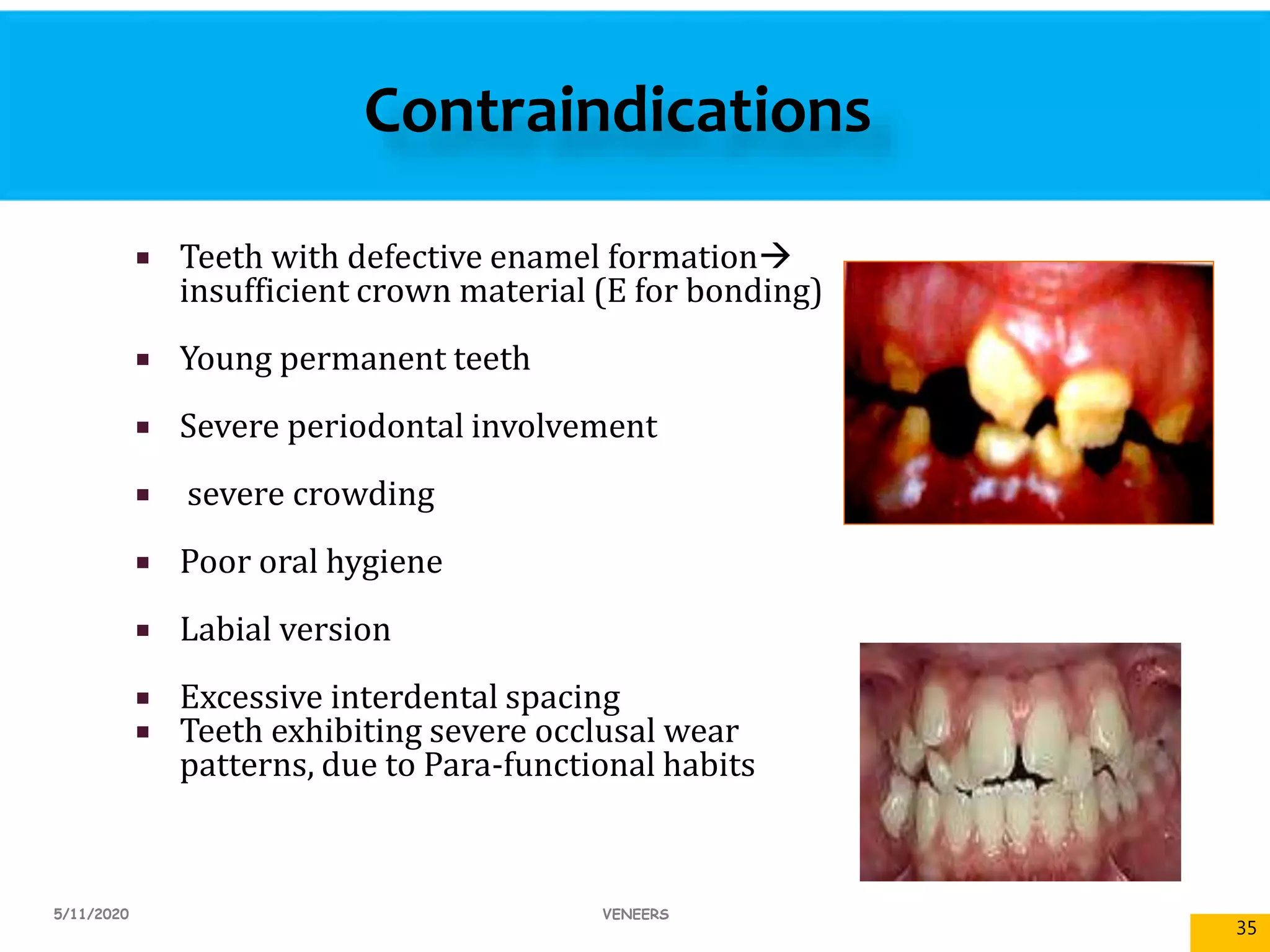
  • #186 (e), illustration to c, d (+) signs show the better placement areas for the PLV margins, whereas (-) signs refer to concavities that are prone to higher tensile stresses, (f) If the lingual margin is located on the lingual concavity, it is better to extend it towards the distal marginal ridge and over the cingulum to minimize the tensile strength that the PLV will face after bonding.
  • #188 (a, b) The color and form of the central are drastically changed. However, all the natural effects, such asthetranslucencies, mamelons and opalescence are respected and reproduced, (c, d) The same delicacy is applied to the laterals.
  • #190 Reverse gradiant