Direct Restorative Materials
Dr. Md. Arifur Rahman
BDS (DU), MPH
Assistant Professor & Head
Northeast Medical College Dental Unit
drarifur_rahman@neub.edu.bd
2
drarifur_rahman@yahoo.com
Bonding
Bonding and adhesion comprise a
complex set of physical, chemical and
mechanical mechanisms that allow
the attachment and binding of one
substance to another.
3
drarifur_rahman@yahoo.com
Function of Banding agent
A dental bonding system performs three essential
functions:
(1) Provides resistance to separation of an adherend
substrate (i.e. enamel, dentin, metal, composite,
ceramic) from a restorative or cementing material;
(2) distributes stress along bonded interfaces; and
(3) seals the interface via adhesive bonding between
dentin and/or enamel and the bonded material, thus
increasing resistance to microleakage and
decreasing the risk for postoperative sensitivity,
marginal staining, and secondary caries.
4
drarifur_rahman@yahoo.com
Mechanism of adhesion
the fundamental mechanism of adhesion to
tooth structure can be regarded simply as
an exchange by which inorganic tooth
material (hydroxyapatite) is replaced by
synthetic resins.
This process involves two parts:
(1) removing hydroxapatite to create
micropores.
(2) infiltration of resin monomers into the
micropores and subsequent
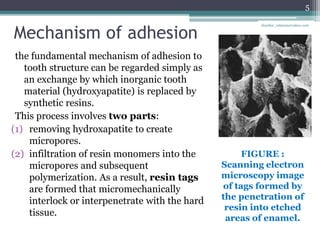
polymerization. As a result, resin tags
are formed that micromechanically
interlock or interpenetrate with the hard
tissue.
FIGURE :
Scanning electron
microscopy image
of tags formed by
the penetration of
resin into etched
areas of enamel.
5
drarifur_rahman@yahoo.com
Mechanism of adhesion (cont.)
In general, the following factors can play major or
minor roles in achieving adhesive bonds:
1. Surface energy and wetting
2. Interpenetration (formation of a hybrid zone)
3. Micromechanical interlocking
4. Chemical bonding
6
drarifur_rahman@yahoo.com
ACID-ETCH TECHNIQUE
• ENAMEL ETCHING
• DENTIN ETCHING
Both dentin and enamel are etched typically using
37% phosphoric acid. Dentin etching is more
technique sensitive than enamel etching because of
the complexity of the dentin structure. Unlike
enamel, dentin is a living tissue, consisting of 50
vol% of calcium phosphate mineral
(hydroxyapatite), 30 vol% of organic material
(mainly type I collagen), and 20 vol% fluid.
7
drarifur_rahman@yahoo.com
ACID-ETCH TECHNIQUE (cont.)
Acid etching removes hydroxyapatite almost completely
from several microns of sound dentin, exposing a
microporous network of collagen suspended in water.
Whereas etched enamel must be completely dry to form a
strong bond with hydrophobic adhesive resins, etched
dentin must be moist to form a hybrid layer.
Acid etching is a very effective way to improve bonding and
durability as well as to ensure a sealed interface. It has
markedly expanded the use of resin-based restorative
materials because it provides a strong bond between resin
and teeth, forming the basis for many innovative dental
procedures.
8
drarifur_rahman@yahoo.com
PROCESS AND PROCEDURAL FACTORS
Several aspects of the total-etch, etch-and-rinse, and
related techniques are critical to the success or
failure of bonding Systems
• Etching time
• Rinsing and Drying stage
• Cleanness of the Bonding Surfaces
9
drarifur_rahman@yahoo.com
Etching time
Currently, the etching time for most etching gels is
approximately 15 seconds. The advantage of
such short etching times is that they yield
acceptable bond strength in most instances,
while conserving enamel and reducing treatment
time.
10
drarifur_rahman@yahoo.com
Rinsing and Drying stage
Once the tooth is etched, the acid should be rinsed away
thoroughly with a stream of water for about 20 seconds, and
the rinsed water must be removed.
When enamel alone is etched and is to be bonded with a
hydrophobic resin (e.g., bisphenol A glycidyl methacrylate
[bis-GMA]–based resin), it must be dried completely with
warm air until it takes on a white, frosted appearance.
Dentin, in contrast, cannot withstand such aggressive drying,
which would cause bond failure because of the formation of
impermeable, collapsed collagen fibers.
In the total-etch technique, a dentin bonding agent and
primer must be used that are compatible with both
moist dentin and moist enamel
11
drarifur_rahman@yahoo.com
Cleanness of the Bonding Surfaces
The etched surfaces must be kept clean (free of contaminants) and
sufficiently dry until the resin is placed to form a sound
mechanical bond. Although etching raises the surface energy,
contamination can readily reduce the energy level of the etched
surface. Reducing the surface energy, in turn, makes it more
difficult to wet the surface with a bonding resin that may have
too high a surface tension to wet the contaminated surface. Thus,
even momentary contact with saliva or blood can prevent
effective resin tag formation and severely reduce the bond
strength. Another potential contaminant is oil that is released
from the air compressor and transported along the air lines to
the air–water syringe.
If contamination occurs, the contaminant should be removed, and
the surface should be etched again for 10 seconds.
12
drarifur_rahman@yahoo.com
13
drarifur_rahman@yahoo.com
Dental Bonding
Dental bonding agents are designed to provide a
sufficiently
strong interface between restorative composites and tooth
structure to withstand mechanical forces and shrinkage
stress.
The success of adhesives is dependent on two types of
bonding:
1. Micromechanical interlocking, chemical bonding with
enamel and dentin, or both.
2. Copolymerization with the resin matrix of composite
materials
14
drarifur_rahman@yahoo.com
Requirement for successful bonding
As discussed in the earlier section on adhesion
mechanisms, a successful dentin bonding system must
meet several requirements:
1. Adequate removal or dissolution of the smear layer from
enamel and dentin
2. Maintenance or reconstitution of the dentin collagen
matrix
3. Good wetting
4. Efficient monomer diffusion and penetration
5. Polymerization within tooth structure
6. Copolymerization with the resin composite matrix
15
drarifur_rahman@yahoo.com
Composition of Bonding
Irrespective of the number of bottles or components, a
typical dentin bonding system includes :
1. etchants,
2. Primers / resin monomers,
3. solvents,
4. Adhesives ,
5. initiators and inhibitors,
6. fillers, and
7. sometimes other functional ingredients such as
antimicrobial agents.
16
drarifur_rahman@yahoo.com
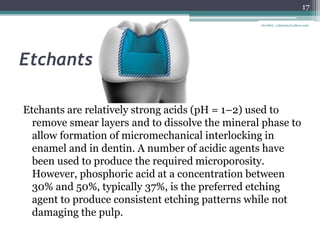
Etchants
Etchants are relatively strong acids (pH = 1–2) used to
remove smear layers and to dissolve the mineral phase to
allow formation of micromechanical interlocking in
enamel and in dentin. A number of acidic agents have
been used to produce the required microporosity.
However, phosphoric acid at a concentration between
30% and 50%, typically 37%, is the preferred etching
agent to produce consistent etching patterns while not
damaging the pulp.
17
drarifur_rahman@yahoo.com
Primers
Dentin etching is highly technique sensitive because the
demineralized collagen network readily collapses when dried.
Therefore, priming is necessary to maintain an expanded
collagen network while removing residual water to allow for the
infiltration of the hydrophobic adhesive monomer. Primers are
solutions containing hydrophilic monomers dissolved in a
solvent such as acetone, ethanol, or water. Such monomers
exhibit hydrophilic properties through phosphate, carboxylic
acid, alcohol, or ester functional groups. HEMA (2-hydroxyl
ethyl meth acrylate) is a widely used primer monomer because of
its high hydrophilicity and solvent-like nature.
If a primer has the ability to both etch and prime, it is
categorized as a self-etching primer. For this purpose, acidic
monomers are frequently used to formulate self-etching primers.
18
drarifur_rahman@yahoo.com
Solvents
Solvents also play important roles in priming systems. The
most commonly used solvents are water, ethanol, and
acetone.
In addition to the enhancement of wetting of hydrophilic
dentin, each solvent has a specific contribution to
improve bond adhesion.
-Water can ionize acidic monomers as well as re-expand
the collapsed collagen network.
-Ethanol and acetone have better miscibility with relatively
hydrophobic monomers, and their “water chasing”
ability facilitates water removal.
19
drarifur_rahman@yahoo
.com
Adhesives
For dentin bonding, the primary purpose of adhesives is to
fill the interfibrillar space of the collagen network,
creating a hybrid layer and resin tags to provide
micromechanical retention upon polymerization.
In addition, adhesive layers also should prevent fluid
leakage along the restorative material’s margin, since
they make up the major part of the intermediate layer
between dentin and/or enamel and restorative
composites.
20
drarifur_rahman@yahoo.com
Initiators
Similar initiator systems are used in both adhesives and
restorative composites.
Polymerization can be initiated either through a photo
initiator system consisting of a photosensitizer (e.g.,
camphorquinone) and an initiator (e.g., tertiary
amine), through a self-cure system that includes a
chemical initiator (e.g., benzoyl peroxide), or through
a dual cure initiator system.
21
drarifur_rahman@yahoo.com
Filler Particles
Nanometer-sized silica particles have been added to some
adhesives to reinforce the adhesive and thereby
produce higher bond strengths. However, the
strengthening effect of the fillers in adhesives is uncertain
because it is not clear whether these fillers can actually
penetrate into the demineralized collagen networks, since the
interfibrillar space of the collagen networks is within the
range of 20 nanometers (nm) while the filler particles have a
size of approximately 40 nm.
The other reason for the addition of fillers is to effectively
modify adhesive viscosity to a thicker, pastier consistency.
When such an adhesive is applied to an etched dental surface,
it yields a thicker bonding layer that can promote increased
bond strength by preventing oxygen inhibition. Moreover, a
thick adhesive layer can reduce shrinkage stress because it is
more compliant compared with restorative composites.
22
drarifur_rahman@yahoo
.com
Other Ingredients
A number of additional ingredients are used with dentin
bonding agents for a variety of specific purposes. A few
examples include the following:
1. glutar aldehyde (Probond, Dentsply, York, PA) is added as
a desensitizer.
2. The monomer MDPB [12-meth acryloyl oxydo
decylpyridinium bromide] (Clearfil Protect Bond, Kuraray
America, New York, NY) and parabene (Adper Prompt-L-
Pop, 3M ESPE, St. Paul, MN) are used as antimicrobials.
3. Fluoride (Prime & Bond NT, Dentsply, York, PA) is added
to prevent secondary caries.
4. Benzal konium chloride (e.g., Etch 37, Bisco,
Schamburg, IL) and chlorhexidine (e.g., Peak LC Bond
Resin, Ultradent Products, South Jordon, UT) are used to
prevent collagen degradation.
23
drarifur_rahman@yahoo.com
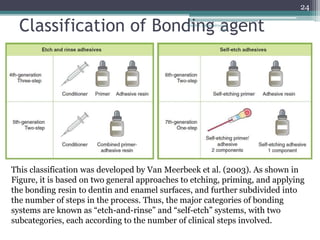
Classification of Bonding agent
This classification was developed by Van Meerbeek et al. (2003). As shown in
Figure, it is based on two general approaches to etching, priming, and applying
the bonding resin to dentin and enamel surfaces, and further subdivided into
the number of steps in the process. Thus, the major categories of bonding
systems are known as “etch-and-rinse” and “self-etch” systems, with two
subcategories, each according to the number of clinical steps involved.
24
drarifur_rahman@yahoo
.com
Etch-and-Rinse Adhesives
Three-step (fourth generation): At this time, the most
established, most reliable adhesion method in this category
consists of three steps: (1) an acid etchant application, (2)
application of the primer, and (3) application of the actual
bonding agent or bonding resin. The primer contains
hydrophilic functional monomers dissolved in an
organic solvent such as acetone, ethanol, or water.
Two-step (fifth generation): A simplified method in this
category combines the primer and adhesive resin into one
application. This etch-and-rinse strategy is the most effective
to achieve efficient and stable bonding to enamel. Etching,
usually with a 30% to 40% phosphoric gel that is rinsed away,
promotes the dissolution of enamel rods, creating porosities
that are filled by bonding agents through capillary action and
then followed by polymerization of resin.
25
drarifur_rahman@yahoo
.com
Self-Etch Adhesives
Two-step (sixth generation): This approach does not
involve a separate etching step. In this case an acidic
monomer which is not rinsed, is used to condition and
prime the tooth at the same time.
One-step (seventh generation): The simplified
method in this category combines conditioner, primer,
and bonding resin into a single step. Most one-step or
“all-in-one” systems are delivered by a bottle, vial, or
single-unit dose applicator, which are formulated as a
single component. However, Adper Promp L-Pop (3M
ESPE, St. Paul, MN) is a variation on this theme, in
which two liquid components are packaged in separate
“blister” compartments in a single dispenser.
26
drarifur_rahman@yahoo.com
Aging Effects and
Degradation of the Hybrid
Layer
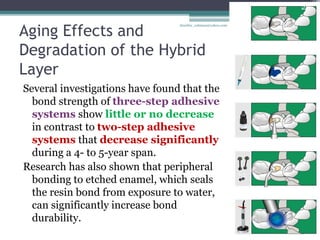
Several investigations have found that the
bond strength of three-step adhesive
systems show little or no decrease
in contrast to two-step adhesive
systems that decrease significantly
during a 4- to 5-year span.
Research has also shown that peripheral
bonding to etched enamel, which seals
the resin bond from exposure to water,
can significantly increase bond
durability.
27
drarifur_rahman@yahoo.com
Which one is best?
General recommendations for specific situations are given below:
• For bonding composite cores, three-step, etch-and-rinse
(fourth-generation) systems are usually recommended.
• For bonding anterior and posterior composites and
cementation of veneers with resin cements, two-step etch-
and-rinse (fifth-generation) systems provide the best
performance.
• For bonding posterior composites, self etch, two-step (sixth-
generation) systems are the better choice.
• Dual-cure one-step, self-etch (seventh-generation) systems
are advised for esthetic posts and ceramic restorations
bonded with resin cement, while light-cured one-step, self-etch
(seventh-generation) systems are recommended for bonding
posterior composite restorations.
28
drarifur_rahman@yahoo.com
Which one is best? (Cont..)
Recently, however, van Landuyt et al. (2011)
showed in a randomized clinical trial that a
onestep, self-etch adhesive had similar clinical
performance after 3 years compared with that of
an etch-and-rinse adhesive in class V
restorations. However, the one-step group
exhibited more incisal marginal defects and
discoloration compared with the etch-and-rinse
group.
29
drarifur_rahman@yahoo.com
LUTING AGENTS AND RESIN CEMENTS
For many years, retention of indirect restorations could
only be attained by the use of favorable tooth
preparations and by micromechanical interlocking of the
luting agent into irregularities present on the
surface of the restoration and the tooth. Adhesive
bonding completely changed the use of direct and
indirect restorations.
A number of materials are available for cementation,
including zinc phosphate cements, polycarboxylate
cements, glass-ionomer cements (GIC), RMGI cements,
and resin cements.
30
drarifur_rahman@yahoo.com
ORTHODONTIC BRACKET BONDING
RESINS
Orthodontic treatment with fixed appliances involves
the use of attachments such as brackets and bands.
Bands are metal rings that go around teeth and are
usually used on molars. Brackets are bonded to
enamel. The development of bonding has
contributed to a decrease in banding even in
posterior teeth.
A variety of luting agents have been used in
orthodontics such as polycarboxylate cement, GIC,
and resin-modified glass ionomer (RMGI) cements.
31
drarifur_rahman@yahoo.com
32
drarifur_rahman@yahoo.com
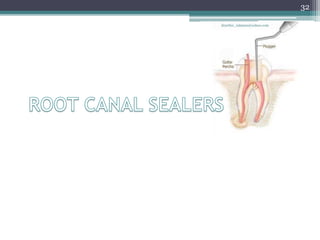
Endodontic sealers are used in conjunction with a solid
or semisolid core material to fill voids and to seal root
canals during obturation. These sealers,
sometimes called cements, should fill and
promote a close seal between the core and the
dentinal walls of the canal, preventing or minimizing
leakage, entombing residual microorganisms, and
possibly filling inaccessible areas of the root canal
system. Sealer selection may influence the outcome of
endodontic treatment.
33
drarifur_rahman@yahoo.com
Traditionally, gutta-percha has been used as the solid
core material in combination with a zinc oxide and
eugenol (ZOE) or calcium hydroxide cement, or an epoxy-
based sealer. Clinical studies have shown predictable
results with these conventional root canal sealers. GICs
and resinmodified GICs are also used as root canal
sealers. These can chemically bond to root canal dentin,
but no bond is obtained to gutta-percha.
34
drarifur_rahman@yahoo.com
Recently, new materials have been introduced on the
market to improve the seal of the root canal system. These
include different types of core materials, the development
of low-viscosity methacrylate resin-based sealers, and the
incorporation of dentin bonding agents.
One system uses conventional cones that are coated with a
proprietary resin coating (EndoRez, Ultradent, South
Jordan, UT) in combination with a methacrylate-based,
dual-cured resin sealer and no dentin-bonding agent. In
this case, the endodontic seal is dependent on the
penetration of the hydrophilic sealer into the dentinal
tubules and lateral canals following removal of the smear
layer.
35
drarifur_rahman@yahoo.com
Another system, called Resilon (SybronEndo
Corporation, Orange, CA) is a thermoplastic composite
polycaprolactone-based core material that contains
dimethacrylate resin, radiopaque fillers, and glass-
ionomer particles. Resilon cones are applied in
combination with a methacrylatebased sealer to root
dentin treated with self-etching primers.
36
drarifur_rahman@yahoo.com
37
drarifur_rahman@yahoo.com

Bonding and bonding agents

  • 1.
    Direct Restorative Materials Dr.Md. Arifur Rahman BDS (DU), MPH Assistant Professor & Head Northeast Medical College Dental Unit drarifur_rahman@neub.edu.bd
  • 2.
  • 3.
    Bonding Bonding and adhesioncomprise a complex set of physical, chemical and mechanical mechanisms that allow the attachment and binding of one substance to another. 3 drarifur_rahman@yahoo.com
  • 4.
    Function of Bandingagent A dental bonding system performs three essential functions: (1) Provides resistance to separation of an adherend substrate (i.e. enamel, dentin, metal, composite, ceramic) from a restorative or cementing material; (2) distributes stress along bonded interfaces; and (3) seals the interface via adhesive bonding between dentin and/or enamel and the bonded material, thus increasing resistance to microleakage and decreasing the risk for postoperative sensitivity, marginal staining, and secondary caries. 4 drarifur_rahman@yahoo.com
  • 5.
    Mechanism of adhesion thefundamental mechanism of adhesion to tooth structure can be regarded simply as an exchange by which inorganic tooth material (hydroxyapatite) is replaced by synthetic resins. This process involves two parts: (1) removing hydroxapatite to create micropores. (2) infiltration of resin monomers into the micropores and subsequent polymerization. As a result, resin tags are formed that micromechanically interlock or interpenetrate with the hard tissue. FIGURE : Scanning electron microscopy image of tags formed by the penetration of resin into etched areas of enamel. 5 drarifur_rahman@yahoo.com
  • 6.
    Mechanism of adhesion(cont.) In general, the following factors can play major or minor roles in achieving adhesive bonds: 1. Surface energy and wetting 2. Interpenetration (formation of a hybrid zone) 3. Micromechanical interlocking 4. Chemical bonding 6 drarifur_rahman@yahoo.com
  • 7.
    ACID-ETCH TECHNIQUE • ENAMELETCHING • DENTIN ETCHING Both dentin and enamel are etched typically using 37% phosphoric acid. Dentin etching is more technique sensitive than enamel etching because of the complexity of the dentin structure. Unlike enamel, dentin is a living tissue, consisting of 50 vol% of calcium phosphate mineral (hydroxyapatite), 30 vol% of organic material (mainly type I collagen), and 20 vol% fluid. 7 drarifur_rahman@yahoo.com
  • 8.
    ACID-ETCH TECHNIQUE (cont.) Acidetching removes hydroxyapatite almost completely from several microns of sound dentin, exposing a microporous network of collagen suspended in water. Whereas etched enamel must be completely dry to form a strong bond with hydrophobic adhesive resins, etched dentin must be moist to form a hybrid layer. Acid etching is a very effective way to improve bonding and durability as well as to ensure a sealed interface. It has markedly expanded the use of resin-based restorative materials because it provides a strong bond between resin and teeth, forming the basis for many innovative dental procedures. 8 drarifur_rahman@yahoo.com
  • 9.
    PROCESS AND PROCEDURALFACTORS Several aspects of the total-etch, etch-and-rinse, and related techniques are critical to the success or failure of bonding Systems • Etching time • Rinsing and Drying stage • Cleanness of the Bonding Surfaces 9 drarifur_rahman@yahoo.com
  • 10.
    Etching time Currently, theetching time for most etching gels is approximately 15 seconds. The advantage of such short etching times is that they yield acceptable bond strength in most instances, while conserving enamel and reducing treatment time. 10 drarifur_rahman@yahoo.com
  • 11.
    Rinsing and Dryingstage Once the tooth is etched, the acid should be rinsed away thoroughly with a stream of water for about 20 seconds, and the rinsed water must be removed. When enamel alone is etched and is to be bonded with a hydrophobic resin (e.g., bisphenol A glycidyl methacrylate [bis-GMA]–based resin), it must be dried completely with warm air until it takes on a white, frosted appearance. Dentin, in contrast, cannot withstand such aggressive drying, which would cause bond failure because of the formation of impermeable, collapsed collagen fibers. In the total-etch technique, a dentin bonding agent and primer must be used that are compatible with both moist dentin and moist enamel 11 drarifur_rahman@yahoo.com
  • 12.
    Cleanness of theBonding Surfaces The etched surfaces must be kept clean (free of contaminants) and sufficiently dry until the resin is placed to form a sound mechanical bond. Although etching raises the surface energy, contamination can readily reduce the energy level of the etched surface. Reducing the surface energy, in turn, makes it more difficult to wet the surface with a bonding resin that may have too high a surface tension to wet the contaminated surface. Thus, even momentary contact with saliva or blood can prevent effective resin tag formation and severely reduce the bond strength. Another potential contaminant is oil that is released from the air compressor and transported along the air lines to the air–water syringe. If contamination occurs, the contaminant should be removed, and the surface should be etched again for 10 seconds. 12 drarifur_rahman@yahoo.com
  • 13.
  • 14.
    Dental Bonding Dental bondingagents are designed to provide a sufficiently strong interface between restorative composites and tooth structure to withstand mechanical forces and shrinkage stress. The success of adhesives is dependent on two types of bonding: 1. Micromechanical interlocking, chemical bonding with enamel and dentin, or both. 2. Copolymerization with the resin matrix of composite materials 14 drarifur_rahman@yahoo.com
  • 15.
    Requirement for successfulbonding As discussed in the earlier section on adhesion mechanisms, a successful dentin bonding system must meet several requirements: 1. Adequate removal or dissolution of the smear layer from enamel and dentin 2. Maintenance or reconstitution of the dentin collagen matrix 3. Good wetting 4. Efficient monomer diffusion and penetration 5. Polymerization within tooth structure 6. Copolymerization with the resin composite matrix 15 drarifur_rahman@yahoo.com
  • 16.
    Composition of Bonding Irrespectiveof the number of bottles or components, a typical dentin bonding system includes : 1. etchants, 2. Primers / resin monomers, 3. solvents, 4. Adhesives , 5. initiators and inhibitors, 6. fillers, and 7. sometimes other functional ingredients such as antimicrobial agents. 16 drarifur_rahman@yahoo.com
  • 17.
    Etchants Etchants are relativelystrong acids (pH = 1–2) used to remove smear layers and to dissolve the mineral phase to allow formation of micromechanical interlocking in enamel and in dentin. A number of acidic agents have been used to produce the required microporosity. However, phosphoric acid at a concentration between 30% and 50%, typically 37%, is the preferred etching agent to produce consistent etching patterns while not damaging the pulp. 17 drarifur_rahman@yahoo.com
  • 18.
    Primers Dentin etching ishighly technique sensitive because the demineralized collagen network readily collapses when dried. Therefore, priming is necessary to maintain an expanded collagen network while removing residual water to allow for the infiltration of the hydrophobic adhesive monomer. Primers are solutions containing hydrophilic monomers dissolved in a solvent such as acetone, ethanol, or water. Such monomers exhibit hydrophilic properties through phosphate, carboxylic acid, alcohol, or ester functional groups. HEMA (2-hydroxyl ethyl meth acrylate) is a widely used primer monomer because of its high hydrophilicity and solvent-like nature. If a primer has the ability to both etch and prime, it is categorized as a self-etching primer. For this purpose, acidic monomers are frequently used to formulate self-etching primers. 18 drarifur_rahman@yahoo.com
  • 19.
    Solvents Solvents also playimportant roles in priming systems. The most commonly used solvents are water, ethanol, and acetone. In addition to the enhancement of wetting of hydrophilic dentin, each solvent has a specific contribution to improve bond adhesion. -Water can ionize acidic monomers as well as re-expand the collapsed collagen network. -Ethanol and acetone have better miscibility with relatively hydrophobic monomers, and their “water chasing” ability facilitates water removal. 19 drarifur_rahman@yahoo .com
  • 20.
    Adhesives For dentin bonding,the primary purpose of adhesives is to fill the interfibrillar space of the collagen network, creating a hybrid layer and resin tags to provide micromechanical retention upon polymerization. In addition, adhesive layers also should prevent fluid leakage along the restorative material’s margin, since they make up the major part of the intermediate layer between dentin and/or enamel and restorative composites. 20 drarifur_rahman@yahoo.com
  • 21.
    Initiators Similar initiator systemsare used in both adhesives and restorative composites. Polymerization can be initiated either through a photo initiator system consisting of a photosensitizer (e.g., camphorquinone) and an initiator (e.g., tertiary amine), through a self-cure system that includes a chemical initiator (e.g., benzoyl peroxide), or through a dual cure initiator system. 21 drarifur_rahman@yahoo.com
  • 22.
    Filler Particles Nanometer-sized silicaparticles have been added to some adhesives to reinforce the adhesive and thereby produce higher bond strengths. However, the strengthening effect of the fillers in adhesives is uncertain because it is not clear whether these fillers can actually penetrate into the demineralized collagen networks, since the interfibrillar space of the collagen networks is within the range of 20 nanometers (nm) while the filler particles have a size of approximately 40 nm. The other reason for the addition of fillers is to effectively modify adhesive viscosity to a thicker, pastier consistency. When such an adhesive is applied to an etched dental surface, it yields a thicker bonding layer that can promote increased bond strength by preventing oxygen inhibition. Moreover, a thick adhesive layer can reduce shrinkage stress because it is more compliant compared with restorative composites. 22 drarifur_rahman@yahoo .com
  • 23.
    Other Ingredients A numberof additional ingredients are used with dentin bonding agents for a variety of specific purposes. A few examples include the following: 1. glutar aldehyde (Probond, Dentsply, York, PA) is added as a desensitizer. 2. The monomer MDPB [12-meth acryloyl oxydo decylpyridinium bromide] (Clearfil Protect Bond, Kuraray America, New York, NY) and parabene (Adper Prompt-L- Pop, 3M ESPE, St. Paul, MN) are used as antimicrobials. 3. Fluoride (Prime & Bond NT, Dentsply, York, PA) is added to prevent secondary caries. 4. Benzal konium chloride (e.g., Etch 37, Bisco, Schamburg, IL) and chlorhexidine (e.g., Peak LC Bond Resin, Ultradent Products, South Jordon, UT) are used to prevent collagen degradation. 23 drarifur_rahman@yahoo.com
  • 24.
    Classification of Bondingagent This classification was developed by Van Meerbeek et al. (2003). As shown in Figure, it is based on two general approaches to etching, priming, and applying the bonding resin to dentin and enamel surfaces, and further subdivided into the number of steps in the process. Thus, the major categories of bonding systems are known as “etch-and-rinse” and “self-etch” systems, with two subcategories, each according to the number of clinical steps involved. 24 drarifur_rahman@yahoo .com
  • 25.
    Etch-and-Rinse Adhesives Three-step (fourthgeneration): At this time, the most established, most reliable adhesion method in this category consists of three steps: (1) an acid etchant application, (2) application of the primer, and (3) application of the actual bonding agent or bonding resin. The primer contains hydrophilic functional monomers dissolved in an organic solvent such as acetone, ethanol, or water. Two-step (fifth generation): A simplified method in this category combines the primer and adhesive resin into one application. This etch-and-rinse strategy is the most effective to achieve efficient and stable bonding to enamel. Etching, usually with a 30% to 40% phosphoric gel that is rinsed away, promotes the dissolution of enamel rods, creating porosities that are filled by bonding agents through capillary action and then followed by polymerization of resin. 25 drarifur_rahman@yahoo .com
  • 26.
    Self-Etch Adhesives Two-step (sixthgeneration): This approach does not involve a separate etching step. In this case an acidic monomer which is not rinsed, is used to condition and prime the tooth at the same time. One-step (seventh generation): The simplified method in this category combines conditioner, primer, and bonding resin into a single step. Most one-step or “all-in-one” systems are delivered by a bottle, vial, or single-unit dose applicator, which are formulated as a single component. However, Adper Promp L-Pop (3M ESPE, St. Paul, MN) is a variation on this theme, in which two liquid components are packaged in separate “blister” compartments in a single dispenser. 26 drarifur_rahman@yahoo.com
  • 27.
    Aging Effects and Degradationof the Hybrid Layer Several investigations have found that the bond strength of three-step adhesive systems show little or no decrease in contrast to two-step adhesive systems that decrease significantly during a 4- to 5-year span. Research has also shown that peripheral bonding to etched enamel, which seals the resin bond from exposure to water, can significantly increase bond durability. 27 drarifur_rahman@yahoo.com
  • 28.
    Which one isbest? General recommendations for specific situations are given below: • For bonding composite cores, three-step, etch-and-rinse (fourth-generation) systems are usually recommended. • For bonding anterior and posterior composites and cementation of veneers with resin cements, two-step etch- and-rinse (fifth-generation) systems provide the best performance. • For bonding posterior composites, self etch, two-step (sixth- generation) systems are the better choice. • Dual-cure one-step, self-etch (seventh-generation) systems are advised for esthetic posts and ceramic restorations bonded with resin cement, while light-cured one-step, self-etch (seventh-generation) systems are recommended for bonding posterior composite restorations. 28 drarifur_rahman@yahoo.com
  • 29.
    Which one isbest? (Cont..) Recently, however, van Landuyt et al. (2011) showed in a randomized clinical trial that a onestep, self-etch adhesive had similar clinical performance after 3 years compared with that of an etch-and-rinse adhesive in class V restorations. However, the one-step group exhibited more incisal marginal defects and discoloration compared with the etch-and-rinse group. 29 drarifur_rahman@yahoo.com
  • 30.
    LUTING AGENTS ANDRESIN CEMENTS For many years, retention of indirect restorations could only be attained by the use of favorable tooth preparations and by micromechanical interlocking of the luting agent into irregularities present on the surface of the restoration and the tooth. Adhesive bonding completely changed the use of direct and indirect restorations. A number of materials are available for cementation, including zinc phosphate cements, polycarboxylate cements, glass-ionomer cements (GIC), RMGI cements, and resin cements. 30 drarifur_rahman@yahoo.com
  • 31.
    ORTHODONTIC BRACKET BONDING RESINS Orthodontictreatment with fixed appliances involves the use of attachments such as brackets and bands. Bands are metal rings that go around teeth and are usually used on molars. Brackets are bonded to enamel. The development of bonding has contributed to a decrease in banding even in posterior teeth. A variety of luting agents have been used in orthodontics such as polycarboxylate cement, GIC, and resin-modified glass ionomer (RMGI) cements. 31 drarifur_rahman@yahoo.com
  • 32.
  • 33.
    Endodontic sealers areused in conjunction with a solid or semisolid core material to fill voids and to seal root canals during obturation. These sealers, sometimes called cements, should fill and promote a close seal between the core and the dentinal walls of the canal, preventing or minimizing leakage, entombing residual microorganisms, and possibly filling inaccessible areas of the root canal system. Sealer selection may influence the outcome of endodontic treatment. 33 drarifur_rahman@yahoo.com
  • 34.
    Traditionally, gutta-percha hasbeen used as the solid core material in combination with a zinc oxide and eugenol (ZOE) or calcium hydroxide cement, or an epoxy- based sealer. Clinical studies have shown predictable results with these conventional root canal sealers. GICs and resinmodified GICs are also used as root canal sealers. These can chemically bond to root canal dentin, but no bond is obtained to gutta-percha. 34 drarifur_rahman@yahoo.com
  • 35.
    Recently, new materialshave been introduced on the market to improve the seal of the root canal system. These include different types of core materials, the development of low-viscosity methacrylate resin-based sealers, and the incorporation of dentin bonding agents. One system uses conventional cones that are coated with a proprietary resin coating (EndoRez, Ultradent, South Jordan, UT) in combination with a methacrylate-based, dual-cured resin sealer and no dentin-bonding agent. In this case, the endodontic seal is dependent on the penetration of the hydrophilic sealer into the dentinal tubules and lateral canals following removal of the smear layer. 35 drarifur_rahman@yahoo.com
  • 36.
    Another system, calledResilon (SybronEndo Corporation, Orange, CA) is a thermoplastic composite polycaprolactone-based core material that contains dimethacrylate resin, radiopaque fillers, and glass- ionomer particles. Resilon cones are applied in combination with a methacrylatebased sealer to root dentin treated with self-etching primers. 36 drarifur_rahman@yahoo.com
  • 37.

Editor's Notes

  • #7 Wetting—Relative interfacial tension between a liquid and a solid substrate that results in a contact angle of less than 90 degrees. Wetting agent—A surface-active substance that reduces the surface tension of a liquid to promote wetting or adhesion.
  • #30 Recently, a new self-etch adhesive bonding agent has been introduced that expands this category for use with total-etch procedures (Scotchbond Universal Adhesive, 3M ESPE, St. Paul, MN). This system contains a specific phosphate monomer and silane and is claimed to offer extended bond durability as well as versatility for use in an array of clinical applications.