DENTIN BONDING AGENTS 1
CONTENTS
• INTRODUCTION
• HISTORY
• APPLICATIONS OF BONDING
• MECHANISM OF BONDING
• FACTORS IN ACHIEVING ADHESIVE BONDS
• STEPS IN FORMING GOOD ADHESION
• ENAMEL ADHESION
• DENTIN ADHESION
2
CONTENTS contd..
• SMEAR LAYER
• DENTIN CONDITIONING
• COMPONENTS OF DENTIN BONDING SYSTEM
• WET BONDING VS DRY BONDING
• CLASSIFICATION OF BONDING SYSTEMS
• REVIEW OF LITERATURE
• CONCLUSION
3
INTRODUCTION
• Conservation of the tooth structure and good esthetics have always
been a long sought after in restorative dentistry.
• Introduction of the acid etch technique and resin based composites
have contributed in a large way towards achieving this goal.
• While effective bonding to enamel has been achieved with relative
ease, bonding to dentin has proved to be more difficult.
4
INTRODUCTION 5
 There is much interest and activity in dentistry today with dentin bonding
agents.
 Moreover, the classic concepts of tooth preparation advocated in the early
1900s have changed dramatically.
HISTORY
• Research into bonding agents for attachment of resins to tooth structure was
started in the early 1950s.
• In 1949, Hagger, a Swiss chemist attempted first to develop an adhesive
system for bonding acrylic resin to the tooth structure, [acidic glycerophosphoric
acid dimethacrylate].
• In 1949, a commercial product Sevriton cavity seal was then marketed.
6
7
• In 1955 Buonocore applied 85% phosphoric acid on enamel for 30 seconds to
achieve a simple acid decalcification.
• In 1962, Bowen introduced Bis-GMA resin based on epoxy molecule.
• In 1965, Bowen proposed that surface active monomers could facilitate the
bonding of resins to teeth by using reactive monomers that could chelate to
calcium.
• In 1977, Fusayama et al, introduced total etching technique for both enamel
and dentin cavity walls, using 40% phosphoric acid.
8
• In 1982, Nakabayashi, reported that dentin clearing by citric acid containing
ferric chloride followed by Dentin Bonding Agent containing 4-META was effective
on bonding.
• In 1984, Nakabayashi, again showed that formation of resin tags in the dentinal
tubules Plays a key point in resin to dentin adhesion.
• In 1980, 1st generation of bonding agents were developed, had minimal bond
strength.
• Mid 1980’s 2nd generation of bonding agents were developed, and Eliades and
Caputo in 1985, introduced it for clinical use.
9
• Late 1980’s 3rd generation dentin bonding agents became available.
• In 1991, Bertolloti and Kanca introduced concept wet bonding.
• In 1992, a product containing 4-META was developed which bonds to dentin as well
as amalgams, metal and porcelain.
• In 1995 5th generation dentin bonding agent were introduced.
• In late 1990’s 6th generation, self etching primer were introduced.
• Recently 7th & 8th generation dentin bonding agents have been introduced.
APPLICATIONS
• Orthodontic bracket bonding
• Porcelain laminate veneer bonding.
• Pit and fissure sealants
• Amalgam bonding
• Bond pre-fabricated fibre or metal posts and cast posts.
• Seal root canals during endodontic therapy.
• Restoration of carious lesions
10
 Adhesion is derived from Latin adhaerere meaning (“to stick to”) "
“The state in which two surfaces are held together by interfacial forces which
may consist of valence forces or interlocking forces or both"
(The American Society for Testing and Materials)
DEFINITION 11
 For the process of adhesion to occur , we need to understand
the role of following components:
 ADHESIVE
 ADHEREND
 ADHESIVE STRENGTH
12
 ADHESIVE is defined as a material , frequently a viscous fluid that
joins two substrates together by solidifying , resisting separation &
transferring a load from one surface to the other.
 ADHEREND is defined the surface to which an adhesive adheres.
 ADHESIVE STRENGTH is the measure of the load-bearing capacity of an
adhesive joint.
13
ESSENTIAL FUNCTION OF DENTAL BONDING
SYSTEM
• Resistance to separation of adherend from restorative or cementing material.
• Distribute stress along the bonded interface.
• Seal the interface – prevent microleakage.
14
MECHANISM OF ADHESION
• CONDITIONS TO BE SATISFIED FOR TRUE ADHESION
1. Sound tooth structure must be conserved.
2. Optimal retention must be achieved.
3. Microleakage must be prevented.
15
• Process of adhesion involves two parts
1. Removing hydroxyapatite to create micropores and
2. Infiltration of resin monomers into the micropores and subsequent polymerization.
As a result, resin tags are formed that micromechanically interlock or interpenetrate with
the hard tissue.
There may also be chemical interactions with the tooth substrate if monomers having
acidic or chelating functional groups are present.
16
FACTORS IN ACHIEVING ADHESIVE BONDS
1. Surface energy and wetting
2. Interpenetration (formation of a hybrid zone)
3. Micromechanical interlocking
4. Chemical bonding
A successful dentin bonding system must meet several
requirements:
1. Adequate removal or dissolution of the smear layer from enamel
and dentin
2. Maintenance or reconstitution of the dentin collagen matrix
3. Good wetting
17
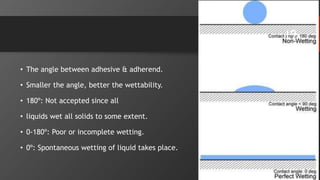
WETTING
• Wetting is the essential first step for the success of all adhesion mechanisms.
• Wettability of a liquid on a solid can be characterized by the contact angle that
forms between a liquid and solid, as measured within the liquid.
• Categories of wettability include
• Mostly nonwetting (>90 degrees)
• Absolutely no wetting(180 degrees)
• Mostly wetting (<90 degrees)
• Absolute wetting (0 degrees).
18
• The angle between adhesive & adherend.
• Smaller the angle, better the wettability.
• 180º: Not accepted since all
• liquids wet all solids to some extent.
• 0-180º: Poor or incomplete wetting.
• 0º: Spontaneous wetting of liquid takes place.
19
SURFACE ENERGY & SURFACE TENSION
• Good bonding can be achieved by increasing the surface energy of the substrates
(e.G., Dentin, enamel, and synthetic materials).
• Acid-etching
A clean, microroughened tooth surface has higher surface energy than unprepared tooth surfaces.
Therefore, the organic adhesives are able to wet and spread over such a surface
• ADHEREND/SUBSTRATE - HIGH SURFACE ENERGY
• ADHESIVE – LOW SURFACE TENSION
20
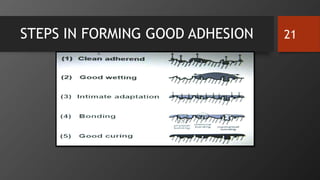
STEPS IN FORMING GOOD ADHESION 21
ACID ETCH TECHNIQUE-
ENAMEL ETCHING
• Michael Buonocore (1955).
• He found that an acrylic restorative material placed on the micromechanically roughened
surfaces greatly increased in the resin–enamel bond strength (~20 megapascals [MPa])
• Phosphoric acid, is still the most widely used etchant today for bonding to both enamel
and dentin.
22
• Depending on the concentration, phosphoric acid removes the smear layer and about
10 microns of enamel to expose prisms of enamel rods to create a honeycomb-like,
high-energy retentive surface.
• Resin monomers will readily wet the surface, infiltrate into the micropores, and
polymerize to form resin tags.
• Resin tags –
• Diameter 6µm
• Length – 10 to 20 µm
23
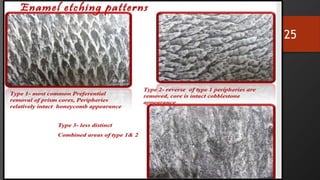
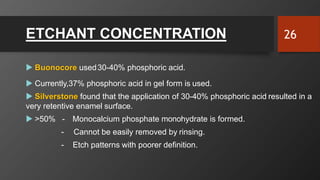
ETCH PATTERNS
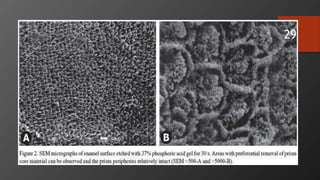
Enamel etching results in three different micro morphologic patterns as described by Silverstone et
al in 1975.
Enamel etching leads to the following types of micromorphological patterns:
TYPE 1 ETCH PATTERN-dissolution of prism cores without the involvement of prism peripheries.
TYPE 2 ETCH PATTERN-peripheral enamel is dissolved, but the cores are left intact.
TYPE 3 ETCH PATTERN-it is less distinct than the other two patterns.
24
25
ETCHANT CONCENTRATION
 Buonocore used30-40% phosphoric acid.
 Currently,37% phosphoric acid in gel form is used.
 Silverstone found that the application of 30-40% phosphoric acid resulted in a
very retentive enamel surface.
 >50% - Monocalcium phosphate monohydrate is formed.
-
- Etch patterns with poorer definition.
Cannot be easily removed by rinsing.
26
• 50 % phosphoric acid for 60 seconds - monocalcium phosphate monohydrate
precipitate
• Concentrations below 25% - dicalcium phosphate dihydrate precipitate
• Concentrations above 40% - Dissolve less calcium and etch patterns with
poor definitions
• 37% for 15 sec is considered appropriate.
• Citric acid ‐10%, Polyacrylic acid‐40%, Maleic acid.
27
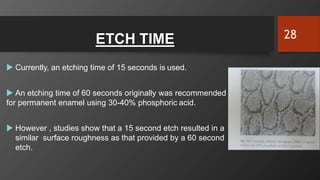
ETCH TIME
 Currently, an etching time of 15 seconds is used.
 An etching time of 60 seconds originally was recommended
for permanent enamel using 30-40% phosphoric acid.
 However , studies show that a 15 second etch resulted in a
similar surface roughness as that provided by a 60 second
etch.
28
29
Phosphoric acid is said to be a more aggressive acid, so alternative
etchants have been suggested:
 EDTA (24%; ph=7)
 Citric acid
 Tannic acid
 Maleic acid
 Polyacrylic acid
ALTERNATE ETCHANT SYSTEMS:
 Lasers
 Air abrasion - Al2O3 particles
30
LASER ETCHING
 Adhesion to dental hard tissues after Er:YAG laser etching is inferior to that
obtained after conventional acid etching.
 Enamel and dentin surfaces prepared by Er:YAG laser etching show extensive
subsurface fissuring that is unfavorable to adhesion.
(J Prosthet Dent 2000;84:280-8.)
 Adhesion to laser-ablated or laser-etched dentin and enamel was inferior to that of
conventional rotary preparation and acid etching.
( Dental Materials (2005) 21, 616–624)
31
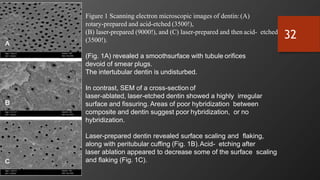
Figure 1 Scanning electron microscopic images of dentin:(A)
rotary-prepared and acid-etched (3500!),
(B) laser-prepared (9000!), and (C) laser-prepared and then acid- etched
(3500!).
(Fig. 1A) revealed a smoothsurface with tubule orifices
devoid of smear plugs.
The intertubular dentin is undisturbed.
In contrast, SEM of a cross-section of
laser-ablated, laser-etched dentin showed a highly irregular
surface and fissuring. Areas of poor hybridization between
composite and dentin suggest poor hybridization, or no
hybridization.
Laser-prepared dentin revealed surface scaling and flaking,
along with peritubular cuffing (Fig. 1B).Acid- etching after
laser ablation appeared to decrease some of the surface scaling
and flaking (Fig. 1C).
32
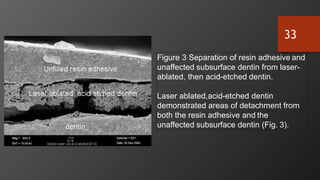
Figure 3 Separation of resin adhesive and
unaffected subsurface dentin from laser-
ablated, then acid-etched dentin.
Laser ablated,acid-etched dentin
demonstrated areas of detachment from
both the resin adhesive and the
unaffected subsurface dentin (Fig. 3).
33
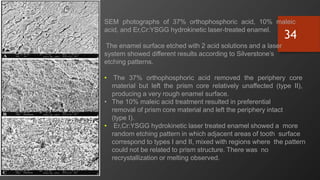
SEM photographs of 37% orthophosphoric acid, 10% maleic
acid, and Er,Cr:YSGG hydrokinetic laser-treated enamel.
The enamel surface etched with 2 acid solutions and a laser
system showed different results according to Silverstone’s
etching patterns.
• The 37% orthophosphoric acid removed the periphery core
material but left the prism core relatively unaffected (type II),
producing a very rough enamel surface.
• The 10% maleic acid treatment resulted in preferential
removal of prism core material and left the periphery intact
(type I).
• Er,Cr:YSGG hydrokinetic laser treated enamel showed a more
random etching pattern in which adjacent areas of tooth surface
correspond to types I and II, mixed with regions where the pattern
could not be related to prism structure. There was no
recrystallization or melting observed.
34
Air Abrasive Technology
• In 1992 U.S. Food and Drug Administration granted clearance to air abrasive
cavity preparation system.
• Here, a high speed stream of purified Aluminium Oxide particles propelled by air-
pressure.
• It can prepare enamel and dentin for bonding, similar to chemical etching.
• Lawrell et al, observed that bond strength to air-abrasive treated enamel
surfaces similar to the values obtained with acid etching.
35
BOND STRENGTH
 Shear bond strength of composite to phosphoric acid etched enamel
exceeded 20 Mpa.
 According to studies,a minimum of 17-21MPa of bond strength is needed to
prevent the disruption of the bond between the tooth and composite.
36
DENTIN ADHESION
 Bonding to dentin is challenging & difficult.
 Adhesion to dentin occurs by mechanical method,chemical or both.
 But the main method is by penetration of adhesive monomers into collagen fibrils
which are exposed post acid etching.
 Structural differences exist between enamel & dentin.
 Therefore the following reasons account for challenges faced in dentin adhesion:
 STRUCTURE OF DENTIN
 SMEAR LAYER
 STRESSES AT RESIN-DENTIN INTERFACE
37
STRUCTURE OF DENTIN
• Enamel contains 90% of hydroxyapatite crystals whereas dentin has only 50%
and the rest is constituted by water(25%) and type I collagen(25% by volume).
• Dentinal tubules exert pressure of 25-30mmHg, thus creating decreased stability
of bond between composite resin and dentin.
• Contain vital processes of the pulp odontoblasts.H ence, vital dentin is a sensitive
structure.
• High water content provides competition with any adhesive biomaterial for bonding
to dentine.
38
SMEAR LAYER
DEFINITION
• Poorly adherent layer of ground dentin produced by cutting a dentin surface;
also, a tenacious deposit of microscopic debris that covers enamel and
dentin surfaces that have been prepared for a restoration.
• While instrumenting, in addition to superficial debris, it has been shown,
using the scanning electron microscope, that a layer of sludge material was
always formed Over the surface of dentinal walls. This layer of debris has
been called the smear layer. (Boyde et al in 1963)
39
ROLE OF THE SMEAR LAYER
• Smear layer:
• Acts as a physical barrier for bacteria and bacterial products.
• Restricts the surface area available for diffusion of both small and large
molecules.
• Resists fluid movement.
• Produces weak bonding because it can be torn away from the underlying
matrix.
40
COMPOSITION OF SMEAR LAYER:
According to SEM studies done by Shulien TM(1988), the smear layer consists of:
INORGANIC AND ORGANIC COMPONENTS
 Inorganic HA particles
 Collagen matrix
 Saliva
 Blood Cells
 Odontoblastic processes,
 Microorganisms.
 According to Branstorm, the organic component consisted of coagulated proteins from collagen
denatured by frictional heat of cutting.
41
42
Any debris, calcific in nature produced by the reduction or
instrumentation of dentin, enamel or cementum or as a contaminant
which precludes interaction with the underlying pure tooth structure.
---EICK
Identification of the smear layer was made possible using the electron
microprobe with scanning electron microscope (SEM) attachment, and first
reported by Eick et al. (1970).
Scanning electron microscope studies of cavity preparations by Brannstrom &
Johnson (1974) demonstrated a thin layer of grinding debris.
43
The thickness and morphology of the smear layer probably varies with
the method used for producing the smear layer and with the location
within dentin in relation to the pulp.
The smear layer has an average depth of 1 to 5 μm but in dentinal
tubules, it may go up to 40 μm.
Smear layer is thickest when tooth is cut by means of coarse diamond point
without coolant.
Enamel – rinsed easily
Dentin –adherent
• Superficial dentin – Less organic content
• Deep dentin- More organic content
44
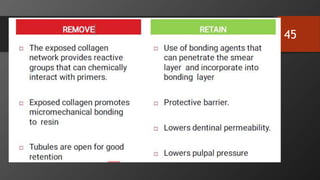
Therefore optimal bonding can occur by:
A. Removal of smear layer by using etch and rinse adhesives.
B. Incorporation of smear layer into bonding layer by self-etch adhesives.
Complete removal of the smear layer increases the dentin
permeability by 90%.
• Pashley suggested a mainly outward fluid flow under pulpal pressure of 20-
70 cm/H2O.
45
46
Disadvantage of a smear layer covering the bonding surface is its inherently weak
bond to the underlying dentin and its brittle nature.
Early smear-layer incorporating non-acidic adhesives, applied without prior
etching, did not penetrate deeply enough to establish a bond with intact dentin.
Such bonds were prone to cohesive failure of the smear layer.
DENTIN CONDITIONING
• Alteration of the dentin surface for incorporation of the smear layer into the bond.
• The principal effects of conditioning are physical and chemical
• Physical effects – Alteration in the thickness and morphology of the smear layer and the dentinal
tubules.
• Chemical effects – Modification of a fraction of the organic matter and decalcification of the
inorganic portion.
47
CONDITIONING OF DENTIN 48
Complete or partial removal of the smear layer can be achieved by applying acidic or
chelating solutions called dentin conditioners.
Strong acids do not only remove the smear layer; they also demineralize intact
dentin along with the removal of smear plugs to a depth of 1-5 µm, while widening
the dentin tubule orifices.
A polyalkenoic acid conditioner used in glass ionomer restorative techniques also
provides clean dentin surfaces, although without substantial dentin demineralization
and without rendering dentin tubules patent.
49
• While NaOCl is applied to remove organic remnants and bacteria in root
canals, chelating agents (a neutral solution of ethylene diamine tetra-acetic
acid) are widely used in endodontics to remove smear debris produced
during canal preparation.
• Acids – Phosphoric acid 10%, 10% citric acid + 3% ferric chloride,
10% citric acid + 20% calcium chloride
• Chelators - EDTA
COMPONENTS OF BONDING SYSTEM
• ETCHANTS
• PRIMERS
• SOLVENTS
• ADHESIVES
• INITIATORS
• FILLERS
• OTHERS
50
PRIMERS
• Primers are solutions containing hydrophilic monomers dissolved in a solvent such as
acetone, ethanol, or water.
• Hydrophilic monomers –
• phosphate,
• carboxylic acid,
• alcohol, or
• ester functional groups.
• HEMA (2-hydroxyethyl methacrylate) is a widely used primer monomer because of
its high hydrophilicity and solvent-like nature.
51
52
• Available in a wide range of pH
• The rank of functional groups in their acidity is as follows:
SULFONIC ACID > PHOSPHONIC > PHOSPHORIC > CARBOXYLIC > ALCOHOL.
• Self-etching primer - If the concentration of acidic monomers is increased in a
HEMA base, a primer formulation may reach a pH low enough (e.g., 1–2) to
remove smear layers and etch underlying dentin.
• The primer has the ability to both etch and prime
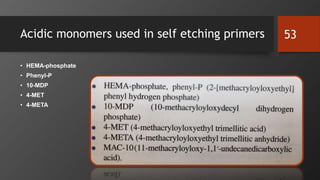
Acidic monomers used in self etching primers
• HEMA-phosphate
• Phenyl-P
• 10-MDP
• 4-MET
• 4-META
53
54
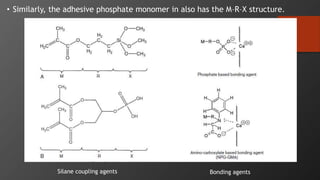
• Early dentin bonding agents were based on the successful model of silane
coupling agents as used to bond the inorganic filler to the matrix resin in
composites
• A silane coupling agent may be represented as M–R–X.
• M represents an unsaturated methacrylate group or groups capable of
copolymerizing with the other monomers of a resin cement or composite
• X represents a group capable of chemically reacting with siliceous materials
such as glass and silicate filler particles in composites, porcelain crowns and
veneers, and/or the calcium ions (Ca++) in dental hard tissues
• R is a spacer group that provides flexibility and mobility, and thus enhanced
reactivity, for the M group after the X group has been immobilized by reaction at
55
• Similarly, the adhesive phosphate monomer in also has the M–R–X structure.
Silane coupling agents Bonding agents
SOLVENTS
• Water
• Ethanol
• Acetone
• Each solvent has a specific contribution to improve bond adhesion.
• Water can ionize acidic monomers as well as re-expand the collapsed collagen
network.
• Ethanol and acetone have better miscibility with relatively hydrophobic
56
WET VS DRY BONDING
• WET BONDING was introduced by Kanca and by Gwinnett et al, in the
1990s
• When acetone/alcohol-based primers are applied to moist demineralized
dentine, the water diffuses from the wet dentine into the acetone, while the
acetone diffuses into the demineralized dentine matrix.
• This chemical dehydration of the collagen network caused by the substitution
of water with acetone also increases the modulus of elasticity of collagen.
57
58
The water is gradually lost as the solvents and resin monomers occupy
the spaces around the collagen fibrils. Therefore, there is much less
shrinkage.
Reasons for better bonding in moist dentin
• Acetone trails water and improves penetration of monomer into the dentin for
better micromechanical bonding.
• Water keeps collagen fibers from collapsing, thus helping in better penetration
and bonding between resin and dentin.
Dry Bonding:
• Refers to the bonding in which the acid etched dentin is dry and uses the adhesive
systems that provide water-based primers.
If the Dentin Surface is Made Too Dry
• Collapse of the collagen fibers and demineralized dentin occurs.
• This results in low bond strength because of ineffective penetration of the adhesive into the
dentin.
59
60
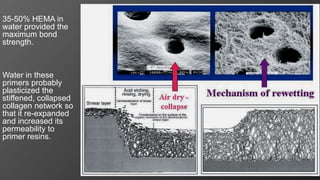
35-50% HEMA in
water provided the
maximum bond
strength.
Water in these
primers probably
plasticized the
stiffened, collapsed
collagen network so
that it re-expanded
and increased its
permeability to
primer resins.
ADHESIVES
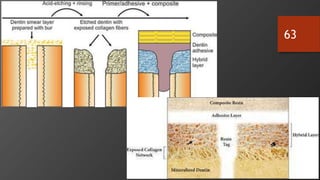
• Adhesives - fill the interfibrillar space of the collagen network, and create a
hybrid layer and resin tags to provide micromechanical retention upon
polymerization.
• HYBRID LAYER
• “The structure formed in the dental hard tissue by
demineralization of the surface and the sub-surface
followed by infiltration of monomers & subsequent
polymerization.”
• ( Nakabayashi,1982)
61
7/3/2024
62
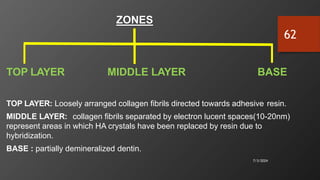
ZONES
TOP LAYER MIDDLE LAYER BASE
TOP LAYER: Loosely arranged collagen fibrils directed towards adhesive resin.
MIDDLE LAYER: collagen fibrils separated by electron lucent spaces(10-20nm)
represent areas in which HA crystals have been replaced by resin due to
hybridization.
BASE : partially demineralized dentin.
63
64
• It should prevent fluid leakage along the restorative material’s
margin
• Adhesive resins are composed mainly of hydrophobic
dimethacrylates such as bis-GMA, TEGDMA, and urethane
dimethacrylates (UDMA), and a small amount of a hydrophilic
monomer such as HEMA
• In recent commercial products , methacrylamides have replaced
methacrylates (e.G., Adhese one F, ivoclar vivadent, amherst, NY).
• The polar ester bond - absorbs water and gradually hydrolyzes
• Carbamides - more hydrolytically stable than ester groups
INITIATORS
• Polymerization can be initiated either
• through a photoinitiator system consisting of a photosensitizer (e.g.,
camphorquinone) and an initiator (e.g., tertiary amine),
• through a self-cure system that includes a chemical initiator (e.g., benzoyl
peroxide [BPO]),
• or through a dual-cure initiator system.
65
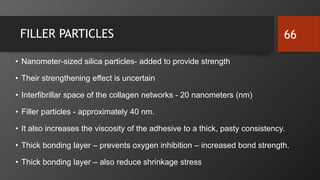
FILLER PARTICLES
• Nanometer-sized silica particles- added to provide strength
• Their strengthening effect is uncertain
• Interfibrillar space of the collagen networks - 20 nanometers (nm)
• Filler particles - approximately 40 nm.
• It also increases the viscosity of the adhesive to a thick, pasty consistency.
• Thick bonding layer – prevents oxygen inhibition – increased bond strength.
• Thick bonding layer – also reduce shrinkage stress
66
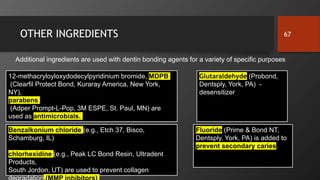
OTHER INGREDIENTS
Additional ingredients are used with dentin bonding agents for a variety of specific purposes
67
Glutaraldehyde (Probond,
Dentsply, York, PA) -
desensitizer
12-methacryloyloxydodecylpyridinium bromide, MDPB
(Clearfil Protect Bond, Kuraray America, New York,
NY),
parabens
(Adper Prompt-L-Pop, 3M ESPE, St. Paul, MN) are
used as antimicrobials.
Fluoride (Prime & Bond NT,
Dentsply, York, PA) is added to
prevent secondary caries.
Benzalkonium chloride (e.g., Etch 37, Bisco,
Schamburg, IL)
chlorhexidine (e.g., Peak LC Bond Resin, Ultradent
Products,
South Jordon, UT) are used to prevent collagen
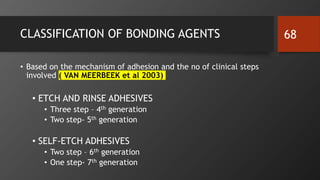
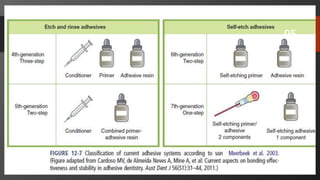
CLASSIFICATION OF BONDING AGENTS
• Based on the mechanism of adhesion and the no of clinical steps
involved ( VAN MEERBEEK et al 2003)
• ETCH AND RINSE ADHESIVES
• Three step – 4th generation
• Two step- 5th generation
• SELF-ETCH ADHESIVES
• Two step – 6th generation
• One step- 7th generation
68
69
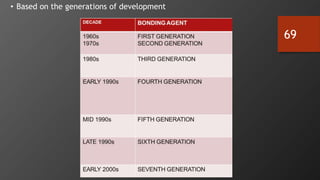
• Based on the generations of development
FIRST GENERATION BONDING AGENTS
 It consisted of surface active co-monomer NPG-GMA(N-phenylglycine glycidyl
methacrylate)
 MECHANISM OF ACTION:
• Deep penetration of the resin tags into the exposed dentinal tubules after etching
and dentin
• This co-monomer could chelate with calcium on the tooth surface to generate
chemical bonds of resin to calcium.
 Example:
 Cervident(S S White burs, Lakewood)
7/3/2024
70
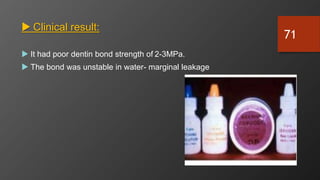
 Clinical result:
 It had poor dentin bond strength of 2-3MPa.
 The bond was unstable in water- marginal leakage
7/3/2024
71
SECOND GENERATION BONDING AGENTS
• Introduced in 1978.
• They were based on phosphorous esters of methacrylate derivatives.
• MECHANISM OF ACTION:
• Adhesion was by means of ionic interaction between the negatively charged
phosphate groups & positively charged calcium in the smear layer.
• No. of steps involved were two; etching of enamel + application of adhesive
72
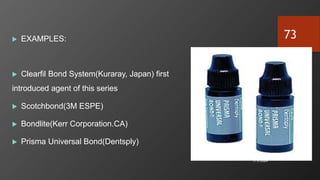
 EXAMPLES:
 Clearfil Bond System(Kuraray, Japan) first
introduced agent of this series
 Scotchbond(3M ESPE)
 Bondlite(Kerr Corporation.CA)
 Prisma Universal Bond(Dentsply)
7/3/2024
73
74
Clearfil Bond System
Composed of an ethyl alcohol solution containing tertiary amine as the activator.
Catalyst liquid – BisGMA monomer containing a phenyl phosphate ester, benzoyl
peroxide ,methyl methacrylate
Scotch bond –
Halo phosphorous ester of BisGMA – formed bby reaction of BisGMA with
phosphorous oxychloride.
Chlorines have a partial negative charge and bind to the calcium ions of smear
layer of dentin
 ADVANTAGE:
 Bond strength was 3 times higher than the earlier ones.
 DISADVANTAGE:
 Bond strength was still lower around 6-8 Mpa.
 Clinical failure due to the bonding instability in the wet oral environment &
their primary bonding to the smear layer and not the dentin.
7/3/2024
75
THIRD GENERATION BONDING AGENTS
• The concept of phosphoric acid etching of dentin before the application of
a phosphate ester type of bonding agent was put forward by FUSAYAMA et
al in 1979.
• The presence of the smear layer was documented to have a negative
influence on bonding.
• The third-generation materials were designed to either remove or modify
the smear layer and allow penetration of acidic monomers.
76
77
• Acid-etching - heavily alter or to remove the smear layer and
demineralize dentin
• Separate primer (bifunctional monomer in a volatile solvent)
designed to penetrate dentin by its own monomer and those of
adhesive monomers
• Adhesive is an unfilled or partially filled resin that may contain
some component of primer (e.g. HEMA) in an attempt to promote
increased bond strength
78
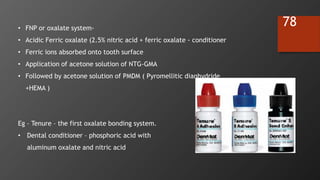
Eg – Tenure – the first oxalate bonding system.
• Dental conditioner – phosphoric acid with
aluminum oxalate and nitric acid
• FNP or oxalate system-
• Acidic Ferric oxalate (2.5% nitric acid + ferric oxalate - conditioner
• Ferric ions absorbed onto tooth surface
• Application of acetone solution of NTG-GMA
• Followed by acetone solution of PMDM ( Pyromellitic dianhydride
+HEMA )
CURRENT STRATEGIES
• ETCH AND RINSE ADHESIVES
• Three step – 4th generation
• Two step- 5th generation
• SELF-ETCH ADHESIVES
• Two step – 6th generation
• One step- 7th generation
79
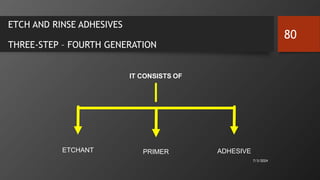
ETCH AND RINSE ADHESIVES
THREE-STEP – FOURTH GENERATION
IT CONSISTS OF
ETCHANT PRIMER ADHESIVE
7/3/2024
80
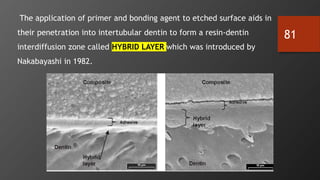
81
The application of primer and bonding agent to etched surface aids in
their penetration into intertubular dentin to form a resin-dentin
interdiffusion zone called HYBRID LAYER which was introduced by
Nakabayashi in 1982.
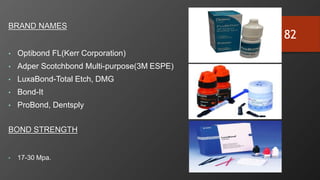
BRAND NAMES
• Optibond FL(Kerr Corporation)
• Adper Scotchbond Multi-purpose(3M ESPE)
• LuxaBond-Total Etch, DMG
• Bond-It
• ProBond, Dentsply
BOND STRENGTH
• 17-30 Mpa. 7/3/2024
82
ADVANTAGES:
 Highest bond strength of 17-24MPa.
 They show reliable and consistent results.
DISADVANTAGES:
 Time consuming procedure.
 Over wetting or over drying of dentin may occur.
 Post conditioning rinsing required, so risk of contamination.
 Risk of over etching the dentin.
 Weak resin collagen interaction leading to nano leakage and early bond degradation.
83
TWO STEP – FIFTH GENERATION
• This was developed to simplify the procedures involved in bonding.
• Therefore, the primer and the bonding agent are present in a single
bottle.
• COMPONENTS:
• ETCHANT GEL + (PRIMER &ADHESIVE)
84
85
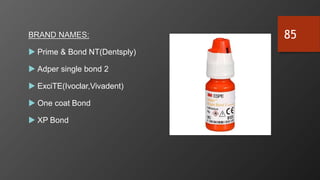
BRAND NAMES:
 Prime & Bond NT(Dentsply)
 Adper single bond 2
 ExciTE(Ivoclar,Vivadent)
 One coat Bond
 XP Bond
7/3/2024
86
ADVANTAGES:
 Simpler application procedure.
 Consistent and stable composition
 Controlled solvent evaporation when provided in single-dose packages
DISADVANTAGES:
 WATER DEGREDATION because – primer is more hydrophilic
 time-consuming procedure.
 Technique sensitive, due to multiple layer application.
 Lower bonding effectiveness than three-step etch and rinse systems.
 Risk of the very thin bonding layer.
SELF-ETCH ADHESIVES – 6TH GENERATION
TWO STEP
• An acidic monomer that is not rinsed, is used to condition and prime the tooth at
the same time.
• There are two types of self-etch adhesives (van meerbeek et al., 2001), mild and
strong varieties.
• Strong self-etch adhesives have low ph (<1) - a bonding mechanism resembles
the etch-and-rinse adhesives.
• Mild self-etch adhesives (ph = 2) only partially dissolve the dentin surface, so a
substantial amount of hydroxyapatite remains available within the hybrid layer
87
88
• Carboxyl or phosphate groups of functional monomers can
then chemically interact with this residual hydroxyapatite.
• The bond to dentin is better than that of etch-and-rinse
adhesives
ADVANTAGES:
 Decrease in the number of steps
 Less technique sensitive.
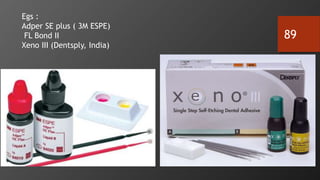
89
Egs :
Adper SE plus ( 3M ESPE)
FL Bond II
Xeno III (Dentsply, India)
ONE STEP- 7TH GENERATION
• This category combines conditioner, primer, and bonding resin into a single
step.
• One-step or “all-in-one” systems are delivered by a bottle, vial, or single-
unit dose applicator, which are formulated as a single component.
• However, adper promp l-pop (3m espe, st. Paul, MN) has two liquid
components packaged in separate “blister” compartments in a single
dispenser.
90
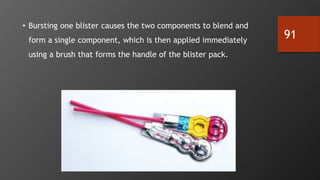
91
• Bursting one blister causes the two components to blend and
form a single component, which is then applied immediately
using a brush that forms the handle of the blister pack.
92
• van Landuyt et al. (2011) showed in a randomized clinical trial that a
onestep, self-etch adhesive had similar clinical performance after 3
years compared with that of an etch-and-rinse adhesive in class V
restorations.
• However, the one-step group exhibited more incisal marginal defects and
discoloration compared with the etch-and-rinse group.
93
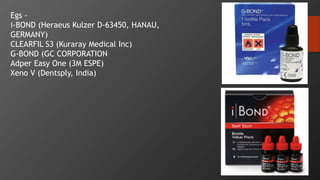
Egs -
i-BOND (Heraeus Kulzer D-63450, HANAU,
GERMANY)
CLEARFIL S3 (Kuraray Medical Inc)
G-BOND (GC CORPORATION
Adper Easy One (3M ESPE)
Xeno V (Dentsply, India)
 ADVANTAGES:
• Lesser application time.
• Decrease in errors with each step.
• Unidose application prevents cross-contamination.
• Less sensitivity to dentin wetness conditions.
 DISADVANTAGES:
• Reduced shelf life.
• Least bond strength.
• Less sealing capacity: acts as a semipermeable membrane
7/3/2024
94
95
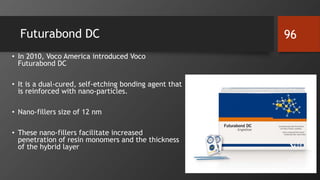
Futurabond DC
• In 2010, Voco America introduced Voco
Futurabond DC
• It is a dual-cured, self-etching bonding agent that
is reinforced with nano-particles.
• Nano-fillers size of 12 nm
• These nano-fillers facilitate increased
penetration of resin monomers and the thickness
of the hybrid layer
96
97
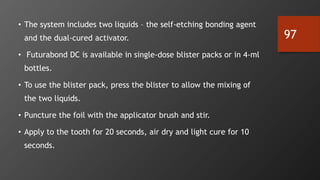
• The system includes two liquids – the self-etching bonding agent
and the dual-cured activator.
• Futurabond DC is available in single-dose blister packs or in 4-ml
bottles.
• To use the blister pack, press the blister to allow the mixing of
the two liquids.
• Puncture the foil with the applicator brush and stir.
• Apply to the tooth for 20 seconds, air dry and light cure for 10
seconds.
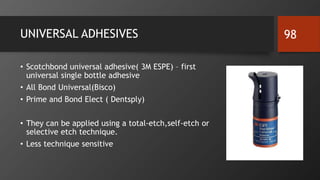
UNIVERSAL ADHESIVES
• Scotchbond universal adhesive( 3M ESPE) – first
universal single bottle adhesive
• All Bond Universal(Bisco)
• Prime and Bond Elect ( Dentsply)
• They can be applied using a total-etch,self-etch or
selective etch technique.
• Less technique sensitive
98
99
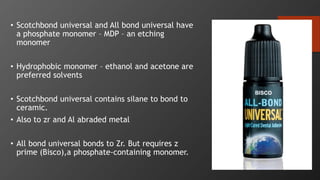
• Scotchbond universal and All bond universal have
a phosphate monomer – MDP – an etching
monomer
• Hydrophobic monomer – ethanol and acetone are
preferred solvents
• Scotchbond universal contains silane to bond to
ceramic.
• Also to zr and Al abraded metal
• All bond universal bonds to Zr. But requires z
prime (Bisco),a phosphate-containing monomer.
SELECTIVE ETCH
• Enamel is etched with phosphoric acid and rinsed.
• Self-etching adhesive applied to enamel and dentin.
• Improve bond strength to enamel and improve peripheral seal
• Universal adhesives- high pH- bond better to etched enamel
• Self-etching adhesives – low bond strength to phosphoric etched
enamel
100
REVIEW OF LITERATURE 101
102
Comparative evaluation of microleakage of newer
generation dentin bonding agents: An in vitro study
Rani Somani, Shipra Jaidka, Sameksha Arora
Indian J Dent Res 2016
The Aim of this study was to determine the microleakage of the 6th , 7th , and 8th
generation dentin bonding agents.
Group i- FL bond ii (6 th generation, giomer self-etching, light-cured dentin bonding
agent).
Group ii- Xeno v (7 th generation, self-etching, light-cured dental adhesive).
Group iii- Futurabond DC (8 th generation, self-etching, dual-cured dental adhesive).
The 8th generation dentin bonding agent presents a better marginal integrity incomparison
to the 6th and 7th generation dentin bonding agents which is in accordance to the studies
done by joseph et al. and kambale et al. (2014)
103
• The 8th generation dentin bonding agent (Futurabond DC) contains
polyfunctional adhesive monomers (phosphoricacid modified methacrylate
esters).
• These acid esters, when mixed with water, produced a favorable lower pH
value of1.4 as in comparison to unfavorable higher pH value of 1.8 and 2.4 of
the 7 th and 6 th generation dentin bonding agents, respectively.
• The lower pH favors complete removal of smear layer and the hydroxyapatite
is dissolved(demineralized), creating a deeper retentive pattern on the tooth
surface.
• Moreover, the 8th generation dentin bonding agent (Futurabond DC) is a
nanofilled adhesive which forms a thicker adhesive layer and a more flexible
interface,which may help to counteract stress resulting from polymerization
shrinkage of the resin composite
104
Comparative evaluation of Microleakage of class ii composite restoration by using 6th 7th and
8TH generation dentin bonding agents: An in vitro study
Dr. Uday Kamath and Dr. Arun CR
International Journal of Applied Dental Sciences 2019;
According to the generation of bonding agent used, the samples were
divided into three groups. 6th generation bonding agent (Parabond) is
bonded in group I, 7th generation (One coat 7) in group II and 8th
generation (G premio bond) in group III respectively. Nano-ceramic
composite (Ceram X) is restored in all the prepared cavities
The highest value of microleakage was in Group II (7th generation
bonding agent) followed by Group I (6th generation bonding agent) and
least in Group III (8th generation bonding agent).
105
Comparative evaluation of shear bond strength of sixth- and seventh-generationbonding agents with
varying pH – An in vitro study
Asim Jamadar, Amulya Vanti, Veerendra Uppin, Madhu Pujar, Sheetal Ghivari, and Hemant Vagarali. J
Conserv Dent. 2020
The pH values did not influence the shear bond strength significantly in the tested
adhesive systems.
ADPER EASY ONE (pH= 2.3, Seventh Generation) showed higher bond strength
followed by XENO IV(pH = 2.1,), XENO III (pH = 1.5,) on dentinalsurface ,where as
ADPER PROMPT L POP (pH =0.7 to 1 Sixth Generation,) showedlower bond
strength.
106
Comparative analysis of bond strength and microleakage of newer generation bonding agents to enamel and
dentin: Anin vitro study
• Nishmitha Hegde, Shruthi Attavar, Mithra N Hegde, Nidarsh D Hegde Department of Conservative Dentistry
and Endodontics, A.B. Shetty Memorial Institute of Dental Sciences,Mangalore, Karnataka, India
• Journal of conservative dentistry 2020
Resin bonded with self-etch G-Premio Bond used in selective etch technique showed the highest
BS and resistance to ML.
• G-Premio Bond (GC Asia Dental Pte. Ltd.,), a universal bonding agent, 8th generation provides
outstanding durability, compatible with total-etch self-etch, and selective etch techniques.
• A unusual combination of three functional monomers (4methacryloyloxyethyltrimellitic acids
[4-MET], MDP and MDTP), excluding HEMA,
• It ensures stability and exceptional BS not only for dental tissue but also for all indirect
substrates, including precious and non-precious metals, composites, alumina, and zirconia for
repair cases.
• This adhesive system was bonded with G-ænial Sculpt, a nanohybrid composite.
107
Comparative Evaluation of Microleakage between Three Adhesive Agents
Shiva Jafarnia, Hani Donyavi, Mohammad Erfan Ardestani, Mohammad Moein Azizi, Sima Shahabi
JDMT, Volume 11, Number 1, March 2022
First group - G-premio bond
Second group - Quickbond (itena clinical, paris, france)
Third group - Iperbond ultra (itena clinical, paris, france)
Quickbond, a 6th-generation adhesive, has a higher level of
microleakage, which can compromise the durability of the restoration.
G-premio bond, a universal adhesive, has less microleakage than the
other two adhesives.
108
Adhesive bond integrity of silanized zirconia nanoparticles inpolymeric resin dentin bonding
agent. An FTIR, SEM, andmicro-tensile experiment
Basil Almutairi Mashael Binhasan Sara Shabib Amal S. Al-Qahtani Huda I. Tulbah Khulud A.Al-Aali
Fahim Vohra Tariq Abduljabbar
International Journal of Adhesion and Adhesives .Volume 114, April 2022.
• The aim of this in vitro investigation was to synthesize and silanize zirconia oxide
(zro) nanoparticles with 3-methacryloxypropyltrimethoxysilane (MPS) and
incorporate into two-step self-etch dentin adhesive at 2.5% and 5% concentrations
to study the mechanical and biological properties at the dentin-resin interface.
• The adhesive specimen modified with 2.5% MPS-ZRO nanofiller exhibited the
highest mean DC
• The 2.5% MPS-ZRO nanofiller had shown the highest micro-tensile bond strength
• And 4-point bending strength after ageing, both of which were significantly higher
than the control adhesive
• After ageing2.5% MPS-ZRO nanofiller has shown a significant lower mean nano-
leakage than control
• Dentin bonding agent modified with 2.5% MPS-ZrO nanofiller substantially
increased bond integrity at the resin-dentin interface.
109
Effect of 940nm Diode Laser Irradiation on Microtensile Bond Strength of an Etch and Rinse
Adhesive (Single Bond 2) to Dentin
Shahin Kasraei, Ebrahim Yarmohamadi, Pegah Ranjbaran Jahromi, and Mahdi Akbarzadeh. J Dent 2019
Mar
This study concluded that dentin surface irradiation with 940nm diode
laser after adhesive application and prior to curing can significantly
increase the bond strength of composite to dentin.
Laser can influence bonding mechanism by increasing the penetration
depth of adhesive insmear layer.
CONCLUSION
• Dentin bonding agents have dramatically improved in recent years
• Although dentin bonding agents are not yet considered “ideal” materials, they are
certainly close.
• The new adhesive systems also can be attributed to their ability to decrease or
eliminate postoperative sensitivity, improve the mar-ginal seal, reduce microleakage
and enhance the flow of resin into the fissures.
110
REFERENCES
• STURDEVANT'S ART & SCIENCE OF DENTISTRY- 6TH EDITION
• PHILLIPS-SCIENCE OF DENTAL MATERIALS- 12th EDITION
• An overview of dentin bonding agents
Kadali Navyasri1,*, Rama Krishna Alla2, Guduri Vineeth3, Suresh
SajjanInternational Journal of Dental Materials 2019;
• Bond strength of universal adhesives: A systematic review and meta-
analysis
Wellington Luiz de Oliveira da Rosaa, Evandro Pivab, Adriana Fernandes da
Silvac*
111
• Comparative evaluation of microleakage of newer generation dentin bonding
agents: An in vitro study .Rani Somani, Shipra Jaidka, Sameksha Arora. Indian J
Dent Res 2016
• Comparative evaluation of Microleakage of class ii composite restoration by
using 6th 7th and 8TH generation dentin bonding agents: An in vitro study . Dr.
Uday Kamath and Dr. Arun CR . International Journal of Applied Dental
Sciences 2019
• Comparative evaluation of shear bond strength of sixth- and seventh-
generationbonding agents with varying pH – An in vitro study. Asim Jamadar,
Amulya Vanti, Veerendra Uppin, Madhu Pujar, Sheetal Ghivari, and Hemant
Vagarali. J Conserv Dent. 2020
112
• Comparative analysis of bond strength and microleakage of newer generation bonding
agents to enamel and dentin: Anin vitro study
Nishmitha Hegde, Shruthi Attavar, Mithra N Hegde, Nidarsh D Hegde Department of
Conservative Dentistry and Endodontics, A.B. Shetty Memorial Institute of Dental
Sciences,Mangalore, Karnataka, India. Journal of conservative dentistry 2020
• Comparative Evaluation of Microleakage between Three Adhesive Agents
Shiva Jafarnia, Hani Donyavi, Mohammad Erfan Ardestani, Mohammad Moein Azizi,
Sima Shahabi. JDMT, Volume 11, Number 1, March 2022
113
• Effect of 940nm Diode Laser Irradiation on Microtensile Bond Strength of
an Etch and Rinse Adhesive (Single Bond 2) to Dentin
Shahin Kasraei, Ebrahim Yarmohamadi, Pegah Ranjbaran Jahromi, and
Mahdi Akbarzadeh. J Dent 2019 Mar
• Adhesive bond integrity of silanized zirconia nanoparticles inpolymeric
resin dentin bonding agent. An FTIR, SEM, andmicro-tensile experiment
Basil Almutairi Mashael Binhasan Sara Shabib Amal S. Al-Qahtani Huda I.
Tulbah Khulud A.Al-Aali Fahim Vohra Tariq Abduljabbar
International Journal of Adhesion and Adhesives .Volume 114, April 2022.
114

7.DENTIN BONDING AGENTS FOR COMPOSITES.pptx

  • 1.
  • 2.
    CONTENTS • INTRODUCTION • HISTORY •APPLICATIONS OF BONDING • MECHANISM OF BONDING • FACTORS IN ACHIEVING ADHESIVE BONDS • STEPS IN FORMING GOOD ADHESION • ENAMEL ADHESION • DENTIN ADHESION 2
  • 3.
    CONTENTS contd.. • SMEARLAYER • DENTIN CONDITIONING • COMPONENTS OF DENTIN BONDING SYSTEM • WET BONDING VS DRY BONDING • CLASSIFICATION OF BONDING SYSTEMS • REVIEW OF LITERATURE • CONCLUSION 3
  • 4.
    INTRODUCTION • Conservation ofthe tooth structure and good esthetics have always been a long sought after in restorative dentistry. • Introduction of the acid etch technique and resin based composites have contributed in a large way towards achieving this goal. • While effective bonding to enamel has been achieved with relative ease, bonding to dentin has proved to be more difficult. 4
  • 5.
    INTRODUCTION 5  Thereis much interest and activity in dentistry today with dentin bonding agents.  Moreover, the classic concepts of tooth preparation advocated in the early 1900s have changed dramatically.
  • 6.
    HISTORY • Research intobonding agents for attachment of resins to tooth structure was started in the early 1950s. • In 1949, Hagger, a Swiss chemist attempted first to develop an adhesive system for bonding acrylic resin to the tooth structure, [acidic glycerophosphoric acid dimethacrylate]. • In 1949, a commercial product Sevriton cavity seal was then marketed. 6
  • 7.
    7 • In 1955Buonocore applied 85% phosphoric acid on enamel for 30 seconds to achieve a simple acid decalcification. • In 1962, Bowen introduced Bis-GMA resin based on epoxy molecule. • In 1965, Bowen proposed that surface active monomers could facilitate the bonding of resins to teeth by using reactive monomers that could chelate to calcium. • In 1977, Fusayama et al, introduced total etching technique for both enamel and dentin cavity walls, using 40% phosphoric acid.
  • 8.
    8 • In 1982,Nakabayashi, reported that dentin clearing by citric acid containing ferric chloride followed by Dentin Bonding Agent containing 4-META was effective on bonding. • In 1984, Nakabayashi, again showed that formation of resin tags in the dentinal tubules Plays a key point in resin to dentin adhesion. • In 1980, 1st generation of bonding agents were developed, had minimal bond strength. • Mid 1980’s 2nd generation of bonding agents were developed, and Eliades and Caputo in 1985, introduced it for clinical use.
  • 9.
    9 • Late 1980’s3rd generation dentin bonding agents became available. • In 1991, Bertolloti and Kanca introduced concept wet bonding. • In 1992, a product containing 4-META was developed which bonds to dentin as well as amalgams, metal and porcelain. • In 1995 5th generation dentin bonding agent were introduced. • In late 1990’s 6th generation, self etching primer were introduced. • Recently 7th & 8th generation dentin bonding agents have been introduced.
  • 10.
    APPLICATIONS • Orthodontic bracketbonding • Porcelain laminate veneer bonding. • Pit and fissure sealants • Amalgam bonding • Bond pre-fabricated fibre or metal posts and cast posts. • Seal root canals during endodontic therapy. • Restoration of carious lesions 10
  • 11.
     Adhesion isderived from Latin adhaerere meaning (“to stick to”) " “The state in which two surfaces are held together by interfacial forces which may consist of valence forces or interlocking forces or both" (The American Society for Testing and Materials) DEFINITION 11
  • 12.
     For theprocess of adhesion to occur , we need to understand the role of following components:  ADHESIVE  ADHEREND  ADHESIVE STRENGTH 12
  • 13.
     ADHESIVE isdefined as a material , frequently a viscous fluid that joins two substrates together by solidifying , resisting separation & transferring a load from one surface to the other.  ADHEREND is defined the surface to which an adhesive adheres.  ADHESIVE STRENGTH is the measure of the load-bearing capacity of an adhesive joint. 13
  • 14.
    ESSENTIAL FUNCTION OFDENTAL BONDING SYSTEM • Resistance to separation of adherend from restorative or cementing material. • Distribute stress along the bonded interface. • Seal the interface – prevent microleakage. 14
  • 15.
    MECHANISM OF ADHESION •CONDITIONS TO BE SATISFIED FOR TRUE ADHESION 1. Sound tooth structure must be conserved. 2. Optimal retention must be achieved. 3. Microleakage must be prevented. 15
  • 16.
    • Process ofadhesion involves two parts 1. Removing hydroxyapatite to create micropores and 2. Infiltration of resin monomers into the micropores and subsequent polymerization. As a result, resin tags are formed that micromechanically interlock or interpenetrate with the hard tissue. There may also be chemical interactions with the tooth substrate if monomers having acidic or chelating functional groups are present. 16
  • 17.
    FACTORS IN ACHIEVINGADHESIVE BONDS 1. Surface energy and wetting 2. Interpenetration (formation of a hybrid zone) 3. Micromechanical interlocking 4. Chemical bonding A successful dentin bonding system must meet several requirements: 1. Adequate removal or dissolution of the smear layer from enamel and dentin 2. Maintenance or reconstitution of the dentin collagen matrix 3. Good wetting 17
  • 18.
    WETTING • Wetting isthe essential first step for the success of all adhesion mechanisms. • Wettability of a liquid on a solid can be characterized by the contact angle that forms between a liquid and solid, as measured within the liquid. • Categories of wettability include • Mostly nonwetting (>90 degrees) • Absolutely no wetting(180 degrees) • Mostly wetting (<90 degrees) • Absolute wetting (0 degrees). 18
  • 19.
    • The anglebetween adhesive & adherend. • Smaller the angle, better the wettability. • 180º: Not accepted since all • liquids wet all solids to some extent. • 0-180º: Poor or incomplete wetting. • 0º: Spontaneous wetting of liquid takes place. 19
  • 20.
    SURFACE ENERGY &SURFACE TENSION • Good bonding can be achieved by increasing the surface energy of the substrates (e.G., Dentin, enamel, and synthetic materials). • Acid-etching A clean, microroughened tooth surface has higher surface energy than unprepared tooth surfaces. Therefore, the organic adhesives are able to wet and spread over such a surface • ADHEREND/SUBSTRATE - HIGH SURFACE ENERGY • ADHESIVE – LOW SURFACE TENSION 20
  • 21.
    STEPS IN FORMINGGOOD ADHESION 21
  • 22.
    ACID ETCH TECHNIQUE- ENAMELETCHING • Michael Buonocore (1955). • He found that an acrylic restorative material placed on the micromechanically roughened surfaces greatly increased in the resin–enamel bond strength (~20 megapascals [MPa]) • Phosphoric acid, is still the most widely used etchant today for bonding to both enamel and dentin. 22
  • 23.
    • Depending onthe concentration, phosphoric acid removes the smear layer and about 10 microns of enamel to expose prisms of enamel rods to create a honeycomb-like, high-energy retentive surface. • Resin monomers will readily wet the surface, infiltrate into the micropores, and polymerize to form resin tags. • Resin tags – • Diameter 6µm • Length – 10 to 20 µm 23
  • 24.
    ETCH PATTERNS Enamel etchingresults in three different micro morphologic patterns as described by Silverstone et al in 1975. Enamel etching leads to the following types of micromorphological patterns: TYPE 1 ETCH PATTERN-dissolution of prism cores without the involvement of prism peripheries. TYPE 2 ETCH PATTERN-peripheral enamel is dissolved, but the cores are left intact. TYPE 3 ETCH PATTERN-it is less distinct than the other two patterns. 24
  • 25.
  • 26.
    ETCHANT CONCENTRATION  Buonocoreused30-40% phosphoric acid.  Currently,37% phosphoric acid in gel form is used.  Silverstone found that the application of 30-40% phosphoric acid resulted in a very retentive enamel surface.  >50% - Monocalcium phosphate monohydrate is formed. - - Etch patterns with poorer definition. Cannot be easily removed by rinsing. 26
  • 27.
    • 50 %phosphoric acid for 60 seconds - monocalcium phosphate monohydrate precipitate • Concentrations below 25% - dicalcium phosphate dihydrate precipitate • Concentrations above 40% - Dissolve less calcium and etch patterns with poor definitions • 37% for 15 sec is considered appropriate. • Citric acid ‐10%, Polyacrylic acid‐40%, Maleic acid. 27
  • 28.
    ETCH TIME  Currently,an etching time of 15 seconds is used.  An etching time of 60 seconds originally was recommended for permanent enamel using 30-40% phosphoric acid.  However , studies show that a 15 second etch resulted in a similar surface roughness as that provided by a 60 second etch. 28
  • 29.
  • 30.
    Phosphoric acid issaid to be a more aggressive acid, so alternative etchants have been suggested:  EDTA (24%; ph=7)  Citric acid  Tannic acid  Maleic acid  Polyacrylic acid ALTERNATE ETCHANT SYSTEMS:  Lasers  Air abrasion - Al2O3 particles 30
  • 31.
    LASER ETCHING  Adhesionto dental hard tissues after Er:YAG laser etching is inferior to that obtained after conventional acid etching.  Enamel and dentin surfaces prepared by Er:YAG laser etching show extensive subsurface fissuring that is unfavorable to adhesion. (J Prosthet Dent 2000;84:280-8.)  Adhesion to laser-ablated or laser-etched dentin and enamel was inferior to that of conventional rotary preparation and acid etching. ( Dental Materials (2005) 21, 616–624) 31
  • 32.
    Figure 1 Scanningelectron microscopic images of dentin:(A) rotary-prepared and acid-etched (3500!), (B) laser-prepared (9000!), and (C) laser-prepared and then acid- etched (3500!). (Fig. 1A) revealed a smoothsurface with tubule orifices devoid of smear plugs. The intertubular dentin is undisturbed. In contrast, SEM of a cross-section of laser-ablated, laser-etched dentin showed a highly irregular surface and fissuring. Areas of poor hybridization between composite and dentin suggest poor hybridization, or no hybridization. Laser-prepared dentin revealed surface scaling and flaking, along with peritubular cuffing (Fig. 1B).Acid- etching after laser ablation appeared to decrease some of the surface scaling and flaking (Fig. 1C). 32
  • 33.
    Figure 3 Separationof resin adhesive and unaffected subsurface dentin from laser- ablated, then acid-etched dentin. Laser ablated,acid-etched dentin demonstrated areas of detachment from both the resin adhesive and the unaffected subsurface dentin (Fig. 3). 33
  • 34.
    SEM photographs of37% orthophosphoric acid, 10% maleic acid, and Er,Cr:YSGG hydrokinetic laser-treated enamel. The enamel surface etched with 2 acid solutions and a laser system showed different results according to Silverstone’s etching patterns. • The 37% orthophosphoric acid removed the periphery core material but left the prism core relatively unaffected (type II), producing a very rough enamel surface. • The 10% maleic acid treatment resulted in preferential removal of prism core material and left the periphery intact (type I). • Er,Cr:YSGG hydrokinetic laser treated enamel showed a more random etching pattern in which adjacent areas of tooth surface correspond to types I and II, mixed with regions where the pattern could not be related to prism structure. There was no recrystallization or melting observed. 34
  • 35.
    Air Abrasive Technology •In 1992 U.S. Food and Drug Administration granted clearance to air abrasive cavity preparation system. • Here, a high speed stream of purified Aluminium Oxide particles propelled by air- pressure. • It can prepare enamel and dentin for bonding, similar to chemical etching. • Lawrell et al, observed that bond strength to air-abrasive treated enamel surfaces similar to the values obtained with acid etching. 35
  • 36.
    BOND STRENGTH  Shearbond strength of composite to phosphoric acid etched enamel exceeded 20 Mpa.  According to studies,a minimum of 17-21MPa of bond strength is needed to prevent the disruption of the bond between the tooth and composite. 36
  • 37.
    DENTIN ADHESION  Bondingto dentin is challenging & difficult.  Adhesion to dentin occurs by mechanical method,chemical or both.  But the main method is by penetration of adhesive monomers into collagen fibrils which are exposed post acid etching.  Structural differences exist between enamel & dentin.  Therefore the following reasons account for challenges faced in dentin adhesion:  STRUCTURE OF DENTIN  SMEAR LAYER  STRESSES AT RESIN-DENTIN INTERFACE 37
  • 38.
    STRUCTURE OF DENTIN •Enamel contains 90% of hydroxyapatite crystals whereas dentin has only 50% and the rest is constituted by water(25%) and type I collagen(25% by volume). • Dentinal tubules exert pressure of 25-30mmHg, thus creating decreased stability of bond between composite resin and dentin. • Contain vital processes of the pulp odontoblasts.H ence, vital dentin is a sensitive structure. • High water content provides competition with any adhesive biomaterial for bonding to dentine. 38
  • 39.
    SMEAR LAYER DEFINITION • Poorlyadherent layer of ground dentin produced by cutting a dentin surface; also, a tenacious deposit of microscopic debris that covers enamel and dentin surfaces that have been prepared for a restoration. • While instrumenting, in addition to superficial debris, it has been shown, using the scanning electron microscope, that a layer of sludge material was always formed Over the surface of dentinal walls. This layer of debris has been called the smear layer. (Boyde et al in 1963) 39
  • 40.
    ROLE OF THESMEAR LAYER • Smear layer: • Acts as a physical barrier for bacteria and bacterial products. • Restricts the surface area available for diffusion of both small and large molecules. • Resists fluid movement. • Produces weak bonding because it can be torn away from the underlying matrix. 40
  • 41.
    COMPOSITION OF SMEARLAYER: According to SEM studies done by Shulien TM(1988), the smear layer consists of: INORGANIC AND ORGANIC COMPONENTS  Inorganic HA particles  Collagen matrix  Saliva  Blood Cells  Odontoblastic processes,  Microorganisms.  According to Branstorm, the organic component consisted of coagulated proteins from collagen denatured by frictional heat of cutting. 41
  • 42.
    42 Any debris, calcificin nature produced by the reduction or instrumentation of dentin, enamel or cementum or as a contaminant which precludes interaction with the underlying pure tooth structure. ---EICK Identification of the smear layer was made possible using the electron microprobe with scanning electron microscope (SEM) attachment, and first reported by Eick et al. (1970). Scanning electron microscope studies of cavity preparations by Brannstrom & Johnson (1974) demonstrated a thin layer of grinding debris.
  • 43.
    43 The thickness andmorphology of the smear layer probably varies with the method used for producing the smear layer and with the location within dentin in relation to the pulp. The smear layer has an average depth of 1 to 5 μm but in dentinal tubules, it may go up to 40 μm. Smear layer is thickest when tooth is cut by means of coarse diamond point without coolant. Enamel – rinsed easily Dentin –adherent • Superficial dentin – Less organic content • Deep dentin- More organic content
  • 44.
    44 Therefore optimal bondingcan occur by: A. Removal of smear layer by using etch and rinse adhesives. B. Incorporation of smear layer into bonding layer by self-etch adhesives. Complete removal of the smear layer increases the dentin permeability by 90%. • Pashley suggested a mainly outward fluid flow under pulpal pressure of 20- 70 cm/H2O.
  • 45.
  • 46.
    46 Disadvantage of asmear layer covering the bonding surface is its inherently weak bond to the underlying dentin and its brittle nature. Early smear-layer incorporating non-acidic adhesives, applied without prior etching, did not penetrate deeply enough to establish a bond with intact dentin. Such bonds were prone to cohesive failure of the smear layer.
  • 47.
    DENTIN CONDITIONING • Alterationof the dentin surface for incorporation of the smear layer into the bond. • The principal effects of conditioning are physical and chemical • Physical effects – Alteration in the thickness and morphology of the smear layer and the dentinal tubules. • Chemical effects – Modification of a fraction of the organic matter and decalcification of the inorganic portion. 47
  • 48.
    CONDITIONING OF DENTIN48 Complete or partial removal of the smear layer can be achieved by applying acidic or chelating solutions called dentin conditioners. Strong acids do not only remove the smear layer; they also demineralize intact dentin along with the removal of smear plugs to a depth of 1-5 µm, while widening the dentin tubule orifices. A polyalkenoic acid conditioner used in glass ionomer restorative techniques also provides clean dentin surfaces, although without substantial dentin demineralization and without rendering dentin tubules patent.
  • 49.
    49 • While NaOClis applied to remove organic remnants and bacteria in root canals, chelating agents (a neutral solution of ethylene diamine tetra-acetic acid) are widely used in endodontics to remove smear debris produced during canal preparation. • Acids – Phosphoric acid 10%, 10% citric acid + 3% ferric chloride, 10% citric acid + 20% calcium chloride • Chelators - EDTA
  • 50.
    COMPONENTS OF BONDINGSYSTEM • ETCHANTS • PRIMERS • SOLVENTS • ADHESIVES • INITIATORS • FILLERS • OTHERS 50
  • 51.
    PRIMERS • Primers aresolutions containing hydrophilic monomers dissolved in a solvent such as acetone, ethanol, or water. • Hydrophilic monomers – • phosphate, • carboxylic acid, • alcohol, or • ester functional groups. • HEMA (2-hydroxyethyl methacrylate) is a widely used primer monomer because of its high hydrophilicity and solvent-like nature. 51
  • 52.
    52 • Available ina wide range of pH • The rank of functional groups in their acidity is as follows: SULFONIC ACID > PHOSPHONIC > PHOSPHORIC > CARBOXYLIC > ALCOHOL. • Self-etching primer - If the concentration of acidic monomers is increased in a HEMA base, a primer formulation may reach a pH low enough (e.g., 1–2) to remove smear layers and etch underlying dentin. • The primer has the ability to both etch and prime
  • 53.
    Acidic monomers usedin self etching primers • HEMA-phosphate • Phenyl-P • 10-MDP • 4-MET • 4-META 53
  • 54.
    54 • Early dentinbonding agents were based on the successful model of silane coupling agents as used to bond the inorganic filler to the matrix resin in composites • A silane coupling agent may be represented as M–R–X. • M represents an unsaturated methacrylate group or groups capable of copolymerizing with the other monomers of a resin cement or composite • X represents a group capable of chemically reacting with siliceous materials such as glass and silicate filler particles in composites, porcelain crowns and veneers, and/or the calcium ions (Ca++) in dental hard tissues • R is a spacer group that provides flexibility and mobility, and thus enhanced reactivity, for the M group after the X group has been immobilized by reaction at
  • 55.
    55 • Similarly, theadhesive phosphate monomer in also has the M–R–X structure. Silane coupling agents Bonding agents
  • 56.
    SOLVENTS • Water • Ethanol •Acetone • Each solvent has a specific contribution to improve bond adhesion. • Water can ionize acidic monomers as well as re-expand the collapsed collagen network. • Ethanol and acetone have better miscibility with relatively hydrophobic 56
  • 57.
    WET VS DRYBONDING • WET BONDING was introduced by Kanca and by Gwinnett et al, in the 1990s • When acetone/alcohol-based primers are applied to moist demineralized dentine, the water diffuses from the wet dentine into the acetone, while the acetone diffuses into the demineralized dentine matrix. • This chemical dehydration of the collagen network caused by the substitution of water with acetone also increases the modulus of elasticity of collagen. 57
  • 58.
    58 The water isgradually lost as the solvents and resin monomers occupy the spaces around the collagen fibrils. Therefore, there is much less shrinkage. Reasons for better bonding in moist dentin • Acetone trails water and improves penetration of monomer into the dentin for better micromechanical bonding. • Water keeps collagen fibers from collapsing, thus helping in better penetration and bonding between resin and dentin.
  • 59.
    Dry Bonding: • Refersto the bonding in which the acid etched dentin is dry and uses the adhesive systems that provide water-based primers. If the Dentin Surface is Made Too Dry • Collapse of the collagen fibers and demineralized dentin occurs. • This results in low bond strength because of ineffective penetration of the adhesive into the dentin. 59
  • 60.
    60 35-50% HEMA in waterprovided the maximum bond strength. Water in these primers probably plasticized the stiffened, collapsed collagen network so that it re-expanded and increased its permeability to primer resins.
  • 61.
    ADHESIVES • Adhesives -fill the interfibrillar space of the collagen network, and create a hybrid layer and resin tags to provide micromechanical retention upon polymerization. • HYBRID LAYER • “The structure formed in the dental hard tissue by demineralization of the surface and the sub-surface followed by infiltration of monomers & subsequent polymerization.” • ( Nakabayashi,1982) 61
  • 62.
    7/3/2024 62 ZONES TOP LAYER MIDDLELAYER BASE TOP LAYER: Loosely arranged collagen fibrils directed towards adhesive resin. MIDDLE LAYER: collagen fibrils separated by electron lucent spaces(10-20nm) represent areas in which HA crystals have been replaced by resin due to hybridization. BASE : partially demineralized dentin.
  • 63.
  • 64.
    64 • It shouldprevent fluid leakage along the restorative material’s margin • Adhesive resins are composed mainly of hydrophobic dimethacrylates such as bis-GMA, TEGDMA, and urethane dimethacrylates (UDMA), and a small amount of a hydrophilic monomer such as HEMA • In recent commercial products , methacrylamides have replaced methacrylates (e.G., Adhese one F, ivoclar vivadent, amherst, NY). • The polar ester bond - absorbs water and gradually hydrolyzes • Carbamides - more hydrolytically stable than ester groups
  • 65.
    INITIATORS • Polymerization canbe initiated either • through a photoinitiator system consisting of a photosensitizer (e.g., camphorquinone) and an initiator (e.g., tertiary amine), • through a self-cure system that includes a chemical initiator (e.g., benzoyl peroxide [BPO]), • or through a dual-cure initiator system. 65
  • 66.
    FILLER PARTICLES • Nanometer-sizedsilica particles- added to provide strength • Their strengthening effect is uncertain • Interfibrillar space of the collagen networks - 20 nanometers (nm) • Filler particles - approximately 40 nm. • It also increases the viscosity of the adhesive to a thick, pasty consistency. • Thick bonding layer – prevents oxygen inhibition – increased bond strength. • Thick bonding layer – also reduce shrinkage stress 66
  • 67.
    OTHER INGREDIENTS Additional ingredientsare used with dentin bonding agents for a variety of specific purposes 67 Glutaraldehyde (Probond, Dentsply, York, PA) - desensitizer 12-methacryloyloxydodecylpyridinium bromide, MDPB (Clearfil Protect Bond, Kuraray America, New York, NY), parabens (Adper Prompt-L-Pop, 3M ESPE, St. Paul, MN) are used as antimicrobials. Fluoride (Prime & Bond NT, Dentsply, York, PA) is added to prevent secondary caries. Benzalkonium chloride (e.g., Etch 37, Bisco, Schamburg, IL) chlorhexidine (e.g., Peak LC Bond Resin, Ultradent Products, South Jordon, UT) are used to prevent collagen
  • 68.
    CLASSIFICATION OF BONDINGAGENTS • Based on the mechanism of adhesion and the no of clinical steps involved ( VAN MEERBEEK et al 2003) • ETCH AND RINSE ADHESIVES • Three step – 4th generation • Two step- 5th generation • SELF-ETCH ADHESIVES • Two step – 6th generation • One step- 7th generation 68
  • 69.
    69 • Based onthe generations of development
  • 70.
    FIRST GENERATION BONDINGAGENTS  It consisted of surface active co-monomer NPG-GMA(N-phenylglycine glycidyl methacrylate)  MECHANISM OF ACTION: • Deep penetration of the resin tags into the exposed dentinal tubules after etching and dentin • This co-monomer could chelate with calcium on the tooth surface to generate chemical bonds of resin to calcium.  Example:  Cervident(S S White burs, Lakewood) 7/3/2024 70
  • 71.
     Clinical result: It had poor dentin bond strength of 2-3MPa.  The bond was unstable in water- marginal leakage 7/3/2024 71
  • 72.
    SECOND GENERATION BONDINGAGENTS • Introduced in 1978. • They were based on phosphorous esters of methacrylate derivatives. • MECHANISM OF ACTION: • Adhesion was by means of ionic interaction between the negatively charged phosphate groups & positively charged calcium in the smear layer. • No. of steps involved were two; etching of enamel + application of adhesive 72
  • 73.
     EXAMPLES:  ClearfilBond System(Kuraray, Japan) first introduced agent of this series  Scotchbond(3M ESPE)  Bondlite(Kerr Corporation.CA)  Prisma Universal Bond(Dentsply) 7/3/2024 73
  • 74.
    74 Clearfil Bond System Composedof an ethyl alcohol solution containing tertiary amine as the activator. Catalyst liquid – BisGMA monomer containing a phenyl phosphate ester, benzoyl peroxide ,methyl methacrylate Scotch bond – Halo phosphorous ester of BisGMA – formed bby reaction of BisGMA with phosphorous oxychloride. Chlorines have a partial negative charge and bind to the calcium ions of smear layer of dentin
  • 75.
     ADVANTAGE:  Bondstrength was 3 times higher than the earlier ones.  DISADVANTAGE:  Bond strength was still lower around 6-8 Mpa.  Clinical failure due to the bonding instability in the wet oral environment & their primary bonding to the smear layer and not the dentin. 7/3/2024 75
  • 76.
    THIRD GENERATION BONDINGAGENTS • The concept of phosphoric acid etching of dentin before the application of a phosphate ester type of bonding agent was put forward by FUSAYAMA et al in 1979. • The presence of the smear layer was documented to have a negative influence on bonding. • The third-generation materials were designed to either remove or modify the smear layer and allow penetration of acidic monomers. 76
  • 77.
    77 • Acid-etching -heavily alter or to remove the smear layer and demineralize dentin • Separate primer (bifunctional monomer in a volatile solvent) designed to penetrate dentin by its own monomer and those of adhesive monomers • Adhesive is an unfilled or partially filled resin that may contain some component of primer (e.g. HEMA) in an attempt to promote increased bond strength
  • 78.
    78 Eg – Tenure– the first oxalate bonding system. • Dental conditioner – phosphoric acid with aluminum oxalate and nitric acid • FNP or oxalate system- • Acidic Ferric oxalate (2.5% nitric acid + ferric oxalate - conditioner • Ferric ions absorbed onto tooth surface • Application of acetone solution of NTG-GMA • Followed by acetone solution of PMDM ( Pyromellitic dianhydride +HEMA )
  • 79.
    CURRENT STRATEGIES • ETCHAND RINSE ADHESIVES • Three step – 4th generation • Two step- 5th generation • SELF-ETCH ADHESIVES • Two step – 6th generation • One step- 7th generation 79
  • 80.
    ETCH AND RINSEADHESIVES THREE-STEP – FOURTH GENERATION IT CONSISTS OF ETCHANT PRIMER ADHESIVE 7/3/2024 80
  • 81.
    81 The application ofprimer and bonding agent to etched surface aids in their penetration into intertubular dentin to form a resin-dentin interdiffusion zone called HYBRID LAYER which was introduced by Nakabayashi in 1982.
  • 82.
    BRAND NAMES • OptibondFL(Kerr Corporation) • Adper Scotchbond Multi-purpose(3M ESPE) • LuxaBond-Total Etch, DMG • Bond-It • ProBond, Dentsply BOND STRENGTH • 17-30 Mpa. 7/3/2024 82
  • 83.
    ADVANTAGES:  Highest bondstrength of 17-24MPa.  They show reliable and consistent results. DISADVANTAGES:  Time consuming procedure.  Over wetting or over drying of dentin may occur.  Post conditioning rinsing required, so risk of contamination.  Risk of over etching the dentin.  Weak resin collagen interaction leading to nano leakage and early bond degradation. 83
  • 84.
    TWO STEP –FIFTH GENERATION • This was developed to simplify the procedures involved in bonding. • Therefore, the primer and the bonding agent are present in a single bottle. • COMPONENTS: • ETCHANT GEL + (PRIMER &ADHESIVE) 84
  • 85.
    85 BRAND NAMES:  Prime& Bond NT(Dentsply)  Adper single bond 2  ExciTE(Ivoclar,Vivadent)  One coat Bond  XP Bond
  • 86.
    7/3/2024 86 ADVANTAGES:  Simpler applicationprocedure.  Consistent and stable composition  Controlled solvent evaporation when provided in single-dose packages DISADVANTAGES:  WATER DEGREDATION because – primer is more hydrophilic  time-consuming procedure.  Technique sensitive, due to multiple layer application.  Lower bonding effectiveness than three-step etch and rinse systems.  Risk of the very thin bonding layer.
  • 87.
    SELF-ETCH ADHESIVES –6TH GENERATION TWO STEP • An acidic monomer that is not rinsed, is used to condition and prime the tooth at the same time. • There are two types of self-etch adhesives (van meerbeek et al., 2001), mild and strong varieties. • Strong self-etch adhesives have low ph (<1) - a bonding mechanism resembles the etch-and-rinse adhesives. • Mild self-etch adhesives (ph = 2) only partially dissolve the dentin surface, so a substantial amount of hydroxyapatite remains available within the hybrid layer 87
  • 88.
    88 • Carboxyl orphosphate groups of functional monomers can then chemically interact with this residual hydroxyapatite. • The bond to dentin is better than that of etch-and-rinse adhesives ADVANTAGES:  Decrease in the number of steps  Less technique sensitive.
  • 89.
    89 Egs : Adper SEplus ( 3M ESPE) FL Bond II Xeno III (Dentsply, India)
  • 90.
    ONE STEP- 7THGENERATION • This category combines conditioner, primer, and bonding resin into a single step. • One-step or “all-in-one” systems are delivered by a bottle, vial, or single- unit dose applicator, which are formulated as a single component. • However, adper promp l-pop (3m espe, st. Paul, MN) has two liquid components packaged in separate “blister” compartments in a single dispenser. 90
  • 91.
    91 • Bursting oneblister causes the two components to blend and form a single component, which is then applied immediately using a brush that forms the handle of the blister pack.
  • 92.
    92 • van Landuytet al. (2011) showed in a randomized clinical trial that a onestep, self-etch adhesive had similar clinical performance after 3 years compared with that of an etch-and-rinse adhesive in class V restorations. • However, the one-step group exhibited more incisal marginal defects and discoloration compared with the etch-and-rinse group.
  • 93.
    93 Egs - i-BOND (HeraeusKulzer D-63450, HANAU, GERMANY) CLEARFIL S3 (Kuraray Medical Inc) G-BOND (GC CORPORATION Adper Easy One (3M ESPE) Xeno V (Dentsply, India)
  • 94.
     ADVANTAGES: • Lesserapplication time. • Decrease in errors with each step. • Unidose application prevents cross-contamination. • Less sensitivity to dentin wetness conditions.  DISADVANTAGES: • Reduced shelf life. • Least bond strength. • Less sealing capacity: acts as a semipermeable membrane 7/3/2024 94
  • 95.
  • 96.
    Futurabond DC • In2010, Voco America introduced Voco Futurabond DC • It is a dual-cured, self-etching bonding agent that is reinforced with nano-particles. • Nano-fillers size of 12 nm • These nano-fillers facilitate increased penetration of resin monomers and the thickness of the hybrid layer 96
  • 97.
    97 • The systemincludes two liquids – the self-etching bonding agent and the dual-cured activator. • Futurabond DC is available in single-dose blister packs or in 4-ml bottles. • To use the blister pack, press the blister to allow the mixing of the two liquids. • Puncture the foil with the applicator brush and stir. • Apply to the tooth for 20 seconds, air dry and light cure for 10 seconds.
  • 98.
    UNIVERSAL ADHESIVES • Scotchbonduniversal adhesive( 3M ESPE) – first universal single bottle adhesive • All Bond Universal(Bisco) • Prime and Bond Elect ( Dentsply) • They can be applied using a total-etch,self-etch or selective etch technique. • Less technique sensitive 98
  • 99.
    99 • Scotchbond universaland All bond universal have a phosphate monomer – MDP – an etching monomer • Hydrophobic monomer – ethanol and acetone are preferred solvents • Scotchbond universal contains silane to bond to ceramic. • Also to zr and Al abraded metal • All bond universal bonds to Zr. But requires z prime (Bisco),a phosphate-containing monomer.
  • 100.
    SELECTIVE ETCH • Enamelis etched with phosphoric acid and rinsed. • Self-etching adhesive applied to enamel and dentin. • Improve bond strength to enamel and improve peripheral seal • Universal adhesives- high pH- bond better to etched enamel • Self-etching adhesives – low bond strength to phosphoric etched enamel 100
  • 101.
  • 102.
    102 Comparative evaluation ofmicroleakage of newer generation dentin bonding agents: An in vitro study Rani Somani, Shipra Jaidka, Sameksha Arora Indian J Dent Res 2016 The Aim of this study was to determine the microleakage of the 6th , 7th , and 8th generation dentin bonding agents. Group i- FL bond ii (6 th generation, giomer self-etching, light-cured dentin bonding agent). Group ii- Xeno v (7 th generation, self-etching, light-cured dental adhesive). Group iii- Futurabond DC (8 th generation, self-etching, dual-cured dental adhesive). The 8th generation dentin bonding agent presents a better marginal integrity incomparison to the 6th and 7th generation dentin bonding agents which is in accordance to the studies done by joseph et al. and kambale et al. (2014)
  • 103.
    103 • The 8thgeneration dentin bonding agent (Futurabond DC) contains polyfunctional adhesive monomers (phosphoricacid modified methacrylate esters). • These acid esters, when mixed with water, produced a favorable lower pH value of1.4 as in comparison to unfavorable higher pH value of 1.8 and 2.4 of the 7 th and 6 th generation dentin bonding agents, respectively. • The lower pH favors complete removal of smear layer and the hydroxyapatite is dissolved(demineralized), creating a deeper retentive pattern on the tooth surface. • Moreover, the 8th generation dentin bonding agent (Futurabond DC) is a nanofilled adhesive which forms a thicker adhesive layer and a more flexible interface,which may help to counteract stress resulting from polymerization shrinkage of the resin composite
  • 104.
    104 Comparative evaluation ofMicroleakage of class ii composite restoration by using 6th 7th and 8TH generation dentin bonding agents: An in vitro study Dr. Uday Kamath and Dr. Arun CR International Journal of Applied Dental Sciences 2019; According to the generation of bonding agent used, the samples were divided into three groups. 6th generation bonding agent (Parabond) is bonded in group I, 7th generation (One coat 7) in group II and 8th generation (G premio bond) in group III respectively. Nano-ceramic composite (Ceram X) is restored in all the prepared cavities The highest value of microleakage was in Group II (7th generation bonding agent) followed by Group I (6th generation bonding agent) and least in Group III (8th generation bonding agent).
  • 105.
    105 Comparative evaluation ofshear bond strength of sixth- and seventh-generationbonding agents with varying pH – An in vitro study Asim Jamadar, Amulya Vanti, Veerendra Uppin, Madhu Pujar, Sheetal Ghivari, and Hemant Vagarali. J Conserv Dent. 2020 The pH values did not influence the shear bond strength significantly in the tested adhesive systems. ADPER EASY ONE (pH= 2.3, Seventh Generation) showed higher bond strength followed by XENO IV(pH = 2.1,), XENO III (pH = 1.5,) on dentinalsurface ,where as ADPER PROMPT L POP (pH =0.7 to 1 Sixth Generation,) showedlower bond strength.
  • 106.
    106 Comparative analysis ofbond strength and microleakage of newer generation bonding agents to enamel and dentin: Anin vitro study • Nishmitha Hegde, Shruthi Attavar, Mithra N Hegde, Nidarsh D Hegde Department of Conservative Dentistry and Endodontics, A.B. Shetty Memorial Institute of Dental Sciences,Mangalore, Karnataka, India • Journal of conservative dentistry 2020 Resin bonded with self-etch G-Premio Bond used in selective etch technique showed the highest BS and resistance to ML. • G-Premio Bond (GC Asia Dental Pte. Ltd.,), a universal bonding agent, 8th generation provides outstanding durability, compatible with total-etch self-etch, and selective etch techniques. • A unusual combination of three functional monomers (4methacryloyloxyethyltrimellitic acids [4-MET], MDP and MDTP), excluding HEMA, • It ensures stability and exceptional BS not only for dental tissue but also for all indirect substrates, including precious and non-precious metals, composites, alumina, and zirconia for repair cases. • This adhesive system was bonded with G-ænial Sculpt, a nanohybrid composite.
  • 107.
    107 Comparative Evaluation ofMicroleakage between Three Adhesive Agents Shiva Jafarnia, Hani Donyavi, Mohammad Erfan Ardestani, Mohammad Moein Azizi, Sima Shahabi JDMT, Volume 11, Number 1, March 2022 First group - G-premio bond Second group - Quickbond (itena clinical, paris, france) Third group - Iperbond ultra (itena clinical, paris, france) Quickbond, a 6th-generation adhesive, has a higher level of microleakage, which can compromise the durability of the restoration. G-premio bond, a universal adhesive, has less microleakage than the other two adhesives.
  • 108.
    108 Adhesive bond integrityof silanized zirconia nanoparticles inpolymeric resin dentin bonding agent. An FTIR, SEM, andmicro-tensile experiment Basil Almutairi Mashael Binhasan Sara Shabib Amal S. Al-Qahtani Huda I. Tulbah Khulud A.Al-Aali Fahim Vohra Tariq Abduljabbar International Journal of Adhesion and Adhesives .Volume 114, April 2022. • The aim of this in vitro investigation was to synthesize and silanize zirconia oxide (zro) nanoparticles with 3-methacryloxypropyltrimethoxysilane (MPS) and incorporate into two-step self-etch dentin adhesive at 2.5% and 5% concentrations to study the mechanical and biological properties at the dentin-resin interface. • The adhesive specimen modified with 2.5% MPS-ZRO nanofiller exhibited the highest mean DC • The 2.5% MPS-ZRO nanofiller had shown the highest micro-tensile bond strength • And 4-point bending strength after ageing, both of which were significantly higher than the control adhesive • After ageing2.5% MPS-ZRO nanofiller has shown a significant lower mean nano- leakage than control • Dentin bonding agent modified with 2.5% MPS-ZrO nanofiller substantially increased bond integrity at the resin-dentin interface.
  • 109.
    109 Effect of 940nmDiode Laser Irradiation on Microtensile Bond Strength of an Etch and Rinse Adhesive (Single Bond 2) to Dentin Shahin Kasraei, Ebrahim Yarmohamadi, Pegah Ranjbaran Jahromi, and Mahdi Akbarzadeh. J Dent 2019 Mar This study concluded that dentin surface irradiation with 940nm diode laser after adhesive application and prior to curing can significantly increase the bond strength of composite to dentin. Laser can influence bonding mechanism by increasing the penetration depth of adhesive insmear layer.
  • 110.
    CONCLUSION • Dentin bondingagents have dramatically improved in recent years • Although dentin bonding agents are not yet considered “ideal” materials, they are certainly close. • The new adhesive systems also can be attributed to their ability to decrease or eliminate postoperative sensitivity, improve the mar-ginal seal, reduce microleakage and enhance the flow of resin into the fissures. 110
  • 111.
    REFERENCES • STURDEVANT'S ART& SCIENCE OF DENTISTRY- 6TH EDITION • PHILLIPS-SCIENCE OF DENTAL MATERIALS- 12th EDITION • An overview of dentin bonding agents Kadali Navyasri1,*, Rama Krishna Alla2, Guduri Vineeth3, Suresh SajjanInternational Journal of Dental Materials 2019; • Bond strength of universal adhesives: A systematic review and meta- analysis Wellington Luiz de Oliveira da Rosaa, Evandro Pivab, Adriana Fernandes da Silvac* 111
  • 112.
    • Comparative evaluationof microleakage of newer generation dentin bonding agents: An in vitro study .Rani Somani, Shipra Jaidka, Sameksha Arora. Indian J Dent Res 2016 • Comparative evaluation of Microleakage of class ii composite restoration by using 6th 7th and 8TH generation dentin bonding agents: An in vitro study . Dr. Uday Kamath and Dr. Arun CR . International Journal of Applied Dental Sciences 2019 • Comparative evaluation of shear bond strength of sixth- and seventh- generationbonding agents with varying pH – An in vitro study. Asim Jamadar, Amulya Vanti, Veerendra Uppin, Madhu Pujar, Sheetal Ghivari, and Hemant Vagarali. J Conserv Dent. 2020 112
  • 113.
    • Comparative analysisof bond strength and microleakage of newer generation bonding agents to enamel and dentin: Anin vitro study Nishmitha Hegde, Shruthi Attavar, Mithra N Hegde, Nidarsh D Hegde Department of Conservative Dentistry and Endodontics, A.B. Shetty Memorial Institute of Dental Sciences,Mangalore, Karnataka, India. Journal of conservative dentistry 2020 • Comparative Evaluation of Microleakage between Three Adhesive Agents Shiva Jafarnia, Hani Donyavi, Mohammad Erfan Ardestani, Mohammad Moein Azizi, Sima Shahabi. JDMT, Volume 11, Number 1, March 2022 113
  • 114.
    • Effect of940nm Diode Laser Irradiation on Microtensile Bond Strength of an Etch and Rinse Adhesive (Single Bond 2) to Dentin Shahin Kasraei, Ebrahim Yarmohamadi, Pegah Ranjbaran Jahromi, and Mahdi Akbarzadeh. J Dent 2019 Mar • Adhesive bond integrity of silanized zirconia nanoparticles inpolymeric resin dentin bonding agent. An FTIR, SEM, andmicro-tensile experiment Basil Almutairi Mashael Binhasan Sara Shabib Amal S. Al-Qahtani Huda I. Tulbah Khulud A.Al-Aali Fahim Vohra Tariq Abduljabbar International Journal of Adhesion and Adhesives .Volume 114, April 2022. 114

Editor's Notes

  • #7 In this system was based on glycerophosphoric acid dimethacrylate, which catalytically polymerized by the action of sulphinic acid in 5 to 30 minute period at 20 degree Celsius
  • #9 • He also introduced the concept of hybrid zone in the dentin.
  • #10 Priming a separate step Hybrid layer also introduced This leads to total etch concept.
  • #15 increasing resistance to microleakage and decreasing the risk for postoperative sensitivity, marginal staining, and secondary caries.
  • #19 Intimate contact is required for good bonding. An adhesive should have intimate contact, spread over the surface and penetrate by capillary inertaction into the irregularities
  • #29 • Fluoridated enamel- require more time • Primary teeth- more aprismatic hence require more time • Various studies show that a 60-second etch is optimal but some studies show 120 seconds provides more consistent bond strength. Clinically, the most important measure of a properly etched tooth is the frosty white appearance of the surface.
  • #32 • Mainly CO2, Argon, and Nd:YAG Lasers are used. • Laser induce changes within enamel to a depth of 10 to 20 um. • Laser etching is a process of continuous vapourization and microexplosions due to vapourization of water trapped within the hydroxyapatite matrix. • Water cooling is required to prevent cracking and melting of enamel and dentin and to prevent thermal damage to pulp
  • #37 Prior to the introduction of enamel acid etching and the use of enamel bonding agents, restorative materials were placed directly on the smear layer of the prepared tooth. Bond strength (5–10 MPa). not sufficient to withstand the daily mechanical forces experienced in the mouth.
  • #44 The smear layer from enamel gets easily washed away but remains adherent to dentin. Dentin is composed of two different layers. Superficial dentin is dentin near the enamel. Deep dentin is near the pulp. Smear layers on deep dentin contain more organic material than superficial dentin because of greater number of proteoglycans lining the tubules and by the greater number of odontoblastic processes near pulp.
  • #45 When dentin is covered with an iatrogenically produced smear layer, and the dentin tubules are occluded with smear plugs, fluid permeability is almost reduced to zero
  • #50 The more acidic and aggressive the conditioner, the more completely the smear layer and smear plugs will be removed [26, 48]. Contemporary etch-and-rinse adhesives usually use a phosphoric acid gel of 30-40 % for the conditioning step. Tested alternatives are maleic acid, nitric acid, citric acid, and tannic acid in varying concentrations.
  • #59 Do not dry dentin with compressed air. Use high volume evacuation and blot with tissue
  • #62 adhesives need to be hydrophobic so that fluid will not be allowed to permeate through the intermediate layer. At the same time, adhesives require a certain hydrophilicity to diffuse into the hydrophilic, primer-wetted dentin.
  • #67 Fillers modify adhesive viscosity to a thicker, pastier consistency. When such an adhesive is applied to an etched dental surface, it yields a thicker bonding layer that can promote increased bond strength by preventing oxygen inhibition
  • #71 Good bond to enamel
  • #72 Etched enamel 15-20 Mpa
  • #73 Phosphate bonding systems.
  • #76 Further generations tried focussing on removal of smear layer and bond to the dentin.
  • #81 This generation relied on total elimination of smear layer and smear plug. Phosphoric acid etchant (in gel form) Primer –it consisted of hydrophilic monomers in ethanol , acetone or water. ADHESIVE – Hydrophobic monomer + small amount hydrophilic monomer
  • #83 Bond strength to enamel 25-30 MPa Dentin 30 MPa Adper Bond It ---29.4 Mpa ProBond—Low Film Thickness Indirect Restoration Luxa Bond PReBond Activator Presnt ------Deeper Penetration
  • #87 No stress relieving shock absorber due to oxygen inhibition. Weak resin collagen interaction