




Maternal Mortality in
Madhya Pradesh
Guided by: Mr. Gaurav Kumar
Submitted by: Dr Kritika Sarkar
Situational analysis
Maternal mortality analysis for
Madhya Pradesh
Introduction
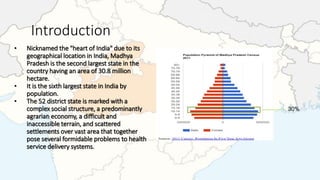
• Nicknamed the "heart of India" due to its
geographical location in India, Madhya
Pradesh is the second largest state in the
country having an area of 30.8 million
hectare.
• It is the sixth largest state in India by
population.
• The 52 district state is marked with a
complex social structure, a predominantly
agrarian economy, a difficult and
inaccessible terrain, and scattered
settlements over vast area that together
pose several formidable problems to health
service delivery systems.
What is MMR?
• As per World Health Organization, “”. Maternal death is the death of a
woman while pregnant or within 42 days of termination of pregnancy,
irrespective of the duration and site of the pregnancy, from any cause
related to or aggravated by the pregnancy or its management but not from
accidental or incidental causes
• Maternal Mortality Ratio (MMR): This is derived as the proportion of
maternal deaths per 1,00,000 live births, reported under the SRS.
• Maternal Mortality Rate: This is calculated as maternal deaths to women in
the ages 15-49 per lakh of women in that age group, reported under SRS.
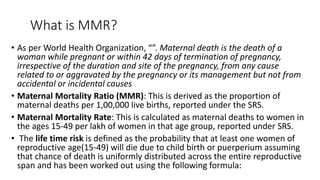
• The life time risk is defined as the probability that at least one women of
reproductive age(15-49) will die due to child birth or puerperium assuming
that chance of death is uniformly distributed across the entire reproductive
span and has been worked out using the following formula:
Maternal mortality and goals
• Improving maternal health is one
of the eight Millennium
Development Goals.
• The target 3.1 of Sustainable
Development Goals (SDG) set by
United Nations aims at reducing
the global maternal mortality ratio
to less than 70 per 100,000 live
births. (UNICEF)
• MP envisions achieving the goal of
reduction of MMR to 100 by 2017
as per the 12th five year plan
which remains unmet. (NHMMP)
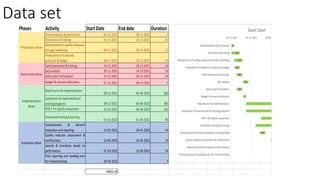
Phases Activity Start Date End date Duration
Disseminations & permissions 01-11-2021 08-11-2021 7
Orientation& training 01-11-2021 22-11-2021 21
Development of quality measures
throughmentoring 08-11-2021 29-11-2021 21
Finalizationof standards,
protocols & budget 08-11-2021 22-11-2021 14
Fieldassessment & training 14-11-2021 28-11-2021 14
Gapanalysis 30-11-2021 14-12-2021 14
Actionplanformulation 14-11-2021 28-11-2021 14
Budget & resource allocation 01-12-2021 08-12-2021 7
Rapidlaunch& implementation
08-12-2021 06-06-2022 180
Sustenance & improvement of
existingprograms 08-12-2021 06-06-2022 180
M& E for quality assuarance 15-01-2022 06-06-2022 142
Continuedtraining& learning
01-01-2022 01-04-2022 90
Achievements & demerit
evaluationandreporting 12-01-2022 26-01-2022 14
Quality indicator assessment &
certifications 10-02-2022 24-02-2022 14
Awards & Incentives based on
performance 01-03-2022 15-03-2022 14
Final reporting and handing over
for mainstreaming 20-04-2022 7
44501.00
Preparatory phase
Assessment phase
Implementation
phase
Evaluationphase
7
21
21
14
14
14
14
7
14
14
01-11-2021 21-12-2021 09-02-2022
Disseminations & permissions
Orientation &training
Developmentof quality measures through mentoring
Finalization of standards, protocols & budget
Field assessment& training
Gap analysis
Action plan formulation
Budget &resource allocation
Rapid launch & implementation
Sustenance & improvementof existingprograms
M & E for quality assuarance
Continued training& learning
Achievements &demeritevaluation and reporting
Quality indicator assessment &certifications
Awards & Incentives based on performance
Final reporting and handing overfor mainstreaming
Gantt Chart
Data set
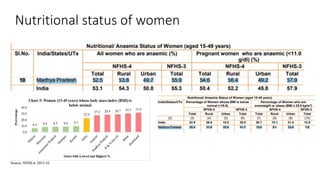
Nutritional status of women
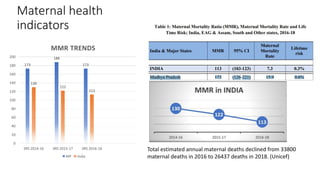
Maternal health
indicators
173
188
173
130
122
113
0
20
40
60
80
100
120
140
160
180
200
SRS 2014-16 SRS 2015-17 SRS 2016-18
MMR TRENDS
MP India
Total estimated annual maternal deaths declined from 33800
maternal deaths in 2016 to 26437 deaths in 2018. (Unicef)
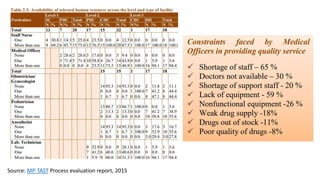
Source: MP-TAST Process evaluation report, 2015
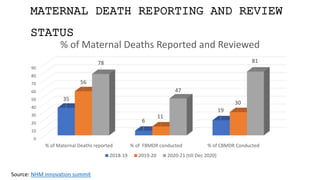
MATERNAL DEATH REPORTING AND REVIEW
STATUS
0
10
20
30
40
50
60
70
80
90
% of Maternal Deaths reported % of FBMDR conducted % of CBMDR Conducted
35
6
19
56
11
30
78
47
81
% of Maternal Deaths Reported and Reviewed
2018-19 2019-20 2020-21 (till Dec 2020)
Source: NHM innovation summit
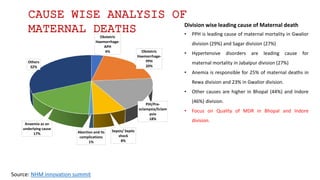
CAUSE WISE ANALYSIS OF
MATERNAL DEATHS
Obstetric
Haemorrhage-
APH
4% Obstetric
Haemorrhage-
PPH
20%
PIH/Pre-
eclampsia/Eclam
psia
18%
Sepsis/ Septic
shock
8%
Abortion and its
complications
1%
Anaemia as an
underlying cause
17%
Others
32%
Division wise leading cause of Maternal death
• PPH is leading cause of maternal mortality in Gwalior
division (29%) and Sagar division (27%)
• Hypertensive disorders are leading cause for
maternal mortality in Jabalpur division (27%)
• Anemia is responsible for 25% of maternal deaths in
Rewa division and 23% in Gwalior division.
• Other causes are higher in Bhopal (44%) and Indore
(46%) division.
• Focus on Quality of MDR in Bhopal and Indore
division.
Source: NHM innovation summit
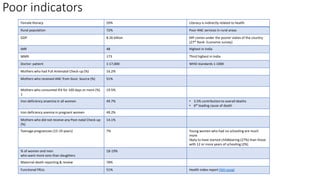
Poor indicators
Female literacy 59% Literacy is indirectly related to health
Rural population 72% Poor ANC services in rural areas
GDP 8.26 billion MP comes under the poorer states of the country
(27th Rank- Economic survey)
IMR 48 Highest in India
MMR 173 Third highest in India
Doctor: patient 1:17,000 WHO standards 1:1000
Mothers who had Full Antenatal Check-up (%) 16.2%
Mothers who received ANC from Govt. Source (%) 51%
Mothers who consumed IFA for 100 days or more (%)
1
19.5%
Iron deficiency anaemia in all women 49.7% • 3.5% contribution to overall deaths
• 6th leading cause of death
Iron deficiency anemia in pregnant women 49.2%
Mothers who did not receive any Post-natal Check-up
(%)
14.1%
Teenage pregnancies (15-19 years) 7% Young women who had no schooling are much
more
likely to have started childbearing (27%) than those
with 12 or more years of schooling (2%)
% of women and men
who want more sons than daughters
18-19%
Maternal death reporting & review 78%
Functional FRUs 51% Health index report (Niti ayog)
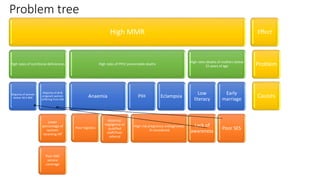
Problem tree
High MMR
High rates of nutritional deficiencies
Majority of women
below 18.5 BMI
Majority of all &
pregnant women
suffering from IDA
Lower
percentage of
women
receiving IAF
Poor ANC
service
coverage
High rates of PPH/ preventable deaths
Anaemia
High risk pregnancy undiagnosed/
ill-considered
Absence/
negligence of
qualified
staff/Poor
referral
Poor logistics
PIH Eclampsia
High rates deaths of mothers below
25 years of age
Low
literacy
Lack of
awareness
Early
marriage
Poor SES
Effect
Problem
Causes
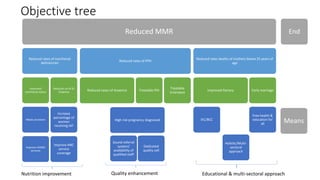
Objective tree
Reduced MMR
Reduced rates of nutritional
deficiencies
Improved
nutritional status
Meals provision
Improve VHSNC
services
Reduced no of ID
Anaemia
Increase
percentage of
women
receiving IAF
Improve ANC
service
coverage
Reduced rates of PPH
Reduced cases of Anaemia
High risk pregnancy diagnosed
Sound referral
system/
availability of
qualified staff
Dedicated
quality cell
Treatable PIH
Treatable
Eclampsia
Reduced rates deaths of mothers below 25 years of
age
Improved literacy
IEC/BCC
Holistic/Multi-
sectoral
approach
Early marriage
Free health &
education for
all
End
Means
Nutrition improvement Quality enhancement Educational & multi-sectoral approach
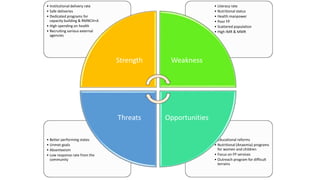
• Educational reforms
• Nutritional (Anaemia) programs
for women and children
• Focus on FP services
• Outreach program for difficult
terrains
• Better performing states
• Unmet goals
• Absenteeism
• Low response rate from the
community
• Literacy rate
• Nutritional status
• Health manpower
• Poor FP
• Scattered population
• High IMR & MMR
• Institutional delivery rate
• Safe deliveries
• Dedicated programs for
capacity building & RMNCH+A
• High spending on health
• Recruiting various external
agencies
Strength Weakness
Opportunities
Threats
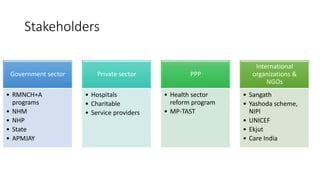
Stakeholders
Government sector
• RMNCH+A
programs
• NHM
• NHP
• State
• APMJAY
Private sector
• Hospitals
• Charitable
• Service providers
PPP
• Health sector
reform program
• MP-TAST
International
organizations &
NGOs
• Sangath
• Yashoda scheme,
NIPI
• UNICEF
• Ekjut
• Care India
NHM & maternal care
• Reduction of MMR has been the
priority agenda of the State Govt.
Madhya Pradesh is showing the steady
trend of decline in the MMR which is
evident from various survey data. The
MMR of MP was 227 in 2012-13 AHS
and with the constant decline in MMR,
it is now 173 as per NFHS-4.
• Under RMNCH+A, identification of 17
high priority districts (HPDs) which are
low performing in terms of process
indicators (HMIS) are the focus
districts in terms of HR, Infrastructure
for achieving overall improvement in
health indicators of MP.
• Analysis at State level has been done
and weak areas have been identified
for planning district specific
interventions for improving the
particular area as per RMNCH 5x5
matrix
• Mamata Abhiyan was launched in
April 2013, which shows a strong
political and programmatic
commitment for reduction of MMR.
• Phase- (11th April 2013) focused on
• strengthening of infrastructure,
• Human resource,
• Supportive services at facilities
• Drugs,
• Diet,
• Diagnostic,
• cleanliness and
• security.
• Phase-II (26 June 2014) to focus on:
• improving quality of services through
• supportive supervision,
• Generating awareness among the
community through IEC and BCC.
Maternal Health Major Interventions by NHM
• Operationalization of MCH centres as Delivery Points
• DAKSHATA abhiyan 2015: to empower providers for Improved MNH Care during Institutional
Deliveries (NHMMP
• Provision of Quality ANC/PNC Services along with identification of High Risk Cases
• Implementation of PPH (Prevention partum haemorrhage) programme for home delivery cases
• Improving reporting and review of maternal deaths through MDR Software
• Janani Shishu Suraksha Karyakram (JSSK)
• Janani Suraksha Yojana (JSY)
• RTI/STI & Safe Abortion (MTP)
• Blood Bank & Blood Storage
• Skill Lab. at SIHMC Gwalior, DH Bhopal, DH Rewa and RHWTC Indore
• Double Fortified Salt for BPL families to reduce anemia prevalence in all ages
• IFA Supplementation and distribution of Albendazol tablet in pregant women and women in
reproductive age group.
• Mass media campaign for promotion of Safe abortion services.
• Madhya Pradesh state of India with 173 maternal deaths on every 100,000
live births was among the states with highest MMR in the country.
• Some of the key reasons behind the high MMR in the state are:
• low literacy levels among population,
• Poor nutritional status of women
• Poor family planning services
• difficult geographic terrain in some parts of the state,
• inadequate availability and lower levels of utilization of emergency obstetric care
services along with
• lower levels of utilization of antenatal care, safe delivery and post natal care services.
• Inadequate availability of health infrastructure and resources (Madhya Pradesh has a
doctor for 16,996 people)
• huge economic inequity,
• gender disparities,
• societal norms and
• attitudes of community and service providers (might be related to low levels of
utilization of health care services in the state.
Planning phase
Problem statement
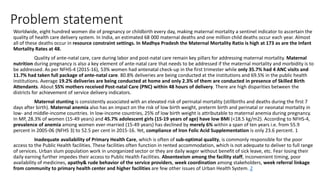
Worldwide, eight hundred women die of pregnancy or childbirth every day, making maternal mortality a sentinel indicator to ascertain the
quality of health care delivery system. In India, an estimated 68 000 maternal deaths and one million child deaths occur each year. Almost
all of these deaths occur in resource constraint settings. In Madhya Pradesh the Maternal Mortality Ratio is high at 173 as are the Infant
Mortality Rates at 48.
Quality of ante-natal care, care during labor and post-natal care remain key pillars for addressing maternal mortality. Maternal
nutrition during pregnancy is also a key element of ante-natal care that needs to be addressed if the maternal mortality and morbidity is to
be addressed. As per NFHS-4 (2015-16), 53% women had antenatal check-up in the first trimester while only 35.7% had 4 ANC visits and
11.7% had taken full package of ante-natal care. 80.8% deliveries are being conducted at the institutions and 69.5% in the public health
institutions. Average 19.2% deliveries are being conducted at home and only 2.3% of them are conducted in presence of Skilled Birth
Attendants. About 55% mothers received Post-natal Care (PNC) within 48 hours of delivery. There are high disparities between the
districts for achievement of service delivery indicators.
Maternal stunting is consistently associated with an elevated risk of perinatal mortality (stillbirths and deaths during the first 7
days after birth). Maternal anemia also has an impact on the risk of low birth weight, preterm birth and perinatal or neonatal mortality in
low- and middle-income countries. In low-income countries, 25% of low birth weight is attributable to maternal anemia during pregnancy.
In MP, 28.3% of women (15-49 years) and 45.7% adolescent girls (15-19 years of age) have low BMI (<18.5 kg/m2). According to NFHS-4,
prevalence of anemia among women ever-married (15-49 years) has declined by merely 6% within a span of ten years i.e. from 55.9
percent in 2005-06 (NFHS 3) to 52.5 per cent in 2015-16. Yet, compliance of Iron Folic Acid Supplementation is only 23.6 percent. 1
Inadequate availability of Primary Health Care, which is often of sub-optimal quality, is commonly responsible for the poor
access to the Public Health facilities. These facilities often function in rented accommodation, which is not adequate to deliver to full range
of services. Urban slum population work in unorganized sector or they are daily wager without benefit of sick leave, etc. Fear losing their
daily earning further impedes their access to Public Health Facilities. Absenteeism among the facility staff, inconvenient timing, poor
availability of medicines, apathy& rude behavior of the service providers, week coordination among stakeholders, week referral linkage
from community to primary health center and higher facilities are few other issues of Urban Health System. 2
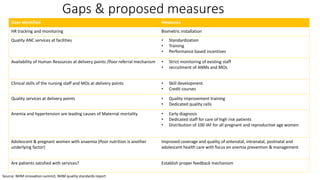
Gaps & proposed measures
Gaps identified Measures
HR tracking and monitoring Biometric installation
Quality ANC services at facilities • Standardization
• Training
• Performance based incentives
Availability of Human Resources at delivery points /Poor referral mechanism • Strict monitoring of existing staff
• recruitment of ANMs and MOs
Clinical skills of the nursing staff and MOs at delivery points • Skill development
• Credit courses
Quality services at delivery points • Quality improvement training
• Dedicated quality cells
Anemia and hypertension are leading causes of Maternal mortality • Early diagnosis
• Dedicated staff for care of high risk patients
• Distribution of 100 IAF for all pregnant and reproductive age women
Adolescent & pregnant women with anaemia (Poor nutrition is another
underlying factor)
Improved coverage and quality of antenatal, intranatal, postnatal and
adolescent health care with focus on anemia prevention & management
Are patients satisfied with services? Establish proper feedback mechanism
Source: NHM innovation summit, NHM quality standards report
7
21
21
14
14
14
14
7
180
180
142
90
14
14
14
7
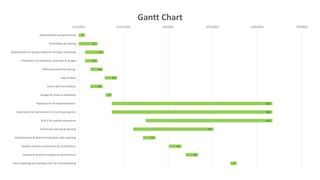
11/1/2021 12/21/2021 2/9/2022 3/31/2022 5/20/2022 7/9/2022
Disseminations & permissions
Orientation & training
Development of quality measures through mentoring
Finalization of standards, protocols & budget
Field assessment & training
Gap analysis
Action plan formulation
Budget & resource allocation
Rapid launch & implementation
Sustenance & improvement of existing programs
M & E for quality assuarance
Continued training & learning
Achievements & demerit evaluation and reporting
Quality indicator assessment & certifications
Awards & Incentives based on performance
Final reporting and handing over for mainstreaming
Gantt Chart
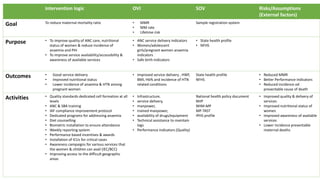
Log frame matrix
Intervention logic OVI SOV Risks/Assumptions
(External factors)
Goal To reduce maternal mortality ratio • MMR
• MM rate
• Lifetime risk
Sample registration system
Purpose • To improve quality of ANC care, nutritional
status of women & reduce incidence of
anaemia and PIH
• To improve service availability/accessibility &
awareness of available services
• ANC service delivery indicators
• Women/adolescent
girls/pregnant women anaemia
indicators
• Safe birth indicators
• State health profile
• NFHS
Outcomes • Good service delivery
• Improved nutritional status
• Lower incidence of anaemia & HTN among
pregnant women
• Improved service delivery , HWF,
BMI, Hb% and incidence of HTN
related conditions
State health profile
NFHS
• Reduced MMR
• Better Performance indicators
• Reduced incidence od
preventable cause of death
Activities • Quality standards dedicated cell formation at all
levels
• ANC & SBA training
• IAF compliance improvement protocol
• Dedicated programs for addressing anaemia
• Diet counselling
• Biometric installation to ensure attendance
• Weekly reporting system
• Performance based incentives & awards
• Installation of ICUs for critical cases
• Awareness campaigns for various services that
the women & children can avail (IEC/BCC)
• Improving access to the difficult geographic
areas
• Infrastructure,
• service delivery,
• manpower,
• trained manpower,
• availability of drugs/equipment
• Technical assistance to maintain
logs
• Performance indicators (Quality)
National health policy document
NHP
NHM-MP
MP-TAST
IPHS profile
• Improved quality & delivery of
services
• Improved nutritional status of
women
• Improved awareness of available
services
• Lower incidence preventable
maternal deaths
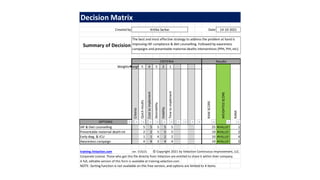
Decision matrix analysis
Created by
Weights
Weight 5 4 3 2 1
Criteria
Quick
results
Cost
to
implement
Desirability
Viability
Time
to
implement
RAW
SCORE
WEIGHTED
SCORE
RANK
OPTIONS Criteria
Quick results
Cost to implement
Desirability
Viability
Time to implement
0 0 0 0 RAW SCORE
WEIGHTED SCORE
RANK
IAF & Diet counselling 5 5 5 5 5 25 #VALUE! 1
Preventable maternal death int 2 2 5 5 5 19 #VALUE! 2
Early diag. & ICU 1 1 4 2 2 10 #VALUE! 4
Awareness campaign 4 4 3 4 4 19 #VALUE! 2
training.Velaction.com ver. 7/25/21 © Copyright 2021 by Velaction Continuous Improvement, LLC.
Corporate License. Those who got this file directly from Velaction are entitled to share it within their company.
A full, editable version of this form is available at training.velaction.com
NOTE: Sorting function is not available on this free version, and options are limited to 4 items.
CRITERIA
Decision Matrix
The best and most effective strategy to address the problem at hand is
improving IAF compliance & diet counselling. Followed by awareness
campaigns and preventable maternal deaths interventions (PPH, PIH, etc).
Summary of Decision
Date 14-10-2021
Results
Kritika Sarkar
References
• https://pib.gov.in/PressReleaseIframePage.aspx?PRID=1697441
• https://censusindia.gov.in/2011-Common/AHSurvey.html
• https://censusindia.gov.in/vital_statistics/SRS_Bulletins/MMR%20Bulletin%202016-18.pdf
• http://www.health.mp.gov.in/en
• https://pmjay.gov.in/sites/default/files/2021-01/Madhya-Pradesh-State-Health-Profile.pdf
• https://main.mohfw.gov.in/sites/default/files/HealthandFamilyWelfarestatisticsinIndia201920.pdf
• http://www.nhmmp.gov.in/RMNCH_MH_Background.aspx
• https://www.downtoearth.org.in/dte-infographics/61322-not_enough_doctors.html
• http://rchiips.org/nfhs/NFHS-4Reports/India.pdf
• http://www.nhmmp.gov.in/RMNCH_RKSK_Briefnote.aspx
• https://www.sams.co.in/Advertisement%20MHN%20consultant%20July-Dec%202018%20edited%20final.pdf
• https://www.researchgate.net/publication/228457745_Is_There_a_Doctor_in_the_House_Medical_Worker_Abse
nce_in_India
• https://nhm.gov.in/images/pdf/NUHM/Quality_Standards_for_Urban_Primary_Health_Centre.pdf
• http://rchiips.org/nfhs/NFHS-4Reports/MadhyaPradesh.pdf
Maternal Mortality in Madhya Pradesh Complete.pptx

Maternal Mortality in Madhya Pradesh Complete.pptx

  • 1.
    Maternal Mortality in MadhyaPradesh Guided by: Mr. Gaurav Kumar Submitted by: Dr Kritika Sarkar
  • 2.
    Situational analysis Maternal mortalityanalysis for Madhya Pradesh
  • 3.
    Introduction • Nicknamed the"heart of India" due to its geographical location in India, Madhya Pradesh is the second largest state in the country having an area of 30.8 million hectare. • It is the sixth largest state in India by population. • The 52 district state is marked with a complex social structure, a predominantly agrarian economy, a difficult and inaccessible terrain, and scattered settlements over vast area that together pose several formidable problems to health service delivery systems.
  • 4.
    What is MMR? •As per World Health Organization, “”. Maternal death is the death of a woman while pregnant or within 42 days of termination of pregnancy, irrespective of the duration and site of the pregnancy, from any cause related to or aggravated by the pregnancy or its management but not from accidental or incidental causes • Maternal Mortality Ratio (MMR): This is derived as the proportion of maternal deaths per 1,00,000 live births, reported under the SRS. • Maternal Mortality Rate: This is calculated as maternal deaths to women in the ages 15-49 per lakh of women in that age group, reported under SRS. • The life time risk is defined as the probability that at least one women of reproductive age(15-49) will die due to child birth or puerperium assuming that chance of death is uniformly distributed across the entire reproductive span and has been worked out using the following formula:
  • 5.
    Maternal mortality andgoals • Improving maternal health is one of the eight Millennium Development Goals. • The target 3.1 of Sustainable Development Goals (SDG) set by United Nations aims at reducing the global maternal mortality ratio to less than 70 per 100,000 live births. (UNICEF) • MP envisions achieving the goal of reduction of MMR to 100 by 2017 as per the 12th five year plan which remains unmet. (NHMMP)
  • 6.
    Phases Activity StartDate End date Duration Disseminations & permissions 01-11-2021 08-11-2021 7 Orientation& training 01-11-2021 22-11-2021 21 Development of quality measures throughmentoring 08-11-2021 29-11-2021 21 Finalizationof standards, protocols & budget 08-11-2021 22-11-2021 14 Fieldassessment & training 14-11-2021 28-11-2021 14 Gapanalysis 30-11-2021 14-12-2021 14 Actionplanformulation 14-11-2021 28-11-2021 14 Budget & resource allocation 01-12-2021 08-12-2021 7 Rapidlaunch& implementation 08-12-2021 06-06-2022 180 Sustenance & improvement of existingprograms 08-12-2021 06-06-2022 180 M& E for quality assuarance 15-01-2022 06-06-2022 142 Continuedtraining& learning 01-01-2022 01-04-2022 90 Achievements & demerit evaluationandreporting 12-01-2022 26-01-2022 14 Quality indicator assessment & certifications 10-02-2022 24-02-2022 14 Awards & Incentives based on performance 01-03-2022 15-03-2022 14 Final reporting and handing over for mainstreaming 20-04-2022 7 44501.00 Preparatory phase Assessment phase Implementation phase Evaluationphase 7 21 21 14 14 14 14 7 14 14 01-11-2021 21-12-2021 09-02-2022 Disseminations & permissions Orientation &training Developmentof quality measures through mentoring Finalization of standards, protocols & budget Field assessment& training Gap analysis Action plan formulation Budget &resource allocation Rapid launch & implementation Sustenance & improvementof existingprograms M & E for quality assuarance Continued training& learning Achievements &demeritevaluation and reporting Quality indicator assessment &certifications Awards & Incentives based on performance Final reporting and handing overfor mainstreaming Gantt Chart Data set
  • 7.
  • 8.
    Maternal health indicators 173 188 173 130 122 113 0 20 40 60 80 100 120 140 160 180 200 SRS 2014-16SRS 2015-17 SRS 2016-18 MMR TRENDS MP India Total estimated annual maternal deaths declined from 33800 maternal deaths in 2016 to 26437 deaths in 2018. (Unicef)
  • 9.
    Source: MP-TAST Processevaluation report, 2015
  • 10.
    MATERNAL DEATH REPORTINGAND REVIEW STATUS 0 10 20 30 40 50 60 70 80 90 % of Maternal Deaths reported % of FBMDR conducted % of CBMDR Conducted 35 6 19 56 11 30 78 47 81 % of Maternal Deaths Reported and Reviewed 2018-19 2019-20 2020-21 (till Dec 2020) Source: NHM innovation summit
  • 11.
    CAUSE WISE ANALYSISOF MATERNAL DEATHS Obstetric Haemorrhage- APH 4% Obstetric Haemorrhage- PPH 20% PIH/Pre- eclampsia/Eclam psia 18% Sepsis/ Septic shock 8% Abortion and its complications 1% Anaemia as an underlying cause 17% Others 32% Division wise leading cause of Maternal death • PPH is leading cause of maternal mortality in Gwalior division (29%) and Sagar division (27%) • Hypertensive disorders are leading cause for maternal mortality in Jabalpur division (27%) • Anemia is responsible for 25% of maternal deaths in Rewa division and 23% in Gwalior division. • Other causes are higher in Bhopal (44%) and Indore (46%) division. • Focus on Quality of MDR in Bhopal and Indore division. Source: NHM innovation summit
  • 12.
    Poor indicators Female literacy59% Literacy is indirectly related to health Rural population 72% Poor ANC services in rural areas GDP 8.26 billion MP comes under the poorer states of the country (27th Rank- Economic survey) IMR 48 Highest in India MMR 173 Third highest in India Doctor: patient 1:17,000 WHO standards 1:1000 Mothers who had Full Antenatal Check-up (%) 16.2% Mothers who received ANC from Govt. Source (%) 51% Mothers who consumed IFA for 100 days or more (%) 1 19.5% Iron deficiency anaemia in all women 49.7% • 3.5% contribution to overall deaths • 6th leading cause of death Iron deficiency anemia in pregnant women 49.2% Mothers who did not receive any Post-natal Check-up (%) 14.1% Teenage pregnancies (15-19 years) 7% Young women who had no schooling are much more likely to have started childbearing (27%) than those with 12 or more years of schooling (2%) % of women and men who want more sons than daughters 18-19% Maternal death reporting & review 78% Functional FRUs 51% Health index report (Niti ayog)
  • 13.
    Problem tree High MMR Highrates of nutritional deficiencies Majority of women below 18.5 BMI Majority of all & pregnant women suffering from IDA Lower percentage of women receiving IAF Poor ANC service coverage High rates of PPH/ preventable deaths Anaemia High risk pregnancy undiagnosed/ ill-considered Absence/ negligence of qualified staff/Poor referral Poor logistics PIH Eclampsia High rates deaths of mothers below 25 years of age Low literacy Lack of awareness Early marriage Poor SES Effect Problem Causes
  • 14.
    Objective tree Reduced MMR Reducedrates of nutritional deficiencies Improved nutritional status Meals provision Improve VHSNC services Reduced no of ID Anaemia Increase percentage of women receiving IAF Improve ANC service coverage Reduced rates of PPH Reduced cases of Anaemia High risk pregnancy diagnosed Sound referral system/ availability of qualified staff Dedicated quality cell Treatable PIH Treatable Eclampsia Reduced rates deaths of mothers below 25 years of age Improved literacy IEC/BCC Holistic/Multi- sectoral approach Early marriage Free health & education for all End Means Nutrition improvement Quality enhancement Educational & multi-sectoral approach
  • 16.
    • Educational reforms •Nutritional (Anaemia) programs for women and children • Focus on FP services • Outreach program for difficult terrains • Better performing states • Unmet goals • Absenteeism • Low response rate from the community • Literacy rate • Nutritional status • Health manpower • Poor FP • Scattered population • High IMR & MMR • Institutional delivery rate • Safe deliveries • Dedicated programs for capacity building & RMNCH+A • High spending on health • Recruiting various external agencies Strength Weakness Opportunities Threats
  • 17.
    Stakeholders Government sector • RMNCH+A programs •NHM • NHP • State • APMJAY Private sector • Hospitals • Charitable • Service providers PPP • Health sector reform program • MP-TAST International organizations & NGOs • Sangath • Yashoda scheme, NIPI • UNICEF • Ekjut • Care India
  • 18.
  • 19.
    • Reduction ofMMR has been the priority agenda of the State Govt. Madhya Pradesh is showing the steady trend of decline in the MMR which is evident from various survey data. The MMR of MP was 227 in 2012-13 AHS and with the constant decline in MMR, it is now 173 as per NFHS-4. • Under RMNCH+A, identification of 17 high priority districts (HPDs) which are low performing in terms of process indicators (HMIS) are the focus districts in terms of HR, Infrastructure for achieving overall improvement in health indicators of MP. • Analysis at State level has been done and weak areas have been identified for planning district specific interventions for improving the particular area as per RMNCH 5x5 matrix • Mamata Abhiyan was launched in April 2013, which shows a strong political and programmatic commitment for reduction of MMR. • Phase- (11th April 2013) focused on • strengthening of infrastructure, • Human resource, • Supportive services at facilities • Drugs, • Diet, • Diagnostic, • cleanliness and • security. • Phase-II (26 June 2014) to focus on: • improving quality of services through • supportive supervision, • Generating awareness among the community through IEC and BCC.
  • 20.
    Maternal Health MajorInterventions by NHM • Operationalization of MCH centres as Delivery Points • DAKSHATA abhiyan 2015: to empower providers for Improved MNH Care during Institutional Deliveries (NHMMP • Provision of Quality ANC/PNC Services along with identification of High Risk Cases • Implementation of PPH (Prevention partum haemorrhage) programme for home delivery cases • Improving reporting and review of maternal deaths through MDR Software • Janani Shishu Suraksha Karyakram (JSSK) • Janani Suraksha Yojana (JSY) • RTI/STI & Safe Abortion (MTP) • Blood Bank & Blood Storage • Skill Lab. at SIHMC Gwalior, DH Bhopal, DH Rewa and RHWTC Indore • Double Fortified Salt for BPL families to reduce anemia prevalence in all ages • IFA Supplementation and distribution of Albendazol tablet in pregant women and women in reproductive age group. • Mass media campaign for promotion of Safe abortion services.
  • 21.
    • Madhya Pradeshstate of India with 173 maternal deaths on every 100,000 live births was among the states with highest MMR in the country. • Some of the key reasons behind the high MMR in the state are: • low literacy levels among population, • Poor nutritional status of women • Poor family planning services • difficult geographic terrain in some parts of the state, • inadequate availability and lower levels of utilization of emergency obstetric care services along with • lower levels of utilization of antenatal care, safe delivery and post natal care services. • Inadequate availability of health infrastructure and resources (Madhya Pradesh has a doctor for 16,996 people) • huge economic inequity, • gender disparities, • societal norms and • attitudes of community and service providers (might be related to low levels of utilization of health care services in the state.
  • 22.
  • 23.
    Problem statement Worldwide, eighthundred women die of pregnancy or childbirth every day, making maternal mortality a sentinel indicator to ascertain the quality of health care delivery system. In India, an estimated 68 000 maternal deaths and one million child deaths occur each year. Almost all of these deaths occur in resource constraint settings. In Madhya Pradesh the Maternal Mortality Ratio is high at 173 as are the Infant Mortality Rates at 48. Quality of ante-natal care, care during labor and post-natal care remain key pillars for addressing maternal mortality. Maternal nutrition during pregnancy is also a key element of ante-natal care that needs to be addressed if the maternal mortality and morbidity is to be addressed. As per NFHS-4 (2015-16), 53% women had antenatal check-up in the first trimester while only 35.7% had 4 ANC visits and 11.7% had taken full package of ante-natal care. 80.8% deliveries are being conducted at the institutions and 69.5% in the public health institutions. Average 19.2% deliveries are being conducted at home and only 2.3% of them are conducted in presence of Skilled Birth Attendants. About 55% mothers received Post-natal Care (PNC) within 48 hours of delivery. There are high disparities between the districts for achievement of service delivery indicators. Maternal stunting is consistently associated with an elevated risk of perinatal mortality (stillbirths and deaths during the first 7 days after birth). Maternal anemia also has an impact on the risk of low birth weight, preterm birth and perinatal or neonatal mortality in low- and middle-income countries. In low-income countries, 25% of low birth weight is attributable to maternal anemia during pregnancy. In MP, 28.3% of women (15-49 years) and 45.7% adolescent girls (15-19 years of age) have low BMI (<18.5 kg/m2). According to NFHS-4, prevalence of anemia among women ever-married (15-49 years) has declined by merely 6% within a span of ten years i.e. from 55.9 percent in 2005-06 (NFHS 3) to 52.5 per cent in 2015-16. Yet, compliance of Iron Folic Acid Supplementation is only 23.6 percent. 1 Inadequate availability of Primary Health Care, which is often of sub-optimal quality, is commonly responsible for the poor access to the Public Health facilities. These facilities often function in rented accommodation, which is not adequate to deliver to full range of services. Urban slum population work in unorganized sector or they are daily wager without benefit of sick leave, etc. Fear losing their daily earning further impedes their access to Public Health Facilities. Absenteeism among the facility staff, inconvenient timing, poor availability of medicines, apathy& rude behavior of the service providers, week coordination among stakeholders, week referral linkage from community to primary health center and higher facilities are few other issues of Urban Health System. 2
  • 24.
    Gaps & proposedmeasures Gaps identified Measures HR tracking and monitoring Biometric installation Quality ANC services at facilities • Standardization • Training • Performance based incentives Availability of Human Resources at delivery points /Poor referral mechanism • Strict monitoring of existing staff • recruitment of ANMs and MOs Clinical skills of the nursing staff and MOs at delivery points • Skill development • Credit courses Quality services at delivery points • Quality improvement training • Dedicated quality cells Anemia and hypertension are leading causes of Maternal mortality • Early diagnosis • Dedicated staff for care of high risk patients • Distribution of 100 IAF for all pregnant and reproductive age women Adolescent & pregnant women with anaemia (Poor nutrition is another underlying factor) Improved coverage and quality of antenatal, intranatal, postnatal and adolescent health care with focus on anemia prevention & management Are patients satisfied with services? Establish proper feedback mechanism Source: NHM innovation summit, NHM quality standards report
  • 25.
    7 21 21 14 14 14 14 7 180 180 142 90 14 14 14 7 11/1/2021 12/21/2021 2/9/20223/31/2022 5/20/2022 7/9/2022 Disseminations & permissions Orientation & training Development of quality measures through mentoring Finalization of standards, protocols & budget Field assessment & training Gap analysis Action plan formulation Budget & resource allocation Rapid launch & implementation Sustenance & improvement of existing programs M & E for quality assuarance Continued training & learning Achievements & demerit evaluation and reporting Quality indicator assessment & certifications Awards & Incentives based on performance Final reporting and handing over for mainstreaming Gantt Chart
  • 26.
  • 27.
    Intervention logic OVISOV Risks/Assumptions (External factors) Goal To reduce maternal mortality ratio • MMR • MM rate • Lifetime risk Sample registration system Purpose • To improve quality of ANC care, nutritional status of women & reduce incidence of anaemia and PIH • To improve service availability/accessibility & awareness of available services • ANC service delivery indicators • Women/adolescent girls/pregnant women anaemia indicators • Safe birth indicators • State health profile • NFHS Outcomes • Good service delivery • Improved nutritional status • Lower incidence of anaemia & HTN among pregnant women • Improved service delivery , HWF, BMI, Hb% and incidence of HTN related conditions State health profile NFHS • Reduced MMR • Better Performance indicators • Reduced incidence od preventable cause of death Activities • Quality standards dedicated cell formation at all levels • ANC & SBA training • IAF compliance improvement protocol • Dedicated programs for addressing anaemia • Diet counselling • Biometric installation to ensure attendance • Weekly reporting system • Performance based incentives & awards • Installation of ICUs for critical cases • Awareness campaigns for various services that the women & children can avail (IEC/BCC) • Improving access to the difficult geographic areas • Infrastructure, • service delivery, • manpower, • trained manpower, • availability of drugs/equipment • Technical assistance to maintain logs • Performance indicators (Quality) National health policy document NHP NHM-MP MP-TAST IPHS profile • Improved quality & delivery of services • Improved nutritional status of women • Improved awareness of available services • Lower incidence preventable maternal deaths
  • 28.
  • 29.
    Created by Weights Weight 54 3 2 1 Criteria Quick results Cost to implement Desirability Viability Time to implement RAW SCORE WEIGHTED SCORE RANK OPTIONS Criteria Quick results Cost to implement Desirability Viability Time to implement 0 0 0 0 RAW SCORE WEIGHTED SCORE RANK IAF & Diet counselling 5 5 5 5 5 25 #VALUE! 1 Preventable maternal death int 2 2 5 5 5 19 #VALUE! 2 Early diag. & ICU 1 1 4 2 2 10 #VALUE! 4 Awareness campaign 4 4 3 4 4 19 #VALUE! 2 training.Velaction.com ver. 7/25/21 © Copyright 2021 by Velaction Continuous Improvement, LLC. Corporate License. Those who got this file directly from Velaction are entitled to share it within their company. A full, editable version of this form is available at training.velaction.com NOTE: Sorting function is not available on this free version, and options are limited to 4 items. CRITERIA Decision Matrix The best and most effective strategy to address the problem at hand is improving IAF compliance & diet counselling. Followed by awareness campaigns and preventable maternal deaths interventions (PPH, PIH, etc). Summary of Decision Date 14-10-2021 Results Kritika Sarkar
  • 30.
    References • https://pib.gov.in/PressReleaseIframePage.aspx?PRID=1697441 • https://censusindia.gov.in/2011-Common/AHSurvey.html •https://censusindia.gov.in/vital_statistics/SRS_Bulletins/MMR%20Bulletin%202016-18.pdf • http://www.health.mp.gov.in/en • https://pmjay.gov.in/sites/default/files/2021-01/Madhya-Pradesh-State-Health-Profile.pdf • https://main.mohfw.gov.in/sites/default/files/HealthandFamilyWelfarestatisticsinIndia201920.pdf • http://www.nhmmp.gov.in/RMNCH_MH_Background.aspx • https://www.downtoearth.org.in/dte-infographics/61322-not_enough_doctors.html • http://rchiips.org/nfhs/NFHS-4Reports/India.pdf • http://www.nhmmp.gov.in/RMNCH_RKSK_Briefnote.aspx • https://www.sams.co.in/Advertisement%20MHN%20consultant%20July-Dec%202018%20edited%20final.pdf • https://www.researchgate.net/publication/228457745_Is_There_a_Doctor_in_the_House_Medical_Worker_Abse nce_in_India • https://nhm.gov.in/images/pdf/NUHM/Quality_Standards_for_Urban_Primary_Health_Centre.pdf • http://rchiips.org/nfhs/NFHS-4Reports/MadhyaPradesh.pdf

Editor's Notes

  • #4 Sources: Census 2011, State health profile (NHA)- for APMJAY
  • #7 State health profile (NHA)- for APMJAY