 Introduction
 Pre-operative analysis
 bite force
 oral habits
 compatibility of materials
 Force
 Force acting on the stomatognathic system
 Normal biting force
 Direction of displacement
 Stress
 types of stress
 Mechanical properties of materials
 Biomechanics for restorative dentistry
 Stress transfer
 Tooth flexure
• stress patterns on teeth
• anterior teeth
• posterior teeth
• Weak areas of teeth
• Applied mechanical properties of teeth
• The vale experiment
• Obtaining resistance form for tooth structure
• Occlusal considerations in restoring teeth
• posterior restoration
• anterior restoration
• Occlusal loading and its effect
• Role of contact areas
• Marginal ridges –mechanical function
• Relation between tooth wear & restorative material
• Forces on
• intracoronal restorations
• extracoronal restorations
• CONCLUSION
Introduction
• All structural analysis and design require knowledge of the
forces that will be applied and the mechanical properties of the
materials that must withstand these forces.
• Most restorative materials must withstand forces in service
either during mastication or fabrication.
• The mechanical properties, quantities of force, stress, strain,
strength hardness, and others can help identify the properties of
a material.
• In many respects designing a structure for the oral
environment is among the most demanding as the
functional and para functional loads that must be
accommodated and the aesthetic and space limitations
makes the designing complicated.
• When we design a structure we try to predict the
stress that will develop in the structure under the
anticipated applied loads.
Pre-clinical Analysis
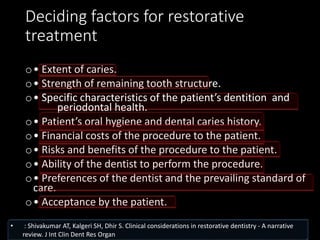
Deciding factors for restorative
treatment
o• Extent of caries.
o• Strength of remaining tooth structure.
o• Specific characteristics of the patient’s dentition and
periodontal health.
o• Patient’s oral hygiene and dental caries history.
o• Financial costs of the procedure to the patient.
o• Risks and benefits of the procedure to the patient.
o• Ability of the dentist to perform the procedure.
o• Preferences of the dentist and the prevailing standard of
care.
o• Acceptance by the patient.
• : Shivakumar AT, Kalgeri SH, Dhir S. Clinical considerations in restorative dentistry - A narrative
review. J Int Clin Dent Res Organ
Trauma from occlusion
• When occlusal forces
exceed the adaptive
capacity of the tissues,
tissue injury occurs,
mainly periodontium.
Occlusal trauma
• Synonym
• Also called traumatism.
(Carranza)
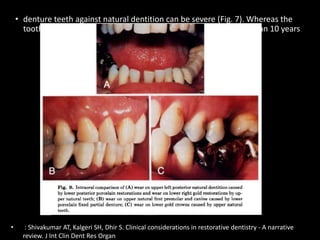
• denture teeth against natural dentition can be severe (Fig. 7). Whereas the
tooth structure loss opposing the complete denture took more than 10 years
• : Shivakumar AT, Kalgeri SH, Dhir S. Clinical considerations in restorative dentistry - A narrative
review. J Int Clin Dent Res Organ
• The general concept of force is gained through the
muscular action of pushing or pulling of an object
• A force always has a direction and the direction is
often characteristic of the type of force.
• If the body to which the force is applied remains at
rest, the force causes the body to deform.
• Units of force are the pound or the kilogram or
Newton.
FORCE
IN STOMATOGNATHIC
SYSTEM
FORCE = MASS OF MANDIBLE x ACCELERATION OF CLOSURE
Four major components that influence the force are ;
1. MUSCLES OF MASTICATION
2. CRANIOMANDIBULAR LIGAMENTS
3. T.M.J
4. TEETH
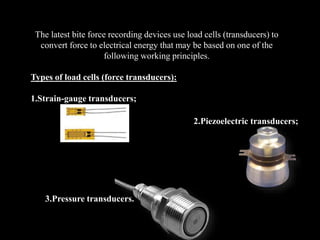
The latest bite force recording devices use load cells (transducers) to
convert force to electrical energy that may be based on one of the
following working principles.
Types of load cells (force transducers):
1.Strain-gauge transducers;
2.Piezoelectric transducers;
3.Pressure transducers.
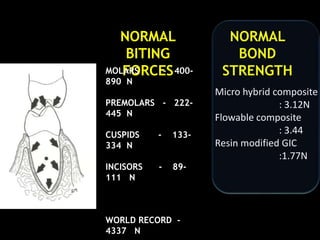
NORMAL
BITING
FORCESMOLARS - 400-
890 N
PREMOLARS - 222-
445 N
CUSPIDS - 133-
334 N
INCISORS - 89-
111 N
WORLD RECORD -
4337 N
NORMAL
BOND
STRENGTH
Micro hybrid composite
: 3.12N
Flowable composite
: 3.44
Resin modified GIC
:1.77N
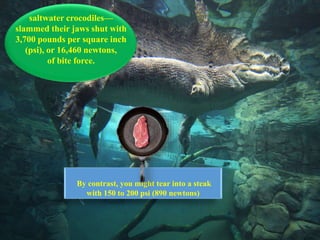
saltwater crocodiles—
slammed their jaws shut with
3,700 pounds per square inch
(psi), or 16,460 newtons,
of bite force.
By contrast, you might tear into a steak
with 150 to 200 psi (890 newtons)
Force acting on the teeth
• These forces vary in magnitude, duration,
frequency and direction.
• The responses by the teeth to the forces depend on
factors such as,
• shape and length of the roots,
• the characteristics of the fluid content of the
periodontal space
• the composition and orientation of the periodontal
fibres
• the extent of the alveolar bone
• The responses by the teeth will also depend on
• the consistency of the bolus being chewed and
• the muscular forces being used to crush it.
• This will also apply to parafunctional clenching and
chewing with or without a foreign body between
the teeth.
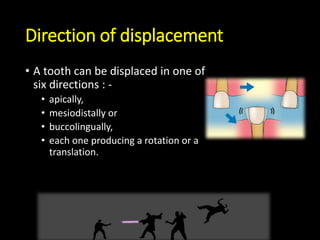
Direction of displacement
• A tooth can be displaced in one of
six directions : -
• apically,
• mesiodistally or
• buccolingually,
• each one producing a rotation or a
translation.
• The result is likely to be a combination of all
directions leading to an omnidirectional
movement.
• The same principle of movement will apply to the
opposing tooth involved.
• These omnidirectional tilting and rotations of teeth
will reach a limit when an equal and opposite
resistance is reached and the periodontal receptors
cause a reflex arrest of the muscle force.
• When the force is removed, the teeth will recover
their positions due to the elastic recovery of the
compressed periodontal tissues. This is referred to
as “replacement” of the teeth.
This phenomenon may be modified by 3 factors ;
• Alveolar bone support
• Adjacent teeth support
• Horizontal muscle activity on both buccal and
lingual surfaces of the teeth.
• These 3 variable factors may lead to an
unidirectional movement of a tooth or teeth when
they will become repositioned.
• Teeth will continue to move unidirectionally until
positions of stability are reached. The opposing
forces are then equal to the moving forces.
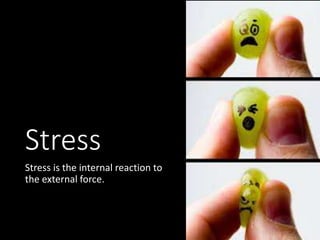
Stress
Stress is the internal reaction to
the external force.
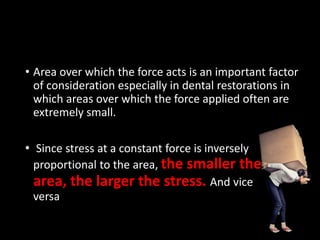
• Area over which the force acts is an important factor
of consideration especially in dental restorations in
which areas over which the force applied often are
extremely small.
•• Since stress at a constant force is inversely
proportional to the area, the smaller the
area, the larger the stress. And vice
versa
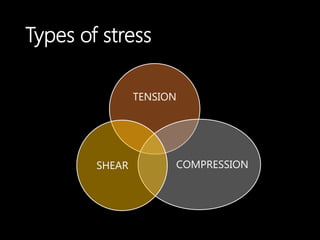
Types of stress
TENSION
COMPRESSIONSHEAR
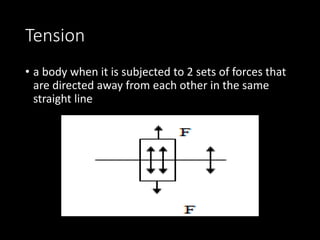
Tension
• a body when it is subjected to 2 sets of forces that
are directed away from each other in the same
straight line
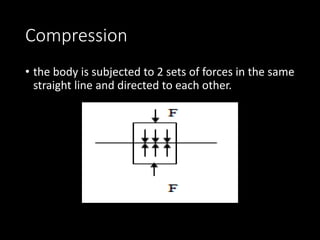
Compression
• the body is subjected to 2 sets of forces in the same
straight line and directed to each other.
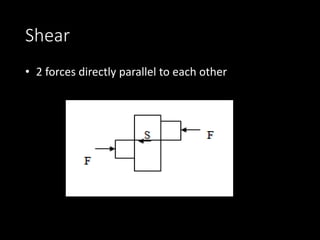
Shear
• 2 forces directly parallel to each other
Complex Stresses :
• Whenever force is applied over a body, complex of
multiple stresses are produced.
• They may be a combination of tensile, shear or
compressive stress. These multiple stresses are
called complex stresses.
MECHANICAL PROPERTIES
OF MATERIALS
The mechanical properties of a material describe its response
to loading.
• During loading, bonds are generally not
compressed as easily as they are stretched.
• Therefore, materials resist compression more
readily and are said to be stronger in compression
than in tension.
• Materials have different properties under different
directions of loading.
• “It is important to determine what the clinical
direction of loading is before assessing the
mechanical property of interest”.
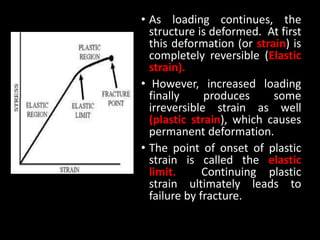
• As loading continues, the
structure is deformed. At first
this deformation (or strain) is
completely reversible (Elastic
strain).
• However, increased loading
finally produces some
irreversible strain as well
(plastic strain), which causes
permanent deformation.
• The point of onset of plastic
strain is called the elastic
limit. Continuing plastic
strain ultimately leads to
failure by fracture.
• Two of the most useful mechanical properties are the
modulus of elasticity and elastic limit.
• A restorative material generally should be very stiff so
that under load, its elastic deformation will be extremely
small.
• An exception is Class V composite which should be
less stiff to accommodate tooth flexure
BIOMECHANICS FOR
RESTORATIVE DENTISTRY
• Teeth are subjected to many forces during normal
use.
The interactions between the applied forces,
the shape and structure of teeth,
the supporting structures, and
the mechanical properties of tooth components
and restorative materials
-are all included in the subject of biomechanics
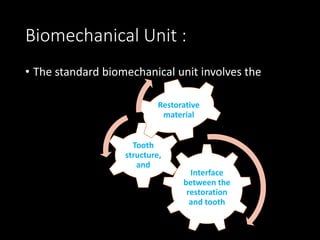
Biomechanical Unit :
• The standard biomechanical unit involves the
Interface
between the
restoration
and tooth
Tooth
structure,
and
Restorative
material
• The importance of considering three structures in
the biomechanical unit is to detect stresses that
may cause unwanted fractures or debonding. The
restorative material may be strong enough to resist
fracture, but the interface or tooth structure may
not be.
STRESS TRANSFER :
• Normal tooth structure transfers external biting
loads through enamel into dentin as compression.
• The concentrated external loads are distributed
over a large internal volume of tooth structure and
the local stresses are lower.
• During this process a small amount of dentin
deformation may occur which results in tooth
flexure .
A restored tooth tends to transfer stress differently
than an intact tooth.
Any force on the restoration produces
compression, tension, or shear along the tooth
restoration interface. Once enamel is no longer
continuous, its resistance is much lower.
Therefore, most restorations are designed to
distribute stresses onto sound dentin, rather than
to enamel.
• The process of stress transfer to dentin becomes
more complicated when the amount of remaining
dentin is thin and the restoration must bridge a
significant distance to seat onto thicker dentin
(Liners or bases).
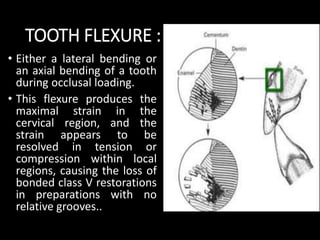
TOOTH FLEXURE :
• Either a lateral bending or
an axial bending of a tooth
during occlusal loading.
• This flexure produces the
maximal strain in the
cervical region, and the
strain appears to be
resolved in tension or
compression within local
regions, causing the loss of
bonded class V restorations
in preparations with no
relative grooves..
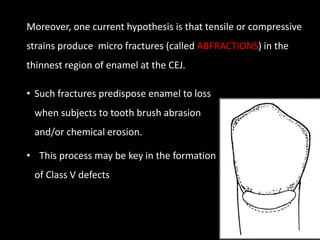
• Such fractures predispose enamel to loss
when subjects to tooth brush abrasion
and/or chemical erosion.
• This process may be key in the formation
of Class V defects
Moreover, one current hypothesis is that tensile or compressive
strains produce micro fractures (called ABFRACTIONS) in the
thinnest region of enamel at the CEJ.
STRESS PATTERNS OF
TEETH
Every tooth has its own stress pattern, and every
location on a tooth has special stress patterns.
Recognizing them is vital prior to designing a
restoration without failure potential
IN ANTERIOR TEETH
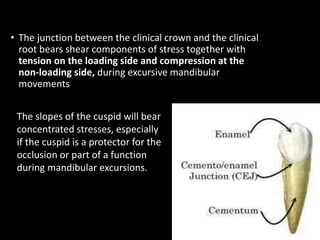
• The junction between the clinical crown and the clinical
root bears shear components of stress together with
tension on the loading side and compression at the
non-loading side, during excursive mandibular
movements
The slopes of the cuspid will bear
concentrated stresses, especially
if the cuspid is a protector for the
occlusion or part of a function
during mandibular excursions.
• The axial angles and lingual marginal ridges will
bear concentrated shear stresses.
• The distal surface of a cuspid exhibits a unique
stress pattern as a result of the anterior
components of force concentrating compressive
loading at the junction of the anterior and posterior
segments of the dental arch and microlateral
displacement of the cuspid during excursive
movements.
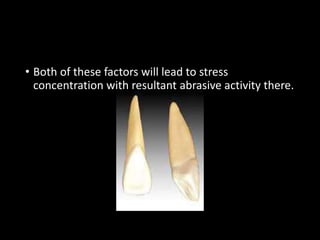
• Both of these factors will lead to stress
concentration with resultant abrasive activity there.
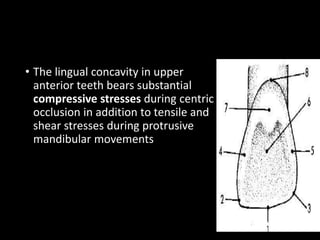
• The lingual concavity in upper
anterior teeth bears substantial
compressive stresses during centric
occlusion in addition to tensile and
shear stresses during protrusive
mandibular movements
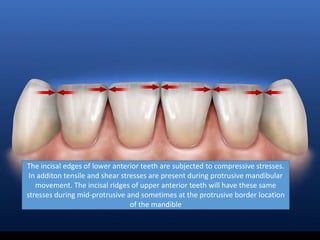
The incisal edges of lower anterior teeth are subjected to compressive stresses.
In additon tensile and shear stresses are present during protrusive mandibular
movement. The incisal ridges of upper anterior teeth will have these same
stresses during mid-protrusive and sometimes at the protrusive border location
of the mandible
In POSTERIOR TEETH
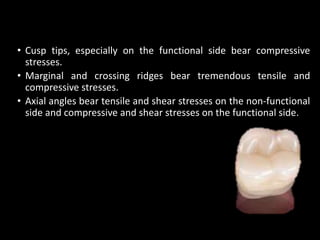
• Cusp tips, especially on the functional side bear compressive
stresses.
• Marginal and crossing ridges bear tremendous tensile and
compressive stresses.
• Axial angles bear tensile and shear stresses on the non-functional
side and compressive and shear stresses on the functional side.
• Any occlusal, facial or lingual concavity will exhibit
compressive stress concentration.
• Especially if it has an opposing cuspal element in
static or functional occlusal contact with it .
WEAK AREAS IN THE TOOTH SHOULD
BE IDENTIFIED AND RECOGNIZED
BEFORE ANY RESTORATIVE ATTEMPT,
in order to avoid destructive loading
They are,
a) Bi and trifurcation.
b) Cementum should be eliminated as a component of a
cavity wall. The junction between the cementum and
the dentin is always irregular so the dentin surface
should be smoothed flat after cementum removal
c) Thin dentin bridges in deep cavity preparation.
d) Subpulpal floors in RCT treated teeth. Any stress
concentation there may split the tooth interceptally.
e) Cracks or crazing in enamel, and / or dentin both
should be treated passively in any restoration design.
They may act as shear lines leading to further spread
SOME APPLIED
MECHANICAL PROPERTIES
OF TEETH:
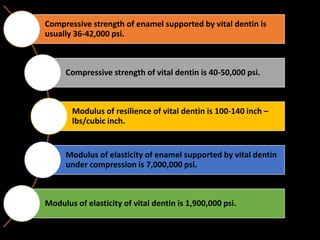
Compressive strength of enamel supported by vital dentin is
usually 36-42,000 psi.
Compressive strength of vital dentin is 40-50,000 psi.
Modulus of resilience of vital dentin is 100-140 inch –
lbs/cubic inch.
Modulus of elasticity of enamel supported by vital dentin
under compression is 7,000,000 psi.
Modulus of elasticity of vital dentin is 1,900,000 psi.
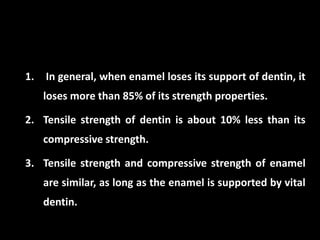
1. In general, when enamel loses its support of dentin, it
loses more than 85% of its strength properties.
2. Tensile strength of dentin is about 10% less than its
compressive strength.
3. Tensile strength and compressive strength of enamel
are similar, as long as the enamel is supported by vital
dentin.
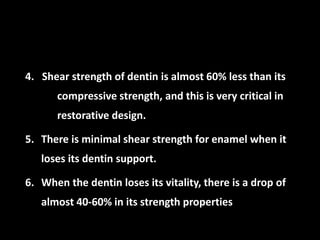
4. Shear strength of dentin is almost 60% less than its
compressive strength, and this is very critical in
restorative design.
5. There is minimal shear strength for enamel when it
loses its dentin support.
6. When the dentin loses its vitality, there is a drop of
almost 40-60% in its strength properties
OBTAINING RESISTANCE
FORM FOR TOOTH
STRUCTURES
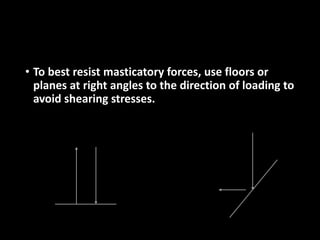
• To best resist masticatory forces, use floors or
planes at right angles to the direction of loading to
avoid shearing stresses.
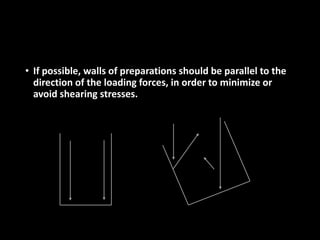
• If possible, walls of preparations should be parallel to the
direction of the loading forces, in order to minimize or
avoid shearing stresses.
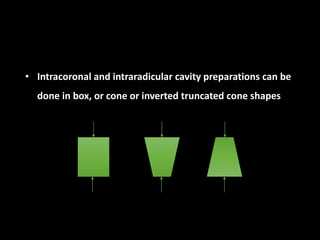
• Intracoronal and intraradicular cavity preparations can be
done in box, or cone or inverted truncated cone shapes
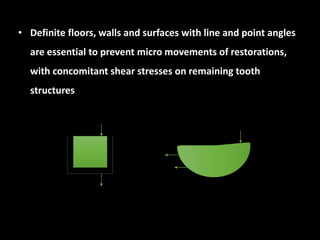
• Definite floors, walls and surfaces with line and point angles
are essential to prevent micro movements of restorations,
with concomitant shear stresses on remaining tooth
structures
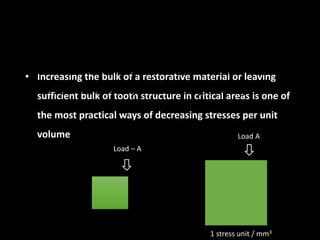
• Increasing the bulk of a restorative material or leaving
sufficient bulk of tooth structure in critical areas is one of
the most practical ways of decreasing stresses per unit
volume
• Increasing the bulk of a restorative material or leaving
sufficient bulk of tooth structure in critical areas is one of
the most practical ways of decreasing stresses per unit
volume
Load – A
Load A
1 stress unit / mm3
• Designing the outline form with minimal exposure
of the restoration surface to occlusal loading will
definitely minimize stresses and the possibility of
mechanical fracture in the restoration
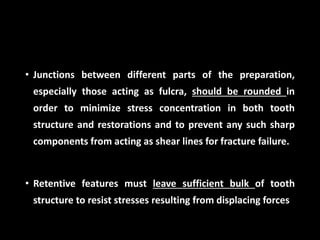
• Junctions between different parts of the preparation,
especially those acting as fulcra, should be rounded in
order to minimize stress concentration in both tooth
structure and restorations and to prevent any such sharp
components from acting as shear lines for fracture failure.
• Retentive features must leave sufficient bulk of tooth
structure to resist stresses resulting from displacing forces
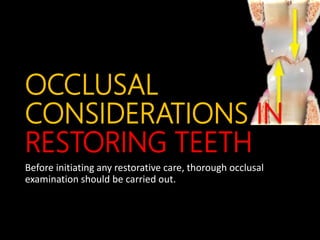
OCCLUSAL
CONSIDERATIONS IN
RESTORING TEETH
Before initiating any restorative care, thorough occlusal
examination should be carried out.
The way we occlude teeth affects the
periodontium, the temporomandibular joints,
throat muscles, tongue, cheeks, lips, nerves .
A clinician must have adequate knowledge about
the principles of occlusion, which enables him to
diagnose cases that need modifications /
alteration of occlusion with or without the use of
various restorative materials
• The kind of occlusion, a patient should have, must be
justified by the principles of physiology.
• The occlusion affects almost every part of
stomatognathic system, mainly :
1) The pulp of the tooth is a very sensitive organ. IT reacts
immediately to abnormal occlusal forces. Hence, occlusion
should not be detrimental to pulp.
2) The proximal relations of the occlusion should prevent food
impaction between teeth.
3) The cusp-fossa relationship should be such that the adequate
forces exerted during functional movement, aids in optimum
health of the periodontium.
OCCLUSAL
CONSIDERATIONS IN
RESTORING TEETH
ANTERIOR RESTORATIONS :
The resin composites and the glass ionomer
cements are mainly used in anterior
restorations.
Though these teeth do not come under direct
occlusion, however, they do take part in
various movements of the mandible.
The restoration should be carved and finished, maintaining the
contacts and the cervical curvature of these restorations. The lingual
area is carved to maintain the anatomy of cingulum and the lingual
marginal ridges.
Patient is asked to protrude and the
interferences are checked and removed
OCCLUSAL
CONSIDERATIONS IN
RESTORING TEETH
POSTERIOR RESTORATIONS :
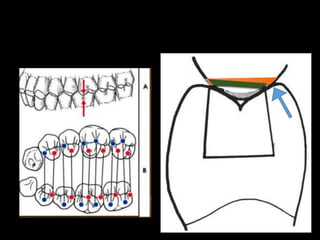
Use articulating paper to register THE CENTRIC HOLDING SPOTS
and excursive contacts so that these marked areas can either be
excluded form the outline form or properly restored.
Prior to cutting a tooth, its opposing occlusal surface should be
examined. Malpositioned opposing supporting cusps and ridges
should be recontoured in order to achieve optimal occlusal
contacts in the restored tooth.
All posterior restorations should be planned keeping in mind
the basic principles of occlusion.
Plunger cusps and over erupted teeth should be reduced,
removing all the cuspal interference’s so as to improve the
plane of occlusion and decrease the chances of fracture of
new restoration as a result of occlusal forces.
When carving for occlusion, attempt to establish stable
centric contacts of cusps with opposing surfaces that are
perpendicular to occlusal forces should be made.
Occlusal contacts located on a cuspal incline or ridge slope are
undesirable because these create a deflective force on the tooth
and hence should be adjusted until the resulting contact is stable.
Occlusal Loading and
Its Effect
• During centric and excursive movements of the
mandible both restoration and the tooth structure
are periodically loaded both separately and jointly.
• This brings about different stresses patterns
depending on the actual morphology of the
occluding area of the both the tooth in question
and opposing contacting cuspal elements.
• For the purpose of this discussion, one can classify
these loading situations and their induced stress
patterns in the following way
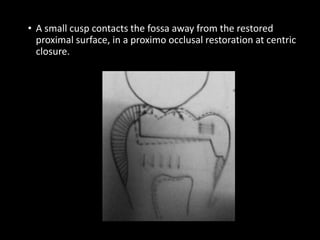
• A small cusp contacts the fossa away from the restored
proximal surface, in a proximo occlusal restoration at centric
closure.
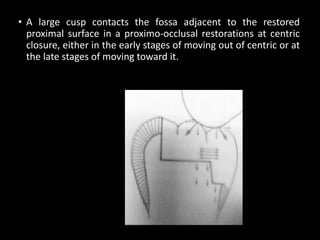
• A large cusp contacts the fossa adjacent to the restored
proximal surface in a proximo-occlusal restorations at centric
closure, either in the early stages of moving out of centric or at
the late stages of moving toward it.
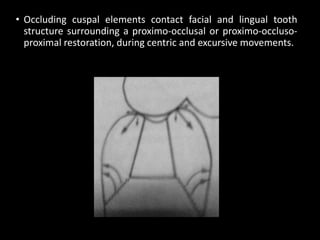
• Occluding cuspal elements contact facial and lingual tooth
structure surrounding a proximo-occlusal or proximo-occluso-
proximal restoration, during centric and excursive movements.
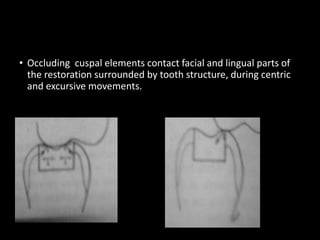
• Occluding cuspal elements contact facial and lingual parts of
the restoration surrounded by tooth structure, during centric
and excursive movements.
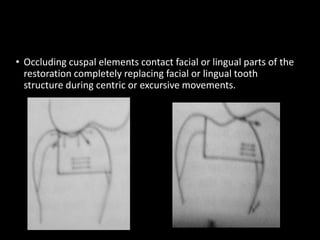
• Occluding cuspal elements contact facial or lingual parts of the
restoration completely replacing facial or lingual tooth
structure during centric or excursive movements.
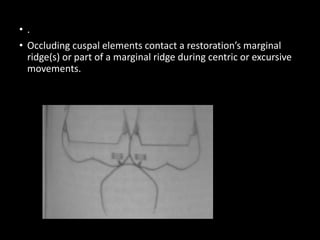
• .
• Occluding cuspal elements contact a restoration’s marginal
ridge(s) or part of a marginal ridge during centric or excursive
movements.
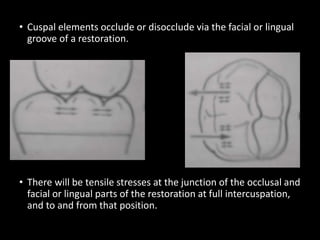
• Cuspal elements occlude or disocclude via the facial or lingual
groove of a restoration.
• There will be tensile stresses at the junction of the occlusal and
facial or lingual parts of the restoration at full intercuspation,
and to and from that position.
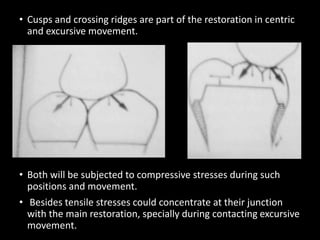
• Cusps and crossing ridges are part of the restoration in centric
and excursive movement.
• Both will be subjected to compressive stresses during such
positions and movement.
• Besides tensile stresses could concentrate at their junction
with the main restoration, specially during contacting excursive
movement.
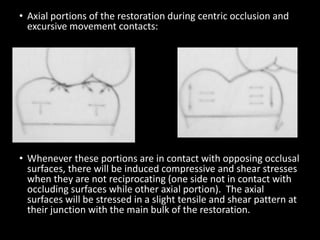
• Axial portions of the restoration during centric occlusion and
excursive movement contacts:
• Whenever these portions are in contact with opposing occlusal
surfaces, there will be induced compressive and shear stresses
when they are not reciprocating (one side not in contact with
occluding surfaces while other axial portion). The axial
surfaces will be stressed in a slight tensile and shear pattern at
their junction with the main bulk of the restoration.
• Restoration is not in occluding contact or is in
premature contact during centric occlusion or
excursive movement of the mandible.
The first situation is not conducive to function, insofar as the
restoration will not be involved with direct loading from the
opposing occluding teeth.
After a period of time, however, the tooth will supra erupt, rotate,
and/or tilt, establishing contact with the opposing cuspal
elements.
Usually, this newly acquired location will not be the most favorable
position for the restoration, tooth, or the remainder of the gnatho
stomatic system, either mechanically or biologically
Role of Contact Areas :
Good restorative dental procedures must reproduce the
proper contact areas. Restorations with contact areas which
are flat, open, improperly placed, rough or poorly polished
will lead to failure.
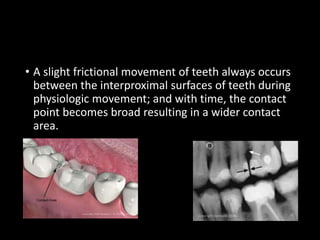
• A slight frictional movement of teeth always occurs
between the interproximal surfaces of teeth during
physiologic movement; and with time, the contact
point becomes broad resulting in a wider contact
area.
• IF the teeth remained in contact with each other
merely by contact points, they would eventually be
forced out of the dental arch in either a buccal or
lingual direction.
• Whereas with a wider contact between teeth, this is
not likely to occur. The opposing interproximal surfaces
of restorations must be hard in order not to flow,
flatten, wear or become abraded with use.
Relationship between
tooth wear and
restorative materials :
Occlusal forces lead to wear of enamel. The wear is, however,
very slow if occlusal forces are appropriately transmitted to
underlying bony tissues
• The pattern of wear varies individually.
• Non-uniform wear of opposing teeth is quite common
when one tooth is restored with a restorative material
whose wear resistance is different as compared to that
of enamel.
• Differential wear can result in localization of occlusal
loads with subsequent failure of restorative materials
or development of deflective contacts with mandibular
repositioning and an effect on a distant tooth.
Hypothetically, if two restorative
materials, which wear at a slower
rate than the natural teeth, are
placed so as to oppose each other in
a dentition undergoing wear, the
restorations will produce occlusal
interferences at a later stage.
Non-wearing materials opposing each
other can lead to natural teeth wear
during contact in lateral and protrusive
movements.
Conversely, if the materials wear
faster than the teeth, the opposing
cusp might over erupt into the
worn material.
IN lateral excursion, this cusp might
then come in contact with an
opposing cusp and if weakened by
previous caries can lead to fracture.
Mn
MECHANICAL FUNCTIONS OF THE
MARGINAL RIDGES
The marginal ridges play an important role in withstanding
and dissipating the occlusal stresses
Role of Marginal Ridges :
• The correct form of marginal ridge compatible with
the adjacent tooth and also with its own
surrounding is important during carving of
posterior restorations.
• The absence of marginal ridge, or marginal ridge
with improper height can lead to altered dissipation
of forces subsequently damaging the underlying
periodontium.
• A marginal ridge should always be formed in two
planes bucco-lingually , meeting at a very obtuse
angle.
• This feature is essential when opposing functional
cusp occludes with the marginal ridge.
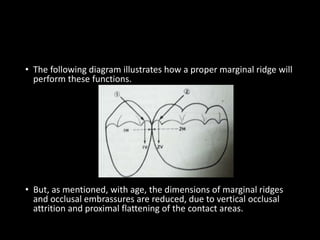
• The following diagram illustrates how a proper marginal ridge will
perform these functions.
• But, as mentioned, with age, the dimensions of marginal ridges
and occlusal embrassures are reduced, due to vertical occlusal
attrition and proximal flattening of the contact areas.
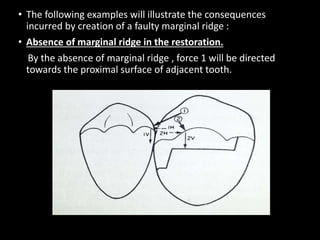
• The following examples will illustrate the consequences
incurred by creation of a faulty marginal ridge :
• Absence of marginal ridge in the restoration.
By the absence of marginal ridge , force 1 will be directed
towards the proximal surface of adjacent tooth.
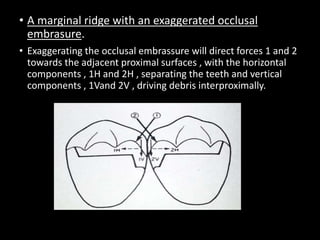
• A marginal ridge with an exaggerated occlusal
embrasure.
• Exaggerating the occlusal embrassure will direct forces 1 and 2
towards the adjacent proximal surfaces , with the horizontal
components , 1H and 2H , separating the teeth and vertical
components , 1Vand 2V , driving debris interproximally.
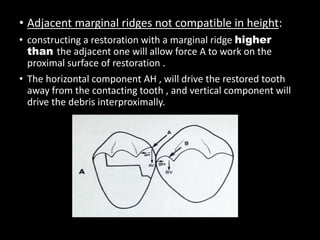
• Adjacent marginal ridges not compatible in height:
• constructing a restoration with a marginal ridge higher
than the adjacent one will allow force A to work on the
proximal surface of restoration .
• The horizontal component AH , will drive the restored tooth
away from the contacting tooth , and vertical component will
drive the debris interproximally.
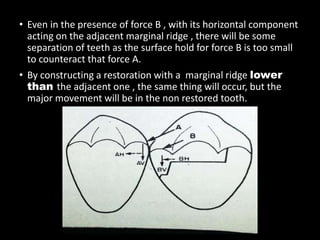
• Even in the presence of force B , with its horizontal component
acting on the adjacent marginal ridge , there will be some
separation of teeth as the surface hold for force B is too small
to counteract that force A.
• By constructing a restoration with a marginal ridge lower
than the adjacent one , the same thing will occur, but the
major movement will be in the non restored tooth.
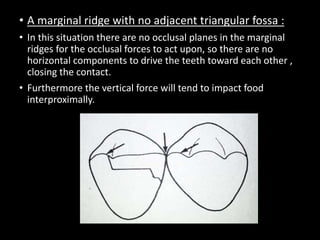
• A marginal ridge with no adjacent triangular fossa :
• In this situation there are no occlusal planes in the marginal
ridges for the occlusal forces to act upon, so there are no
horizontal components to drive the teeth toward each other ,
closing the contact.
• Furthermore the vertical force will tend to impact food
interproximally.
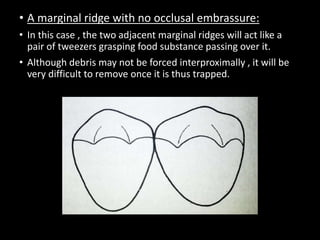
• A marginal ridge with no occlusal embrassure:
• In this case , the two adjacent marginal ridges will act like a
pair of tweezers grasping food substance passing over it.
• Although debris may not be forced interproximally , it will be
very difficult to remove once it is thus trapped.
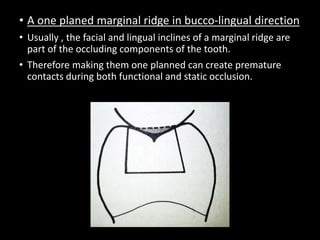
• A one planed marginal ridge in bucco-lingual direction
• Usually , the facial and lingual inclines of a marginal ridge are
part of the occluding components of the tooth.
• Therefore making them one planned can create premature
contacts during both functional and static occlusion.
• A one planed marginal ridge increases the depth of the
adjacent triangular fossa , magnifying stress in this area.
• Moreover , the one planned marginal ridge could increase
the height of marginal ridge in the center, making it
amenable to adverse effects of horizontal components of
force.
• Like wise a one planed marginal ridge will deflect the food
stream away from normal, proximal embrasure movements
( spill away )
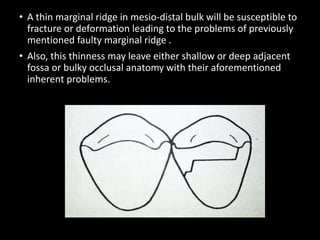
• A thin marginal ridge in mesio-distal bulk will be susceptible to
fracture or deformation leading to the problems of previously
mentioned faulty marginal ridge .
• Also, this thinness may leave either shallow or deep adjacent
fossa or bulky occlusal anatomy with their aforementioned
inherent problems.
Forces acting on
Intracoronal
restorations
The cavity should have such retention form that the
restorations will be firmly held in place, the cavity should also
have resistance form that the restoration will withstand the
stress without being dislodged.
FORCES ACTING ON
POSTS
FORCES ACTING ON POSTS
• An endodontically treated tooth has been structurally
compromised by caries and its removal, prior restorations,
and finally, endodontic preparation and filling.
• It should be emphasized again that posts are only used
for retaining the restorative material in the remaining tooth
structures, and by no means will they reinforce or improve
the strengths of these tooth structures
• Because the retention of posts is accomplished by various
means, it might be expected that different stresses are
associated with post installation.
• With posts retained by the cement alone, the main
potential for installation induced stresses is the build up of
hydrostatic back pressure.
This potential with parallel – sided post is circumvented by
means of longitudinal vents along the posts, which provide
an outlet for the pressure.
Tapered post are self-venting, and consequently there is no
pressure build up.
MECHANICAL ASPECTS OF POST-
RETAINED RESTORATIONS AND
FOUNDATIONS :
• The Stressing Capabilities of Posts :
• The following features and factors of posts and the
involved tooth will govern the stress patter induced in the
surrounding tooth structures due to the use of posts as
retentive means :
• Type of Posts :
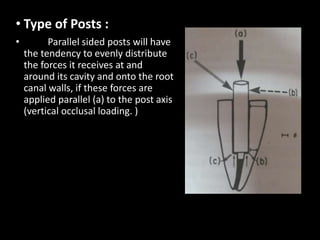
• Parallel sided posts will have
the tendency to evenly distribute
the forces it receives at and
around its cavity and onto the root
canal walls, if these forces are
applied parallel (a) to the post axis
(vertical occlusal loading. )
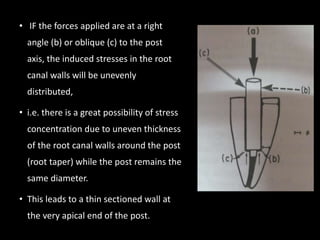
• IF the forces applied are at a right
angle (b) or oblique (c) to the post
axis, the induced stresses in the root
canal walls will be unevenly
distributed,
• i.e. there is a great possibility of stress
concentration due to uneven thickness
of the root canal walls around the post
(root taper) while the post remains the
same diameter.
• This leads to a thin sectioned wall at
the very apical end of the post.
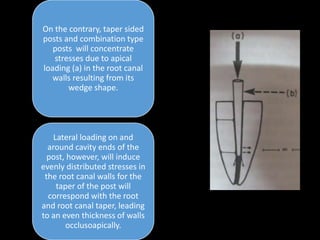
On the contrary, taper sided
posts and combination type
posts will concentrate
stresses due to apical
loading (a) in the root canal
walls resulting from its
wedge shape.
Lateral loading on and
around cavity ends of the
post, however, will induce
evenly distributed stresses in
the root canal walls for the
taper of the post will
correspond with the root
and root canal taper, leading
to an even thickness of walls
occlusoapically.
• During insertion of a post into the root canals, highly threaded
posts can induce ten times the amount and extent of stresses
as smooth sided posts.
• Serrated surface posts will induce about one and a half to two
times the stresses that are induced by smooth surfaced posts.
• This can be explained by the cemented technique utilized by
the serrated and smooth surfaced posts.
• . Bulk of dentin in root canal walls :
•
Naturally, the bulkier that the dentin surrounding a
root canal post is, the less will be the induced stresses
per unit volume during the post insertion and
functional use of the post retained restoration.
It has been estimated that a minimum of 2 mm of
dentinal root canal wall should surround a post, so that
the stresses induced there will not lead to dentinal
failure in the form of cracks and gross fracture.
• Length of clinical root involved with the root canal post :
• Although the tooth to receive a root canal post should be non-vital
and endodontically treated, the clinical crown portion of the tooth is
much more dehydrated than the clinical root portion as the dentin
portion of the root still receives some fluids from the adjacent
periodontal ligament.
• The more dehydration that there is, the less will be the modulus of
resilience and elasticity of the dentin, and consequently the less will
be the dentin’s ability to absorb and resist stresses without failure
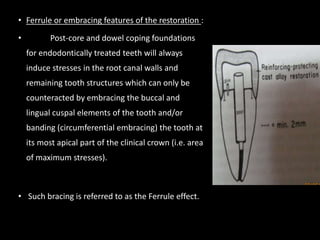
• Ferrule or embracing features of the restoration :
• Post-core and dowel coping foundations
for endodontically treated teeth will always
induce stresses in the root canal walls and
remaining tooth structures which can only be
counteracted by embracing the buccal and
lingual cuspal elements of the tooth and/or
banding (circumferential embracing) the tooth at
its most apical part of the clinical crown (i.e. area
of maximum stresses).
• Such bracing is referred to as the Ferrule effect.
The Ferrule feature of the restoration should
involve at least 2 mm of crown length to
counteract stresses induced by the post.
The closer this embracing feature is to the
junction between the clinical crown and the
root, the more effective it will be.
This is the major protecting feature against
induced stresses in a restoration for
endodontically treated teeth.
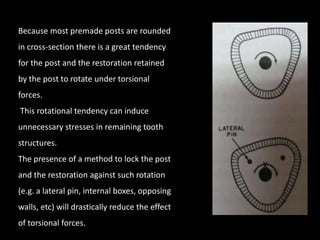
• . Lateral Locking Mechanisms for the post and restoration :
Because most premade posts are rounded
in cross-section there is a great tendency
for the post and the restoration retained
by the post to rotate under torsional
forces.
This rotational tendency can induce
unnecessary stresses in remaining tooth
structures.
The presence of a method to lock the post
and the restoration against such rotation
(e.g. a lateral pin, internal boxes, opposing
walls, etc) will drastically reduce the effect
of torsional forces.
• 9. Proximity of the post to the root canal filling :
IF the post approximates the root canal filling, forces can be
transmitted to that filling, which mechanically is made of very
weak materials, and lead to profound straining.
For this reason, there should be a space between the apical end
of the post and the occlusal end of the root canal filling.
Root canal fillings should not be involved in the mechanical
problems of the posts.
In addition, the direct or indirect loading of the root canal filling
may change its relationship to the surrounding walls and apical
anatomy, resulting in endodontic failure.
This can move the post in an undesirable direction, and it may
induce unnecessary stresses in the remaining tooth structure.
• . Presence of flat planes in the remaining tooth structures, at a
right angle to occluding forces :
Flat planes, in the form of tables, gingival floors and ledges,
etc, which will be able to receive and resist occluding
forces before arriving to the post, are the second major
feature used to reduce induces stresses in the remaining
tooth structure.
Besides partially protecting the post from direct loading,
these flat planes will protect a very weak subpulpal floor
from being directly loaded
• Presence of lateral walls in the remaining tooth structure :
• Extra or intracoronal axial walls, that will receive and
resist laterally applied forces on the restoration before they
arrive at the post, will drastically reduce stresses in the
remaining weakened tooth structure, primarily in the root
canal walls.
• . The root post portion relative to the crown post portion :
The ideal ratio is to have the
root portion of the post twice
as long as the crown portion,
i.e. a ratio of 2:1.
Less than that, especially less
than a ratio of 1:1, will
definitely concentrate
intolerable stresses on the
lateral walls of the root canal
adjacent to the apical end of
the post.
• . Hydraulic pressure during post cementation :
• If there are no lateral vents in the post, or if the post diameter
is very close to that of the post channel diameter, the semi-
liquid cement mix, during the cementation of the posts, may
exert tremendous amounts of hydraulic pressure that exceed
the elastic limit of the surrounding dentin or prevent complete
seating of the post.
• . Surface texture and shape of the root end of the post :
Greater post surface
roughness and/or the
presence of a chisel, wedge, or
irregular configuration on the
root end of the post, increases
the possibilities of stress
concentration on the root
canal walls.
The concentration of these
stresses will increase with
increasing proximity of the
post to the involved root canal
anatomy.
By placing the tip of the root post
there, with attendant possibilities of
substantial stresses being
concentrated at that tip, catastrophic
failures become inevitable.
As a rule from one half to two
thirds of the root canal should
encapsulate the post if the forces
transmitted by the post are to be
adequately dissipated.
• . Shape of the post in cross section relative to the shape of the
post channel :
A post should have a circumference that coincides with the
post channel.
Differences, e.g. rounded post in an oval post channel, will
concentrate stresses at isolated locations in the root canal
wall, possibly exceeding the local breaking point of the
dentin.
• Unconfined movements of a post
within a root canal can exaggerate
stresses in the root canal walls
upto the fracture point of dentin.
. Loose post
in the post
channel :
• Thread numbers and patterns :
• Continuous threads from one end of a post to another
create more stresses than interrupted threading.
• The greater that the spacing is between threads, the less will
be the attendant stresses.
• The sharper that the threads are, the less will be the stresses.
• Circumferentially interrupted threading creates less stresses
than continuous threading.
• The wider and more frequent that the interruptions are, the less
will be the stresses.
• Interruptions (cross cuts) further serve to facilitate escape of
debris during post insertion.
• The more extended that the threads are laterally, the more the
surface interfacial contact with dentin will be and consequently,
the higher the stresses.
FORCES ACTING ON A CAST
METAL AND PORCELAIN
RESTORATIONS
•FORCES ACTING ON A CAST METAL AND
PORCELAIN RESTORATIONS
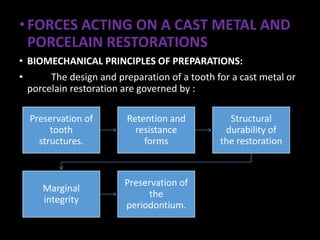
• BIOMECHANICAL PRINCIPLES OF PREPARATIONS:
• The design and preparation of a tooth for a cast metal or
porcelain restoration are governed by :
Preservation of
tooth
structures.
Retention and
resistance
forms
Structural
durability of
the restoration
Marginal
integrity
Preservation of
the
periodontium.
• A restoration can meet its functional, biological and esthetic
requirements if it remains firmly attached to the tooth.
• Its capability for retention and resistance must be great enough to
withstand the dislodging forces it will encounter in function.
• An estimate as to the prevailing occlusal forces can be had by noting
the degree of wear on the other teeth, firmness of the opposing
teeth, thickness of the supporting base and the bulk of masticatory
muscles.
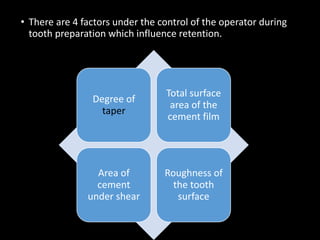
• There are 4 factors under the control of the operator during
tooth preparation which influence retention.
Degree of
taper
Total surface
area of the
cement film
Area of
cement
under shear
Roughness of
the tooth
surface
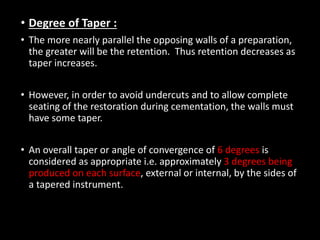
• Degree of Taper :
• The more nearly parallel the opposing walls of a preparation,
the greater will be the retention. Thus retention decreases as
taper increases.
• However, in order to avoid undercuts and to allow complete
seating of the restoration during cementation, the walls must
have some taper.
• An overall taper or angle of convergence of 6 degrees is
considered as appropriate i.e. approximately 3 degrees being
produced on each surface, external or internal, by the sides of
a tapered instrument.
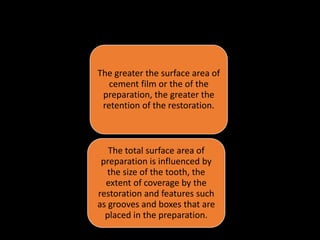
• Total Surface Area of Cement Film :
The greater the surface area of
cement film or the of the
preparation, the greater the
retention of the restoration.
The total surface area of
preparation is influenced by
the size of the tooth, the
extent of coverage by the
restoration and features such
as grooves and boxes that are
placed in the preparation.
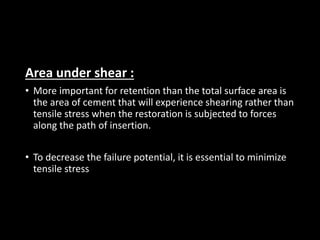
Area under shear :
• More important for retention than the total surface area is
the area of cement that will experience shearing rather than
tensile stress when the restoration is subjected to forces
along the path of insertion.
• To decrease the failure potential, it is essential to minimize
tensile stress
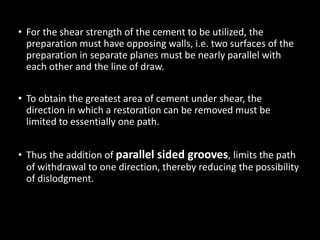
• For the shear strength of the cement to be utilized, the
preparation must have opposing walls, i.e. two surfaces of the
preparation in separate planes must be nearly parallel with
each other and the line of draw.
• To obtain the greatest area of cement under shear, the
direction in which a restoration can be removed must be
limited to essentially one path.
• Thus the addition of parallel sided grooves, limits the path
of withdrawal to one direction, thereby reducing the possibility
of dislodgment.
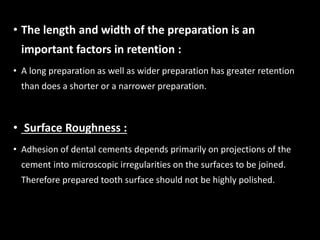
• The length and width of the preparation is an
important factors in retention :
• A long preparation as well as wider preparation has greater retention
than does a shorter or a narrower preparation.
• Surface Roughness :
• Adhesion of dental cements depends primarily on projections of the
cement into microscopic irregularities on the surfaces to be joined.
Therefore prepared tooth surface should not be highly polished.
Forces acting on
Extracoronal
restorations
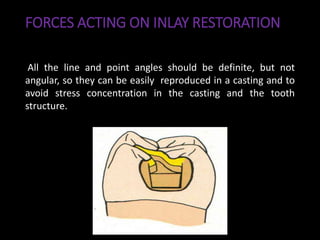
FORCES ACTING ON INLAY RESTORATION
All the line and point angles should be definite, but not
angular, so they can be easily reproduced in a casting and to
avoid stress concentration in the casting and the tooth
structure.
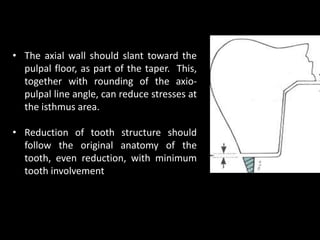
• The axial wall should slant toward the
pulpal floor, as part of the taper. This,
together with rounding of the axio-
pulpal line angle, can reduce stresses at
the isthmus area.
• Reduction of tooth structure should
follow the original anatomy of the
tooth, even reduction, with minimum
tooth involvement
• Maximum reduction should be at the occluding
surfaces,
• average of 1 mm should be cleared for metallic
casting in the inclined planes of the cusps. This
reduction should be 1.5 mm for cast ceramics.
• The reduction of the occluding inclined planes
should be cut in a concave form, to accommodate
maximal bulk of the casting where stresses are at
their maximum.
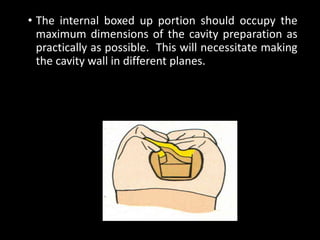
• The internal boxed up portion should occupy the
maximum dimensions of the cavity preparation as
practically as possible. This will necessitate making
the cavity wall in different planes.
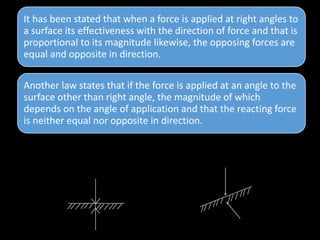
It has been stated that when a force is applied at right angles to
a surface its effectiveness with the direction of force and that is
proportional to its magnitude likewise, the opposing forces are
equal and opposite in direction.
Another law states that if the force is applied at an angle to the
surface other than right angle, the magnitude of which
depends on the angle of application and that the reacting force
is neither equal nor opposite in direction.
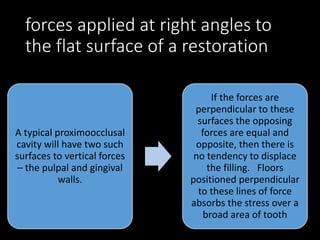
forces applied at right angles to
the flat surface of a restoration
A typical proximoocclusal
cavity will have two such
surfaces to vertical forces
– the pulpal and gingival
walls.
If the forces are
perpendicular to these
surfaces the opposing
forces are equal and
opposite, then there is
no tendency to displace
the filling. Floors
positioned perpendicular
to these lines of force
absorbs the stress over a
broad area of tooth
It is only when the pulpal wall is flat and the two vertical walls
are parallel to each other that the maximum retention form is
obtained.
In a tooth weakened by extensive caries, the resistance form
is obtained by extracoronal extension of the preparation in
the form of extra long reverse bevel in capped cusps or
by partial or complete coverage of facial or lingual surfaces
• But because of the inherent weakness of the
gingival groove the possible fracture to this wall of
the tooth structure between the groove and the
cavosurface angle.
• so many operators prefer the inward beveling of
the gingival wall, forming an acute angle between
the axial and gingival walls.
• Pulpal Wall : another method of obtaining
opposing movements to horizontal displacing force
is by establishing resistance into pulpal wall.
• The pulp wall which is flat offers no resistance to
horizontal displacement.
• when it is prepared with two inclined planes it will
prevent the lateral displacement of the inlay.
• Another modification is placement of grooves
parallel to the long axis of the tooth at the axial
angles
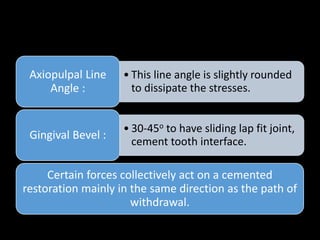
• This line angle is slightly rounded
to dissipate the stresses.
Axiopulpal Line
Angle :
• 30-45o to have sliding lap fit joint,
cement tooth interface.
Gingival Bevel :
Certain forces collectively act on a cemented
restoration mainly in the same direction as the path of
withdrawal.
The factors pertaining to these
forces
• Magnitude of the dislodging forces :
• Forces that tend to remove a cemented restoration along its
path of withdrawal are small compared to those that tend
to tilt it.
• depends on the stickiness of food, occluding and lateral
movement forces of the jaws and the surface area and
texture of restoration being pulled.
• Stress Concentration :
• Stresses are not uniform throughout the cement but are
concentrated around the junction of the axial and occlusal
surfaces (axio pulpal line angle). This may explain the
retentive failure of the cast restoration. The strength of the
cement is less than the induced stresses.
FORCES ACTING ON DIRECT
TOOTH COLOURED
RESTORATIONS
• FORCES ACTING ON DIRECT TOOTH COLOURED
RESTORATIONS
•
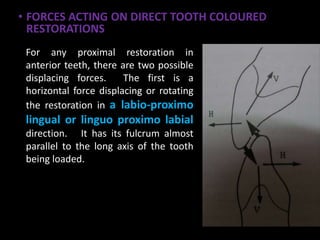
For any proximal restoration in
anterior teeth, there are two possible
displacing forces. The first is a
horizontal force displacing or rotating
the restoration in a labio-proximo
lingual or linguo proximo labial
direction. It has its fulcrum almost
parallel to the long axis of the tooth
being loaded.
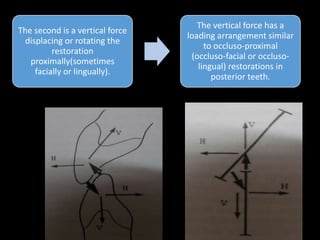
The second is a vertical force
displacing or rotating the
restoration
proximally(sometimes
facially or lingually).
The vertical force has a
loading arrangement similar
to occluso-proximal
(occluso-facial or occluso-
lingual) restorations in
posterior teeth.
• The mechanical picture can be summarized as follows :
In anterior teeth with normal overbite
and overjet during centric closure of the
mandible (from centric relation to centric
occlusion), mainly the horizontal forces
will be in action.
Those forces, if loading the proximal
restoration directly, would try to move it
linguo-proximo labially (for the upper
restoration) and labio-proximo lingually (for
the lower one).
3. If the upper and lower anterior teeth meet such that the lowers
are labial to the uppers in centric occlusion (Angle’s Class III),
there will be the same type of loading conditions mentioned in (1)
except the horizontal loading will tend to rotate or displace
restorations labio proximo lingually (for uppers) and linguo-
proximo labially (for lowers).
2. If anterior teeth meet in edge-to-edge fashion at centric
occlusion, loading of the proximal restoration, involving incisal
angles (Class IV) will be similar to any Class II proximo-occlusal
restorations, i.e. vertical displacing forces with very limited
horizontal components.
4. In occlusions with deep
anterior overbite and normal or
no overjet, the horizontal type
of loading will be greatly
exaggerated. The vertical
displacement, although present,
will be minimal by comparison.
5. In occlusion with anterior
open bite or severe overjet, or
any other condition that creates
a no-contact situation between
upper and lower anterior teeth
during centric occlusion and
excursive movements of the
mandible, proximal restorations
will not be loaded directly
either vertically or horizontally.
• . Loss of the incisal angle of a tooth, i.e. conversion
from a Class III to a Class IV represents a major
complication in the mechanical problems of
anterior tooth restorations.
Anterior teeth have their maximal
bulk gingivally.
They taper incisally with the
least bulk at the incisal ridge. So
resistance to stress fractures will
be maximum at the gingival end
and decrease incisally
Forces are directed horizontally and
vertically on anterior teeth.
These forces accumulate maximal
shear stresses at the junction of the
clinical root with the clinical crown
and maximum tensile stresses at the
incisal ridges, especially their corners
(incisal angles).
The labial enamel plate is
much thicker than the
lingual or proximal ones,
with maximal thickness of
enamel usually at the incisal
ridge.
The incisor may be involved
in a disclusion mechanism
of the mandible with
loading similar to that of the
cuspid, but to a much lesser
extent.
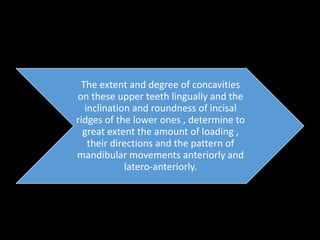
Occluding surfaces of anterior teeth,
especially the lingual surfaces of upper
teeth and incisal ridges of lowers are the
most important anterior determinant of
mandibular movements.
The extent and degree of concavities
on these upper teeth lingually and the
inclination and roundness of incisal
ridges of the lower ones , determine to
great extent the amount of loading ,
their directions and the pattern of
mandibular movements anteriorly and
latero-anteriorly.
• Cervical portions of anterior teeth when they are affected
with a Class V lesion or cavity preparation will have a stress
pattern similar to posterior teeth, and the stress pattern is
governed by the same factors as in posterior teeth.
• In addition, the deeper the overbite is, the more induced
the stresses are at these cervical areas.
Ideally, a restoration made of tooth
colored materials should not be loaded
directly, i.e. there should be intervening
tooth structure between the occluding
tooth and the restoration.
This situation can only be achieved by
four intact walls surrounding the
restoration. This is usually not the case.
That is why the clinical performance of
tooth colored materials differs form the
situation to another, sometimes
dramatically.
Crowns
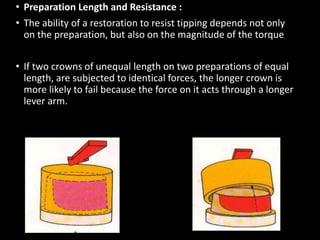
• Preparation Length and Resistance :
• The ability of a restoration to resist tipping depends not only
on the preparation, but also on the magnitude of the torque
• If two crowns of unequal length on two preparations of equal
length, are subjected to identical forces, the longer crown is
more likely to fail because the force on it acts through a longer
lever arm.
ADEQUATE PREPRATION SHORT PREPRATION
• Leverage and Resistance :
• The strongest forces encountered in function are apically
directed and can produce tension and shear in the cement
film only through leverage.
• If the line of action of force passes within the margin of a
restoration, there will be no tipping of restoration. The
margin on all sides of the restoration is supported by the
preparation. The torque produced merely tends to seat the
crown further.
• If the line of action of force passes outside the margins of
restoration the occlusal table of the restoration is wide, even
a vertical force can pass outside the supported margin and
produce destructive torque. This can also occur in crowns on
tipped teeth
• Resistance and Tooth Width :
• A wide preparation has greater retention than a
narrower one of equal height.
•
• Taper and Resistance :
• The resisting area decreases as the preparation
taper increases.
• The walls of a short, wide preparation must be kept
nearly parallel to achieve adequate resistance form.
• Rotation around a vertical axis :
• Geometric forms such as grooves or “wings” increase
resistance by blocking rotation around a vertical axis.
•
• Path of Insertion :
• The path of insertion for posterior full and partial
veneer crown is usually parallel with the long axis
of the tooth
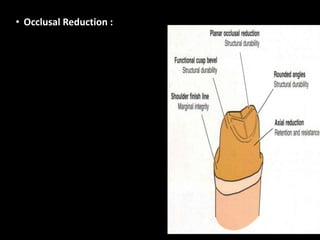
• Occlusal Reduction :
CONCLUSION
• Optimal functional capacity and stability of occlusal
relationships are major considerations in every phase of
restorative dentistry.
• Restoration not only mechanically replace the lost part but,
acts as a medium through which physical and mechanical
forces are transmitted to the tooth and investing tissues. Each
tooth has its own stress patterns. A thorough knowledge in
dental materials is necessary to understand the physical
properties including their response to stress.
References
• Textbook of clinical operative dentistry by sturdevant
• Textbook charbeneur
• Textbook marzook
• Textbook of periodontology by Carranza
• Shivakumar AT, Kalgeri SH, Dhir S. Clinical considerations in restorative dentistry
- A narrative review. J Int Clin Dent Res Organ
• Journal of international clinic dental organization
• Journal of Clinical and Diagnostic Research. 2017 Sep, Vol-11(9): ZE01-ZE0
• 0022-3913/79/020143 + 03$00.30/O 0 1979 The C. V. Mosby Co.
• THE JOURNAL OF PROSTHETIC DENTISTRY 143
• Google
• Googlescholar
• Ncbi

Forces acting on restoration

  • 2.
     Introduction  Pre-operativeanalysis  bite force  oral habits  compatibility of materials  Force  Force acting on the stomatognathic system  Normal biting force  Direction of displacement  Stress  types of stress  Mechanical properties of materials  Biomechanics for restorative dentistry  Stress transfer  Tooth flexure
  • 3.
    • stress patternson teeth • anterior teeth • posterior teeth • Weak areas of teeth • Applied mechanical properties of teeth • The vale experiment • Obtaining resistance form for tooth structure • Occlusal considerations in restoring teeth • posterior restoration • anterior restoration • Occlusal loading and its effect • Role of contact areas • Marginal ridges –mechanical function • Relation between tooth wear & restorative material • Forces on • intracoronal restorations • extracoronal restorations • CONCLUSION
  • 4.
    Introduction • All structuralanalysis and design require knowledge of the forces that will be applied and the mechanical properties of the materials that must withstand these forces. • Most restorative materials must withstand forces in service either during mastication or fabrication. • The mechanical properties, quantities of force, stress, strain, strength hardness, and others can help identify the properties of a material.
  • 5.
    • In manyrespects designing a structure for the oral environment is among the most demanding as the functional and para functional loads that must be accommodated and the aesthetic and space limitations makes the designing complicated. • When we design a structure we try to predict the stress that will develop in the structure under the anticipated applied loads.
  • 6.
  • 7.
    Deciding factors forrestorative treatment o• Extent of caries. o• Strength of remaining tooth structure. o• Specific characteristics of the patient’s dentition and periodontal health. o• Patient’s oral hygiene and dental caries history. o• Financial costs of the procedure to the patient. o• Risks and benefits of the procedure to the patient. o• Ability of the dentist to perform the procedure. o• Preferences of the dentist and the prevailing standard of care. o• Acceptance by the patient. • : Shivakumar AT, Kalgeri SH, Dhir S. Clinical considerations in restorative dentistry - A narrative review. J Int Clin Dent Res Organ
  • 8.
    Trauma from occlusion •When occlusal forces exceed the adaptive capacity of the tissues, tissue injury occurs, mainly periodontium. Occlusal trauma • Synonym • Also called traumatism. (Carranza)
  • 10.
    • denture teethagainst natural dentition can be severe (Fig. 7). Whereas the tooth structure loss opposing the complete denture took more than 10 years • : Shivakumar AT, Kalgeri SH, Dhir S. Clinical considerations in restorative dentistry - A narrative review. J Int Clin Dent Res Organ
  • 12.
    • The generalconcept of force is gained through the muscular action of pushing or pulling of an object • A force always has a direction and the direction is often characteristic of the type of force. • If the body to which the force is applied remains at rest, the force causes the body to deform. • Units of force are the pound or the kilogram or Newton. FORCE
  • 13.
  • 14.
    FORCE = MASSOF MANDIBLE x ACCELERATION OF CLOSURE Four major components that influence the force are ; 1. MUSCLES OF MASTICATION 2. CRANIOMANDIBULAR LIGAMENTS 3. T.M.J 4. TEETH
  • 15.
    The latest biteforce recording devices use load cells (transducers) to convert force to electrical energy that may be based on one of the following working principles. Types of load cells (force transducers): 1.Strain-gauge transducers; 2.Piezoelectric transducers; 3.Pressure transducers.
  • 16.
    NORMAL BITING FORCESMOLARS - 400- 890N PREMOLARS - 222- 445 N CUSPIDS - 133- 334 N INCISORS - 89- 111 N WORLD RECORD - 4337 N NORMAL BOND STRENGTH Micro hybrid composite : 3.12N Flowable composite : 3.44 Resin modified GIC :1.77N
  • 17.
    saltwater crocodiles— slammed theirjaws shut with 3,700 pounds per square inch (psi), or 16,460 newtons, of bite force. By contrast, you might tear into a steak with 150 to 200 psi (890 newtons)
  • 18.
    Force acting onthe teeth • These forces vary in magnitude, duration, frequency and direction. • The responses by the teeth to the forces depend on factors such as, • shape and length of the roots, • the characteristics of the fluid content of the periodontal space • the composition and orientation of the periodontal fibres • the extent of the alveolar bone
  • 19.
    • The responsesby the teeth will also depend on • the consistency of the bolus being chewed and • the muscular forces being used to crush it. • This will also apply to parafunctional clenching and chewing with or without a foreign body between the teeth.
  • 20.
    Direction of displacement •A tooth can be displaced in one of six directions : - • apically, • mesiodistally or • buccolingually, • each one producing a rotation or a translation.
  • 21.
    • The resultis likely to be a combination of all directions leading to an omnidirectional movement. • The same principle of movement will apply to the opposing tooth involved. • These omnidirectional tilting and rotations of teeth will reach a limit when an equal and opposite resistance is reached and the periodontal receptors cause a reflex arrest of the muscle force.
  • 22.
    • When theforce is removed, the teeth will recover their positions due to the elastic recovery of the compressed periodontal tissues. This is referred to as “replacement” of the teeth.
  • 23.
    This phenomenon maybe modified by 3 factors ; • Alveolar bone support • Adjacent teeth support • Horizontal muscle activity on both buccal and lingual surfaces of the teeth.
  • 24.
    • These 3variable factors may lead to an unidirectional movement of a tooth or teeth when they will become repositioned. • Teeth will continue to move unidirectionally until positions of stability are reached. The opposing forces are then equal to the moving forces.
  • 25.
    Stress Stress is theinternal reaction to the external force.
  • 26.
    • Area overwhich the force acts is an important factor of consideration especially in dental restorations in which areas over which the force applied often are extremely small. •• Since stress at a constant force is inversely proportional to the area, the smaller the area, the larger the stress. And vice versa
  • 27.
  • 28.
    Tension • a bodywhen it is subjected to 2 sets of forces that are directed away from each other in the same straight line
  • 29.
    Compression • the bodyis subjected to 2 sets of forces in the same straight line and directed to each other.
  • 30.
    Shear • 2 forcesdirectly parallel to each other
  • 31.
    Complex Stresses : •Whenever force is applied over a body, complex of multiple stresses are produced. • They may be a combination of tensile, shear or compressive stress. These multiple stresses are called complex stresses.
  • 32.
    MECHANICAL PROPERTIES OF MATERIALS Themechanical properties of a material describe its response to loading.
  • 33.
    • During loading,bonds are generally not compressed as easily as they are stretched. • Therefore, materials resist compression more readily and are said to be stronger in compression than in tension. • Materials have different properties under different directions of loading. • “It is important to determine what the clinical direction of loading is before assessing the mechanical property of interest”.
  • 34.
    • As loadingcontinues, the structure is deformed. At first this deformation (or strain) is completely reversible (Elastic strain). • However, increased loading finally produces some irreversible strain as well (plastic strain), which causes permanent deformation. • The point of onset of plastic strain is called the elastic limit. Continuing plastic strain ultimately leads to failure by fracture.
  • 35.
    • Two ofthe most useful mechanical properties are the modulus of elasticity and elastic limit. • A restorative material generally should be very stiff so that under load, its elastic deformation will be extremely small. • An exception is Class V composite which should be less stiff to accommodate tooth flexure
  • 36.
  • 37.
    • Teeth aresubjected to many forces during normal use. The interactions between the applied forces, the shape and structure of teeth, the supporting structures, and the mechanical properties of tooth components and restorative materials -are all included in the subject of biomechanics
  • 38.
    Biomechanical Unit : •The standard biomechanical unit involves the Interface between the restoration and tooth Tooth structure, and Restorative material
  • 39.
    • The importanceof considering three structures in the biomechanical unit is to detect stresses that may cause unwanted fractures or debonding. The restorative material may be strong enough to resist fracture, but the interface or tooth structure may not be.
  • 40.
    STRESS TRANSFER : •Normal tooth structure transfers external biting loads through enamel into dentin as compression. • The concentrated external loads are distributed over a large internal volume of tooth structure and the local stresses are lower. • During this process a small amount of dentin deformation may occur which results in tooth flexure .
  • 41.
    A restored toothtends to transfer stress differently than an intact tooth. Any force on the restoration produces compression, tension, or shear along the tooth restoration interface. Once enamel is no longer continuous, its resistance is much lower. Therefore, most restorations are designed to distribute stresses onto sound dentin, rather than to enamel.
  • 42.
    • The processof stress transfer to dentin becomes more complicated when the amount of remaining dentin is thin and the restoration must bridge a significant distance to seat onto thicker dentin (Liners or bases).
  • 43.
    TOOTH FLEXURE : •Either a lateral bending or an axial bending of a tooth during occlusal loading. • This flexure produces the maximal strain in the cervical region, and the strain appears to be resolved in tension or compression within local regions, causing the loss of bonded class V restorations in preparations with no relative grooves..
  • 44.
    • Such fracturespredispose enamel to loss when subjects to tooth brush abrasion and/or chemical erosion. • This process may be key in the formation of Class V defects Moreover, one current hypothesis is that tensile or compressive strains produce micro fractures (called ABFRACTIONS) in the thinnest region of enamel at the CEJ.
  • 45.
    STRESS PATTERNS OF TEETH Everytooth has its own stress pattern, and every location on a tooth has special stress patterns. Recognizing them is vital prior to designing a restoration without failure potential
  • 46.
  • 47.
    • The junctionbetween the clinical crown and the clinical root bears shear components of stress together with tension on the loading side and compression at the non-loading side, during excursive mandibular movements The slopes of the cuspid will bear concentrated stresses, especially if the cuspid is a protector for the occlusion or part of a function during mandibular excursions.
  • 48.
    • The axialangles and lingual marginal ridges will bear concentrated shear stresses. • The distal surface of a cuspid exhibits a unique stress pattern as a result of the anterior components of force concentrating compressive loading at the junction of the anterior and posterior segments of the dental arch and microlateral displacement of the cuspid during excursive movements.
  • 49.
    • Both ofthese factors will lead to stress concentration with resultant abrasive activity there.
  • 50.
    • The lingualconcavity in upper anterior teeth bears substantial compressive stresses during centric occlusion in addition to tensile and shear stresses during protrusive mandibular movements
  • 51.
    The incisal edgesof lower anterior teeth are subjected to compressive stresses. In additon tensile and shear stresses are present during protrusive mandibular movement. The incisal ridges of upper anterior teeth will have these same stresses during mid-protrusive and sometimes at the protrusive border location of the mandible
  • 52.
  • 53.
    • Cusp tips,especially on the functional side bear compressive stresses. • Marginal and crossing ridges bear tremendous tensile and compressive stresses. • Axial angles bear tensile and shear stresses on the non-functional side and compressive and shear stresses on the functional side.
  • 54.
    • Any occlusal,facial or lingual concavity will exhibit compressive stress concentration. • Especially if it has an opposing cuspal element in static or functional occlusal contact with it .
  • 55.
    WEAK AREAS INTHE TOOTH SHOULD BE IDENTIFIED AND RECOGNIZED BEFORE ANY RESTORATIVE ATTEMPT, in order to avoid destructive loading They are,
  • 56.
    a) Bi andtrifurcation. b) Cementum should be eliminated as a component of a cavity wall. The junction between the cementum and the dentin is always irregular so the dentin surface should be smoothed flat after cementum removal c) Thin dentin bridges in deep cavity preparation. d) Subpulpal floors in RCT treated teeth. Any stress concentation there may split the tooth interceptally. e) Cracks or crazing in enamel, and / or dentin both should be treated passively in any restoration design. They may act as shear lines leading to further spread
  • 57.
  • 58.
    Compressive strength ofenamel supported by vital dentin is usually 36-42,000 psi. Compressive strength of vital dentin is 40-50,000 psi. Modulus of resilience of vital dentin is 100-140 inch – lbs/cubic inch. Modulus of elasticity of enamel supported by vital dentin under compression is 7,000,000 psi. Modulus of elasticity of vital dentin is 1,900,000 psi.
  • 59.
    1. In general,when enamel loses its support of dentin, it loses more than 85% of its strength properties. 2. Tensile strength of dentin is about 10% less than its compressive strength. 3. Tensile strength and compressive strength of enamel are similar, as long as the enamel is supported by vital dentin.
  • 60.
    4. Shear strengthof dentin is almost 60% less than its compressive strength, and this is very critical in restorative design. 5. There is minimal shear strength for enamel when it loses its dentin support. 6. When the dentin loses its vitality, there is a drop of almost 40-60% in its strength properties
  • 61.
  • 62.
    • To bestresist masticatory forces, use floors or planes at right angles to the direction of loading to avoid shearing stresses.
  • 63.
    • If possible,walls of preparations should be parallel to the direction of the loading forces, in order to minimize or avoid shearing stresses.
  • 64.
    • Intracoronal andintraradicular cavity preparations can be done in box, or cone or inverted truncated cone shapes
  • 65.
    • Definite floors,walls and surfaces with line and point angles are essential to prevent micro movements of restorations, with concomitant shear stresses on remaining tooth structures
  • 66.
    • Increasing thebulk of a restorative material or leaving sufficient bulk of tooth structure in critical areas is one of the most practical ways of decreasing stresses per unit volume • Increasing the bulk of a restorative material or leaving sufficient bulk of tooth structure in critical areas is one of the most practical ways of decreasing stresses per unit volume Load – A Load A 1 stress unit / mm3
  • 67.
    • Designing theoutline form with minimal exposure of the restoration surface to occlusal loading will definitely minimize stresses and the possibility of mechanical fracture in the restoration
  • 68.
    • Junctions betweendifferent parts of the preparation, especially those acting as fulcra, should be rounded in order to minimize stress concentration in both tooth structure and restorations and to prevent any such sharp components from acting as shear lines for fracture failure. • Retentive features must leave sufficient bulk of tooth structure to resist stresses resulting from displacing forces
  • 69.
    OCCLUSAL CONSIDERATIONS IN RESTORING TEETH Beforeinitiating any restorative care, thorough occlusal examination should be carried out.
  • 70.
    The way weocclude teeth affects the periodontium, the temporomandibular joints, throat muscles, tongue, cheeks, lips, nerves . A clinician must have adequate knowledge about the principles of occlusion, which enables him to diagnose cases that need modifications / alteration of occlusion with or without the use of various restorative materials
  • 71.
    • The kindof occlusion, a patient should have, must be justified by the principles of physiology. • The occlusion affects almost every part of stomatognathic system, mainly : 1) The pulp of the tooth is a very sensitive organ. IT reacts immediately to abnormal occlusal forces. Hence, occlusion should not be detrimental to pulp. 2) The proximal relations of the occlusion should prevent food impaction between teeth. 3) The cusp-fossa relationship should be such that the adequate forces exerted during functional movement, aids in optimum health of the periodontium.
  • 72.
  • 73.
    The resin compositesand the glass ionomer cements are mainly used in anterior restorations. Though these teeth do not come under direct occlusion, however, they do take part in various movements of the mandible. The restoration should be carved and finished, maintaining the contacts and the cervical curvature of these restorations. The lingual area is carved to maintain the anatomy of cingulum and the lingual marginal ridges. Patient is asked to protrude and the interferences are checked and removed
  • 74.
  • 75.
    Use articulating paperto register THE CENTRIC HOLDING SPOTS and excursive contacts so that these marked areas can either be excluded form the outline form or properly restored. Prior to cutting a tooth, its opposing occlusal surface should be examined. Malpositioned opposing supporting cusps and ridges should be recontoured in order to achieve optimal occlusal contacts in the restored tooth. All posterior restorations should be planned keeping in mind the basic principles of occlusion.
  • 77.
    Plunger cusps andover erupted teeth should be reduced, removing all the cuspal interference’s so as to improve the plane of occlusion and decrease the chances of fracture of new restoration as a result of occlusal forces. When carving for occlusion, attempt to establish stable centric contacts of cusps with opposing surfaces that are perpendicular to occlusal forces should be made. Occlusal contacts located on a cuspal incline or ridge slope are undesirable because these create a deflective force on the tooth and hence should be adjusted until the resulting contact is stable.
  • 78.
  • 79.
    • During centricand excursive movements of the mandible both restoration and the tooth structure are periodically loaded both separately and jointly. • This brings about different stresses patterns depending on the actual morphology of the occluding area of the both the tooth in question and opposing contacting cuspal elements. • For the purpose of this discussion, one can classify these loading situations and their induced stress patterns in the following way
  • 80.
    • A smallcusp contacts the fossa away from the restored proximal surface, in a proximo occlusal restoration at centric closure.
  • 81.
    • A largecusp contacts the fossa adjacent to the restored proximal surface in a proximo-occlusal restorations at centric closure, either in the early stages of moving out of centric or at the late stages of moving toward it.
  • 82.
    • Occluding cuspalelements contact facial and lingual tooth structure surrounding a proximo-occlusal or proximo-occluso- proximal restoration, during centric and excursive movements.
  • 83.
    • Occluding cuspalelements contact facial and lingual parts of the restoration surrounded by tooth structure, during centric and excursive movements.
  • 84.
    • Occluding cuspalelements contact facial or lingual parts of the restoration completely replacing facial or lingual tooth structure during centric or excursive movements.
  • 85.
    • . • Occludingcuspal elements contact a restoration’s marginal ridge(s) or part of a marginal ridge during centric or excursive movements.
  • 86.
    • Cuspal elementsocclude or disocclude via the facial or lingual groove of a restoration. • There will be tensile stresses at the junction of the occlusal and facial or lingual parts of the restoration at full intercuspation, and to and from that position.
  • 87.
    • Cusps andcrossing ridges are part of the restoration in centric and excursive movement. • Both will be subjected to compressive stresses during such positions and movement. • Besides tensile stresses could concentrate at their junction with the main restoration, specially during contacting excursive movement.
  • 88.
    • Axial portionsof the restoration during centric occlusion and excursive movement contacts: • Whenever these portions are in contact with opposing occlusal surfaces, there will be induced compressive and shear stresses when they are not reciprocating (one side not in contact with occluding surfaces while other axial portion). The axial surfaces will be stressed in a slight tensile and shear pattern at their junction with the main bulk of the restoration.
  • 89.
    • Restoration isnot in occluding contact or is in premature contact during centric occlusion or excursive movement of the mandible. The first situation is not conducive to function, insofar as the restoration will not be involved with direct loading from the opposing occluding teeth. After a period of time, however, the tooth will supra erupt, rotate, and/or tilt, establishing contact with the opposing cuspal elements. Usually, this newly acquired location will not be the most favorable position for the restoration, tooth, or the remainder of the gnatho stomatic system, either mechanically or biologically
  • 90.
    Role of ContactAreas : Good restorative dental procedures must reproduce the proper contact areas. Restorations with contact areas which are flat, open, improperly placed, rough or poorly polished will lead to failure.
  • 91.
    • A slightfrictional movement of teeth always occurs between the interproximal surfaces of teeth during physiologic movement; and with time, the contact point becomes broad resulting in a wider contact area.
  • 92.
    • IF theteeth remained in contact with each other merely by contact points, they would eventually be forced out of the dental arch in either a buccal or lingual direction. • Whereas with a wider contact between teeth, this is not likely to occur. The opposing interproximal surfaces of restorations must be hard in order not to flow, flatten, wear or become abraded with use.
  • 93.
    Relationship between tooth wearand restorative materials : Occlusal forces lead to wear of enamel. The wear is, however, very slow if occlusal forces are appropriately transmitted to underlying bony tissues
  • 94.
    • The patternof wear varies individually. • Non-uniform wear of opposing teeth is quite common when one tooth is restored with a restorative material whose wear resistance is different as compared to that of enamel. • Differential wear can result in localization of occlusal loads with subsequent failure of restorative materials or development of deflective contacts with mandibular repositioning and an effect on a distant tooth.
  • 95.
    Hypothetically, if tworestorative materials, which wear at a slower rate than the natural teeth, are placed so as to oppose each other in a dentition undergoing wear, the restorations will produce occlusal interferences at a later stage. Non-wearing materials opposing each other can lead to natural teeth wear during contact in lateral and protrusive movements.
  • 96.
    Conversely, if thematerials wear faster than the teeth, the opposing cusp might over erupt into the worn material. IN lateral excursion, this cusp might then come in contact with an opposing cusp and if weakened by previous caries can lead to fracture.
  • 97.
  • 98.
    MECHANICAL FUNCTIONS OFTHE MARGINAL RIDGES The marginal ridges play an important role in withstanding and dissipating the occlusal stresses
  • 99.
    Role of MarginalRidges : • The correct form of marginal ridge compatible with the adjacent tooth and also with its own surrounding is important during carving of posterior restorations. • The absence of marginal ridge, or marginal ridge with improper height can lead to altered dissipation of forces subsequently damaging the underlying periodontium.
  • 100.
    • A marginalridge should always be formed in two planes bucco-lingually , meeting at a very obtuse angle. • This feature is essential when opposing functional cusp occludes with the marginal ridge.
  • 101.
    • The followingdiagram illustrates how a proper marginal ridge will perform these functions. • But, as mentioned, with age, the dimensions of marginal ridges and occlusal embrassures are reduced, due to vertical occlusal attrition and proximal flattening of the contact areas.
  • 102.
    • The followingexamples will illustrate the consequences incurred by creation of a faulty marginal ridge : • Absence of marginal ridge in the restoration. By the absence of marginal ridge , force 1 will be directed towards the proximal surface of adjacent tooth.
  • 103.
    • A marginalridge with an exaggerated occlusal embrasure. • Exaggerating the occlusal embrassure will direct forces 1 and 2 towards the adjacent proximal surfaces , with the horizontal components , 1H and 2H , separating the teeth and vertical components , 1Vand 2V , driving debris interproximally.
  • 104.
    • Adjacent marginalridges not compatible in height: • constructing a restoration with a marginal ridge higher than the adjacent one will allow force A to work on the proximal surface of restoration . • The horizontal component AH , will drive the restored tooth away from the contacting tooth , and vertical component will drive the debris interproximally.
  • 105.
    • Even inthe presence of force B , with its horizontal component acting on the adjacent marginal ridge , there will be some separation of teeth as the surface hold for force B is too small to counteract that force A. • By constructing a restoration with a marginal ridge lower than the adjacent one , the same thing will occur, but the major movement will be in the non restored tooth.
  • 106.
    • A marginalridge with no adjacent triangular fossa : • In this situation there are no occlusal planes in the marginal ridges for the occlusal forces to act upon, so there are no horizontal components to drive the teeth toward each other , closing the contact. • Furthermore the vertical force will tend to impact food interproximally.
  • 107.
    • A marginalridge with no occlusal embrassure: • In this case , the two adjacent marginal ridges will act like a pair of tweezers grasping food substance passing over it. • Although debris may not be forced interproximally , it will be very difficult to remove once it is thus trapped.
  • 108.
    • A oneplaned marginal ridge in bucco-lingual direction • Usually , the facial and lingual inclines of a marginal ridge are part of the occluding components of the tooth. • Therefore making them one planned can create premature contacts during both functional and static occlusion.
  • 109.
    • A oneplaned marginal ridge increases the depth of the adjacent triangular fossa , magnifying stress in this area. • Moreover , the one planned marginal ridge could increase the height of marginal ridge in the center, making it amenable to adverse effects of horizontal components of force. • Like wise a one planed marginal ridge will deflect the food stream away from normal, proximal embrasure movements ( spill away )
  • 110.
    • A thinmarginal ridge in mesio-distal bulk will be susceptible to fracture or deformation leading to the problems of previously mentioned faulty marginal ridge . • Also, this thinness may leave either shallow or deep adjacent fossa or bulky occlusal anatomy with their aforementioned inherent problems.
  • 111.
    Forces acting on Intracoronal restorations Thecavity should have such retention form that the restorations will be firmly held in place, the cavity should also have resistance form that the restoration will withstand the stress without being dislodged.
  • 112.
  • 113.
    FORCES ACTING ONPOSTS • An endodontically treated tooth has been structurally compromised by caries and its removal, prior restorations, and finally, endodontic preparation and filling. • It should be emphasized again that posts are only used for retaining the restorative material in the remaining tooth structures, and by no means will they reinforce or improve the strengths of these tooth structures
  • 114.
    • Because theretention of posts is accomplished by various means, it might be expected that different stresses are associated with post installation. • With posts retained by the cement alone, the main potential for installation induced stresses is the build up of hydrostatic back pressure. This potential with parallel – sided post is circumvented by means of longitudinal vents along the posts, which provide an outlet for the pressure. Tapered post are self-venting, and consequently there is no pressure build up.
  • 115.
    MECHANICAL ASPECTS OFPOST- RETAINED RESTORATIONS AND FOUNDATIONS : • The Stressing Capabilities of Posts : • The following features and factors of posts and the involved tooth will govern the stress patter induced in the surrounding tooth structures due to the use of posts as retentive means :
  • 116.
    • Type ofPosts : • Parallel sided posts will have the tendency to evenly distribute the forces it receives at and around its cavity and onto the root canal walls, if these forces are applied parallel (a) to the post axis (vertical occlusal loading. )
  • 117.
    • IF theforces applied are at a right angle (b) or oblique (c) to the post axis, the induced stresses in the root canal walls will be unevenly distributed, • i.e. there is a great possibility of stress concentration due to uneven thickness of the root canal walls around the post (root taper) while the post remains the same diameter. • This leads to a thin sectioned wall at the very apical end of the post.
  • 118.
    On the contrary,taper sided posts and combination type posts will concentrate stresses due to apical loading (a) in the root canal walls resulting from its wedge shape. Lateral loading on and around cavity ends of the post, however, will induce evenly distributed stresses in the root canal walls for the taper of the post will correspond with the root and root canal taper, leading to an even thickness of walls occlusoapically.
  • 119.
    • During insertionof a post into the root canals, highly threaded posts can induce ten times the amount and extent of stresses as smooth sided posts. • Serrated surface posts will induce about one and a half to two times the stresses that are induced by smooth surfaced posts. • This can be explained by the cemented technique utilized by the serrated and smooth surfaced posts.
  • 120.
    • . Bulkof dentin in root canal walls : • Naturally, the bulkier that the dentin surrounding a root canal post is, the less will be the induced stresses per unit volume during the post insertion and functional use of the post retained restoration. It has been estimated that a minimum of 2 mm of dentinal root canal wall should surround a post, so that the stresses induced there will not lead to dentinal failure in the form of cracks and gross fracture.
  • 121.
    • Length ofclinical root involved with the root canal post : • Although the tooth to receive a root canal post should be non-vital and endodontically treated, the clinical crown portion of the tooth is much more dehydrated than the clinical root portion as the dentin portion of the root still receives some fluids from the adjacent periodontal ligament. • The more dehydration that there is, the less will be the modulus of resilience and elasticity of the dentin, and consequently the less will be the dentin’s ability to absorb and resist stresses without failure
  • 122.
    • Ferrule orembracing features of the restoration : • Post-core and dowel coping foundations for endodontically treated teeth will always induce stresses in the root canal walls and remaining tooth structures which can only be counteracted by embracing the buccal and lingual cuspal elements of the tooth and/or banding (circumferential embracing) the tooth at its most apical part of the clinical crown (i.e. area of maximum stresses). • Such bracing is referred to as the Ferrule effect.
  • 123.
    The Ferrule featureof the restoration should involve at least 2 mm of crown length to counteract stresses induced by the post. The closer this embracing feature is to the junction between the clinical crown and the root, the more effective it will be. This is the major protecting feature against induced stresses in a restoration for endodontically treated teeth.
  • 124.
    • . LateralLocking Mechanisms for the post and restoration : Because most premade posts are rounded in cross-section there is a great tendency for the post and the restoration retained by the post to rotate under torsional forces. This rotational tendency can induce unnecessary stresses in remaining tooth structures. The presence of a method to lock the post and the restoration against such rotation (e.g. a lateral pin, internal boxes, opposing walls, etc) will drastically reduce the effect of torsional forces.
  • 125.
    • 9. Proximityof the post to the root canal filling : IF the post approximates the root canal filling, forces can be transmitted to that filling, which mechanically is made of very weak materials, and lead to profound straining. For this reason, there should be a space between the apical end of the post and the occlusal end of the root canal filling. Root canal fillings should not be involved in the mechanical problems of the posts.
  • 126.
    In addition, thedirect or indirect loading of the root canal filling may change its relationship to the surrounding walls and apical anatomy, resulting in endodontic failure. This can move the post in an undesirable direction, and it may induce unnecessary stresses in the remaining tooth structure.
  • 127.
    • . Presenceof flat planes in the remaining tooth structures, at a right angle to occluding forces : Flat planes, in the form of tables, gingival floors and ledges, etc, which will be able to receive and resist occluding forces before arriving to the post, are the second major feature used to reduce induces stresses in the remaining tooth structure. Besides partially protecting the post from direct loading, these flat planes will protect a very weak subpulpal floor from being directly loaded
  • 128.
    • Presence oflateral walls in the remaining tooth structure : • Extra or intracoronal axial walls, that will receive and resist laterally applied forces on the restoration before they arrive at the post, will drastically reduce stresses in the remaining weakened tooth structure, primarily in the root canal walls.
  • 129.
    • . Theroot post portion relative to the crown post portion : The ideal ratio is to have the root portion of the post twice as long as the crown portion, i.e. a ratio of 2:1. Less than that, especially less than a ratio of 1:1, will definitely concentrate intolerable stresses on the lateral walls of the root canal adjacent to the apical end of the post.
  • 130.
    • . Hydraulicpressure during post cementation : • If there are no lateral vents in the post, or if the post diameter is very close to that of the post channel diameter, the semi- liquid cement mix, during the cementation of the posts, may exert tremendous amounts of hydraulic pressure that exceed the elastic limit of the surrounding dentin or prevent complete seating of the post.
  • 131.
    • . Surfacetexture and shape of the root end of the post : Greater post surface roughness and/or the presence of a chisel, wedge, or irregular configuration on the root end of the post, increases the possibilities of stress concentration on the root canal walls. The concentration of these stresses will increase with increasing proximity of the post to the involved root canal anatomy.
  • 132.
    By placing thetip of the root post there, with attendant possibilities of substantial stresses being concentrated at that tip, catastrophic failures become inevitable. As a rule from one half to two thirds of the root canal should encapsulate the post if the forces transmitted by the post are to be adequately dissipated.
  • 133.
    • . Shapeof the post in cross section relative to the shape of the post channel : A post should have a circumference that coincides with the post channel. Differences, e.g. rounded post in an oval post channel, will concentrate stresses at isolated locations in the root canal wall, possibly exceeding the local breaking point of the dentin.
  • 134.
    • Unconfined movementsof a post within a root canal can exaggerate stresses in the root canal walls upto the fracture point of dentin. . Loose post in the post channel :
  • 135.
    • Thread numbersand patterns : • Continuous threads from one end of a post to another create more stresses than interrupted threading. • The greater that the spacing is between threads, the less will be the attendant stresses. • The sharper that the threads are, the less will be the stresses. • Circumferentially interrupted threading creates less stresses than continuous threading.
  • 136.
    • The widerand more frequent that the interruptions are, the less will be the stresses. • Interruptions (cross cuts) further serve to facilitate escape of debris during post insertion. • The more extended that the threads are laterally, the more the surface interfacial contact with dentin will be and consequently, the higher the stresses.
  • 137.
    FORCES ACTING ONA CAST METAL AND PORCELAIN RESTORATIONS
  • 138.
    •FORCES ACTING ONA CAST METAL AND PORCELAIN RESTORATIONS • BIOMECHANICAL PRINCIPLES OF PREPARATIONS: • The design and preparation of a tooth for a cast metal or porcelain restoration are governed by : Preservation of tooth structures. Retention and resistance forms Structural durability of the restoration Marginal integrity Preservation of the periodontium.
  • 139.
    • A restorationcan meet its functional, biological and esthetic requirements if it remains firmly attached to the tooth. • Its capability for retention and resistance must be great enough to withstand the dislodging forces it will encounter in function. • An estimate as to the prevailing occlusal forces can be had by noting the degree of wear on the other teeth, firmness of the opposing teeth, thickness of the supporting base and the bulk of masticatory muscles.
  • 140.
    • There are4 factors under the control of the operator during tooth preparation which influence retention. Degree of taper Total surface area of the cement film Area of cement under shear Roughness of the tooth surface
  • 141.
    • Degree ofTaper : • The more nearly parallel the opposing walls of a preparation, the greater will be the retention. Thus retention decreases as taper increases. • However, in order to avoid undercuts and to allow complete seating of the restoration during cementation, the walls must have some taper. • An overall taper or angle of convergence of 6 degrees is considered as appropriate i.e. approximately 3 degrees being produced on each surface, external or internal, by the sides of a tapered instrument.
  • 142.
    • Total SurfaceArea of Cement Film : The greater the surface area of cement film or the of the preparation, the greater the retention of the restoration. The total surface area of preparation is influenced by the size of the tooth, the extent of coverage by the restoration and features such as grooves and boxes that are placed in the preparation.
  • 143.
    Area under shear: • More important for retention than the total surface area is the area of cement that will experience shearing rather than tensile stress when the restoration is subjected to forces along the path of insertion. • To decrease the failure potential, it is essential to minimize tensile stress
  • 144.
    • For theshear strength of the cement to be utilized, the preparation must have opposing walls, i.e. two surfaces of the preparation in separate planes must be nearly parallel with each other and the line of draw. • To obtain the greatest area of cement under shear, the direction in which a restoration can be removed must be limited to essentially one path. • Thus the addition of parallel sided grooves, limits the path of withdrawal to one direction, thereby reducing the possibility of dislodgment.
  • 145.
    • The lengthand width of the preparation is an important factors in retention : • A long preparation as well as wider preparation has greater retention than does a shorter or a narrower preparation. • Surface Roughness : • Adhesion of dental cements depends primarily on projections of the cement into microscopic irregularities on the surfaces to be joined. Therefore prepared tooth surface should not be highly polished.
  • 146.
  • 147.
    FORCES ACTING ONINLAY RESTORATION
  • 148.
    FORCES ACTING ONINLAY RESTORATION All the line and point angles should be definite, but not angular, so they can be easily reproduced in a casting and to avoid stress concentration in the casting and the tooth structure.
  • 149.
    • The axialwall should slant toward the pulpal floor, as part of the taper. This, together with rounding of the axio- pulpal line angle, can reduce stresses at the isthmus area. • Reduction of tooth structure should follow the original anatomy of the tooth, even reduction, with minimum tooth involvement
  • 150.
    • Maximum reductionshould be at the occluding surfaces, • average of 1 mm should be cleared for metallic casting in the inclined planes of the cusps. This reduction should be 1.5 mm for cast ceramics. • The reduction of the occluding inclined planes should be cut in a concave form, to accommodate maximal bulk of the casting where stresses are at their maximum.
  • 151.
    • The internalboxed up portion should occupy the maximum dimensions of the cavity preparation as practically as possible. This will necessitate making the cavity wall in different planes.
  • 152.
    It has beenstated that when a force is applied at right angles to a surface its effectiveness with the direction of force and that is proportional to its magnitude likewise, the opposing forces are equal and opposite in direction. Another law states that if the force is applied at an angle to the surface other than right angle, the magnitude of which depends on the angle of application and that the reacting force is neither equal nor opposite in direction.
  • 153.
    forces applied atright angles to the flat surface of a restoration A typical proximoocclusal cavity will have two such surfaces to vertical forces – the pulpal and gingival walls. If the forces are perpendicular to these surfaces the opposing forces are equal and opposite, then there is no tendency to displace the filling. Floors positioned perpendicular to these lines of force absorbs the stress over a broad area of tooth
  • 154.
    It is onlywhen the pulpal wall is flat and the two vertical walls are parallel to each other that the maximum retention form is obtained. In a tooth weakened by extensive caries, the resistance form is obtained by extracoronal extension of the preparation in the form of extra long reverse bevel in capped cusps or by partial or complete coverage of facial or lingual surfaces
  • 155.
    • But becauseof the inherent weakness of the gingival groove the possible fracture to this wall of the tooth structure between the groove and the cavosurface angle. • so many operators prefer the inward beveling of the gingival wall, forming an acute angle between the axial and gingival walls.
  • 156.
    • Pulpal Wall: another method of obtaining opposing movements to horizontal displacing force is by establishing resistance into pulpal wall. • The pulp wall which is flat offers no resistance to horizontal displacement. • when it is prepared with two inclined planes it will prevent the lateral displacement of the inlay. • Another modification is placement of grooves parallel to the long axis of the tooth at the axial angles
  • 157.
    • This lineangle is slightly rounded to dissipate the stresses. Axiopulpal Line Angle : • 30-45o to have sliding lap fit joint, cement tooth interface. Gingival Bevel : Certain forces collectively act on a cemented restoration mainly in the same direction as the path of withdrawal.
  • 158.
    The factors pertainingto these forces • Magnitude of the dislodging forces : • Forces that tend to remove a cemented restoration along its path of withdrawal are small compared to those that tend to tilt it. • depends on the stickiness of food, occluding and lateral movement forces of the jaws and the surface area and texture of restoration being pulled. • Stress Concentration : • Stresses are not uniform throughout the cement but are concentrated around the junction of the axial and occlusal surfaces (axio pulpal line angle). This may explain the retentive failure of the cast restoration. The strength of the cement is less than the induced stresses.
  • 159.
    FORCES ACTING ONDIRECT TOOTH COLOURED RESTORATIONS
  • 160.
    • FORCES ACTINGON DIRECT TOOTH COLOURED RESTORATIONS • For any proximal restoration in anterior teeth, there are two possible displacing forces. The first is a horizontal force displacing or rotating the restoration in a labio-proximo lingual or linguo proximo labial direction. It has its fulcrum almost parallel to the long axis of the tooth being loaded.
  • 161.
    The second isa vertical force displacing or rotating the restoration proximally(sometimes facially or lingually). The vertical force has a loading arrangement similar to occluso-proximal (occluso-facial or occluso- lingual) restorations in posterior teeth.
  • 162.
    • The mechanicalpicture can be summarized as follows : In anterior teeth with normal overbite and overjet during centric closure of the mandible (from centric relation to centric occlusion), mainly the horizontal forces will be in action. Those forces, if loading the proximal restoration directly, would try to move it linguo-proximo labially (for the upper restoration) and labio-proximo lingually (for the lower one).
  • 163.
    3. If theupper and lower anterior teeth meet such that the lowers are labial to the uppers in centric occlusion (Angle’s Class III), there will be the same type of loading conditions mentioned in (1) except the horizontal loading will tend to rotate or displace restorations labio proximo lingually (for uppers) and linguo- proximo labially (for lowers). 2. If anterior teeth meet in edge-to-edge fashion at centric occlusion, loading of the proximal restoration, involving incisal angles (Class IV) will be similar to any Class II proximo-occlusal restorations, i.e. vertical displacing forces with very limited horizontal components.
  • 164.
    4. In occlusionswith deep anterior overbite and normal or no overjet, the horizontal type of loading will be greatly exaggerated. The vertical displacement, although present, will be minimal by comparison. 5. In occlusion with anterior open bite or severe overjet, or any other condition that creates a no-contact situation between upper and lower anterior teeth during centric occlusion and excursive movements of the mandible, proximal restorations will not be loaded directly either vertically or horizontally.
  • 165.
    • . Lossof the incisal angle of a tooth, i.e. conversion from a Class III to a Class IV represents a major complication in the mechanical problems of anterior tooth restorations.
  • 166.
    Anterior teeth havetheir maximal bulk gingivally. They taper incisally with the least bulk at the incisal ridge. So resistance to stress fractures will be maximum at the gingival end and decrease incisally
  • 167.
    Forces are directedhorizontally and vertically on anterior teeth. These forces accumulate maximal shear stresses at the junction of the clinical root with the clinical crown and maximum tensile stresses at the incisal ridges, especially their corners (incisal angles).
  • 168.
    The labial enamelplate is much thicker than the lingual or proximal ones, with maximal thickness of enamel usually at the incisal ridge. The incisor may be involved in a disclusion mechanism of the mandible with loading similar to that of the cuspid, but to a much lesser extent.
  • 169.
    Occluding surfaces ofanterior teeth, especially the lingual surfaces of upper teeth and incisal ridges of lowers are the most important anterior determinant of mandibular movements.
  • 170.
    The extent anddegree of concavities on these upper teeth lingually and the inclination and roundness of incisal ridges of the lower ones , determine to great extent the amount of loading , their directions and the pattern of mandibular movements anteriorly and latero-anteriorly.
  • 171.
    • Cervical portionsof anterior teeth when they are affected with a Class V lesion or cavity preparation will have a stress pattern similar to posterior teeth, and the stress pattern is governed by the same factors as in posterior teeth. • In addition, the deeper the overbite is, the more induced the stresses are at these cervical areas.
  • 172.
    Ideally, a restorationmade of tooth colored materials should not be loaded directly, i.e. there should be intervening tooth structure between the occluding tooth and the restoration. This situation can only be achieved by four intact walls surrounding the restoration. This is usually not the case. That is why the clinical performance of tooth colored materials differs form the situation to another, sometimes dramatically.
  • 173.
  • 174.
    • Preparation Lengthand Resistance : • The ability of a restoration to resist tipping depends not only on the preparation, but also on the magnitude of the torque • If two crowns of unequal length on two preparations of equal length, are subjected to identical forces, the longer crown is more likely to fail because the force on it acts through a longer lever arm. ADEQUATE PREPRATION SHORT PREPRATION
  • 175.
    • Leverage andResistance : • The strongest forces encountered in function are apically directed and can produce tension and shear in the cement film only through leverage. • If the line of action of force passes within the margin of a restoration, there will be no tipping of restoration. The margin on all sides of the restoration is supported by the preparation. The torque produced merely tends to seat the crown further. • If the line of action of force passes outside the margins of restoration the occlusal table of the restoration is wide, even a vertical force can pass outside the supported margin and produce destructive torque. This can also occur in crowns on tipped teeth

  • 176.
    • Resistance andTooth Width : • A wide preparation has greater retention than a narrower one of equal height. • • Taper and Resistance : • The resisting area decreases as the preparation taper increases. • The walls of a short, wide preparation must be kept nearly parallel to achieve adequate resistance form.
  • 177.
    • Rotation arounda vertical axis : • Geometric forms such as grooves or “wings” increase resistance by blocking rotation around a vertical axis. • • Path of Insertion : • The path of insertion for posterior full and partial veneer crown is usually parallel with the long axis of the tooth
  • 178.
  • 179.
    CONCLUSION • Optimal functionalcapacity and stability of occlusal relationships are major considerations in every phase of restorative dentistry. • Restoration not only mechanically replace the lost part but, acts as a medium through which physical and mechanical forces are transmitted to the tooth and investing tissues. Each tooth has its own stress patterns. A thorough knowledge in dental materials is necessary to understand the physical properties including their response to stress.
  • 180.
    References • Textbook ofclinical operative dentistry by sturdevant • Textbook charbeneur • Textbook marzook • Textbook of periodontology by Carranza • Shivakumar AT, Kalgeri SH, Dhir S. Clinical considerations in restorative dentistry - A narrative review. J Int Clin Dent Res Organ • Journal of international clinic dental organization • Journal of Clinical and Diagnostic Research. 2017 Sep, Vol-11(9): ZE01-ZE0 • Journal of Clinical and Diagnostic Research. 2017 Sep, Vol-11(9): ZE01-ZE0 • 0022-3913/79/020143 + 03$00.30/O 0 1979 The C. V. Mosby Co. • THE JOURNAL OF PROSTHETIC DENTISTRY 143 • Google • Googlescholar • Ncbi

Editor's Notes

  • #8 These are the factors that determine the restoration. Amom=ng these the third point is of significance for my seminar topic.
  • #25 Thus, maxillary incisors with poor periodontal support and incompetent lips will drift forwards. This forward drift will continue until the teeth are shortened or are prevented from moving further by an appliance and by treatment of the periodontal breakdown.
  • #27 When a force acts on a body, tending to produce deformation, a resistance is developed to this external force application
  • #59 Although the following figures are averages, they provide an idea about the principal mechanical properties of tooth structure. It must be understood that these figures can differ from one location on a tooth to another and from one tooth to another.
  • #81 As shown due to the elasticity of the dentin, (in young teeth) a restoration will bevel at the axio-pulpal line angle (provided the proximal part of the restoration is self-retained). This creates tensile stresses at the isthmus portion of the restoration, shear stresses at the junction of the main bulk of the proximal part of the restoration and self retained parts and compressive stresses in the underlying dentin.
  • #82 As shown, the large cusps will tend to separate the proximal part of the restoration from the occlusal part. This crates tensile stresses at the isthmus portion of the restoration even fi the proximal portion is self – retained. This loading situation will deliver compressive forces in the remaining tooth structure, apical to the restoration.
  • #83 As shown - Concentrated shear stresses will occur at the junction of the surrounding tooth structure and corresponding floors, with a tendency towards failure there. This loading situation can be unilateral or bilateral, depending on the mandibular movement it is the most deleterious to tooth structure especially on the orbiting side if there is interference during lateral excursion.
  • #84 This arrangement will induce tensile and compressive stresses in the restoration which will be transmitted to the surrounding tooth structure.
  • #85 The tensile stresses will be induced at the junction of the occlusal and facial and/or lingual part of the restoration in both occluding situations
  • #86 As shown in the mesio distal cross section (assuming the restoration is locked occlusally), there will be concentrated tensile stresses at the (junction of the occlusal and facial or lingual parts of the restoration at full intercuspation and to end from that position) at the junction of the marginal ridge and the rest of the restoration. This will be true if its an area of advance contact during mandibular closure.
  • #153 Lateral or tangential forces may cause displacement of the restoration unless adequate resistance and retention have been incorporated in the preparation.
  • #162 3 . The amount of each depends upon the location, extent and type of occluding contacts between the upper and lower teeth during function.
  • #173 Compo resins used with acid etching and bonding tech are the only non cast rest materials that can combine the undermined enamel and cuspal elemnts to sound tooth structure there by incresing their resistance form . There are 4 methods to accomadate and properly retain a restoration of these materials within the tooth structure. They are : Acid conditioning of surface enamel Reentive cavity preperation with internal details Physico chemical adhesion to some components of tooth structure. Pins and posts Combination.