Bonding
Current perspectives
Dr. Josey Mathew
2
What comes in this?
• History
• The basics
• Components of Dental Adhesive Systems
• Enamel Bonding
• Dentine Bonding
• Generations of DBAs
• Today’s Adhesives
• Strategies to preserve bond stability
• Universal adhesives
• Future
• Conclusion
3
“Marriage is a sacred bond between two imperfect souls, which
is made possible by God”
Dave Willis
“Bonding in dentistry may be a marriage between two imperfect
surfaces (resin and tooth) made possible by the dentist”
4
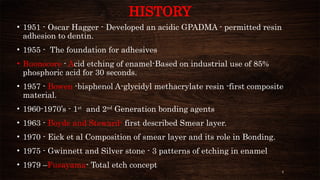
HISTORY
• 1951 - Oscar Hagger - Developed an acidic GPADMA - permitted resin
adhesion to dentin.
• 1955 - The foundation for adhesives
• Buonocore - Acid etching of enamel-Based on industrial use of 85%
phosphoric acid for 30 seconds.
• 1957 - Bowen -bisphenol A-glycidyl methacrylate resin -first composite
material.
• 1960-1970’s - 1st
and 2nd
Generation bonding agents
• 1963 - Boyde and Steward- first described Smear layer.
• 1970 - Eick et al Composition of smear layer and its role in Bonding.
• 1975 - Gwinnett and Silver stone - 3 patterns of etching in enamel
• 1979 –Fusayama- Total etch concept
5
• 1980’s – 3rd
Generation Bonding agents
• 1982- Nakabayashi - Hybrid layer
• Early 1990’s – 4th
Generation Dentin bonding system
• 1992 - Kanca et al -Wet bonding technique
• 1999 - Prati and Pashley - Reverse Hybrid layer
• Mid 1990s - 5th
Generation Dentin Bonding Systems
• Early 2000’s - 6th
Generation Dentin Bonding Systems
• 2003 -7th
Generation Dentin Bonding System
• 2010 -8th
Generation Dentin Bonding System
• 2011-Universal adhesives
6
7
ADHESION- THE BASICS
• ADHESIVE/ ADHERENT- A material, that joins two substrates together
and solidifies and is able to transfer a load from one surface to the other.
• ADHEREND- Material to which an adhesive is applied
• ADHESION -Intermolecular attraction that exists between
molecules of two unlike substances when placed in intimate
contact with each other.
• COHESION- Force with which molecules of the same kind are attracted.
8
PRIMARY MECHANISM OF
ADHESION
9
WETTING OF A LIQUID
• Surface Energy-Intermolecular forces at the interface between two media
• Surface Tension-The force that holds liquid molecules together.
10
REQUIREMENTS FOR GOOD ADHESION
• Clean adherend
• Good wetting
• Intimate Contact
• Bonding
• Good polymerisation
11
CO-FACTORS FOR ADHESION
• Surface roughness
• Surface Energy of Substrate
– High for etched enamel
– Low for smear layer covered dentine
• Bond promoting effects
– Eg. Capillary forces-Etched enamel
• Hydrophilicity/phobicity
• Interfacial pores(air/moisture)
12
SUBSTRATES
Enamel / Dentin / Cementum
Enamel
• Ideal
• Dry
• Mineral - 92 Vol % -
Hydroxyapatite
Dentin
• Complex
• Moist
• 45 Vol % Hydroxyapatite
• More Organic - 33 Vol % -
• Predominantly-Type I Collagen
• Approx 32%-Water
• Water content-increases 20 X
from superficial to deep
13
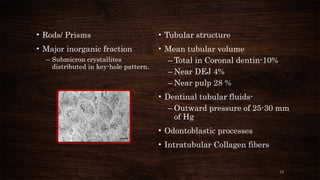
• Tubular structure
• Mean tubular volume
– Total in Coronal dentin-10%
– Near DEJ 4%
– Near pulp 28 %
• Dentinal tubular fluids-
– Outward pressure of 25-30 mm
of Hg
• Odontoblastic processes
• Intratubular Collagen fibers
• Rods/ Prisms
• Major inorganic fraction
– Submicron crystallites
distributed in key-hole pattern.
14
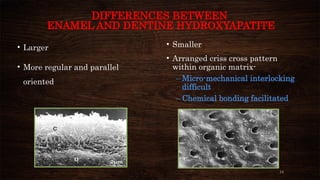
DIFFERENCES BETWEEN
ENAMEL AND DENTINE HYDROXYAPATITE
• Larger
• More regular and parallel
oriented
• Smaller
• Arranged criss cross pattern
within organic matrix-
– Micro-mechanical interlocking
difficult
– Chemical bonding facilitated
15
SMEAR LAYER-REMOVE OR RETAIN??
Remove…
 Tubules are open for good
retention
 The exposed collagen
network provides reactive
groups that can chemically
interact with primers.
 Exposed collagen promotes
micro mechanical bonding to
resin
Retain….
 Protective barrier.
 Lowers dentinal permeability.
 Lowers pulpal pressure
 Use of bonding agents that can
penetrate the smear layer and
incorporate into bonding layer
16
COMPONENTS OF
DENTAL ADHESIVE SYSTEMS
• Etchant
• Primer
• Dentin adhesive / Bonding resin
17
ETCHANTS
30-40% Phosphoric acid
Thickeners (Silica micro particles
or Xanthum gums )
Colour dye
Glycol for wettability and to
decrease viscosity
Organic
– Maleic acid
– Tartaric acid
– Citric acid
– EDTA
– Acidic monomers-SE systems
Polymeric
- Polyacrylic acid
Mineral acids
– Hydrochloric acid
– Nitric acid
– Hydrofluoric acid
18
CALCIUM CHELATORS
Remove smear layer without decalcification or significant physical changes
in the underlying dentin substrate.
EDTA
• pH - 7.4
Tublicid :
– 0.1% EDTA
– 0.15% Benzalkonium chloride
• Scrubbed on the surface for a few seconds,
• Smear layer removal, smear plug intact
19
LASERS & AIR ABRASION
• Nd: YAG lasers used at 10-30 pulses per second
– The surface is desensitized by occlusion of open and
permeable dentinal tubules.
• Air abrasion:
– Aluminium oxide particles of particle size of 0.5 microns are
used
20
PRIMERS
Bifunctional monomer in a volatile solvent such as acetone or alcohol
hydrophilic, low viscosity
Adhesion promoting agents
• Displaces residual moisture in dentine
• Wets and envelops the exposed collagen fibrils.
• Carry monomers into interfibrillar channels
• Transforms hydrophilic dentine into hydrophobic
• Increases surface free energy
SEs use acidic monomers as primers
21
COMMONLY USED PRIMERS
• 30-55% HEMA (Hydroxy ethyl methacrylate)- most commonly used
• 2-5% NTG-GMA (N-Tolyglycine- glycidyl methacrylate)
• 16% BPDM (Biphenyl dimethacrylate)
• 6% PENTA( dipentaerythritol penta acrylate monophosphate)
• 10% PMDM (Pyromellitic acid diethyl methacrylate)
22
DENTIN ADHESIVES / BONDING RESIN
• Thin layer of resin applied between conditioned dentin and composite.
• Link between hydrophilic primer and hydrophobic composite
– Co polymerizes with the primer molecules and restorative resin
• Form resin tags to seal open dentinal tubules
• Stabilizes the formed hybrid layer and resin tags
• Commonly used Bis GMA, UDMA, TEGDMA, Methacrylated phosphates,
PENTA.
• Act as a stress relaxation buffer - relieve polymerization stresses
• Usually unfilled but may contain fillers ( Optibond Solo, Prime and bond NT)
23
• Initiators and Accelerators:
Light cured:
- Camphoroquinone and
organic amine
Dual cured bonding agents :
- Catalyst to promote self curing
• Fillers:
Mostly unfilled
Inorganic fillers 0.5% to 40% by wt.
Microfillers or nanofillers
Functions of nanofillers
– Prevents nanoleakage
– Causes uniform thickness of adhesive
layer
– Better flexibility to adhesives
– Better dissipation of forces
24
SOLVENTS
• Acetone, Ethanol, Water
• Acetone evaporates fast- requires shortest drying time in mouth.
• Ethanol evaporates more slowly-moderate drying time
• Water evaporates very slowly-longest drying time.
25
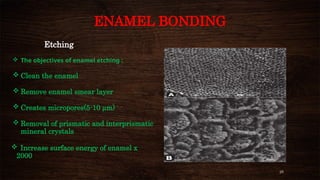
ENAMEL BONDING
Etching
 The objectives of enamel etching :
 Clean the enamel
 Remove enamel smear layer
 Creates micropores(5-10 µm)
 Removal of prismatic and interprismatic
mineral crystals
 Increase surface energy of enamel x
2000
26
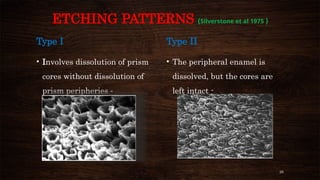
ETCHING PATTERNS (Silverstone et al 1975 )
Type I
• Involves dissolution of prism
cores without dissolution of
prism peripheries -
HONEY COMB
Type II
• The peripheral enamel is
dissolved, but the cores are
left intact -
COBBLESTONE
27
Type III
• Mixture of
• Type I
• &
• Type II configurations
Type IV
• Shows a pitted enamel surface
• Random distribution of
depressions with no preferential
destruction of either cores or
peripheries.
• These areas occasionally occur in
little patches over enamel surface
28
Type V
• Extremely flat and smooth
• Lacking micro irregularities for penetration and retention of
resins
• Similar to Type IV patterns
– No evidence of prism outlines seen.
29
ENAMEL BONDING AGENTS
Used in the past -
– Consists of bis-GMA or UDMA resins with diluents like TEGDMA.
• Flow easily into the microporosities of enamel.
Now
– EBAs replaced by DBAs.
Advantage
• Simultaneous bonding to both enamel and dentin possible
30
RESIN TAGS
Macro tags - space surrounding the enamel prisms
Micro tags- result from resin infiltration /
polymerization within the tiny etch-pits at the
cores of the etched enamel prisms.
Major contribution to retention to enamel.
31
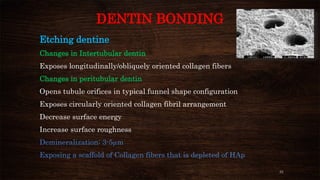
DENTIN BONDING
Etching dentine
Changes in Intertubular dentin
Exposes longitudinally/obliquely oriented collagen fibers
Changes in peritubular dentin
Opens tubule orifices in typical funnel shape configuration
Exposes circularly oriented collagen fibril arrangement
Decrease surface energy
Increase surface roughness
Demineralization; 3-5µm
Exposing a scaffold of Collagen fibers that is depleted of HAp
32
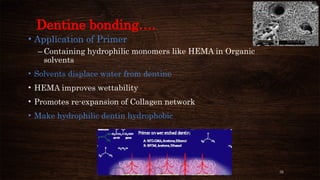
Dentine bonding….
• Application of Primer
– Containing hydrophilic monomers like HEMA in Organic
solvents
• Solvents displace water from dentine
• HEMA improves wettability
• Promotes re-expansion of Collagen network
• Make hydrophilic dentin hydrophobic
33
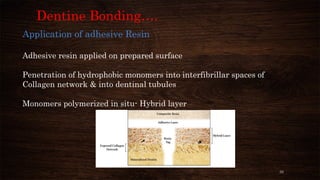
Dentine Bonding….
Application of adhesive Resin
Adhesive resin applied on prepared surface
Penetration of hydrophobic monomers into interfibrillar spaces of
Collagen network & into dentinal tubules
Monomers polymerized in situ- Hybrid layer
34
35
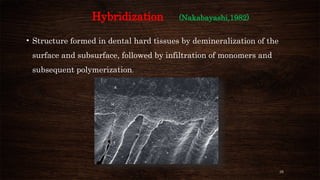
Hybridization (Nakabayashi,1982)
• Structure formed in dental hard tissues by demineralization of the
surface and subsurface, followed by infiltration of monomers and
subsequent polymerization.
36
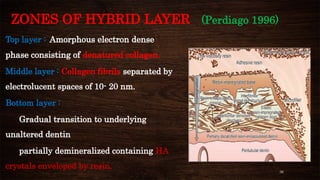
ZONES OF HYBRID LAYER (Perdiago 1996)
Top layer : Amorphous electron dense
phase consisting of denatured collagen.
Middle layer : Collagen fibrils separated by
electrolucent spaces of 10- 20 nm.
Bottom layer :
Gradual transition to underlying
unaltered dentin
partially demineralized containing HA
crystals enveloped by resin.
37
ULTRAMORPHOLOGIC FEATURES OF
HYBRIDISATION
• Shag carpet appearance
• Tubule wall hybridization
• Lateral tubule hybridization
38
SHAG CARPET APPEARANCE (Bradjdic et al 2008)
• Appears when acid etched dentin surface is actively scrubbed with an acidic
primer solution.
• Mechanical + Chemical action-
– Dissolves additional mineral salts
– Causes fluffing and separation of entangled collagen
at the surface.
• Loose organization of collagen fibrils directed towards the adhesive resin often
unraveled into their micro-fibrils.
39
TUBULE WALL HYBRIDIZATION
• Extension of the hybrid layer into tubule wall area.
• Hermetically seals the pulp dentinal complex against microleakage.
• Especially protective when bond fails at top or bottom of the hybrid
layer
• Tubule wall hybridization ensures a leakage free seal of tubules
40
LATERAL TUBULE HYBRIDIZATION
• Formation of tiny hybrid layer into the walls of lateral tubule
branches.
• This microversion of hybrid layer typically surrounds a central
core of resin called microresin tag.
41
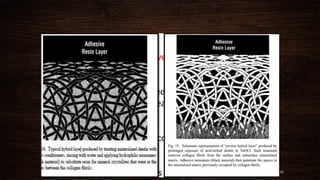
REVERSE HYBRID LAYER Prati et al 1999
 Application of NaOCI after acid etching
 Removes exposed collagen - solubilizes the fibrils down into the
underlying mineralized matrix -- creating sub micron porosities
Cylindrical channels -available for resin infiltration within the
mineralized matrix.
 Proposed as mineralized, hydrophilic alternatives to collagen rich,
hydrophobic acid- demineralized dentin, possessing increased bond
strengths
 Not recommended for clinical use.
42
43
GHOST HYBRID LAYER
• In pre bonded dentine
• Aluminum oxide air abrasion (white arrows)
results in partial removal of the original
hybrid layer (HL)
• --new ghost-like hybrid layer (HL2).
• The adhesive layer interface (ALI) was also
modified, causing incorporation of
aluminum oxide powder even after cleaning.
44
DRY BONDING
Drying dentine by blast of air
• Collapse of collagen fibres –
• Ineffective penetration
• HYBRIDOID ZONE
45
WET BONDING
WWBT (WATER WET BONDING TECHNIQUE)
• Acetone/ alcohol based primers applied to moist demineralized dentine,
– water diffuses from the wet dentine into the acetone,
– while the acetone diffuses into the demineralized dentine matrix.
• Substitution of water - chemical dehydration of the collagen network -also
increases the modulus of elasticity of collagen.
• Solvents evaporate - resin monomers occupy the spaces around the collagen
fibrils.
• Hybrid layer formation
Kanca and Gwinnett et al, in 1990s
46
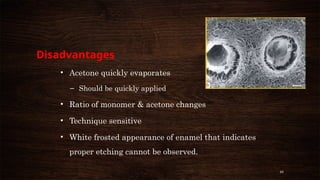
Disadvantages
• Acetone quickly evaporates
– Should be quickly applied
• Ratio of monomer & acetone changes
• Technique sensitive
• White frosted appearance of enamel that indicates
proper etching cannot be observed.
47
DRY BONDING
WITH WATER BASED PRIMERS
• Too much water -- dilute the monomer
concentration
• Bonding in which acid etched dentin is
dried
• Uses adhesive systems that use water
based primers
• Water in these primers—
– Probably plasticized the stiffened, collapsed collagen
network
– Re- expanded collagen network
– Increased permeability to primer resins.
• 35-50% HEMA in water - maximum bond
strength
48
OVER WET PHENOMENA
• Some regions in complex cavity preparations
(such as proximal boxes) may be too wet.
• When single bottle primer/adhesives are
applied
– Solvent may diffuse into the water, instead of
vice versa,
– Adhesive monomers undergo phase changes,
forming blisters, resin globules
49
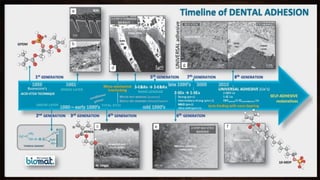
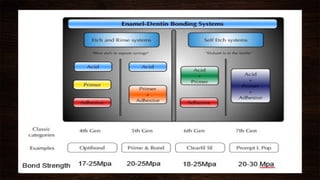
Generations of Dentin Bonding Agents
• First generation bonding agent
• Second generation bonding agents.
• Third generation bonding systems.
• Fourth generation bonding systems.
• Fifth generation bonding systems.
• Sixth generation bonding systems
• Seventh generation
• Eighth generation
Historical
Current
50
1ST
GENERATION DENTIN ADHESIVES-1960s
• Contained N-phenylglycine and glycidyl methacrylate (NPG-GMA)
• NPG-GMA is a bifunctional molecule
• One bonds to dentin through chelation with calcium on the tooth
surface while the other bonds (polymerizes) to composite resin.
• Bond strength - 1 to 3 Mpa
• Eg. Cervident (S S white Co, PA)
51
2ND
GENERATION ADHESIVES - LATE 1970s
Phosphate esters containing phenyl-P & HEMA in ethanol.
 Mechanism of action – polar interactions between negatively
charged phosphate groups in resin and positively charged Ca ion in
the smear layer.
 Bond strength - 1- 5 Mpa
Clearfil bond system F.(Kuraray)
• Disadvantages: I & II
 Low bond strength
 Bonding obtained to the smear layer, not to the dentin itself.
52
3RD
GENERATION - LATE 1980S
• Required either removal, modification or dissolution of the smear layer.
• Two component Primer / adhesive system
• PHOSPHATE BASED (HEMA+10 MDP)
• Bonding through Ca- Phosphate interaction
• Bond strength: 8-15 MPa
• Eg : Scotch bond 2 (3M Dental)
53
4TH
GENERATION – EARLY 1990s
• Hybrid layer -Nakabayashi 1982
• Total etch concept
3 Steps
– Etching
– Priming
– Bonding
54
Advantages
Good Bond strength: 17-25
Mpa.
No reduction in bond strength
when applied to moist surface
Can bond to mineralized tissue
as well as metal, amalgam,
composite and porcelain
Disadvantages
Multiple steps: Technique sensitive
• All bond 2( Bisco Dental)
• Scotch bond multipurpose( 3M
Dental
• Optibond( Kerr)
55
5TH
GENERATION- MID 1990S
2 steps
– Etching
– Priming + Bonding
Moist bonding
Removes smear layer
Total etch
56
Advantages
– Good Bond strength:20-25
Mpa.
– Time saving and simple to
use
– Some agents have
incorporated fluoride and
elastomeric components -
improve marginal integrity
Disadvantages
– Two steps: Technique sensitive
– Lack many of the components
to perform multisubstrate
bonding
– Post operative sensitivity
• Eg.Prime and Bond (Dentsply)
• Optibond Solo(Kerr)
• Single Bond 3M
57
6TH
GENERATION- EARLY 2000s
• Etchant and Primer are combined in one step. (Self etching
primers)
• Contains
– Phosphate derivatives of hydrophilic monomer such as Phenyl-P
(Acidic Monomer)
– 50% HEMA or other hydrophilic monomer -prime the dentin
Types
TYPE 1
Light / Dual cure
Applied in separate layers
Liquid 1- acidic primer and
Liquid 2- adhesive.
Solvent used is water.
Eg.Clearfil SE Bond 2(Kuraray)
TYPE II
 Light cure type
The self etch primer and adhesive
are
mixed outside and applied.
Eg AdheSE One (Ivoclar)
58
Advantages
• No need to acid etch with
phosphoric acid.
• No post conditioning rinsing
required
• Reduced post operative
sensitivity
• Simultaneous demineralization
and resin infiltration.
• Less sensitive to degree of
wetness and dryness.
• Low technique sensitivity
Disadvantages
• Less effective bonding to enamel,
Sclerotic and caries affected dentin
• Initial bond might deteriorate with
aging
• May inhibit set of self cure or dual
cure resin materials
59
7TH
GENERATION
ALL IN ONE SYSTEMS 2003
• Combine conditioning, priming & application of adhesive resin but unlike
6th
gen don’t require mixing
• Use smear layer as a bonding substrate.
• Bond strength to
– Enamel 19-32 Mpa
– Dentine 18-28 Mpa
Eg.
• iBond™ (Heraeus)
• Xeno® IV (Dentsply)
• G-Bond™ (GC)
60
61
8TH
GENERATION
NANO FILLER CONTAINING
Futurabond DC (Voco America)
• Increases penetration of resin monomers & Hybrid layer thickness
– Better enamel and dentine bond strengths
– Stress absorption
– Longer shelf life
– Decrease dimensional changes
• Draw backs
– Increased viscosity
– Accumulation of Fillers on top surface-
• Act as flaws and induce cracks
• Decrease bond strength
E Sofan Etal 2017
62
WATER TREES
• All-in-one adhesives--very acidic and very hydrophilic.
• They attract and absorb water—
– Leaching of unpolymerized monomers or hydrolytic degradation products through water-filled
channels
– Water trees
• These channels pass from the hybrid layers, through the adhesives, to the
adhesive-composite interface.
– Lower bond strength
– Reduces Bond durability.
63
REVERSE WATER TREES
• Originate from water trapped at the interface between the
adhesive and the overlying resin composite.
• During light curing,the heat generated by light curing
reflect trapped water back into less polymerized subsurface
• They spread downward with their branches pointing toward the dentin.
64
TODAYS ADHESIVES
• Etch and rinse adhesives (E & R)
• Self Etch (SE) Mild/Ultra mild
65
ETCH AND RINSE ADHESIVES (E & R)
• Positives…
• Micromechanical bonding
• Complete smear layer removal
• Best approach for enamel, the bond is long lasting
• Long track record (>20 years)
• Proven long-term clinical bonding effectiveness (>10 years)
• Annual failure rate 3.1- 5.8 %
• Possibility to apply a thick film of hydrophobic adhesive resin --
Stress absorbing potential.
66
• Negatives….
• Phosporic acid -Aggressive deep demineralization of dentin ( 4-5µm).
• Dentinal HAp -The natural protection of collagen is removed--Collagen is
deeply exposed,
• Thick hybrid layers should be produced-Deep resin infiltration needed
• E&R hybrid layers are vulnerable to leakage and enzymatic degradation.
• Chemical interaction is weak and only secondary (Van der Waals forces
Hydrogen bonding…)
67
E&R BONDING PROTOCOL-TOTAL ETCH
• Enamel
– Total removal of Smear layer -Deep pits in Enamel + dentin
– Rinse and Air dry
– White frosted appearance-Macro and Micro resin tags
– Enamel to appear white frosted
• Dentine
– Phosphoric acid- Never more than 15 sec
– WET Bonding –Mandatory for acetone based primers-technique
sensitive
– Gentle air drying for Water/Alcohol based allowed
– Application of Water/Ethanol based primer will rewet partially
collapsed Collagen fibers
– Dentine dull
68
• Application of Primer or Primer + Bonding Resin
– To be applied for at least 15 sec
– Active Rubbing dentin surface with a microbrush using light finger
pressure
• Intensify functional monomers interaction with dentin
• Massage resin into Collagen network
– Apply fresh primer out of dispensing well
– Gently air dry to evaporate primer solvent
– Glossy film should not move on airdrying
– Priming to be repeated /prolonged if dull spots are seen on primed dentine
surface
• Primer containing photo initiator better
– Polymerization of primer in the Collagen meshwork
69
• Adhesive resin application
– Adhesive resin should be in visible thick layers
– Always to be light cured
• To stabilize the adhesive interface
– Prevent water uptake from underlying dentin
• Flowable composite application on top of adhesive
– Thin film thickness
– Stabilize interface and stress absorption
70
SE ADHESIVES
• Depending on etching aggressiveness
• Strong pH< 1
• Intermediate pH ≈ 1.5
• Mild pH ≈ 2
• Ultramild pH >2.5
71
SELF ETCHING OF ENAMEL
• Strong SE-
–Etching pattern similar to Phosphoric acid(PA)
–Micromechanical retention with resin
–Difference with Phosphoric Acid
• Dissolved calcium phosphate is not rinsed off
• These embedded Calcium phosphates –very unstable-weakening
interfacial integrity
• Mild and ultra mild
–Demineralisation capacity is limited
–Bonding to enamel poor - particularly to unprepared enamel
72
WHY STRONG SE SYSTEMS ARE NOT
FAVORED NOW?
• Eg . Adper Prompt –L –Pop -- strong SE adhesive(3M ESPE)
• Functional monomer - diHEMA Phosphate
• Ca-Salt of Phosphoric acid is formed
• Ca- Salt of Phosphoric acid is not very stable-dissociates into
Phosphoric acid
• Too strong- Destabilizing dentin bonding
73
MILD & ULTRA MILD SEs
• Dentine surface is only partially demineralized – micro retention is
produced within first superficial micro meter
- micromechanical bonding
• Collagen remains surrounded and protected by Hap
– Abundantly available Ca bond with reactive functional monomer - Chemical
bonding
Mild preferred over ultra mild-Smear may interfere with bonding
74
BOND STRENGTH OF SEs TO ENAMEL
• To bur cut enamel
– Bond strength of SE adhesives significantly lower compared to E & R.
• To uncut enamel
– Outer surface of enamel-indistinct and abnormal prism structures or no
prism - stronger resistance to acid
Mild / ultramild SE - Poor bond strength - PA pre etching needed
75
• Concern regarding pre etching with PA acid-
– PA can “over etch” the parallel prismatic enamel surface-weaker bonding
– Etching of parallel prismatic enamel surface-separate the apatite crystals
and subsurface enamel prisms from deeper part of Enamel
76
MILD SELF - ETCH
• Positives….
• Shallow hybridization (<1 µm) - easy for resin to diffuse
• Partial Demineralization – Sufficient micromechanical interlocking
• Limited collagen exposure – less vulnerable for enzymatic bio degradation
• Primary (ionic) chemical interaction- depends on functional monomer
• Long track record especially for 2 step self adhesives - >20 Yrs
• Proven long term clinical bonding effectiveness - > 10 Yrs
• Lowest annual failure rate – 2.5 to 3.8 %
• Possibility to apply thick film of hydrophobic adhesive resin - providing stress
absorbing potential.
77
• Negatives….
• Enamel – Poor bond strength
• Potential smear layer interference (ultra mild/mild )
• Functional monomers sensitive for hydrolytic degradation
78
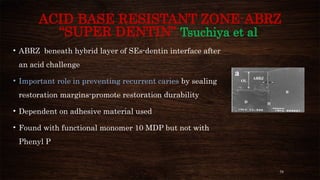
ACID BASE RESISTANT ZONE-ABRZ
“SUPER DENTIN” Tsuchiya et al
• ABRZ beneath hybrid layer of SEs-dentin interface after
an acid challenge
• Important role in preventing recurrent caries by sealing
restoration margins-promote restoration durability
• Dependent on adhesive material used
• Found with functional monomer 10 MDP but not with
Phenyl P
79
PREFERRED BONDING TECHNIQUE
SELECTIVE ETCHING - PROTOCOL
• Selectively etch enamel -30-50% Phosphoric acid- 15 Sec
• Thorough rinsing with water and air dry
• Actively rub 10 MDP based mild SE for at least 15 Sec
– Longer the better
– Continuously supply fresh primer onto the dentin
• Gentle air dry for solvent evaporation
• Apply adhesive resin in a visibly thick layer
– Stress absorption
• Light cure
80
10-MDP
• Most effective functional monomer available now
1. Methacrylate functional groups at one end
– copolymerises with the adhesive
2. Hydrophilic phosphoric acid ester functional group at the other end
– ionically bonds to Ca of Hap
3. Longer Carbon spacer group
– prevents steric hindrance between methacrylate and phosphoric acid ester group
– provides hydrophobicity to reduce water sorption
– Enable parallel alignment of adjacent 10-MDP molecules during nanolayering
81
4. Has substantial etching effects
– produces micromechanical interlocking
– releases Ca substantially from dentin-10-MDP nanolayering
• 10 MDP ionically react with Ca Producing CaRPO4 structure
resistant to water and acids
• Nano layering results in stable 3D structures –contribute to
bond durability
82
SHORTCOMINGS OF 10 MDP
• Sensitive to hydrolytic breakdown (SEs contain water)
– Degrade to hydrodecyl dihydrogen phosphate and methacrylate
• Attempts to overcome hydrolytic breakdown
– Analoges of 10-MDP
• Hydrloytically stable Phosphonate and acrylamide based monomers-Not
effective as 10MDP
• Fluoro carbon functional monomers MF8P and MF10 P (Kuraray
Noritake)-promising but very expensive
83
STRATEGIES
TO PRESERVE BOND STABILITY
1.Non-Thermal Atmospheric Plasma Treatment (NTAP)
• Highly reactive particles-cross link rapidly to form various functional
groups on the surface of the substrates
NTAP of Dentine-
– Increased surface wettability, improved resin polymerization, deeper
resin penetration
– Activates the dentin surface by depositing free radicals or peroxides,
thereby intensifying the interaction between adhesive monomers and
dentin collagen.
• Present status-No consistent results-not considered sufficiently effective
84
2.Ethanol wet bonding-for E &R
Strategy
• Gradual exchange of dentine surface water for ethanol
• Serving as better medium for infiltration of hydrophobic resin into
the collagen-fibril network deeply exposed by Phosphoric acid.
• THEORETICALLY MOST EFFECTIVE STRATEGY
• Clinically impractical as successive ethanol applications requires at
least several minutes
85
3. Inhibition of enzymatic degradation
• MMPs along with cysteine cathepsin
• Linked to degradation of adhesive-dentine interfaces
• Present status
– MMPs are released by phosphoric acid etching in E & R mode
– Not always confirmed in SE adhesives
• Hydrolytic breakdown due to water sorption –Causes more relevant
bond degradation.
• Doubtful role of MMPs in bond failure
86
• Most common MMP inhibitor - Chlorhexidine gluconate
i. incorporated into etchant
– ii. incorporated in adhesive
– iii. applied as a solution directly on dentin after etching
• Retards bond degradation
• Not detected beyond 1 year
• Present status-Does not harm bonding but beneficial effect not
supported by evidence
87
4.Dentin biomodification by collagen cross –linking
• Basic principle
– Inhibit MMPs
• Enhance intra and inter molecular cross linking of collagen- Collagen
more resistant to biodegradation
– Natural – Proanthocyanidin (appln time 10 min-40h), Riboflavin
– Synthetic – Gluteraldhehyde - reduce cell viability-not advised now
• Benefits not that substantiated but some evidence regarding improvement
with 60 sec application also seen.
88
5.Biomimetic repair of E &R hybrid layers by
Remineralization Tay & Pashley 2008
• Aim –To prevent degradation of denuded collagen within incompletely resin –
infiltrated adhesive dentine interfaces produced by E& R adhesives
• Possible in lab-Intra and inter fibrillar remineralization after several months
• Applicability in clinical setting –doubtful, time consuming
• Defies logic –Why to demineralize first n then try remineralization when you
have SE (Partial demineralization+ Most collagen surrounded/protected by
mineral.)
89
6.Effective Polymerization of adhesives
• General guideline
– Always light cure adhesive immediately, separately
– Blocks water uptake from underlying wet dentine through osmosis
• For direct restorations
– Apply adhesive in visibly thick layer
• For indirect restorations
– Thoroughly air thin until adhesive no longer moves and does not pool
prior to light curing
• Use of warm air stream (60 degree) for solvent evaporation
– Increase the immediate and the six-month resin-dentin BS
90
• Extend light curing time
• Higher energy density (produced by the longer exposure times)
enhances the formation of free radicals, which initiates
polymerization.
– Heat produced by light curing units mainly during prolonged
exposure time, is likely to increase solvent evaporation rates.
– This may provide room for the formation of a high-molecular weight
and cross-linked polymer
• Delayed light-curing protocol
– Can ensure better resin penetration and faster solvent evaporation.
91
7.Extra Hydrophobic Resin Sealing
• Most clinically possible technique
–Placement of an extra adhesive layer results in
1.Higher hydrophobicity
2.Better polymerization efficiency
3.thicker film thickness
–Prevents water sorption from wet underlying dentine
• Alternate technique
–Apply flowable composite on top of low film thickness adhesive
• ELASTIC BONDING CONCEPT
92
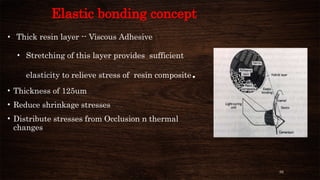
Elastic bonding concept
• Thick resin layer -- Viscous Adhesive
• Stretching of this layer provides sufficient
elasticity to relieve stress of resin composite.
• Thickness of 125um
• Reduce shrinkage stresses
• Distribute stresses from Occlusion n thermal
changes
93
8. Ionic Bonding of 10 MDP with HAP &
10 MDP – Ca salt nano layering
• For -Mild self etch n Universal adhesives
• Based on
–Adhesion-decalcification (AD) concept
Bart Van Meerbeek et al 2020
94
ADHESION-DECALCIFICATION CONCEPT
• 10-MDP-acidic functional monomer
• Limited surface decalcification and etching effects on HAp
-Micro retention
• Ionically interact through their phosphate group to Ca of HAp
• Calcium released causes 10-MDP to self assemble into 4 nm nanolayers
– stable 10-MDp salt formation
• Thus mild SEs & UAs bond to teeth chemically
95
Adhesion-Decalcification Concept
• Causes durable nano layering of 10-MDP Ca Salts in Hybrid and
adhesive layer
– Improve clinical longevity of adhesive restorations
96
UNIVERSAL ADHESIVES/
MULTIMODE ADHESIVES - 2011
• Can be used in E&R / SE /Selective etching modes
• Bonds to Enamel/Dentine/Glass rich Ceramics (through Silane) or Glass
poor Zirconia (Via 10-MDP) and metal alloys
• Multitude of clinical situations-Direct, indirect restorations, resin coating,
core built ups, Zirconia primer, tooth desensitizer
• Modifications of 1- Step SE adhesives
• Long term bonding - still unproven
97
SHORTCOMINGS
1. Low film thickness, less than 10 microns
– Oxygen inhibition-suboptimal polymerization
– Insufficient stabilization of adhesive layer-water sorption
– Reduce adhesive layers stress absorption capacity
2.Many UAs contain HEMA
– Highly Hydrophilic-Promotes water uptake from underlying dentine
– Adhesive interface undergoes hydrolysis
3.Compromised bonding bec of incorporated silane
– Silane unstable in acidic environment-Hence UAs should have pH
more than 2.
• This decreases etching potential of UAs
98
4.10-MDP spacer connecting methacrylate and phosphate groups
at both monomer ends
– sensitive to hydrolytic degeneration
5.MDP concentration and quality affects bonding effectiveness
– Different brands of UAs- Different performance
99
FUTURE….
• Bioactive adhesive materials
• Anti bacterial, anti enzymatic and remineralization
effects-
–Bioactivity with mechanical stability is the challenge
• Antibacterial monomer 12-methacryloxyloxydodecyl
pyridinium bromide (MDPB)
–Added to Clearfil SE Protect(Kuraray)
–Not clinically proven
• Chlorhexidine and Nano silver containing adhesives-
–Uncontrolled shot-lived burst release.
100
• Cetylpyridinium Chloride(CPC)
– Added to bonding resin
• Antibacterial effect confined to area directly in contact
• CPC incorporated in poly 2 hydroxy ethyl
methacrylate/trimethylolpropane trimethacrylate hydrogels
– Short release but can be recharged
– High water sorption
• CPC loaded into inorganic compounds for controlled release of CPC
– CPC incorporated in montmorillonite(Mont) Clay-CPC_ Mont
• Rechargeable
• Antibacterial
• No reduction in bonding
101
• Self adhesive restoratives
– Eg. Vertise Flow (Kerr) - No etching No bonding
• Retention rate very low
• After 24 months-only 62.9%
• Self adhesive (bulk fill)restorative
– Surefil One (Dentsply Sirona)
– Withdrawn
• Activa Bioactive Restorative (Pulpdent)
– Chemically bonds to teeth
– Unacceptable very high failure rate
– Now Company advices etching and bonding
102
ALTERNATIVES TO PHOSPHORIC ACID(PA)
• Double layer application of Universal adhesives
– To increase enamel bonding
• Active application of UA in SE mode
– To increase enamel bonding
• Active application in E & R mode X
– Significantly lower enamel bond strength- (Imai A etal-2017)
• Alternative etchants with milder acidity than PA
– To prevent degradation of Dentin
• Phosphoric acid ester monomer - PPM
• Poly alkenoic acid
• Proprietary etchants-ME (Yamakin)-EC-Shofu , ZON (Ivoclar)
103
CONCLUSIONS
Adhesive Dentistry is fast evolving….
104
References
• Van Meerbeek B, Yoshihara K, Van Landuyt K, Yoshida Y, Peumans M. From Buonocore's Pioneering
Acid-Etch Technique to Self-Adhering Restoratives. A Status Perspective of Rapidly Advancing Dental
Adhesive Technology. J Adhes Dent. 2020;22(1):7-34. doi: 10.3290/j.jad.a43994. PMID: 32030373.
• Jorge Perdigão; Current perspectives on dental adhesion: (1) Dentin adhesion – not there yet; Japanese
Dental Science Review 56 (2020) 190–207
• Jorge Perdigao etal ;Adhesive dentistry: Current concepts and clinical considerations : J Esthet Restor
Dent. 2020;1–18.
• Eliseu A. Münchow and Marco C. Bottino ; Recent Advances in Adhesive Bonding - The Role of
Biomolecules, Nanocompounds, and Bonding Strategies in Enhancing Resin Bonding to Dental
Substrates; Curr Oral Health Rep. 2017 September ; 4(3): 215–227. doi:10.1007/s40496-017-0146-y
• Takaaki Sato et al ;Update on Enamel Bonding Strategies; Front. Dent. Med. 2:666379. doi:
10.3389/fdmed.2021.666379
• Duarte et al ; Adhesive Resin Cements for Bonding Esthetic Restorations: A Review;, Biomaterials update
QDT 2011
105
Thank You

Dentine Bonding Current Perspectives.pptx

  • 1.
  • 2.
    2 What comes inthis? • History • The basics • Components of Dental Adhesive Systems • Enamel Bonding • Dentine Bonding • Generations of DBAs • Today’s Adhesives • Strategies to preserve bond stability • Universal adhesives • Future • Conclusion
  • 3.
    3 “Marriage is asacred bond between two imperfect souls, which is made possible by God” Dave Willis “Bonding in dentistry may be a marriage between two imperfect surfaces (resin and tooth) made possible by the dentist”
  • 4.
    4 HISTORY • 1951 -Oscar Hagger - Developed an acidic GPADMA - permitted resin adhesion to dentin. • 1955 - The foundation for adhesives • Buonocore - Acid etching of enamel-Based on industrial use of 85% phosphoric acid for 30 seconds. • 1957 - Bowen -bisphenol A-glycidyl methacrylate resin -first composite material. • 1960-1970’s - 1st and 2nd Generation bonding agents • 1963 - Boyde and Steward- first described Smear layer. • 1970 - Eick et al Composition of smear layer and its role in Bonding. • 1975 - Gwinnett and Silver stone - 3 patterns of etching in enamel • 1979 –Fusayama- Total etch concept
  • 5.
    5 • 1980’s –3rd Generation Bonding agents • 1982- Nakabayashi - Hybrid layer • Early 1990’s – 4th Generation Dentin bonding system • 1992 - Kanca et al -Wet bonding technique • 1999 - Prati and Pashley - Reverse Hybrid layer • Mid 1990s - 5th Generation Dentin Bonding Systems • Early 2000’s - 6th Generation Dentin Bonding Systems • 2003 -7th Generation Dentin Bonding System • 2010 -8th Generation Dentin Bonding System • 2011-Universal adhesives
  • 6.
  • 7.
    7 ADHESION- THE BASICS •ADHESIVE/ ADHERENT- A material, that joins two substrates together and solidifies and is able to transfer a load from one surface to the other. • ADHEREND- Material to which an adhesive is applied • ADHESION -Intermolecular attraction that exists between molecules of two unlike substances when placed in intimate contact with each other. • COHESION- Force with which molecules of the same kind are attracted.
  • 8.
  • 9.
    9 WETTING OF ALIQUID • Surface Energy-Intermolecular forces at the interface between two media • Surface Tension-The force that holds liquid molecules together.
  • 10.
    10 REQUIREMENTS FOR GOODADHESION • Clean adherend • Good wetting • Intimate Contact • Bonding • Good polymerisation
  • 11.
    11 CO-FACTORS FOR ADHESION •Surface roughness • Surface Energy of Substrate – High for etched enamel – Low for smear layer covered dentine • Bond promoting effects – Eg. Capillary forces-Etched enamel • Hydrophilicity/phobicity • Interfacial pores(air/moisture)
  • 12.
    12 SUBSTRATES Enamel / Dentin/ Cementum Enamel • Ideal • Dry • Mineral - 92 Vol % - Hydroxyapatite Dentin • Complex • Moist • 45 Vol % Hydroxyapatite • More Organic - 33 Vol % - • Predominantly-Type I Collagen • Approx 32%-Water • Water content-increases 20 X from superficial to deep
  • 13.
    13 • Tubular structure •Mean tubular volume – Total in Coronal dentin-10% – Near DEJ 4% – Near pulp 28 % • Dentinal tubular fluids- – Outward pressure of 25-30 mm of Hg • Odontoblastic processes • Intratubular Collagen fibers • Rods/ Prisms • Major inorganic fraction – Submicron crystallites distributed in key-hole pattern.
  • 14.
    14 DIFFERENCES BETWEEN ENAMEL ANDDENTINE HYDROXYAPATITE • Larger • More regular and parallel oriented • Smaller • Arranged criss cross pattern within organic matrix- – Micro-mechanical interlocking difficult – Chemical bonding facilitated
  • 15.
    15 SMEAR LAYER-REMOVE ORRETAIN?? Remove…  Tubules are open for good retention  The exposed collagen network provides reactive groups that can chemically interact with primers.  Exposed collagen promotes micro mechanical bonding to resin Retain….  Protective barrier.  Lowers dentinal permeability.  Lowers pulpal pressure  Use of bonding agents that can penetrate the smear layer and incorporate into bonding layer
  • 16.
    16 COMPONENTS OF DENTAL ADHESIVESYSTEMS • Etchant • Primer • Dentin adhesive / Bonding resin
  • 17.
    17 ETCHANTS 30-40% Phosphoric acid Thickeners(Silica micro particles or Xanthum gums ) Colour dye Glycol for wettability and to decrease viscosity Organic – Maleic acid – Tartaric acid – Citric acid – EDTA – Acidic monomers-SE systems Polymeric - Polyacrylic acid Mineral acids – Hydrochloric acid – Nitric acid – Hydrofluoric acid
  • 18.
    18 CALCIUM CHELATORS Remove smearlayer without decalcification or significant physical changes in the underlying dentin substrate. EDTA • pH - 7.4 Tublicid : – 0.1% EDTA – 0.15% Benzalkonium chloride • Scrubbed on the surface for a few seconds, • Smear layer removal, smear plug intact
  • 19.
    19 LASERS & AIRABRASION • Nd: YAG lasers used at 10-30 pulses per second – The surface is desensitized by occlusion of open and permeable dentinal tubules. • Air abrasion: – Aluminium oxide particles of particle size of 0.5 microns are used
  • 20.
    20 PRIMERS Bifunctional monomer ina volatile solvent such as acetone or alcohol hydrophilic, low viscosity Adhesion promoting agents • Displaces residual moisture in dentine • Wets and envelops the exposed collagen fibrils. • Carry monomers into interfibrillar channels • Transforms hydrophilic dentine into hydrophobic • Increases surface free energy SEs use acidic monomers as primers
  • 21.
    21 COMMONLY USED PRIMERS •30-55% HEMA (Hydroxy ethyl methacrylate)- most commonly used • 2-5% NTG-GMA (N-Tolyglycine- glycidyl methacrylate) • 16% BPDM (Biphenyl dimethacrylate) • 6% PENTA( dipentaerythritol penta acrylate monophosphate) • 10% PMDM (Pyromellitic acid diethyl methacrylate)
  • 22.
    22 DENTIN ADHESIVES /BONDING RESIN • Thin layer of resin applied between conditioned dentin and composite. • Link between hydrophilic primer and hydrophobic composite – Co polymerizes with the primer molecules and restorative resin • Form resin tags to seal open dentinal tubules • Stabilizes the formed hybrid layer and resin tags • Commonly used Bis GMA, UDMA, TEGDMA, Methacrylated phosphates, PENTA. • Act as a stress relaxation buffer - relieve polymerization stresses • Usually unfilled but may contain fillers ( Optibond Solo, Prime and bond NT)
  • 23.
    23 • Initiators andAccelerators: Light cured: - Camphoroquinone and organic amine Dual cured bonding agents : - Catalyst to promote self curing • Fillers: Mostly unfilled Inorganic fillers 0.5% to 40% by wt. Microfillers or nanofillers Functions of nanofillers – Prevents nanoleakage – Causes uniform thickness of adhesive layer – Better flexibility to adhesives – Better dissipation of forces
  • 24.
    24 SOLVENTS • Acetone, Ethanol,Water • Acetone evaporates fast- requires shortest drying time in mouth. • Ethanol evaporates more slowly-moderate drying time • Water evaporates very slowly-longest drying time.
  • 25.
    25 ENAMEL BONDING Etching  Theobjectives of enamel etching :  Clean the enamel  Remove enamel smear layer  Creates micropores(5-10 µm)  Removal of prismatic and interprismatic mineral crystals  Increase surface energy of enamel x 2000
  • 26.
    26 ETCHING PATTERNS (Silverstoneet al 1975 ) Type I • Involves dissolution of prism cores without dissolution of prism peripheries - HONEY COMB Type II • The peripheral enamel is dissolved, but the cores are left intact - COBBLESTONE
  • 27.
    27 Type III • Mixtureof • Type I • & • Type II configurations Type IV • Shows a pitted enamel surface • Random distribution of depressions with no preferential destruction of either cores or peripheries. • These areas occasionally occur in little patches over enamel surface
  • 28.
    28 Type V • Extremelyflat and smooth • Lacking micro irregularities for penetration and retention of resins • Similar to Type IV patterns – No evidence of prism outlines seen.
  • 29.
    29 ENAMEL BONDING AGENTS Usedin the past - – Consists of bis-GMA or UDMA resins with diluents like TEGDMA. • Flow easily into the microporosities of enamel. Now – EBAs replaced by DBAs. Advantage • Simultaneous bonding to both enamel and dentin possible
  • 30.
    30 RESIN TAGS Macro tags- space surrounding the enamel prisms Micro tags- result from resin infiltration / polymerization within the tiny etch-pits at the cores of the etched enamel prisms. Major contribution to retention to enamel.
  • 31.
    31 DENTIN BONDING Etching dentine Changesin Intertubular dentin Exposes longitudinally/obliquely oriented collagen fibers Changes in peritubular dentin Opens tubule orifices in typical funnel shape configuration Exposes circularly oriented collagen fibril arrangement Decrease surface energy Increase surface roughness Demineralization; 3-5µm Exposing a scaffold of Collagen fibers that is depleted of HAp
  • 32.
    32 Dentine bonding…. • Applicationof Primer – Containing hydrophilic monomers like HEMA in Organic solvents • Solvents displace water from dentine • HEMA improves wettability • Promotes re-expansion of Collagen network • Make hydrophilic dentin hydrophobic
  • 33.
    33 Dentine Bonding…. Application ofadhesive Resin Adhesive resin applied on prepared surface Penetration of hydrophobic monomers into interfibrillar spaces of Collagen network & into dentinal tubules Monomers polymerized in situ- Hybrid layer
  • 34.
  • 35.
    35 Hybridization (Nakabayashi,1982) • Structureformed in dental hard tissues by demineralization of the surface and subsurface, followed by infiltration of monomers and subsequent polymerization.
  • 36.
    36 ZONES OF HYBRIDLAYER (Perdiago 1996) Top layer : Amorphous electron dense phase consisting of denatured collagen. Middle layer : Collagen fibrils separated by electrolucent spaces of 10- 20 nm. Bottom layer : Gradual transition to underlying unaltered dentin partially demineralized containing HA crystals enveloped by resin.
  • 37.
    37 ULTRAMORPHOLOGIC FEATURES OF HYBRIDISATION •Shag carpet appearance • Tubule wall hybridization • Lateral tubule hybridization
  • 38.
    38 SHAG CARPET APPEARANCE(Bradjdic et al 2008) • Appears when acid etched dentin surface is actively scrubbed with an acidic primer solution. • Mechanical + Chemical action- – Dissolves additional mineral salts – Causes fluffing and separation of entangled collagen at the surface. • Loose organization of collagen fibrils directed towards the adhesive resin often unraveled into their micro-fibrils.
  • 39.
    39 TUBULE WALL HYBRIDIZATION •Extension of the hybrid layer into tubule wall area. • Hermetically seals the pulp dentinal complex against microleakage. • Especially protective when bond fails at top or bottom of the hybrid layer • Tubule wall hybridization ensures a leakage free seal of tubules
  • 40.
    40 LATERAL TUBULE HYBRIDIZATION •Formation of tiny hybrid layer into the walls of lateral tubule branches. • This microversion of hybrid layer typically surrounds a central core of resin called microresin tag.
  • 41.
    41 REVERSE HYBRID LAYERPrati et al 1999  Application of NaOCI after acid etching  Removes exposed collagen - solubilizes the fibrils down into the underlying mineralized matrix -- creating sub micron porosities Cylindrical channels -available for resin infiltration within the mineralized matrix.  Proposed as mineralized, hydrophilic alternatives to collagen rich, hydrophobic acid- demineralized dentin, possessing increased bond strengths  Not recommended for clinical use.
  • 42.
  • 43.
    43 GHOST HYBRID LAYER •In pre bonded dentine • Aluminum oxide air abrasion (white arrows) results in partial removal of the original hybrid layer (HL) • --new ghost-like hybrid layer (HL2). • The adhesive layer interface (ALI) was also modified, causing incorporation of aluminum oxide powder even after cleaning.
  • 44.
    44 DRY BONDING Drying dentineby blast of air • Collapse of collagen fibres – • Ineffective penetration • HYBRIDOID ZONE
  • 45.
    45 WET BONDING WWBT (WATERWET BONDING TECHNIQUE) • Acetone/ alcohol based primers applied to moist demineralized dentine, – water diffuses from the wet dentine into the acetone, – while the acetone diffuses into the demineralized dentine matrix. • Substitution of water - chemical dehydration of the collagen network -also increases the modulus of elasticity of collagen. • Solvents evaporate - resin monomers occupy the spaces around the collagen fibrils. • Hybrid layer formation Kanca and Gwinnett et al, in 1990s
  • 46.
    46 Disadvantages • Acetone quicklyevaporates – Should be quickly applied • Ratio of monomer & acetone changes • Technique sensitive • White frosted appearance of enamel that indicates proper etching cannot be observed.
  • 47.
    47 DRY BONDING WITH WATERBASED PRIMERS • Too much water -- dilute the monomer concentration • Bonding in which acid etched dentin is dried • Uses adhesive systems that use water based primers • Water in these primers— – Probably plasticized the stiffened, collapsed collagen network – Re- expanded collagen network – Increased permeability to primer resins. • 35-50% HEMA in water - maximum bond strength
  • 48.
    48 OVER WET PHENOMENA •Some regions in complex cavity preparations (such as proximal boxes) may be too wet. • When single bottle primer/adhesives are applied – Solvent may diffuse into the water, instead of vice versa, – Adhesive monomers undergo phase changes, forming blisters, resin globules
  • 49.
    49 Generations of DentinBonding Agents • First generation bonding agent • Second generation bonding agents. • Third generation bonding systems. • Fourth generation bonding systems. • Fifth generation bonding systems. • Sixth generation bonding systems • Seventh generation • Eighth generation Historical Current
  • 50.
    50 1ST GENERATION DENTIN ADHESIVES-1960s •Contained N-phenylglycine and glycidyl methacrylate (NPG-GMA) • NPG-GMA is a bifunctional molecule • One bonds to dentin through chelation with calcium on the tooth surface while the other bonds (polymerizes) to composite resin. • Bond strength - 1 to 3 Mpa • Eg. Cervident (S S white Co, PA)
  • 51.
    51 2ND GENERATION ADHESIVES -LATE 1970s Phosphate esters containing phenyl-P & HEMA in ethanol.  Mechanism of action – polar interactions between negatively charged phosphate groups in resin and positively charged Ca ion in the smear layer.  Bond strength - 1- 5 Mpa Clearfil bond system F.(Kuraray) • Disadvantages: I & II  Low bond strength  Bonding obtained to the smear layer, not to the dentin itself.
  • 52.
    52 3RD GENERATION - LATE1980S • Required either removal, modification or dissolution of the smear layer. • Two component Primer / adhesive system • PHOSPHATE BASED (HEMA+10 MDP) • Bonding through Ca- Phosphate interaction • Bond strength: 8-15 MPa • Eg : Scotch bond 2 (3M Dental)
  • 53.
    53 4TH GENERATION – EARLY1990s • Hybrid layer -Nakabayashi 1982 • Total etch concept 3 Steps – Etching – Priming – Bonding
  • 54.
    54 Advantages Good Bond strength:17-25 Mpa. No reduction in bond strength when applied to moist surface Can bond to mineralized tissue as well as metal, amalgam, composite and porcelain Disadvantages Multiple steps: Technique sensitive • All bond 2( Bisco Dental) • Scotch bond multipurpose( 3M Dental • Optibond( Kerr)
  • 55.
    55 5TH GENERATION- MID 1990S 2steps – Etching – Priming + Bonding Moist bonding Removes smear layer Total etch
  • 56.
    56 Advantages – Good Bondstrength:20-25 Mpa. – Time saving and simple to use – Some agents have incorporated fluoride and elastomeric components - improve marginal integrity Disadvantages – Two steps: Technique sensitive – Lack many of the components to perform multisubstrate bonding – Post operative sensitivity • Eg.Prime and Bond (Dentsply) • Optibond Solo(Kerr) • Single Bond 3M
  • 57.
    57 6TH GENERATION- EARLY 2000s •Etchant and Primer are combined in one step. (Self etching primers) • Contains – Phosphate derivatives of hydrophilic monomer such as Phenyl-P (Acidic Monomer) – 50% HEMA or other hydrophilic monomer -prime the dentin Types TYPE 1 Light / Dual cure Applied in separate layers Liquid 1- acidic primer and Liquid 2- adhesive. Solvent used is water. Eg.Clearfil SE Bond 2(Kuraray) TYPE II  Light cure type The self etch primer and adhesive are mixed outside and applied. Eg AdheSE One (Ivoclar)
  • 58.
    58 Advantages • No needto acid etch with phosphoric acid. • No post conditioning rinsing required • Reduced post operative sensitivity • Simultaneous demineralization and resin infiltration. • Less sensitive to degree of wetness and dryness. • Low technique sensitivity Disadvantages • Less effective bonding to enamel, Sclerotic and caries affected dentin • Initial bond might deteriorate with aging • May inhibit set of self cure or dual cure resin materials
  • 59.
    59 7TH GENERATION ALL IN ONESYSTEMS 2003 • Combine conditioning, priming & application of adhesive resin but unlike 6th gen don’t require mixing • Use smear layer as a bonding substrate. • Bond strength to – Enamel 19-32 Mpa – Dentine 18-28 Mpa Eg. • iBond™ (Heraeus) • Xeno® IV (Dentsply) • G-Bond™ (GC)
  • 60.
  • 61.
    61 8TH GENERATION NANO FILLER CONTAINING FuturabondDC (Voco America) • Increases penetration of resin monomers & Hybrid layer thickness – Better enamel and dentine bond strengths – Stress absorption – Longer shelf life – Decrease dimensional changes • Draw backs – Increased viscosity – Accumulation of Fillers on top surface- • Act as flaws and induce cracks • Decrease bond strength E Sofan Etal 2017
  • 62.
    62 WATER TREES • All-in-oneadhesives--very acidic and very hydrophilic. • They attract and absorb water— – Leaching of unpolymerized monomers or hydrolytic degradation products through water-filled channels – Water trees • These channels pass from the hybrid layers, through the adhesives, to the adhesive-composite interface. – Lower bond strength – Reduces Bond durability.
  • 63.
    63 REVERSE WATER TREES •Originate from water trapped at the interface between the adhesive and the overlying resin composite. • During light curing,the heat generated by light curing reflect trapped water back into less polymerized subsurface • They spread downward with their branches pointing toward the dentin.
  • 64.
    64 TODAYS ADHESIVES • Etchand rinse adhesives (E & R) • Self Etch (SE) Mild/Ultra mild
  • 65.
    65 ETCH AND RINSEADHESIVES (E & R) • Positives… • Micromechanical bonding • Complete smear layer removal • Best approach for enamel, the bond is long lasting • Long track record (>20 years) • Proven long-term clinical bonding effectiveness (>10 years) • Annual failure rate 3.1- 5.8 % • Possibility to apply a thick film of hydrophobic adhesive resin -- Stress absorbing potential.
  • 66.
    66 • Negatives…. • Phosporicacid -Aggressive deep demineralization of dentin ( 4-5µm). • Dentinal HAp -The natural protection of collagen is removed--Collagen is deeply exposed, • Thick hybrid layers should be produced-Deep resin infiltration needed • E&R hybrid layers are vulnerable to leakage and enzymatic degradation. • Chemical interaction is weak and only secondary (Van der Waals forces Hydrogen bonding…)
  • 67.
    67 E&R BONDING PROTOCOL-TOTALETCH • Enamel – Total removal of Smear layer -Deep pits in Enamel + dentin – Rinse and Air dry – White frosted appearance-Macro and Micro resin tags – Enamel to appear white frosted • Dentine – Phosphoric acid- Never more than 15 sec – WET Bonding –Mandatory for acetone based primers-technique sensitive – Gentle air drying for Water/Alcohol based allowed – Application of Water/Ethanol based primer will rewet partially collapsed Collagen fibers – Dentine dull
  • 68.
    68 • Application ofPrimer or Primer + Bonding Resin – To be applied for at least 15 sec – Active Rubbing dentin surface with a microbrush using light finger pressure • Intensify functional monomers interaction with dentin • Massage resin into Collagen network – Apply fresh primer out of dispensing well – Gently air dry to evaporate primer solvent – Glossy film should not move on airdrying – Priming to be repeated /prolonged if dull spots are seen on primed dentine surface • Primer containing photo initiator better – Polymerization of primer in the Collagen meshwork
  • 69.
    69 • Adhesive resinapplication – Adhesive resin should be in visible thick layers – Always to be light cured • To stabilize the adhesive interface – Prevent water uptake from underlying dentin • Flowable composite application on top of adhesive – Thin film thickness – Stabilize interface and stress absorption
  • 70.
    70 SE ADHESIVES • Dependingon etching aggressiveness • Strong pH< 1 • Intermediate pH ≈ 1.5 • Mild pH ≈ 2 • Ultramild pH >2.5
  • 71.
    71 SELF ETCHING OFENAMEL • Strong SE- –Etching pattern similar to Phosphoric acid(PA) –Micromechanical retention with resin –Difference with Phosphoric Acid • Dissolved calcium phosphate is not rinsed off • These embedded Calcium phosphates –very unstable-weakening interfacial integrity • Mild and ultra mild –Demineralisation capacity is limited –Bonding to enamel poor - particularly to unprepared enamel
  • 72.
    72 WHY STRONG SESYSTEMS ARE NOT FAVORED NOW? • Eg . Adper Prompt –L –Pop -- strong SE adhesive(3M ESPE) • Functional monomer - diHEMA Phosphate • Ca-Salt of Phosphoric acid is formed • Ca- Salt of Phosphoric acid is not very stable-dissociates into Phosphoric acid • Too strong- Destabilizing dentin bonding
  • 73.
    73 MILD & ULTRAMILD SEs • Dentine surface is only partially demineralized – micro retention is produced within first superficial micro meter - micromechanical bonding • Collagen remains surrounded and protected by Hap – Abundantly available Ca bond with reactive functional monomer - Chemical bonding Mild preferred over ultra mild-Smear may interfere with bonding
  • 74.
    74 BOND STRENGTH OFSEs TO ENAMEL • To bur cut enamel – Bond strength of SE adhesives significantly lower compared to E & R. • To uncut enamel – Outer surface of enamel-indistinct and abnormal prism structures or no prism - stronger resistance to acid Mild / ultramild SE - Poor bond strength - PA pre etching needed
  • 75.
    75 • Concern regardingpre etching with PA acid- – PA can “over etch” the parallel prismatic enamel surface-weaker bonding – Etching of parallel prismatic enamel surface-separate the apatite crystals and subsurface enamel prisms from deeper part of Enamel
  • 76.
    76 MILD SELF -ETCH • Positives…. • Shallow hybridization (<1 µm) - easy for resin to diffuse • Partial Demineralization – Sufficient micromechanical interlocking • Limited collagen exposure – less vulnerable for enzymatic bio degradation • Primary (ionic) chemical interaction- depends on functional monomer • Long track record especially for 2 step self adhesives - >20 Yrs • Proven long term clinical bonding effectiveness - > 10 Yrs • Lowest annual failure rate – 2.5 to 3.8 % • Possibility to apply thick film of hydrophobic adhesive resin - providing stress absorbing potential.
  • 77.
    77 • Negatives…. • Enamel– Poor bond strength • Potential smear layer interference (ultra mild/mild ) • Functional monomers sensitive for hydrolytic degradation
  • 78.
    78 ACID BASE RESISTANTZONE-ABRZ “SUPER DENTIN” Tsuchiya et al • ABRZ beneath hybrid layer of SEs-dentin interface after an acid challenge • Important role in preventing recurrent caries by sealing restoration margins-promote restoration durability • Dependent on adhesive material used • Found with functional monomer 10 MDP but not with Phenyl P
  • 79.
    79 PREFERRED BONDING TECHNIQUE SELECTIVEETCHING - PROTOCOL • Selectively etch enamel -30-50% Phosphoric acid- 15 Sec • Thorough rinsing with water and air dry • Actively rub 10 MDP based mild SE for at least 15 Sec – Longer the better – Continuously supply fresh primer onto the dentin • Gentle air dry for solvent evaporation • Apply adhesive resin in a visibly thick layer – Stress absorption • Light cure
  • 80.
    80 10-MDP • Most effectivefunctional monomer available now 1. Methacrylate functional groups at one end – copolymerises with the adhesive 2. Hydrophilic phosphoric acid ester functional group at the other end – ionically bonds to Ca of Hap 3. Longer Carbon spacer group – prevents steric hindrance between methacrylate and phosphoric acid ester group – provides hydrophobicity to reduce water sorption – Enable parallel alignment of adjacent 10-MDP molecules during nanolayering
  • 81.
    81 4. Has substantialetching effects – produces micromechanical interlocking – releases Ca substantially from dentin-10-MDP nanolayering • 10 MDP ionically react with Ca Producing CaRPO4 structure resistant to water and acids • Nano layering results in stable 3D structures –contribute to bond durability
  • 82.
    82 SHORTCOMINGS OF 10MDP • Sensitive to hydrolytic breakdown (SEs contain water) – Degrade to hydrodecyl dihydrogen phosphate and methacrylate • Attempts to overcome hydrolytic breakdown – Analoges of 10-MDP • Hydrloytically stable Phosphonate and acrylamide based monomers-Not effective as 10MDP • Fluoro carbon functional monomers MF8P and MF10 P (Kuraray Noritake)-promising but very expensive
  • 83.
    83 STRATEGIES TO PRESERVE BONDSTABILITY 1.Non-Thermal Atmospheric Plasma Treatment (NTAP) • Highly reactive particles-cross link rapidly to form various functional groups on the surface of the substrates NTAP of Dentine- – Increased surface wettability, improved resin polymerization, deeper resin penetration – Activates the dentin surface by depositing free radicals or peroxides, thereby intensifying the interaction between adhesive monomers and dentin collagen. • Present status-No consistent results-not considered sufficiently effective
  • 84.
    84 2.Ethanol wet bonding-forE &R Strategy • Gradual exchange of dentine surface water for ethanol • Serving as better medium for infiltration of hydrophobic resin into the collagen-fibril network deeply exposed by Phosphoric acid. • THEORETICALLY MOST EFFECTIVE STRATEGY • Clinically impractical as successive ethanol applications requires at least several minutes
  • 85.
    85 3. Inhibition ofenzymatic degradation • MMPs along with cysteine cathepsin • Linked to degradation of adhesive-dentine interfaces • Present status – MMPs are released by phosphoric acid etching in E & R mode – Not always confirmed in SE adhesives • Hydrolytic breakdown due to water sorption –Causes more relevant bond degradation. • Doubtful role of MMPs in bond failure
  • 86.
    86 • Most commonMMP inhibitor - Chlorhexidine gluconate i. incorporated into etchant – ii. incorporated in adhesive – iii. applied as a solution directly on dentin after etching • Retards bond degradation • Not detected beyond 1 year • Present status-Does not harm bonding but beneficial effect not supported by evidence
  • 87.
    87 4.Dentin biomodification bycollagen cross –linking • Basic principle – Inhibit MMPs • Enhance intra and inter molecular cross linking of collagen- Collagen more resistant to biodegradation – Natural – Proanthocyanidin (appln time 10 min-40h), Riboflavin – Synthetic – Gluteraldhehyde - reduce cell viability-not advised now • Benefits not that substantiated but some evidence regarding improvement with 60 sec application also seen.
  • 88.
    88 5.Biomimetic repair ofE &R hybrid layers by Remineralization Tay & Pashley 2008 • Aim –To prevent degradation of denuded collagen within incompletely resin – infiltrated adhesive dentine interfaces produced by E& R adhesives • Possible in lab-Intra and inter fibrillar remineralization after several months • Applicability in clinical setting –doubtful, time consuming • Defies logic –Why to demineralize first n then try remineralization when you have SE (Partial demineralization+ Most collagen surrounded/protected by mineral.)
  • 89.
    89 6.Effective Polymerization ofadhesives • General guideline – Always light cure adhesive immediately, separately – Blocks water uptake from underlying wet dentine through osmosis • For direct restorations – Apply adhesive in visibly thick layer • For indirect restorations – Thoroughly air thin until adhesive no longer moves and does not pool prior to light curing • Use of warm air stream (60 degree) for solvent evaporation – Increase the immediate and the six-month resin-dentin BS
  • 90.
    90 • Extend lightcuring time • Higher energy density (produced by the longer exposure times) enhances the formation of free radicals, which initiates polymerization. – Heat produced by light curing units mainly during prolonged exposure time, is likely to increase solvent evaporation rates. – This may provide room for the formation of a high-molecular weight and cross-linked polymer • Delayed light-curing protocol – Can ensure better resin penetration and faster solvent evaporation.
  • 91.
    91 7.Extra Hydrophobic ResinSealing • Most clinically possible technique –Placement of an extra adhesive layer results in 1.Higher hydrophobicity 2.Better polymerization efficiency 3.thicker film thickness –Prevents water sorption from wet underlying dentine • Alternate technique –Apply flowable composite on top of low film thickness adhesive • ELASTIC BONDING CONCEPT
  • 92.
    92 Elastic bonding concept •Thick resin layer -- Viscous Adhesive • Stretching of this layer provides sufficient elasticity to relieve stress of resin composite. • Thickness of 125um • Reduce shrinkage stresses • Distribute stresses from Occlusion n thermal changes
  • 93.
    93 8. Ionic Bondingof 10 MDP with HAP & 10 MDP – Ca salt nano layering • For -Mild self etch n Universal adhesives • Based on –Adhesion-decalcification (AD) concept Bart Van Meerbeek et al 2020
  • 94.
    94 ADHESION-DECALCIFICATION CONCEPT • 10-MDP-acidicfunctional monomer • Limited surface decalcification and etching effects on HAp -Micro retention • Ionically interact through their phosphate group to Ca of HAp • Calcium released causes 10-MDP to self assemble into 4 nm nanolayers – stable 10-MDp salt formation • Thus mild SEs & UAs bond to teeth chemically
  • 95.
    95 Adhesion-Decalcification Concept • Causesdurable nano layering of 10-MDP Ca Salts in Hybrid and adhesive layer – Improve clinical longevity of adhesive restorations
  • 96.
    96 UNIVERSAL ADHESIVES/ MULTIMODE ADHESIVES- 2011 • Can be used in E&R / SE /Selective etching modes • Bonds to Enamel/Dentine/Glass rich Ceramics (through Silane) or Glass poor Zirconia (Via 10-MDP) and metal alloys • Multitude of clinical situations-Direct, indirect restorations, resin coating, core built ups, Zirconia primer, tooth desensitizer • Modifications of 1- Step SE adhesives • Long term bonding - still unproven
  • 97.
    97 SHORTCOMINGS 1. Low filmthickness, less than 10 microns – Oxygen inhibition-suboptimal polymerization – Insufficient stabilization of adhesive layer-water sorption – Reduce adhesive layers stress absorption capacity 2.Many UAs contain HEMA – Highly Hydrophilic-Promotes water uptake from underlying dentine – Adhesive interface undergoes hydrolysis 3.Compromised bonding bec of incorporated silane – Silane unstable in acidic environment-Hence UAs should have pH more than 2. • This decreases etching potential of UAs
  • 98.
    98 4.10-MDP spacer connectingmethacrylate and phosphate groups at both monomer ends – sensitive to hydrolytic degeneration 5.MDP concentration and quality affects bonding effectiveness – Different brands of UAs- Different performance
  • 99.
    99 FUTURE…. • Bioactive adhesivematerials • Anti bacterial, anti enzymatic and remineralization effects- –Bioactivity with mechanical stability is the challenge • Antibacterial monomer 12-methacryloxyloxydodecyl pyridinium bromide (MDPB) –Added to Clearfil SE Protect(Kuraray) –Not clinically proven • Chlorhexidine and Nano silver containing adhesives- –Uncontrolled shot-lived burst release.
  • 100.
    100 • Cetylpyridinium Chloride(CPC) –Added to bonding resin • Antibacterial effect confined to area directly in contact • CPC incorporated in poly 2 hydroxy ethyl methacrylate/trimethylolpropane trimethacrylate hydrogels – Short release but can be recharged – High water sorption • CPC loaded into inorganic compounds for controlled release of CPC – CPC incorporated in montmorillonite(Mont) Clay-CPC_ Mont • Rechargeable • Antibacterial • No reduction in bonding
  • 101.
    101 • Self adhesiverestoratives – Eg. Vertise Flow (Kerr) - No etching No bonding • Retention rate very low • After 24 months-only 62.9% • Self adhesive (bulk fill)restorative – Surefil One (Dentsply Sirona) – Withdrawn • Activa Bioactive Restorative (Pulpdent) – Chemically bonds to teeth – Unacceptable very high failure rate – Now Company advices etching and bonding
  • 102.
    102 ALTERNATIVES TO PHOSPHORICACID(PA) • Double layer application of Universal adhesives – To increase enamel bonding • Active application of UA in SE mode – To increase enamel bonding • Active application in E & R mode X – Significantly lower enamel bond strength- (Imai A etal-2017) • Alternative etchants with milder acidity than PA – To prevent degradation of Dentin • Phosphoric acid ester monomer - PPM • Poly alkenoic acid • Proprietary etchants-ME (Yamakin)-EC-Shofu , ZON (Ivoclar)
  • 103.
  • 104.
    104 References • Van MeerbeekB, Yoshihara K, Van Landuyt K, Yoshida Y, Peumans M. From Buonocore's Pioneering Acid-Etch Technique to Self-Adhering Restoratives. A Status Perspective of Rapidly Advancing Dental Adhesive Technology. J Adhes Dent. 2020;22(1):7-34. doi: 10.3290/j.jad.a43994. PMID: 32030373. • Jorge Perdigão; Current perspectives on dental adhesion: (1) Dentin adhesion – not there yet; Japanese Dental Science Review 56 (2020) 190–207 • Jorge Perdigao etal ;Adhesive dentistry: Current concepts and clinical considerations : J Esthet Restor Dent. 2020;1–18. • Eliseu A. Münchow and Marco C. Bottino ; Recent Advances in Adhesive Bonding - The Role of Biomolecules, Nanocompounds, and Bonding Strategies in Enhancing Resin Bonding to Dental Substrates; Curr Oral Health Rep. 2017 September ; 4(3): 215–227. doi:10.1007/s40496-017-0146-y • Takaaki Sato et al ;Update on Enamel Bonding Strategies; Front. Dent. Med. 2:666379. doi: 10.3389/fdmed.2021.666379 • Duarte et al ; Adhesive Resin Cements for Bonding Esthetic Restorations: A Review;, Biomaterials update QDT 2011
  • 105.