SINGLE COMPLETE
DENTURE
PRESENTED BY:
Dr. Anshul Sahu
2nd
Year
PG Student
CONTENTS
 Introduction
 Definition
 Indication
 Diagnosis and treatment planning
 Various combinations of single complete denture
 Problem associated with single complete denture
 Common occlusal disharmonies & ways to adjust them
 Mouth preparation
 Methods to achieve balanced /harmonious occlusion
 Teeth selection
 Adverse outcomes
 Cases done in department
 Conclusion
 References
INTRODUCTION:
 The single complete denture opposing all or some
of the natural dentition is not an uncommon
occurrence.
 Several causes for the loss of teeth
 Incidence of tooth loss: Maxillary > Mandibular
 Single complete denture should be given for
many reason.
 Several difficulties are encountered
DEFINITION
 The making of a maxillary or mandibular
denture as distinguished from a set of
complete dentures (GPT-1)
 A single complete denture is a complete denture
that occludes against some or all natural teeth, a
fixed restoration, or a previously constructed
removable partial denture or a complete denture.
INDICATIONS
A single complete denture may be desirable when it is to
oppose any one of the following:
 Natural teeth that are sufficient in number not to
necessitate a fixed or removable partial denture.
 A partially edentulous arch in which missing teeth
have been or will be replaced by removable partial
denture.
 A partially edentulous arch in which missing teeth
have been or will be replaced by fixed partial denture.
 An existing complete denture.
DIAGNOSIS & TREATMENT PLANNING
For proper diagnosis and treatment planning - evaluate
 Edentulous arch - Frenii, sulcus, palate, mucosa,
ridge, severe undercuts, tongue, lips,
temporomandibular joints, mouth opening
 Dentulous arch - number of teeth present, position of
teeth, condition of teeth, endodontic condition,
restorative condition, condition of existing restoration
and periodontal condition
VARIOUS COMBINATIONS
OF
SINGLE COMPLETE DENTURE
MANDIBULAR DENTURE TO OPPOSE NATURAL
MAXILLARY TEETH
 This situation occurs due to:
 1. Surgical trauma
 Accidental trauma
 Greater challenge than maxillary single complete
denture
Factors which particularly have to be evaluated for this
scenario are:
Preservation of Residual Alveolar Ridge:
 Force of jaw closure is greater with opposing natural
teeth than with a complete denture. When the force is
more the pressure is greater and bone resorption follows.
 Stability of mandibular denture is very difficult due to
tongue movements - denture movement will increase the
pressure and stress on the mucosa and bone, which is
detrimental to comfort and preservation.
 Minimal availability of mucosa with tightly attached
submucosa will lead to stress concentration.
 So the ultimate result is that tissues become not
tolerable to dentures.
Necessity for retaining maxillary teeth:
• Maxillary dentition may needed to retain prosthesis .
This situation is usually associated with congenital
degects cleft palate or stoma resulting from surgical or
accidental trauma.
Mental trauma:
 Some patients becomedepressed with the loss
of teeth.
 This depression may lead to more complicated
psycological problems.
 Removal of remaining maxillary teeth even if
indicated has to be carefully analyzed and retained.
SINGLE COMPLETE MAXILLARY DENTURE TO
OPPOSE NATURAL MANDIBULAR TEETH
 Most frequently encountered
Problems:
 Malposed, tipped & supraerupted teeth in lower arch
& unfavorable plane of occlusion
 Position of mandibular anterior teeth
 Reposition
 Alteration
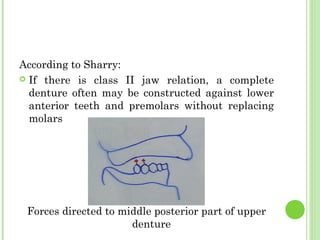
According to Sharry:
 If there is class II jaw relation, a complete
denture often may be constructed against lower
anterior teeth and premolars without replacing
molars
Forces directed to middle posterior part of upper
denture
 But if class III jaw relation situation is different
because mandibular premolars would apply
occlusal forces against the anterior part of the
maxillary ridge
Forces against the anterior part of the maxillary
ridge
COMPLETE MAXILLARY DENTURE TO OPPOSE
A PARTIALLY EDENTULOUS MANDIBULAR
ARCH WITH FIXED PROSTHESIS
 The following points must be evaluated for the proper
diagnosis and treatment planning:
 It must be determined whether fixed restorations are
possible
 If any fixed partial denture is acceptable,
1. Then the occlusal concept based on which it is
going to be constructed
2. Composition of the artificial teeth to be used
If the fixed partial dentures have
 Porcelain occlusals then → porcelain / resin teeth
 Enamel→ gold / resin teeth
COMPLETE MAXILLARY DENTURE TO OPPOSE
A PARTIALLY EDENTULOUS ARCH AND A
REMOVABLE PARTIAL DENTURE
 Remaining mandibular teeth should be in an
acceptable state of dental health.
 The partial denture should meet minimal acceptable
requirements.
 The occlusal plane, tooth arrangement for occlusion,
esthetics and the material composition of the
removable partial denture should be suitable to be
opposed by a complete denture.
 It is always wise to construct both the removable
partial denture and complete denture at the same
time.
SINGLE COMPLETE DENTURE OPPOSING
AN EXISTING DENTURE
 The following questions have to be analyzed
before giving a single complete denture opposing
an existing denture:
 How long has the existing denture been in use?
 Was the denture an immediate insertion at the
time of tooth removal?
 Does the denture meet the requirements
of an acceptable denture?
 Has the denture opposed another complete
denture, a partially edentulous arch that
supported a removable partial denture, restored
natural teeth, a fixed partial denture?
 Is the operator satisfied to institute complete
denture procedures utilizing the existing
denture?
PROBLEM ASSOCIATED WITH
SINGLE COMPLETE DENTURE
 Occlusal forces
 Occlusal form of the natural teeth
 Support of the denture base
 Supraerupted & tilted teeth
These factors causes occurrence of “SingleSingle
denture syndromedenture syndrome”
 Loose or tilting denture
 Damage of mucosa
 Ridge resorption
COMMON OCCLUSAL DISHARMONIES
& WAYS TO ADJUST THEM
1. Tilted molars with distal halves supraerupted
 Steeply inclined occlusal surfaces tend to drive
denture forward when brought into centric
occlusion
 Only contact is on the distal half of lower molar
in protrusive and lateral excursions
Denture easily dislodged during functional
movements
ADJUSTMENT FOR TILTED MOLAR:
 If molars are not severely tilted
Can be reshaped by selective grinding
 If more tooth structure is needed to be removed
Restored with crown or Fixed partial denture
 If large space exist mesial to tilted molar
Rpd restoring the mesial half of the molars, lower
the distal cusps
(Mesial half onlay mesial rest or extended rest)
 Orthodontic repositioning of tilted molar
 If severely tilted and supraerupted
Extraction
2. Natural lower cuspids and insicors are
supraerupted
Selective grinding
Canine region, occlusal adjustment should aim at
providing a definite distal slope on the lower Canine so
as to allow space for free passage of the upper artificial
canine between the lower canine and first premolar in
lateral movements.
MOUTH PREPARATION
It is essential to obtain the occlusion and articulation
that is desired
Indications:
 Malposed teeth
 Severely tipped teeth
 Supraerupted teeth
 Irregular occlusal plane
 Less space for teeth
TECHNIQUES TO DETERMINE THE
NECESSARY TOOTH MODIFICATIONS PRIOR
TO DENTURE CONSTRUCTION
 Swenson`s Technique
 Yursktas Technique
 Bruce Technique
 Boucher Technique
1. SWENSON'S TECHNIQUE:
 Mount maxillary and mandibular casts at an
acceptable VD with a CR record.
 A maxillary base is made and denture teeth set.
 If interferences are there, adjusted on the cast
and mark with pencil.
 Natural teeth modified with this guide and a
new diagnostic cast made and mounted on the
articulator.
 If this occlusal modification is sufficient, denture
teeth are reset for trial.
Disadvantages
 Time consuming if it needs several
impressions and mountings before the occlusion
is finalized.
2. YURKSTAS TECHNIQUE:
 Uses a metal ‘U’ shaped occlusal template
 Placed on the occlusal surfaces of the remaining
teeth and cusps are adjusted and identified.
 Stone cast is modified to a more acceptable
occlusal relationship and the reduced areas are
marked with a pencil.
 Necessary alterations done on the natural teeth
using the cast as a guide.
3. BRUCE TECHNIQUE:
 The lower diagnostic cast is mounted with the upper
with the proper CR record.
 Necessary modifications are made on the stone cast.
 Acrylic resin template is fabricated on the modified
stone cast.
 Checked in the patient's mouth for interferences and
the interferences are removed
 Process is repeated until the template seats properly.
Areas to be
modified are
marked with
pencil on
the cast
Clear acrylic resin
template is formed
over the corrected
cast
Initial modification done
Template coated with
Pressure indicating paste
& placed over teeth
Interferences can be seen through the clear template
and can be removed accordingly.
Process repeated till template fits the teeth perfectly
 Advantage: Produces accurate results
4. BOUCHER'S TECHNIQUE:
 Casts are mounted on a programmed articulator.
 Artificial are arranged to obtain best possible
balancing contacts.
 If a natural tooth prevents balancing, interferences
are removed by moving porcelain teeth over the
mandibular stone teeth.
 Areas to be ground are marked on the cast
 The denture is processed and will be used as a guide
to modify natural opposing teeth.
METHODS TO ACHIEVE
HARMONIOUS BALANCED
OCCLUSION
1. Functional chew in techniques
2. Articulator equilibration techniques
1. FUNCTIONAL CHEW IN TECHNIQUE
Most accurate method of recording occlusal
patterns
To obtain functional chew in technique:
 Record bases should have good stability
 Patient should have good neuromuscular
control
 Mental competence to effectively co-operate
FUNCTIONAL CHEW IN TECHNIQUE:
a. Stansbury technique (1928)
b. Vig's technique (1964)
c. Sharry technique
d. Rudd technique
a. Stansbury Technique (1928)
For upper complete denture opposing lower
natural teeth
Compound maxillary occlusal rim trimmed
buccally and lingually so that occlusion is free in
lateral excursions
Carding wax added buccally and lingually and
patient instructed to perform chewing movements
Carding wax gets functionally molded whereas
the compound rim in the central fossa maintains
the VD.
 The generated occlusal rim is removed from the
mouth and stone is vibrated into the wax path of
the cusps and this record is secured to the lower
member of the articulator
 The denture teeth are first set to the lower cast of
the patient's teeth
 After esthetics approved at try in, lower cast chew
in record is secured and all the interfering spots
are ground. Thus in centric and eccentric
movements maximus balanced occlusion is
established.
b. Vig's Technique (1964)
 Modified functional chew-in and impression
technique
 Anterior teeth are set chair side. Wax occlusal
rims posterior to the cuspid teeth are removed.
Acrylic resin is added and firmly pressed
against the occlusal surface of the teeth on the
mandibular cast.
 When set, acrylic resin is trimmed so as to
leave only a fin of resin falling into the central
grooves of the lower posterior teeth to maintain
the vertical dimension.
 The base is then inserted into the mouth for cusp
and sulcus analysis.
 The fin is then built up with a soft wax and with
resilient liner on the tissue side final path is
recorded.
 The teeth are then set against the recorded chew
in cast and interferences are ground to obtain a
smooth harmonious
c. Sharry Technique
 Simple technique of using a maxillary rim of
softened wax
 Lateral and protrusive chewing movements are
made so that wax is abraded generating the
final paths of the lower cusps.
 Continued until the correct VD is achieved
d. Rudd Technique
 Suggests a technique similar to Stansbury's
 But suggests using two maxillary bases, one for
recording the generated path and the other for
setting the teeth
 Advantage - decreases the number of
appointments necessary for the construction of
the upper denture
2. ARTICULATOR EQUILIBRATION
TECHNIQUES
 Upper cast mounted on the articulator using a face-
bow with an orbitale pointer
 The lower cast is related to the upper by a centric
interocclusal record at an acceptable VD.
 The bucco-lingual position of the teeth and their
relation to the upper arch is studied. Cusp-fossa
relationship of the teeth is essential.
 At the time of wax try-in, eccentric records made
and condylar inclinations are set and posterior
teeth are now balanced.
 After denture is processed, then centric holding
cusps are achieved by selective grinding and then
eccentric balance is achieved.
 However, perfectly balanced occlusion in all
eccentric positions may not be possible in many
cases when working with natural teeth in one
arch.
TEETH SELECTION
1. Porcelain
 Advantages
 Maintains VD
 Wears very slowly
× Disadvantages
 Fracture and chipping of natural teeth
 Difficult to equilibrate
 Cannot be used in decreased inter-occlusal
distance
2. Acrylic Resin
 Advantages
 Does not wear opposing natural teeth
 Easy to equilibrate
× Disadvantages
 Loss of VD
 Wears fast
3. Gold Occlusals
 Advantages-
 Best to oppose natural teeth
× Disadvantages -
 Expensive
 Time consuming
4. Acrylic resin with amalgam stops
 Advantages:
• Reduces occlusal wear of resin teeth
• Less expensive then gold
• Facilitates the final staeges of occlusal adjustment
Procedure
 After the acrylic teeth have been balanced, occlusal
preparations are made in the acrylic teeth, extending
to include as much of the articulating paper tracing
as possible.
 Amalgam is condensed into the preparations and
the articulator is gently closed, going side to side,
and back and forth until the incisal guide pin is
again flush with the table.
 Thus the centric holding areas as well as some of
the excursions are recorded in amalgam by the
articulator that has been programmed to closely
simulate the patients jaw movements.
5. IPN Resin
 Consists of an unfilled highly cross-linked, inter
penetrating polymer network
 Prevents excessive wearing of artificial teeth
 Minimizes the disadvantage of acrylic resin
teeth and porcelain
POTENTIAL ADVERSE TREATMENT
OUTCOMES
Most common adverse sequelae are:
1. Kelly’s combination syndrome
2. Denture fracture
3. Tooth wear
1. Kelly's Combination Syndrome
A series of destructive changes occurring in
the jaws of the patients wearing a complete
maxillary denture opposed by a mandibular
distal extension partial denture has been
described as "combination syndrome" by Kelly.
Description of features
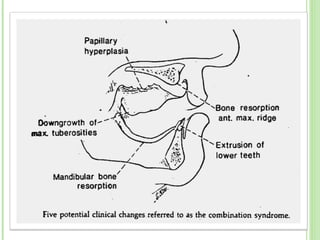
Kelly (1972) put forward five features of combination
syndrome:
 Loss of bone in anterior maxilla and subsequent
replacement with flabby fibrous tissue
 Down growth of the tuberosities
 Papillary hyperplasia of the palate
 Lower incisors supra eruption
 Bone loss under the removable prostheses
Saunders et al (1978) added 6 more additional
features:
 Loss of vertical dimension
 Occlusal plane discrepancy
 Anterior spatial repositioning of the mandible
 Loss of stability and refabrication of the existing
dentures
 Epulis fissuratum
 Periodontal problems of the remaining teeth
COMBINATION SYNDROME
SYNDROME
Mechanics:
 Kelly - Bone loss in the anterior maxilla is the
first to occur
 Saunders - Bone loss under the removable
prosthesis was the root cause for the problem
Systemic and Dental Considerations:
a. Systemic factors
 Diabetes and osteoporosis increase the rate of
resorption of the bone.
b. Dental factors
 In case of class III jaw relationships, there will be
increased pressure in the anterior maxilla.
 When lower anteriors are retained for a long time, the
patient is accustomed to bite in the anterior region.
 Presence of parafunctional habits increases bone
resorption.
 Type of occlusal scheme also has direct effect
on the development of the syndrome.
Rationale:
 Prevention of rapid resorption of the bone under
the removable prosthesis
 Prevention of excessive load in the anterior
region
 Providing stable occlusal scheme
 Allowing anterior teeth only for phonetics and
esthetics
 Education of the patient
Treatment planning
 Treatment planning plays an important role in
the prevention and management of the
combination syndrome.
a. Prevention
 Retain weaker posterior teeth by using
combined endodontic and periodontic
techniques.
 Endosseous endodontic implants are used in the
posterior mandibular region.
 An overlay denture on the lower may avoid the
combination syndrome.
b. Modifications in removable partial denture
and complete dentures
 Kelly - advocated covering of retromolar pad
to have stability of the lower removable partial
denture
 Schumitt - advocated construction of lower
removable partial denture first and then to
construct the upper complete denture
c. Choice of occlusion
 Anterior teeth - only for esthetics and phonetics
 Posterior occlusion - free of supra contacts
during centric and all eccentric positions
 During protrusive movement, there should be
minimum contact in the anterior region, when
posterior teeth are in contact.
d. Over dentures
 Lower anterior teeth are treated endodontically
and their height is reduced.
 This can be used for proprioceptive sensation of
the lower jaw and prevents resorption of the
underlying bone.
 Langer advocated the use of "stud attachments"
in over denture
e. Implant - supported prosthesis
 Implants in the posterior region of the
mandible to decrease the residual ridge
resorption
f. Surgical consideration
 Kelly advocated surgical excision of the maxillary
tuberosity fibrous growth to establish proper
occlusion.
 Treating the combination syndrome requires
recognition of the factors involved.
 Frequent recalls visits and check ups with frequent
relining to compensate for the resorption especially
in the lower distal extension prosthesis.
 Educating the patient about the possible outcome of
the treatment and better understanding of the
syndrome so that patient cooperates with the dentist.
2. DENTURE FRACTURE
 Specific conditions:
 Heavy anterior occlusal contact
 Deep labial frenal notches
 High occlusal forces due to strong mandibular
elevator musculature
 If the clinician is unable to control these factors or the
fracture potential is high, a cast metal base is best
used to resist deformation and fracture.
Fiber Force is a fiberglass mesh
composite resin
Metal meshwork
CARBON FIBRES
Carbon fibers can be added to PMMA as loose strands or
in woven mat form.
3. TOOTH WEAR
 Use of porcelain material opposing the natural
teeth will wear away the tooth structure. Hence
the material selection is according to the
opposing material to avoid this adverse effect.
MAINTENANCE VISIT:
 Verification of occlusal contact relationships
 Condition of the supporting tissues
 And compulsory recalls for relining depending on
the supporting tissues.
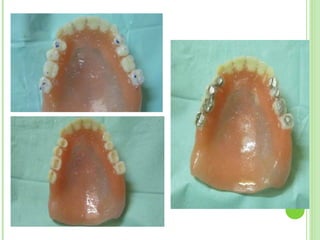
CASES DONE IN DEPARTMENT
Custom made metal reinforced single complete
denture
METAL DENTURE BASE
CONCLUSION
The patient who requires a single denture
opposing a natural or restored dentition
challenges the clinician even more than the
completely edentulous patient does. This is due
to the biomechanical differences in the
supporting tissues of the opposing arches. So a
proper evaluation, correction of the existing
factors and proper sequence of denture
construction is necessary to give a more stable
prosthesis.
REFERENCES
 Carr AB. Single Dentures. In: Zarb GA, et al, editors.
Prosthodontic Treatment for Edentulous Patients. 12 th
ed. St.Louis: Mosby; 2004. p. 427-436.
 Heartwell CM, Rahn AO, editors. Textbook of
Complete Dentures. 5th
ed. Canada: B.C. Decker; 2002.
p. 481-492. .
 Stephens AP. The Single Complete Denture. In:
Sharry JJ, editor. Complete Denture Prosthodontics.
3rd
ed. New York: McGraw – Hill; 1962 p. 310-319.
 Lauciello FR. The Single Complete Maxillary Denture.
In: Winkler S, editor. Essentials of Complete Denture
Prosthodontics. 2nd
ed. USA: Ishiyaku Euro America
Inc; 1996. p. 417-426.
 Langer Y et al. Modalities of Treatment for the
Combination Syndrome. JOP 1995: 4; 76 - 81.
 Kelly E. Change caused by a mandibular removable
partial denture opposing a maxillary complete
denture. J Prosthet Dent 1972: 27; 140 -150.
 Vig RG. A Modified Chew - In and Functional
Impression Technique. J Prosthet Dent 1964: 14; 214 –
220.
THANK
YOU

Single Complete Denture

  • 1.
    SINGLE COMPLETE DENTURE PRESENTED BY: Dr.Anshul Sahu 2nd Year PG Student
  • 2.
    CONTENTS  Introduction  Definition Indication  Diagnosis and treatment planning  Various combinations of single complete denture  Problem associated with single complete denture  Common occlusal disharmonies & ways to adjust them  Mouth preparation  Methods to achieve balanced /harmonious occlusion  Teeth selection  Adverse outcomes  Cases done in department  Conclusion  References
  • 3.
    INTRODUCTION:  The singlecomplete denture opposing all or some of the natural dentition is not an uncommon occurrence.  Several causes for the loss of teeth  Incidence of tooth loss: Maxillary > Mandibular  Single complete denture should be given for many reason.  Several difficulties are encountered
  • 4.
    DEFINITION  The makingof a maxillary or mandibular denture as distinguished from a set of complete dentures (GPT-1)  A single complete denture is a complete denture that occludes against some or all natural teeth, a fixed restoration, or a previously constructed removable partial denture or a complete denture.
  • 5.
    INDICATIONS A single completedenture may be desirable when it is to oppose any one of the following:  Natural teeth that are sufficient in number not to necessitate a fixed or removable partial denture.  A partially edentulous arch in which missing teeth have been or will be replaced by removable partial denture.  A partially edentulous arch in which missing teeth have been or will be replaced by fixed partial denture.  An existing complete denture.
  • 6.
    DIAGNOSIS & TREATMENTPLANNING For proper diagnosis and treatment planning - evaluate  Edentulous arch - Frenii, sulcus, palate, mucosa, ridge, severe undercuts, tongue, lips, temporomandibular joints, mouth opening  Dentulous arch - number of teeth present, position of teeth, condition of teeth, endodontic condition, restorative condition, condition of existing restoration and periodontal condition
  • 7.
  • 8.
    MANDIBULAR DENTURE TOOPPOSE NATURAL MAXILLARY TEETH  This situation occurs due to:  1. Surgical trauma  Accidental trauma  Greater challenge than maxillary single complete denture
  • 9.
    Factors which particularlyhave to be evaluated for this scenario are: Preservation of Residual Alveolar Ridge:  Force of jaw closure is greater with opposing natural teeth than with a complete denture. When the force is more the pressure is greater and bone resorption follows.  Stability of mandibular denture is very difficult due to tongue movements - denture movement will increase the pressure and stress on the mucosa and bone, which is detrimental to comfort and preservation.  Minimal availability of mucosa with tightly attached submucosa will lead to stress concentration.  So the ultimate result is that tissues become not tolerable to dentures.
  • 10.
    Necessity for retainingmaxillary teeth: • Maxillary dentition may needed to retain prosthesis . This situation is usually associated with congenital degects cleft palate or stoma resulting from surgical or accidental trauma. Mental trauma:  Some patients becomedepressed with the loss of teeth.  This depression may lead to more complicated psycological problems.  Removal of remaining maxillary teeth even if indicated has to be carefully analyzed and retained.
  • 11.
    SINGLE COMPLETE MAXILLARYDENTURE TO OPPOSE NATURAL MANDIBULAR TEETH  Most frequently encountered Problems:  Malposed, tipped & supraerupted teeth in lower arch & unfavorable plane of occlusion  Position of mandibular anterior teeth  Reposition  Alteration
  • 12.
    According to Sharry: If there is class II jaw relation, a complete denture often may be constructed against lower anterior teeth and premolars without replacing molars Forces directed to middle posterior part of upper denture
  • 13.
     But ifclass III jaw relation situation is different because mandibular premolars would apply occlusal forces against the anterior part of the maxillary ridge Forces against the anterior part of the maxillary ridge
  • 14.
    COMPLETE MAXILLARY DENTURETO OPPOSE A PARTIALLY EDENTULOUS MANDIBULAR ARCH WITH FIXED PROSTHESIS  The following points must be evaluated for the proper diagnosis and treatment planning:  It must be determined whether fixed restorations are possible
  • 15.
     If anyfixed partial denture is acceptable, 1. Then the occlusal concept based on which it is going to be constructed 2. Composition of the artificial teeth to be used If the fixed partial dentures have  Porcelain occlusals then → porcelain / resin teeth  Enamel→ gold / resin teeth
  • 16.
    COMPLETE MAXILLARY DENTURETO OPPOSE A PARTIALLY EDENTULOUS ARCH AND A REMOVABLE PARTIAL DENTURE  Remaining mandibular teeth should be in an acceptable state of dental health.  The partial denture should meet minimal acceptable requirements.  The occlusal plane, tooth arrangement for occlusion, esthetics and the material composition of the removable partial denture should be suitable to be opposed by a complete denture.  It is always wise to construct both the removable partial denture and complete denture at the same time.
  • 17.
    SINGLE COMPLETE DENTUREOPPOSING AN EXISTING DENTURE  The following questions have to be analyzed before giving a single complete denture opposing an existing denture:  How long has the existing denture been in use?  Was the denture an immediate insertion at the time of tooth removal?  Does the denture meet the requirements of an acceptable denture?
  • 18.
     Has thedenture opposed another complete denture, a partially edentulous arch that supported a removable partial denture, restored natural teeth, a fixed partial denture?  Is the operator satisfied to institute complete denture procedures utilizing the existing denture?
  • 19.
    PROBLEM ASSOCIATED WITH SINGLECOMPLETE DENTURE  Occlusal forces  Occlusal form of the natural teeth  Support of the denture base  Supraerupted & tilted teeth
  • 20.
    These factors causesoccurrence of “SingleSingle denture syndromedenture syndrome”  Loose or tilting denture  Damage of mucosa  Ridge resorption
  • 21.
    COMMON OCCLUSAL DISHARMONIES &WAYS TO ADJUST THEM 1. Tilted molars with distal halves supraerupted
  • 22.
     Steeply inclinedocclusal surfaces tend to drive denture forward when brought into centric occlusion
  • 23.
     Only contactis on the distal half of lower molar in protrusive and lateral excursions Denture easily dislodged during functional movements
  • 24.
    ADJUSTMENT FOR TILTEDMOLAR:  If molars are not severely tilted Can be reshaped by selective grinding
  • 25.
     If moretooth structure is needed to be removed Restored with crown or Fixed partial denture
  • 26.
     If largespace exist mesial to tilted molar Rpd restoring the mesial half of the molars, lower the distal cusps (Mesial half onlay mesial rest or extended rest)
  • 27.
     Orthodontic repositioningof tilted molar  If severely tilted and supraerupted Extraction
  • 28.
    2. Natural lowercuspids and insicors are supraerupted Selective grinding
  • 29.
    Canine region, occlusaladjustment should aim at providing a definite distal slope on the lower Canine so as to allow space for free passage of the upper artificial canine between the lower canine and first premolar in lateral movements.
  • 30.
    MOUTH PREPARATION It isessential to obtain the occlusion and articulation that is desired Indications:  Malposed teeth  Severely tipped teeth  Supraerupted teeth  Irregular occlusal plane  Less space for teeth
  • 31.
    TECHNIQUES TO DETERMINETHE NECESSARY TOOTH MODIFICATIONS PRIOR TO DENTURE CONSTRUCTION  Swenson`s Technique  Yursktas Technique  Bruce Technique  Boucher Technique
  • 32.
    1. SWENSON'S TECHNIQUE: Mount maxillary and mandibular casts at an acceptable VD with a CR record.  A maxillary base is made and denture teeth set.  If interferences are there, adjusted on the cast and mark with pencil.  Natural teeth modified with this guide and a new diagnostic cast made and mounted on the articulator.
  • 33.
     If thisocclusal modification is sufficient, denture teeth are reset for trial. Disadvantages  Time consuming if it needs several impressions and mountings before the occlusion is finalized.
  • 34.
    2. YURKSTAS TECHNIQUE: Uses a metal ‘U’ shaped occlusal template  Placed on the occlusal surfaces of the remaining teeth and cusps are adjusted and identified.  Stone cast is modified to a more acceptable occlusal relationship and the reduced areas are marked with a pencil.  Necessary alterations done on the natural teeth using the cast as a guide.
  • 36.
    3. BRUCE TECHNIQUE: The lower diagnostic cast is mounted with the upper with the proper CR record.  Necessary modifications are made on the stone cast.  Acrylic resin template is fabricated on the modified stone cast.  Checked in the patient's mouth for interferences and the interferences are removed  Process is repeated until the template seats properly.
  • 37.
    Areas to be modifiedare marked with pencil on the cast
  • 38.
    Clear acrylic resin templateis formed over the corrected cast
  • 39.
    Initial modification done Templatecoated with Pressure indicating paste & placed over teeth
  • 40.
    Interferences can beseen through the clear template and can be removed accordingly. Process repeated till template fits the teeth perfectly  Advantage: Produces accurate results
  • 41.
    4. BOUCHER'S TECHNIQUE: Casts are mounted on a programmed articulator.  Artificial are arranged to obtain best possible balancing contacts.  If a natural tooth prevents balancing, interferences are removed by moving porcelain teeth over the mandibular stone teeth.  Areas to be ground are marked on the cast  The denture is processed and will be used as a guide to modify natural opposing teeth.
  • 42.
    METHODS TO ACHIEVE HARMONIOUSBALANCED OCCLUSION 1. Functional chew in techniques 2. Articulator equilibration techniques
  • 43.
    1. FUNCTIONAL CHEWIN TECHNIQUE Most accurate method of recording occlusal patterns To obtain functional chew in technique:  Record bases should have good stability  Patient should have good neuromuscular control  Mental competence to effectively co-operate
  • 44.
    FUNCTIONAL CHEW INTECHNIQUE: a. Stansbury technique (1928) b. Vig's technique (1964) c. Sharry technique d. Rudd technique
  • 45.
    a. Stansbury Technique(1928) For upper complete denture opposing lower natural teeth Compound maxillary occlusal rim trimmed buccally and lingually so that occlusion is free in lateral excursions Carding wax added buccally and lingually and patient instructed to perform chewing movements Carding wax gets functionally molded whereas the compound rim in the central fossa maintains the VD.
  • 46.
     The generatedocclusal rim is removed from the mouth and stone is vibrated into the wax path of the cusps and this record is secured to the lower member of the articulator  The denture teeth are first set to the lower cast of the patient's teeth  After esthetics approved at try in, lower cast chew in record is secured and all the interfering spots are ground. Thus in centric and eccentric movements maximus balanced occlusion is established.
  • 50.
    b. Vig's Technique(1964)  Modified functional chew-in and impression technique  Anterior teeth are set chair side. Wax occlusal rims posterior to the cuspid teeth are removed. Acrylic resin is added and firmly pressed against the occlusal surface of the teeth on the mandibular cast.  When set, acrylic resin is trimmed so as to leave only a fin of resin falling into the central grooves of the lower posterior teeth to maintain the vertical dimension.
  • 51.
     The baseis then inserted into the mouth for cusp and sulcus analysis.  The fin is then built up with a soft wax and with resilient liner on the tissue side final path is recorded.  The teeth are then set against the recorded chew in cast and interferences are ground to obtain a smooth harmonious
  • 52.
    c. Sharry Technique Simple technique of using a maxillary rim of softened wax  Lateral and protrusive chewing movements are made so that wax is abraded generating the final paths of the lower cusps.  Continued until the correct VD is achieved
  • 53.
    d. Rudd Technique Suggests a technique similar to Stansbury's  But suggests using two maxillary bases, one for recording the generated path and the other for setting the teeth  Advantage - decreases the number of appointments necessary for the construction of the upper denture
  • 54.
    2. ARTICULATOR EQUILIBRATION TECHNIQUES Upper cast mounted on the articulator using a face- bow with an orbitale pointer  The lower cast is related to the upper by a centric interocclusal record at an acceptable VD.  The bucco-lingual position of the teeth and their relation to the upper arch is studied. Cusp-fossa relationship of the teeth is essential.
  • 55.
     At thetime of wax try-in, eccentric records made and condylar inclinations are set and posterior teeth are now balanced.  After denture is processed, then centric holding cusps are achieved by selective grinding and then eccentric balance is achieved.  However, perfectly balanced occlusion in all eccentric positions may not be possible in many cases when working with natural teeth in one arch.
  • 56.
    TEETH SELECTION 1. Porcelain Advantages  Maintains VD  Wears very slowly × Disadvantages  Fracture and chipping of natural teeth  Difficult to equilibrate  Cannot be used in decreased inter-occlusal distance
  • 57.
    2. Acrylic Resin Advantages  Does not wear opposing natural teeth  Easy to equilibrate × Disadvantages  Loss of VD  Wears fast
  • 58.
    3. Gold Occlusals Advantages-  Best to oppose natural teeth × Disadvantages -  Expensive  Time consuming
  • 59.
    4. Acrylic resinwith amalgam stops  Advantages: • Reduces occlusal wear of resin teeth • Less expensive then gold • Facilitates the final staeges of occlusal adjustment Procedure  After the acrylic teeth have been balanced, occlusal preparations are made in the acrylic teeth, extending to include as much of the articulating paper tracing as possible.
  • 60.
     Amalgam iscondensed into the preparations and the articulator is gently closed, going side to side, and back and forth until the incisal guide pin is again flush with the table.  Thus the centric holding areas as well as some of the excursions are recorded in amalgam by the articulator that has been programmed to closely simulate the patients jaw movements.
  • 62.
    5. IPN Resin Consists of an unfilled highly cross-linked, inter penetrating polymer network  Prevents excessive wearing of artificial teeth  Minimizes the disadvantage of acrylic resin teeth and porcelain
  • 63.
    POTENTIAL ADVERSE TREATMENT OUTCOMES Mostcommon adverse sequelae are: 1. Kelly’s combination syndrome 2. Denture fracture 3. Tooth wear
  • 64.
    1. Kelly's CombinationSyndrome A series of destructive changes occurring in the jaws of the patients wearing a complete maxillary denture opposed by a mandibular distal extension partial denture has been described as "combination syndrome" by Kelly.
  • 65.
    Description of features Kelly(1972) put forward five features of combination syndrome:  Loss of bone in anterior maxilla and subsequent replacement with flabby fibrous tissue  Down growth of the tuberosities  Papillary hyperplasia of the palate  Lower incisors supra eruption  Bone loss under the removable prostheses
  • 67.
    Saunders et al(1978) added 6 more additional features:  Loss of vertical dimension  Occlusal plane discrepancy  Anterior spatial repositioning of the mandible  Loss of stability and refabrication of the existing dentures  Epulis fissuratum  Periodontal problems of the remaining teeth
  • 69.
  • 70.
  • 72.
    Mechanics:  Kelly -Bone loss in the anterior maxilla is the first to occur  Saunders - Bone loss under the removable prosthesis was the root cause for the problem
  • 73.
    Systemic and DentalConsiderations: a. Systemic factors  Diabetes and osteoporosis increase the rate of resorption of the bone. b. Dental factors  In case of class III jaw relationships, there will be increased pressure in the anterior maxilla.  When lower anteriors are retained for a long time, the patient is accustomed to bite in the anterior region.  Presence of parafunctional habits increases bone resorption.  Type of occlusal scheme also has direct effect on the development of the syndrome.
  • 74.
    Rationale:  Prevention ofrapid resorption of the bone under the removable prosthesis  Prevention of excessive load in the anterior region  Providing stable occlusal scheme  Allowing anterior teeth only for phonetics and esthetics  Education of the patient
  • 75.
    Treatment planning  Treatmentplanning plays an important role in the prevention and management of the combination syndrome.
  • 76.
    a. Prevention  Retainweaker posterior teeth by using combined endodontic and periodontic techniques.  Endosseous endodontic implants are used in the posterior mandibular region.  An overlay denture on the lower may avoid the combination syndrome.
  • 77.
    b. Modifications inremovable partial denture and complete dentures  Kelly - advocated covering of retromolar pad to have stability of the lower removable partial denture  Schumitt - advocated construction of lower removable partial denture first and then to construct the upper complete denture
  • 78.
    c. Choice ofocclusion  Anterior teeth - only for esthetics and phonetics  Posterior occlusion - free of supra contacts during centric and all eccentric positions  During protrusive movement, there should be minimum contact in the anterior region, when posterior teeth are in contact.
  • 79.
    d. Over dentures Lower anterior teeth are treated endodontically and their height is reduced.  This can be used for proprioceptive sensation of the lower jaw and prevents resorption of the underlying bone.  Langer advocated the use of "stud attachments" in over denture
  • 80.
    e. Implant -supported prosthesis  Implants in the posterior region of the mandible to decrease the residual ridge resorption
  • 81.
    f. Surgical consideration Kelly advocated surgical excision of the maxillary tuberosity fibrous growth to establish proper occlusion.  Treating the combination syndrome requires recognition of the factors involved.  Frequent recalls visits and check ups with frequent relining to compensate for the resorption especially in the lower distal extension prosthesis.  Educating the patient about the possible outcome of the treatment and better understanding of the syndrome so that patient cooperates with the dentist.
  • 82.
    2. DENTURE FRACTURE Specific conditions:  Heavy anterior occlusal contact  Deep labial frenal notches  High occlusal forces due to strong mandibular elevator musculature  If the clinician is unable to control these factors or the fracture potential is high, a cast metal base is best used to resist deformation and fracture.
  • 85.
    Fiber Force isa fiberglass mesh composite resin Metal meshwork
  • 86.
    CARBON FIBRES Carbon fiberscan be added to PMMA as loose strands or in woven mat form.
  • 87.
    3. TOOTH WEAR Use of porcelain material opposing the natural teeth will wear away the tooth structure. Hence the material selection is according to the opposing material to avoid this adverse effect.
  • 88.
    MAINTENANCE VISIT:  Verificationof occlusal contact relationships  Condition of the supporting tissues  And compulsory recalls for relining depending on the supporting tissues.
  • 89.
    CASES DONE INDEPARTMENT Custom made metal reinforced single complete denture
  • 90.
  • 91.
    CONCLUSION The patient whorequires a single denture opposing a natural or restored dentition challenges the clinician even more than the completely edentulous patient does. This is due to the biomechanical differences in the supporting tissues of the opposing arches. So a proper evaluation, correction of the existing factors and proper sequence of denture construction is necessary to give a more stable prosthesis.
  • 92.
    REFERENCES  Carr AB.Single Dentures. In: Zarb GA, et al, editors. Prosthodontic Treatment for Edentulous Patients. 12 th ed. St.Louis: Mosby; 2004. p. 427-436.  Heartwell CM, Rahn AO, editors. Textbook of Complete Dentures. 5th ed. Canada: B.C. Decker; 2002. p. 481-492. .  Stephens AP. The Single Complete Denture. In: Sharry JJ, editor. Complete Denture Prosthodontics. 3rd ed. New York: McGraw – Hill; 1962 p. 310-319.
  • 93.
     Lauciello FR.The Single Complete Maxillary Denture. In: Winkler S, editor. Essentials of Complete Denture Prosthodontics. 2nd ed. USA: Ishiyaku Euro America Inc; 1996. p. 417-426.  Langer Y et al. Modalities of Treatment for the Combination Syndrome. JOP 1995: 4; 76 - 81.  Kelly E. Change caused by a mandibular removable partial denture opposing a maxillary complete denture. J Prosthet Dent 1972: 27; 140 -150.  Vig RG. A Modified Chew - In and Functional Impression Technique. J Prosthet Dent 1964: 14; 214 – 220.
  • 94.

Editor's Notes

  • #82 Maxillary resorpyoion
  • #85 Methods to reinforce
  • #89 Compulsary recalls for relining