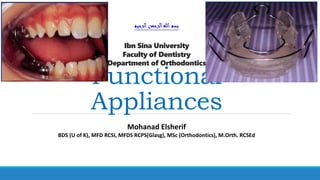
Functional
Appliances
Mohanad Elsherif
BDS (U of K), MFD RCSI, MFDS RCPS(Glasg), MSc (Orthodontics), M.Orth. RCSEd
‫الرحيم‬‫الرحمن‬‫هللا‬ ‫بسم‬
Ibn Sina University
Faculty of Dentistry
Department of Orthodontics
Introduction
 Our teeth lies in a balanced zone where the
natural forces of the extraoral and intraoral
muscles applied to it are equal, any disturbance
or alteration of these forces will results in tooth
movement.
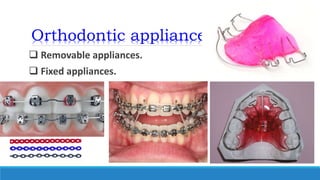
Orthodontic appliances
 Removable appliances.
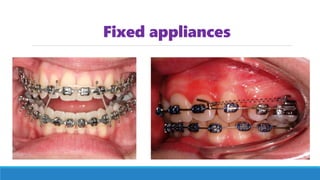
 Fixed appliances.
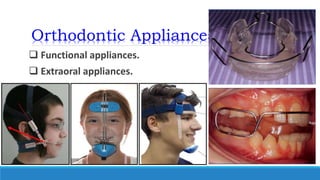
Orthodontic Appliances
 Functional appliances.
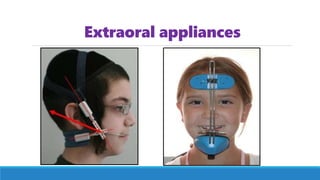
 Extraoral appliances.
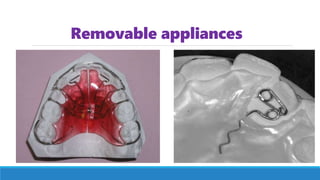
Removable appliances
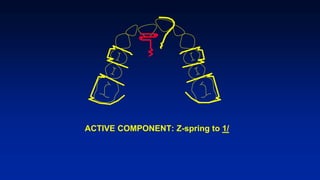
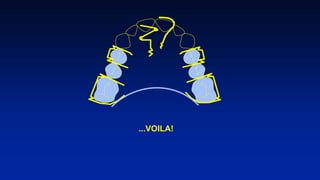
ACTIVE COMPONENT: Z-spring to 1/
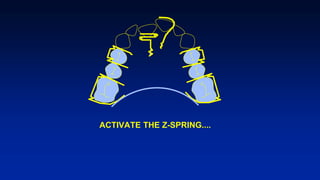
ACTIVATE THE Z-SPRING....
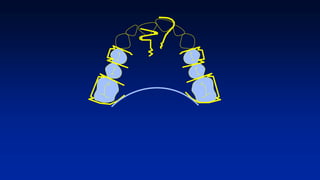
...VOILA!
Fixed appliances
Extraoral appliances
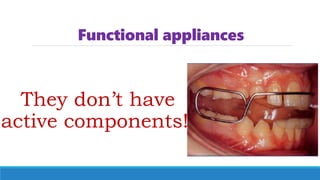
Functional appliances
They don’t have
active components!!
Definition
 A group of orthodontic appliances, mostly
removable, that generally are not active by
themselves, but instead utilize forces
generated by the masticatory and facial
musculature.
Graber
Mechanism of Action
How do they work!!
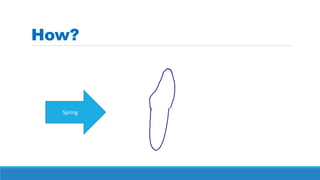
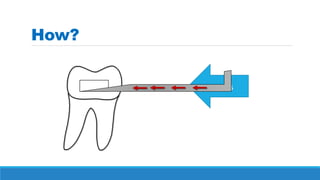
How?
Spring
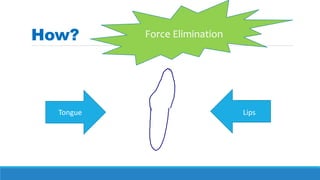
How?
Tongue Lips
Force Elimination
Lips
How?
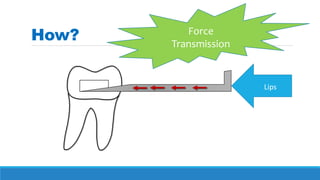
How?
Lips
Force
Transmission
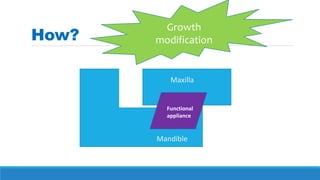
Mandible
Maxilla
Functional
appliance
How?
Growth
modification
Mandible
Maxilla
Functional
appliance
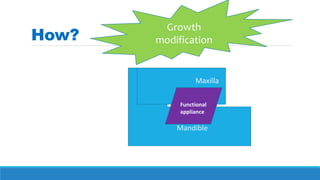
How?
Growth
modification
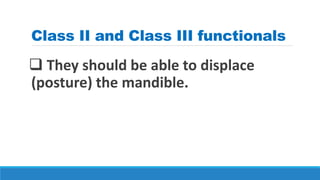
Class II and Class III functionals
 They should be able to displace
(posture) the mandible.
Mandible
Maxilla
Functional
appliance
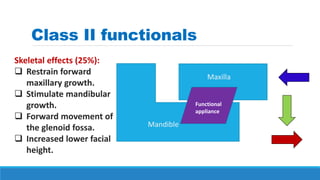
Class II functionals
Skeletal effects (25%):
 Restrain forward
maxillary growth.
 Stimulate mandibular
growth.
 Forward movement of
the glenoid fossa.
 Increased lower facial
height.
Mandible
Maxilla
Functional
appliance
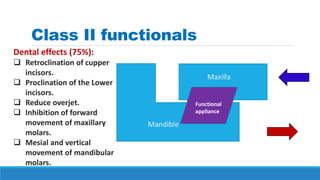
Class II functionals
Dental effects (75%):
 Retroclination of cupper
incisors.
 Proclination of the Lower
incisors.
 Reduce overjet.
 Inhibition of forward
movement of maxillary
molars.
 Mesial and vertical
movement of mandibular
molars.
Mandible
Maxilla
Functional
appliance
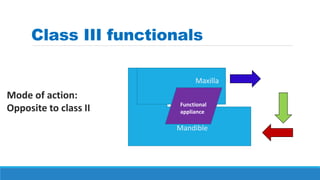
Class III functionals
Mode of action:
Opposite to class II
Indications
 Growing patient.
 Well motivated.
 Favorable pattern and direction of growth.
 Reduced lower facial height.
 Spaced upper incisors and crowded lower ones (in
class II malocclusion).
 Class II div 1 malocclusion mainly.
Contraindications
 Adults.
 Children with neuromuscular disorders: e.g.
poliomyelitis, cerebral palsy.
 Uncooperative patients.
 High angle cases (i.e. increased lower facial height).
 Unfavorable growth.
 Protruded lower incisors.
 Airway obstruction.
Components
 Mandibular posturing component.
 Eruption guidance components ( vertical control
components).
 Retentive (stabilizing) components.
 Passive components.
 Active components. Contemporary orthodontics
5th edition
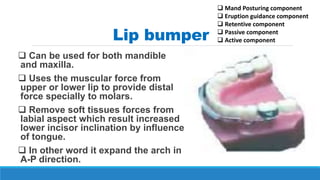
Lip bumper
 Can be used for both mandible
and maxilla.
 Uses the muscular force from
upper or lower lip to provide distal
force specially to molars.
 Remove soft tissues forces from
labial aspect which result increased
lower incisor inclination by influence
of tongue.
 In other word it expand the arch in
A-P direction.
 Mand Posturing component
 Eruption guidance component
 Retentive component
 Passive component
 Active component
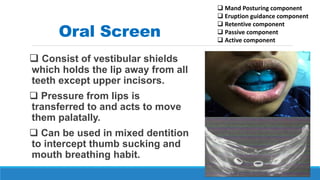
Oral Screen
 Consist of vestibular shields
which holds the lip away from all
teeth except upper incisors.
 Pressure from lips is
transferred to and acts to move
them palatally.
 Can be used in mixed dentition
to intercept thumb sucking and
mouth breathing habit.
 Mand Posturing component
 Eruption guidance component
 Retentive component
 Passive component
 Active component
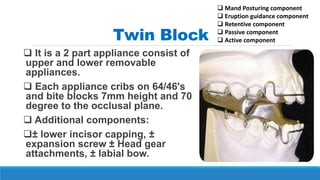
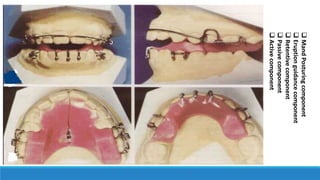
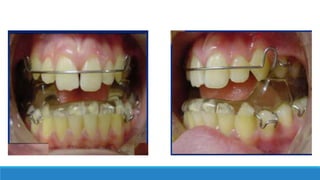
Twin Block
 It is a 2 part appliance consist of
upper and lower removable
appliances.
 Each appliance cribs on 64/46's
and bite blocks 7mm height and 70
degree to the occlusal plane.
 Additional components:
± lower incisor capping, ±
expansion screw ± Head gear
attachments, ± labial bow.
 Mand Posturing component
 Eruption guidance component
 Retentive component
 Passive component
 Active component
MandPosturingcomponent
Eruptionguidancecomponent
Retentivecomponent
Passivecomponent
Activecomponent
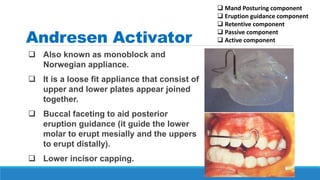
Andresen Activator
 Also known as monoblock and
Norwegian appliance.
 It is a loose fit appliance that consist of
upper and lower plates appear joined
together.
 Buccal faceting to aid posterior
eruption guidance (it guide the lower
molar to erupt mesially and the uppers
to erupt distally).
 Lower incisor capping.
 Mand Posturing component
 Eruption guidance component
 Retentive component
 Passive component
 Active component
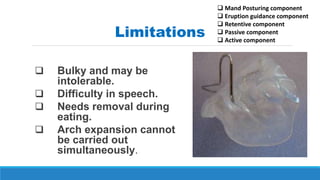
 Bulky and may be
intolerable.
 Difficulty in speech.
 Needs removal during
eating.
 Arch expansion cannot
be carried out
simultaneously.
Limitations
 Mand Posturing component
 Eruption guidance component
 Retentive component
 Passive component
 Active component
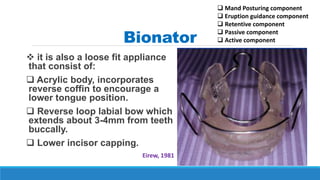
Bionator
 it is also a loose fit appliance
that consist of:
 Acrylic body, incorporates
reverse coffin to encourage a
lower tongue position.
 Reverse loop labial bow which
extends about 3-4mm from teeth
buccally.
 Lower incisor capping.
Eirew, 1981
 Mand Posturing component
 Eruption guidance component
 Retentive component
 Passive component
 Active component
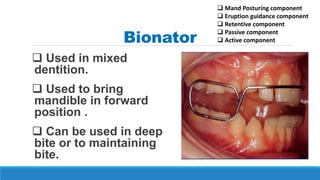
Bionator
 Used in mixed
dentition.
 Used to bring
mandible in forward
position .
 Can be used in deep
bite or to maintaining
bite.
 Mand Posturing component
 Eruption guidance component
 Retentive component
 Passive component
 Active component
General rule
 Appliance name: Class II
Activator, bionator, twin block, ……
 Reversed: class III
Reversed activator, reversed bionator, reversed twin block, ……
 Modified: open bite
Modified activator, modified bionator , modified twin block, ….
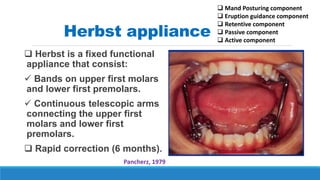
Herbst appliance
 Herbst is a fixed functional
appliance that consist:
 Bands on upper first molars
and lower first premolars.
 Continuous telescopic arms
connecting the upper first
molars and lower first
premolars.
 Rapid correction (6 months).
Pancherz, 1979
 Mand Posturing component
 Eruption guidance component
 Retentive component
 Passive component
 Active component
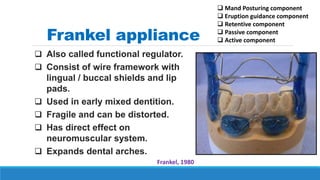
Frankel appliance
 Also called functional regulator.
 Consist of wire framework with
lingual / buccal shields and lip
pads.
 Used in early mixed dentition.
 Fragile and can be distorted.
 Has direct effect on
neuromuscular system.
 Expands dental arches.
Frankel, 1980
 Mand Posturing component
 Eruption guidance component
 Retentive component
 Passive component
 Active component
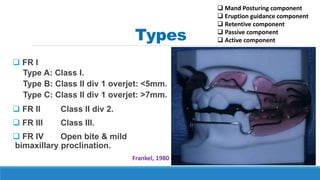
Types
 FR I
Type A: Class I.
Type B: Class II div 1 overjet: <5mm.
Type C: Class II div 1 overjet: >7mm.
 FR II Class II div 2.
 FR III Class III.
 FR IV Open bite & mild
bimaxillary proclination.
Frankel, 1980
 Mand Posturing component
 Eruption guidance component
 Retentive component
 Passive component
 Active component
Classification
Depending on the type:
1. Removable functional appliances
2. Fixed functional appliances.
Classification
Depending on the mode of action:
1. Active appliances:
Reposition the mandible so that the condyle is forced out of
the glenoid fossa and this in turn is thought to stimulate the
posterior/superior growth of the condyle. e.g. twin block
2. Passive appliances:
Act by repositioning the musculature associated with the
mandible so that the jaw bone itself responds by growing to the
new equilibrium position. e.g. Frankle
Classification
Depending on the relationship with the oral tissues:
1. Passive tooth borne e.g. Andresen.
2. Active tooth borne e.g. Twin block.
3. Tissue borne e.g. Frankel.
Proffit et al., 2007
Classification
Depending on the degree of mandibular displacement:
1. Myodynamic:
Medium mandibular opening(< 5mm), work by stimulating
muscle activity e.g. Andresen activator.
2. Myotonic:
Large mandibular opening (8-10mm), work by passive muscle
stretch e.g. Harvold appliance.
Houston et al., 1993
Choice
Depends on:
 Patient factors:
• Age.
• Compliance.
• Malocclusion.
 Clinician factors:
• preference I familiarity.
• laboratory facilities.
Management of functional
appliance
 Full records: SM, DPT, Lateral Ceph, Photos.
 Well extended upper and lower imprisons.
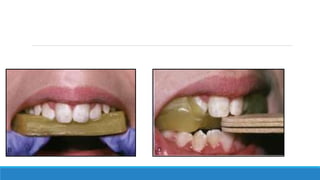
 Construction bite.
 The cast along with the construction bite are mounted
on the articulator.
 Use cold or heat cure to fabricate the appliance.
 Motivate the patient and the family.
 Wear gradually till reach 14 hours/day at least.
wear
 12-14 hours:
• Andresen.
• Harvold.
• Bionator.
 full-time:
• Twin block.
• Herbst.
• Frankel (except for eating/sports).
At each visit assess
 Comfort.
 Wear.
 Interferences with the eruption.
 Overjet and buccal segment relationship.
 Activation.
 Motivation.
Retention
 Wear the same functional appliance night time
only until growth stops or,
 Upper removable appliance with labial bow and
anterior inclined bite plane, part time wear.
Problems
 Compliance.
 Lower incisor proclination.
 Breakage.
 Precise detailing of tooth position not possible, so it
may require second phase of treatment.
 Biological variability.
 Relapse.
Declaration
 The author wish to declare that; these presentations are his original work, all
materials and pictures collection, typing and slide design has been done by the
author.
 Most of these materials has been done for undergraduate students, although
postgraduate students may find some useful basic and advanced information.
 The universities title at the front page indicate where the lecture was first
presented. The author was working as a lecturer of orthodontics at Ibn Sina
University, Sudan International University, and as a Master student in Orthodontics at
University of Khartoum.
 The author declare that all materials and photos in these presentations has been
collected from different textbooks, papers and online websites. These pictures are
presented here for education and demonstration purposes only. The author are not
attempting to plagiarize or reproduced unauthorized material, and the intellectual
properties of these photos belong to their original authors.
Declaration
 As the authors reviews several textbooks, papers and other references during
preparation of these materials, it was impossible to cite every textbook and journal
article, the main textbooks that has been reviewed during preparation of these
presentations were:
Contemporary Orthodontics 5th edition; Proffit, William R, Henry W. Fields, and
David M. Sarver.
Handbook of Orthodontics. 1st edition; Cobourne, Martyn T, and Andrew T. DiBiase.
Essentials of orthodontics: Diagnosis and Treatment; Robert N. Staley, Neil T. Reske
Orthodontics: Current Principles & Techniques 5th edition; Graber, Lee W, Robert L.
Vanarsdall, and Katherine W. L. Vig
Orthodontics: The Art and Science. 3rd Edition. Bhalajhi, S.I.
Declaration
 For the purposes of dissemination and sharing of knowledge, these
lectures were given to several colleagues and students. It were also
uploaded to SlideShare website by the author. Colleagues and students
may download, use, and modify these materials as they see fit for non-
profit purposes. The author retain the copyright of the original work.
 The author wish to thank his family, teachers, colleagues and students
for their love and support throughout his career. I also wish to express
my sincere gratitude to all orthodontic pillars for their tremendous
contribution to our specialty.
 Finally, the author welcome any advices and enquires through his
email address: Mohanad-07@hotmail.com
Thank you

Functional appliances

  • 1.
    Functional Appliances Mohanad Elsherif BDS (Uof K), MFD RCSI, MFDS RCPS(Glasg), MSc (Orthodontics), M.Orth. RCSEd ‫الرحيم‬‫الرحمن‬‫هللا‬ ‫بسم‬ Ibn Sina University Faculty of Dentistry Department of Orthodontics
  • 2.
    Introduction  Our teethlies in a balanced zone where the natural forces of the extraoral and intraoral muscles applied to it are equal, any disturbance or alteration of these forces will results in tooth movement.
  • 3.
    Orthodontic appliances  Removableappliances.  Fixed appliances.
  • 4.
    Orthodontic Appliances  Functionalappliances.  Extraoral appliances.
  • 5.
  • 6.
  • 7.
  • 9.
  • 10.
  • 11.
  • 12.
    Functional appliances They don’thave active components!!
  • 13.
    Definition  A groupof orthodontic appliances, mostly removable, that generally are not active by themselves, but instead utilize forces generated by the masticatory and facial musculature. Graber
  • 14.
  • 15.
  • 16.
  • 17.
  • 18.
  • 19.
  • 20.
  • 21.
    Class II andClass III functionals  They should be able to displace (posture) the mandible.
  • 22.
    Mandible Maxilla Functional appliance Class II functionals Skeletaleffects (25%):  Restrain forward maxillary growth.  Stimulate mandibular growth.  Forward movement of the glenoid fossa.  Increased lower facial height.
  • 23.
    Mandible Maxilla Functional appliance Class II functionals Dentaleffects (75%):  Retroclination of cupper incisors.  Proclination of the Lower incisors.  Reduce overjet.  Inhibition of forward movement of maxillary molars.  Mesial and vertical movement of mandibular molars.
  • 24.
  • 25.
    Indications  Growing patient. Well motivated.  Favorable pattern and direction of growth.  Reduced lower facial height.  Spaced upper incisors and crowded lower ones (in class II malocclusion).  Class II div 1 malocclusion mainly.
  • 26.
    Contraindications  Adults.  Childrenwith neuromuscular disorders: e.g. poliomyelitis, cerebral palsy.  Uncooperative patients.  High angle cases (i.e. increased lower facial height).  Unfavorable growth.  Protruded lower incisors.  Airway obstruction.
  • 27.
    Components  Mandibular posturingcomponent.  Eruption guidance components ( vertical control components).  Retentive (stabilizing) components.  Passive components.  Active components. Contemporary orthodontics 5th edition
  • 28.
    Lip bumper  Canbe used for both mandible and maxilla.  Uses the muscular force from upper or lower lip to provide distal force specially to molars.  Remove soft tissues forces from labial aspect which result increased lower incisor inclination by influence of tongue.  In other word it expand the arch in A-P direction.  Mand Posturing component  Eruption guidance component  Retentive component  Passive component  Active component
  • 29.
    Oral Screen  Consistof vestibular shields which holds the lip away from all teeth except upper incisors.  Pressure from lips is transferred to and acts to move them palatally.  Can be used in mixed dentition to intercept thumb sucking and mouth breathing habit.  Mand Posturing component  Eruption guidance component  Retentive component  Passive component  Active component
  • 30.
    Twin Block  Itis a 2 part appliance consist of upper and lower removable appliances.  Each appliance cribs on 64/46's and bite blocks 7mm height and 70 degree to the occlusal plane.  Additional components: ± lower incisor capping, ± expansion screw ± Head gear attachments, ± labial bow.  Mand Posturing component  Eruption guidance component  Retentive component  Passive component  Active component
  • 31.
  • 33.
    Andresen Activator  Alsoknown as monoblock and Norwegian appliance.  It is a loose fit appliance that consist of upper and lower plates appear joined together.  Buccal faceting to aid posterior eruption guidance (it guide the lower molar to erupt mesially and the uppers to erupt distally).  Lower incisor capping.  Mand Posturing component  Eruption guidance component  Retentive component  Passive component  Active component
  • 34.
     Bulky andmay be intolerable.  Difficulty in speech.  Needs removal during eating.  Arch expansion cannot be carried out simultaneously. Limitations  Mand Posturing component  Eruption guidance component  Retentive component  Passive component  Active component
  • 35.
    Bionator  it isalso a loose fit appliance that consist of:  Acrylic body, incorporates reverse coffin to encourage a lower tongue position.  Reverse loop labial bow which extends about 3-4mm from teeth buccally.  Lower incisor capping. Eirew, 1981  Mand Posturing component  Eruption guidance component  Retentive component  Passive component  Active component
  • 36.
    Bionator  Used inmixed dentition.  Used to bring mandible in forward position .  Can be used in deep bite or to maintaining bite.  Mand Posturing component  Eruption guidance component  Retentive component  Passive component  Active component
  • 37.
    General rule  Appliancename: Class II Activator, bionator, twin block, ……  Reversed: class III Reversed activator, reversed bionator, reversed twin block, ……  Modified: open bite Modified activator, modified bionator , modified twin block, ….
  • 38.
    Herbst appliance  Herbstis a fixed functional appliance that consist:  Bands on upper first molars and lower first premolars.  Continuous telescopic arms connecting the upper first molars and lower first premolars.  Rapid correction (6 months). Pancherz, 1979  Mand Posturing component  Eruption guidance component  Retentive component  Passive component  Active component
  • 39.
    Frankel appliance  Alsocalled functional regulator.  Consist of wire framework with lingual / buccal shields and lip pads.  Used in early mixed dentition.  Fragile and can be distorted.  Has direct effect on neuromuscular system.  Expands dental arches. Frankel, 1980  Mand Posturing component  Eruption guidance component  Retentive component  Passive component  Active component
  • 40.
    Types  FR I TypeA: Class I. Type B: Class II div 1 overjet: <5mm. Type C: Class II div 1 overjet: >7mm.  FR II Class II div 2.  FR III Class III.  FR IV Open bite & mild bimaxillary proclination. Frankel, 1980  Mand Posturing component  Eruption guidance component  Retentive component  Passive component  Active component
  • 41.
    Classification Depending on thetype: 1. Removable functional appliances 2. Fixed functional appliances.
  • 42.
    Classification Depending on themode of action: 1. Active appliances: Reposition the mandible so that the condyle is forced out of the glenoid fossa and this in turn is thought to stimulate the posterior/superior growth of the condyle. e.g. twin block 2. Passive appliances: Act by repositioning the musculature associated with the mandible so that the jaw bone itself responds by growing to the new equilibrium position. e.g. Frankle
  • 43.
    Classification Depending on therelationship with the oral tissues: 1. Passive tooth borne e.g. Andresen. 2. Active tooth borne e.g. Twin block. 3. Tissue borne e.g. Frankel. Proffit et al., 2007
  • 44.
    Classification Depending on thedegree of mandibular displacement: 1. Myodynamic: Medium mandibular opening(< 5mm), work by stimulating muscle activity e.g. Andresen activator. 2. Myotonic: Large mandibular opening (8-10mm), work by passive muscle stretch e.g. Harvold appliance. Houston et al., 1993
  • 45.
    Choice Depends on:  Patientfactors: • Age. • Compliance. • Malocclusion.  Clinician factors: • preference I familiarity. • laboratory facilities.
  • 46.
    Management of functional appliance Full records: SM, DPT, Lateral Ceph, Photos.  Well extended upper and lower imprisons.  Construction bite.  The cast along with the construction bite are mounted on the articulator.  Use cold or heat cure to fabricate the appliance.  Motivate the patient and the family.  Wear gradually till reach 14 hours/day at least.
  • 48.
    wear  12-14 hours: •Andresen. • Harvold. • Bionator.  full-time: • Twin block. • Herbst. • Frankel (except for eating/sports).
  • 49.
    At each visitassess  Comfort.  Wear.  Interferences with the eruption.  Overjet and buccal segment relationship.  Activation.  Motivation.
  • 50.
    Retention  Wear thesame functional appliance night time only until growth stops or,  Upper removable appliance with labial bow and anterior inclined bite plane, part time wear.
  • 51.
    Problems  Compliance.  Lowerincisor proclination.  Breakage.  Precise detailing of tooth position not possible, so it may require second phase of treatment.  Biological variability.  Relapse.
  • 52.
    Declaration  The authorwish to declare that; these presentations are his original work, all materials and pictures collection, typing and slide design has been done by the author.  Most of these materials has been done for undergraduate students, although postgraduate students may find some useful basic and advanced information.  The universities title at the front page indicate where the lecture was first presented. The author was working as a lecturer of orthodontics at Ibn Sina University, Sudan International University, and as a Master student in Orthodontics at University of Khartoum.  The author declare that all materials and photos in these presentations has been collected from different textbooks, papers and online websites. These pictures are presented here for education and demonstration purposes only. The author are not attempting to plagiarize or reproduced unauthorized material, and the intellectual properties of these photos belong to their original authors.
  • 53.
    Declaration  As theauthors reviews several textbooks, papers and other references during preparation of these materials, it was impossible to cite every textbook and journal article, the main textbooks that has been reviewed during preparation of these presentations were: Contemporary Orthodontics 5th edition; Proffit, William R, Henry W. Fields, and David M. Sarver. Handbook of Orthodontics. 1st edition; Cobourne, Martyn T, and Andrew T. DiBiase. Essentials of orthodontics: Diagnosis and Treatment; Robert N. Staley, Neil T. Reske Orthodontics: Current Principles & Techniques 5th edition; Graber, Lee W, Robert L. Vanarsdall, and Katherine W. L. Vig Orthodontics: The Art and Science. 3rd Edition. Bhalajhi, S.I.
  • 54.
    Declaration  For thepurposes of dissemination and sharing of knowledge, these lectures were given to several colleagues and students. It were also uploaded to SlideShare website by the author. Colleagues and students may download, use, and modify these materials as they see fit for non- profit purposes. The author retain the copyright of the original work.  The author wish to thank his family, teachers, colleagues and students for their love and support throughout his career. I also wish to express my sincere gratitude to all orthodontic pillars for their tremendous contribution to our specialty.  Finally, the author welcome any advices and enquires through his email address: Mohanad-07@hotmail.com
  • 55.