Buoyancy and Archimedes’
principle
For class -IX
Introduction
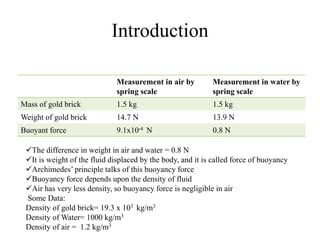
Measurement in air by
spring scale
Measurement in water by
spring scale
Mass of gold brick 1.5 kg 1.5 kg
Weight of gold brick 14.7 N 13.9 N
Buoyant force 9.1x10⁻⁴ N 0.8 N
The difference in weight in air and water = 0.8 N
It is weight of the fluid displaced by the body, and it is called force of buoyancy
Archimedes’ principle talks of this buoyancy force
Buoyancy force depends upon the density of fluid
Air has very less density, so buoyancy force is negligible in air
Some Data:
Density of gold brick= 19.3 x 10³ kg/m3
Density of Water= 1000 kg/m3
Density of air = 1.2 kg/m3
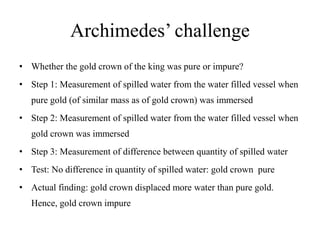
Archimedes’ challenge
• Whether the gold crown of the king was pure or impure?
• Step 1: Measurement of spilled water from the water filled vessel when
pure gold (of similar mass as of gold crown) was immersed
• Step 2: Measurement of spilled water from the water filled vessel when
gold crown was immersed
• Step 3: Measurement of difference between quantity of spilled water
• Test: No difference in quantity of spilled water: gold crown pure
• Actual finding: gold crown displaced more water than pure gold.
Hence, gold crown impure
Learning objective
• What is Buoyancy and Buoyant force?
• When a body will sink or float in fluid?
• How to calculate Force of Buoyancy?
Archimedes’ Principle
• When a body is completely or partially
immersed in a fluid, the fluid exerts an upward
force on the body equal to the weight of the
fluid displaced by the body
Archimedes’ Principle-part I
• A body immersed in a fluid experiences a
vertical buoyant force equal to the weight of
the fluid it displaces
• Buoyant Force, FB =weight of fluid equivalent
to body volume
Archimedes’ Principle -part II
• A floating body displaces its own weight in the
fluid in which it floats
• Floating bodies are special case
• Only a portion of the body is submerged
• Buoyant Force for floating body, FB =weight
of fluid equivalent to displaced volume
Examples
• In what direction does the buoyant force on an
object immersed in a liquid act?
• Why does a block of plastic released under
water come up to the surface of water?
Example
• The volume of 50 g of substance is 20 cm3 . If the
density of water is 1 g cm-3 , will the substance float or
sink?
Ans) Body Volume = 20 cm3
Mass of body = 50 g
Density of body = Mass of body/Body Volume
= 50/20 g/cm3 = 2.5 g/cm3
2.5g/cm3 > 1 g/cm3
or Density of body > Density of water
Hence, body will sink
Example
• The volume of a 500 g sealed packet is 350 cm3 . Will the packet float or sink
in water if the density of water is 1 g cm-3 ? What will be the mass of the water
displaced by this packet? (given g = 1000 cm s-2 )
Ans) Volume of body = 350cm3
FB = weight of liquid equivalent to body volume
FB = liquid x Vbody x g
FB = (1 g/cm3 )(350 cm3)(1000 cm s-2)
FB = 350000 Dynes
Wbody = mg = 500 x1000 = 500000 Dynes
Since Wbody > FB , object will sink
Amount of water displaced = mass of liquid= density of liquid x body volume
= 1 g cm-3 x 350 cm3
= 350 g
FB
mg
Example
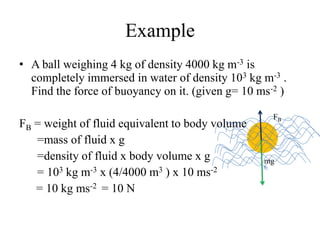
• A ball weighing 4 kg of density 4000 kg m-3 is
completely immersed in water of density 103 kg m-3 .
Find the force of buoyancy on it. (given g= 10 ms-2 )
FB = weight of fluid equivalent to body volume
=mass of fluid x g
=density of fluid x body volume x g
= 103 kg m-3 x (4/4000 m3 ) x 10 ms-2
= 10 kg ms-2 = 10 N
mg
FB