DENSITY
D = m/v (g/cm3)
 Mass usually expressed in grams
 Volume usually expressed in cm3 or ml
etc.
Density = amount of matter per unit volume
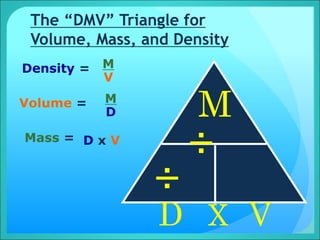
The “DMV” Triangle for
Volume, Mass, and Density
M
÷
÷
D X V
Density = M
V
Volume = M
D
Mass = D x V
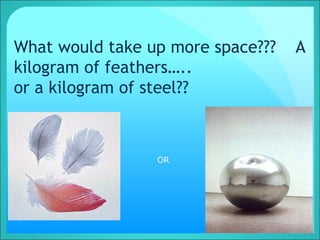
What would take up more space??? A
kilogram of feathers…..
or a kilogram of steel??
OR
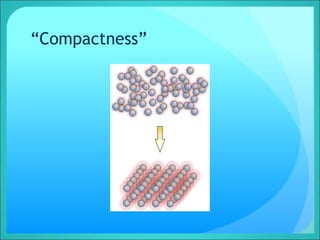
How close the atoms or molecules are to
each other
More than “heaviness” - density includes
how much space an object takes up!!
All substances have density including
liquids, solids, and gases
Density is the measure of the
“compactness” of a material
“Compactness”
Gases
How much kinetic energy do the
molecules have??
The greater the kinetic energy
 ……the greater the volume
 …… and the less dense that
gas is!!
Therefore, cold air is more dense
than warm air

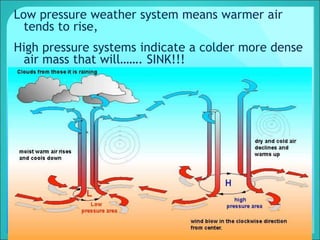
Low pressure weather system means warmer air
tends to rise,
High pressure systems indicate a colder more dense
air mass that will……. SINK!!!
LIQUIDS
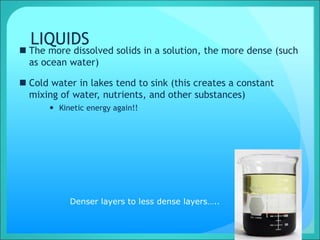
 The more dissolved solids in a solution, the more dense (such
as ocean water)
 Cold water in lakes tend to sink (this creates a constant
mixing of water, nutrients, and other substances)
 Kinetic energy again!!
Denser layers to less dense layers…..
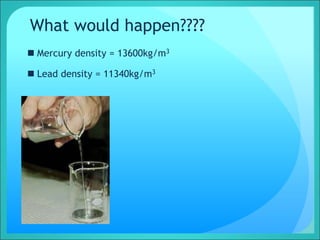
What would happen????
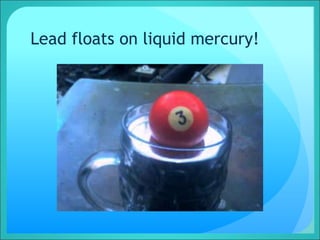
 Mercury density = 13600kg/m3
 Lead density = 11340kg/m3
Lead floats on liquid mercury!
Solids
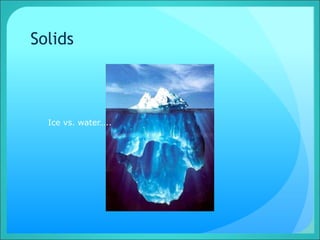
Ice vs. water…..
SOLIDS
 Ice is less dense than water (which is why lakes and
ponds have a thin layer of ice covering in winter, with
water underneath)
 Various rocks, woods, metals have a characteristic
density specific to that substance
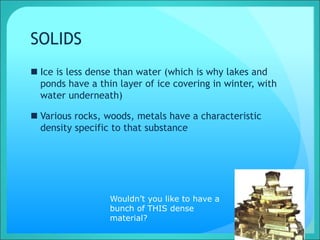
Wouldn’t you like to have a
bunch of THIS dense
material?
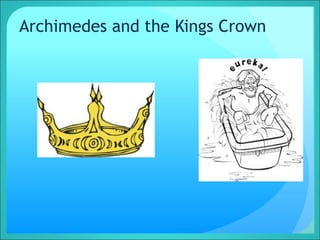
Archimedes and the Kings Crown
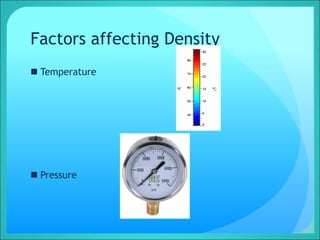
Factors affecting Density
 Temperature
 Pressure
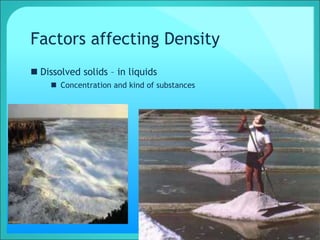
Factors affecting Density
 Dissolved solids – in liquids
 Concentration and kind of substances
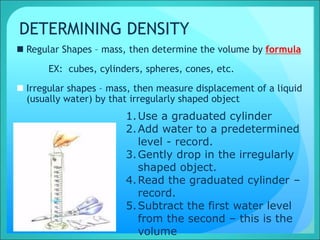
DETERMINING DENSITY
 Regular Shapes – mass, then determine the volume by formula
EX: cubes, cylinders, spheres, cones, etc.
 Irregular shapes – mass, then measure displacement of a liquid
(usually water) by that irregularly shaped object
1.Use a graduated cylinder
2.Add water to a predetermined
level - record.
3.Gently drop in the irregularly
shaped object.
4.Read the graduated cylinder –
record.
5.Subtract the first water level
from the second – this is the
volume
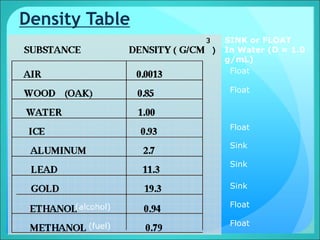
Density Table
SINK or FLOAT
In Water (D = 1.0
g/mL)
Float
Float
Float
Sink
Sink
Sink
Float
Float
(alcohol)
(fuel)

densityabbreviated.pptx

  • 1.
    DENSITY D = m/v(g/cm3)  Mass usually expressed in grams  Volume usually expressed in cm3 or ml etc. Density = amount of matter per unit volume
  • 2.
    The “DMV” Trianglefor Volume, Mass, and Density M ÷ ÷ D X V Density = M V Volume = M D Mass = D x V
  • 3.
    What would takeup more space??? A kilogram of feathers….. or a kilogram of steel?? OR
  • 4.
    How close theatoms or molecules are to each other More than “heaviness” - density includes how much space an object takes up!! All substances have density including liquids, solids, and gases Density is the measure of the “compactness” of a material
  • 5.
  • 6.
    Gases How much kineticenergy do the molecules have?? The greater the kinetic energy  ……the greater the volume  …… and the less dense that gas is!! Therefore, cold air is more dense than warm air 
  • 7.
    Low pressure weathersystem means warmer air tends to rise, High pressure systems indicate a colder more dense air mass that will……. SINK!!!
  • 8.
    LIQUIDS  The moredissolved solids in a solution, the more dense (such as ocean water)  Cold water in lakes tend to sink (this creates a constant mixing of water, nutrients, and other substances)  Kinetic energy again!! Denser layers to less dense layers…..
  • 9.
    What would happen???? Mercury density = 13600kg/m3  Lead density = 11340kg/m3
  • 10.
    Lead floats onliquid mercury!
  • 11.
  • 12.
    SOLIDS  Ice isless dense than water (which is why lakes and ponds have a thin layer of ice covering in winter, with water underneath)  Various rocks, woods, metals have a characteristic density specific to that substance Wouldn’t you like to have a bunch of THIS dense material?
  • 13.
    Archimedes and theKings Crown
  • 14.
    Factors affecting Density Temperature  Pressure
  • 15.
    Factors affecting Density Dissolved solids – in liquids  Concentration and kind of substances
  • 16.
    DETERMINING DENSITY  RegularShapes – mass, then determine the volume by formula EX: cubes, cylinders, spheres, cones, etc.  Irregular shapes – mass, then measure displacement of a liquid (usually water) by that irregularly shaped object 1.Use a graduated cylinder 2.Add water to a predetermined level - record. 3.Gently drop in the irregularly shaped object. 4.Read the graduated cylinder – record. 5.Subtract the first water level from the second – this is the volume
  • 17.
    Density Table SINK orFLOAT In Water (D = 1.0 g/mL) Float Float Float Sink Sink Sink Float Float (alcohol) (fuel)