You will Need:
1)Pencil, Colored Pencil,
Highlighters, Calculator
2)Density – 2 pages 4 sides –
Bookshelf- Please staple
3) Log #3 – Bookshelf- Update –
Managers Log in
4) Power Notes – Physical vs.
Chemical Changes + Cornell Notes
– Due Now
1) Density – Due on Friday – Oct. 18th
2) Binder Check #2 – Due Thur. Oct.
17th
at the beginning of class
3) Test #2 – Thur. Oct. 17th
- Target
Concepts on-line- ½ page of notes
front side only done by hand
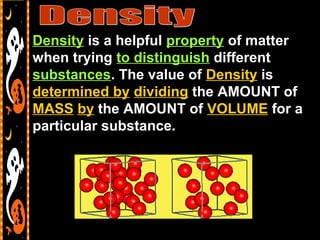
Density is a helpful property of matter
when trying to distinguish different
substances. The value of Density is
determined by dividing the AMOUNT of
MASS by the AMOUNT of VOLUME for a
particular substance.
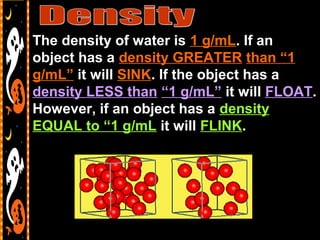
The density of water is 1 g/mL. If an
object has a density GREATER than “1
g/mL” it will SINK. If the object has a
density LESS than “1 g/mL” it will FLOAT.
However, if an object has a density
EQUAL to “1 g/mL it will FLINK.
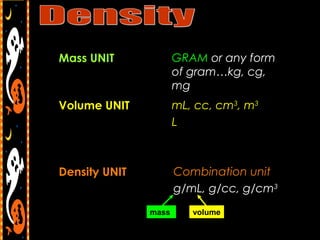
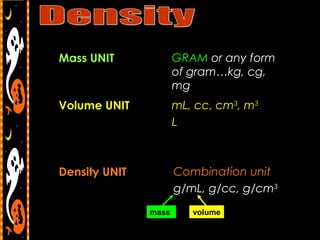
Mass UNIT GRAM or any form
of gram…kg, cg,
mg
Volume UNIT mL, cc, cm3
, m3
L
Density UNIT Combination unit
g/mL, g/cc, g/cm3
mass volume
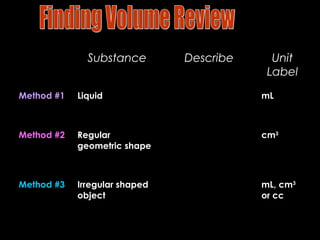
Substance Describe Unit
Label
Method #1 Liquid mL
Method #2 Regular
geometric shape
cm3
Method #3 Irregular shaped
object
mL, cm3
or cc
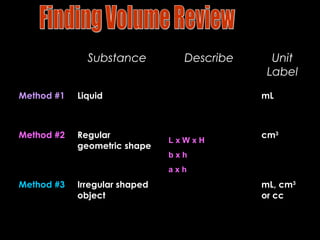
Substance Describe Unit
Label
Method #1 Liquid mL
Method #2 Regular
geometric shape
cm3
Method #3 Irregular shaped
object
mL, cm3
or cc
L x W x H
b x h
a x h
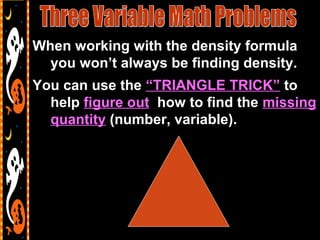
When working with the density formula
you won’t always be finding density.
You can use the “TRIANGLE TRICK” to
help figure out how to find the missing
quantity (number, variable).
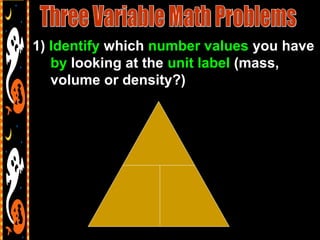
1) Identify which number values you have
by looking at the unit label (mass,
volume or density?)
Mass UNIT GRAM or any form
of gram…kg, cg,
mg
Volume UNIT mL, cc, cm3
, m3
L
Density UNIT Combination unit
g/mL, g/cc, g/cm3
mass volume
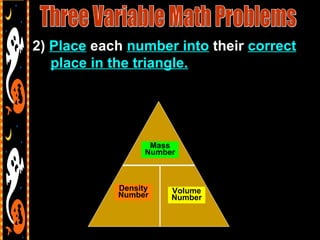
2) Place each number into their correct
place in the triangle.
Volume
Number
Mass
Number
Density
Number
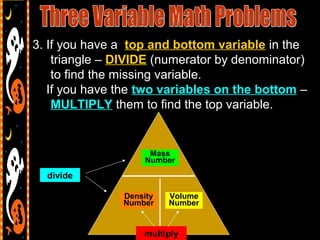
3. If you have a top and bottom variable in the
triangle – DIVIDE (numerator by denominator)
to find the missing variable.
If you have the two variables on the bottom –
MULTIPLY them to find the top variable.
Volume
Number
Mass
Number
Density
Number
divide
multiply
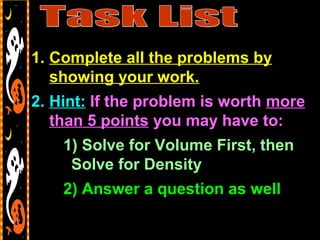
1. Complete all the problems by
showing your work.
2. Hint: If the problem is worth more
than 5 points you may have to:
1) Solve for Volume First, then
Solve for Density
2) Answer a question as well
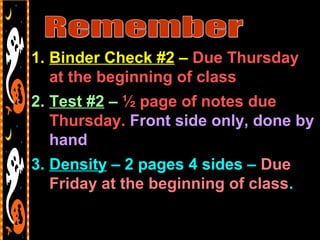
1. Binder Check #2 – Due Thursday
at the beginning of class
2. Test #2 – ½ page of notes due
Thursday. Front side only, done by
hand
3. Density – 2 pages 4 sides – Due
Friday at the beginning of class.

Density 2013

  • 1.
    You will Need: 1)Pencil,Colored Pencil, Highlighters, Calculator 2)Density – 2 pages 4 sides – Bookshelf- Please staple 3) Log #3 – Bookshelf- Update – Managers Log in 4) Power Notes – Physical vs. Chemical Changes + Cornell Notes – Due Now
  • 2.
    1) Density –Due on Friday – Oct. 18th 2) Binder Check #2 – Due Thur. Oct. 17th at the beginning of class 3) Test #2 – Thur. Oct. 17th - Target Concepts on-line- ½ page of notes front side only done by hand
  • 3.
    Density is ahelpful property of matter when trying to distinguish different substances. The value of Density is determined by dividing the AMOUNT of MASS by the AMOUNT of VOLUME for a particular substance.
  • 4.
    The density ofwater is 1 g/mL. If an object has a density GREATER than “1 g/mL” it will SINK. If the object has a density LESS than “1 g/mL” it will FLOAT. However, if an object has a density EQUAL to “1 g/mL it will FLINK.
  • 5.
    Mass UNIT GRAMor any form of gram…kg, cg, mg Volume UNIT mL, cc, cm3 , m3 L Density UNIT Combination unit g/mL, g/cc, g/cm3 mass volume
  • 6.
    Substance Describe Unit Label Method#1 Liquid mL Method #2 Regular geometric shape cm3 Method #3 Irregular shaped object mL, cm3 or cc
  • 7.
    Substance Describe Unit Label Method#1 Liquid mL Method #2 Regular geometric shape cm3 Method #3 Irregular shaped object mL, cm3 or cc L x W x H b x h a x h
  • 8.
    When working withthe density formula you won’t always be finding density. You can use the “TRIANGLE TRICK” to help figure out how to find the missing quantity (number, variable).
  • 9.
    1) Identify whichnumber values you have by looking at the unit label (mass, volume or density?)
  • 10.
    Mass UNIT GRAMor any form of gram…kg, cg, mg Volume UNIT mL, cc, cm3 , m3 L Density UNIT Combination unit g/mL, g/cc, g/cm3 mass volume
  • 11.
    2) Place eachnumber into their correct place in the triangle. Volume Number Mass Number Density Number
  • 12.
    3. If youhave a top and bottom variable in the triangle – DIVIDE (numerator by denominator) to find the missing variable. If you have the two variables on the bottom – MULTIPLY them to find the top variable. Volume Number Mass Number Density Number divide multiply
  • 13.
    1. Complete allthe problems by showing your work. 2. Hint: If the problem is worth more than 5 points you may have to: 1) Solve for Volume First, then Solve for Density 2) Answer a question as well
  • 14.
    1. Binder Check#2 – Due Thursday at the beginning of class 2. Test #2 – ½ page of notes due Thursday. Front side only, done by hand 3. Density – 2 pages 4 sides – Due Friday at the beginning of class.