DENGUE
• Presented By
• Dr. Md Imtiaz Hossain Bhuiyan (Jesun)
• PHC DOCTOR| IQARUS | UN PRIMARY
HEALTH FACILITY - Cox’s Bazar - Bangladesh
• Email: Imtiaz.Bhuiyan@iqarus.com
CONTENTS
• Introduction
• Epidemiology
• Etiology/Cause
• Transmission
• Classification
• Clinical Presentation
• Prevention
• Vaccines
INTRODUCTION
Dengue fever is an acute infectious viral disease, also known as break
bone fever.
It is a arthropod-borne (arboviral) illness in human.
It is caused by infection with 1 of the 4vserotypes of dengue virus
(DENV1,2,3,4),which is a flavivirus ( a genus of single-stranded non-
segmented RNA viruses).
Once affected persons acquired long-acting serotypes specific
immunity.
Continue:
• A small percentage of persons who have previously been infected by
one dengue serotype develop bleeding & endothelial leak up on
infection with another dengue serotype. This syndrome is termed
Dengue hemorrhagic fever (DHF). Also been termed dengue
vasculopathy.
• Vascular leakage in these patients results in hemoconcentration &
serious effusions & can lead to circulatory collapse.
• This, in conjunction with severe hemorrhagic complications, can lead
to dengue shock syndrome (DSS) ,which poses a greater fatality risk
than bleeding.
Epidemiology
• The epidemiology of dengue exhibits a complex relationship between
the host (man and mosquito), agent (virus), and the environment.
This relationship determines the level of endemicity in an area. The
transmission of dengue remains low due to extremes of temperature
with low relative humidity. Temperatures in the range of 25 C ± 5 C,
relative humidity around 80%, and innumerable small water
collections result in high transmission.
Dengue Virus
• The dengue virus forms a distinct complex under the genus
flaviviruses based on antigenic and biological characteristics. There
are four dengue virus serotypes which are designated as DENV-1,
DENV-2, DENV-3, and DENV-4. Infection with anyone of these
serotypes confers lifelong immunity to that virus serotype. Although
all four serotypes are antigenically similar, yet they elicit cross
protection for only few months .Secondary infection with another
serotype or multiple infection with different serotypes enhance
chances of occurring more severe form of diseases
Vector
• Aedes aegypti and Aedes albopictus are the two most important vectors of
dengue but Aedes aegypti is highly domesticated and strongly
anthropophilic. Aedes albopictus is an aggressive feeder and can take the
amount of blood they need for each gonotropic cycle in one bite. They
usually are distributed in the peripheral areas of urban cities.
• .The eggs of Aedes mosquito can remain in a viable dry condition for more
than a year and emerge within 24 hours once it comes in contact with
water. This is also a major hurdle in the prevention and control of dengue
• It prefers natural larval habitats which include tree holes, latex collecting
cups in rubber plantations, leaf axils, bamboo stumps, coconut shells, etc.
However, breeding has been reported recently in domestic habitats as well
Transmission Cycle and Time
• The female Aedes mosquito usually becomes infected with the
dengue virus when it takes a blood meal from a person during the
acute febrile (viremia) phase of dengue illness.
• After an extrinsic incubation period of 8 to 10 days, the mosquito
becomes infected. The virus is transmitted when the infected female
mosquito bites and injects its saliva into the wound of the person
bitten.
• Dengue begins abruptly after an intrinsic incubation period of 4 to 7
days (range 3–14 days).
Dengue Case burden in Bangladesh:
• The first epidemic of dengue hemorrhagic fever occurred in mid-2000
when 5,551 dengue infections were reported from Dhaka, Chittagong,
and Khulna cities, occurring mainly among adults.
• Among the reported cases, 4,385 (62.4%) were dengue fever (DF)
infections, and 1,186 (37.6%) cases were dengue hemorrhagic fever
(DHF).
• The case-fatality rate (CFR) was 1.7%, with 93 reported deaths.
Transmission of DF/DHF
For transmission to occur the female Ae. aegypti must bite an infected
human during the viraemic phase of the illness that manifests two days
before the onset of fever and lasts 4–5 days after onset of fever. After
ingestion of the infected blood meal the virus replicates in the epithelial cell
lining of Comprehensive Guidelines for Prevention and Control of Dengue
and Dengue Haemorrhagic Fever 13 the midgut and escapes into
haemocoele to infect the salivary glands and finally enters the saliva causing
infection during probing
Continue:
• . The genital track is also infected, and the virus may enter the fully
developed eggs at the time of oviposition. The extrinsic incubation
period (EIP) lasts from 8 to 12 days and the mosquito remains
infected for the rest of its life. The intrinsic incubation period covers
five to seven days.
• Dengue transmission usually occurs during the rainy season when the
temperature and humidity are conducive for build-up of the vector
population breeding in secondary habitats as well as for longer
mosquito survival.
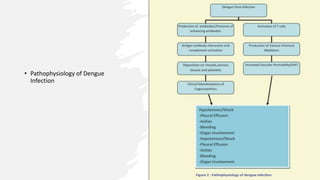
• Pathophysiology of Dengue
Infection
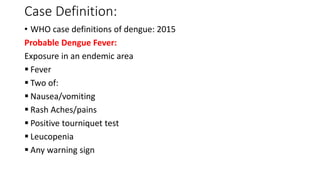
Case Definition:
• WHO case definitions of dengue: 2015
Probable Dengue Fever:
Exposure in an endemic area
 Fever
 Two of:
 Nausea/vomiting
 Rash Aches/pains
 Positive tourniquet test
 Leucopenia
 Any warning sign
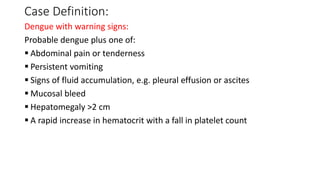
Case Definition:
Dengue with warning signs:
Probable dengue plus one of:
 Abdominal pain or tenderness
 Persistent vomiting
 Signs of fluid accumulation, e.g. pleural effusion or ascites
 Mucosal bleed
 Hepatomegaly >2 cm
 A rapid increase in hematocrit with a fall in platelet count
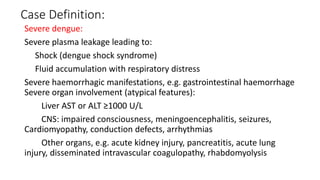
Case Definition:
Severe dengue:
Severe plasma leakage leading to:
Shock (dengue shock syndrome)
Fluid accumulation with respiratory distress
Severe haemorrhagic manifestations, e.g. gastrointestinal haemorrhage
Severe organ involvement (atypical features):
Liver AST or ALT ≥1000 U/L
CNS: impaired consciousness, meningoencephalitis, seizures,
Cardiomyopathy, conduction defects, arrhythmias
Other organs, e.g. acute kidney injury, pancreatitis, acute lung
injury, disseminated intravascular coagulopathy, rhabdomyolysis
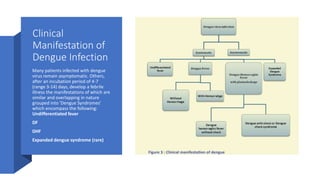
Clinical
Manifestation of
Dengue Infection
Many patients infected with dengue
virus remain asymptomatic. Others,
after an incubation period of 4-7
(range 3-14) days, develop a febrile
illness the manifestations of which are
similar and overlapping in nature
grouped into 'Dengue Syndromes'
which encompass the following:
Undifferentiated fever
DF
DHF
Expanded dengue syndrome (rare)
Clinical feature
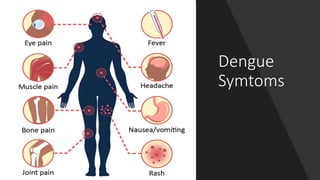
Symptoms:
1. Prodrome: 2 days of malaise and headache.
2. Acute onset: Fever, backache, arthralgias, headache, generalized pains
(‘break-bone fever’), pain in eye movement, lacrimation,
3. Fever: Continuous or ‘saddle-back’, with a break on 4th or 5th day and
then recrudescence; usually lasts 7–8 days.
4. Anorexia, Nausea, Vomiting, Pharyngitis
Dengue
Symtoms
Clinical
feature:
Sign:
1. Rash Initial flushing faint macular rash in first 1–2
days.
2. Maculopapular, scarlet morbilliform blanching
rash from days 3–5 on the trunk, spreading
centrifugally and sparing palms and soles.
3. Relative bradycardia, Prostration, depression,
lymphadenopathy.
4. Minor (petechiae, ecchymoses, epistaxis).
5. Major ( Gastrointestinal bleeding)
6. Hypotension.
7. Splenomegaly.
High Risk Patient
Infants & the elderly
Obesity
Pregnant Woman
Peptic Ulcer disease.
Woman who have menstruation or abnormal vaginal bleeding.
Haemolytic diseases: (G-6PD) deficiency, thalassemia & other hemoglobinopathies.
Congenital Heart disease.
Patient on steroid or NSAID treatment.
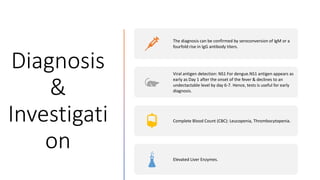
Diagnosis
&
Investigati
on
The diagnosis can be confirmed by seroconversion of IgM or a
fourfold rise in IgG antibody titers.
Viral antigen detection: NS1 For dengue.NS1 antigen appears as
early as Day 1 after the onset of the fever & declines to an
undectactable level by day 6-7. Hence, tests is useful for early
diagnosis.
Complete Blood Count (CBC): Leucopenia, Thrombocytopenia.
Elevated Liver Enzymes.
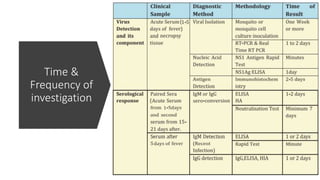
Time &
Frequency of
investigation
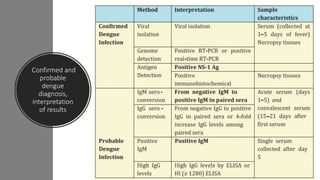
Confirmed and
probable
dengue
diagnosis,
interpretation
of results
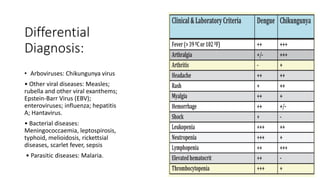
Differential
Diagnosis:
• Arboviruses: Chikungunya virus
• Other viral diseases: Measles;
rubella and other viral exanthems;
Epstein-Barr Virus (EBV);
enteroviruses; influenza; hepatitis
A; Hantavirus.
• Bacterial diseases:
Meningococcaemia, leptospirosis,
typhoid, melioidosis, rickettsial
diseases, scarlet fever, sepsis
• Parasitic diseases: Malaria.
Management
Treatment is supportive, emphasizing fluid replacement and appropriate
management of shock and organ dysfunction, which is a major determinant of
morbidity and mortality. With intensive care support, mortality rates are 1% or less.
Aspirin should be avoided due to bleeding risk.
A live attenuated tetravalent chimeric vaccine was licensed in 2019 for children. It
is recommended only for children who have already had a first infection and live in
a dengue-endemic area. Other vaccines are also in development.
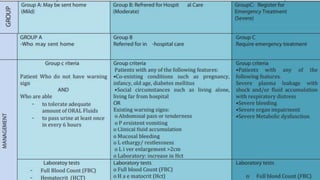
Case Management According to National
Guidelines -Bangladesh
Patients Group A: These are patients who are dengue patients without
warning sign and they may be sent home. These patients are able to tolerate
adequate volumes of oral fluids, pass urine at least once every six hours
Patients Group B: These include patients with warning signs. These are
patients who should be admitted for in-hospital management for close
observation as they approach the critical phase,. Rapid fluid replacement in
patients with warning signs is the key to prevent progression to the shock
state
Warning Sign
• No clinical improvement or worsening of the situation just
before or during the transition to afebrile phase or as the
disease progresses.
• Persistent vomiting.
• Severe abdominal pain.
• Lethargy and/or restlessness, sudden behavioural changes.
• Bleeding: Epistaxis, black stool, haematemesis, excessive
menstrual bleeding, dark coloured urine (haemoglobinuria) or
haematuria.
• Giddiness.
• Pale, cold and clammy hands and feet.
• Less/no urine output for 4 – 6 hours
• Liver enlargement > 2cm
• Haematocrit >20%
Case Management According to National
Guidelines -Bangladesh
• Patients Group C : These are patients with severe dengue who require
emergency treatment and urgent referral because they are in the critical
phase of the disease and have: Severe plasma leakage leading to dengue
shock and/or fluid accumulation with respiratory distress Severe organ
impairment (hepatic damage, renal impairment) Myocarditis,
cardiomyopathy, encephalopathy or encephalitis Severe metabolic
abnormalities (metabolic acidosis, severe Hypocalcaemia etc
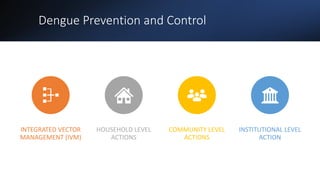
Dengue Prevention and Control
INTEGRATED VECTOR
MANAGEMENT (IVM)
HOUSEHOLD LEVEL
ACTIONS
COMMUNITY LEVEL
ACTIONS
INSTITUTIONAL LEVEL
ACTION
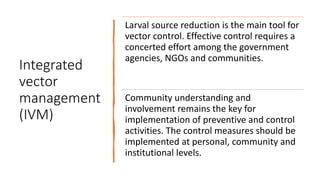
Integrated
vector
management
(IVM)
Larval source reduction is the main tool for
vector control. Effective control requires a
concerted effort among the government
agencies, NGOs and communities.
Community understanding and
involvement remains the key for
implementation of preventive and control
activities. The control measures should be
implemented at personal, community and
institutional levels.
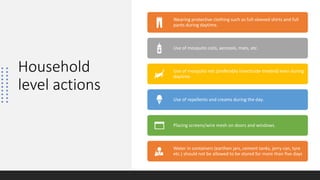
Household
level actions
Wearing protective clothing such as full-sleeved shirts and full
pants during daytime.
Use of mosquito coils, aerosols, mats, etc.
Use of mosquito net (preferably insecticide-treated) even during
daytime.
Use of repellents and creams during the day.
Placing screens/wire mesh on doors and windows.
Water in containers (earthen jars, cement tanks, jerry can, tyre
etc.) should not be allowed to be stored for more than five days
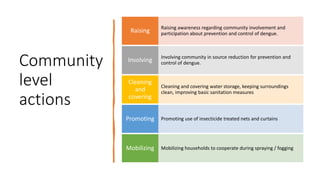
Community
level
actions
Raising awareness regarding community involvement and
participation about prevention and control of dengue.
Raising
Involving community in source reduction for prevention and
control of dengue.
Involving
Cleaning and covering water storage, keeping surroundings
clean, improving basic sanitation measures
Cleaning
and
covering
Promoting use of insecticide treated nets and curtains
Promoting
Mobilizing households to cooperate during spraying / fogging
Mobilizing
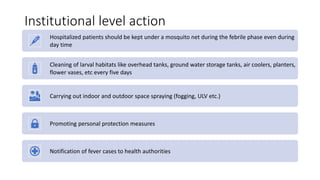
Institutional level action
Hospitalized patients should be kept under a mosquito net during the febrile phase even during
day time
Cleaning of larval habitats like overhead tanks, ground water storage tanks, air coolers, planters,
flower vases, etc every five days
Carrying out indoor and outdoor space spraying (fogging, ULV etc.)
Promoting personal protection measures
Notification of fever cases to health authorities
Vaccine
No Vaccine is currently approved for the prevention of
dengue infection.
Because immunity to a single dengue strain is the major
risk factor for dengue hemorrhagic fever & dengue shock
syndrome.A vaccine must be provided high levels of
immunity to all 4 dengue strains to be clinically useful.
A live attenuated tetravalent chimeric vaccine was
licensed in 2019 for children. It is recommended only for
children who have already had a first infection and live in
a dengue-endemic area.(Davidson's 24th Edition )
References
• Comprehensive Guidelines for Prevention
and Control of Dengue and Dengue
Haemorrhagic Fever Revised and expanded
edition, SEARO,WHO,2011.
• National Guideline for Clinical Management
of Dengue Syndrome (4th Edition 2018).
• Davidson’s Principles and Practice of
Medicine (24th Edition).
• https://www.cdc.gov/dengue/resources/den
gue-clinician-guide_508.pdf.
• Oxford handbook of clinical medicine. (10th
edition)
DENGUE.pptx

DENGUE.pptx

  • 1.
    DENGUE • Presented By •Dr. Md Imtiaz Hossain Bhuiyan (Jesun) • PHC DOCTOR| IQARUS | UN PRIMARY HEALTH FACILITY - Cox’s Bazar - Bangladesh • Email: Imtiaz.Bhuiyan@iqarus.com
  • 2.
    CONTENTS • Introduction • Epidemiology •Etiology/Cause • Transmission • Classification • Clinical Presentation • Prevention • Vaccines
  • 3.
    INTRODUCTION Dengue fever isan acute infectious viral disease, also known as break bone fever. It is a arthropod-borne (arboviral) illness in human. It is caused by infection with 1 of the 4vserotypes of dengue virus (DENV1,2,3,4),which is a flavivirus ( a genus of single-stranded non- segmented RNA viruses). Once affected persons acquired long-acting serotypes specific immunity.
  • 4.
    Continue: • A smallpercentage of persons who have previously been infected by one dengue serotype develop bleeding & endothelial leak up on infection with another dengue serotype. This syndrome is termed Dengue hemorrhagic fever (DHF). Also been termed dengue vasculopathy. • Vascular leakage in these patients results in hemoconcentration & serious effusions & can lead to circulatory collapse. • This, in conjunction with severe hemorrhagic complications, can lead to dengue shock syndrome (DSS) ,which poses a greater fatality risk than bleeding.
  • 5.
    Epidemiology • The epidemiologyof dengue exhibits a complex relationship between the host (man and mosquito), agent (virus), and the environment. This relationship determines the level of endemicity in an area. The transmission of dengue remains low due to extremes of temperature with low relative humidity. Temperatures in the range of 25 C ± 5 C, relative humidity around 80%, and innumerable small water collections result in high transmission.
  • 6.
    Dengue Virus • Thedengue virus forms a distinct complex under the genus flaviviruses based on antigenic and biological characteristics. There are four dengue virus serotypes which are designated as DENV-1, DENV-2, DENV-3, and DENV-4. Infection with anyone of these serotypes confers lifelong immunity to that virus serotype. Although all four serotypes are antigenically similar, yet they elicit cross protection for only few months .Secondary infection with another serotype or multiple infection with different serotypes enhance chances of occurring more severe form of diseases
  • 7.
    Vector • Aedes aegyptiand Aedes albopictus are the two most important vectors of dengue but Aedes aegypti is highly domesticated and strongly anthropophilic. Aedes albopictus is an aggressive feeder and can take the amount of blood they need for each gonotropic cycle in one bite. They usually are distributed in the peripheral areas of urban cities. • .The eggs of Aedes mosquito can remain in a viable dry condition for more than a year and emerge within 24 hours once it comes in contact with water. This is also a major hurdle in the prevention and control of dengue • It prefers natural larval habitats which include tree holes, latex collecting cups in rubber plantations, leaf axils, bamboo stumps, coconut shells, etc. However, breeding has been reported recently in domestic habitats as well
  • 8.
    Transmission Cycle andTime • The female Aedes mosquito usually becomes infected with the dengue virus when it takes a blood meal from a person during the acute febrile (viremia) phase of dengue illness. • After an extrinsic incubation period of 8 to 10 days, the mosquito becomes infected. The virus is transmitted when the infected female mosquito bites and injects its saliva into the wound of the person bitten. • Dengue begins abruptly after an intrinsic incubation period of 4 to 7 days (range 3–14 days).
  • 9.
    Dengue Case burdenin Bangladesh: • The first epidemic of dengue hemorrhagic fever occurred in mid-2000 when 5,551 dengue infections were reported from Dhaka, Chittagong, and Khulna cities, occurring mainly among adults. • Among the reported cases, 4,385 (62.4%) were dengue fever (DF) infections, and 1,186 (37.6%) cases were dengue hemorrhagic fever (DHF). • The case-fatality rate (CFR) was 1.7%, with 93 reported deaths.
  • 10.
    Transmission of DF/DHF Fortransmission to occur the female Ae. aegypti must bite an infected human during the viraemic phase of the illness that manifests two days before the onset of fever and lasts 4–5 days after onset of fever. After ingestion of the infected blood meal the virus replicates in the epithelial cell lining of Comprehensive Guidelines for Prevention and Control of Dengue and Dengue Haemorrhagic Fever 13 the midgut and escapes into haemocoele to infect the salivary glands and finally enters the saliva causing infection during probing
  • 11.
    Continue: • . Thegenital track is also infected, and the virus may enter the fully developed eggs at the time of oviposition. The extrinsic incubation period (EIP) lasts from 8 to 12 days and the mosquito remains infected for the rest of its life. The intrinsic incubation period covers five to seven days. • Dengue transmission usually occurs during the rainy season when the temperature and humidity are conducive for build-up of the vector population breeding in secondary habitats as well as for longer mosquito survival.
  • 12.
    • Pathophysiology ofDengue Infection
  • 13.
    Case Definition: • WHOcase definitions of dengue: 2015 Probable Dengue Fever: Exposure in an endemic area  Fever  Two of:  Nausea/vomiting  Rash Aches/pains  Positive tourniquet test  Leucopenia  Any warning sign
  • 14.
    Case Definition: Dengue withwarning signs: Probable dengue plus one of:  Abdominal pain or tenderness  Persistent vomiting  Signs of fluid accumulation, e.g. pleural effusion or ascites  Mucosal bleed  Hepatomegaly >2 cm  A rapid increase in hematocrit with a fall in platelet count
  • 15.
    Case Definition: Severe dengue: Severeplasma leakage leading to: Shock (dengue shock syndrome) Fluid accumulation with respiratory distress Severe haemorrhagic manifestations, e.g. gastrointestinal haemorrhage Severe organ involvement (atypical features): Liver AST or ALT ≥1000 U/L CNS: impaired consciousness, meningoencephalitis, seizures, Cardiomyopathy, conduction defects, arrhythmias Other organs, e.g. acute kidney injury, pancreatitis, acute lung injury, disseminated intravascular coagulopathy, rhabdomyolysis
  • 16.
    Clinical Manifestation of Dengue Infection Manypatients infected with dengue virus remain asymptomatic. Others, after an incubation period of 4-7 (range 3-14) days, develop a febrile illness the manifestations of which are similar and overlapping in nature grouped into 'Dengue Syndromes' which encompass the following: Undifferentiated fever DF DHF Expanded dengue syndrome (rare)
  • 17.
    Clinical feature Symptoms: 1. Prodrome:2 days of malaise and headache. 2. Acute onset: Fever, backache, arthralgias, headache, generalized pains (‘break-bone fever’), pain in eye movement, lacrimation, 3. Fever: Continuous or ‘saddle-back’, with a break on 4th or 5th day and then recrudescence; usually lasts 7–8 days. 4. Anorexia, Nausea, Vomiting, Pharyngitis
  • 18.
  • 19.
    Clinical feature: Sign: 1. Rash Initialflushing faint macular rash in first 1–2 days. 2. Maculopapular, scarlet morbilliform blanching rash from days 3–5 on the trunk, spreading centrifugally and sparing palms and soles. 3. Relative bradycardia, Prostration, depression, lymphadenopathy. 4. Minor (petechiae, ecchymoses, epistaxis). 5. Major ( Gastrointestinal bleeding) 6. Hypotension. 7. Splenomegaly.
  • 20.
    High Risk Patient Infants& the elderly Obesity Pregnant Woman Peptic Ulcer disease. Woman who have menstruation or abnormal vaginal bleeding. Haemolytic diseases: (G-6PD) deficiency, thalassemia & other hemoglobinopathies. Congenital Heart disease. Patient on steroid or NSAID treatment.
  • 21.
    Diagnosis & Investigati on The diagnosis canbe confirmed by seroconversion of IgM or a fourfold rise in IgG antibody titers. Viral antigen detection: NS1 For dengue.NS1 antigen appears as early as Day 1 after the onset of the fever & declines to an undectactable level by day 6-7. Hence, tests is useful for early diagnosis. Complete Blood Count (CBC): Leucopenia, Thrombocytopenia. Elevated Liver Enzymes.
  • 22.
  • 23.
  • 24.
    Differential Diagnosis: • Arboviruses: Chikungunyavirus • Other viral diseases: Measles; rubella and other viral exanthems; Epstein-Barr Virus (EBV); enteroviruses; influenza; hepatitis A; Hantavirus. • Bacterial diseases: Meningococcaemia, leptospirosis, typhoid, melioidosis, rickettsial diseases, scarlet fever, sepsis • Parasitic diseases: Malaria.
  • 25.
    Management Treatment is supportive,emphasizing fluid replacement and appropriate management of shock and organ dysfunction, which is a major determinant of morbidity and mortality. With intensive care support, mortality rates are 1% or less. Aspirin should be avoided due to bleeding risk. A live attenuated tetravalent chimeric vaccine was licensed in 2019 for children. It is recommended only for children who have already had a first infection and live in a dengue-endemic area. Other vaccines are also in development.
  • 26.
    Case Management Accordingto National Guidelines -Bangladesh Patients Group A: These are patients who are dengue patients without warning sign and they may be sent home. These patients are able to tolerate adequate volumes of oral fluids, pass urine at least once every six hours Patients Group B: These include patients with warning signs. These are patients who should be admitted for in-hospital management for close observation as they approach the critical phase,. Rapid fluid replacement in patients with warning signs is the key to prevent progression to the shock state
  • 27.
    Warning Sign • Noclinical improvement or worsening of the situation just before or during the transition to afebrile phase or as the disease progresses. • Persistent vomiting. • Severe abdominal pain. • Lethargy and/or restlessness, sudden behavioural changes. • Bleeding: Epistaxis, black stool, haematemesis, excessive menstrual bleeding, dark coloured urine (haemoglobinuria) or haematuria. • Giddiness. • Pale, cold and clammy hands and feet. • Less/no urine output for 4 – 6 hours • Liver enlargement > 2cm • Haematocrit >20%
  • 28.
    Case Management Accordingto National Guidelines -Bangladesh • Patients Group C : These are patients with severe dengue who require emergency treatment and urgent referral because they are in the critical phase of the disease and have: Severe plasma leakage leading to dengue shock and/or fluid accumulation with respiratory distress Severe organ impairment (hepatic damage, renal impairment) Myocarditis, cardiomyopathy, encephalopathy or encephalitis Severe metabolic abnormalities (metabolic acidosis, severe Hypocalcaemia etc
  • 30.
    Dengue Prevention andControl INTEGRATED VECTOR MANAGEMENT (IVM) HOUSEHOLD LEVEL ACTIONS COMMUNITY LEVEL ACTIONS INSTITUTIONAL LEVEL ACTION
  • 31.
    Integrated vector management (IVM) Larval source reductionis the main tool for vector control. Effective control requires a concerted effort among the government agencies, NGOs and communities. Community understanding and involvement remains the key for implementation of preventive and control activities. The control measures should be implemented at personal, community and institutional levels.
  • 32.
    Household level actions Wearing protectiveclothing such as full-sleeved shirts and full pants during daytime. Use of mosquito coils, aerosols, mats, etc. Use of mosquito net (preferably insecticide-treated) even during daytime. Use of repellents and creams during the day. Placing screens/wire mesh on doors and windows. Water in containers (earthen jars, cement tanks, jerry can, tyre etc.) should not be allowed to be stored for more than five days
  • 33.
    Community level actions Raising awareness regardingcommunity involvement and participation about prevention and control of dengue. Raising Involving community in source reduction for prevention and control of dengue. Involving Cleaning and covering water storage, keeping surroundings clean, improving basic sanitation measures Cleaning and covering Promoting use of insecticide treated nets and curtains Promoting Mobilizing households to cooperate during spraying / fogging Mobilizing
  • 34.
    Institutional level action Hospitalizedpatients should be kept under a mosquito net during the febrile phase even during day time Cleaning of larval habitats like overhead tanks, ground water storage tanks, air coolers, planters, flower vases, etc every five days Carrying out indoor and outdoor space spraying (fogging, ULV etc.) Promoting personal protection measures Notification of fever cases to health authorities
  • 35.
    Vaccine No Vaccine iscurrently approved for the prevention of dengue infection. Because immunity to a single dengue strain is the major risk factor for dengue hemorrhagic fever & dengue shock syndrome.A vaccine must be provided high levels of immunity to all 4 dengue strains to be clinically useful. A live attenuated tetravalent chimeric vaccine was licensed in 2019 for children. It is recommended only for children who have already had a first infection and live in a dengue-endemic area.(Davidson's 24th Edition )
  • 36.
    References • Comprehensive Guidelinesfor Prevention and Control of Dengue and Dengue Haemorrhagic Fever Revised and expanded edition, SEARO,WHO,2011. • National Guideline for Clinical Management of Dengue Syndrome (4th Edition 2018). • Davidson’s Principles and Practice of Medicine (24th Edition). • https://www.cdc.gov/dengue/resources/den gue-clinician-guide_508.pdf. • Oxford handbook of clinical medicine. (10th edition)