DENGUE FEVER
Ms. Roshani P. Naik
Roll No 13
2ND YEAR B.SC.NURSING STUDENT
DATE: 27-1-2015
INTRODUTION:
 Dengue Virus – One of four closely related but
antigenic ally distinct virus serotypes.
 [DEN-1,DEN-2,DEN-3 & DEN-4] of the genus Flavi
Virus.
 Dengue Fever is transmitted by the bite of an
Aedes mosquito infected with a Dengue Virus.
 when it bites a person with engue virus in their
blood.
 It Can’t be spread directly from one person to
another person.
 Dengue Viruses are Arboviruses causing disease
condition.
 These infections may be a symptomatic or may
lead to
 Classical Dengue Fever
 Dengue haemorrhagic fever without shock.
 Dengue haemorrhagic fever with shock
DEFINITION
 Dengue is an infecyion caused by Dengue
viruse which is spread in human beings by Aedes
Aegypti and Aedes Alvopictus mosquitoes. The
fever caused by dengue is called Dengue Fever.
HISTORY:
 In 15th to 19th Centuries – A aegypti spread out of Africa.
 In 1779 & 1780 – Spread to Aisa, Africa & North
America.
 Until 1940 – In frequent epidemics outbreaks.
 1906- confirmed that transmission by the Aedes
mosquitoes.
 During and after 2nd World War – attributed to ecologge
disruption
 1953 – sever form of diseases first reported in
Philippines.
 1970- It become a major cause of child mortality.
 Till 2014-there is a long intervals [10-40 years] between
major epidemics.
EPEDEMIOLOGY:
 Common in more than 110 cpuntries.
 50 to 528 million people hospitalized world wide a year
 And 25,000 deaths.
 In 2000 year
 12 countries in Southest Asia

 3 million infections
 6000 deaths annually.
 22 countries in Africa

 20% population get infection.
 Rates of dengue increased 30 told between 1960 &
2010.
 Due to urbanization, population growth, increased
international travel global warming.
 Past 40 years- increase number of cases.
 2.5 to 3 billion people live in where dengue viruses is
transmitted.
 50 million infection
 5,00,000 cases of dengue hemorrhagic fever 12,000
deaths.
 Children mainly.
 2008- South East Asia Region and Western Pacific
Region
 70% of DHF
 Indonesia, Thailand & Myanmar India, Bangladesh,
Maldives,Shrilanka
 Current emerging situation of dengue in INDIA:
 IN 2012: 47,029 dengue fever
 242 deaths.
 Dengue is an actue viral infection caused by atleast
4 serotypes [1,2,3 & 4] of dengue virus
 It occur epidemically or endemically.
 It start during the rainy season when the breeding
of the vector mosquitoes in generally abundant.
 Temperature also plays an important role in the
transmission of dengue virus by mosquitoes.
 Mosquitoes kept at 260 Celsius fail to transmit
DEN-2 Virus.
TRANSMISSION OF DISEASE:
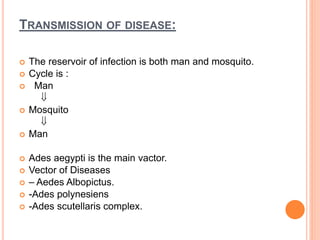
 The reservoir of infection is both man and mosquito.
 Cycle is :
 Man

 Mosquito

 Man
 Ades aegypti is the main vactor.
 Vector of Diseases
 – Aedes Albopictus.
 -Ades polynesiens
 -Ades scutellaris complex.
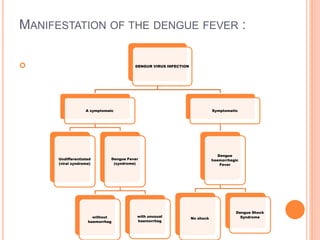
MANIFESTATION OF THE DENGUE FEVER :
 DENGUR VIRUS INFECTION
A symptomaic
Undifferentiated
(viral syndrome)
Dengue Fever
(syndrome)
without
haemorrhag
with unusual
haemorrhag
Symptomatic
Dengue
haemorrhagic
Fever
No shock
Dengue Shock
Syndrome
TYPES OF DENGUE FEVER :
 Classical Dengue Fever
 Dengue Hamorrhagic Fever.
1. CLASSICAL DENGUE FEVER :-
 All ages & both sex are cuceptible.
 Incubation period – 3 to 10 days.
 Sign & Symtoms :
 -Sudden Chills
 -High fever
 -intense headache.
 -muscle & Joint Pain.
 -within 24 hours retro orbital pain.
 -photo phobia.
 Common Symptoms:-
 -extreme weakness
 -anorexia
 -constipation
 -altered test sensation
 -Abdominal tenderness
 -Sore Throat
 -General depression.
 Fever is usually between 390 Celsius & 400 Celsius
 It lasts for about 5 days.
 The case fatality is exceedingly low.
 Infection with one dengue serotype gives immunity
againsy that particular serotype and practical protection
against others.
2. DENGUE HAEMORRHAGIC FEVER:
 It is a severe foam of dengue fever.
 Caused by infection with more than one dengue
virus.
 Dengue Shock Syndrome :
 A more severe foam of the disease characterized
by shock & haemoconcentration.
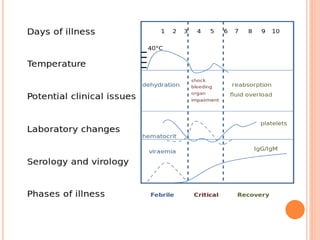
 The course of dengue illness can be divided into
three phases-
 Febrile Phase
 Critical Phase
 Recovery Phase.
1. FORBILE PHASE :
 - Incubation period of our to six days.
 Symptoms:-
 High Fever
 Facial flushing & headache
 Anorexia
 Vomitting
 Epigastric discomfort
 Tenderness at right lostal margin
 Abdominal pain
 Fever
 Temperature level – 40. C to 41. C
 Febrile convulstion occur in infants.
 Major Pathophysiologic changes
 Plasma Leakage
 Abnormal heamostasis
 Rising heamatocrit value
 Moderate throm bocytopenics
 This two are distinctive & constants findings
2. CRITICAL PHASE:-
 - 3 to 7 days of illness
 - Temperature level – 37.5. C to 38. C or less
 - increase capillary permeability
 - increasing heamatocrit levels
 -significant plasma leakage lasts 24-48 hours.
 This marks are beginning of the critical phase.
 For Diagnostic evaluation:-
 Chest X-Ray
 Abdominal ultrasound
 Pleural effusion & ascites may be clinically detectable
depending on the degree of plasma leakage & the volume of
fluid therapy.
 Shock occurs when a critical volume of plasma is lost through
leakage.
 Symptoms :- Abdominal pain
 Tenderness
 Persistent vomiting
 Clinical fluid accumulation
 Mucosal bleeding
 Lethargy
 Restlessness
 Liver enlargement more than 2 cm.
 Body temperature – subnormal
 With prolonged shock:
 Consequent organ hypoperfusion
 Organ impairment
 Metabolic acidosis
 Disseminated intravascular coagulation.
 Leucopenia – total white cell count may increase in
patient with server bleeding.
 Sever hepatitis
 Encephalitis
 myocarditis
 Cases of dengue with warning signs will probably
recover with early intravenous rehydration.
 Some cases will deteriorate to server dengue.
3. RECOVERY PHASE:
 - After the critical phase 48-72 hours are recovery phase
 - 8 to 10 days of illness.
 General well being improve
 Appetite returns
 Gastrointestinal symptoms abate
 Heamodynamic status stabilize
 Dieresis ensues.
 Some may experience generalized pruritus
 Bradycardia & electro cardiographic changes are common
during this stage.
 Haematocrit stabilizes.
 During this phase excessive fluid therapy is associated with
pulmonary oedema or congestive heart failure.
SEVERE DENGUE
 Plasma leakage

 Lead to shock
 Fluid accumulation with or without respiratory
distress
 Sever bleeding
 Sever organ impairment
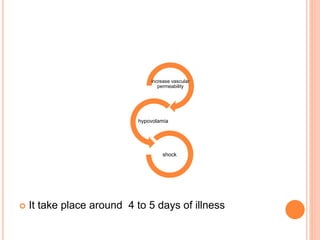
 It take place around 4 to 5 days of illness
increase vascular
permeability
hypovolamia
shock
 In initial stage of shock
 Compensatory mechanism maintains normal systolic
blood pressure.
 & produce tachycardia
 Peripheral vasoconstriction
 With reduced skin perfusion
 Patient with sever dengue may have:
 Coagulation abnormalities
 Thrombocytopenia
 Hypoxia
 Acidosis
 And it leads to multiple organ failure.
 Disseminated intravascular coagulation.
 Unusual manifestation
 Acute liver failure
 Encephalopathy
 Cardiomyopathy
 encephalitis
CLINICAL DIAGNOSIS
 fever - acute onset
 -high fever
 -2 to 7 days
 hemorrhagic manifestation
 -petechiae, purpura ecchymosis
 -epistaxis, gum bleeding
 -hematemesis or melena
 enlargement of liver
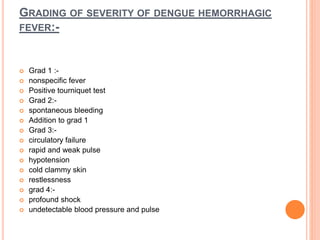
GRADING OF SEVERITY OF DENGUE HEMORRHAGIC
FEVER:-
 Grad 1 :-
 nonspecific fever
 Positive tourniquet test
 Grad 2:-
 spontaneous bleeding
 Addition to grad 1
 Grad 3:-
 circulatory failure
 rapid and weak pulse
 hypotension
 cold clammy skin
 restlessness
 grad 4:-
 profound shock
 undetectable blood pressure and pulse
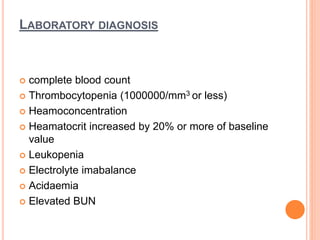
LABORATORY DIAGNOSIS
 complete blood count
 Thrombocytopenia (1000000/mm3 or less)
 Heamoconcentration
 Heamatocrit increased by 20% or more of baseline
value
 Leukopenia
 Electrolyte imabalance
 Acidaemia
 Elevated BUN
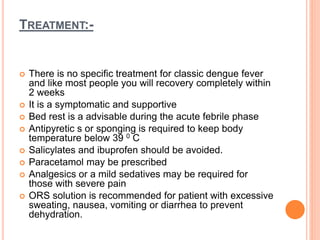
TREATMENT:-
 There is no specific treatment for classic dengue fever
and like most people you will recovery completely within
2 weeks
 It is a symptomatic and supportive
 Bed rest is a advisable during the acute febrile phase
 Antipyretic s or sponging is required to keep body
temperature below 39 0 C
 Salicylates and ibuprofen should be avoided.
 Paracetamol may be prescribed
 Analgesics or a mild sedatives may be required for
those with severe pain
 ORS solution is recommended for patient with excessive
sweating, nausea, vomiting or diarrhea to prevent
dehydration.
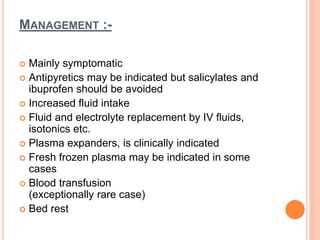
MANAGEMENT :-
 Mainly symptomatic
 Antipyretics may be indicated but salicylates and
ibuprofen should be avoided
 Increased fluid intake
 Fluid and electrolyte replacement by IV fluids,
isotonics etc.
 Plasma expanders, is clinically indicated
 Fresh frozen plasma may be indicated in some
cases
 Blood transfusion
(exceptionally rare case)
 Bed rest
NURSING MANAGMENT:
 Early detection treatment & notification.
 Observe clinical features of dengue.
 Monitor carefully the patient.
 The treatment should be started without waiting for
investigation on the basis of symptoms.
 Dengue fever is controlled by suitable antipyretics.
 Patient needs immediate hospitalization for maintaining
fluid and electrolyte balance and blood transfusion.
 Emotional & spiritual support may be appropriate.
HEALTH EDUCATION:-
 Give health education to the patient
 To prevent mosquito bite people are advised to:
 -use mosquito net
 -use mosquito repellant cream
 -cover whole body parts
 -avoid exposed arms and legs.
 To prevent mosquito breeding places. People are
advised to:
 - Clean and remove breeding places
 -cleaning and drying of man made water containers.
 - Change the water in flower vases every week
PREVENTION AND CONTROL:-
 At present, there is no effective vaccine against dengue
fever.
 Therefore the best way to prevent the disease is to take
appropriate personal preventive measures against
mosquito bites:
 Vector control is the only feasible and effective control
measure available today
 Aerosol and liquid spray has to be applied for effective
killing
 Mosquito coil to be placed near possible entrance
 Wear long sleeved clothes and long trousers when
going outdoors.
 Mosquito bed net could be used when the room is not
air conditioned.
 Keeping unscreened windows and doors closed.
 Advice for parents on source reduction in the home:
 Cover all the water containers tightly
 Change the water in flower vases every week
 Clean the surrounding area of your house
 Use an insecticide spray in the house to kill adult
mosquitoes.
COMPLICATIONS
 Brain damage from prolonged shock or intracellular
hemorrhage
 Myocarditis
 Encephalopathy
 Liver failure

Degue fever

  • 2.
    DENGUE FEVER Ms. RoshaniP. Naik Roll No 13 2ND YEAR B.SC.NURSING STUDENT DATE: 27-1-2015
  • 3.
    INTRODUTION:  Dengue Virus– One of four closely related but antigenic ally distinct virus serotypes.  [DEN-1,DEN-2,DEN-3 & DEN-4] of the genus Flavi Virus.  Dengue Fever is transmitted by the bite of an Aedes mosquito infected with a Dengue Virus.  when it bites a person with engue virus in their blood.
  • 4.
     It Can’tbe spread directly from one person to another person.  Dengue Viruses are Arboviruses causing disease condition.  These infections may be a symptomatic or may lead to  Classical Dengue Fever  Dengue haemorrhagic fever without shock.  Dengue haemorrhagic fever with shock
  • 5.
    DEFINITION  Dengue isan infecyion caused by Dengue viruse which is spread in human beings by Aedes Aegypti and Aedes Alvopictus mosquitoes. The fever caused by dengue is called Dengue Fever.
  • 6.
    HISTORY:  In 15thto 19th Centuries – A aegypti spread out of Africa.  In 1779 & 1780 – Spread to Aisa, Africa & North America.  Until 1940 – In frequent epidemics outbreaks.  1906- confirmed that transmission by the Aedes mosquitoes.  During and after 2nd World War – attributed to ecologge disruption  1953 – sever form of diseases first reported in Philippines.  1970- It become a major cause of child mortality.  Till 2014-there is a long intervals [10-40 years] between major epidemics.
  • 7.
    EPEDEMIOLOGY:  Common inmore than 110 cpuntries.  50 to 528 million people hospitalized world wide a year  And 25,000 deaths.  In 2000 year  12 countries in Southest Asia   3 million infections  6000 deaths annually.  22 countries in Africa   20% population get infection.  Rates of dengue increased 30 told between 1960 & 2010.
  • 8.
     Due tourbanization, population growth, increased international travel global warming.  Past 40 years- increase number of cases.  2.5 to 3 billion people live in where dengue viruses is transmitted.  50 million infection  5,00,000 cases of dengue hemorrhagic fever 12,000 deaths.  Children mainly.  2008- South East Asia Region and Western Pacific Region  70% of DHF  Indonesia, Thailand & Myanmar India, Bangladesh, Maldives,Shrilanka
  • 9.
     Current emergingsituation of dengue in INDIA:  IN 2012: 47,029 dengue fever  242 deaths.
  • 10.
     Dengue isan actue viral infection caused by atleast 4 serotypes [1,2,3 & 4] of dengue virus  It occur epidemically or endemically.  It start during the rainy season when the breeding of the vector mosquitoes in generally abundant.  Temperature also plays an important role in the transmission of dengue virus by mosquitoes.  Mosquitoes kept at 260 Celsius fail to transmit DEN-2 Virus.
  • 11.
    TRANSMISSION OF DISEASE: The reservoir of infection is both man and mosquito.  Cycle is :  Man   Mosquito   Man  Ades aegypti is the main vactor.  Vector of Diseases  – Aedes Albopictus.  -Ades polynesiens  -Ades scutellaris complex.
  • 12.
    MANIFESTATION OF THEDENGUE FEVER :  DENGUR VIRUS INFECTION A symptomaic Undifferentiated (viral syndrome) Dengue Fever (syndrome) without haemorrhag with unusual haemorrhag Symptomatic Dengue haemorrhagic Fever No shock Dengue Shock Syndrome
  • 13.
    TYPES OF DENGUEFEVER :  Classical Dengue Fever  Dengue Hamorrhagic Fever.
  • 14.
    1. CLASSICAL DENGUEFEVER :-  All ages & both sex are cuceptible.  Incubation period – 3 to 10 days.  Sign & Symtoms :  -Sudden Chills  -High fever  -intense headache.  -muscle & Joint Pain.  -within 24 hours retro orbital pain.  -photo phobia.
  • 15.
     Common Symptoms:- -extreme weakness  -anorexia  -constipation  -altered test sensation  -Abdominal tenderness  -Sore Throat  -General depression.  Fever is usually between 390 Celsius & 400 Celsius  It lasts for about 5 days.  The case fatality is exceedingly low.  Infection with one dengue serotype gives immunity againsy that particular serotype and practical protection against others.
  • 16.
    2. DENGUE HAEMORRHAGICFEVER:  It is a severe foam of dengue fever.  Caused by infection with more than one dengue virus.  Dengue Shock Syndrome :  A more severe foam of the disease characterized by shock & haemoconcentration.  The course of dengue illness can be divided into three phases-  Febrile Phase  Critical Phase  Recovery Phase.
  • 17.
    1. FORBILE PHASE:  - Incubation period of our to six days.  Symptoms:-  High Fever  Facial flushing & headache  Anorexia  Vomitting  Epigastric discomfort  Tenderness at right lostal margin  Abdominal pain  Fever  Temperature level – 40. C to 41. C  Febrile convulstion occur in infants.
  • 18.
     Major Pathophysiologicchanges  Plasma Leakage  Abnormal heamostasis  Rising heamatocrit value  Moderate throm bocytopenics  This two are distinctive & constants findings
  • 19.
    2. CRITICAL PHASE:- - 3 to 7 days of illness  - Temperature level – 37.5. C to 38. C or less  - increase capillary permeability  - increasing heamatocrit levels  -significant plasma leakage lasts 24-48 hours.  This marks are beginning of the critical phase.  For Diagnostic evaluation:-  Chest X-Ray  Abdominal ultrasound  Pleural effusion & ascites may be clinically detectable depending on the degree of plasma leakage & the volume of fluid therapy.  Shock occurs when a critical volume of plasma is lost through leakage.
  • 20.
     Symptoms :-Abdominal pain  Tenderness  Persistent vomiting  Clinical fluid accumulation  Mucosal bleeding  Lethargy  Restlessness  Liver enlargement more than 2 cm.  Body temperature – subnormal  With prolonged shock:
  • 21.
     Consequent organhypoperfusion  Organ impairment  Metabolic acidosis  Disseminated intravascular coagulation.  Leucopenia – total white cell count may increase in patient with server bleeding.  Sever hepatitis  Encephalitis  myocarditis  Cases of dengue with warning signs will probably recover with early intravenous rehydration.  Some cases will deteriorate to server dengue.
  • 22.
    3. RECOVERY PHASE: - After the critical phase 48-72 hours are recovery phase  - 8 to 10 days of illness.  General well being improve  Appetite returns  Gastrointestinal symptoms abate  Heamodynamic status stabilize  Dieresis ensues.  Some may experience generalized pruritus  Bradycardia & electro cardiographic changes are common during this stage.  Haematocrit stabilizes.  During this phase excessive fluid therapy is associated with pulmonary oedema or congestive heart failure.
  • 24.
    SEVERE DENGUE  Plasmaleakage   Lead to shock  Fluid accumulation with or without respiratory distress  Sever bleeding  Sever organ impairment
  • 25.
     It takeplace around 4 to 5 days of illness increase vascular permeability hypovolamia shock
  • 26.
     In initialstage of shock  Compensatory mechanism maintains normal systolic blood pressure.  & produce tachycardia  Peripheral vasoconstriction  With reduced skin perfusion  Patient with sever dengue may have:  Coagulation abnormalities  Thrombocytopenia  Hypoxia  Acidosis  And it leads to multiple organ failure.  Disseminated intravascular coagulation.
  • 27.
     Unusual manifestation Acute liver failure  Encephalopathy  Cardiomyopathy  encephalitis
  • 28.
    CLINICAL DIAGNOSIS  fever- acute onset  -high fever  -2 to 7 days  hemorrhagic manifestation  -petechiae, purpura ecchymosis  -epistaxis, gum bleeding  -hematemesis or melena  enlargement of liver
  • 29.
    GRADING OF SEVERITYOF DENGUE HEMORRHAGIC FEVER:-  Grad 1 :-  nonspecific fever  Positive tourniquet test  Grad 2:-  spontaneous bleeding  Addition to grad 1  Grad 3:-  circulatory failure  rapid and weak pulse  hypotension  cold clammy skin  restlessness  grad 4:-  profound shock  undetectable blood pressure and pulse
  • 30.
    LABORATORY DIAGNOSIS  completeblood count  Thrombocytopenia (1000000/mm3 or less)  Heamoconcentration  Heamatocrit increased by 20% or more of baseline value  Leukopenia  Electrolyte imabalance  Acidaemia  Elevated BUN
  • 31.
    TREATMENT:-  There isno specific treatment for classic dengue fever and like most people you will recovery completely within 2 weeks  It is a symptomatic and supportive  Bed rest is a advisable during the acute febrile phase  Antipyretic s or sponging is required to keep body temperature below 39 0 C  Salicylates and ibuprofen should be avoided.  Paracetamol may be prescribed  Analgesics or a mild sedatives may be required for those with severe pain  ORS solution is recommended for patient with excessive sweating, nausea, vomiting or diarrhea to prevent dehydration.
  • 32.
    MANAGEMENT :-  Mainlysymptomatic  Antipyretics may be indicated but salicylates and ibuprofen should be avoided  Increased fluid intake  Fluid and electrolyte replacement by IV fluids, isotonics etc.  Plasma expanders, is clinically indicated  Fresh frozen plasma may be indicated in some cases  Blood transfusion (exceptionally rare case)  Bed rest
  • 33.
    NURSING MANAGMENT:  Earlydetection treatment & notification.  Observe clinical features of dengue.  Monitor carefully the patient.  The treatment should be started without waiting for investigation on the basis of symptoms.  Dengue fever is controlled by suitable antipyretics.  Patient needs immediate hospitalization for maintaining fluid and electrolyte balance and blood transfusion.  Emotional & spiritual support may be appropriate.
  • 34.
    HEALTH EDUCATION:-  Givehealth education to the patient  To prevent mosquito bite people are advised to:  -use mosquito net  -use mosquito repellant cream  -cover whole body parts  -avoid exposed arms and legs.  To prevent mosquito breeding places. People are advised to:  - Clean and remove breeding places  -cleaning and drying of man made water containers.  - Change the water in flower vases every week
  • 35.
    PREVENTION AND CONTROL:- At present, there is no effective vaccine against dengue fever.  Therefore the best way to prevent the disease is to take appropriate personal preventive measures against mosquito bites:  Vector control is the only feasible and effective control measure available today  Aerosol and liquid spray has to be applied for effective killing  Mosquito coil to be placed near possible entrance  Wear long sleeved clothes and long trousers when going outdoors.  Mosquito bed net could be used when the room is not air conditioned.  Keeping unscreened windows and doors closed.
  • 36.
     Advice forparents on source reduction in the home:  Cover all the water containers tightly  Change the water in flower vases every week  Clean the surrounding area of your house  Use an insecticide spray in the house to kill adult mosquitoes.
  • 37.
    COMPLICATIONS  Brain damagefrom prolonged shock or intracellular hemorrhage  Myocarditis  Encephalopathy  Liver failure