
Demographic Transition and
its relation to NCD
Presented by-
Dr. Jheelam Biswas
Department of NCD
BUHS
Outline
• What is demographic transition
• Stages of demographic transition
• Demographic transition and NCD around the
world
• Demographic transition and NCD in Bangladesh
• Challenges and policies to combat NCD
What is demographic transition
• It describes the transition from high birth and
death rates to low birth and death rates as the
country or region progresses from the pre-
industrial to industrialized economic system.
• 1st described by Warren Thompson in 1929.
Frank W. Notestein gave the modern DTM.
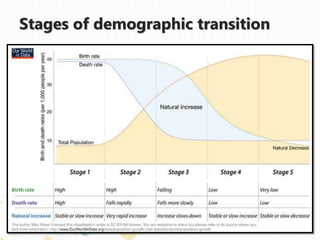
Stages of demographic transition
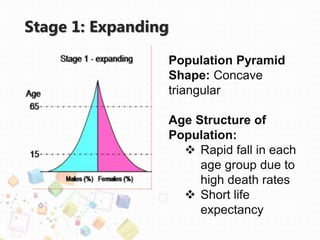
Stage 1: Expanding
Population Pyramid
Shape: Concave
triangular
Age Structure of
Population:
 Rapid fall in each
age group due to
high death rates
 Short life
expectancy
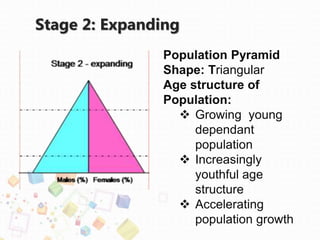
Stage 2: Expanding
Population Pyramid
Shape: Triangular
Age structure of
Population:
 Growing young
dependant
population
 Increasingly
youthful age
structure
 Accelerating
population growth
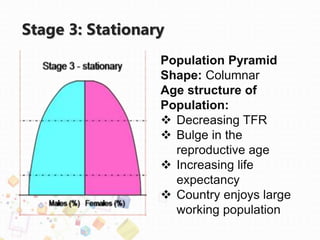
Stage 3: Stationary
Population Pyramid
Shape: Columnar
Age structure of
Population:
 Decreasing TFR
 Bulge in the
reproductive age
 Increasing life
expectancy
 Country enjoys large
working population
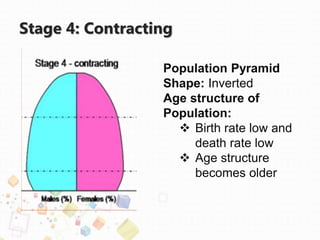
Stage 4: Contracting
Population Pyramid
Shape: Inverted
Age structure of
Population:
 Birth rate low and
death rate low
 Age structure
becomes older
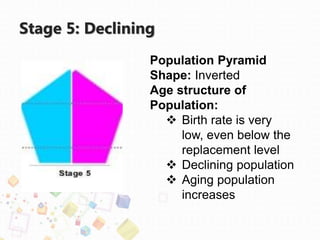
Stage 5: Declining
Population Pyramid
Shape: Inverted
Age structure of
Population:
 Birth rate is very
low, even below the
replacement level
 Declining population
 Aging population
increases
Relationship between DTM and NCD
As a country goes through the stages of this
transition there is also shift of the disease
pattern to NCD because-
Increasing burden of aging population
Changes in lifestyle and urbanization
Increasing risk factors among the younger
population causing development of NCD in later
age.
DTM and NCD in developed countries
• The completion of the demographic transition
has left fertility rates in most developed
countries at below replacement levels.
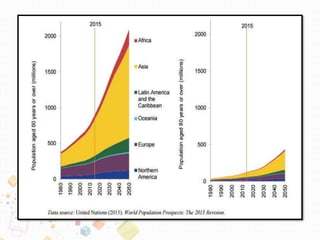
• In 2010, the number of elderly people around
the world was 524 million (65 and older), and at
this rate, in 2050, the number would be expected
to be triple, almost 16% of the world population.
Cont…
• As the burden of aging population increases,
annual NCD deaths are projected to rise
substantially, reaching 52 million by 2030.
• By 2030, NCDs are projected to account for more
than one-half of the disease burden in low-
income countries and more than three-fourths in
middle-income countries. Mainly people over 80
will share this burden.
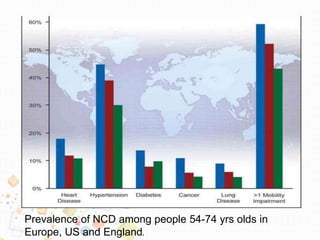
Prevalence of NCD among people 54-74 yrs olds in
Europe, US and England.
DTM, NCD and developing countries
• In developing countries urbanization and
industrialization also play role along with aging.
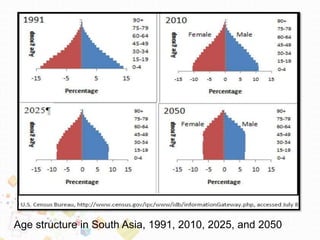
• In SEA, most countries are in stage 3 of DTM.
• So industrialization and urbanization are taking
their tolls along with falling birth rate and death
rates as well as improved health system.
Cont..
• Exposure to other risk factors responsible for
NCD like unhealthy diet, tobacco and others
cause rise of NCD among young people, and
also there is fall in death rates, so many people
will live with this increasing burden, and also
many more will be affected as they age.
Age structure in South Asia, 1991, 2010, 2025, and 2050
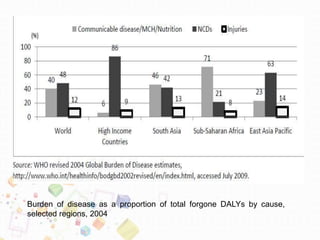
Burden of disease as a proportion of total forgone DALYs by cause,
selected regions, 2004
Cont..
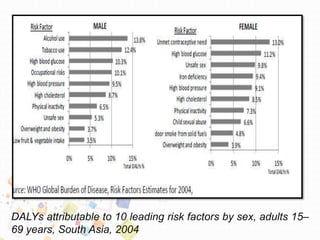
• Among females the risk factor of NCD are mainly
hypertension and high blood lipids.
• Among males, the risk factors of NCD are
tobacco consumption and alcohol use, high
cholesterol, high blood pressure, and low
consumption of fruits and vegetables.
DALYs attributable to 10 leading risk factors by sex, adults 15–
69 years, South Asia, 2004
Cont..
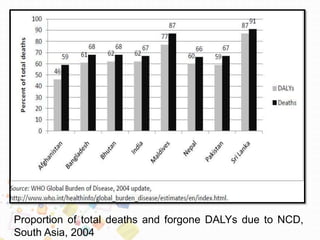
• The burden of NCD varies from country to
country.
• In more developed countries like SriLanka NCD
are definitely increasing, but in developing
countries like Nepal or Bangladesh, both
communicable and noncommunicable diseases
persist, but NCD are definitely increasing.
Proportion of total deaths and forgone DALYs due to NCD,
South Asia, 2004
DTM and NCD in Bangladesh
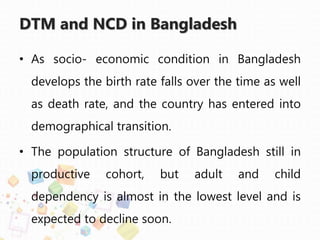
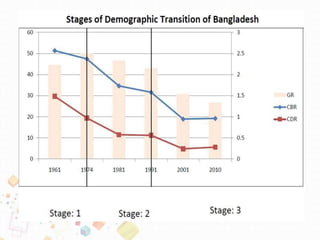
• As socio- economic condition in Bangladesh
develops the birth rate falls over the time as well
as death rate, and the country has entered into
demographical transition.
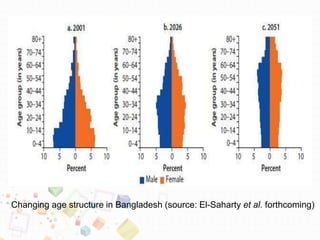
• The population structure of Bangladesh still in
productive cohort, but adult and child
dependency is almost in the lowest level and is
expected to decline soon.
Changing age structure in Bangladesh (source: El-Saharty et al. forthcoming)
Cont..
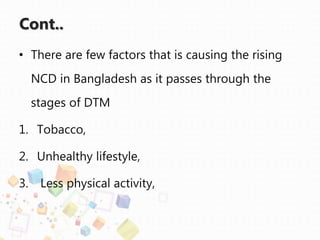
• There are few factors that is causing the rising
NCD in Bangladesh as it passes through the
stages of DTM
1. Tobacco,
2. Unhealthy lifestyle,
3. Less physical activity,
Cont..
4. Huge middle-age bulge in the population
structure, exposed to risk factors and
developing NCDs
5. Rising older population group
Double burden of diseases in
Bangladesh
• Mortality from communicable, maternal,
neonatal and nutritional disorders fell in
Bangladesh dramatically from 583/100 000 in
1990 to 178 /100 000 in 2010, with similar falls in
males and females.
• Mainly due to fall in MMR and childhood
communicable diseases.
Cont…
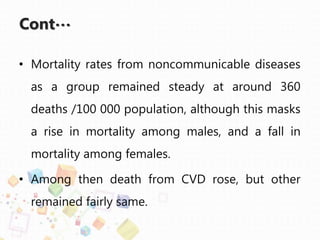
• Mortality rates from noncommunicable diseases
as a group remained steady at around 360
deaths /100 000 population, although this masks
a rise in mortality among males, and a fall in
mortality among females.
• Among then death from CVD rose, but other
remained fairly same.
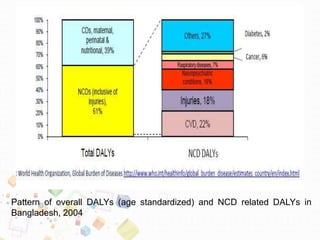
Pattern of overall DALYs (age standardized) and NCD related DALYs in
Bangladesh, 2004
Challenges and policies to combat
NCD
• The main challenges for NCD in Bangladesh are-
Population age will increase in future
NCD now the major concern in the health related
challenges
Prevealence of risk factors, especially tobacco
higher in South Asian region, also in Bangladesh,
especially among low income people
Cont..
• Right now a few NGOs, private sectors and WHO
are mainly working to combat NCD in
Bangladesh.
• But government must take some initiative too.
• In 2010 WHO has suggested a policy framework
for Bangladesh to combat NCD. The options
are-
Cont..
Retool health services delivery for NCD
Strengthen tobacco control policy
Strengthen injury control policy
Develop national NCD surveillance system
Strengthen and evaluate capacity
Participating regional collaboration
Demographic transition and its relation to NCD

Demographic transition and its relation to NCD

  • 1.
    Demographic Transition and itsrelation to NCD Presented by- Dr. Jheelam Biswas Department of NCD BUHS
  • 2.
    Outline • What isdemographic transition • Stages of demographic transition • Demographic transition and NCD around the world • Demographic transition and NCD in Bangladesh • Challenges and policies to combat NCD
  • 3.
    What is demographictransition • It describes the transition from high birth and death rates to low birth and death rates as the country or region progresses from the pre- industrial to industrialized economic system. • 1st described by Warren Thompson in 1929. Frank W. Notestein gave the modern DTM.
  • 4.
  • 5.
    Stage 1: Expanding PopulationPyramid Shape: Concave triangular Age Structure of Population:  Rapid fall in each age group due to high death rates  Short life expectancy
  • 6.
    Stage 2: Expanding PopulationPyramid Shape: Triangular Age structure of Population:  Growing young dependant population  Increasingly youthful age structure  Accelerating population growth
  • 7.
    Stage 3: Stationary PopulationPyramid Shape: Columnar Age structure of Population:  Decreasing TFR  Bulge in the reproductive age  Increasing life expectancy  Country enjoys large working population
  • 8.
    Stage 4: Contracting PopulationPyramid Shape: Inverted Age structure of Population:  Birth rate low and death rate low  Age structure becomes older
  • 9.
    Stage 5: Declining PopulationPyramid Shape: Inverted Age structure of Population:  Birth rate is very low, even below the replacement level  Declining population  Aging population increases
  • 10.
    Relationship between DTMand NCD As a country goes through the stages of this transition there is also shift of the disease pattern to NCD because- Increasing burden of aging population Changes in lifestyle and urbanization Increasing risk factors among the younger population causing development of NCD in later age.
  • 12.
    DTM and NCDin developed countries • The completion of the demographic transition has left fertility rates in most developed countries at below replacement levels. • In 2010, the number of elderly people around the world was 524 million (65 and older), and at this rate, in 2050, the number would be expected to be triple, almost 16% of the world population.
  • 14.
    Cont… • As theburden of aging population increases, annual NCD deaths are projected to rise substantially, reaching 52 million by 2030. • By 2030, NCDs are projected to account for more than one-half of the disease burden in low- income countries and more than three-fourths in middle-income countries. Mainly people over 80 will share this burden.
  • 15.
    Prevalence of NCDamong people 54-74 yrs olds in Europe, US and England.
  • 16.
    DTM, NCD anddeveloping countries • In developing countries urbanization and industrialization also play role along with aging. • In SEA, most countries are in stage 3 of DTM. • So industrialization and urbanization are taking their tolls along with falling birth rate and death rates as well as improved health system.
  • 17.
    Cont.. • Exposure toother risk factors responsible for NCD like unhealthy diet, tobacco and others cause rise of NCD among young people, and also there is fall in death rates, so many people will live with this increasing burden, and also many more will be affected as they age.
  • 18.
    Age structure inSouth Asia, 1991, 2010, 2025, and 2050
  • 19.
    Burden of diseaseas a proportion of total forgone DALYs by cause, selected regions, 2004
  • 20.
    Cont.. • Among femalesthe risk factor of NCD are mainly hypertension and high blood lipids. • Among males, the risk factors of NCD are tobacco consumption and alcohol use, high cholesterol, high blood pressure, and low consumption of fruits and vegetables.
  • 21.
    DALYs attributable to10 leading risk factors by sex, adults 15– 69 years, South Asia, 2004
  • 22.
    Cont.. • The burdenof NCD varies from country to country. • In more developed countries like SriLanka NCD are definitely increasing, but in developing countries like Nepal or Bangladesh, both communicable and noncommunicable diseases persist, but NCD are definitely increasing.
  • 23.
    Proportion of totaldeaths and forgone DALYs due to NCD, South Asia, 2004
  • 24.
    DTM and NCDin Bangladesh • As socio- economic condition in Bangladesh develops the birth rate falls over the time as well as death rate, and the country has entered into demographical transition. • The population structure of Bangladesh still in productive cohort, but adult and child dependency is almost in the lowest level and is expected to decline soon.
  • 26.
    Changing age structurein Bangladesh (source: El-Saharty et al. forthcoming)
  • 27.
    Cont.. • There arefew factors that is causing the rising NCD in Bangladesh as it passes through the stages of DTM 1. Tobacco, 2. Unhealthy lifestyle, 3. Less physical activity,
  • 28.
    Cont.. 4. Huge middle-agebulge in the population structure, exposed to risk factors and developing NCDs 5. Rising older population group
  • 29.
    Double burden ofdiseases in Bangladesh • Mortality from communicable, maternal, neonatal and nutritional disorders fell in Bangladesh dramatically from 583/100 000 in 1990 to 178 /100 000 in 2010, with similar falls in males and females. • Mainly due to fall in MMR and childhood communicable diseases.
  • 30.
    Cont… • Mortality ratesfrom noncommunicable diseases as a group remained steady at around 360 deaths /100 000 population, although this masks a rise in mortality among males, and a fall in mortality among females. • Among then death from CVD rose, but other remained fairly same.
  • 31.
    Pattern of overallDALYs (age standardized) and NCD related DALYs in Bangladesh, 2004
  • 32.
    Challenges and policiesto combat NCD • The main challenges for NCD in Bangladesh are- Population age will increase in future NCD now the major concern in the health related challenges Prevealence of risk factors, especially tobacco higher in South Asian region, also in Bangladesh, especially among low income people
  • 33.
    Cont.. • Right nowa few NGOs, private sectors and WHO are mainly working to combat NCD in Bangladesh. • But government must take some initiative too. • In 2010 WHO has suggested a policy framework for Bangladesh to combat NCD. The options are-
  • 34.
    Cont.. Retool health servicesdelivery for NCD Strengthen tobacco control policy Strengthen injury control policy Develop national NCD surveillance system Strengthen and evaluate capacity Participating regional collaboration