Social determinants and global
health
Joyce L. Browne, MD MSc
PhD fellow
Julius Global Health, Julius Center
for Health Sciences and Primary Care
UMC Utrecht, The Netherlands
www.globalhealth.eu
J.L.Browne@umcutrecht.nl
Fundamentals of Global Health Summer School 2014
1
Learning objectives
• To appreciate the historical context and
evidence for a social gradient in morbidity
and mortality
• To understand and discuss what social
determinants are, and how they get under
the skin
• Recognize and address the social gradients
that occur in Global Health context
2
Understanding social determinants
3
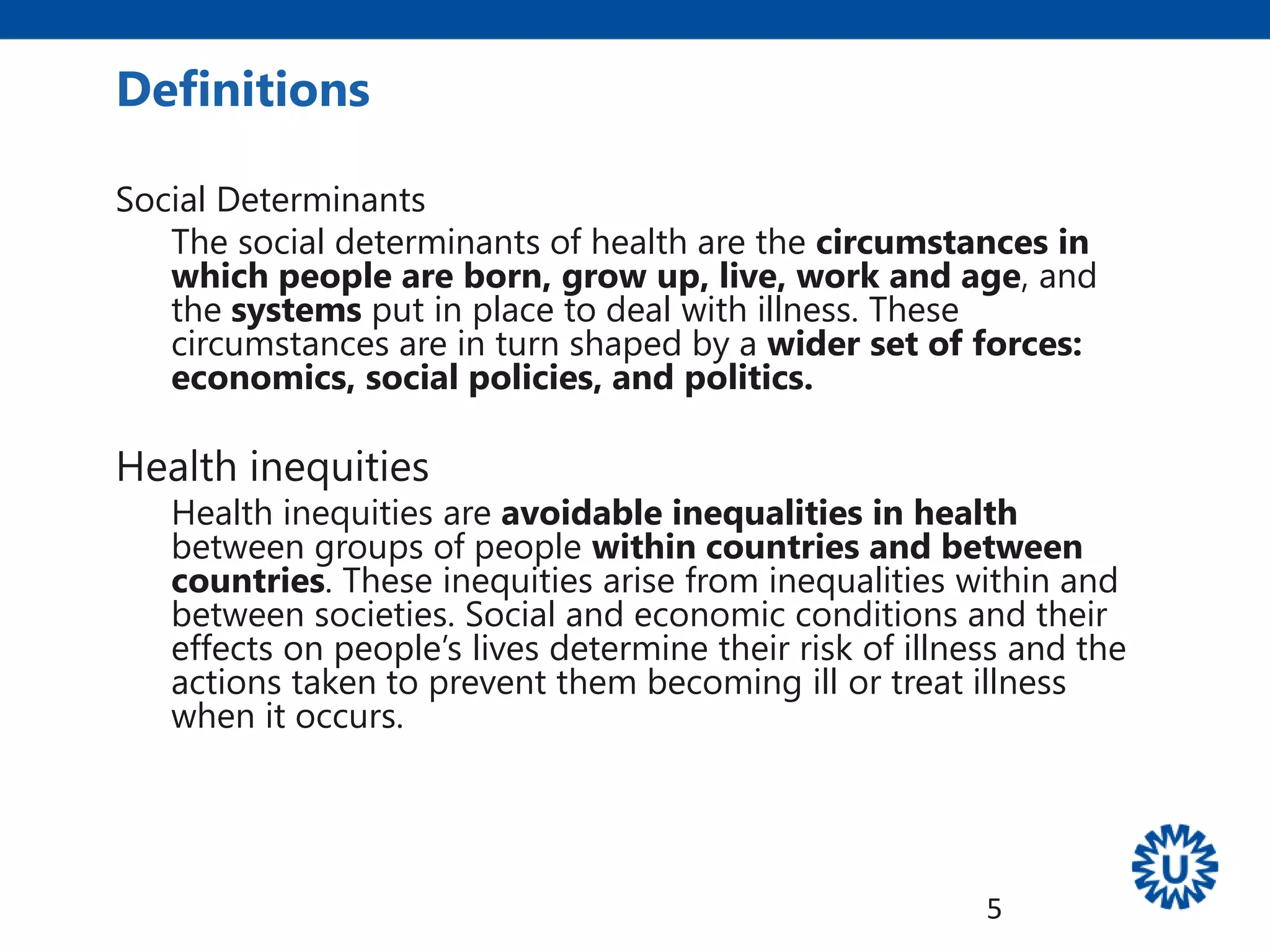
Definitions
• Social determinants
• Health (in)equity
• Common measurements?
4
Definitions
Social Determinants
The social determinants of health are the circumstances in
which people are born, grow up, live, work and age, and
the systems put in place to deal with illness. These
circumstances are in turn shaped by a wider set of forces:
economics, social policies, and politics.
Health inequities
Health inequities are avoidable inequalities in health
between groups of people within countries and between
countries. These inequities arise from inequalities within and
between societies. Social and economic conditions and their
effects on people’s lives determine their risk of illness and the
actions taken to prevent them becoming ill or treat illness
when it occurs.
5
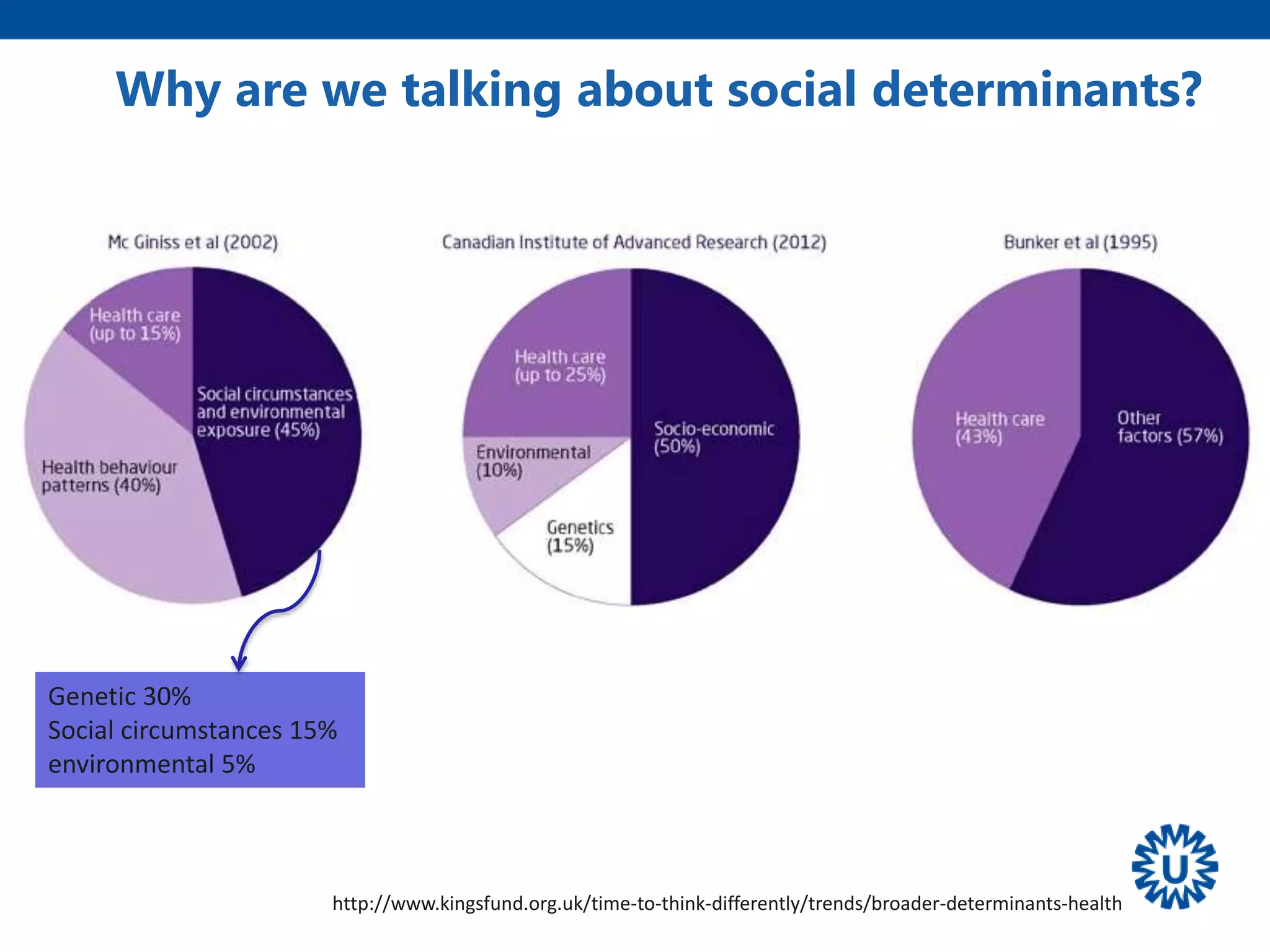
Why are we talking about social determinants?
http://www.kingsfund.org.uk/time-to-think-differently/trends/broader-determinants-health
Genetic 30%
Social circumstances 15%
environmental 5%
Historical context of the Social Determinants
in Health
7
Historical context of the Social Determinants in
Health (1)
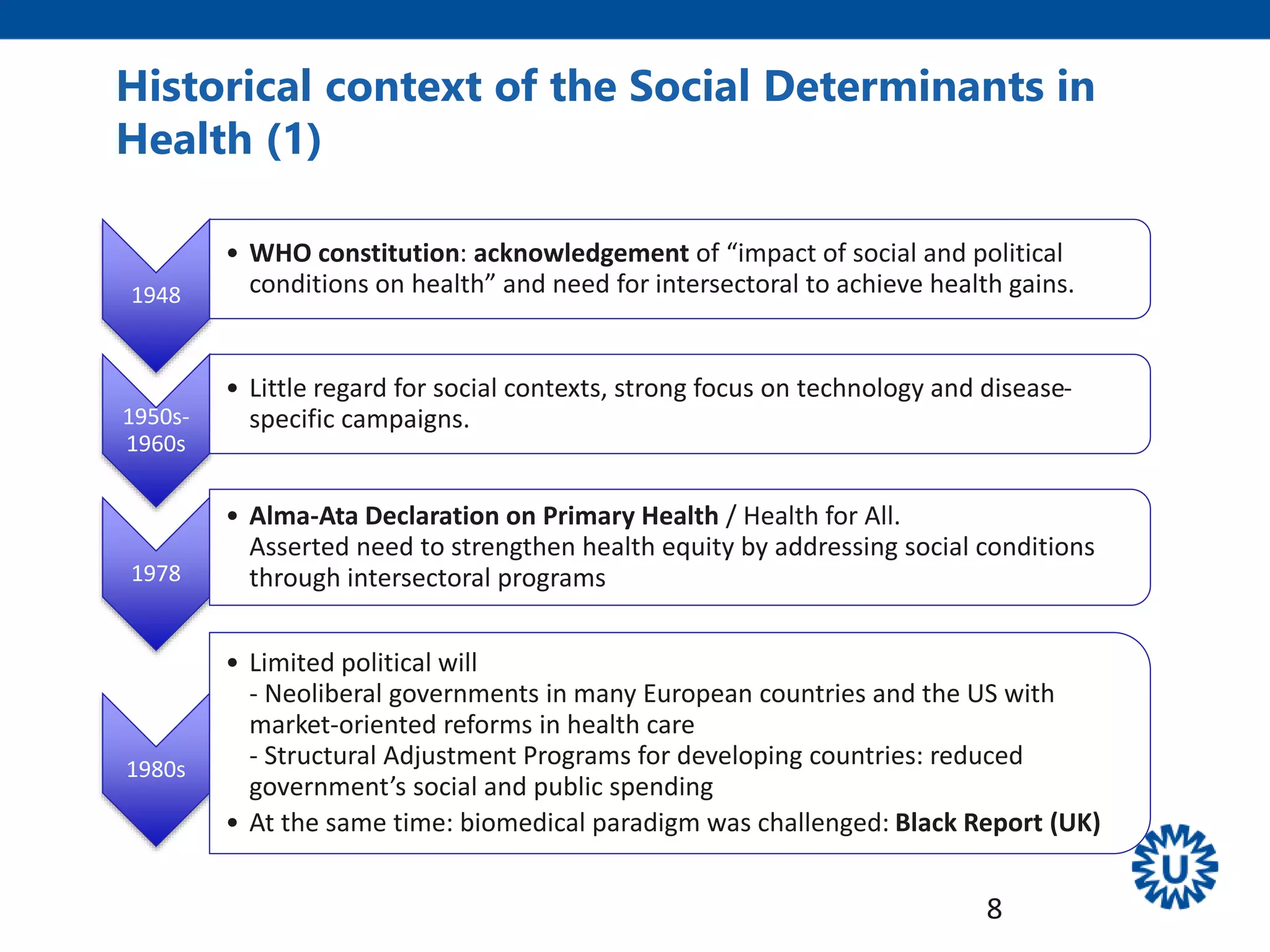
1948
• WHO constitution: acknowledgement of “impact of social and political
conditions on health” and need for intersectoral to achieve health gains.

1950s-
1960s
• Little regard for social contexts, strong focus on technology and disease-
specific campaigns.
1978
• Alma-Ata Declaration on Primary Health / Health for All.
Asserted need to strengthen health equity by addressing social conditions
through intersectoral programs
1980s
• Limited political will
- Neoliberal governments in many European countries and the US with
market-oriented reforms in health care
- Structural Adjustment Programs for developing countries: reduced
government’s social and public spending
• At the same time: biomedical paradigm was challenged: Black Report (UK)
8
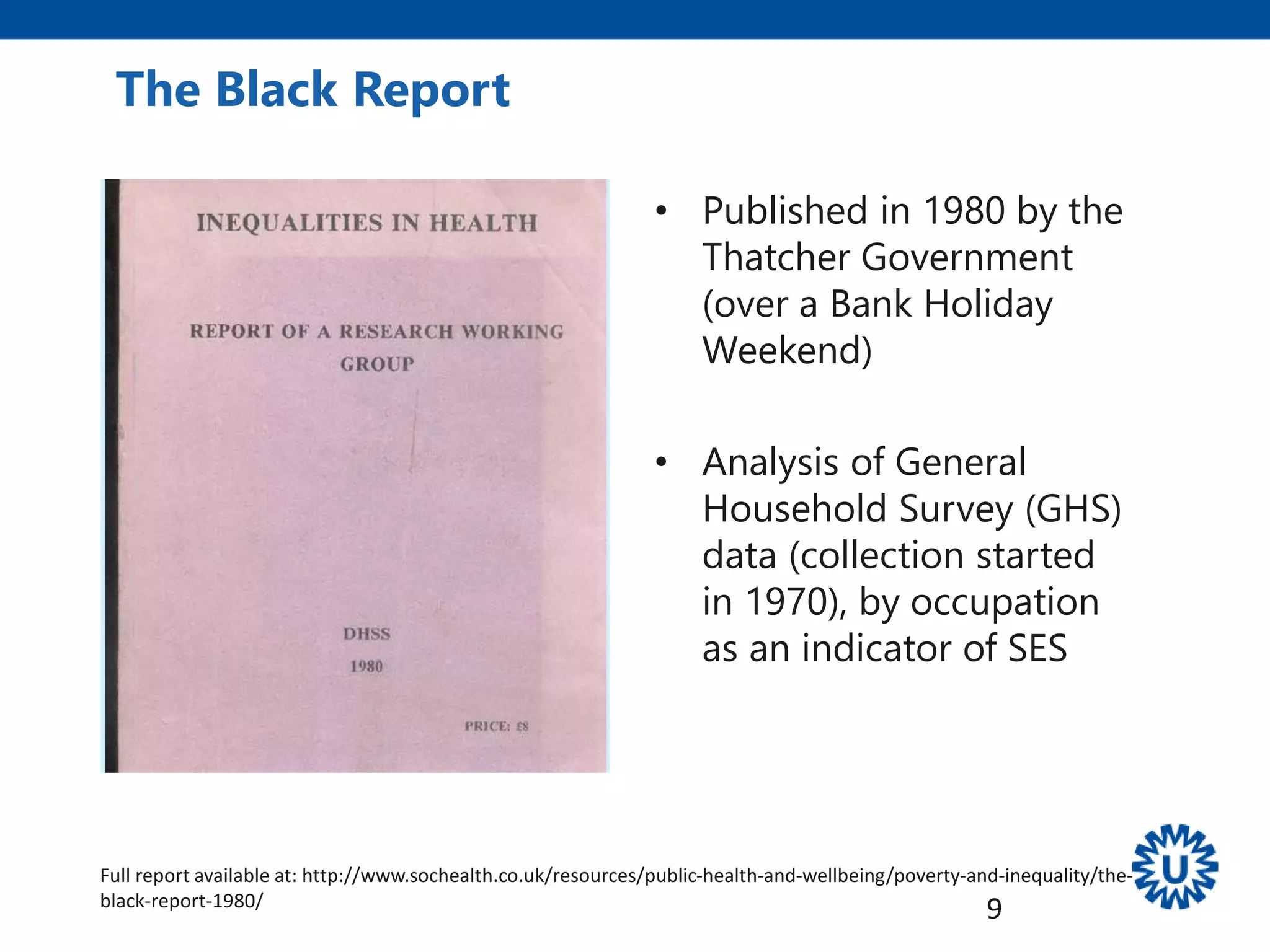
• Published in 1980 by the
Thatcher Government
(over a Bank Holiday
Weekend)
• Analysis of General
Household Survey (GHS)
data (collection started
in 1970), by occupation
as an indicator of SES
The Black Report
9
Full report available at: http://www.sochealth.co.uk/resources/public-health-and-wellbeing/poverty-and-inequality/the-
black-report-1980/
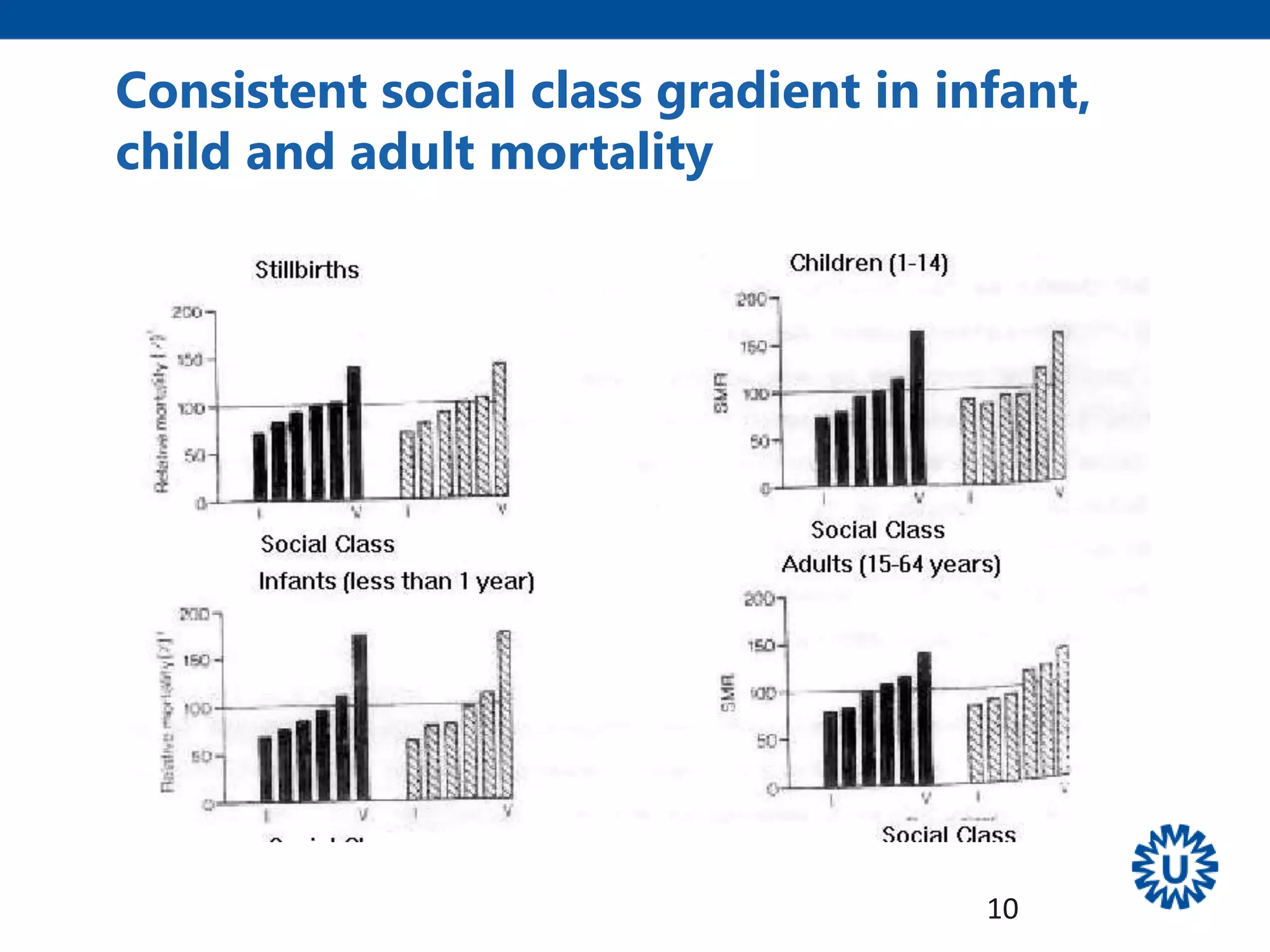
Consistent social class gradient in infant,
child and adult mortality
10
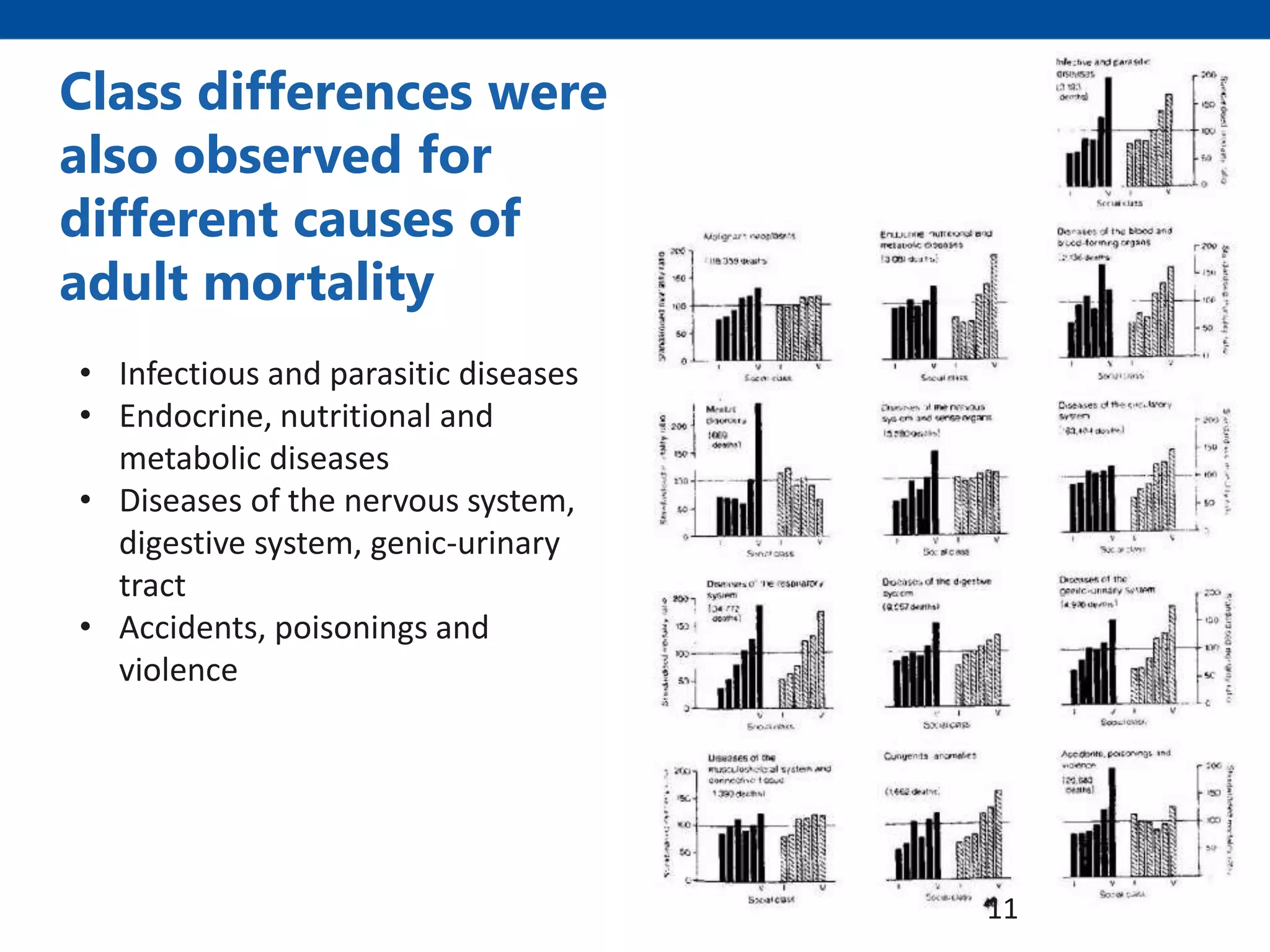
Class differences were
also observed for
different causes of
adult mortality
11
• Infectious and parasitic diseases
• Endocrine, nutritional and
metabolic diseases
• Diseases of the nervous system,
digestive system, genic-urinary
tract
• Accidents, poisonings and
violence
Historical context of the Social Determinants in
Health (2)
1980s-
1990s
• Increasing scientific evidence (e.g.
Whitehall studies, UK)
• Political landscape: (social-
)democrats within market systems
2004:
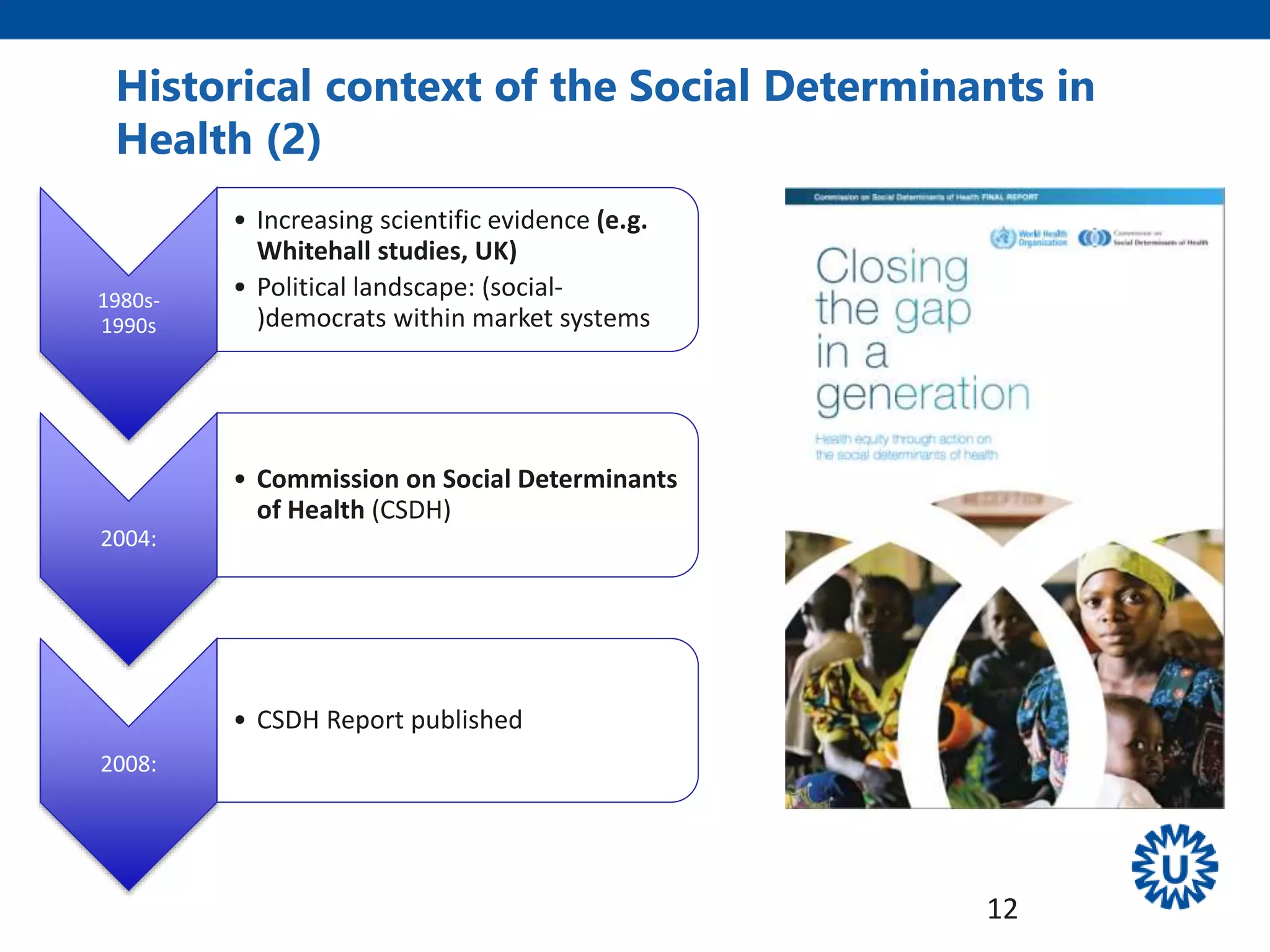
• Commission on Social Determinants
of Health (CSDH)
2008:
• CSDH Report published
12
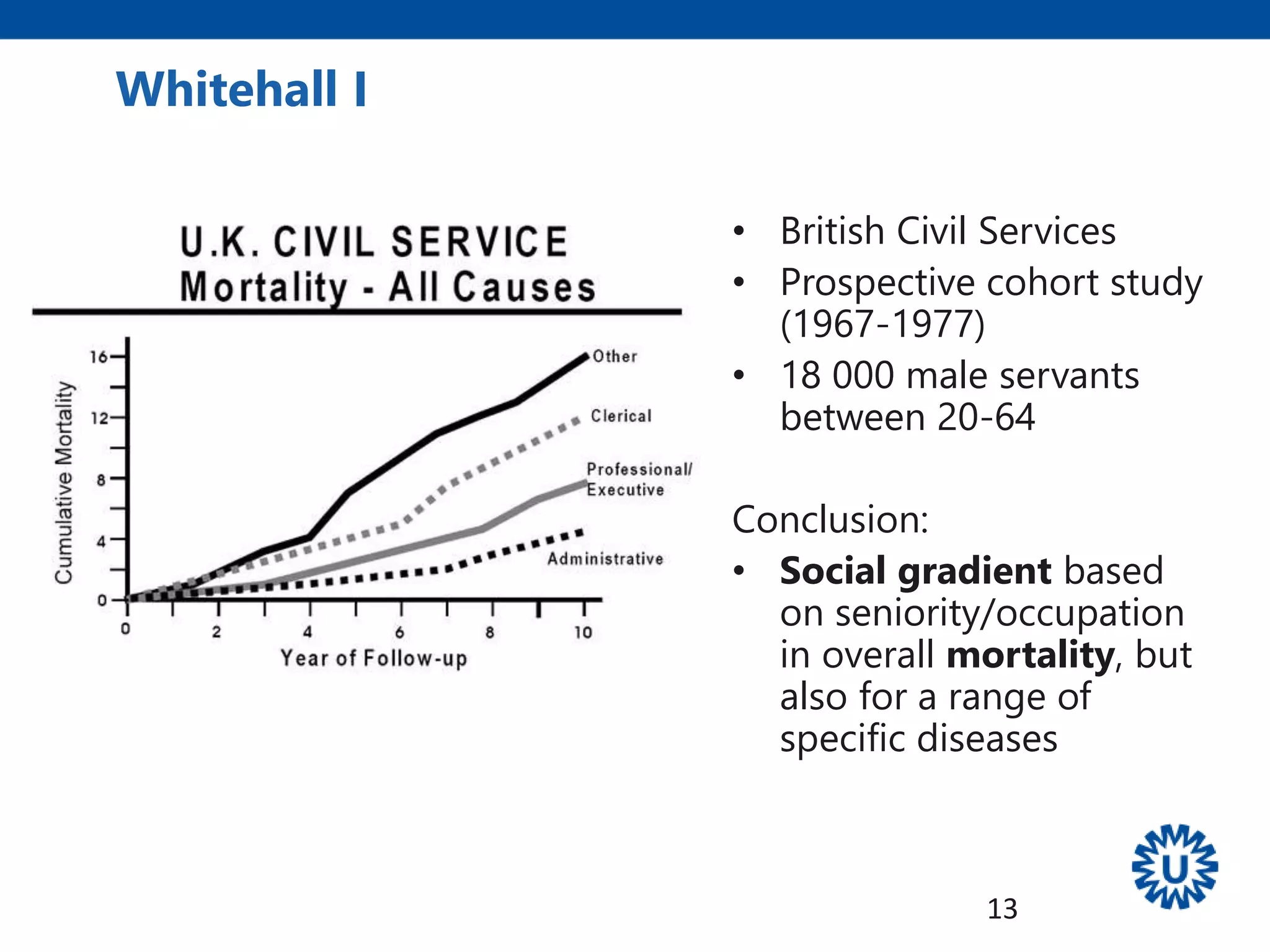
• British Civil Services
• Prospective cohort study
(1967-1977)
• 18 000 male servants
between 20-64
Conclusion:
• Social gradient based
on seniority/occupation
in overall mortality, but
also for a range of
specific diseases
Whitehall I
13
• British Civil Service, London
offices
• Prospective cohort, start
1985
• 10,308 civil servants
between 35-55 (33%
female)
Conclusions:
• Social gradient in
morbidity for men and
women
• Causal factors identified:
lifestyle (smoking, lack of physical
activity, obesity, biometric markers),
early life factors, the way work is
organized, work climate, social
influences
Whitehall II
14
Bosma et al, 1998
Historical context of the Social Determinants in
Health (2)
1980s-
1990s
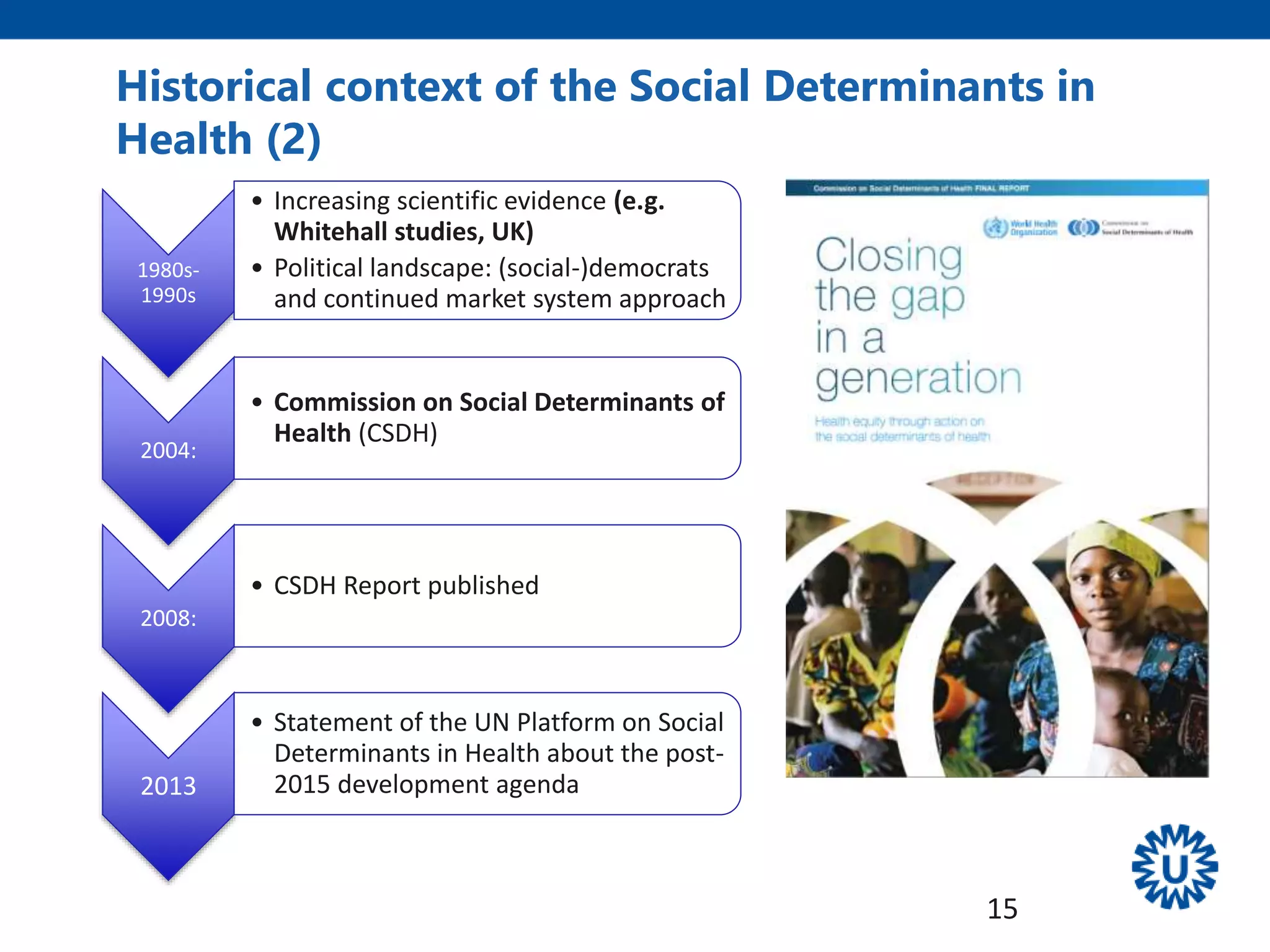
• Increasing scientific evidence (e.g.
Whitehall studies, UK)
• Political landscape: (social-)democrats
and continued market system approach
2004:
• Commission on Social Determinants of
Health (CSDH)
2008:
• CSDH Report published
2013
• Statement of the UN Platform on Social
Determinants in Health about the post-
2015 development agenda
15
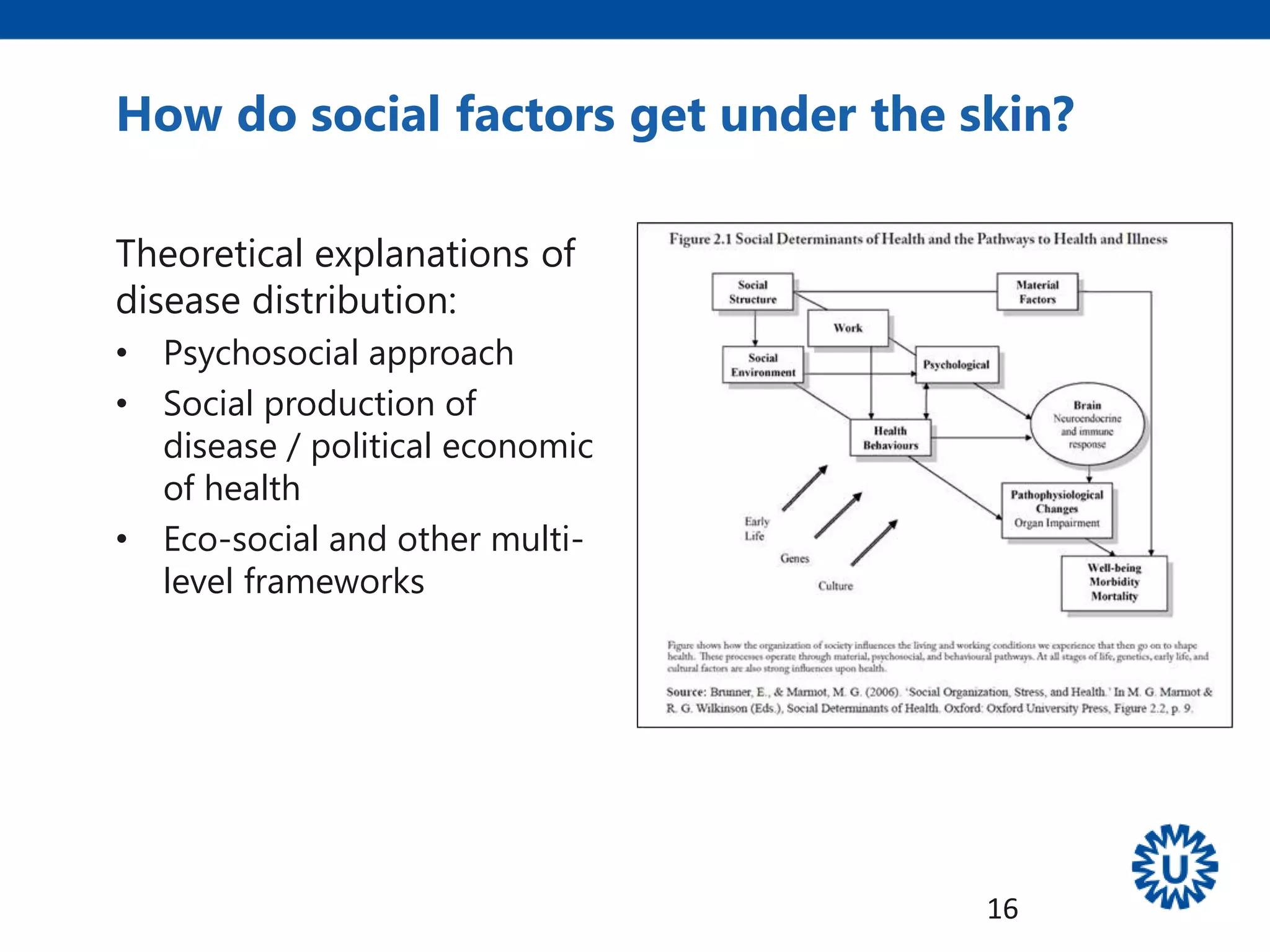
Theoretical explanations of
disease distribution:
• Psychosocial approach
• Social production of
disease / political economic
of health
• Eco-social and other multi-
level frameworks
How do social factors get under the skin?
16
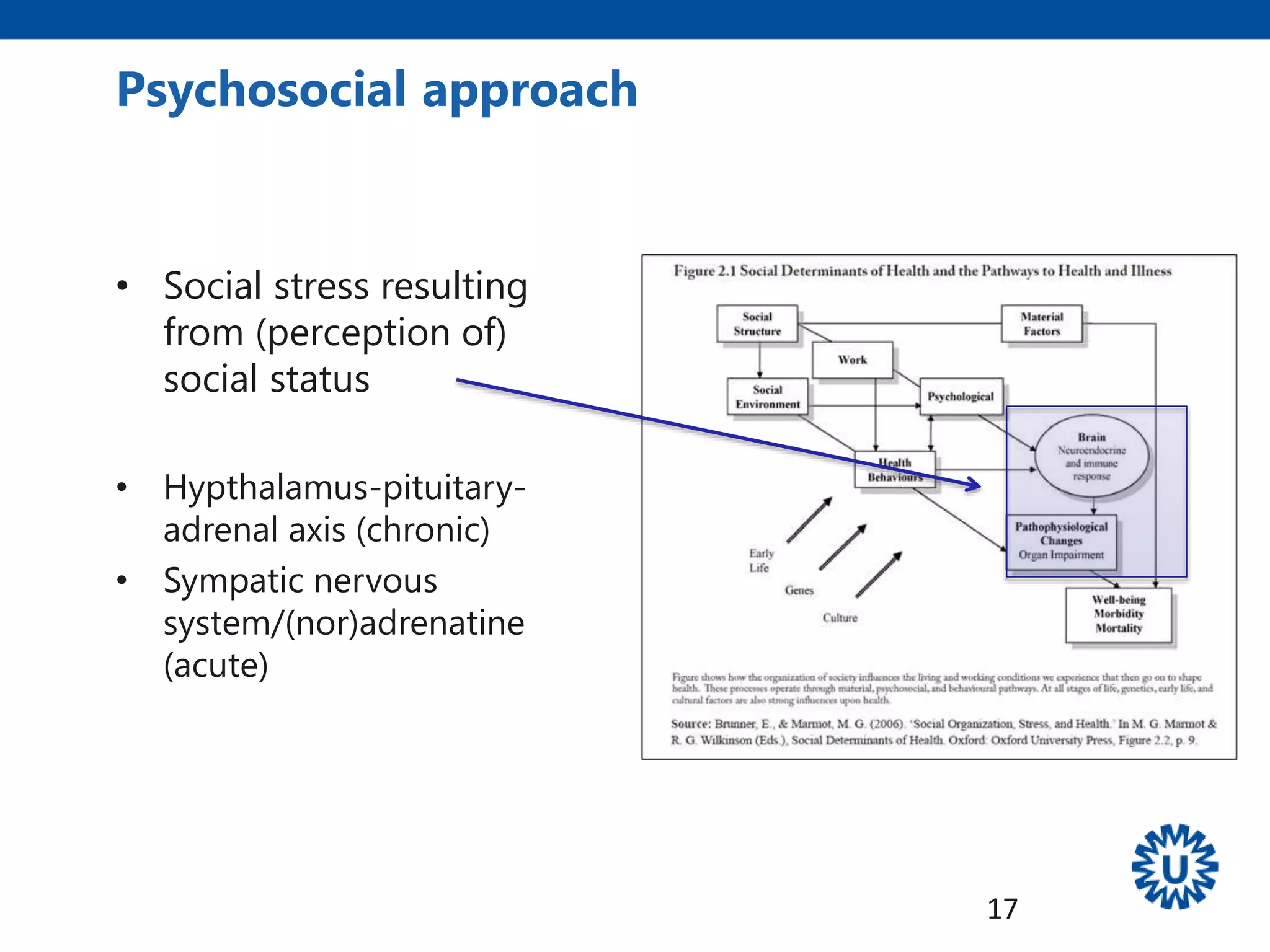
• Social stress resulting
from (perception of)
social status
• Hypthalamus-pituitary-
adrenal axis (chronic)
• Sympatic nervous
system/(nor)adrenatine
(acute)
Psychosocial approach
17
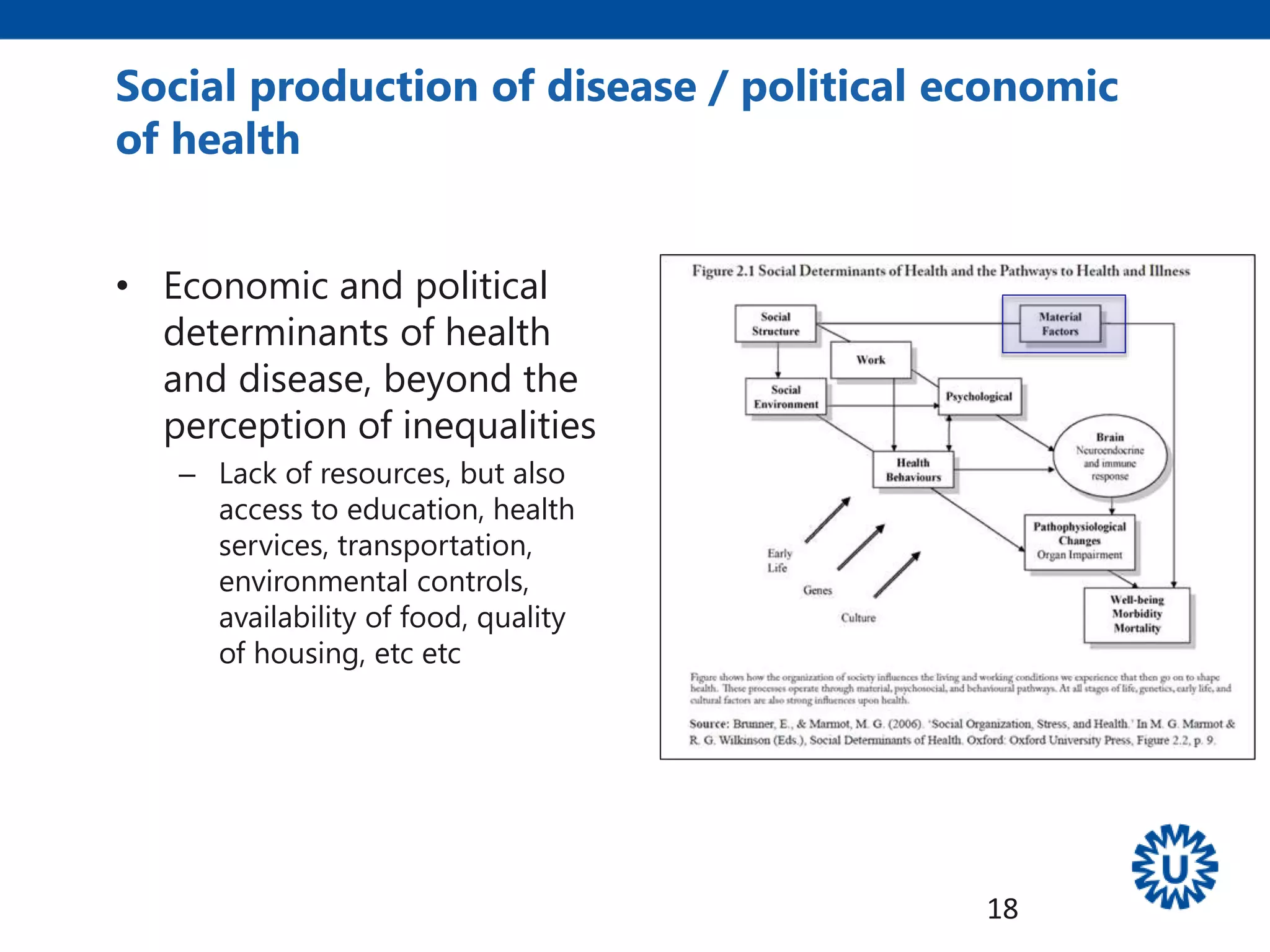
• Economic and political
determinants of health
and disease, beyond the
perception of inequalities
– Lack of resources, but also
access to education, health
services, transportation,
environmental controls,
availability of food, quality
of housing, etc etc
Social production of disease / political economic
of health
18
Krieger’s “embodiment”:
“we literally incorporate
biological influences from the
material and social world” and
that “no aspect of our biology
can be understood divorced
from knowledge of history and
individual and societal ways of
living”
Eco-social and other multi-level frameworks
19
How is social economic position (social status)
operationalized?
20
How is social economic position (social status)
operationalized?
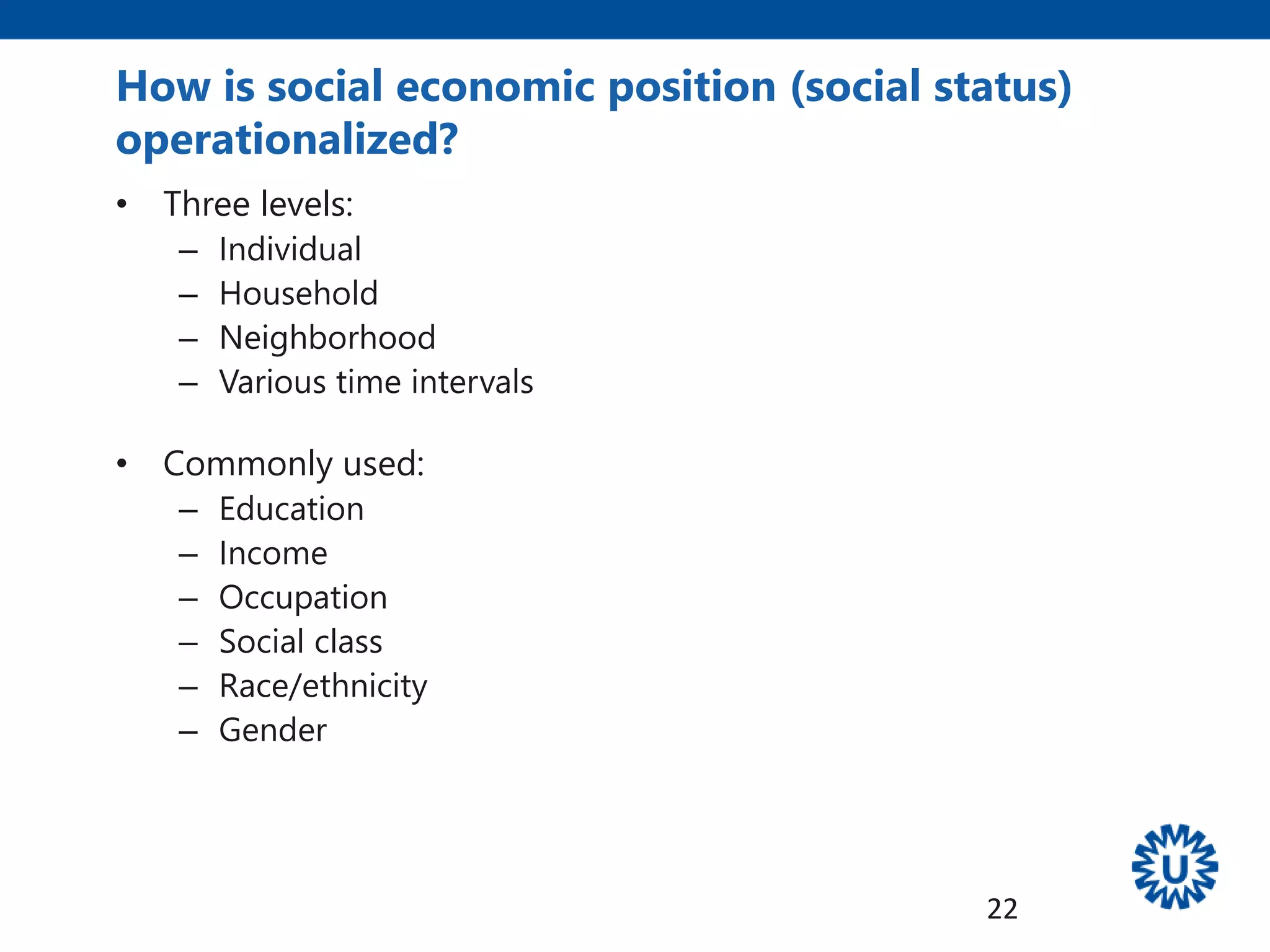
• Three levels:
– Individual
– Household
– Neighborhood
– Various time intervals
21
How is social economic position (social status)
operationalized?
• Three levels:
– Individual
– Household
– Neighborhood
– Various time intervals
• Commonly used:
– Education
– Income
– Occupation
– Social class
– Race/ethnicity
– Gender
22
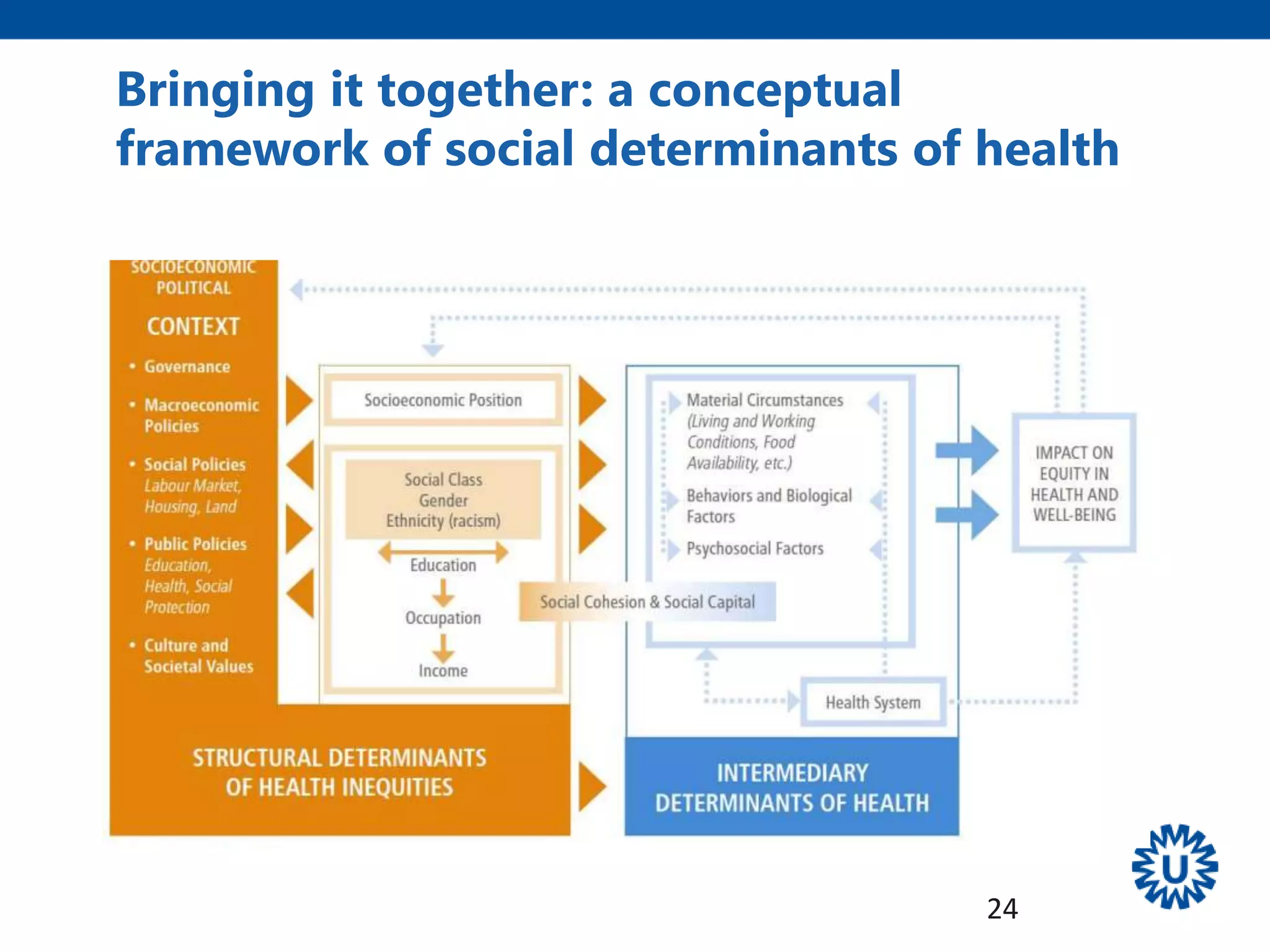
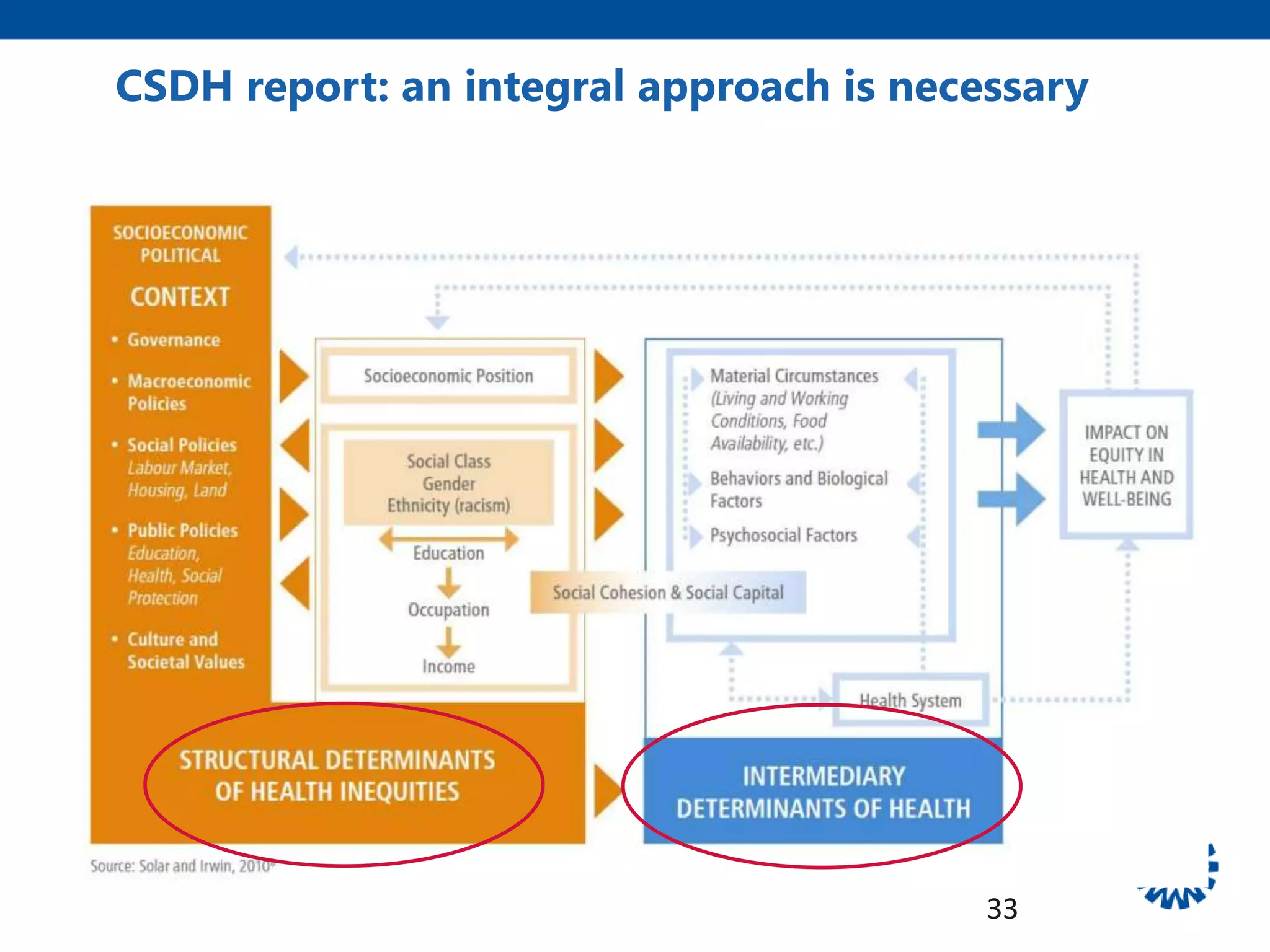
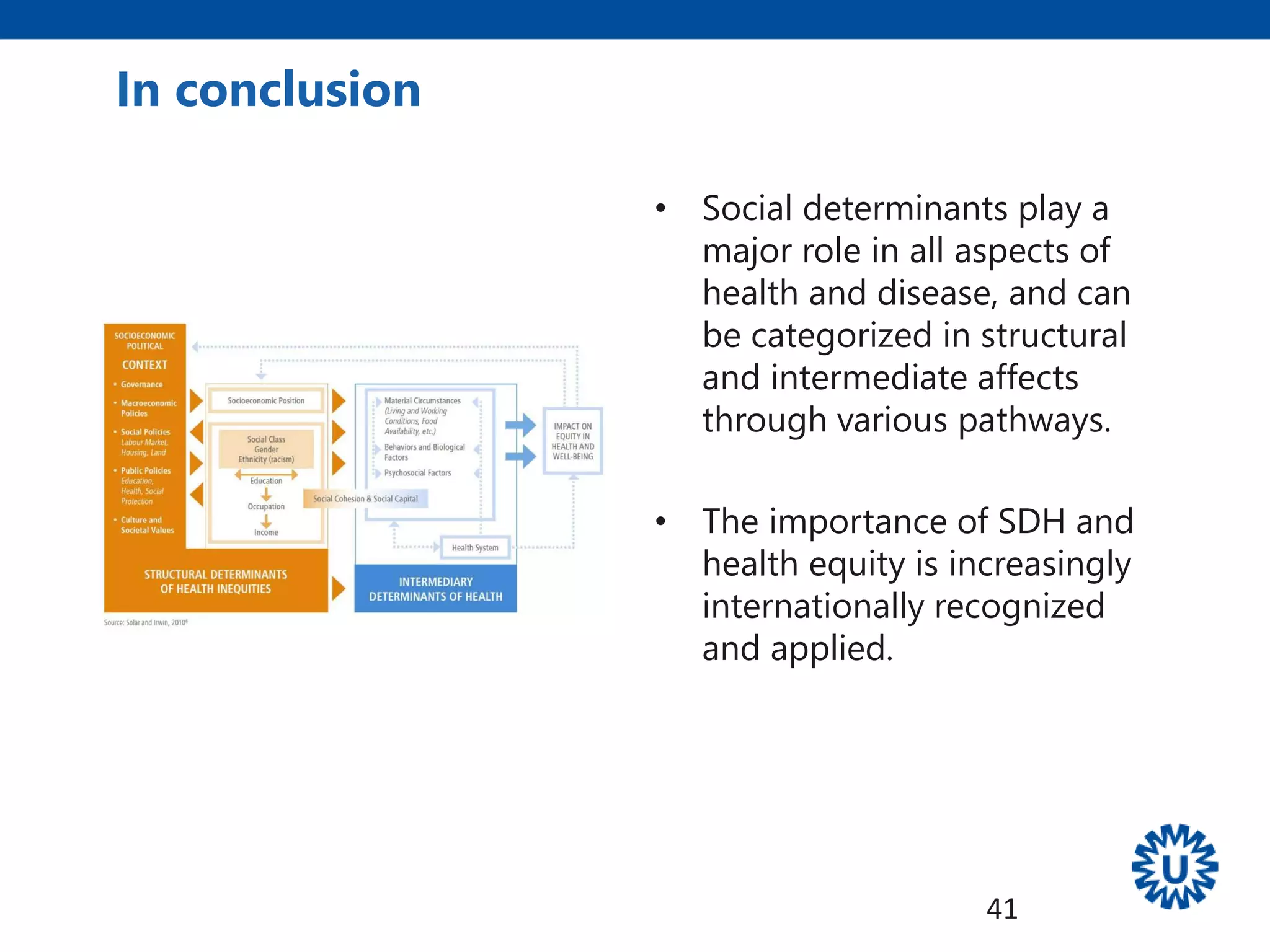
Bringing it together: a conceptual framework
of social determinants of health
• Structural (or “distal” factors)
• Intermediate factors (“proximal” factors)
..and their impact on health
23
Bringing it together: a conceptual
framework of social determinants of health
24
Social determinants and global health
25
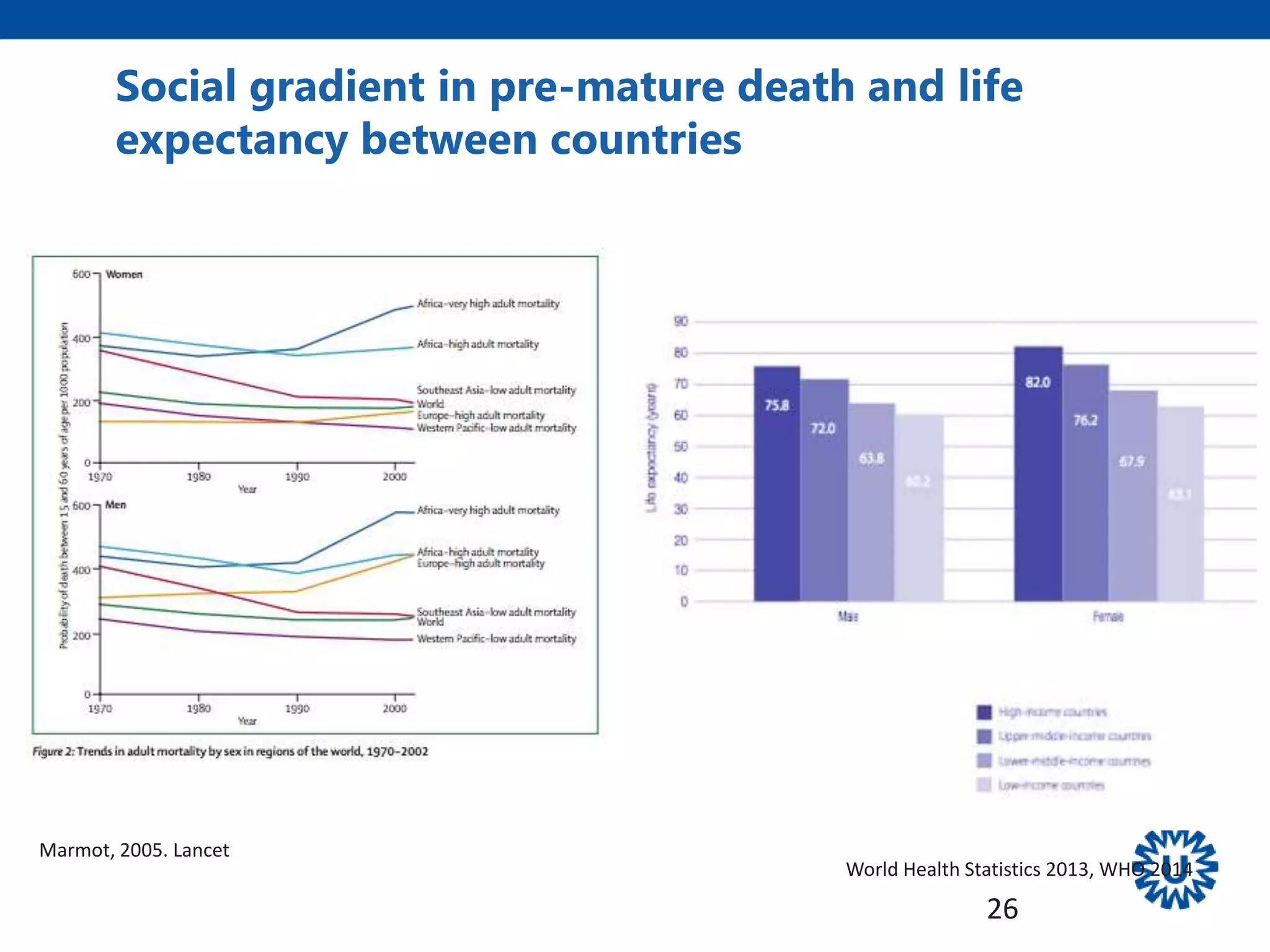
Social gradient in pre-mature death and life
expectancy between countries
26
Marmot, 2005. Lancet
World Health Statistics 2013, WHO 2014
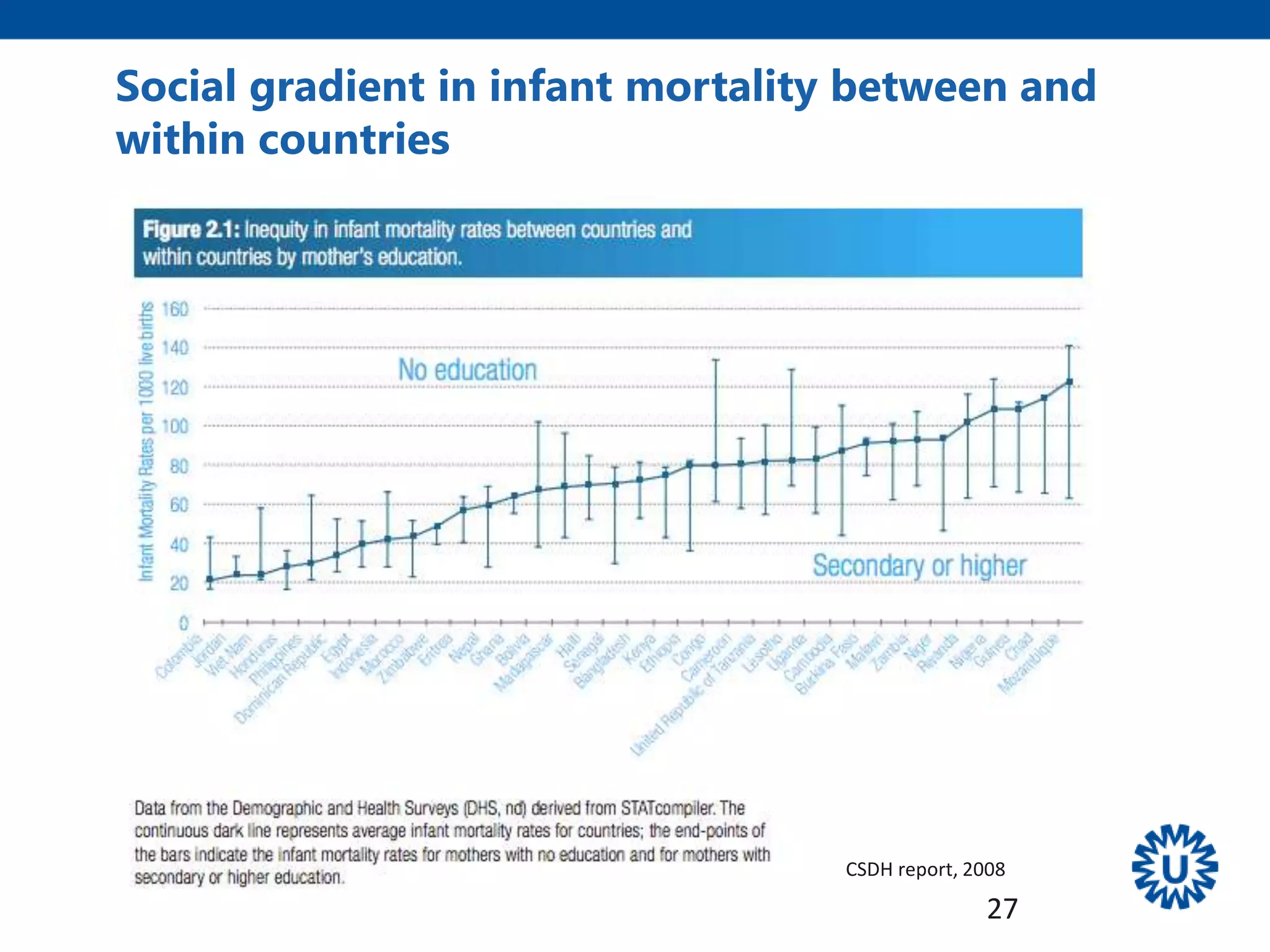
Social gradient in infant mortality between and
within countries
27
CSDH report, 2008
Social gradient in maternal mortality
Rosmans (2006)
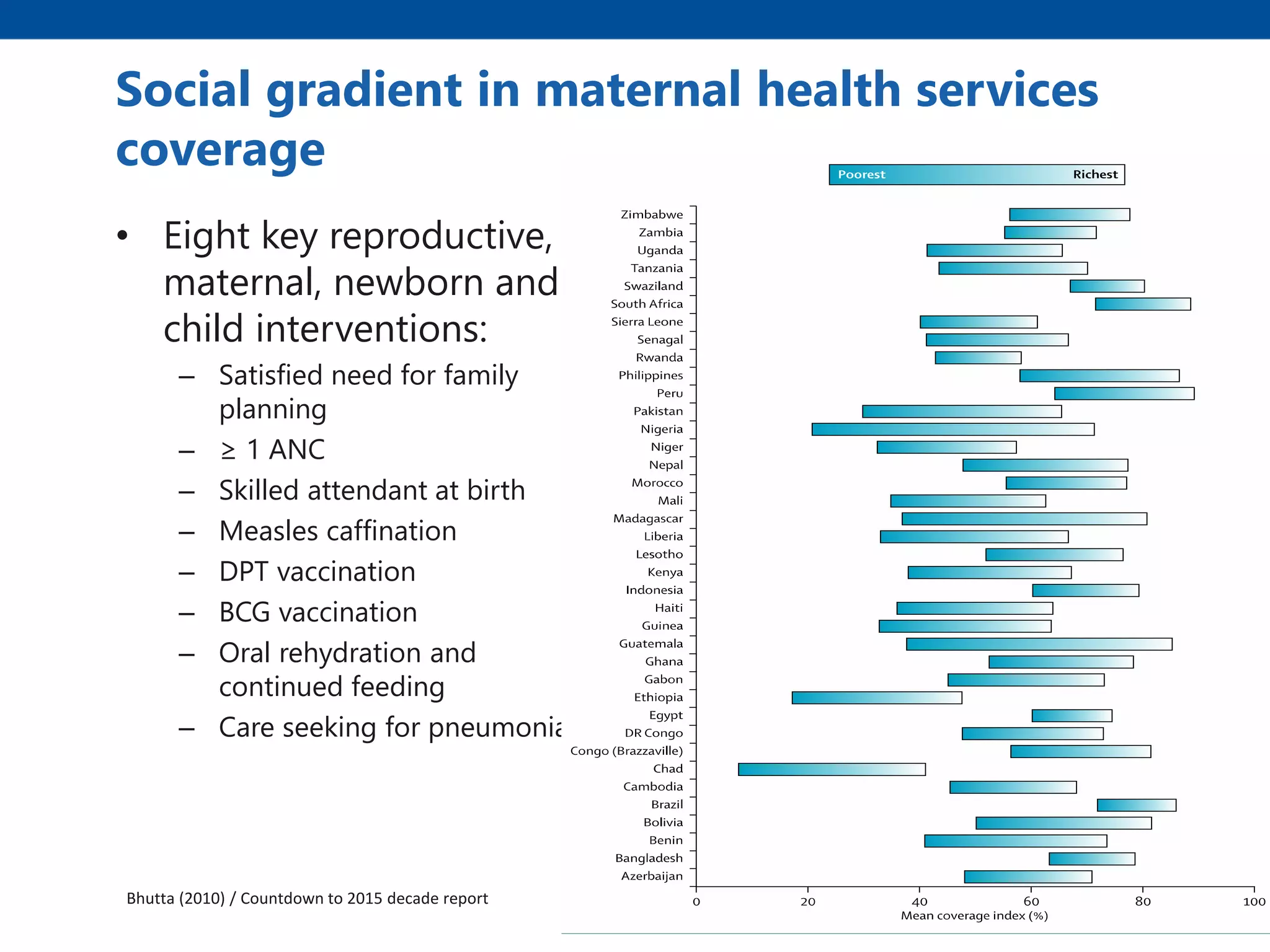
• Eight key reproductive,
maternal, newborn and
child interventions:
– Satisfied need for family
planning
– ≥ 1 ANC
– Skilled attendant at birth
– Measles caffination
– DPT vaccination
– BCG vaccination
– Oral rehydration and
continued feeding
– Care seeking for pneumonia
Social gradient in maternal health services
coverage
Bhutta (2010) / Countdown to 2015 decade report
How to address the social inequalities in
health?
30
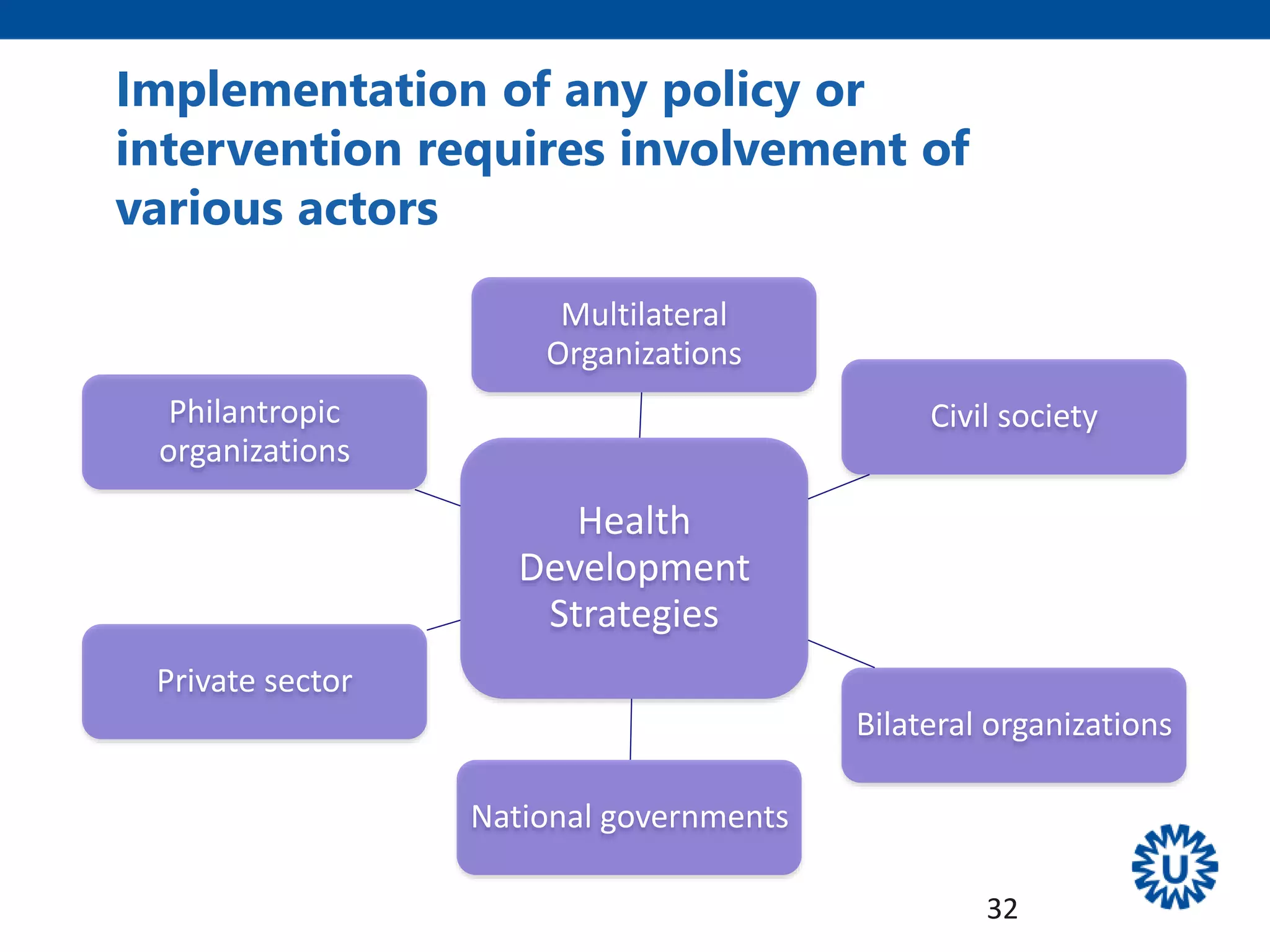
Implementation of any policy or intervention
requires involvement of various actors
• What actors/stakeholders should be involved?
31
Implementation of any policy or
intervention requires involvement of
various actors
32
Health
Development
Strategies
Multilateral
Organizations
Civil society
Bilateral organizations
National governments
Private sector
Philantropic
organizations
CSDH report: an integral approach is necessary
33
Examples of intermediary approaches
• What could be examples?
34
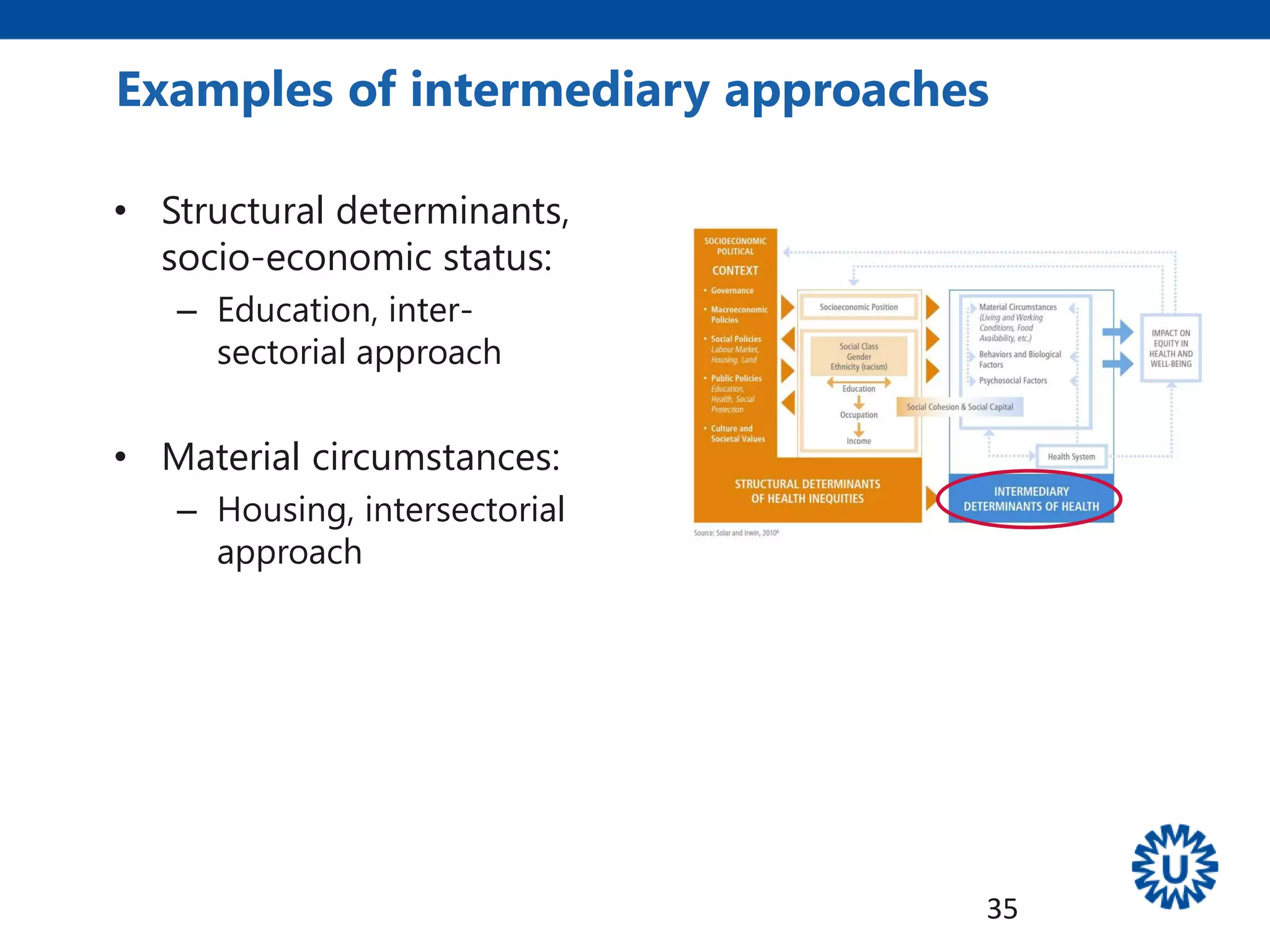
• Structural determinants,
socio-economic status:
– Education, inter-
sectorial approach
• Material circumstances:
– Housing, intersectorial
approach
Examples of intermediary approaches
35
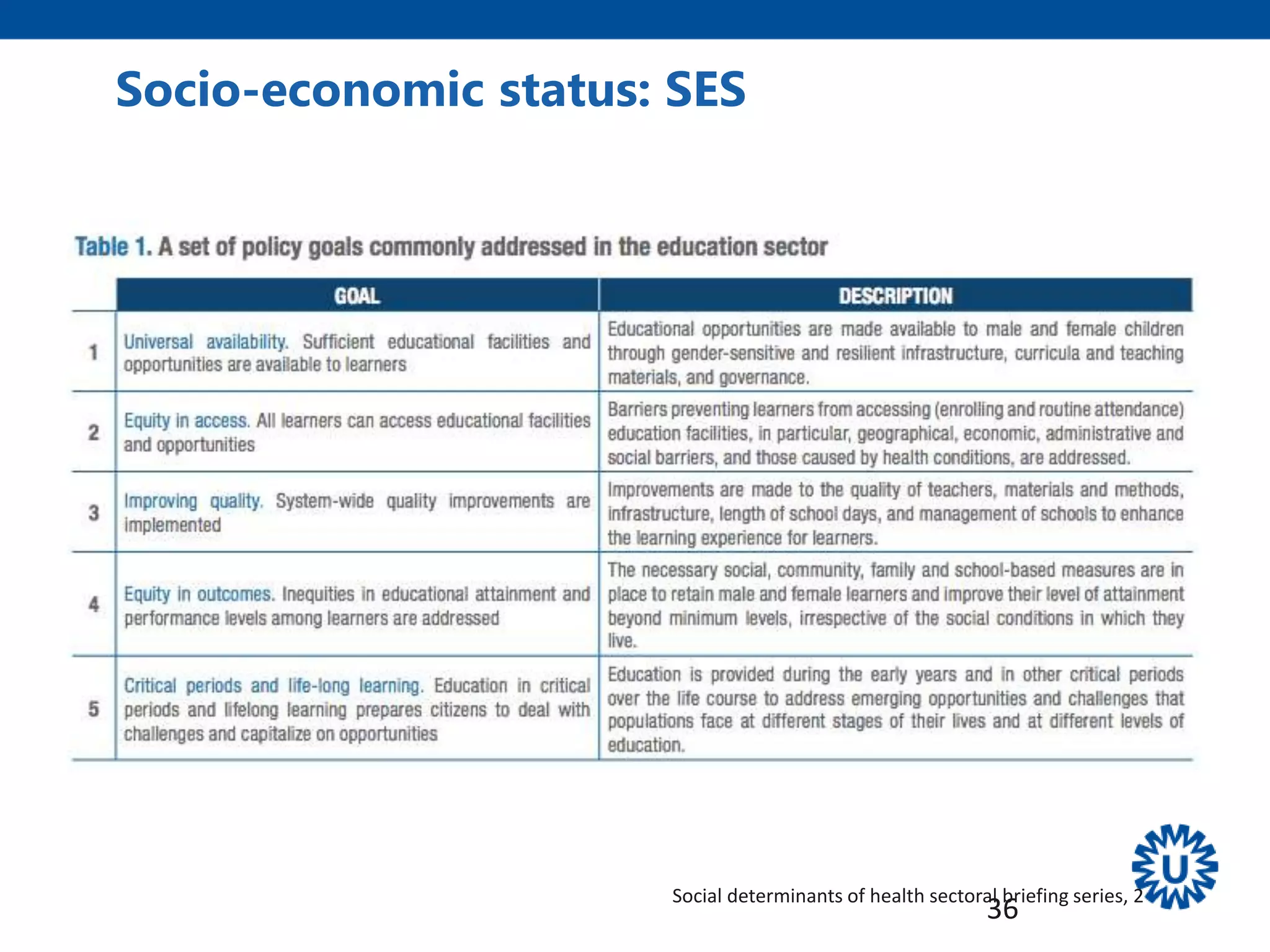
Socio-economic status: SES
36
Social determinants of health sectoral briefing series, 2
Material circumstances: housing
37
Social determinants of health sectoral briefing series, 1
Examples of structural approaches?
• What could be examples?
38
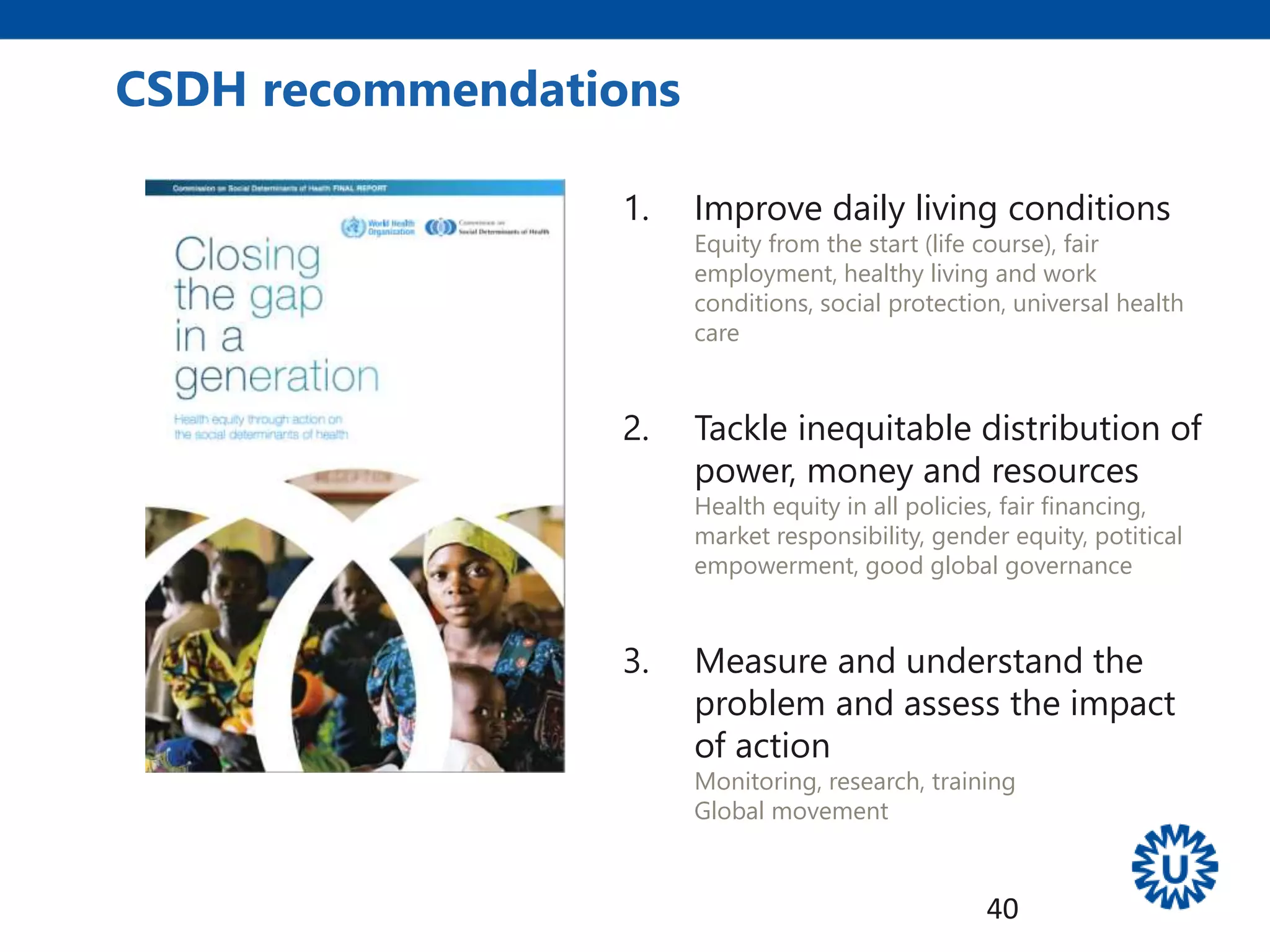
1. Improve daily living conditions
2. Tackle inequitable distribution
of power, money and resources
3. Measure and understand the
problem and assess the impact
of action
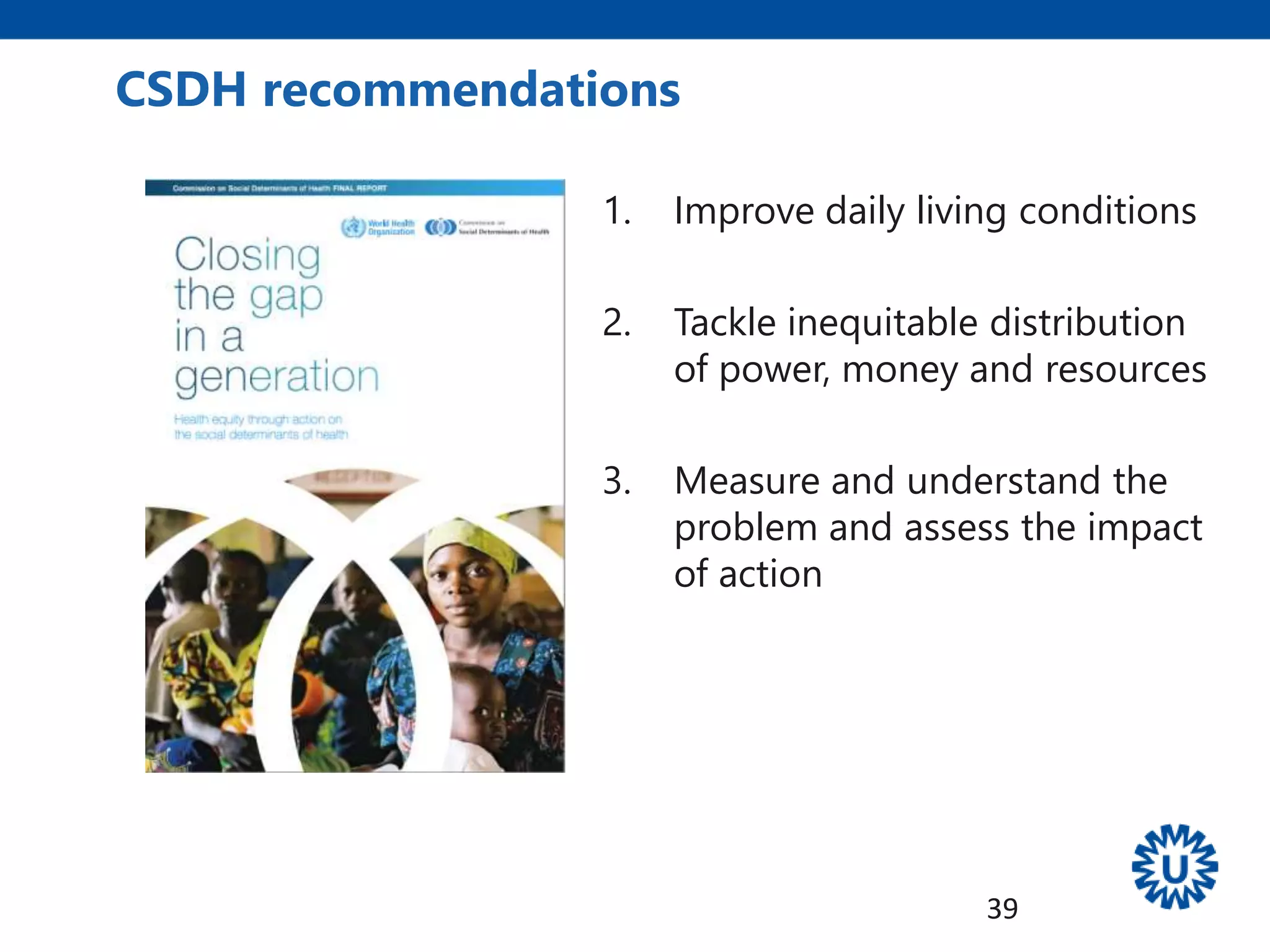
CSDH recommendations
39
1. Improve daily living conditions
Equity from the start (life course), fair
employment, healthy living and work
conditions, social protection, universal health
care
2. Tackle inequitable distribution of
power, money and resources
Health equity in all policies, fair financing,
market responsibility, gender equity, potitical
empowerment, good global governance
3. Measure and understand the
problem and assess the impact
of action
Monitoring, research, training
Global movement
CSDH recommendations
40
• Social determinants play a
major role in all aspects of
health and disease, and can
be categorized in structural
and intermediate affects
through various pathways.
• The importance of SDH and
health equity is increasingly
internationally recognized
and applied.
In conclusion
41
Want to know more about social
determinants?
• Online Social determinants game
www.playspent.org
• Not about SHD, but VERY COOL!:
www.thegreatflu.com

Social determinants and Global Health

  • 1.
    Social determinants andglobal health Joyce L. Browne, MD MSc PhD fellow Julius Global Health, Julius Center for Health Sciences and Primary Care UMC Utrecht, The Netherlands www.globalhealth.eu J.L.Browne@umcutrecht.nl Fundamentals of Global Health Summer School 2014 1
  • 2.
    Learning objectives • Toappreciate the historical context and evidence for a social gradient in morbidity and mortality • To understand and discuss what social determinants are, and how they get under the skin • Recognize and address the social gradients that occur in Global Health context 2
  • 3.
  • 4.
    Definitions • Social determinants •Health (in)equity • Common measurements? 4
  • 5.
    Definitions Social Determinants The socialdeterminants of health are the circumstances in which people are born, grow up, live, work and age, and the systems put in place to deal with illness. These circumstances are in turn shaped by a wider set of forces: economics, social policies, and politics. Health inequities Health inequities are avoidable inequalities in health between groups of people within countries and between countries. These inequities arise from inequalities within and between societies. Social and economic conditions and their effects on people’s lives determine their risk of illness and the actions taken to prevent them becoming ill or treat illness when it occurs. 5
  • 6.
    Why are wetalking about social determinants? http://www.kingsfund.org.uk/time-to-think-differently/trends/broader-determinants-health Genetic 30% Social circumstances 15% environmental 5%
  • 7.
    Historical context ofthe Social Determinants in Health 7
  • 8.
    Historical context ofthe Social Determinants in Health (1) 1948 • WHO constitution: acknowledgement of “impact of social and political conditions on health” and need for intersectoral to achieve health gains. 1950s- 1960s • Little regard for social contexts, strong focus on technology and disease- specific campaigns. 1978 • Alma-Ata Declaration on Primary Health / Health for All. Asserted need to strengthen health equity by addressing social conditions through intersectoral programs 1980s • Limited political will - Neoliberal governments in many European countries and the US with market-oriented reforms in health care - Structural Adjustment Programs for developing countries: reduced government’s social and public spending • At the same time: biomedical paradigm was challenged: Black Report (UK) 8
  • 9.
    • Published in1980 by the Thatcher Government (over a Bank Holiday Weekend) • Analysis of General Household Survey (GHS) data (collection started in 1970), by occupation as an indicator of SES The Black Report 9 Full report available at: http://www.sochealth.co.uk/resources/public-health-and-wellbeing/poverty-and-inequality/the- black-report-1980/
  • 10.
    Consistent social classgradient in infant, child and adult mortality 10
  • 11.
    Class differences were alsoobserved for different causes of adult mortality 11 • Infectious and parasitic diseases • Endocrine, nutritional and metabolic diseases • Diseases of the nervous system, digestive system, genic-urinary tract • Accidents, poisonings and violence
  • 12.
    Historical context ofthe Social Determinants in Health (2) 1980s- 1990s • Increasing scientific evidence (e.g. Whitehall studies, UK) • Political landscape: (social- )democrats within market systems 2004: • Commission on Social Determinants of Health (CSDH) 2008: • CSDH Report published 12
  • 13.
    • British CivilServices • Prospective cohort study (1967-1977) • 18 000 male servants between 20-64 Conclusion: • Social gradient based on seniority/occupation in overall mortality, but also for a range of specific diseases Whitehall I 13
  • 14.
    • British CivilService, London offices • Prospective cohort, start 1985 • 10,308 civil servants between 35-55 (33% female) Conclusions: • Social gradient in morbidity for men and women • Causal factors identified: lifestyle (smoking, lack of physical activity, obesity, biometric markers), early life factors, the way work is organized, work climate, social influences Whitehall II 14 Bosma et al, 1998
  • 15.
    Historical context ofthe Social Determinants in Health (2) 1980s- 1990s • Increasing scientific evidence (e.g. Whitehall studies, UK) • Political landscape: (social-)democrats and continued market system approach 2004: • Commission on Social Determinants of Health (CSDH) 2008: • CSDH Report published 2013 • Statement of the UN Platform on Social Determinants in Health about the post- 2015 development agenda 15
  • 16.
    Theoretical explanations of diseasedistribution: • Psychosocial approach • Social production of disease / political economic of health • Eco-social and other multi- level frameworks How do social factors get under the skin? 16
  • 17.
    • Social stressresulting from (perception of) social status • Hypthalamus-pituitary- adrenal axis (chronic) • Sympatic nervous system/(nor)adrenatine (acute) Psychosocial approach 17
  • 18.
    • Economic andpolitical determinants of health and disease, beyond the perception of inequalities – Lack of resources, but also access to education, health services, transportation, environmental controls, availability of food, quality of housing, etc etc Social production of disease / political economic of health 18
  • 19.
    Krieger’s “embodiment”: “we literallyincorporate biological influences from the material and social world” and that “no aspect of our biology can be understood divorced from knowledge of history and individual and societal ways of living” Eco-social and other multi-level frameworks 19
  • 20.
    How is socialeconomic position (social status) operationalized? 20
  • 21.
    How is socialeconomic position (social status) operationalized? • Three levels: – Individual – Household – Neighborhood – Various time intervals 21
  • 22.
    How is socialeconomic position (social status) operationalized? • Three levels: – Individual – Household – Neighborhood – Various time intervals • Commonly used: – Education – Income – Occupation – Social class – Race/ethnicity – Gender 22
  • 23.
    Bringing it together:a conceptual framework of social determinants of health • Structural (or “distal” factors) • Intermediate factors (“proximal” factors) ..and their impact on health 23
  • 24.
    Bringing it together:a conceptual framework of social determinants of health 24
  • 25.
    Social determinants andglobal health 25
  • 26.
    Social gradient inpre-mature death and life expectancy between countries 26 Marmot, 2005. Lancet World Health Statistics 2013, WHO 2014
  • 27.
    Social gradient ininfant mortality between and within countries 27 CSDH report, 2008
  • 28.
    Social gradient inmaternal mortality Rosmans (2006)
  • 29.
    • Eight keyreproductive, maternal, newborn and child interventions: – Satisfied need for family planning – ≥ 1 ANC – Skilled attendant at birth – Measles caffination – DPT vaccination – BCG vaccination – Oral rehydration and continued feeding – Care seeking for pneumonia Social gradient in maternal health services coverage Bhutta (2010) / Countdown to 2015 decade report
  • 30.
    How to addressthe social inequalities in health? 30
  • 31.
    Implementation of anypolicy or intervention requires involvement of various actors • What actors/stakeholders should be involved? 31
  • 32.
    Implementation of anypolicy or intervention requires involvement of various actors 32 Health Development Strategies Multilateral Organizations Civil society Bilateral organizations National governments Private sector Philantropic organizations
  • 33.
    CSDH report: anintegral approach is necessary 33
  • 34.
    Examples of intermediaryapproaches • What could be examples? 34
  • 35.
    • Structural determinants, socio-economicstatus: – Education, inter- sectorial approach • Material circumstances: – Housing, intersectorial approach Examples of intermediary approaches 35
  • 36.
    Socio-economic status: SES 36 Socialdeterminants of health sectoral briefing series, 2
  • 37.
    Material circumstances: housing 37 Socialdeterminants of health sectoral briefing series, 1
  • 38.
    Examples of structuralapproaches? • What could be examples? 38
  • 39.
    1. Improve dailyliving conditions 2. Tackle inequitable distribution of power, money and resources 3. Measure and understand the problem and assess the impact of action CSDH recommendations 39
  • 40.
    1. Improve dailyliving conditions Equity from the start (life course), fair employment, healthy living and work conditions, social protection, universal health care 2. Tackle inequitable distribution of power, money and resources Health equity in all policies, fair financing, market responsibility, gender equity, potitical empowerment, good global governance 3. Measure and understand the problem and assess the impact of action Monitoring, research, training Global movement CSDH recommendations 40
  • 41.
    • Social determinantsplay a major role in all aspects of health and disease, and can be categorized in structural and intermediate affects through various pathways. • The importance of SDH and health equity is increasingly internationally recognized and applied. In conclusion 41
  • 42.
    Want to knowmore about social determinants? • Online Social determinants game www.playspent.org • Not about SHD, but VERY COOL!: www.thegreatflu.com

Editor's Notes

  • #7 McGiniss: - genetic: 30%, social circumstances 15%, environmental exposures 5%, behavioral patterns 40
  • #14 http://www.ucl.ac.uk/whitehallII/pdf/Whitehallbooklet_1_.pdf