FRAMEWORK for
IMPLEMENTATION
National Health Mission
Ministry of Health and Family Welfare
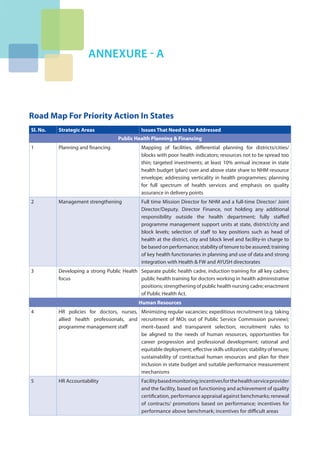
Government of India
2012-2017
NATION
AL HEALTH M
ISSION
Ministry of Health and Family Welfare
Government of India
NATION
AL HEALTH M
ISSION
IMPLEMENTATION
National Health Mission
2012-2017
FRAMEWORK for
1.	 Introduction 1
2.	 Vision, Guiding Principles and Core Values of the NHM 2
3.	 Institutional Mechanisms 7
4.	 Strengthening State Health Systems 9
5.	 Critical Areas for Concerted Action towards Health Systems Strengthening 11
	 5.1	 Decentralized health Planning 11
	 5.2	 Facility Based Service Delivery  12
	 5.3	 The District Hospital and Knowledge Centre 13
	 5.4	 Outreach Services 14
	 5.5	Community Processes, Behaviour Change Communication, and Addressing
Social Determinants 16
	 5.6	 Social Protection Function of Public Health Services 20
	 5.7	 Partnerships with the NGOs, Civil society, and the for profit private sector 22
	 5.8	 Human Resources Development 23
	 5.9	 Public Health Management  24
	 5.10	 Health of tribal and populations in Left Wing Extremist (LWE) affected areas 26
	 5.11	 Health of the urban poor 27
	 5.12	 Pilots for Universal Health Coverage 28
	 5.13	 Health Management Information Systems (HMIS) 28
	 5.14	 Governance and Accountability Framework 30
6.	 Service Delivery Strategies  31
	 6.1	 Reproductive, Maternal, Newborn, Child Health and Adolescent (RMNCH + A) Services 31
	 6.2	 Control of Communicable Diseases 35
	 6.3	 Non Communicable Diseases (NCD) 37
7.	 Monitoring and Evaluation 42
8.	 Financing of the National Health Mission  44
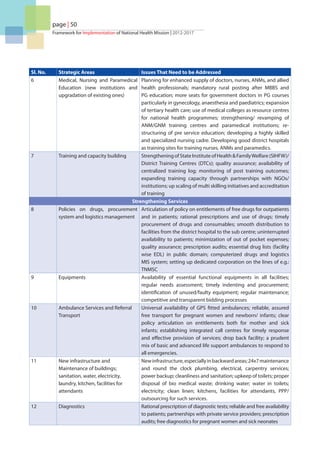
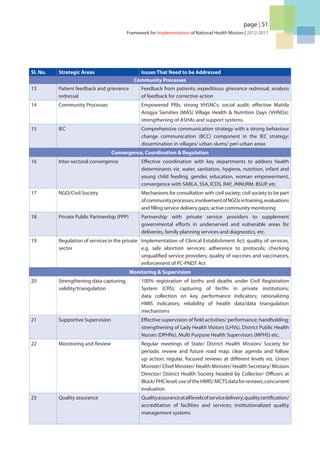
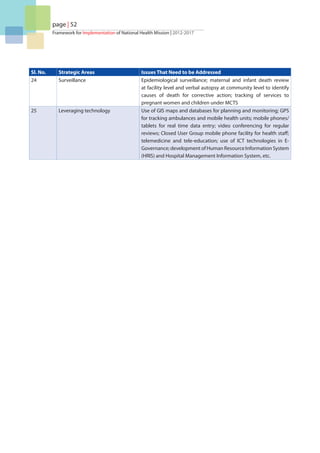
Annexure - A 49
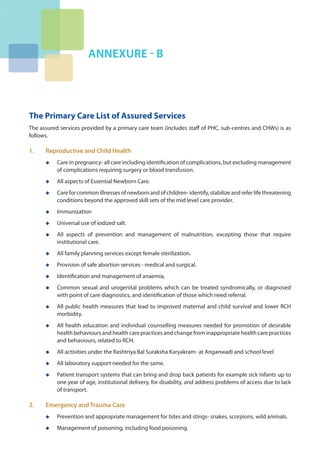
Annexure - B 53
List of Abbreviations 55
Table of Contents
Background
1.1	ThisFrameworkforImplementationlaysoutthebroadprinciplesandstrategicdirectionsoftheNational
Health Mission (NHM) encompassing two Sub-Missions, National Rural Health Mission (NRHM) and
National Urban Health Mission (NUHM). It is both flexible and dynamic and is intended to guide States1
towards ensuring the achievement of universal access to health care through strengthening of health
systems, institutions and capabilities.
1.2	This Framework draws on several sources. First, it builds on the Framework for Implementation2
approved by the Cabinet in 2006, for the first phase of the NRHM. The second is the learning from
NRHM implementation over the past seven years, documented in several evaluation reports and
studies3
and the experiences of people and practitioners across the rural areas of the country. Third,
the Chapter on Health of the Twelfth Plan provides the broad guidance for this Framework. Finally, it
also incorporates the comments and suggestions from the Planning Commission, various Ministries,
and state governments.
1.3	This Framework document is intended to lay out the approach for the National Health Mission for the
period 2012-2017 and beyond.
1.4	The 2006 Framework for Implementation has served the Mission well and has guided the NRHM so far.
The Framework for Implementation of NUHM has been approved by the Cabinet on May 1, 2013. These
Frameworks will continue to guide the NRHM and the NUHM in so far as they are not inconsistent with
any of the provisions of the NHM Framework.
1.	 States include Union Territories.
2.	
National Rural Health Mission, Meeting People’s Health Needs in Rural areas, Framework for Implementation, 2005-2012,
Ministry of Health and Family Welfare, Government of India.
3.	(Detailed evaluation study of the National Rural Health Mission undertaken and completed by the Planning Commission in
February 2011, the concurrent evaluation of the NRHM, the evaluation undertaken by the International Advisory Panel, and the
annual Common Review Missions).
Introduction
Chapter 1
Vision, Guiding Principles and
Core Values of the NHM
2.1	 Vision of the NHM
“Attainment of Universal Access to Equitable, Affordable and Quality health care services, accountable and
responsive to people’s needs, with effective inter-sectoral convergent action to address the wider social
determinants of health”.
2.2	 Core Values
Safeguard the health of the poor, vulnerable and disadvantaged, and move towards a right based‹‹
approach to health through entitlements and service guarantees
Strengthen public health systems as a basis for universal access and social protection against the‹‹
rising costs of health care.
Build environment of trust between people and providers of health services.‹‹
Empower community to become active participants in the process of attainment of highest‹‹
possible levels of health.
Institutionalize transparency and accountability in all processes and mechanisms.‹‹
Improve efficiency to optimize use of available resources.‹‹
2.3	 Guiding Principles
2.3.1	Build an integrated network of all primary, secondary and a substantial part of tertiary care,
providing a continuum from community level to the district hospital, with robust referral
linkages to tertiary care and a particular focus on strengthening the Primary Health Care System
including outreach services in both rural areas and urban slums.
2.3.2	Ensure coordinated inter-sectoral action to address issues of food security and nutrition, access
to safe drinking water and sanitation, education particularly girls education, occupational and
environmental health determinants, women’s rights and empowerment and different forms of
marginalization and vulnerability.
2.3.3	Incentivize states and UTs to undertake health sector reforms that lead to greater efficiency
and equity in health care delivery.
2.3.4	Ensureprioritizationofservicesthataddressthehealthofwomenandchildrenandtheprevention
and control of communicable and non-communicable diseases, including locally endemic
diseases.
2.3.5	Reduce out of pocket expenditure on health care, eliminate catastrophic health expenditures
andprovidesocialprotectiontothepooragainsttherisingcostsofhealthcare,throughcashless
services delivered by public health care facilities, supplemented by contracted-in private sector
facilities wherever necessary.
Chapter 2
page | 3
Framework for Implementation of National Health Mission | 2012-2017
2.3.6	Ensure that all public health care facilities or publicly financed private care facilities provide
assured quality of health care services.
2.3.7	Ensure increased access and utilization of quality health services to minimize disparity on
account of gender, poverty, caste, other forms of social exclusion and geographical barriers.
2.3.8	Plan for differential financial investments and technical support to cities, districts and states
with higher proportions of vulnerable population groups, urban poor and destitute, and with
difficult geographical terrain that face special challenges to meeting health goals.
2.3.9	Strengthen state level implementation capacity to progress towards achievement of universal
health care through flexible and responsive resource allocation, the creation of efficient
institutional mechanisms, rules, regulations and processes to enable effective decentralized
health planning and management.
2.3.10	 Incentivize good performance of both facilities and providers.
2.3.11	Address shortages of skilled workers in remote, rural areas, and other under-served pockets
through appropriate monetary and non-monetary incentives.
2.3.12	Promote partnerships with private, for profit, and not for profit agencies including civil society
organizations to achieve health outcomes.
2.3.13	Facilitate knowledge networks and create effective public health institutions.
2.3.14	EncourageandenabletheinvolvementofPanchayatiRajInstitutions(PRIs)/UrbanLocalBodies
(ULBs) representatives in the governance and oversight of health services, and undertake
proactive efforts for convergence and concerted action on social determinants of health such
as food and nutrition, safe drinking water, sanitation and hygiene, housing, environment and
waste management, education, child marriage, gender and social inequity.
2.3.15	Establish an accountability and governance Framework that would include social audits
through people’s bodies, community based monitoring and an effective mechanism of
concurrent evaluation.
2.3.16	Mainstream AYUSH, so as to enhance choice of services for users and to learn from and
revitalize local health care traditions.
2.3.17	Expand focus beyond maternal and child survival to ensuring quality of life for women,
children and adolescents.
2.4	 Goals, Outcomes and Strategies
2.4.1	The key goals of this phase of NHM will be towards enabling and achieving the stated vision,
making the system responsive to the needs of citizens, building a broad based inclusive
partnership for realizing National health goals, focusing on the survival and well being of
women and children, reducing existing disease burden and ensuring financial protection for
households.
2.4.2	 To achieve these goals, NHM will implement the following strategies:
2.4.2.1	Support and supplement state efforts to undertake sector wide health system
strengthening through the provision of financial and technical assistance.
page | 4
Framework for Implementation of National Health Mission | 2012-2017
2.4.2.2	Build state, district and city capacity for decentralized outcome based planning and
implementation, based on varying diseases burden scenarios, and using a differential
financing approach. There will be a focus on results and performance based funding
including linkage to case loads.
2.4.2.3	Enable integrated facility development planning which would include infrastructure,
human resources, drugs and supplies, quality assurance, and effective Rogi Kalyan
Samitis (RKS).
2.4.2.4	Create a District Level Knowledge Centre within each District Hospital to serve as the
hub for a range of tasks including inter alia, provision of secondary care and selected
elements of tertiary care, and the site for skill based training for all cadres of health
workers, collating and analyzing data and coordinating district planning.
2.4.2.5	Improve delivery of outreach services through a mix of static facilities and mobile
medical units with a team of health service providers with the skill mix and capacity
to address primary health care needs.
2.4.2.6	Strengthen the sub-centre/Urban Primary Health Centre (UPHC) with additional
humanresourcesandsuppliestodeliveramuchlargerrangeofpreventive,promotive
and curative care services- so that it becomes the first port of call for each family to
access a full range of primary care services.
2.4.2.7 	Prioritize achievement of universal coverage for Reproductive Maternal, Newborn,
Child Health + Adolescent (RMNCH+A), National Communicable Disease Control and
Non Communicable Diseases programmes.
2.4.2.8 	Expand focus from child survival to child development of all children 0-18 years
throughamixofCommunity,Anganwadi,andSchoolbasedhealthservices.Thefocus
of such services will be on prevention and early identification of diseases through
periodic screening, health education and promotion of good health practices and
values during these formative years and timely management including assured
referral for secondary and tertiary level care as appropriate.
2.4.2.9 	Achieve the goals of safe motherhood and transition to addressing the broader
reproductive health needs of women.
2.4.2.10 	 Focus on adolescents and their health needs.
2.4.2.11 	Ensure the control of communicable disease which includes prompt response to
epidemics and effective surveillance.
2.4.2.12 	Use primary health care delivery platforms to address the rising burden of Non-
Communicable Diseases
2.4.2.13 	Converge with Ministry of Women  Child Development and other related Ministries
for effective prevention and reduction of under-nutrition in children aged 0-3 years
and anaemia among children, adolescents and women.
2.4.2.14 	Empower the ASHA to serve as a facilitator, mobilizer and provider of community
level care.
2.4.2.15 	Strengthen people’s organizations such as theVillage Health Sanitation and Nutrition
Committees (VHSNC) and Mahila Arogya Samitis (MAS) for convergent inter-sectoral
page | 5
Framework for Implementation of National Health Mission | 2012-2017
planning to address social determinants of health and increasing utilization of health
and related public services at the community level.
2.4.2.16 	Create mechanisms to strengthen Behaviour Change Communication efforts for
preventive and promotive health functions, action on social determinants and to
reach the most marginalized.
2.4.2.17 	Enable Social Protection Function of Public Hospitals through the universal provision
of free consultations, free drugs and diagnostics, free emergency response and
patient transport systems.
2.4.2.18 	Develop effective partnerships with the not-for-profit, nongovernmental
organizations and with the for-profit, private sector to bring in additional capacity
where needed to close gaps or improve quality of services.
2.4.2.19 	Improve Public Health Management by encouraging states to create public health
cadre,andstrengthening/creatingeffectiveinstitutionsforprogrammemanagement,
providing incentives for improved performance and building high quality research
and knowledge management structures.
2.4.2.20 	Support states to develop a comprehensive strategy for human resources in health,
throughpoliciestosupportimprovedrecruitment,retentionandmotivationofhealth
workers in rural, remote and underserved areas, improved workforce management,
required staff to help achieve IPHS norms of human resource deployment,
development of mid level care providers and creation of new cadres with appropriate
skill sets, and in-service training.
2.4.2.21 	Enhance use of Information  Communication Technology to improve health care
and health systems performance.
2.4.2.22 	Strengthen Health Management Information Systems as an effective instrument for
programme planning and monitoring, supplemented by regular district level surveys
and a strong disease surveillance system.
2.4.2.23 	Ensure universal registration of births and deaths with adequate information on
cause of death, to assist in health outcome measurements and health planning.
2.4.2.24 	EstablishAccountabilityFrameworksatalllevelsforimprovedoversightofprogramme
implementation and achievement of goals. Mechanisms for accountability shall
range from participatory community processes like Jan Sunwais/Samwads, Social
Audit through Gram Sabhas to professional independent concurrent evaluation.
2.4.2.25	Implement pilots for Universal Health Coverage (UHC) in selected districts in both
EAG and non EAG States to test approaches and innovations before scaling up.
2.5 	To ensure equitable health care and to bring about sharper improvements in health outcomes,
a systematic effort to effectively address the intrastate disparities in health outcomes would be
undertaken. 25% of all districts in each state that are in the lowest quintile of composite health
index have been identified as high priority districts. All tribal and LWE affected districts which
are below the state’s average of composite health index have also been included as high priority
districts. Further, all the LWE districts have been identified as special focus districts. These districts
would receive higher per capita funding, relaxed norms, enhanced monitoring and focussed
supportive supervision, and encouraged to adopt innovative approaches to address their peculiar
page | 6
Framework for Implementation of National Health Mission | 2012-2017
health challenges. Technical support from all sources is being harmonised and aligned with NHM to
support implementation of key intervention packages.
2.6 	Thereisasharedconvictionamongpolicymakersandpublichealthexpertsthatitwouldbeatleasttwo
to three plan periods before India can provide UHC to all its citizens. NHM represents the prime vehicle
for achieving UHC. The government has already taken steps towards provision of free maternal, and
child health services, including newborn care, immunization, adolescent health, and family planning.
Free diagnostic and treatment services are provided for major communicable and a selected range of
non communicable diseases. These need to be further expanded and strengthened.
2.7	The NHM will essentially focus on strengthening primary health care across the country. The
emphasis would be on strengthening health facilities and services upto the district level in urban
and rural areas. The Twelfth Plan document states that expenditures on primary health care should
account for at least 70% of the health care expenditure. Tertiary care and regulatory functions
should be a part of the other Central Sector and/or Centrally Sponsored scheme, namely, Human
Resources  Medical Education.
2.8	Outcomes for NHM in the 12th
Plan are synonymous with those of the 12th Plan2
, and are part of the
overall vision. The endeavour would be to ensure achievement of those indicators in Box 1. Specific
goals for the states will be based on existing levels, capacity and context. State specific innovations
would be encouraged. Process and outcome indicators will be developed to reflect equity, quality,
efficiency and responsiveness. Targets for communicable and non communicable disease will be set
at state level based on local epidemiological patterns and taking into account the financing available
for each of these conditions.
Box 1
1.	 Reduce MMR to 1/1000 live births
2.	 Reduce IMR to 25/1000 live births
3.	 Reduce TFR to 2.1
4.	 Prevention and reduction of anaemia in women aged 15–49 years
5.	Prevent and reduce mortality  morbidity from communicable, non- communicable; injuries
and emerging diseases
6.	 Reduce household out-of-pocket expenditure on total health care expenditure
7.	 Reduce annual incidence and mortality from Tuberculosis by half
8.	Reduce prevalence of Leprosy to 1/10000 population and incidence to zero in all districts
9.	 Annual Malaria Incidence to be 1/1000
10.	 Less than 1 per cent microfilaria prevalence in all districts
11.	 Kala-Azar Elimination by 2015, 1 case per 10000 population in all blocks
2	 Health Chapter, Twelfth Plan, 2012-217,
Institutional Mechanisms
3.1	 The institutional structures have been approved by the Cabinet for NHM vide its decision dated
May 1, 2013.
3.2	At the National level, the Mission Steering Group (MSG) and the Empowered Programme Committee
(EPC) are in place. The MSG provides policy direction to the Mission. The Union Minister of Health 
Family Welfare chairs the MSG. The convenor is the Secretary, Department of Health  Family Welfare
andtheco-convenoristheAdditionalSecretaryMissionDirector.Financialproposalsbroughtbefore
the MSG are first placed before and examined by the EPC, which is headed by the Union Secretary of
Health and Family Welfare. The composition, role and powers of the MSG and EPC are in accordance
with the Cabinet approval of May 1, 2013.
3.3	The Mission is headed by a Mission Director, of the rank of Additional Secretary, supported by a team
of Joint Secretaries. The Mission handles not just the day-to-day administrative affairs of the Mission
but is responsible for planning, implementing and monitoring Mission activities.
3.4	Upto 0.5% of NHM Outlay is earmarked for programme management and activities for policy support
at the national level through a National Programme Management Unit (NPMU).
3.5	The National Health Systems Resource Centre (NHSRC) would continue to serve as the apex body
for technical support to the Centre and states.Technical support focuses on problem identification,
analysis and problem solving in the process of implementation. It also includes capacity building
for district/city planning, organization of community processes and over all dimensions of
institutional capacity, of which skills is only a part. NHSRC would also undertake implementation
research and evaluation and support the development of State Health Systems Resource Centres
(SHSRC) and knowledge networks and partnerships in the states. NHSRC would further provide
support for policy and strategy development, through collating evidence and knowledge from
published work, from experiences in implementation and serve as institutional memory.
3.6	The National Institute of Health and Family Welfare (NIHFW) is the country’s apex body for training.
Its main focus is on public health education, development of skills in public health management
and all training needs of the health care providers. Training is focused on skill based training
of service providers and includes selected aspects of health management training. Its primary
accountability is to see that along with its state counterparts, necessary skills for public health
management and service provision are in place. One of the major roles of the NIHFW would be to
revitalize and strengthen the State Institutes of Health and Family Welfare (SIHFW). Another role
would be to develop into a centre of e-learning. The NIHFW would also play a leading role in public
health research and support to health and family welfare programmes.
3.7	The huge need of institutional capacity development across the nation can be met only by
coordinated efforts between networks of a large number of public health institutions. Knowledge
resources for the National Disease Control Programmes are supported by the National Centre for
Communicable Diseases. Additional knowledge resources can be harnessed from a number of
emerging public health institutions, such as the public health divisions of centrally sponsored
institutes namely, All India Institutes of Medical Sciences, (AIIMS) and Post Graduate Medical
Chapter 3
page | 8
Framework for Implementation of National Health Mission | 2012-2017
Education and Research, (PGIMER) others, such as, the Public Health Foundation of India, (PHFI)
the Indian Institute of Health Management and Research (IIHMR) and other institutes and schools
of public health in states.
3.8	 At the state level, the Mission functions under the overall guidance of the State Health Mission (SHM)
headed by the State Chief Minister. The State Health Society (SHS) would carry the functions under
the Mission and would be headed by the Chief Secretary.
3.9	The District Health Mission (DHM)/City Health Mission (CHM) would be headed by the head of the
local self-government i.e. Chair Person Zila Parishad/Mayor as decided by the state depending upon
whether the district is predominantly rural or urban. Every district will have a District Health Society
(DHS), which will be headed by the District Collector. At the city level, the Mission or Society may be
established based on local context. Existing vertical societies for various national and state health
programmes will be merged in the DHS.
3.10	The management of NUHM activities may be coordinated by a city level Urban Health Committee
headed by the Municipal Commissioner/District Magistrate/Deputy Commissioner/District Collector/
Sub-DivisionalMagistrate/AssistantCommissionerbasedonwhetherthecityisthedistrictheadquarter
or a sub-divisional headquarter as may be decided by the state.This would facilitate coordination with
other related departments like Women  Child Development, Water Supply and Sanitation especially
in times of response to disease outbreaks/ epidemics in the cities.
3.11	For the seven mega cities of Delhi, Mumbai, Chennai, Kolkata, Bengaluru, Hyderabad and Ahmedabad,
NHM will be implemented by the City Health Mission.
3.12	The State Program Management Unit (SPMU), State Health System Resource Centres (SHSRC) and the
State Institutes of Health and Family Welfare (SIHFW) will continue to play similar roles for the State
as do their national counterparts for the Centre. The SPMU acts as the main secretariat of the SHS.
The constitution and functioning of the SPMU and Executive Committee of the SHS shall be such that
there is no hiatus between the Directorate of Health and Family Welfare services and the SPMU. The
exact detail of how this would be achieved is left to the State.
3.13	SIHFWs and SHSRCs will be strengthened with the necessary infrastructure and human resources to
enableprovisionofqualitytrainingsandskilldevelopmentprograms.Linkageswithresearchinstitutes,
schools of public health and medical colleges at State and National level would be supported.
3.14	The District Programme Management Unit (DPMU) would be linked to a District Health Knowledge
Centre (DHKC) and its partners for the requisite technical assistance.The DistrictTraining Centre (DTC)
would be the nodal agency for training requirements of the District Health Society (DHS).
Strengthening State Health
Systems
4.1	TheNHMshallbeamajorinstrumentoffinancingandsupporttothestatestostrengthenpublichealth
systems and health care delivery. This financing to the state will be based on the state’s Programme
Implementation Plan (PIP). The PIP shall have following parts:
Part I	 : 	 NRHM RCH Flexipool
Part II	 : 	 NUHM Flexipool,
Part III	 : 	 Flexible Pool for Communicable Diseases
Part IV	 : 	 Flexible Pool for Non Communicable Diseases, Injury and Trauma
Part V	 : 	 Infrastructure Maintenance
4.2	Within the broad national parameters and priorities, States would have the flexibility to plan and
implement state specific action plans. The state PIP would spell out the key strategies, activities
undertaken, budgetary requirements and key health outputs and outcomes.
4.3	The state PIPs would be an aggregate of the district/city health action plans, and include activities
to be carried out at the state level. They would be expected to include the individual district plans
particularly of High Priority Districts and City Plans.This has several advantages: one, it will strengthen
local planning at the district/city level, two, it would ensure approval of adequate resources for high
priority district action plans, and three, enable communication of approvals to the districts at the
same time as to the state.
4.4	The existing Memorandum of Understanding (MOU) signed with the states under NRHM will operate
as the MOU under the NHM with modifications as required.The MOU spells out the responsibilities and
commitments of the Centre and the state, the outcomes expected from the financial investments and
the institutional reforms to strengthen accountability and regulatory frameworks in the state health
system. States would be incentivized to undertake governance and institutional reforms for improved
health outcomes. The incentive fund approved by the MSG would be used for this purpose. Further,
failuretoexecutefundamentalreformsorcomplywithkeyconditionalitieswouldattractdisincentives.
Trust in the state’s ability to adhere to rules, norms and procedures in program implementation and
the delivery of results is the cornerstone of the relationship between the centre and the state. A road
map for priority action in states is given in Annexure A.
4.5	The fund flow from the Central Government to the states would be as per the procedure prescribed
by the Government of India.
4.6	The State PIP is approved by the Union Secretary of Health  Family Welfare as Chairman of the EPC,
based on appraisal by the National Programme Coordination Committee (NPCC), which is chaired by
the Mission Director and includes representatives of the state, Technical and Programme divisions of
the MoHFW, National Technical Assistance agencies providing support to the respective states, other
departments of the MoHFW and other Ministries as appropriate.
Chapter 4
page | 10
Framework for Implementation of National Health Mission | 2012-2017
4.7	All existing vertical programmes, shall be horizontally integrated at state, district and block levels.
This will mean incorporation into an integrated state, district/city programme implementation plan,
sharing data and information across these structures. It shall also mean rationalization of use of
infrastructure and human resources across these vertical programmes.
Critical Areas for Concerted
Action towards Health Systems
Strengthening
5.1	 Decentralized Health Planning
5.1.1	The District/City Health Action Plan is an important institutional structure for enabling
decentralization, convergence, and integration, and is also the vehicle for promoting equity
and prioritizing the needs of the most socially and economically vulnerable groups in a district.
The District/City Health Action Plan will be developed as an instrument of progress towards the
provision of universal health care in a phased manner.
5.1.2	The District/City Health Action Plan would outline the facility strengthening plan- essentially
listing the facilities and defining the assured services each would provide and ensure that all
essential health services are provided within the district. These plans would specify the current
(baseline) package of services available in each facility, the inputs, activities and budget
requiredtoexpandthispackage,improvethequalityofcare,expandaccess,andenablepositive
outcomes in service delivery for the following areas of service coverage: (1) Reproductive,
Maternal, Newborn, Child Health and Adolescents (RMNCH+A), (2) Communicable Diseases, (3)
Non Communicable diseases, and (4) Emergency Care Services.
5.1.3	Districts with poor health indicators would be prioritized and be the focus of concerted
action by all stakeholders including the centre, state, and technical agencies at national
and state levels and other partners. In urban areas cities with large slums and poor service
access would be prioritized.
5.1.4	To address issues of access and continuum of care, the plan would prioritize the
creation/up gradation of a set of inter-connected facilities based on “time to care” and
caseloads. The endeavour would be to ensure that primary services are available within
30 minutes of any habitation and secondary services including C-section and blood
transfusion are available within two hours of any habitation, with an assured referral
transport system connecting the two. Further, a continuum of care from the level of
community to primary and secondary care facility and back again to the community
shall be established.
5.1.5	Thedistrict/cityhealthactionplanswillbepreparedonthebasisofasocio-epidemiological
profile with a focus on the health needs of vulnerable groups (i.e. people living in difficult
and remote hamlets, migrants, SC/ST and Primitive Tribal Groups, and other such
populations including the poor, homeless, street children, construction and migrant
workers, rag pickers, vendors, beggars, sex workers, etc.). Implicit in this is the use of
a decentralized health information system which has robust data quality and is largely
consistent with external surveys.
5.1.6 	Once the district/city health action plan has specified the facilities where assured services
(Annexure B) would be available (including through contracted-in private facilities where
necessary), a comprehensive plan for improving and prioritizing services for drugs and
supplies, equipment, diagnostic services, human resources and infrastructure will be
prepared.
Chapter 5
page | 12
Framework for Implementation of National Health Mission | 2012-2017
5.1.7 	The district/city health action plan will be the platform for convergent local action and will
integratethecommongoalsofrelateddepartmentslikeWomenandChildDevelopment,School
Education, Water and Sanitation, Housing and Urban Poverty Alleviation, Rural Development,
Urban Development, and Environment for addressing the wider social determinants of health.
As part of the planning process, the draft plan would be shared with these departments for
their inputs. Similarly the district/city plans of these departments would also be shared with
the DHS.
5.1.8	The district/city health action plan will clearly prioritize intra district areas which are more
difficult to reach, or have lower baseline indicators and devise plans to improve access to
services. The plans should demonstrate through measurable indicators and increased financial
allocation rules, that equity considerations are paramount in planning. Additional resources
would be allowed for incentive packages for ensuring availability of human resources in remote
and difficult areas.
5.1.9 	The district health action plans also would include a component on the District Hospital, the
District Training and Education Centre and the District Knowledge Facility which will have a
knowledge management function and will be a repository for technical skill building. These
will be pooled from various quarters to cater to both rural and urban health needs.
5.1.10	The process of making the district and city health action plans would include consultations
with key stakeholders including people’s representatives, community organizations such as
SelfHelpGroups(SHG)/MahilaArogyaSamit(MAS)andotherCommunityBasedOrganizations
(CBOs), specifically representing marginalized communities, and local NGOs. The plan
process would require approval of District and City Health Society and Zila Panchayat/District
Planning Committee. A district plan should include block wise activities and budget. Village
health plans are within the ambit of the VHSNC and inform the block health plan.
5.2	Facility Based Service Delivery
5.2.1	A Facility Development Plan has the following components: Infrastructure, equipment,
human resources, drugs and supplies, quality assurance systems and service provisioning.
While the Indian Public Health Standards (IPHS) guide the facility strengthening plan in
terms of specifications, appropriate increases in Human Resources, beds, drugs and supplies
commensurate with caseloads will be made. Facilities prioritized for development on account
of high caseloads, would receive additional inputs. Excess staff would be redeployed from
facilities with low caseloads.
5.2.2	Newconstructionwouldbeplannednotjustonthebasisofpopulationnorms,butalsoconsider
other factors such as utilization of existing facility, existence of other facilities (public as well
as private) and disease burden. State investments in technical support agencies or capacity
building programmes to ensure building designs that conform to health care requirements
would be needed. In the plan for developing health care facilities, efforts would be to review
the entire set of facilities as an integrated care network in rural and urban areas.
5.2.3	The facility development plan would normally include the provision of AYUSH services. The
important principle of co-location of AYUSH services in health facilities would continue to be
supported. Provision for supply of AYUSH drugs to support the human resource deployed
would be made.
page | 13
Framework for Implementation of National Health Mission | 2012-2017
5.2.4	Strengthening district hospital capacity entails the creation of a minimum number of hospital
beds in the public sector for serving the secondary care clinical needs of the district population.
WHO norms mandate 1500 beds for a ten lakh (1,000,000) population. However given the
country’s existing context, i.e. limited public sector capacity and low private sector presence
and capacity, the starting point for all districts should be the provision of 500 public hospital
beds for a population of 10 lakhs. Thus for a 10 lakh district population, a minimum of 500
beds is required across all facilities. The 500 public hospital beds per 10 lakh population, is a
minimum commitment, not a ceiling.
5.2.5	Rogi Kalyan Samiti (RKS) would be strengthened to oversee governance and serve as an
effective Grievance Redressal mechanism at the facility level, with active engagement of
Panchayati Raj Institutions (PRIs)/Urban Local Bodies (ULBs). Regularity in functioning of RKS
would be ensured by improved supervision and support.
5.2.6	Every facility would have a quality management system in place to ensure quality assurance
of all services. This would lead to improvements in health outcomes, support and ancillary
systems, including diagnostic services, diet, laundry, security, sanitation, biomedical-waste
disposal, better patient amenities and smooth patient flow, record maintenance, for the
safety, security, comfort and satisfaction of the patient. The quality standards would follow
national guidelines and allow for scoring quality achievements of each facility. States would be
provided with technical support to build capacity to ensure that quality standards are reached
and independently certified. For facilities that meet standards of quality certification, suitable
recognition and rewards would be provided to the RKS, and a part (not exceeding 25%) could
be distributed among the service providers as incentives.
5.2.7	Every facility shall display prominently not only the citizen’s charter but the assured list of
services available.
5.3	 The District Hospital and Knowledge Centre
5.3.1	The district hospital needs to be strengthened to broadly serve the following roles which
together define the District Hospital and Knowledge Centre (DHKC):
Provide all secondary and considerable elements of tertiary care required, so that mosti.	
morbidities are managed within the district itself.
Provide adequate referral support for clinical care at primary care levels.ii.	
Serve as the preferred site for skill based in-service training.iii.	
Function as the clinical site for a nursing school and college, for paramedicaliv.	
education programmes, for a diploma/degree in public health, for a three year B.Sc.
in community health, nursing and other similar programs.
Perform the function of resource support and serve as the institutional memory forv.	
district planning and data management and analysis.
The DHKC, would act as the knowledge support for clinical care in facilities below it,vi.	
through a tele-medicine centre located in the district headquarters.
Provide laboratory support for public health programmesvii.
page | 14
Framework for Implementation of National Health Mission | 2012-2017
5.3.2	The District Hospital (DH) would meet most of the secondary health requirements of the
communityatdistrictlevel.Thesecouldbemodified/adaptedtotheneedsofeachspecific
district and include outpatient, indoor and emergency services. The minimum assured
secondary level health care services will be General Medicine, General Surgery, Obstetrics
and Gynaecology, Paediatrics including Neonatology, Anaesthesia, ENT, Ophthalmology,
Dermatology andVenereology, Dental Care, Orthopaedics, Physiotherapy, Psychiatry and
De-Addiction services. In addition, states which have already achieved these could also
provide the services for Cardiology and Cardio thoracic surgery, Urology and Nephrology,
Neurosurgery, Gastro-enterology, Oncology, Palliative care and Geriatric care, particularly
in such district head quarters where there is no medical college. These services as well as
those for diagnostic and laboratory services have been elaborated in the IPHS. The district
hospital would be supported by telemedicine centres, established in centres of excellence for
tertiary care. They would also serve as channels to provide continuing education for doctors
and nurses.
5.3.3	Most district hospitals are located in urban areas. Though they are meant to act mainly as
sites of referral care, in practice however, since primary care in urban areas is weak, the district
hospitals also serve as a primary care centre for the urban poor. With the launch of NUHM,
primary health care in urban areas would be strengthened, and district hospitals would be
enabled to provide multi specialty referral care.
5.3.4	All district hospitals would have a quality management system that would be certified against
set standards. A full time qualified hospital manager would be desirable. An approach to quality
certification would be developed, based on learning from the pilots in quality management
systems undertaken in the XI plan period.
5.3.5 	A District Public Health Resource Centre would provide the technical inputs, support and
handholdingforplanning,forepidemiologyanddataanalysis,andforknowledgemanagement,
in a number of areas. The centre would preferably be staffed by Public Health Managers,
Epidemiologists, Medical Entomologist, (optional), Microbiologist, Data Management and
Analysis or Health Informatics specialists, Public health Administrator, and Hospital Manager.
5.3.6 	A District Education and Training Centre would be developed in the district to provide pre-
service training for nurses - ANM, GNM and if feasible B.Sc (Nursing), courses for Allied Health
Professionals, and potentially for a three year mid-level provider (B.Sc. community health)
course. It will also provide training for trainers and where feasible skill-based, in-service
training for all categories. The centre would be a hub for coordinating all training activities
in the district particularly for service providers. The training centre would be accountable for
ensuring skill updating of all service providers in the district. In larger districts, the district
hospital knowledge centres could be designed to reach the standards of a medical college
hospital and have the potential to be linked to new medical colleges. This Education and
Training Centre may be funded by the Centrally Sponsored Scheme on Human Resources
and Medical Education.
5.4	 Outreach Services
5.4.1 	Sub Centres are the hub for delivering effective outreach services in rural areas. Most outreach
activities will take place at the village level, with the Anganwadi Centre being the usual platform
for service delivery. For the sub centres to become the first port of call, an assured set of services
page | 15
Framework for Implementation of National Health Mission | 2012-2017
would need to be provided at the sub centre level. For facilitating access to the community
and for the safety of the providers, new construction of sub-centres must be located in well-
populated and frequented parts of the village.
5.4.2 	The set of services that the sub centre will provide is laid down under the IPHS. Where the
population to be covered is high, and the numbers of women and children are large, the
priority will remain RCH services. But this plan period will see a transition of the sub centre to
becoming the first point of access for a comprehensive range of primary care services.This may
entail strengthening the staffing at sub centre level, through additional ANM, a multipurpose
worker, a lab technician and a community health officer and further augmentation based on
case loads.
5.4.3 	In urban areas, Urban Primary Health Centres (U-PHC) would serve as the first point for delivery
of primary health care. Outreach services would be provided through ANMs based in UPHCs.
ANMs would provide preventive, promotive and curative health care services to households
through routine outreach sessions.
5.4.4 	The U-PHC would be appropriately staffed with doctors, staff nurses, pharmacist, laboratory
technician, and ANMs, depending upon the caseloads and populations covered.
5.4.5 	During the 12th Plan period, the infrastructure gaps in the sub centre would reduce but may
not close. However within the first three years, all sub-centres providing regular midwifery
services should function out of government owned buildings. Sub-centres providing only
ambulatory care require an examination room to ensure privacy for women patients, and
space for basic stores and records. This requirement could also be met through a rented
building.
5.4.6 	A critical issue in delivering health care in the outreach areas, particularly in hilly and desert
areas is the “time-to-care”. Health care delivery facilities should be within 30 minutes of
walking distance, from habitation, implying that additional sub-centres where population
is dispersed would need to be created. Though there is the assured sub centre team per
population of 5000 (3000 in hilly, desert and tribal areas), where the population is dense,
the gap can be met by positioning multiple service provider teams at existing sub-centres/
UPHCs.
5.4.7 	The existing provision of sub-centre workers could be continued with modifications in roles
of existing workers and adding workers as necessary to undertake functions such as non-
communicable diseases interventions or others. A mid-level worker with a B.Sc. qualification
in public health or community health could also be included. In sub-centres that serve as
delivery points and undertake deliveries regularly, additional ANMs can be added based on
caseloads. The emphasis is on the general principle that increasing caseloads should have
matching HR deployed. States that make a special case for training and retaining Traditional
Birth Attendants or RMPs in select areas should be allowed to experiment with this approach.
However since past experience in integrating traditional and non-formal providers into the
formal system has not been successful, the NHM would provide support for well designed
pilots in this area.
5.4.8 	The drugs and supplies provided to the sub-centre/UPHC would be integrated with the state’s
drug procurement and logistics system. The provision of a bag or container for the drug kit
is a one time or occasional event. It is the regular refill of the drug stocks at the sub-centre
that is critical. All equipment in the sub-centre may also follow the district warehouse route.
page | 16
Framework for Implementation of National Health Mission | 2012-2017
The immediate stores from which the health workers get their stock would be the block,
and wherever possible, the PHC. The diagnostic and equipment kit of sub-centre/UPHC is
proposed to be modernized through a specific technology innovation board.
5.4.9 	The sub-centre would continue to receive its untied fund, with additional allocation of untied
funds to sub-centres providing midwifery services, and/or handling larger caseloads and those
that have special difficulties to overcome.
5.4.10	The sub-centre currently has a committee with the Gram Panchayat representative and ANM
as managers of the untied funds. This could be retained as such or merged with the Village
Health Sanitation and Nutrition Committee (VHSNC) or with the RKS of the local PHC as per
the situation in the State. The aim is to make the sub-centre more responsive and accountable
to local needs, while recognizing that in some states they would like to reduce the number of
committees at the village level.
5.4.11	Mobile Medical Units (MMUs) to take health services to remote, far flung, difficult to reach
areas and urban slums shall be supported. The pattern of MMUs will depend on the geography
and could provide a package of services equivalent to a primary health centre, and have the
necessary HR, equipment and supplies.
5.5	Community Processes, Behaviour Change Communication, and
Addressing Social Determinants
5.5.1	 ASHA
5.5.1.1	The ASHA component would continue to be strengthened, while preserving the
principles of voluntarism, local residency, community based selection, and the three
key roles of facilitation for health care services, community level care provision
including counselling and interpersonal communication for behaviour change, and
social mobilization, especially for the marginalized to access essential health care
services. Each of these roles reinforces the other. Community mobilization will also
include action in convergent areas such as importance of sanitation facilities, safe
drinkingwaterandhealthandhygieneeducationprograms,inschoolsandAnganwadi
centres. While there is substantial experience with the ASHA programme in rural
areas, ASHAs in urban areas would be a new feature. Broadly selection processes and
roles would be similar but would be tailored to the urban context as appropriate.
They would be selected at the level of 200-500 households, using community based
selection mechanisms.
5.5.1.2 	The tasks expected of the ASHA define the skills she needs. A dedicated training
structure at district, state and national levels would ensure that she gets these skills
that would support her in her functioning.Training is not seen as a onetime event, but
a continuous process of renewal, reinforcement and motivation as is essential for a
voluntary force.
5.5.1.3 	 Support to the ASHA rests on the following:
Apromptpaymentofperformancebasedincentiveswhichareadequatetoenablei.	
an ASHA working in a population, of 1000, (1000-2500 in urban areas) to earn at
least Rs. 3000 per month, (in difficult areas where she serves populations of less
page | 17
Framework for Implementation of National Health Mission | 2012-2017
than a 1000, additional incentives may be provided by states after notification).
Incentives at national and state levels may be appropriately designed for a range
of activities, based on the complexity of tasks undertaken by the ASHAs and
the principle of fair remuneration. States would have the flexibility to design
appropriate incentives for ASHAs. To ensure timely payment and monitor fund
flows, ASHA payments would be linked to the MCTS-Central Plan Scheme
Monitoring System (CPSMS).
A clear structure of facilitators and coordinators (from state to sub blockii.	
levels) - who provide in-service support. In urban areas, ANMs would be
trained to perform the role of a facilitator to provide on the job support to the
ASHAs.
Adequate response to referrals made by her and treatment with dignity when sheiii.	
escorts patients.
A basic set of drugs in her drug kit that enables her to provide lifesaving but basiciv.	
first contact community level care.
A well-functioning Grievance Redressal Systemv.	
5.5.1.4 	Given the enormity of the tasks of supporting such a work-force for ASHAs in rural
and urban areas, the internal capacity of the department, must be enhanced by
recruiting additional capacity from civil society and NGOs. Such support can also
be garnered through creating organizational structures, such as ASHA mentoring
groups, ASHA Resource Centres and contracting out some of the training and
support functions at different levels to NGO partners. Additional technical
capacity from such sources is necessary because the capacity available within
government is better prioritized for skill training and support to service providers.
The training and support for ASHAs could be assigned to NGOs, with experience
in training community health workers. This must be done without reducing
government participation and ownership over the programme for it is neither
feasible nor desirable for NGOs to manage the entire programme.
5.5.1.5 	This is a dynamic and evolving programme. As the programme evolves it will face new
challenges. There is a need to plan for an annual turnover and fresh recruitment of
about 5% of ASHAs at least. There would also be turnover in trainers. The programme
in many states would take on new priorities- depending on local needs and there
would be a need to pilot these new tasks and approaches. For example, some states
require a greater role of ASHA in community mobilization for prevention, behaviour
change and screening for non–communicable diseases, or palliative care, or disability.
All this calls for a systematic approach and states need to develop a number of sites
for community health innovation, learning and training. Most sites would focus only
on training but some would have the capacity for innovation as well.These sites would
be built through a consortia or partnership between a state department agency like
SIHFW, and NGO and a medical college department- so that the wide range of skills
required are in place.
5.5.1.6 	Sustaining the ASHA programme also requires increasing the avenues for career
opportunity of those ASHA with such aspirations, e.g. by giving eligible ASHAs,
preference in admission to ANM/GNM schools. This will also expand the human
page | 18
Framework for Implementation of National Health Mission | 2012-2017
resource pool at the local level. Suitably qualified ASHAs should also be seen as
preferential candidates for posts of AWW and in other relevant departments.
5.5.1.7 	A system for certification is needed for all ASHAs, who have achieved a minimum set
of competencies required of community health workers (CHWs). The certification will
help improve the quality of training and provide assurance to the community on the
quality of services being provided by ASHA. The process will require accreditation
of the trainers, the training sites and the training syllabi/curriculum for the ASHA
program, and could be facilitated through the Open School System.
5.5.1.8 	Sensitization and advocacy on the role and scope of this programme for senior and
mid level managers is important in implementation of the programme.
5.5.2	 The Village, Health, Sanitation and Nutrition Committee (VHSNC)
5.5.2.1 	The VHSNC will be a sub-committee or a standing committee of the Gram
Panchayat. The VHSNCs shall be supported to develop village health plans to - a)
ensure convergent action on social determinants of health, b) ensure access to
health services, especially of the more marginalized sections in the village, and c)
support the organization of the Village Health and Nutrition Day. The VHSNC will
also monitor the services provided by the Anganwadi Worker, the ASHA, and the
sub-centre.
5.5.2.2 	The system’s capacity for energizing, supporting and monitoring the VHSNC needs
to be expanded through partnerships as described in Para 5.5.1.5 above. States
shall work with NGOs to build capacities of VHSNC members for making village
health plans and increasing community participation. Particular emphasis will be
on strengthening the capacity of members in understanding their roles in relation
to development, implementation and monitoring of convergent action plans.
VHSNC training will include skill building for development of convergent action
plans including provision of safe drinking water, sanitation, and health and hygiene
education.
5.5.2.3 	The VHSNC will act as a platform for convergence between different
departments and committees at village level. All committees can jointly
organize a monthly review to monitor scheme convergence in terms of pooling of
funds and human resources, which can also become an integral part of organizing
VHND.
Greater involvement of PRIs, Self Help groups and community based organizations through
representation and active engagement in the VHSNC and supporting the ASHAs should be
encouraged.
5.5.3	Behaviour Change Communication (BCC)
5.5.3.1 	BCC will be an important adjunct to every programme and on a number of
themes would also be a standalone programme of its own.
5.5.3.2 	There is considerable space for participation of non government agencies and
professional and specialized agencies in such a massive health communication
effort.
page | 19
Framework for Implementation of National Health Mission | 2012-2017
5.5.3.3 	BCC programmes will be based on systematic identification of key behaviours and
health care related practices and attitudes, which are detrimental to good health and
those which promote good health, as well as analysis to understand the determinants
of such behaviour. This shall be the basis of determining the mix of media, message
and communicators through which a measurable change in behaviours and health
care practices shall be secured.
5.5.3.4	A substantial portion of the interpersonal BCC effort will be through peripheral service
providers including ASHA and ANMs, and community level structures equipped with
communication kits, interacting on a one to one basis with families. But to be effective,
such inter-personal and local efforts need to be supported by other visible mass
media, acting as constant reminders, or by creating a favourable cultural environment
for change.
5.5.4	Addressing Social Determinants
5.5.4.1	Action on social determinants will occur at many levels. One is the integration into
respective district/city plans as described earlier. Another level is shaping the VHSNC
as a forum of convergent grass roots level action to address social determinants. A
thirdlevelisinter-sectoralcoordinationatthestateandcentrallevelsforpolicyreforms
needed including“health in all policies”that would address social determinants.
5.5.4.2	At the district/city level, the level of malnutrition, outbreaks of water borne diseases,
and the health of preschool and school children and out of school adolescents, are
seen as important areas where convergent action is necessary and will be supported
to achieve desired outcomes. Other than monitoring outcome indicators there must
be a planned effort to gather sectoral process indicators and relate them to health
outcomes. Joint monitoring and review of Anganwadi worker and ASHA should
be undertaken by the CDPO and Block Medical Officers, and ANM and Anganwadi
supervisor.
5.5.4.3 	ASHAs, ANMs, and other frontline health workers will be trained in the critical areas
of sanitation, safe drinking water, health and hygiene. This will also be an important
component of the training curriculum for the Rashtriya Bal Swasthya Karyakram (RBSK)
teams.
5.5.4.4 	Another area for convergence is addressing the prevention, identification, and
management of malnutrition in children. In line with the ICDS restructuring, ASHA and
the VHSNC/MAS will work with the AWW, in enabling the Sneha Shivirs, community
forums to address malnutrition, and ensuring referral for examination by the Medical
Officer. In addition mobile health teams under RBSK will screen children in AWC,
government and government-aided schools for nutrition related deficiencies.
5.5.4.5 	The health hazards of poor access to safe water and poor sanitary practices including
open defecation are well known. The Ministry of Drinking Water and Sanitation
(MWDS) has developed a Framework for advocacy and communication to strengthen
fourcritical behaviours to improvesanitationand hygiene: Building and useof toilets,
the safe disposal of child faeces, hand washing with soap after defecation, before
food and after handling child faeces, and safe storage and handling of drinking
water. This involves enabling the ASHA to function as Swachata Doot, and the use
of Village Water and Sanitation Committees (whose role has now been merged with
page | 20
Framework for Implementation of National Health Mission | 2012-2017
that of theVHNSC). NHM supported community level interventions such as the ASHA
and the VHSNC/MAS offer a viable platform to address health issues related to safe
water and improved sanitation in urban and rural areas. In urban areas, convergent
action with the Urban Local Bodies responsible for improved sanitation will be
undertaken.
5.5.4.6 	One major social determinant of health is gender. Mainstreaming gender concerns
shall be done by sensitizing providers and mid level managers to gender issues,
and making facility level care women friendly, both as patients or care givers. Other
women’s health related interventions and interventions on gender issues are in sub
section 6.
5.5.4.7 	There are numerous physical and mental health consequences associated with early
age at marriage for girls. Girls aged 15-19 years are twice as likely to die in pregnancy
or childbirth in comparison to women aged 20-24. Good antenatal care reduces the
risk of childbirth complications, but in many instances, due to limited autonomy
or freedom of movement, young wives are not able to negotiate access to health
care. Another advantage of delaying age at marriage among girls is that the total
fertility rate declines. Evidence shows that the more education a girl receives, and
the longer the years she spends in school, her chances of early marriage reduce.
Therefore improving access to education for girls and eliminating gender gaps in
education are important strategies in addressing early marriage. It is also important
to capitalize on the window of opportunity created by the increasing gap in time
between the onset of puberty and the time of marriage by providing substantive
skill enhancement opportunities. Thus convergence with the Education department
and programmes such as SABLA which are directly concerned with these strategies
would be required.
5.6	Social Protection Function of Public Health Services
5.6.1	Social protection from the rising cost of health care is a desirable and critical component
of an effective health system. In order to achieve the NHM objectives, it is essential that
good quality and safe medicines, diagnostics, and therapeutic procedures should be
accessible, available and affordable to the beneficiaries. The public provisioning of services
is expected to provide social protection and ensure equity of access. However high
Out of pocket (OOP) expenditure is a barrier to accessing health care. The provision of free
drugs and diagnostics, free transport, and the removal of user fees under JSSK, has brought
down OOP expenditures.
5.6.2 	The most cost effective way of providing social protection against the rising costs of health care
is by making the major part of health services available through public health facilities on cash-
less basis. In effect, it means the reduction and where possible elimination not only of explicit
user fees but all out-of-pocket expenditures related to health care. Studies show that the major
part of expenditure is on drugs and diagnostics. This would be the focus of NHM efforts to
reduce OOP expenditures.
5.6.3 	In addition, the free provision of diet for in-patients, cashless patient transport systems and
emergency response systems are areas where public intervention is immediately possible. The
strategies for these are known and tested, and would increase access and use of the public
health sector In the first phase of NRHM, more than 13,000 ambulances with Dial 108/102 have
page | 21
Framework for Implementation of National Health Mission | 2012-2017
been operationalized and are a key success of the Mission. In the 12th Plan, focus would be to
ensure universal access to patient transport services with response time of not more than 30
minutes.
5.6.4 	Access to free drugs is an important initiative under NHM in the 12th Plan. The route to
ensuring free drug supply is to strengthen the capacity of the states in procurement,
supply chain management and quality assurance, preferably through the establishment of
a state level autonomous corporation/body which is in charge not only of transparent and
efficient procurement of drugs, but also of quality assurance and logistics, including efficient
distribution systems down to the facility level. The Tamil Nadu Medical Services Corporation
(TNMSC) has established benchmarks for this, recently followed by other states, e.g. Kerala and
Rajasthan. The NHM or separate schemes for that purpose need to provide funds for drugs,
and related systems. To ensure the effectiveness of such an initiative, other measures including
development and use of state and national level Essential Drug Lists, preparation and use of
Standard Treatment Guidelines, building the capacity of the doctors and sensitizing them on
rational prescription, use of rational and generic drugs and public education measures would
be necessary.
5.6.5 	Making diagnostics free in the hospital is also essential for eliminating OOP expenditure since
it is another major cost centre and therefore an NHM priority. Minor equipment, diagnostic
reagents and consumables, would have to be made available through funding on case load
and utilization basis. The district untied fund pool can also be used to cover the cost of most
diagnostics.
5.6.6 	Provision of free diet for all in-patients in the public hospital, including pregnant women is an
essential part of the package of assured services offered by the public facility. Nutritious food
of good quality should be aimed at and could be prepared in the facility, but in many situations
it may be more efficient and effective to outsource it.
5.6.7 	AssuredfreetransportintheformofEmergencyResponseSystem(ERS)andPatientTransport
Systems (PTS) is an essential requirement of the public hospital and one which would
reduce the cost barriers to institutional care. The ERS will cater to all medical emergencies
and delivery cases while the PTS will primarily be used to ensure entitlements for mothers
and sick infants under JSSK, and shifting of patients (non-critical) to higher health facilities.
Other patients however will not be denied PTS facility. The ERS/PTS would respond within
a time interval of 30 minutes of the call. This system requires a referral matrix as a basis for
the coordination between ambulances and the hospitals, a well-established pre-defined
process at the call-centre guiding the ambulance staff to the right hospital, victim arrival
information to the hospital by EMT, and a supporting institutional Framework.  Systems for
Monitoring and Evaluation, HR strategy and Technical Training for EMTs and paramedics
should be put in place.
5.6.8 	There is also a section of the population who are not only poor, but also suffers from additional
cause of vulnerability and marginalization. This includes the migrant worker, the homeless,
the street children, occupational groups like rag-pickers, sanitation workers, trans-gender
population, commercial sex workers and so on. For these groups to access essential health care
services affirmative action is needed. Efforts will be made to ensure that these populations are
adequately covered by NHM’s social protection initiatives.
page | 22
Framework for Implementation of National Health Mission | 2012-2017
5.7	Partnerships with the NGOs, Civil Society, and the for Profit
Private Sector
5.7.1 	The private sector has immense potential to contribute to the achievement of public health
goals, and will form a significant source of additional capacity for a range of functions where
there are critical gaps, through clearly articulated deliverables and well designed monitoring
mechanisms. IPHS norms shall be adhered to while contracting for services with the private not
for profit or for profit sector.
5.7.2 	NHM will encourage the public sector to contract-in or outsource those services which improve
efficiency and quality of care in the public hospital.
5.7.3 	These services include the provision of diet, of emergency transport services, of housekeeping
services, and diagnostic services. In cases where the skill sets required are non-clinical but
specialized, and high quality cannot be assured because the public health workforce is largely
clinical; outsourcing has significant advantages.
5.7.4 	There are also instances where specialized clinical services can be outsourced. For example
common blood tests may be provided locally at the public health institutions but biopsies or
more technically demanding blood tests can be best done where there is specific expertise and
specialization. Similarly the provision of ambulance services based on a call centre which meet
standards of immediacy and quality are a specialized skill, and could be outsourced.
5.7.5 	Purchase of specific secondary or tertiary care services should be limited to services which
are part of the“assured services”for that level of care, and ought to be available in the district/
public health facility, but are not for a range of reasons. This decision to purchase care can be
taken based on local needs by the RKS/DHS. Thus for example, a district hospital that is unable
to provide C-section services may refer the patients to a nearby non-governmental or private
sector institution and undertake to pay for those services on a pre fixed rate. The government
institution will monitor the service to ensure quality. The private sector engagement is clearly
supplemental to the public sector, and can be from within and outside the district. The cost
of transport would be included, provided that the said service was included on the assured
services list.
5.7.6 	Purchase of those services which are needed in large numbers and where the demand exceeds
public provider capacity could also be considered. For example, cataract surgery, or sterilization
servicesinadistrictcouldbepurchased.Itcouldalsoapplywheretheloadofaparticularservice
is high and where quality cannot be assured beyond a certain number of cases, viz: the load
exceeds the quantity ceiling required for quality care e.g. where number of C-sections exceeds
the capacity of a single gynaecologist in a district hospital. Where services are contracted in,
these will be governed by well designed contracts, which should include a set of measurable
outcomes, quality control measures, careful monitoring, and appropriate budgets. Preference
would be given to competent not for profit agencies.
5.7.7 	Contracting out of services which require specialists or medical doctors would be considered
in case they are not available or adequate within the public health system.
5.7.8 	Contracting in of a private care facility in case there is no public health facility, can also be
considered. For e.g., in urban agglomerations with large low income populations seeking
publicly financed care.
page | 23
Framework for Implementation of National Health Mission | 2012-2017
5.7.9 	Contracting out of those tasks where internal capacity is already saturated, or which are
not prioritized, such as training of VHSNC/MAS members or even ASHAs, to NGOs could be
considered.
5.7.10 	A key function of NGO support would not only be to involve them as additional technical
capacity to supplement government efforts in capacity building and support for community
processes – mainly for theVHSNC/MAS and the ASHA programme, but also to encourage public
participation in Rogi Kalyan Samiti and district/city planning. NGOs would be supported to
mobilize additional technical capacity from a national canvas, where intra-district management
and training capacity is overwhelmed by existing requirements in districts with limited
capacity.
5.7.11 	CommunitybasedmonitoringwouldbecontinuedintotheTwelfthPlanandscaledup.However
this must be closely linked to local health planning and facilitation of service delivery and
efforts must be made to bring community and service providers closer to develop mutual trust
and support. Community monitoring could be further expanded into areas such as improving
data quality in HMIS and MCTS, measuring availability of drugs, monitoring implementation of
JSSK and RBSK, and cashless Public-Private Partnership (PPP) arrangements.
5.7.12 	NGO involvement in NHM will be through the states, with the centre playing a facilitatory
role through a resource cell at the national level in NHSRC. NGO involvement would inter alia
include areas such as community monitoring, the monitoring of Pre-Conception Prenatal
DiagnosticTechniques (PCPNDT) Act implementation, assessing health impact of development
programmes, monitoring of Food and Drug adulteration (consumer education and assistance
to inspection roles), ensuring implementation of the Infant Milk Substitutes Act, Promotion
of Rational Drug Use, amongst the public and professionals, where they have the necessary
expertise.
5.8	 Human Resource Development
5.8.1 	The component of the Human Resources (HR) strategy that relates to increasing numbers of
key staff in consonance with IPHS and assured services has already been presented as a sub-
component of facility strengthening. Many areas of skill development are presented as part of
specific RCH, and communicable and non-communicable disease control programmes. This
section focuses on the overall strategy for HR development.
5.8.2 	NHM shall also focus on creating/strengthening institutions for building capacity at state and
sub-state and regional levels. States will be supported to develop strong HR Management
systems with improved practices for decentralized recruitment, fair and transparent systems
of postings, timely promotions, financial and non financial incentives for performance and
service in underserved areas, measures to reduce professional isolation by provisioning access
to continuing medical education and skill up gradation programs, provide career opportunities
for frontline workers, and utilize the enormous flexibility available under the Mission.
5.8.3 	NHM will support in-service programmes, both residential and through distance education
mode on family medicine, epidemiology, public health management and such other skills
and specialisations as needed. In service training will also emphasize building leadership skills
among key functionaries. Special emphasis is needed for family medicine programmes to
ameliorate the specialist gaps at secondary care levels and provide a better quality and range
of services at both primary and secondary levels.
page | 24
Framework for Implementation of National Health Mission | 2012-2017
5.8.4 	NHM would encourage development of bridge courses for ASHAs to become ANMs/GNMs and
for ANMs to become nurses and nurses to become nurse practitioners.
5.8.5 	NHM will support development of a course for B.Sc in Community Health for mid-level clinical
care provider. Graduates from different clinical and paramedical backgrounds, like pharmacists,
BSc Nurses, etc, would also be able to obtain this qualification through appropriate bridge
courses.Thedesignanddurationofthebridgecoursewoulddependuponanassessmentofthe
gap between current and desired competencies. Locale based selection, a special curriculum
of training close to the place where they live and work, conditional licensing and a positive
practice environment will ensure that this new cadre is preferentially available where they are
needed most, i.e. in the under-served areas.
5.8.6	Nurses will serve as the backbone of clinical facilities and NHM will support the expansion of
their role as clinical care providers. NHM will support advanced training of nurses, including
multi skilling and task shifting in order to enable and empower them to take on newer service
areas. They will also be supported to obtain educational advancement through bridge courses
and other training.
5.8.7 	NHM envisages the use of telemedicine to support continuing medical and nursing education
and on the job support to providers working in professional isolation in rural areas.
5.8.8 	NHM would also support strategies to recruit, and deploy skilled health workers in rural
and remote areas. These strategies would include financial and non-financial incentives,
regulatory measures, workforce management and measures to reduce professional and
social isolation.
5.8.9 	For the staff of programme management units, improved performance will be enabled through
settingcleardeliverables,undertakingregularperformancemonitoringandinstitutingaproper
appraisal system. In addition, training based on gaps identified through skill assessment and
supportive supervision will enable service providers to achieve their performance goals. One
related issue is the conflict of interest situations that arise when government doctors are also
involved in private practice.This should be discouraged and suitable incentives made available
to such providers to spend extra time in public service in the public hospital. However many
states would need to start by focusing on conflict of interest situations such as, private practice
on public time, cross referral to their own clinics, and other unscrupulous practices. The RKS
should also be enabled to monitor and address such situations.
5.9	 Public Health Management
5.9.1 	Managerial expertise is needed for public health services and clinical services, to enhance their
outreach and effectiveness. While public health professionals should be provided training in
managerial skills apart from public health related knowledge, a specialized Public Health Cadre
would be needed to infuse managerial expertise into health services.
5.9.2 	TheNHMshallstrivetoincreasethequalityofpublichealthmanagementthroughthefollowing
measures:
Support the establishment and strengthening of State, District, City and Block Programmei.	
Management Units with suitably qualified and supported human resources and requisite
infrastructure.
page | 25
Framework for Implementation of National Health Mission | 2012-2017
Support public health management training of programme officers and city, district andii.	
state level officers with management functions.
Incentivize the development of a Public Health Cadre by the states, at block, city, districtiii.	
and state levels and ensure that they are non-practising positions.
Improve the coordinated and synergistic functioning of the Directorate of Health Servicesiv.	
with the SPMU.The SPMU enables the induction of multi-disciplinary skills and of deputing
younger officers from within the government cadre to form viable leadership teams at the
state level. The conventional administrative structure of the Directorate does not allow
this, but by placing Joint Directors with the Programme Management Committees for
each major programme component and giving them charge of districts, their leadership
and experience can be utilized.
Promote synergy at leadership level between the Directorate and State Health Society.v.	
Past experience shows coordination is facilitated where the Mission Director is also
a Secretary or Commissioner of Health Services, and the Director of Health and Family
Welfare serves as the Additional or Joint Mission Director or equivalent. This arrangement
would be encouraged under NHM.
Incentivize the creation of the necessary organizational structures at state level requiredvi.	
for effective management of the finances and implementation of the programmes. These
shall include the following:
Strengthen the Directorate(s) of Health Services to provide leadership to public health‹‹
programmes and interventions.
Strengthen the Programme Management Units under the State Health Society‹‹
Establish a Corporation/body for procurement and logistics of equipment and‹‹
supplies
Establish a Cell, Division or Corporation for infrastructure development.‹‹
Strengthen/Create an SIHFW which provides or coordinates all skill building,‹‹
continuing medical education and related operational research efforts. It should
preferably be registered as a society.
Create/Strengthen an SHSRC to provide knowledge management support for district‹‹
planning, quality improvement systems, data analysis, building information systems
and evidence based support to decision making. Results have been seen to be most
effective where such an organization is registered as a society.
Establish a Community Processes Resource support team. This function could be‹‹
outsourced to an NGO, or provided through a separate cell in the programme
management unit or through the SHSRC.
Create a full time management unit for managing the Emergency Response and‹‹
Transport Systems. Outsourcing has worked well for this.
5.9.3 	Effective implementation of the complex interventions under NHM necessitates technical
supportandhandholdingwhichrequiresamultiplicityofskillsandcompetencies.Suchresource
support needs to be organized through distinct entities/agencies with the ability to convert
knowledge gained from the field through practice, research, and training into implementation
page | 26
Framework for Implementation of National Health Mission | 2012-2017
processes, constant internal learning and renewal, ability to draw on skilled human resources
and build institutional memory. This is essential to not just ensure the pace and quality of
implementation, but for the absorption of funds and delivery of outcomes. However for small
states these functions could be integrated into fewer institutions.
5.9.4 	Given the huge requirement for technical support, other national institutions to meet the
technical needs of states and districts in programme planning and implementation need to be
involved.Thiswouldalsostrengthenthequalityandrelevanceofworkdoneintheseinstitutions.
Examples of such institutions are NIHFW, All India Institute of Public Health and Hygiene,
(AIIPHH), the National Institute of Nutrition (NIN), other Indian Council of Medical research
(ICMR) funded research institutions, Schools of Public Health and Health Administration and
NGOs. Enabling these institutions would require grant-in-aid to expand human resources and
skills and ensure policies by which they can respond to such requests. Incentives for experts in
such institutions who invest their efforts in providing technical support without detriment to
their core research work could also be considered.
5.9.5 	In addition to this, states would need to invest in building capacity in public health education
and research institutions for research support and for partnering with the organizations that
are directly involved in day to day programme support and implementation.
5.9.6 	States would also need to develop strong financial management teams and expand their
capacity in terms of institutional structures and systems so as to be able to handle the
increased amounts efficiently and reliably.
5.10	Health of Tribals and People in Left Wing Extremist (LWE)
affected areas
5.10.1 	NHM would enable strategies to address the specific needs of tribals and people living in Left
Wing Extremist (LWE) affected areas/districts. Such districts/areas would receive higher per
capita resource allocations as appropriate.
5.10.2 	The key areas to be addressed in planning for tribal health include malnutrition, gender issues,
limited access to health care services, specific conditions like sickle cell anaemia and malaria
and special needs of Particularly Vulnerable Tribal Groups.
5.10.3 	Health Care services in tribal and LWE areas are adversely impacted by poor access and quality,
scattered habitations, insufficient HR, and infrastructure. Strategies to address this include
differential planning for these areas, expeditious filling of gaps in HR and infrastructure,
strengtheninghomeandoutreachservices,throughamuchstrongercommunityhealthworker
programme, and a well trained and well supported cadre of nurses, allied health professionals,
medical and mid care providers recruited locally and trained appropriately. Such alternative HR
policy (local recruitment, creation of a special workforce, preferential admission to allied health
courses, multiskilling, and medical colleges in tribal areas) would require the necessary policy
and legal support and finances. Expanding MMUs would also improve service access. Given
wide dispersion of hamlets and scarce availability of transport, a higher intensity of patient
transport and emergency ambulances, is required. Further, rural hospitals in this area would
require a good telemedicine back up, since medical officers and mid level care providers also
need to provide a higher range of specialist services.
page | 27
Framework for Implementation of National Health Mission | 2012-2017
5.10.4 	Strengthening AYUSH and alternative systems of medicine, such as tribal medicinal practices
must be built into the programme, since the cultural acceptance of such forms of medicine is
higher in these areas.
5.10.5 	Malaria is endemic in many of these areas, and effective strategies to reduce prevalence
include: reducing the pool of infectives through early diagnoses and management, improved
vector control measures, distributing and promoting use of insecticide treated bed-nets, and
mosquito repellents, improved surveillance, training ASHA in the use of Rapid Diagnostic Kits
(RDK) and providing her with kits and medication.
5.10.6	Strategies to cater to the health needs of Particularly Vulnerable Tribal Groups would include
accurate assessments of needs and access to health services, improving health care through
universal coverage, focused attention for this group in planning at district and block levels,
improved access though the provision of Mobile Medical Units, abolition of discriminatory
practices related to family planning, and enable convergence with other agencies for food
security and improvements in other social determinants.
5.11	Health of the Urban Poor
5.11.1	The sub-mission of National Urban Health Mission (NUHM) under the NHM strives to improve
the health status of the urban poor particularly the slum dwellers and other disadvantaged
sections by facilitating equitable access to quality health care.
5.11.2	The urban population of country has gone up to 37.7 crores as per the 2011 Census. Urban
growth has also led to increase in the urban poor, especially those living in slums, thus putting
greater strain on an already deficient urban infrastructure. While on the one hand, policy
prescriptionshavenotbeenoptimallytranslatedintofocusedstrategiesforimprovingthehealth
status of the urban poor, on the other, the challenges posed by rapid urbanization, degraded
environmental conditions, poor health indicators among the urban poor, inadequacy and sub
optimal functioning of urban primary health infrastructure, overcrowding at secondary level,
multiplicity of service providers with weak interdepartmental coordination, heterogeneity and
need for different strategies to reach different section of population; sub optimal utilization of
the strengths of private, service providers, and weak community capacity clearly emphasize
the need to articulate a distinct set of strategies for urban areas.
5.11.3	Despite the supposed proximity of the urban poor to urban health facilities their access to
these is severely restricted. This is on account of their being “crowded out” because of the
inadequacy of the urban public health delivery system. Ineffective outreach and weak referral
system also limits the access of urban poor to health care services. Social exclusion and lack of
information and assistance at the secondary and tertiary hospitals makes the urban poor wary
of the modern environment of hospitals, thus restricting their access. The lack of economic
resources inhibits/ restricts their access to the available private facilities.
5.11.4	The urban poor suffer from poor health status with a higher burden of mortality and morbidity.
Rates of under-nutrition, anaemia, and incidence of vector borne diseases, TB, and other
respiratory infections are significantly higher than among other urban population groups.
5.11.5	This situation is further exacerbated by the fact that a large number of urban poor are living in
slums that are not part of the official list as slums.This compromises the entitlement of the slum
dweller to basic services. Slum populations face greater health hazards due to overcrowding,
page | 28
Framework for Implementation of National Health Mission | 2012-2017
poorsanitation,lackofaccesstosafedrinkingwaterandenvironmentalpollution.UnderNUHM,
the most vulnerable including construction site workers, homeless persons, street children,
victims of communal violence, invisible habitations such as lime and brick kiln workers would
be accorded focused attention and health care through strategies appropriate to the local
situation.
5.11.6	States will be required to plan for the specific needs of such areas and populations, city-wise
and allocate higher resource to them in their plan.
5.12	Pilots for Universal Health Coverage
5.12.1	One of the key objectives of the 12th Plan is to design and run pilots which move towards
Universal Health Coverage (UHC). Each state would be encouraged to undertake two to three
pilot districts, if they are performing well against the existing programme and fulfilling the
mandatory conditionalities and preparatory activities for the UHC.
5.12.2 	Three key preparatory activities are
A good baseline measurement of the effective coverage/access to different services andi.	
the current out of pocket expenditure on health care.
A good quality district action planii.	
A health management information system linked to family health cards, which is ableiii.	
to support population-based health services for both RCH and NCDs as well as support
continuity of care across different levels of care.
5.12.3	The pilots would demonstrate how access to care and social protection against the costs of
care can be meaningfully expanded in the most cost effective manner, while at the same time
reducing health inequity.
5.12.4	Innovations would be required in financing, institutional arrangements, capacity development
and the organization of service delivery and in the building of partnerships. Care would be
taken to ensure that the models so proposed are scalable in terms of costs, efficiencies and the
boundary conditions needed for such scaling up.
5.13	Health Management Information Systems (HMIS)
5.13.1 	NHM envisages a fully functional health information system facilitating smooth flow of
information for effective decision-making. A robust health management information system is
essentialfordecentralizedhealthplanning.Lackofindicatorsandlocalhealthneedsassessment
have been identified as constraints to effective decentralization.
5.13.2 	The health management information systems would be designed to support regular
decentralized analysis of data and for decision making at state, district, city and sub-district
levels.The information systems will enable local users in management of health service delivery
as well as help them in their routine activities.
5.13.3 	Multiple information systems in various health programs need to be integrated for seamless
data exchange to enable comprehensive decision making. This requires integration of service
delivery data (both aggregate and granular, including HMIS, MCTS Hospital information
page | 29
Framework for Implementation of National Health Mission | 2012-2017
Systems data, tracking data etc.), Nikshay with morbidity (IDSP), mortality (death reporting and
MDR) and with other management information systems data (human resource management
systems, finance management systems, drug inventory management systems, and information
forprivatesectorregulatorysystems,e.g.,ClinicalEstablishmentsAct,PCPNDTimplementation).
The output of these systems will be linked for display in GIS application for comprehensive
decision-making. In addition information systems will provide flexibility to the users not only
in developing their own output reports but also in entering data in software in and accessing
information through various means i.e. mobile, offline excel upload, InteractiveVoice Response
(IVR), etc.  
5.13.4 	States differ substantially in their health and management priorities and readiness in terms
of technical and human capacity to absorb technology.  The health information architecture
that is selected for use should conform to common data and meta data standards for
interoperability, so that each user can draw down the necessary information from various
systems.
5.13.5 	The Centre would have a national web-portal, which could “communicate with” the state and
district level systems and other national health information systems, from which it would take
the requisite information.
5.13.6 	Problems of data quality would be systematically studied by comparing data from routine
reporting systems with external surveys. Independent assessment of data quality by accredited
agencies will also help in identifying issues and providing feedback through proper sampling
and comparison of recorded and reported figures at each level.
5.13.7 	Another measure would be the dissemination of the analysis of key data elements like maternal
or child mortality to community monitoring groups, PRI/ULB representatives, VHSNCs, etc, and
obtain their assistance to correct information gaps. These inputs for identifying and correcting
data quality gaps should be provided on a continuing basis. 
5.13.8 	An important step to improve data quality and utility is to actually use the data on a regular
basis for planning and monitoring implementation of various programmes at all levels. This
would be emphasized.
5.13.9 	There would be an integrated National Family Health Survey (NFHS) which will provide
district level data on key programme outcome indicators with a periodicity of three years.
Efforts would also be made to obtain district wise data on vital indicators like CBR, CDR,
IMR, Neo-natal Mortality (NMR), U5MR, MMR, TFR etc. with fixed periodicity through a
dedicated survey by Registrar General of India (RGI).The HMIS would be further strengthened
and expanded to provide data on a wide range of new and emerging programme
components.
5.13.10	NHM will work with RGI office to strengthen the contribution of sub-centres/U-PHC and public
health facilities as registration sites and ensure universal registration of births and deaths. A
major component of this would be to improve reporting on cause of death data. This would
serveasanimportantdatasourceforplanningactiononcommunicableandnoncommunicable
diseases.
5.13.11 	Periodic measurement on governance related parameters for the states would also be
developed and used for incentivizing the states to achieve institutional reform.
page | 30
Framework for Implementation of National Health Mission | 2012-2017
5.14	Governance and Accountability Framework
5.14.1	 The NHM would have the following Framework for ensuring accountability:
At the national level, the Mission Steering Group would continue to exercise the main‹‹
programme and governance oversight.
At the state level, the State Health Mission and the Governing Body (GB) of the State‹‹
Health Society and the District/City Health Society would serve as the primary mechanism
of holding programme executives accountable.
TheGBwouldmeetannually,whiletheExecutiveCommittee(EC)wouldmeetatleastthrice‹‹
ayear.RegularmeetingsoftheGBandECwithadequatepreparation,reports,transparency
and multi-stakeholder participation are essential. The Society is also answerable through
its Chairperson and Member Secretary to the Legislature and Parliament.
The Statutory Audit report would mandatorily be placed before the GB of the SHS every‹‹
year and shall report compliance on observations of statutory auditor.
5.14.2	At the facility level, the RKS would play a similar role. Intensive capacity building for improving
thecurrentlyloweffectivenessoftheRKSasanaccountabilitymechanismwouldbeundertaken.
Score cards would capture the performance of all facilities and these would be used for
monitoring and redressing areas of low performance and rewarding those who are doing well.
Community monitoring structures may be involved in making these scorecards. Scoring would
be based on key performance indicators.
5.14.3 	All districts will have a system of periodic concurrent audit and an annual audit. The national
programme on the whole is subject to the Comptroller and Audit General (CAG) audit. All
accounts down to the district level, and increasingly to the block level have been computerized,
and with insistence on the CPSMS the entire flow of funds would be visible and monitored from
higher levels. This will be strengthened further.
5.14.4 	Levels of service delivery on key parameters would be visible through the HMIS, and can be
triangulated with data of high quality and reliability which is available at a lower frequency from
external surveys. The most important of these external surveys are the Sample Registration
Survey (SRS), the District Level Household Survey (DLHS) and NFHS. A concurrent evaluation is
conducted under the leadership of the International Institute of Population Studies (IIPS) which
also leads the NFHS and DLHS. The Common Review Mission (CRM) also provides programme
related information on an annual basis.
5.14.5 	Regular monitoring visits from National Programme Management Units to states and districts/
cities and from states to districts/cities and blocks would also strengthen accountability.
5.14.6 	Community monitoring of facilities supported by NGOs, would also contribute to holding the
system accountable. Other innovative systems of community oversight such as social audit
should be encouraged. Another major accountability mechanism is District LevelVigilance and
Monitoring Committees (DLVMC) that function under the chairpersonship of the Member of
Parliament (MP).
Service Delivery Strategies
6.1	Reproductive, Maternal, Newborn, Child Health and Adolescent
(RMNCH+A) Services
6.1.1	All schemes and programmes that constituted RCH-II would be absorbed into the NHM. The
NHM provides an opportunity to build on past work and renew the emphasis on strategies for
improving maternal and child health through a continuum of care and the life cycle approach.
The inextricable linkages between adolescent health, family planning, maternal health and
child survival have been recognized. There is additional focus on adolescence as a distinct‘life
stage’and the strategy is to increase knowledge and access to reproductive health services and
information for adolescents and to address nutritional anaemia.
6.1.2	Another dimension of the continuum of care which will receive attention is the linking of
community and facility-based care and strengthening referrals between various levels of
health care system to create a continuous care pathway. All these aspects are embodied
in the ‘Strategic Approach to Reproductive, Maternal, Newborn, Child and Adolescent
Health (RMNCH+A) in India’. The main strategies for RMNCH+A include services for mothers,
newborns, children, adolescents and women and men in the reproductive age group.
Maternal Health:i.	 Key strategies include improved access to skilled obstetric care
through facility development, increased coverage and quality of ante-natal and post
natal care, increased access to skilled birth attendance, institutional delivery; basic and
comprehensive emergency obstetric care through strengthening of carefully prioritized
health care facilities. This will be done through mapping and identifying health facilities
as “delivery points” and strengthening them for delivery of comprehensive package of
RMNCH+A services. The purpose is to ensure universal access to all populations in a
district. Wherever required, private providers would also be contracted-in to supplement
services through public health facilities. Multi-skilling medical officers with specialist
skills will be needed to provide emergency obstetric care. The Janani Suraksha Yojana
(JSY) which enables institutional delivery will be modified in the NHM period to synergize
with the new Food Security legislation. Another key goal is to move towards UHC through
an expanding comprehensive package of free and cashless services currently covering
all pregnant women, and sick infants up to the age of one year, in government health
institutions through Janani Shishu Suraksha Karyakram (JSSK), thereby reducing financial
barriers to care and improving access to health services by eliminating OOP expenditure
in all government facilities. In addition strengthened emergency response and patient
transport systems for improving access to institutional care, including assured availability
of referral and transport services with respect to inter facility transfers and out referrals
will be supported. Improved monitoring of care in pregnancy will be enabled by mother
and child name based information systems, and facility and community based Maternal
Death Reviews (MDRs) will be emphasized. Comprehensive women’s health including
pregnancy related morbidity, care for non communicable diseases among women
including screening and treatment of women for common cancers such as cervix and
breast would be emphasized.
Chapter 6
page | 32
Framework for Implementation of National Health Mission | 2012-2017
Access to safe abortion services:ii.	 The focus would be to improve access to
comprehensive abortion care, including post abortion contraceptive counselling
and services, by expanding the network of facilities providing Medical Termination
of Pregnancy (MTP) services. MTP services would be provided at least in every 24×7
facility in every block and in every facility upgraded for FRU services (also Level 3
services). Multi-skilling of providers will include use of Manual Vacuum Aspiration
(MVA) and medical abortion.
Prevention and Management of Reproductive Tract Infections (RTI) and Sexuallyiii.	
Transmitted Infections (STI): Key strategies include: prevention of RTI/STI to be
included in BCC interventions for community health education and as part of
adolescent health education, provision of diagnosis and treatment services at health
facilities, syndromic management at 24×7 and lower levels, and laboratory and
diagnostic based services at Level 3 facilities. Special focus would be given on linking
up with Integrated Counselling and Treatment Centres (ICTCs) and establishing
appropriate referrals for HIV testing and RTI/STI management.
Gender Based Violence:iv.	 The consequences of gender based violence against women
include physical injuries, reproductive health problems, and mental health. Because
women are most often seen for the provision of reproductive and child health services,
this is a starting point to identify women who are at risk for or who are subject to domestic
violence. The steps towards enabling a system wide response to gender based violence
(GBV) include: sensitize and train frontline workers and clinical service providers to identify
and manage GBV, train ASHAs to identify and refer/counsel cases of GBV in the community,
develop effective referral mechanisms from primary care to secondary and tertiary centres,
with assured services, build functional referral linkages and create follow up mechanisms
with government departments and NGOs providing legal and social welfare services and
women’s support groups in the district.
Newborn and Child Health:v.	 This will be through a continuum of care from the
community to facility level and include the provision of home based newborn and
child care through ASHAs and ANMs, supplemented by AWW, and community level
care for acute respiratory infections, diarrhoea, and fevers, including home remedies,
first contact curative care, or referral as appropriate. Essential newborn care and
resuscitation at all delivery points through establishment of Newborn Care Corners and
skilled personnel will be ensured. Facility Based Care for sick newborns will be provided
through the establishment of Newborn Stabilization Units (NBSU) and Special Newborn
Care Units (SNCU). This includes strengthening public health facilities and accrediting
privateproviderstomanagereferrals.Institutionalcareforsickchildrenandprovisionfor
management of Severe Acute Malnourished (SAM) children at Nutrition Rehabilitation
Centres (NRC) will be linked to community based care for SAM. Infant and Young Child
Feeding (IYCF) and nutrition counselling to support early and exclusive breastfeeding,
complementary feeding, micronutrient supplementation and convergent action will be
also encouraged through platforms likeVHSNC,VHNDs etc. Reporting and reviewing of
child deaths (under five years) is another area of attention.
Universal Immunization:vi.	 Sustaining Pulse polio campaigns and achieving over 80%
routine immunization in all districts will be emphasized. Introduction of new and
underutilized vaccines will be considered on the basis of recommendations of the
page | 33
Framework for Implementation of National Health Mission | 2012-2017
National Technical Advisory Group on Immunization (NTAGI). Improved cold chain
management would be ensured with adequate densities of Ice Lined Refrigerators
(ILRs) and deep freezers. Adequate number of vaccination sessions and sites, and
logistics arrangements to reach all such sites especially in remote areas will be a
key area of intervention. Surveillance of vaccine preventable diseases would be
integrated with IDSP and name based monitoring of children done through the
MCTS system.
Child Health Screening and Early Intervention Services:vii.	 The purpose is to
improve the overall quality of life of children 0-18 years through early detection
of birth defects, diseases, deficiencies, development delays including disability
and provide comprehensive care at appropriate levels of health facilities. These
services will be delivered through the Rashtriya Bal Swasthya Karyakram (RBSK).
RBSK will cover at least 30 identi­fied health conditions for early detection, free
treatment and management through dedicated mobile health teams placed in
every block in the country. District Early Intervention Centres (DEIC) will be set up to
provide further screening and management support to children detected with health
conditions and make appropriate referrals. The mechanism to reach all the target
groups of children for health screening will be through enabling facility based
newborn screening at public health facilities, by existing health manpower, and
community based newborn screening at home through ASHAs during home visits.
Children six weeks to six years would be screened periodically by dedicated Mobile
Health Teams at the Anganwadi Centre. Further, in Government and Government
aided schools children six years to 18 years will be screened. This intervention will
not only halt deterioration of the condition but also reduce the OOP expenditure
among the poor and the marginalized. Additionally, the Child Health Screening and
Early Intervention Services will also provide country-wide epidemiological data on
the 4 Ds (i.e., Defects at birth, Diseases, De­ficiencies, Developmental Delays and
Disabilities). This is important to inform planning in the future, for area specific
services. Public health institutions, private sector partnerships and partnerships
with NGOs will be encouraged to provide specialized diagnostics/tests and services
and to fill gaps in services. Such institutions would be reimbursed for services
as per agreed costs of tests or treatment. In addition to the direct provision of
such services, the state will enable convergence with ongoing schemes of other
relevant ministries. Patient transport network supported under NHM will be used
to transport sick children to higher facilities.
AdolescentHealth:viii.	 AdolescentHealthprogrammesincludethefollowingpriority
interventions:IronandFolicAcid(IFA)supplementation,facility-basedadolescent
health services, community based health promotion activities, information and
counselling on sexual and reproductive health (including menstrual hygiene),
substance abuse, mental health, non-communicable diseases, injuries and
violence including domestic violence.These interventions will be operationalized
through various platforms including Adolescent Friendly Health Clinics (AFHC),
VHNDs, Schools, Anganwadi Centres and Nehru Yuva Kendra Sangathan (NYKS),
Teen Clubs and a dedicated Adolescent Health Day. Outreach activities aimed at
information provision and health promotion will be through Peer educators and
mentors. Provision of nutrition counselling, treatment for RTIs/STIs, appropriate
page | 34
Framework for Implementation of National Health Mission | 2012-2017
referrals and commodities such as IFA tablets, condoms, Oral Contraceptive
Pills (OCPs) and pregnancy kits for all adolescent girls and boys at the AFHCs.
Information and counselling will be provided by dedicated and trained
counsellors. There will be enhanced focus on vulnerable and marginalized sub-
groups. Menstrual hygiene practices will be promoted in rural areas through use
of sanitary napkins. This is to be combined with building adequate knowledge
and information about the product through ASHAs. Provision of Weekly Iron and
Folic acid Supplementation (WIFS) for addressing nutritional anaemia among
adolescent boys and girls in rural and urban areas would be part of the National
Iron Plus Initiative. The scheme also includes nutrition and health education
sessions, screening of target groups for moderate/severe anaemia and referring
these cases to an appropriate health facility. There would be provision for
biannual de-worming (Albendazole 400mg), six months apart, for control of
helminthic infestation, information and counselling for improving dietary intake
and preventing intestinal worm infestation.
ix.	 Family Planning: Meeting unmet needs for contraception through provisioning
of a range of family planning methods will be prioritized. A differential approach
between the high fertility states and the rest will be followed. In high fertility states
the aim is to reduce fertility to replacement levels and states which have achieved
replacement levels will sustain it. Family planning services would be utilized as a
key strategy to reduce maternal and child morbidities and mortalities in addition
to stabilizing population. Post-partum and post abortion contraception would
be a priority. All states would be encouraged to focus on promotion of spacing
methods, especially Intra-Uterine Contraceptive Devices (IUCDs). Post-partum
IUCD will be emphasized as a key spacing method to leverage the increase in
institutional deliveries while ensuring appropriate counselling and quality of
services. In addition to existing providers, AYUSH doctors will also be trained for
IUCD services. Male involvement including male sterilization would be promoted.
Distribution of contraceptives at the doorstep through ASHAs and other channels
will be actively promoted. Improved family planning service delivery including
access, availability and quality of services; counselling services through dedicated
counsellors; improved technical competence of the providers and increased
awareness among the beneficiaries would be ensured. Month-long national
campaigns on the eve of World Population Day would be continued every year in
all states/ districts across the country. The compensation scheme for sterilization
acceptors to cover loss of wages to the beneficiary and also to the service
provider (and team) for conducting sterilizations would be continued. The clients
will be insured in the eventuality of deaths, complications and failures following
sterilization and the providers/ accredited institutions will be indemnified against
litigations in those eventualities under the National Family Planning Indemnity
Scheme (NFPIS). The State Quality Assurance Cell would be responsible for
management of claims under the NFPIS scheme. Additional strategies to be
adopted in the high fertility states are: the promotion of healthy spacing after
marriage and between the births by engaging ASHAs as the motivator and
counsellor for the community; intensification of skill building strategies for family
planning providers; involvement of private providers as appropriate to increase
the use of spacing and limiting methods; substantial expansion in facilities and
page | 35
Framework for Implementation of National Health Mission | 2012-2017
providers offering the full range of contraceptive services; and BCC activities that
focuses on improving access and reducing unmet need.
Addressing the Declining Sex Ratio:x.	 Improving the adverse child sex ratio will be crucial
and strategies that lie within the domain of health include: stricter enforcement of the
PCPNDT Act, improved monitoring and sensitization of the medical community, and
a greater role for civil society action in addressing son preference, addressing neglect
of the girl child in illness care, observing sex ratios in hospital admissions for illness
in children, and providing proactive support for girl children through the ASHA and
Anganwadi system.
xi.	 Cross cutting areas: BCC and addressing social determinants is complementary
to all the above strategies. Human resources and infrastructure requirements for
RMNCH +A services would be integrated with the facility strengthening component.
Continuous training, technical support and supervision of the RMNCH+A programme
and management support through Programme Management Units at the national,
state, district and block levels, SIHFW, SHSRC and District Knowledge Centres will be
critical.
6.2	 Control of Communicable Diseases:
6.2.1	The NHM will continue to focus on communicable disease control programmes and disease
surveillance. The strategies, interventions and activities under each programme as also
the resource envelopes have been approved already for the years 2013-17. The strategies,
interventions and activities will be appropriately adapted and fine-tuned to meet the distinct
challenges of urban settings. The Flexipool for Communicable Diseases will facilitate the states
in preparing state, district and city specific PIPs.
i.	 The National Vector Borne Diseases Control Programme (NVBDCP) is an umbrella
programme for prevention and control of vector borne diseases viz. Malaria, Japanese
Encephalitis (JE), Dengue, Chikungunya, Kala-Azar and Lymphatic Filariasis. Of these,
Kala-Azar and Lymphatic Filariasis have been targeted for elimination by 2015.
The states are responsible for programme implementation and the Directorate of
NVBDCP provides policy guidance and technical assistance, and support to the states
in the form of funds and commodities. The Government of India provides technical
assistance and logistics support including anti-malaria drugs, DDT, larvicides, etc.
under the programme. State Governments have to meet other requirements of the
programme and to ensure effective programme implementation.There would also be
athrustonidentifiedgeographicareaswheretheproblemsaremostsevere.Strategies
employed would include early case detection and prompt treatment, strengthening
of referral services, integrated vector management, use of Long Lasting Insecticidal
Nets (LLIN) and larvivorous fishes. Other interventions including behaviour change
communication will also be undertaken.
ii.	 Revised National Tuberculosis Control Programme (RNTCP): The goal is to decrease
mortality and morbidity due to TB and reduce transmission of infection until TB
ceases to be a major public health problem in India. Objectives of the programme are
to achieve and maintain cure rate of at least 85% among New Sputum Positive (NSP)
patients and achieve and maintain case detection of at least 70% of the estimated NSP
page | 36
Framework for Implementation of National Health Mission | 2012-2017
cases in the community. The current focus of the programme is on ensuring universal
access to qualityTB diagnosis and treatment services toTB patients in the community
and now aims to widen the scope for providing standardized, good quality treatment
and diagnostic services to all TB patients in a patient-friendly environment, in which
ever health care facility they seek treatment from. The programme has made special
provisions to reach marginalized sections including creating demand for services
through specific advocacy, communication and social mobilization activities.
iii.	 National Leprosy Control Programme (NLEP). Key activities include diagnosis and
treatment of leprosy. Services for diagnosis and treatment (Multi Drug Therapy, MDT)
are provided by all primary health centres and government dispensaries throughout
the country free of cost. ASHAs are involved in bringing leprosy cases from villages
for diagnosis at PHC, following up cases for treatment completion, and are paid an
incentive for this. To address the problem in urban areas, Urban Leprosy control
activities are being implemented in 422 urban areas with a population of over 100,000.
These activities include MDT delivery services and follow up of patient for treatment
completion, providing supportive medicines, dressing material and monitoring 
supervision.
Integrated Disease Surveillance Programme (IDSP)iv.	 is being implemented in all the
states for surveillance of out-break of communicable diseases. Surveillance units have
been established in all states/districts (SSU/DSU), with a Central Surveillance Unit (CSU)
established and integrated in the National Centre for Disease Control (NCDC), Delhi.Weekly
disease surveillance data on epidemic disease are being collected from reporting units such
as sub-centres, PHC, CHC, DH and other hospitals including government and private sector
hospitals and medical colleges. The data are being collected on ‘S’ syndromic; ‘P’ probable;
 ‘L’ laboratory formats using standard case definitions. Over 90% districts report such
weekly data through a dedicated e-mail/portal. The weekly data are analyzed by SSU/DSU
for disease trends. Whenever there is rising trend of illnesses, it is investigated to manage
and control the outbreak.
6.2.2 	Communicable diseases need a special focus in urban areas, where disease transmission is
facilitated by high population density. Poor urban management, lack of implementation of
construction/building laws, issues relating to water supply, poor waste disposal practices
etc have a direct bearing on vector breeding. Diseases like TB which are transmitted through
droplets have a higher incidence in crowded habitats. The NUHM, with a focus on urban
areas, will enable heightened attention on prevention and control activities of communicable
diseases
6.2.3	 Integration of communicable disease programmes will occur at six levels:
Ti.	 he district plan and facility strengthening plan for disease control programmes will
be integrated with the overall strategy. For each of these programmes, there is a
facility development requirement and a community action component. A strategic
district plan would be able to ensure that both components are put in place.
The BCC strategy will be integrated with the BCC strategy for the ASHA and VHSNC.ii.	
Each programme could manage and maintain its own information system withiii.	
the condition that the data from each system shall be exported to a common data
warehouse. The current web-portal would be modified to allow data entry through
page | 37
Framework for Implementation of National Health Mission | 2012-2017
multiple formats and routes of entry, and serve as a portal of access to information
in different systems. The IDSP data, the data from the Disease Control programmes,
from the health care facilities and the mortality data will be taken together to build an
information base of all diseases in the district.
The district/city plan will specifically address prevention and control of otheriv.	
communicable diseases with a significant prevalence specific to a district or city,
other than the national disease control programmes.
Progress review of the communicable disease programmes will be undertaken by thev.	
state, city and district health societies.
Institutional mechanisms for capacity building, knowledge management andvi.	
technical support at state and national levels will be developed, but at the district/
city level activities would be integrated into the broad heads indicated earlier.
6.3	 Non Communicable Diseases (NCD)
6.3.1	NCDs account for 53% of the total deaths (10.3 million) and 44% (291 million) of disability
adjusted life years (DALYs) lost in India. By 2030, NCDs are projected to cause up to 67%
of all deaths in India. Most NCDs have common risk factors such as tobacco use, unhealthy
diet, physical inactivity, alcohol use and require integrated interventions targeting these risk
factors. The rising burden of NCDs calls for concerted public health action. In addition to
clinical approaches, preventive action and policy responses involving multiple stakeholders
are required, and the NHM will need to address the growing burden of non communicable
diseases.
6.3.2	The schemes and interventions under the non communicable diseases that would be
implemented upto the district hospital would be financed through a Flexible Pool for non-
communicable diseases under NHM.
	i.	 NationalProgrammeforPreventionandControlofCancer,Diabetes,Cardiovascular
Diseases and Stroke (NPCDCS): Primary care includes primary prevention of
hypertension and diabetes, screening for these diseases and secondary prevention
by routine follow up with medication to prevent strokes and ischemic heart disease.
Thisneedstobelinkedthroughtwowayreferrallinkageswithappropriatesecondary
and tertiary care providers. Cardiac Care Units for treatment of Ischemic heart
disease, stroke and other cardiovascular emergencies, and facilities for diagnosis
and treatment of chronic kidney diseases including dialysis will be made available at
districthospitallevel.Forcancercontrol,onedimensioniscareattheprimarylevel,i.e.
prevention, promotion, and early detection, assisted access to higher specialist care,
guidance and support. Another dimension is to create a network of hospitals that
could provide free care for cancer patients. Most of the latter is in the tertiary sector,
but a number of district hospitals should also be able to provide cancer treatment.
Facilities for screening of common cancers (Cervical Cancer, Breast Cancer and Oral
cancer) and Day Care Centres for chemotherapy prescribed by Tertiary level cancer
hospitals would be provided.
	ii.	 National Programme for the Control of Blindness (NPCB): The NPCB would be part
of the NCD flexi-pool under the overarching umbrella of the NHM. The focus in the
12th Plan period would be to consolidate gains in controlling cataract blindness
page | 38
Framework for Implementation of National Health Mission | 2012-2017
and also initiate activities to prevent and control blindness due to other causes. Key
strategies are to increase public awareness about prevention and timely treatment
of eye ailments; with a special focus on illiterate women in rural areas; continuing
emphasis on primary healthcare (eye care) by establishing Vision Centres in all PHCs;
active screening of population above 50 years through screening camps; transporting
operable cases to eye care facilities; screening of school age children for identification
and treatment of refractive errors (in synergy with the RBSK); with special attention
in under-served areas; provision of assistance for other eye diseases like Diabetic
Retinopathy, Glaucoma and childhood blindness through use of laser techniques,
corneal transplantation, Vitreoretinal Surgery, construction of dedicated Eye Wards
and Eye Operation Theatres (OT) in District Hospitals and in NE states and few other
statesasneeded,useofMobileOphthalmicUnits,atdistrictlevelforpatientscreening
 transportation; and strengthening of existing Eye Banks and Eye Donation Centres.
NGOs will be involved and the private sector will be contracted-in where required.
	iii.	 National Mental Health Programme (NMHP): The existing District Mental Health
Programme would be integrated into NHM, and expanded to cover all districts in
a phased manner. In addition to managing common mental problems, severe
mental diseases, and mental emergencies, new components like suicide prevention,
workplace stress management, adolescent mental health and college counselling
services will be included. Services for alcohol and substance use, rehabilitation of
the mentally ill community and home care for chronic and enduring mental illness
will be provided and synergies will be built with RMNCH+A to identify and manage
post partum depression. 108 Ambulance services will be made available to transport
patients to the District Hospital in an emergency and a country wide mental health
help line will be set up. Day Care Centres, Residential Continuing Care Centres, and
Long Term Residential Continuing Care Centre will be provided in selected districts
in this plan period. The provision of mental health in NHM will entail the provision of
an integrated package of care to be delivered at various levels. Outreach services will
be provided by community mental health nurses supported by the PHC which will
also undertake case detection, management of common mental illness, stabilizing
and referral of severe illness or emergency and providing medication refills. The CHC
will provide outpatient services for walk in patients and patients referred by the PHC,
inpatient services for emergencies and assessment, Medical and Social Care and
Support to Continuing Care services and Counselling services. The District Hospital
will offer outpatient services, inpatient services, child mental health service, specialist
and counselling services, referrals for day centres, medium stay centres and long
stay centres, disability certification by the psychiatrist, laboratory services including
Therapeutic Drug Monitoring for psychotropic medications, training, supervision
and support to taluk/CHC and primary health care staff at the PHCs, and conducting
periodicoutreachclinicsattheCHC.Additionalhumanresourcesincludepsychiatrists,
clinical psychologists, trained psychiatric nurses, and counsellors. Existing staff,
charged with supporting the programme will be trained appropriately. NGOs and
CBOs will be involved in the provision of services such as counselling and managing
selected interventions.
	iv.	 National Programme for the Healthcare of the Elderly (NPHCE): The aim of the
NPHCE is to provide comprehensive health care to senior citizens through all levels
page | 39
Framework for Implementation of National Health Mission | 2012-2017
of the health care delivery system including outreach services. In addition to services
in 100 identified districts, 225 additional districts will be taken up, and the eight
Regional Geriatric Centres will be expanded to 20. At the community level, ASHA
will enable mobilization of elderly to screening camps and be trained to provide
home based care. The sub-centre team will support home visits, IEC, related to
healthy ageing, environmental modification, nutritional requirements, life style and
behavioural changes, and support care givers in care for home bound/bedridden
elderly persons, arrange for callipers and supportive devices from PHC to make
patients ambulatory, and facilitate linkage with other support groups and day care
centres etc. operational in the area. PHC/CHC will undertake periodic check-up of the
elderly, and the information updated in a Health Card for the Elderly. Training will be
integrated with the NPCDCS. The PHC will organize weekly Geriatric Clinics, conduct
basic clinical assessments of the elderly relating to vision, joints, hearing, chest, and
blood pressure, undertake simple investigations including blood sugar, etc, ensure
provision of drugs to the elderly, and facilitate referral for further investigations and
treatment to the CHC or DH.The CHC will be the first medical referral unit for patients
from PHCs and below, organize bi weekly Geriatric Clinics, provide Rehabilitation
Services and requisite equipment through a Physiotherapist/Rehabilitation worker,
and organize referral to DH/Medical college. Geriatric Units are to be set up in 100
selected District Hospitals to conduct geriatric clinics through regular dedicated
OPD. Other interventions at the DH include a ten bedded geriatric ward for in-patient
care, facilities for laboratory investigations, provision of equipment and medicines
for geriatric care, training of MOs and allied health staff at CHCs and PHCs, and referral
services for severe cases to tertiary level hospitals/Regional Geriatric Centres. Given
the scarcity of specialists in geriatric field, existing specialists in various fields who
are either trained in geriatric or interested in the field will be utilized for managing
geriatric clinic and geriatric wards. At all levels, there would be synergy with other
NCD programmes and interventions for the provision of diagnostics, equipments,
consumables, medicines and services for geriatric care.
	v.	 National Programme for the Prevention and Control of Deafness (NPPCD): The
current pilot phase of the NPPCD in 192 districts, will be expanded to 200 additional
districts. Its key objectives are to prevent avoidable hearing loss, early identification,
diagnosis and treatment of ear problems responsible for hearing loss and deafness,
rehabilitate persons of all age groups, suffering with deafness, and strengthen the
existing inter-sectoral linkages for continuity of the rehabilitation programme,
and develop institutional capacity for ear care services by providing support for
equipment, material and training. This will be done through strengthening capacity
of DH, CHC and PHC for Ear Nose Throat (ENT) and Audiology infrastructure; training
of human resources, including an Audiometric Assistant/Instructor for the hearing
impaired, management of hearing and speech impaired cases and rehabilitation at
different levels of health care delivery system. Provision of hearing aid to hearing
impaired children and conducting screening camps for early detection of hearing
impairment, will be through RBSK and in convergence with the Ministry for Social
Justice and Empowerment.
	vi.	 National Tobacco Control Programme (NTCP): Interventions under the NTCP
will be largely at the primordial and primary levels of prevention. Key thrust areas
page | 40
Framework for Implementation of National Health Mission | 2012-2017
include training of health and social workers including ASHAs, NGOs, school
teachers, enforcement officers; IEC activities; school based programmes; monitoring
tobacco control laws; co-ordination with PRI/VHSNC for village level activities
and strengthening/establishment of cessation facilities including provision of
pharmacological treatment facilities at district level. The NTCP would emphasize
tobacco cessation services at all levels of the healthcare delivery system. The NTCP
would tap all possible opportunities to integrate tobacco control interventions with
other health programmes to ensure most effective and efficient use of available
resources. Through NHM, the NTCP would specially strive to reach out to the urban
poor, tribals and populations in Left Wing Extremism affected areas as well as in
underserved areas, who are prone to the menace of tobacco products including
smokeless forms of tobacco.
	vii.	 NationalOralHealthProgramme(NOHP):Atotalof200districtsinaphasedmanner
would be taken up to strengthen the existing healthcare delivery system at primary
and secondary level in order to provide promotive and preventive oral health care
The district will be supported with equipment, human resources and consumables
for a dental unit. States which already have a dental unit at district level would be
enabled to set up such units at CHC level.
viii.	 National Programme for Palliative Care (NPPC): Palliative care improves the quality
of life by alleviating pain and suffering, and may influence the course of the disease
in patients with cancer, AIDS, chronic disease, and the bed ridden elderly. Palliative
care strategies will be synergized with programmes for the care of the elderly and
patients with cancer and chronic diseases. Strategies for palliative care in NHM will
use the continuum of care approach, through IEC, outreach and coordination of
referral at the level of the PHC, out-patient and home-based care at the PHC and
in-patient care through allocating specific beds at the DH, Medical College and
Regional Cancer Centres. Additional human resources (medical officers, nurses and
counsellors) would be provided for and appropriately trained in palliative care.
	ix.	 National Programme for the Prevention and Management of Burn Injuries
(NPPMBI): Key objectives are to reduce incidence, mortality, morbidity and disability
due to burn injuries, improve awareness among the general masses and vulnerable
groups (women, children, industrial and hazardous occupational workers), establish
adequate infrastructural facility and network for BCC, enable burn management and
rehabilitation, and carry out formative research to assess behavioural, social and other
determinants of burn injuries to facilitate need based program planning. Prevention
would be through school based programmes, mass media programmes for general
public and appropriate advocacy. District hospitals would be provided with six
beds for burn units. Rehabilitation services would be provided through facility and
community based rehabilitation services, and HR would be trained appropriately.
	x.	 National Programme for Prevention and Control of Fluorosis (NPPCF): The
programme will be expanded from the existing 100 to an additional 95 new districts.
The key strategies are surveillance of fluorosis in the community, capacity building in
the form of training and manpower support as required, management of fluorosis cases
including surgery, rehabilitation and health education for prevention and control of
fluorosis.
page | 41
Framework for Implementation of National Health Mission | 2012-2017
6.3.3	In addition, NHM would also support interventions upto district hospital level, for other NCDs
not specifically mentioned above. Programmes for NCDs would emphasize on continuity of
care. At the primary level it would include preventive and promotive activities, including
BCC, early screening, case detection and appropriate referral through outreach services,
specialist consultation, and follow up with provision of essential drugs at the primary
care level. For specialist referral, the primary health facilities must be linked to secondary
and tertiary levels of care for each disease related group.
6.3.4	All aspects of care for NCD are part of the integrated district plan. However tertiary level
care for NCD would not be supported through this flexi pool. The district hospitals may
however draw some of their resources from non NHM sources to address NCDs.
6.3.5	The central approach to integrating NCD into the district/city health plan would be to
define the pathway of care in an integrated care network for each disease category. This
would imply defining services available at the ASHA and outreach level, and the package
of care in SHCs, PHCs, CHCs and district hospital, the BCC strategy and preventive public
health measures.
6.3.6	Given the limitations in specialist human resource there would be a need to prioritize
which facilities at a given level would be taken up for strengthening and providing
assured referral services. Initially this service may be offered only at the district hospital,
selected sub district hospitals and CHCs, and with skill building, supportive supervision,
resource support, and additional human resources, the number of such facilities will
expand, thereby reducing the time taken to access such care.
6.3.7	An important dimension is building accessible health records for patients requiring
long term follow up at primary levels with occasional visits to the specialist in the higher
facility. The programme will put in place indicators for monitoring process and outcomes
and organize the analysis of information flowing in. This will be the responsibility of
the programme management cells located within District, City and State Programme
Management Units.
6.3.8	The NCD intervention in the district plan will get a boost from the supply of free drugs
and diagnostics within the health system. The assurance that anti-diabetic drugs
including insulin, anti-hypertensives, essential medicines for treatment of cardiovascular
diseases, chemotherapy for cancer patients through day care centres, anti-asthmatics,
anti-epileptics, anti-depressants and other basic psycho-active drugs, are available on a
cashless basis to the poor will greatly expand the range of illnesses managed. An annual
specialist consultation enabled through electronic medical records will improve quality
of care. But even to reach this level would be a significant achievement.
6.3.9	Mainstreaming AYUSH is another key strategy that will increase the care available for NCD.
AYUSH practitioners will be trained in preventive, promotive activities and screening for
NCD, and integrating Indian system of medicine with modern systems of medicine in
rejuvenation therapy.
Monitoring and Evaluation
7.1	 There will be four major approaches to monitoring and evaluation. They include: use of data from
large scale population surveys, commissioning implementation research or evaluation studies, use
of HMIS data and field appraisals and reviews. Health outcomes, output and process indicators will
be monitored.
7.2	The first will be through the using the periodic Population Health Surveys and Demographic
Information. These include: The Sample Registration Surveys (SRS), Death statistics, National Sample
Survey Organization (NSSO) data on cost of care and morbidity, DLHS and NFHS.
7.3	The second will be through the commissioning of special studies. There will be a concurrent
evaluation study and an end of the project impact evaluation study. Both studies will be designed
by an expert group drawn from multiple organisations, which shall act as a steering and advisory
committee for the study. The studies shall be commissioned through a transparent process,
based on robustness of study design, the quality of study team committed and the costs. All
major components of the NHM will be independently evaluated, though in most cases an impact
evaluation may not be possible.
7.4	The third is the use of data from the Health Management Information systems. This would be the
most useful source of information for monitoring by district teams. Capacity for analysis and use of
information would need to be rapidly built up.
7.5	The fourth approach would be through appraisal visits. Rapid appraisals by public health experts
from varying types of organizations have added significant value to implementation. Most important
of these is the Common Review Mission (CRM). Despite its limitations, there is evidence to show that
CRM reports are a frequently cited and used form of evaluation information, more so than any other
comparablesourcesofinformation.TheCRMshallbestrengthenedandretainedasanannualfeature.
Reports of integrated monitoring teams of the Ministry, the Regional Directors, and the Population
Resource Centres (PRC) would also contribute to monitoring which in turn would lead to improved
programme management
7.6	Both process and outcome indicators will be measured. Main outcome measures are mortality and
morbidity rates which can be measured for diseases under the national disease surveillance system,
supplemented by surveys.
7.7	Other than the outcome measures above, monitoring and evaluation must include progress with
respect to other dimensions of achieving the goal of universal health care.These aspects of universal
health care are measured as progress on three axes:
The Cost Dimension is measured as Out of pocket expenditure on health care as a proportion‹‹
of total health care expenditure. A key goal of UHC is to reduce OOP expenditure to less than
20% of total health expenditure.
Chapter 7
page | 43
Framework for Implementation of National Health Mission | 2012-2017
The coverage/access dimension is measured as the percentage of population-in-‹‹
need of specific services who are actually able to access these services. A key goal
of UHC is that it should reach 100%. This includes preventive care.
The service package dimension: This includes the list of assured services that‹‹
are available on a cashless basis and the time/difficulty to access these services.
A general principle is that quality primary care should be available as close as
possible to where people live and work and emergency care should be available
within the golden hour and the full package of assured services within the
district.
7.8	Collection of disaggregated data is important to identify the socially and geographically
disadvantaged. This is best obtained from well planned surveys with adequate sample
sizes.Asandwhenpatientrecordsbecomedigitized,aggregateddatacanbeautomatically
culled out from such records. Such disaggregation could become available even through
existing reporting systems e.g. wherever MCTS is in place, annual disaggregated data can
be made available and this disaggregation could apply to disadvantaged communities
of geographical areas.
Financing of the National Health
Mission
8.1	The National Health Mission is a flagship programme of the Government of India. The Government
of India has a policy commitment to increase public expenditure on health to at least 2.5% of the
GDP. In the 12th Plan period, the commitment is to increase it to 1.87% of the GDP. The NHM shall
be one of the main vehicles for increasing central government share of total health expenditure.
8.2	Attaining a public expenditure of 2.5% of the GDP cannot be achieved without a major effort from
the states, which currently account for nearly two-thirds of total public health expenditure. State
governments would contribute to 25% of the share under the NHM, except for the North- East states
andthespecialcategorystates(JK,HimachalPradesh,andUttarakhand)wherethestatesharewould
be 10%. The state government would further have to maintain a minimum of 10% annual increase in
budgetary outlay on health sector. This requires creating the necessary political and administrative
will in the states through active advocacy and incentives. With both central and state government
increasing their health spends; the immediate objective of reducing out of pocket expenditure should
be more attainable.
8.3	NHM would have six financing components, namely (i) NRHM/RCH Flexi-pool, (ii) NUHM Flexi-pool
(iii) Flexible pool for Communicable Disease, (iv) Flexible pool for Non Communicable Disease
including injury and trauma, (v) Infrastructure Maintenance and (vi) Family Welfare Central Sector
Component.
8.4	Funding to states shall be based on the approved PIPs, which will have following parts:
Part I	 :	 NRHM RCH Flexipool
Part II	 :	 NUHM Flexipool,
Part III	 : 	 Flexible Pool for Communicable Diseases
Part IV	 : 	 Flexible Pool for Non Communicable Diseases, Injury and Trauma
Part V	 :	 Infrastructure Maintenance
8.5	States would be informed of the resource envelope likely to be available to enable development of
realistic state plans. Of the NHM funds provided in the national budget, a part would be committed
as an incentive pool. Once a state demonstrates that it is able to absorb the funds already provided
and is able to show progress on key areas of institutional reforms identified in the MoU with the SHS,
and those communicated in the approvals of the PIPs, it becomes eligible for further funds from the
incentive pool. The size of the incentive pool would be a minimum of 10%.
8.6	The funds from the central government shall be given to the State Health Society in the manner as
decided by the Central Government.
8.7	The State Health Society would earmark part of the expenditure for such activities that are
approved for state level. The remaining would be provided to the district/city through the District/
City Health Society. The funds to the districts would be for financing the activities to be carried out
at the district/city level. The state would convey to the district/city vide a single sanction letter the
Chapter 8
page | 45
Framework for Implementation of National Health Mission | 2012-2017
approved activities for the district along with the approved budget. The district would implement
activities as per the approved budget. The releases to the district would normally be made in two
or three instalments.
8.8	One of the major areas of emphasis in the 12th
Plan and in this Framework for implementation is the
provision of greater flexibility to the States in planning and the use of resources to finance state plans.
Hence instead of fixing all norms centrally, broad principles and illustrative norms will guide planning
and implementation.
8.9	The NRHM RCH Flexipool would be utilised for Health systems strengthening including
Infrastructure, Mobile Medical Units, Patient Transport Systems (for referral and emergency),
procurementofequipmentanddrugs,AYUSHmainstreaminganddrugs,supporttoASHAsandVHSNC,
Maternal and Child Health interventions, Adolescent health interventions and Immunization.
8.10	NUHM Flexipool would be utilised to meet the health needs of urban population particularly the
poor and vulnerable sections.
8.11	The Flexible Pool for Communicable Disease would be utilised for interventions under
Communicable Disease Control Programmes.
8.12	The Flexible Pool for Non-Communicable Disease including Injury and Trauma would be utilised
for interventions for non-communicable diseases including National Programme for Prevention
and Control of Cancer, Diabetes, Cardiovascular diseases and Stroke, National Mental Health
Programme, National Programme for Control of Blindness and National Programme for Health care
of the Elderly.
8.13	Infrastructure Maintenance: This component of Family Welfare Programme has been supported over
several Plan periods. Support under this component is provided to states to meet salary requirement
of Schemes viz. Direction  Administration (Family Welfare Bureaus at state  district level), Sub-
Centres, Urban Family Welfare Centres, Urban Revamping Scheme (Health Posts), ANM/LHV Training
Schools, Health  Family Welfare Training Centres, and Training of Multi-Purpose Workers (Male). This
dispensation would continue. However, any new SHCs or health posts under this component would
be supported only with the approval of the GOI.
8.14	Family Welfare Central Sector Component: There is one component for Central sector activities/
schemes which support the NHM. For this component, no funds are provided to states and all the
funds are utilized at the central level. These include schemes/activities to support Management
Information system, such as HMIS and MCTS, Population Research Centres, National Institute of
Health  Family Welfare (NIHFW), International Institute of Population Sciences (IIPS), National
Commission on Population, free distribution of contraceptives, National Programme Management
of NHM including support to NHSRC. Support for the Annual Health Survey, District Level Household
Survey and National Family Health Survey (NFHS) is also provided under this component.
These schemes/activities are integral to and important for NHM planning, implementation and
monitoring. 
page | 46
Framework for Implementation of National Health Mission | 2012-2017
Table A:	 Nhm Activities and Norms
Sl. No. Activity Broad Principles and illustrative norms Remarks
1 Construction of
new buildings
and renovation of
existing ones.
Upto one third of allocation of total
resource envelope to the states, for closing
gaps between IPHS and what currently
exists.
This is in conformity with the existing
implementation Framework of NRHM.
2 Human Resources
for Health:
Remuneration of
service providers - at
all levels
1. HR gaps will be met in line with IPHS, but
in proportion to case-loads.
2. State specific cost norms as per state
specific requirements for training,
remuneration and orientation will apply.
3. Recruitments should preferably be
decentralized.
4. Provision for Incentives based on
performance and for working in difficult
areas.
5. Special incentives to address shortage
of skilled health workers in rural and
remote areas to be permitted.
This is in conformity with the existing
implementation Framework of NRHM
and in consonance with the state
needs and experience,
3 Mobile Medical
Units
1. The objective is to take health care to
the door step of the public in the rural
areas, especially in under-served areas
and in urban slums. The states are
expected to address the diversity and
ensure the adoption of most suitable
and sustainable model for the MMU
to suit their local requirements. They
are also required to plan for long term
sustainability of the intervention.
2. Under the NRHM component, the
existing cap of five per district can be
relaxed based on the area, difficult
terrain, size of population, tribal and LWE
areas, which are underserved.
3. Norms for capital and operational
expenditure will be suitably revised
from time to time based on Consumer
Price Index (CPI) and range of services
provided.
4 Community
Processes
interventions
page | 47
Framework for Implementation of National Health Mission | 2012-2017
Sl. No. Activity Broad Principles and illustrative norms Remarks
4a Untied grants to
Village Health
Sanitation
and Nutrition
Committees
(VHSNC)/MAS
VHSNC expenditures upto Rs 10,000 per
VHSNC, to flow according to utilization
and needs, with an increase of ceiling by
10% per year. The total funds for VHSNC
in a district will be pooled for appropriate
inter-se allocation based on expenditure.
MAS will be provided with untied grant of
Rs 5000 per year.
4b Behaviour Change
communication-
including health
camps, melas
Funds will be provided based on specific
plans- retaining the earlier norm of ceiling
at Rs 10 per capita.
4c District and Block
level support
structure for CP
interventions,
including Grievance
Redressal
At the district and sub-district level upto
5% of the total Community processes
(VHSNCs, ASHA, CBM and grievance
redressal budgets taken together).
At the state level- 2% of entire costs of
VHSNCs, ASHA programme, CBM and
Grievance Redressal components taken
together could be to setup resource
centre(s) or programme management
units which provide oversight and resource
support to community monitoring support.
5 Grant in aid to NGOs Upto 5% of the NHM budget (of resource
envelope of state): to be used to support
NGOs for a range of activities: to provide
implementation support, undertake service
delivery in remote areas, community
monitoring, capacity building, for
innovations in community processes,
implementation research, impact
assessments and research. This 5% could
overlap with other activities like ASHA and
VHSNC training etc.
6 Programme
management costs-
at block, district,
city, and state and
national levels
1. As per the existing norms, up to 5.5 % of
the total Annual Work Plan for that year,
calculated on the basis of the total state
PIP.
2. For small states and UTs this amount
could be increased to 10%.
7 Monitoring
Costs- especially
management
information
systems.
1% of the NHM funds – of which resource
20 % may be used at the national level,
30% at the state level and the rest at district
level and below.
page | 48
Framework for Implementation of National Health Mission | 2012-2017
Sl. No. Activity Broad Principles and illustrative norms Remarks
8 Resource Support-
Technical Assistance
in states,
State Health
Systems Resource
Centres
District and sub-
district planning
efforts and district
and state reports on
progress
Research inputs and
evaluation studies.
Upto 2% of the annual work plan- includes
establishment and consultant costs in
SHSRC operational research and studies
and knowledge partnerships at the state
and district levels.
9 Capacity Building To be a priority at all levels and to be
designed as per local needs. Quality and
standards to be non-negotiable, NGOs
to be involved. Includes costs of resource
teams and institutions at all levels for
capacity building. Upto 5% of the resource
envelope.
10 National Programme
Unit
National Programme management
support, National Health Systems
Resource Centre, Operational research,
technical support requirements from other
institutions. 0.5% of the NHM funds.
11 State Innovation
fund and support
for disaster
management
Upto 10% of the resource envelope
would be used to fund innovations at
the state level. Disaster response related
interventions would be supported based
on fund availability.
ANNEXURE - A
Road Map For Priority Action In States
Sl. No. Strategic Areas Issues That Need to be Addressed
Public Health Planning  Financing
1 Planning and financing Mapping of facilities, differential planning for districts/cities/
blocks with poor health indicators; resources not to be spread too
thin; targeted investments; at least 10% annual increase in state
health budget (plan) over and above state share to NHM resource
envelope; addressing verticality in health programmes; planning
for full spectrum of health services and emphasis on quality
assurance in delivery points
2 Management strengthening Full time Mission Director for NHM and a full-time Director/ Joint
Director/Deputy. Director Finance, not holding any additional
responsibility outside the health department; fully staffed
programme management support units at state, district/city and
block levels; selection of staff to key positions such as head of
health at the district, city and block level and facility-in charge to
be based on performance; stability of tenure to be assured; training
of key health functionaries in planning and use of data and strong
integration with Health  FW and AYUSH directorates
3 Developing a strong Public Health
focus
Separate public health cadre, induction training for all key cadres;
public health training for doctors working in health administrative
positions; strengthening of public health nursing cadre; enactment
of Public Health Act.
Human Resources
4 HR policies for doctors, nurses,
allied health professionals, and
programme management staff
Minimizing regular vacancies; expeditious recruitment (e.g. taking
recruitment of MOs out of Public Service Commission purview);
merit–based and transparent selection; recruitment rules to
be aligned to the needs of human resources, opportunities for
career progression and professional development; rational and
equitable deployment; effective skills utilization; stability of tenure;
sustainability of contractual human resources and plan for their
inclusion in state budget and suitable performance measurement
mechanisms
5 HR Accountability Facilitybasedmonitoring;incentivesforthehealthserviceprovider
and the facility, based on functioning and achievement of quality
certification, performance appraisal against benchmarks; renewal
of contracts/ promotions based on performance; incentives for
performance above benchmark; incentives for difficult areas
page | 50
Framework for Implementation of National Health Mission | 2012-2017
Sl. No. Strategic Areas Issues That Need to be Addressed
6 Medical, Nursing and Paramedical
Education (new institutions and
upgradation of existing ones)
Planning for enhanced supply of doctors, nurses, ANMs, and allied
health professionals; mandatory rural posting after MBBS and
PG education; more seats for government doctors in PG courses
particularly in gynecology, anaesthesia and paediatrics; expansion
of tertiary health care; use of medical colleges as resource centres
for national health programmes; strengthening/ revamping of
ANM/GNM training centres and paramedical institutions; re-
structuring of pre service education; developing a highly skilled
and specialized nursing cadre. Developing good district hospitals
as training sites for training nurses, ANMs and paramedics.
7 Training and capacity building StrengtheningofStateInstituteofHealthFamilyWelfare(SIHFW)/
District Training Centres (DTCs); quality assurance; availability of
centralized training log; monitoring of post training outcomes;
expanding training capacity through partnerships with NGOs/
institutions; up scaling of multi skilling initiatives and accreditation
of training
Strengthening Services
8 Policies on drugs, procurement
system and logistics management
Articulation of policy on entitlements of free drugs for outpatients
and in patients; rational prescriptions and use of drugs; timely
procurement of drugs and consumables; smooth distribution to
facilities from the district hospital to the sub centre; uninterrupted
availability to patients; minimization of out of pocket expenses;
quality assurance; prescription audits; essential drug lists (facility
wise EDL) in public domain; computerized drugs and logistics
MIS system; setting up dedicated corporation on the lines of e.g.:
TNMSC
9 Equipments Availability of essential functional equipments in all facilities;
regular needs assessment; timely indenting and procurement;
identification of unused/faulty equipment; regular maintenance;
competitive and transparent bidding processes
10 Ambulance Services and Referral
Transport
Universal availability of GPS fitted ambulances; reliable, assured
free transport for pregnant women and newborn/ infants; clear
policy articulation on entitlements both for mother and sick
infants; establishing integrated call centres for timely response
and effective provision of services; drop back facility; a prudent
mix of basic and advanced life support ambulances to respond to
all emergencies.
11 New infrastructure and
Maintenance of buildings;
sanitation, water, electricity,
laundry, kitchen, facilities for
attendants
Newinfrastructure,especiallyinbackwardareas;24x7maintenance
and round the clock plumbing, electrical, carpentry services;
power backup; cleanliness and sanitation; upkeep of toilets; proper
disposal of bio medical waste; drinking water; water in toilets;
electricity; clean linen; kitchens, facilities for attendants, PPP/
outsourcing for such services.
12 Diagnostics Rational prescription of diagnostic tests; reliable and free availability
to patients; partnerships with private service providers; prescription
audits; free diagnostics for pregnant women and sick neonates
page | 51
Framework for Implementation of National Health Mission | 2012-2017
Sl. No. Strategic Areas Issues That Need to be Addressed
Community Processes
13 Patient feedback and grievance
redressal
Feedback from patients; expeditious grievance redressal; analysis
of feedback for corrective action
14 Community Processes Empowered PRIs; strong VHSNCs; social audit; effective Mahila
Arogya Samities (MAS) Village Health  Nutrition Days (VHNDs);
strengthening of ASHAs and support systems.
15 IEC Comprehensive communication strategy with a strong behaviour
change communication (BCC) component in the IEC strategy;
dissemination in villages/ urban slums/ peri urban areas
Convergence, Coordination  Regulation
16 Inter-sectoral convergence Effective coordination with key departments to address health
determinants viz. water, sanitation, hygiene, nutrition, infant and
young child feeding, gender, education, woman empowerment,
convergence with SABLA, SSA, ICDS, RAY, JNNURM, BSUP, etc.
17 NGO/Civil Society Mechanisms for consultation with civil society; civil society to be part
ofcommunityprocesses;involvementofNGOsintraining,evaluations
and filling service delivery gaps; active community monitoring
18 Private Public Partnership (PPP) Partnership with private service providers to supplement
governmental efforts in underserved and vulnerable areas for
deliveries, family planning services and diagnostics, etc.
19 Regulation of services in the private
sector
Implementation of Clinical Establishment Act; quality of services,
e.g. safe abortion services; adherence to protocols; checking
unqualified service providers; quality of vaccines and vaccinators,
enforcement of PC-PNDT Act
Monitoring  Supervision
20 Strengthening data capturing,
validity/triangulation
100% registration of births and deaths under Civil Registration
System (CRS); capturing of births in private institutions;
data collection on key performance indicators; rationalizing
HMIS indicators; reliability of health data/data triangulation
mechanisms
21 Supportive Supervision Effective supervision of field activities/ performance; handholding;
strengthening of Lady Health Visitors (LHVs), District Public Health
Nurses (DPHNs), Multi Purpose Health Supervisors (MPHS) etc.
22 Monitoring and Review Regular meetings of State/ District Health Mission/ Society for
periodic review and future road map; clear agenda and follow
up action; regular, focused reviews at different levels viz. Union
Minister/ Chief Minister/ Health Minister/ Health Secretary/ Mission
Director/ District Health Society headed by Collector/ Officers at
Block/PHClevel;useoftheHMIS/MCTSdataforreviews;concurrent
evaluation
23 Quality assurance Qualityassuranceatalllevelsofservicedelivery;qualitycertification/
accreditation of facilities and services; institutionalized quality
management systems
page | 52
Framework for Implementation of National Health Mission | 2012-2017
Sl. No. Strategic Areas Issues That Need to be Addressed
24 Surveillance Epidemiological surveillance; maternal and infant death review
at facility level and verbal autopsy at community level to identify
causes of death for corrective action; tracking of services to
pregnant women and children under MCTS
25 Leveraging technology Use of GIS maps and databases for planning and monitoring; GPS
for tracking ambulances and mobile health units; mobile phones/
tablets for real time data entry; video conferencing for regular
reviews; Closed User Group mobile phone facility for health staff;
telemedicine and tele-education; use of ICT technologies in E-
Governance; development of Human Resource Information System
(HRIS) and Hospital Management Information System, etc.
ANNEXURE - B
The Primary Care List of Assured Services
The assured services provided by a primary care team (includes staff of PHC, sub-centres and CHWs) is as
follows.
1.	Reproductive and Child Health
Care in pregnancy- all care including identification of complications, but excluding management‹‹
of complications requiring surgery or blood transfusion.
All aspects of Essential Newborn Care.‹‹
Careforcommonillnessesofnewbornandofchildren-identify,stabilizeandreferlifethreatening‹‹
conditions beyond the approved skill sets of the mid level care provider.
Immunization‹‹
Universal use of iodized salt.‹‹
All aspects of prevention and management of malnutrition, excepting those that require‹‹
institutional care.
All family planning services except female sterilization.‹‹
Provision of safe abortion services - medical and surgical.‹‹
Identification and management of anaemia,‹‹
Common sexual and urogenital problems which can be treated syndromically, or diagnosed‹‹
with point of care diagnostics, and identification of those which need referral.
All public health measures that lead to improved maternal and child survival and lower RCH‹‹
morbidity.
All health education and individual counselling measures needed for promotion of desirable‹‹
health behaviours and health care practices and change from inappropriate health care practices
and behaviours, related to RCH.
All activities under the Rashtriya Bal Suraksha Karyakram- at Anganwadi and school level‹‹
All laboratory support needed for the same.‹‹
Patient transport systems that can bring and drop back patients for example sick infants up to‹‹
one year of age, institutional delivery, for disability, and address problems of access due to lack
of transport.
2.	Emergency and Trauma Care
Prevention and appropriate management for bites and stings- snakes, scorpions, wild animals.‹‹
Management of poisoning, including food poisoning.‹‹
page | 54
Framework for Implementation of National Health Mission | 2012-2017
Complete first aid including management of minor injuries‹‹
Stabilization care in poisoning and major injuries and ensuring referral through emergency‹‹
response systems.
3.	 Control of Communicable Disease
Screening for leprosy, referral on suspicion, and follow up of cases with confirmed diagnosis and‹‹
prescribed treatment.
Referral of suspect tuberculosis, family level screening of known patients, and follow up of cases‹‹
with confirmed diagnosis and prescribed treatment.
HIV testing, appropriate referral and follow up of specialist-initiated treatment.‹‹
All measures for the prevention of Vector Borne Diseases; early and prompt treatment for these‹‹
diseases, with referral of complicated cases.
Control of helminthiasis.‹‹
Reduction in burden of waterborne disease, especially diarrhoea and dysentery, typhoid and‹‹
water borne hepatitis, prompt and appropriate care leading to reduction of mortality and
morbidity due to these diseases.
Reduction of infectious hepatitis B and identification and referral for the same.‹‹
Primary care for other infectious diseases, presenting as fever especially ARI, UTI with referral‹‹
where institutional care is required or where diagnosis is not ascertained.
4.	Non-Communicable Disease
Screening for breast and cervical cancers in all women over the age of 30.‹‹
Screening for mental disorders, counselling, and follow up to specialist initiated care.‹‹
Detection of epilepsy and stroke and follow up to specialist initiated drugs and rehabilitative‹‹
measures.
Screening for visual impairments, correction of refractive errors and referrals for the rest.‹‹
Screening for diabetes and hypertension in all population above 30 annually.‹‹
Ensuring follow up on doctor initiated drugs in diabetes and hypertension- and secondary‹‹
prevention – so that no complications develop.
Prevention – primary, secondary and tertiary preventive care in rheumatic heart disease.‹‹
(prevention of rheumatic disease, prevention of rheumatic heart disease, and prevention of
mortality and excess morbidity in rheumatic heart disease).
Primary and secondary prevention in COPD and bronchial asthma, with provision of follow up‹‹
care in patients put on treatment by specialists.
Counselling and support to victims of violence.‹‹
Preventive measures against all harmful addictive substances- tobacco in the main, but also‹‹
alcohol and addictive drugs.
Community based geriatric care support.‹‹
Preventive and promotive measures to address musculo-skeletal disorders- mainly osteoporosis,‹‹
arthritis of different types and referral or follow up as indicated.
Community based rehabilitative and disability care support.‹‹
List of Abbreviations
AFHC	 :	 Adolescent Friendly Health Clinics
AIIMS	 :	 All India Institute of Medical Sciences
AIIPHH	 :	 All India Institute of Public Health  Hygiene
ANM	 :	 Auxiliary Nurse Midwife
AYUSH	 :	 Ayurveda, Yoga, Unani, Siddha, Homeopathy
BCC	 :	 Behaviour Change Communication
CAG	 :	 Comptroller and Audit General
CBR	 :	 Crude Birth Rate
CDR	 :	 Crude Death Rate
CHC	 :	 Community Health Centre
CHW	 :	 Community Health Worker
CPSMS	 :	 Central Plan Scheme Monitoring System
CRM	 :	 Common Review Mission
CSS	 :	 Central Sponsored Schemes
CSU	 :	 Central Surveillance Unit
DDT	 :	 Dichloro Diphenyl Trichloroethane
DEIC	 :	 District Early Intervention Centres
DH	 :	 District Hospital
DHKC	 :	 District Hospital Knowledge Centre
DLHS	 :	 District Level Household Survey
DLVMC	 :	 District Level Vigilance and Monitoring System
DPMU	 :	 District Programme Management Unit
DSU	 :	 District Surveillance Unit
EAG	 :	 Empowered Action Group
EPC	 :	 Empowered Programme Committee
ERS	 :	 Emergency Response System
page | 56
Framework for Implementation of National Health Mission | 2012-2017
FRU	 :	 First Referral Unit
GBV	 :	 Gender Based Violence
GIS	 :	 Geographical Information System
HFWTC	 :	 Health Family Welfare Training Centre
HMIS	 :	 Health Management Information System
ICTCs	 :	 Integrated Counselling and Treatment Centres
IDSP	 :	 Integrated Disease Surveillance Programme
IDSP	 :	 Intensified Disease Surveillance Programme
IEC-BCC	 :	Information Education Communication – Behaviour Change Communication
IFA	 :	 Iron Folic Acid
IIHMR	 :	 Indian Institute of Health Management  Research
IIPS	 :	 International Institute of Population Sciences
ILR	 :	 Ice Lined Refrigerators
IMR	 :	 Infant Mortality Rate
IPHS	 :	 Indian Public Health Standards
IUCD	 :	 Intra Uterine Contraceptive Device
IVR	 :	 Interactive Voice Response
IYCF	 :	 Infant and Young Child Feeding
JSSK	 :	 Janani Shishu Suraksha Karyakram
JSY	 :	 Janani Suraksha Yojana
LLIN	 :	 Long Lasting Insecticidal Nets
LWE	 :	 Left Wing Extremism
MCTS	 :	 Mother and Child Tracking System
MDR	 :	 Maternal Death Review
MDT	 :	 Multi Drug Therapy
MMR	 :	 Maternal Mortality Ratio
MMU	 :	 Mobile Medical Unit
MP	 :	 Member of Parliament
MSG	 :	 Mission Steering Group
MTP	 :	 Medical Termination of Pregnancy
page | 57
Framework for Implementation of National Health Mission | 2012-2017
MVA	 :	 Manual Vacuum Aspiration
NBCC	 :	 Newborn Care Corner
NBSU	 :	 Newborn Stabilisation Unit
NCD	 :	 Non Communicable Disease
NCDC	 :	 National Centre for Disease Control
NCMP	 :	 National Common Minimum Program
NDC	 :	 National Development Council
NDCPs	 :	 National Disease Control Programmes
NFHS	 :	 National Family Health Survey
NFPIS	 :	 National Family Planning Indemnity Scheme
NHM	 :	 National Health Mission
NHSRC	 :	 National Health Systems Resource Centre
NIDDCP	 :	 National Iodine Deficiency Disease Control Programme
NIN	 :	 National Institute of Nutrition
NLEP	 :	 National Leprosy Eradication Programme
NMMHP	 :	 National Mental Health Programme
NMR	 :	 Neonatal Mortality Rate
NOHP	 :	 National Oral Health Programme
NPCB	 :	 National Programme for Control of Blindness
NPCDCS	 :	National Programme for Prevention and Control of Cancer, Diabetes, Cardiovascular
Disease and Stroke
NPHCE	 :	 National Programme for Health Care of Elderly
NPMU	 :	 National Programme Management Unit
NPPC	 :	 National Programme for Palliative Care
NPPCD	 :	 National Programme for Prevention and Control of Deafness
NPPCF	 :	 National Programme for Prevention and Control of Fluorosis
NPPMBI	 :	 National Programme for Prevention and Management of Burn Injuries
NRC	 :	 Nutrition Rehabilitation Centre
NRHM	 :	 National Rural Health Mission
page | 58
Framework for Implementation of National Health Mission | 2012-2017
NSP	 :	 New Sputum Positive
NSSO	 :	 National Sample Survey Organisation
NTAGI	 :	 National Technical Advisory Group on Immunization
NTCP	 :	 National Tobacco Control Programme
NUHM	 :	 National Urban Health Mission
NVBDCP	 :	 National Vector Borne Disease Control Programme
NYKS	 :	 Nehru Yuva Kendra Sangathan
OCP	 :	 Oral Contraceptive Pills
OOPE	 :	 Out of Pocket Expenditure
PCPNDT	 :	 Pre Conception Pre Natal Diagnostic Act.
PGIMER	 :	 Post Graduate Institute of Medical Education  Research
PHC	 :	 Primary Health Centre
PHFI	 :	 Public Health Foundation of India
PIP	 :	 Programme Implementation Plan
PPIUCD	 :	 Post-Partum Intra Uterine Contraceptive Device
PRI	 :	 Panchayati Raj Institutions
PTS	 :	 Patient Transport System
RBSK	 :	 Rashtriya Bal Swasthya Karyakram
RCH	 :	 Reproductive  Child Health
RDK	 :	 Rapid Diagnostic Kits
RGI	 :	 Registrar General of India
RKS	 :	 Rogi Kalyan Samitis
RMNCH+A	 :	 Reproductive, Maternal Newborn, Child Health plus Adolescents
RNTCP	 :	 Revised National Tuberculosis Control Programme
RTI	 :	 Reproductive Tract Infection
SAM	 :	 Severe Acute Malnourished
SDH	 :	 Sub-Divisional Hospital
SHC	 :	 Sub-Health Centre
SHSRC	 :	 State Health System Resource Centre
SIHFW	 :	 State Institute of Health  Family Welfare
page | 59
Framework for Implementation of National Health Mission | 2012-2017
SNCU	 :	 Sick Newborn Care Unit
SPMU	 :	 State Programme Management Unit
SRS	 :	 Sample Registration Survey
SSU	 :	 State Surveillance Units
STI	 :	 Sexually Transmitted Infection
TFR	 : 	 Total Fertility Rate
TNMSC	 :	 Tamil Nadu Medical Services Corporation
U5MR	 :	 Under 5 Mortality Rate
UHC	 :	 Universal Health Coverage
ULB	 :	 Urban Local Bodies
UPHC	 :	 Urban Primary Health Centres
VHND	 : 	 Village Health and Nutrition Day
VHSNC	 : 	 Village Health, Sanitation Nutrition Committee
NATION
AL HEALTH M
ISSION
National Health Mission
Ministry of Health  Family Welfare
Government of India
Nirman Bhawan, New Delhi

Nhm framework for_implementation

  • 1.
    FRAMEWORK for IMPLEMENTATION National HealthMission Ministry of Health and Family Welfare Government of India 2012-2017 NATION AL HEALTH M ISSION
  • 3.
    Ministry of Healthand Family Welfare Government of India NATION AL HEALTH M ISSION IMPLEMENTATION National Health Mission 2012-2017 FRAMEWORK for
  • 5.
    1. Introduction 1 2. Vision, Guiding Principles and Core Values of the NHM 2 3. Institutional Mechanisms 7 4. Strengthening State Health Systems 9 5. Critical Areas for Concerted Action towards Health Systems Strengthening 11 5.1 Decentralized health Planning 11 5.2 Facility Based Service Delivery 12 5.3 The District Hospital and Knowledge Centre 13 5.4 Outreach Services 14 5.5 Community Processes, Behaviour Change Communication, and Addressing Social Determinants 16 5.6 Social Protection Function of Public Health Services 20 5.7 Partnerships with the NGOs, Civil society, and the for profit private sector 22 5.8 Human Resources Development 23 5.9 Public Health Management 24 5.10 Health of tribal and populations in Left Wing Extremist (LWE) affected areas 26 5.11 Health of the urban poor 27 5.12 Pilots for Universal Health Coverage 28 5.13 Health Management Information Systems (HMIS) 28 5.14 Governance and Accountability Framework 30 6. Service Delivery Strategies 31 6.1 Reproductive, Maternal, Newborn, Child Health and Adolescent (RMNCH + A) Services 31 6.2 Control of Communicable Diseases 35 6.3 Non Communicable Diseases (NCD) 37 7. Monitoring and Evaluation 42 8. Financing of the National Health Mission 44 Annexure - A 49 Annexure - B 53 List of Abbreviations 55 Table of Contents
  • 7.
    Background 1.1 ThisFrameworkforImplementationlaysoutthebroadprinciplesandstrategicdirectionsoftheNational Health Mission (NHM)encompassing two Sub-Missions, National Rural Health Mission (NRHM) and National Urban Health Mission (NUHM). It is both flexible and dynamic and is intended to guide States1 towards ensuring the achievement of universal access to health care through strengthening of health systems, institutions and capabilities. 1.2 This Framework draws on several sources. First, it builds on the Framework for Implementation2 approved by the Cabinet in 2006, for the first phase of the NRHM. The second is the learning from NRHM implementation over the past seven years, documented in several evaluation reports and studies3 and the experiences of people and practitioners across the rural areas of the country. Third, the Chapter on Health of the Twelfth Plan provides the broad guidance for this Framework. Finally, it also incorporates the comments and suggestions from the Planning Commission, various Ministries, and state governments. 1.3 This Framework document is intended to lay out the approach for the National Health Mission for the period 2012-2017 and beyond. 1.4 The 2006 Framework for Implementation has served the Mission well and has guided the NRHM so far. The Framework for Implementation of NUHM has been approved by the Cabinet on May 1, 2013. These Frameworks will continue to guide the NRHM and the NUHM in so far as they are not inconsistent with any of the provisions of the NHM Framework. 1. States include Union Territories. 2. National Rural Health Mission, Meeting People’s Health Needs in Rural areas, Framework for Implementation, 2005-2012, Ministry of Health and Family Welfare, Government of India. 3. (Detailed evaluation study of the National Rural Health Mission undertaken and completed by the Planning Commission in February 2011, the concurrent evaluation of the NRHM, the evaluation undertaken by the International Advisory Panel, and the annual Common Review Missions). Introduction Chapter 1
  • 8.
    Vision, Guiding Principlesand Core Values of the NHM 2.1 Vision of the NHM “Attainment of Universal Access to Equitable, Affordable and Quality health care services, accountable and responsive to people’s needs, with effective inter-sectoral convergent action to address the wider social determinants of health”. 2.2 Core Values Safeguard the health of the poor, vulnerable and disadvantaged, and move towards a right based‹‹ approach to health through entitlements and service guarantees Strengthen public health systems as a basis for universal access and social protection against the‹‹ rising costs of health care. Build environment of trust between people and providers of health services.‹‹ Empower community to become active participants in the process of attainment of highest‹‹ possible levels of health. Institutionalize transparency and accountability in all processes and mechanisms.‹‹ Improve efficiency to optimize use of available resources.‹‹ 2.3 Guiding Principles 2.3.1 Build an integrated network of all primary, secondary and a substantial part of tertiary care, providing a continuum from community level to the district hospital, with robust referral linkages to tertiary care and a particular focus on strengthening the Primary Health Care System including outreach services in both rural areas and urban slums. 2.3.2 Ensure coordinated inter-sectoral action to address issues of food security and nutrition, access to safe drinking water and sanitation, education particularly girls education, occupational and environmental health determinants, women’s rights and empowerment and different forms of marginalization and vulnerability. 2.3.3 Incentivize states and UTs to undertake health sector reforms that lead to greater efficiency and equity in health care delivery. 2.3.4 Ensureprioritizationofservicesthataddressthehealthofwomenandchildrenandtheprevention and control of communicable and non-communicable diseases, including locally endemic diseases. 2.3.5 Reduce out of pocket expenditure on health care, eliminate catastrophic health expenditures andprovidesocialprotectiontothepooragainsttherisingcostsofhealthcare,throughcashless services delivered by public health care facilities, supplemented by contracted-in private sector facilities wherever necessary. Chapter 2
  • 9.
    page | 3 Frameworkfor Implementation of National Health Mission | 2012-2017 2.3.6 Ensure that all public health care facilities or publicly financed private care facilities provide assured quality of health care services. 2.3.7 Ensure increased access and utilization of quality health services to minimize disparity on account of gender, poverty, caste, other forms of social exclusion and geographical barriers. 2.3.8 Plan for differential financial investments and technical support to cities, districts and states with higher proportions of vulnerable population groups, urban poor and destitute, and with difficult geographical terrain that face special challenges to meeting health goals. 2.3.9 Strengthen state level implementation capacity to progress towards achievement of universal health care through flexible and responsive resource allocation, the creation of efficient institutional mechanisms, rules, regulations and processes to enable effective decentralized health planning and management. 2.3.10 Incentivize good performance of both facilities and providers. 2.3.11 Address shortages of skilled workers in remote, rural areas, and other under-served pockets through appropriate monetary and non-monetary incentives. 2.3.12 Promote partnerships with private, for profit, and not for profit agencies including civil society organizations to achieve health outcomes. 2.3.13 Facilitate knowledge networks and create effective public health institutions. 2.3.14 EncourageandenabletheinvolvementofPanchayatiRajInstitutions(PRIs)/UrbanLocalBodies (ULBs) representatives in the governance and oversight of health services, and undertake proactive efforts for convergence and concerted action on social determinants of health such as food and nutrition, safe drinking water, sanitation and hygiene, housing, environment and waste management, education, child marriage, gender and social inequity. 2.3.15 Establish an accountability and governance Framework that would include social audits through people’s bodies, community based monitoring and an effective mechanism of concurrent evaluation. 2.3.16 Mainstream AYUSH, so as to enhance choice of services for users and to learn from and revitalize local health care traditions. 2.3.17 Expand focus beyond maternal and child survival to ensuring quality of life for women, children and adolescents. 2.4 Goals, Outcomes and Strategies 2.4.1 The key goals of this phase of NHM will be towards enabling and achieving the stated vision, making the system responsive to the needs of citizens, building a broad based inclusive partnership for realizing National health goals, focusing on the survival and well being of women and children, reducing existing disease burden and ensuring financial protection for households. 2.4.2 To achieve these goals, NHM will implement the following strategies: 2.4.2.1 Support and supplement state efforts to undertake sector wide health system strengthening through the provision of financial and technical assistance.
  • 10.
    page | 4 Frameworkfor Implementation of National Health Mission | 2012-2017 2.4.2.2 Build state, district and city capacity for decentralized outcome based planning and implementation, based on varying diseases burden scenarios, and using a differential financing approach. There will be a focus on results and performance based funding including linkage to case loads. 2.4.2.3 Enable integrated facility development planning which would include infrastructure, human resources, drugs and supplies, quality assurance, and effective Rogi Kalyan Samitis (RKS). 2.4.2.4 Create a District Level Knowledge Centre within each District Hospital to serve as the hub for a range of tasks including inter alia, provision of secondary care and selected elements of tertiary care, and the site for skill based training for all cadres of health workers, collating and analyzing data and coordinating district planning. 2.4.2.5 Improve delivery of outreach services through a mix of static facilities and mobile medical units with a team of health service providers with the skill mix and capacity to address primary health care needs. 2.4.2.6 Strengthen the sub-centre/Urban Primary Health Centre (UPHC) with additional humanresourcesandsuppliestodeliveramuchlargerrangeofpreventive,promotive and curative care services- so that it becomes the first port of call for each family to access a full range of primary care services. 2.4.2.7 Prioritize achievement of universal coverage for Reproductive Maternal, Newborn, Child Health + Adolescent (RMNCH+A), National Communicable Disease Control and Non Communicable Diseases programmes. 2.4.2.8 Expand focus from child survival to child development of all children 0-18 years throughamixofCommunity,Anganwadi,andSchoolbasedhealthservices.Thefocus of such services will be on prevention and early identification of diseases through periodic screening, health education and promotion of good health practices and values during these formative years and timely management including assured referral for secondary and tertiary level care as appropriate. 2.4.2.9 Achieve the goals of safe motherhood and transition to addressing the broader reproductive health needs of women. 2.4.2.10 Focus on adolescents and their health needs. 2.4.2.11 Ensure the control of communicable disease which includes prompt response to epidemics and effective surveillance. 2.4.2.12 Use primary health care delivery platforms to address the rising burden of Non- Communicable Diseases 2.4.2.13 Converge with Ministry of Women Child Development and other related Ministries for effective prevention and reduction of under-nutrition in children aged 0-3 years and anaemia among children, adolescents and women. 2.4.2.14 Empower the ASHA to serve as a facilitator, mobilizer and provider of community level care. 2.4.2.15 Strengthen people’s organizations such as theVillage Health Sanitation and Nutrition Committees (VHSNC) and Mahila Arogya Samitis (MAS) for convergent inter-sectoral
  • 11.
    page | 5 Frameworkfor Implementation of National Health Mission | 2012-2017 planning to address social determinants of health and increasing utilization of health and related public services at the community level. 2.4.2.16 Create mechanisms to strengthen Behaviour Change Communication efforts for preventive and promotive health functions, action on social determinants and to reach the most marginalized. 2.4.2.17 Enable Social Protection Function of Public Hospitals through the universal provision of free consultations, free drugs and diagnostics, free emergency response and patient transport systems. 2.4.2.18 Develop effective partnerships with the not-for-profit, nongovernmental organizations and with the for-profit, private sector to bring in additional capacity where needed to close gaps or improve quality of services. 2.4.2.19 Improve Public Health Management by encouraging states to create public health cadre,andstrengthening/creatingeffectiveinstitutionsforprogrammemanagement, providing incentives for improved performance and building high quality research and knowledge management structures. 2.4.2.20 Support states to develop a comprehensive strategy for human resources in health, throughpoliciestosupportimprovedrecruitment,retentionandmotivationofhealth workers in rural, remote and underserved areas, improved workforce management, required staff to help achieve IPHS norms of human resource deployment, development of mid level care providers and creation of new cadres with appropriate skill sets, and in-service training. 2.4.2.21 Enhance use of Information Communication Technology to improve health care and health systems performance. 2.4.2.22 Strengthen Health Management Information Systems as an effective instrument for programme planning and monitoring, supplemented by regular district level surveys and a strong disease surveillance system. 2.4.2.23 Ensure universal registration of births and deaths with adequate information on cause of death, to assist in health outcome measurements and health planning. 2.4.2.24 EstablishAccountabilityFrameworksatalllevelsforimprovedoversightofprogramme implementation and achievement of goals. Mechanisms for accountability shall range from participatory community processes like Jan Sunwais/Samwads, Social Audit through Gram Sabhas to professional independent concurrent evaluation. 2.4.2.25 Implement pilots for Universal Health Coverage (UHC) in selected districts in both EAG and non EAG States to test approaches and innovations before scaling up. 2.5 To ensure equitable health care and to bring about sharper improvements in health outcomes, a systematic effort to effectively address the intrastate disparities in health outcomes would be undertaken. 25% of all districts in each state that are in the lowest quintile of composite health index have been identified as high priority districts. All tribal and LWE affected districts which are below the state’s average of composite health index have also been included as high priority districts. Further, all the LWE districts have been identified as special focus districts. These districts would receive higher per capita funding, relaxed norms, enhanced monitoring and focussed supportive supervision, and encouraged to adopt innovative approaches to address their peculiar
  • 12.
    page | 6 Frameworkfor Implementation of National Health Mission | 2012-2017 health challenges. Technical support from all sources is being harmonised and aligned with NHM to support implementation of key intervention packages. 2.6 Thereisasharedconvictionamongpolicymakersandpublichealthexpertsthatitwouldbeatleasttwo to three plan periods before India can provide UHC to all its citizens. NHM represents the prime vehicle for achieving UHC. The government has already taken steps towards provision of free maternal, and child health services, including newborn care, immunization, adolescent health, and family planning. Free diagnostic and treatment services are provided for major communicable and a selected range of non communicable diseases. These need to be further expanded and strengthened. 2.7 The NHM will essentially focus on strengthening primary health care across the country. The emphasis would be on strengthening health facilities and services upto the district level in urban and rural areas. The Twelfth Plan document states that expenditures on primary health care should account for at least 70% of the health care expenditure. Tertiary care and regulatory functions should be a part of the other Central Sector and/or Centrally Sponsored scheme, namely, Human Resources Medical Education. 2.8 Outcomes for NHM in the 12th Plan are synonymous with those of the 12th Plan2 , and are part of the overall vision. The endeavour would be to ensure achievement of those indicators in Box 1. Specific goals for the states will be based on existing levels, capacity and context. State specific innovations would be encouraged. Process and outcome indicators will be developed to reflect equity, quality, efficiency and responsiveness. Targets for communicable and non communicable disease will be set at state level based on local epidemiological patterns and taking into account the financing available for each of these conditions. Box 1 1. Reduce MMR to 1/1000 live births 2. Reduce IMR to 25/1000 live births 3. Reduce TFR to 2.1 4. Prevention and reduction of anaemia in women aged 15–49 years 5. Prevent and reduce mortality morbidity from communicable, non- communicable; injuries and emerging diseases 6. Reduce household out-of-pocket expenditure on total health care expenditure 7. Reduce annual incidence and mortality from Tuberculosis by half 8. Reduce prevalence of Leprosy to 1/10000 population and incidence to zero in all districts 9. Annual Malaria Incidence to be 1/1000 10. Less than 1 per cent microfilaria prevalence in all districts 11. Kala-Azar Elimination by 2015, 1 case per 10000 population in all blocks 2 Health Chapter, Twelfth Plan, 2012-217,
  • 13.
    Institutional Mechanisms 3.1 Theinstitutional structures have been approved by the Cabinet for NHM vide its decision dated May 1, 2013. 3.2 At the National level, the Mission Steering Group (MSG) and the Empowered Programme Committee (EPC) are in place. The MSG provides policy direction to the Mission. The Union Minister of Health Family Welfare chairs the MSG. The convenor is the Secretary, Department of Health Family Welfare andtheco-convenoristheAdditionalSecretaryMissionDirector.Financialproposalsbroughtbefore the MSG are first placed before and examined by the EPC, which is headed by the Union Secretary of Health and Family Welfare. The composition, role and powers of the MSG and EPC are in accordance with the Cabinet approval of May 1, 2013. 3.3 The Mission is headed by a Mission Director, of the rank of Additional Secretary, supported by a team of Joint Secretaries. The Mission handles not just the day-to-day administrative affairs of the Mission but is responsible for planning, implementing and monitoring Mission activities. 3.4 Upto 0.5% of NHM Outlay is earmarked for programme management and activities for policy support at the national level through a National Programme Management Unit (NPMU). 3.5 The National Health Systems Resource Centre (NHSRC) would continue to serve as the apex body for technical support to the Centre and states.Technical support focuses on problem identification, analysis and problem solving in the process of implementation. It also includes capacity building for district/city planning, organization of community processes and over all dimensions of institutional capacity, of which skills is only a part. NHSRC would also undertake implementation research and evaluation and support the development of State Health Systems Resource Centres (SHSRC) and knowledge networks and partnerships in the states. NHSRC would further provide support for policy and strategy development, through collating evidence and knowledge from published work, from experiences in implementation and serve as institutional memory. 3.6 The National Institute of Health and Family Welfare (NIHFW) is the country’s apex body for training. Its main focus is on public health education, development of skills in public health management and all training needs of the health care providers. Training is focused on skill based training of service providers and includes selected aspects of health management training. Its primary accountability is to see that along with its state counterparts, necessary skills for public health management and service provision are in place. One of the major roles of the NIHFW would be to revitalize and strengthen the State Institutes of Health and Family Welfare (SIHFW). Another role would be to develop into a centre of e-learning. The NIHFW would also play a leading role in public health research and support to health and family welfare programmes. 3.7 The huge need of institutional capacity development across the nation can be met only by coordinated efforts between networks of a large number of public health institutions. Knowledge resources for the National Disease Control Programmes are supported by the National Centre for Communicable Diseases. Additional knowledge resources can be harnessed from a number of emerging public health institutions, such as the public health divisions of centrally sponsored institutes namely, All India Institutes of Medical Sciences, (AIIMS) and Post Graduate Medical Chapter 3
  • 14.
    page | 8 Frameworkfor Implementation of National Health Mission | 2012-2017 Education and Research, (PGIMER) others, such as, the Public Health Foundation of India, (PHFI) the Indian Institute of Health Management and Research (IIHMR) and other institutes and schools of public health in states. 3.8 At the state level, the Mission functions under the overall guidance of the State Health Mission (SHM) headed by the State Chief Minister. The State Health Society (SHS) would carry the functions under the Mission and would be headed by the Chief Secretary. 3.9 The District Health Mission (DHM)/City Health Mission (CHM) would be headed by the head of the local self-government i.e. Chair Person Zila Parishad/Mayor as decided by the state depending upon whether the district is predominantly rural or urban. Every district will have a District Health Society (DHS), which will be headed by the District Collector. At the city level, the Mission or Society may be established based on local context. Existing vertical societies for various national and state health programmes will be merged in the DHS. 3.10 The management of NUHM activities may be coordinated by a city level Urban Health Committee headed by the Municipal Commissioner/District Magistrate/Deputy Commissioner/District Collector/ Sub-DivisionalMagistrate/AssistantCommissionerbasedonwhetherthecityisthedistrictheadquarter or a sub-divisional headquarter as may be decided by the state.This would facilitate coordination with other related departments like Women Child Development, Water Supply and Sanitation especially in times of response to disease outbreaks/ epidemics in the cities. 3.11 For the seven mega cities of Delhi, Mumbai, Chennai, Kolkata, Bengaluru, Hyderabad and Ahmedabad, NHM will be implemented by the City Health Mission. 3.12 The State Program Management Unit (SPMU), State Health System Resource Centres (SHSRC) and the State Institutes of Health and Family Welfare (SIHFW) will continue to play similar roles for the State as do their national counterparts for the Centre. The SPMU acts as the main secretariat of the SHS. The constitution and functioning of the SPMU and Executive Committee of the SHS shall be such that there is no hiatus between the Directorate of Health and Family Welfare services and the SPMU. The exact detail of how this would be achieved is left to the State. 3.13 SIHFWs and SHSRCs will be strengthened with the necessary infrastructure and human resources to enableprovisionofqualitytrainingsandskilldevelopmentprograms.Linkageswithresearchinstitutes, schools of public health and medical colleges at State and National level would be supported. 3.14 The District Programme Management Unit (DPMU) would be linked to a District Health Knowledge Centre (DHKC) and its partners for the requisite technical assistance.The DistrictTraining Centre (DTC) would be the nodal agency for training requirements of the District Health Society (DHS).
  • 15.
    Strengthening State Health Systems 4.1 TheNHMshallbeamajorinstrumentoffinancingandsupporttothestatestostrengthenpublichealth systemsand health care delivery. This financing to the state will be based on the state’s Programme Implementation Plan (PIP). The PIP shall have following parts: Part I : NRHM RCH Flexipool Part II : NUHM Flexipool, Part III : Flexible Pool for Communicable Diseases Part IV : Flexible Pool for Non Communicable Diseases, Injury and Trauma Part V : Infrastructure Maintenance 4.2 Within the broad national parameters and priorities, States would have the flexibility to plan and implement state specific action plans. The state PIP would spell out the key strategies, activities undertaken, budgetary requirements and key health outputs and outcomes. 4.3 The state PIPs would be an aggregate of the district/city health action plans, and include activities to be carried out at the state level. They would be expected to include the individual district plans particularly of High Priority Districts and City Plans.This has several advantages: one, it will strengthen local planning at the district/city level, two, it would ensure approval of adequate resources for high priority district action plans, and three, enable communication of approvals to the districts at the same time as to the state. 4.4 The existing Memorandum of Understanding (MOU) signed with the states under NRHM will operate as the MOU under the NHM with modifications as required.The MOU spells out the responsibilities and commitments of the Centre and the state, the outcomes expected from the financial investments and the institutional reforms to strengthen accountability and regulatory frameworks in the state health system. States would be incentivized to undertake governance and institutional reforms for improved health outcomes. The incentive fund approved by the MSG would be used for this purpose. Further, failuretoexecutefundamentalreformsorcomplywithkeyconditionalitieswouldattractdisincentives. Trust in the state’s ability to adhere to rules, norms and procedures in program implementation and the delivery of results is the cornerstone of the relationship between the centre and the state. A road map for priority action in states is given in Annexure A. 4.5 The fund flow from the Central Government to the states would be as per the procedure prescribed by the Government of India. 4.6 The State PIP is approved by the Union Secretary of Health Family Welfare as Chairman of the EPC, based on appraisal by the National Programme Coordination Committee (NPCC), which is chaired by the Mission Director and includes representatives of the state, Technical and Programme divisions of the MoHFW, National Technical Assistance agencies providing support to the respective states, other departments of the MoHFW and other Ministries as appropriate. Chapter 4
  • 16.
    page | 10 Frameworkfor Implementation of National Health Mission | 2012-2017 4.7 All existing vertical programmes, shall be horizontally integrated at state, district and block levels. This will mean incorporation into an integrated state, district/city programme implementation plan, sharing data and information across these structures. It shall also mean rationalization of use of infrastructure and human resources across these vertical programmes.
  • 17.
    Critical Areas forConcerted Action towards Health Systems Strengthening 5.1 Decentralized Health Planning 5.1.1 The District/City Health Action Plan is an important institutional structure for enabling decentralization, convergence, and integration, and is also the vehicle for promoting equity and prioritizing the needs of the most socially and economically vulnerable groups in a district. The District/City Health Action Plan will be developed as an instrument of progress towards the provision of universal health care in a phased manner. 5.1.2 The District/City Health Action Plan would outline the facility strengthening plan- essentially listing the facilities and defining the assured services each would provide and ensure that all essential health services are provided within the district. These plans would specify the current (baseline) package of services available in each facility, the inputs, activities and budget requiredtoexpandthispackage,improvethequalityofcare,expandaccess,andenablepositive outcomes in service delivery for the following areas of service coverage: (1) Reproductive, Maternal, Newborn, Child Health and Adolescents (RMNCH+A), (2) Communicable Diseases, (3) Non Communicable diseases, and (4) Emergency Care Services. 5.1.3 Districts with poor health indicators would be prioritized and be the focus of concerted action by all stakeholders including the centre, state, and technical agencies at national and state levels and other partners. In urban areas cities with large slums and poor service access would be prioritized. 5.1.4 To address issues of access and continuum of care, the plan would prioritize the creation/up gradation of a set of inter-connected facilities based on “time to care” and caseloads. The endeavour would be to ensure that primary services are available within 30 minutes of any habitation and secondary services including C-section and blood transfusion are available within two hours of any habitation, with an assured referral transport system connecting the two. Further, a continuum of care from the level of community to primary and secondary care facility and back again to the community shall be established. 5.1.5 Thedistrict/cityhealthactionplanswillbepreparedonthebasisofasocio-epidemiological profile with a focus on the health needs of vulnerable groups (i.e. people living in difficult and remote hamlets, migrants, SC/ST and Primitive Tribal Groups, and other such populations including the poor, homeless, street children, construction and migrant workers, rag pickers, vendors, beggars, sex workers, etc.). Implicit in this is the use of a decentralized health information system which has robust data quality and is largely consistent with external surveys. 5.1.6 Once the district/city health action plan has specified the facilities where assured services (Annexure B) would be available (including through contracted-in private facilities where necessary), a comprehensive plan for improving and prioritizing services for drugs and supplies, equipment, diagnostic services, human resources and infrastructure will be prepared. Chapter 5
  • 18.
    page | 12 Frameworkfor Implementation of National Health Mission | 2012-2017 5.1.7 The district/city health action plan will be the platform for convergent local action and will integratethecommongoalsofrelateddepartmentslikeWomenandChildDevelopment,School Education, Water and Sanitation, Housing and Urban Poverty Alleviation, Rural Development, Urban Development, and Environment for addressing the wider social determinants of health. As part of the planning process, the draft plan would be shared with these departments for their inputs. Similarly the district/city plans of these departments would also be shared with the DHS. 5.1.8 The district/city health action plan will clearly prioritize intra district areas which are more difficult to reach, or have lower baseline indicators and devise plans to improve access to services. The plans should demonstrate through measurable indicators and increased financial allocation rules, that equity considerations are paramount in planning. Additional resources would be allowed for incentive packages for ensuring availability of human resources in remote and difficult areas. 5.1.9 The district health action plans also would include a component on the District Hospital, the District Training and Education Centre and the District Knowledge Facility which will have a knowledge management function and will be a repository for technical skill building. These will be pooled from various quarters to cater to both rural and urban health needs. 5.1.10 The process of making the district and city health action plans would include consultations with key stakeholders including people’s representatives, community organizations such as SelfHelpGroups(SHG)/MahilaArogyaSamit(MAS)andotherCommunityBasedOrganizations (CBOs), specifically representing marginalized communities, and local NGOs. The plan process would require approval of District and City Health Society and Zila Panchayat/District Planning Committee. A district plan should include block wise activities and budget. Village health plans are within the ambit of the VHSNC and inform the block health plan. 5.2 Facility Based Service Delivery 5.2.1 A Facility Development Plan has the following components: Infrastructure, equipment, human resources, drugs and supplies, quality assurance systems and service provisioning. While the Indian Public Health Standards (IPHS) guide the facility strengthening plan in terms of specifications, appropriate increases in Human Resources, beds, drugs and supplies commensurate with caseloads will be made. Facilities prioritized for development on account of high caseloads, would receive additional inputs. Excess staff would be redeployed from facilities with low caseloads. 5.2.2 Newconstructionwouldbeplannednotjustonthebasisofpopulationnorms,butalsoconsider other factors such as utilization of existing facility, existence of other facilities (public as well as private) and disease burden. State investments in technical support agencies or capacity building programmes to ensure building designs that conform to health care requirements would be needed. In the plan for developing health care facilities, efforts would be to review the entire set of facilities as an integrated care network in rural and urban areas. 5.2.3 The facility development plan would normally include the provision of AYUSH services. The important principle of co-location of AYUSH services in health facilities would continue to be supported. Provision for supply of AYUSH drugs to support the human resource deployed would be made.
  • 19.
    page | 13 Frameworkfor Implementation of National Health Mission | 2012-2017 5.2.4 Strengthening district hospital capacity entails the creation of a minimum number of hospital beds in the public sector for serving the secondary care clinical needs of the district population. WHO norms mandate 1500 beds for a ten lakh (1,000,000) population. However given the country’s existing context, i.e. limited public sector capacity and low private sector presence and capacity, the starting point for all districts should be the provision of 500 public hospital beds for a population of 10 lakhs. Thus for a 10 lakh district population, a minimum of 500 beds is required across all facilities. The 500 public hospital beds per 10 lakh population, is a minimum commitment, not a ceiling. 5.2.5 Rogi Kalyan Samiti (RKS) would be strengthened to oversee governance and serve as an effective Grievance Redressal mechanism at the facility level, with active engagement of Panchayati Raj Institutions (PRIs)/Urban Local Bodies (ULBs). Regularity in functioning of RKS would be ensured by improved supervision and support. 5.2.6 Every facility would have a quality management system in place to ensure quality assurance of all services. This would lead to improvements in health outcomes, support and ancillary systems, including diagnostic services, diet, laundry, security, sanitation, biomedical-waste disposal, better patient amenities and smooth patient flow, record maintenance, for the safety, security, comfort and satisfaction of the patient. The quality standards would follow national guidelines and allow for scoring quality achievements of each facility. States would be provided with technical support to build capacity to ensure that quality standards are reached and independently certified. For facilities that meet standards of quality certification, suitable recognition and rewards would be provided to the RKS, and a part (not exceeding 25%) could be distributed among the service providers as incentives. 5.2.7 Every facility shall display prominently not only the citizen’s charter but the assured list of services available. 5.3 The District Hospital and Knowledge Centre 5.3.1 The district hospital needs to be strengthened to broadly serve the following roles which together define the District Hospital and Knowledge Centre (DHKC): Provide all secondary and considerable elements of tertiary care required, so that mosti. morbidities are managed within the district itself. Provide adequate referral support for clinical care at primary care levels.ii. Serve as the preferred site for skill based in-service training.iii. Function as the clinical site for a nursing school and college, for paramedicaliv. education programmes, for a diploma/degree in public health, for a three year B.Sc. in community health, nursing and other similar programs. Perform the function of resource support and serve as the institutional memory forv. district planning and data management and analysis. The DHKC, would act as the knowledge support for clinical care in facilities below it,vi. through a tele-medicine centre located in the district headquarters. Provide laboratory support for public health programmesvii.
  • 20.
    page | 14 Frameworkfor Implementation of National Health Mission | 2012-2017 5.3.2 The District Hospital (DH) would meet most of the secondary health requirements of the communityatdistrictlevel.Thesecouldbemodified/adaptedtotheneedsofeachspecific district and include outpatient, indoor and emergency services. The minimum assured secondary level health care services will be General Medicine, General Surgery, Obstetrics and Gynaecology, Paediatrics including Neonatology, Anaesthesia, ENT, Ophthalmology, Dermatology andVenereology, Dental Care, Orthopaedics, Physiotherapy, Psychiatry and De-Addiction services. In addition, states which have already achieved these could also provide the services for Cardiology and Cardio thoracic surgery, Urology and Nephrology, Neurosurgery, Gastro-enterology, Oncology, Palliative care and Geriatric care, particularly in such district head quarters where there is no medical college. These services as well as those for diagnostic and laboratory services have been elaborated in the IPHS. The district hospital would be supported by telemedicine centres, established in centres of excellence for tertiary care. They would also serve as channels to provide continuing education for doctors and nurses. 5.3.3 Most district hospitals are located in urban areas. Though they are meant to act mainly as sites of referral care, in practice however, since primary care in urban areas is weak, the district hospitals also serve as a primary care centre for the urban poor. With the launch of NUHM, primary health care in urban areas would be strengthened, and district hospitals would be enabled to provide multi specialty referral care. 5.3.4 All district hospitals would have a quality management system that would be certified against set standards. A full time qualified hospital manager would be desirable. An approach to quality certification would be developed, based on learning from the pilots in quality management systems undertaken in the XI plan period. 5.3.5 A District Public Health Resource Centre would provide the technical inputs, support and handholdingforplanning,forepidemiologyanddataanalysis,andforknowledgemanagement, in a number of areas. The centre would preferably be staffed by Public Health Managers, Epidemiologists, Medical Entomologist, (optional), Microbiologist, Data Management and Analysis or Health Informatics specialists, Public health Administrator, and Hospital Manager. 5.3.6 A District Education and Training Centre would be developed in the district to provide pre- service training for nurses - ANM, GNM and if feasible B.Sc (Nursing), courses for Allied Health Professionals, and potentially for a three year mid-level provider (B.Sc. community health) course. It will also provide training for trainers and where feasible skill-based, in-service training for all categories. The centre would be a hub for coordinating all training activities in the district particularly for service providers. The training centre would be accountable for ensuring skill updating of all service providers in the district. In larger districts, the district hospital knowledge centres could be designed to reach the standards of a medical college hospital and have the potential to be linked to new medical colleges. This Education and Training Centre may be funded by the Centrally Sponsored Scheme on Human Resources and Medical Education. 5.4 Outreach Services 5.4.1 Sub Centres are the hub for delivering effective outreach services in rural areas. Most outreach activities will take place at the village level, with the Anganwadi Centre being the usual platform for service delivery. For the sub centres to become the first port of call, an assured set of services
  • 21.
    page | 15 Frameworkfor Implementation of National Health Mission | 2012-2017 would need to be provided at the sub centre level. For facilitating access to the community and for the safety of the providers, new construction of sub-centres must be located in well- populated and frequented parts of the village. 5.4.2 The set of services that the sub centre will provide is laid down under the IPHS. Where the population to be covered is high, and the numbers of women and children are large, the priority will remain RCH services. But this plan period will see a transition of the sub centre to becoming the first point of access for a comprehensive range of primary care services.This may entail strengthening the staffing at sub centre level, through additional ANM, a multipurpose worker, a lab technician and a community health officer and further augmentation based on case loads. 5.4.3 In urban areas, Urban Primary Health Centres (U-PHC) would serve as the first point for delivery of primary health care. Outreach services would be provided through ANMs based in UPHCs. ANMs would provide preventive, promotive and curative health care services to households through routine outreach sessions. 5.4.4 The U-PHC would be appropriately staffed with doctors, staff nurses, pharmacist, laboratory technician, and ANMs, depending upon the caseloads and populations covered. 5.4.5 During the 12th Plan period, the infrastructure gaps in the sub centre would reduce but may not close. However within the first three years, all sub-centres providing regular midwifery services should function out of government owned buildings. Sub-centres providing only ambulatory care require an examination room to ensure privacy for women patients, and space for basic stores and records. This requirement could also be met through a rented building. 5.4.6 A critical issue in delivering health care in the outreach areas, particularly in hilly and desert areas is the “time-to-care”. Health care delivery facilities should be within 30 minutes of walking distance, from habitation, implying that additional sub-centres where population is dispersed would need to be created. Though there is the assured sub centre team per population of 5000 (3000 in hilly, desert and tribal areas), where the population is dense, the gap can be met by positioning multiple service provider teams at existing sub-centres/ UPHCs. 5.4.7 The existing provision of sub-centre workers could be continued with modifications in roles of existing workers and adding workers as necessary to undertake functions such as non- communicable diseases interventions or others. A mid-level worker with a B.Sc. qualification in public health or community health could also be included. In sub-centres that serve as delivery points and undertake deliveries regularly, additional ANMs can be added based on caseloads. The emphasis is on the general principle that increasing caseloads should have matching HR deployed. States that make a special case for training and retaining Traditional Birth Attendants or RMPs in select areas should be allowed to experiment with this approach. However since past experience in integrating traditional and non-formal providers into the formal system has not been successful, the NHM would provide support for well designed pilots in this area. 5.4.8 The drugs and supplies provided to the sub-centre/UPHC would be integrated with the state’s drug procurement and logistics system. The provision of a bag or container for the drug kit is a one time or occasional event. It is the regular refill of the drug stocks at the sub-centre that is critical. All equipment in the sub-centre may also follow the district warehouse route.
  • 22.
    page | 16 Frameworkfor Implementation of National Health Mission | 2012-2017 The immediate stores from which the health workers get their stock would be the block, and wherever possible, the PHC. The diagnostic and equipment kit of sub-centre/UPHC is proposed to be modernized through a specific technology innovation board. 5.4.9 The sub-centre would continue to receive its untied fund, with additional allocation of untied funds to sub-centres providing midwifery services, and/or handling larger caseloads and those that have special difficulties to overcome. 5.4.10 The sub-centre currently has a committee with the Gram Panchayat representative and ANM as managers of the untied funds. This could be retained as such or merged with the Village Health Sanitation and Nutrition Committee (VHSNC) or with the RKS of the local PHC as per the situation in the State. The aim is to make the sub-centre more responsive and accountable to local needs, while recognizing that in some states they would like to reduce the number of committees at the village level. 5.4.11 Mobile Medical Units (MMUs) to take health services to remote, far flung, difficult to reach areas and urban slums shall be supported. The pattern of MMUs will depend on the geography and could provide a package of services equivalent to a primary health centre, and have the necessary HR, equipment and supplies. 5.5 Community Processes, Behaviour Change Communication, and Addressing Social Determinants 5.5.1 ASHA 5.5.1.1 The ASHA component would continue to be strengthened, while preserving the principles of voluntarism, local residency, community based selection, and the three key roles of facilitation for health care services, community level care provision including counselling and interpersonal communication for behaviour change, and social mobilization, especially for the marginalized to access essential health care services. Each of these roles reinforces the other. Community mobilization will also include action in convergent areas such as importance of sanitation facilities, safe drinkingwaterandhealthandhygieneeducationprograms,inschoolsandAnganwadi centres. While there is substantial experience with the ASHA programme in rural areas, ASHAs in urban areas would be a new feature. Broadly selection processes and roles would be similar but would be tailored to the urban context as appropriate. They would be selected at the level of 200-500 households, using community based selection mechanisms. 5.5.1.2 The tasks expected of the ASHA define the skills she needs. A dedicated training structure at district, state and national levels would ensure that she gets these skills that would support her in her functioning.Training is not seen as a onetime event, but a continuous process of renewal, reinforcement and motivation as is essential for a voluntary force. 5.5.1.3 Support to the ASHA rests on the following: Apromptpaymentofperformancebasedincentiveswhichareadequatetoenablei. an ASHA working in a population, of 1000, (1000-2500 in urban areas) to earn at least Rs. 3000 per month, (in difficult areas where she serves populations of less
  • 23.
    page | 17 Frameworkfor Implementation of National Health Mission | 2012-2017 than a 1000, additional incentives may be provided by states after notification). Incentives at national and state levels may be appropriately designed for a range of activities, based on the complexity of tasks undertaken by the ASHAs and the principle of fair remuneration. States would have the flexibility to design appropriate incentives for ASHAs. To ensure timely payment and monitor fund flows, ASHA payments would be linked to the MCTS-Central Plan Scheme Monitoring System (CPSMS). A clear structure of facilitators and coordinators (from state to sub blockii. levels) - who provide in-service support. In urban areas, ANMs would be trained to perform the role of a facilitator to provide on the job support to the ASHAs. Adequate response to referrals made by her and treatment with dignity when sheiii. escorts patients. A basic set of drugs in her drug kit that enables her to provide lifesaving but basiciv. first contact community level care. A well-functioning Grievance Redressal Systemv. 5.5.1.4 Given the enormity of the tasks of supporting such a work-force for ASHAs in rural and urban areas, the internal capacity of the department, must be enhanced by recruiting additional capacity from civil society and NGOs. Such support can also be garnered through creating organizational structures, such as ASHA mentoring groups, ASHA Resource Centres and contracting out some of the training and support functions at different levels to NGO partners. Additional technical capacity from such sources is necessary because the capacity available within government is better prioritized for skill training and support to service providers. The training and support for ASHAs could be assigned to NGOs, with experience in training community health workers. This must be done without reducing government participation and ownership over the programme for it is neither feasible nor desirable for NGOs to manage the entire programme. 5.5.1.5 This is a dynamic and evolving programme. As the programme evolves it will face new challenges. There is a need to plan for an annual turnover and fresh recruitment of about 5% of ASHAs at least. There would also be turnover in trainers. The programme in many states would take on new priorities- depending on local needs and there would be a need to pilot these new tasks and approaches. For example, some states require a greater role of ASHA in community mobilization for prevention, behaviour change and screening for non–communicable diseases, or palliative care, or disability. All this calls for a systematic approach and states need to develop a number of sites for community health innovation, learning and training. Most sites would focus only on training but some would have the capacity for innovation as well.These sites would be built through a consortia or partnership between a state department agency like SIHFW, and NGO and a medical college department- so that the wide range of skills required are in place. 5.5.1.6 Sustaining the ASHA programme also requires increasing the avenues for career opportunity of those ASHA with such aspirations, e.g. by giving eligible ASHAs, preference in admission to ANM/GNM schools. This will also expand the human
  • 24.
    page | 18 Frameworkfor Implementation of National Health Mission | 2012-2017 resource pool at the local level. Suitably qualified ASHAs should also be seen as preferential candidates for posts of AWW and in other relevant departments. 5.5.1.7 A system for certification is needed for all ASHAs, who have achieved a minimum set of competencies required of community health workers (CHWs). The certification will help improve the quality of training and provide assurance to the community on the quality of services being provided by ASHA. The process will require accreditation of the trainers, the training sites and the training syllabi/curriculum for the ASHA program, and could be facilitated through the Open School System. 5.5.1.8 Sensitization and advocacy on the role and scope of this programme for senior and mid level managers is important in implementation of the programme. 5.5.2 The Village, Health, Sanitation and Nutrition Committee (VHSNC) 5.5.2.1 The VHSNC will be a sub-committee or a standing committee of the Gram Panchayat. The VHSNCs shall be supported to develop village health plans to - a) ensure convergent action on social determinants of health, b) ensure access to health services, especially of the more marginalized sections in the village, and c) support the organization of the Village Health and Nutrition Day. The VHSNC will also monitor the services provided by the Anganwadi Worker, the ASHA, and the sub-centre. 5.5.2.2 The system’s capacity for energizing, supporting and monitoring the VHSNC needs to be expanded through partnerships as described in Para 5.5.1.5 above. States shall work with NGOs to build capacities of VHSNC members for making village health plans and increasing community participation. Particular emphasis will be on strengthening the capacity of members in understanding their roles in relation to development, implementation and monitoring of convergent action plans. VHSNC training will include skill building for development of convergent action plans including provision of safe drinking water, sanitation, and health and hygiene education. 5.5.2.3 The VHSNC will act as a platform for convergence between different departments and committees at village level. All committees can jointly organize a monthly review to monitor scheme convergence in terms of pooling of funds and human resources, which can also become an integral part of organizing VHND. Greater involvement of PRIs, Self Help groups and community based organizations through representation and active engagement in the VHSNC and supporting the ASHAs should be encouraged. 5.5.3 Behaviour Change Communication (BCC) 5.5.3.1 BCC will be an important adjunct to every programme and on a number of themes would also be a standalone programme of its own. 5.5.3.2 There is considerable space for participation of non government agencies and professional and specialized agencies in such a massive health communication effort.
  • 25.
    page | 19 Frameworkfor Implementation of National Health Mission | 2012-2017 5.5.3.3 BCC programmes will be based on systematic identification of key behaviours and health care related practices and attitudes, which are detrimental to good health and those which promote good health, as well as analysis to understand the determinants of such behaviour. This shall be the basis of determining the mix of media, message and communicators through which a measurable change in behaviours and health care practices shall be secured. 5.5.3.4 A substantial portion of the interpersonal BCC effort will be through peripheral service providers including ASHA and ANMs, and community level structures equipped with communication kits, interacting on a one to one basis with families. But to be effective, such inter-personal and local efforts need to be supported by other visible mass media, acting as constant reminders, or by creating a favourable cultural environment for change. 5.5.4 Addressing Social Determinants 5.5.4.1 Action on social determinants will occur at many levels. One is the integration into respective district/city plans as described earlier. Another level is shaping the VHSNC as a forum of convergent grass roots level action to address social determinants. A thirdlevelisinter-sectoralcoordinationatthestateandcentrallevelsforpolicyreforms needed including“health in all policies”that would address social determinants. 5.5.4.2 At the district/city level, the level of malnutrition, outbreaks of water borne diseases, and the health of preschool and school children and out of school adolescents, are seen as important areas where convergent action is necessary and will be supported to achieve desired outcomes. Other than monitoring outcome indicators there must be a planned effort to gather sectoral process indicators and relate them to health outcomes. Joint monitoring and review of Anganwadi worker and ASHA should be undertaken by the CDPO and Block Medical Officers, and ANM and Anganwadi supervisor. 5.5.4.3 ASHAs, ANMs, and other frontline health workers will be trained in the critical areas of sanitation, safe drinking water, health and hygiene. This will also be an important component of the training curriculum for the Rashtriya Bal Swasthya Karyakram (RBSK) teams. 5.5.4.4 Another area for convergence is addressing the prevention, identification, and management of malnutrition in children. In line with the ICDS restructuring, ASHA and the VHSNC/MAS will work with the AWW, in enabling the Sneha Shivirs, community forums to address malnutrition, and ensuring referral for examination by the Medical Officer. In addition mobile health teams under RBSK will screen children in AWC, government and government-aided schools for nutrition related deficiencies. 5.5.4.5 The health hazards of poor access to safe water and poor sanitary practices including open defecation are well known. The Ministry of Drinking Water and Sanitation (MWDS) has developed a Framework for advocacy and communication to strengthen fourcritical behaviours to improvesanitationand hygiene: Building and useof toilets, the safe disposal of child faeces, hand washing with soap after defecation, before food and after handling child faeces, and safe storage and handling of drinking water. This involves enabling the ASHA to function as Swachata Doot, and the use of Village Water and Sanitation Committees (whose role has now been merged with
  • 26.
    page | 20 Frameworkfor Implementation of National Health Mission | 2012-2017 that of theVHNSC). NHM supported community level interventions such as the ASHA and the VHSNC/MAS offer a viable platform to address health issues related to safe water and improved sanitation in urban and rural areas. In urban areas, convergent action with the Urban Local Bodies responsible for improved sanitation will be undertaken. 5.5.4.6 One major social determinant of health is gender. Mainstreaming gender concerns shall be done by sensitizing providers and mid level managers to gender issues, and making facility level care women friendly, both as patients or care givers. Other women’s health related interventions and interventions on gender issues are in sub section 6. 5.5.4.7 There are numerous physical and mental health consequences associated with early age at marriage for girls. Girls aged 15-19 years are twice as likely to die in pregnancy or childbirth in comparison to women aged 20-24. Good antenatal care reduces the risk of childbirth complications, but in many instances, due to limited autonomy or freedom of movement, young wives are not able to negotiate access to health care. Another advantage of delaying age at marriage among girls is that the total fertility rate declines. Evidence shows that the more education a girl receives, and the longer the years she spends in school, her chances of early marriage reduce. Therefore improving access to education for girls and eliminating gender gaps in education are important strategies in addressing early marriage. It is also important to capitalize on the window of opportunity created by the increasing gap in time between the onset of puberty and the time of marriage by providing substantive skill enhancement opportunities. Thus convergence with the Education department and programmes such as SABLA which are directly concerned with these strategies would be required. 5.6 Social Protection Function of Public Health Services 5.6.1 Social protection from the rising cost of health care is a desirable and critical component of an effective health system. In order to achieve the NHM objectives, it is essential that good quality and safe medicines, diagnostics, and therapeutic procedures should be accessible, available and affordable to the beneficiaries. The public provisioning of services is expected to provide social protection and ensure equity of access. However high Out of pocket (OOP) expenditure is a barrier to accessing health care. The provision of free drugs and diagnostics, free transport, and the removal of user fees under JSSK, has brought down OOP expenditures. 5.6.2 The most cost effective way of providing social protection against the rising costs of health care is by making the major part of health services available through public health facilities on cash- less basis. In effect, it means the reduction and where possible elimination not only of explicit user fees but all out-of-pocket expenditures related to health care. Studies show that the major part of expenditure is on drugs and diagnostics. This would be the focus of NHM efforts to reduce OOP expenditures. 5.6.3 In addition, the free provision of diet for in-patients, cashless patient transport systems and emergency response systems are areas where public intervention is immediately possible. The strategies for these are known and tested, and would increase access and use of the public health sector In the first phase of NRHM, more than 13,000 ambulances with Dial 108/102 have
  • 27.
    page | 21 Frameworkfor Implementation of National Health Mission | 2012-2017 been operationalized and are a key success of the Mission. In the 12th Plan, focus would be to ensure universal access to patient transport services with response time of not more than 30 minutes. 5.6.4 Access to free drugs is an important initiative under NHM in the 12th Plan. The route to ensuring free drug supply is to strengthen the capacity of the states in procurement, supply chain management and quality assurance, preferably through the establishment of a state level autonomous corporation/body which is in charge not only of transparent and efficient procurement of drugs, but also of quality assurance and logistics, including efficient distribution systems down to the facility level. The Tamil Nadu Medical Services Corporation (TNMSC) has established benchmarks for this, recently followed by other states, e.g. Kerala and Rajasthan. The NHM or separate schemes for that purpose need to provide funds for drugs, and related systems. To ensure the effectiveness of such an initiative, other measures including development and use of state and national level Essential Drug Lists, preparation and use of Standard Treatment Guidelines, building the capacity of the doctors and sensitizing them on rational prescription, use of rational and generic drugs and public education measures would be necessary. 5.6.5 Making diagnostics free in the hospital is also essential for eliminating OOP expenditure since it is another major cost centre and therefore an NHM priority. Minor equipment, diagnostic reagents and consumables, would have to be made available through funding on case load and utilization basis. The district untied fund pool can also be used to cover the cost of most diagnostics. 5.6.6 Provision of free diet for all in-patients in the public hospital, including pregnant women is an essential part of the package of assured services offered by the public facility. Nutritious food of good quality should be aimed at and could be prepared in the facility, but in many situations it may be more efficient and effective to outsource it. 5.6.7 AssuredfreetransportintheformofEmergencyResponseSystem(ERS)andPatientTransport Systems (PTS) is an essential requirement of the public hospital and one which would reduce the cost barriers to institutional care. The ERS will cater to all medical emergencies and delivery cases while the PTS will primarily be used to ensure entitlements for mothers and sick infants under JSSK, and shifting of patients (non-critical) to higher health facilities. Other patients however will not be denied PTS facility. The ERS/PTS would respond within a time interval of 30 minutes of the call. This system requires a referral matrix as a basis for the coordination between ambulances and the hospitals, a well-established pre-defined process at the call-centre guiding the ambulance staff to the right hospital, victim arrival information to the hospital by EMT, and a supporting institutional Framework.  Systems for Monitoring and Evaluation, HR strategy and Technical Training for EMTs and paramedics should be put in place. 5.6.8 There is also a section of the population who are not only poor, but also suffers from additional cause of vulnerability and marginalization. This includes the migrant worker, the homeless, the street children, occupational groups like rag-pickers, sanitation workers, trans-gender population, commercial sex workers and so on. For these groups to access essential health care services affirmative action is needed. Efforts will be made to ensure that these populations are adequately covered by NHM’s social protection initiatives.
  • 28.
    page | 22 Frameworkfor Implementation of National Health Mission | 2012-2017 5.7 Partnerships with the NGOs, Civil Society, and the for Profit Private Sector 5.7.1 The private sector has immense potential to contribute to the achievement of public health goals, and will form a significant source of additional capacity for a range of functions where there are critical gaps, through clearly articulated deliverables and well designed monitoring mechanisms. IPHS norms shall be adhered to while contracting for services with the private not for profit or for profit sector. 5.7.2 NHM will encourage the public sector to contract-in or outsource those services which improve efficiency and quality of care in the public hospital. 5.7.3 These services include the provision of diet, of emergency transport services, of housekeeping services, and diagnostic services. In cases where the skill sets required are non-clinical but specialized, and high quality cannot be assured because the public health workforce is largely clinical; outsourcing has significant advantages. 5.7.4 There are also instances where specialized clinical services can be outsourced. For example common blood tests may be provided locally at the public health institutions but biopsies or more technically demanding blood tests can be best done where there is specific expertise and specialization. Similarly the provision of ambulance services based on a call centre which meet standards of immediacy and quality are a specialized skill, and could be outsourced. 5.7.5 Purchase of specific secondary or tertiary care services should be limited to services which are part of the“assured services”for that level of care, and ought to be available in the district/ public health facility, but are not for a range of reasons. This decision to purchase care can be taken based on local needs by the RKS/DHS. Thus for example, a district hospital that is unable to provide C-section services may refer the patients to a nearby non-governmental or private sector institution and undertake to pay for those services on a pre fixed rate. The government institution will monitor the service to ensure quality. The private sector engagement is clearly supplemental to the public sector, and can be from within and outside the district. The cost of transport would be included, provided that the said service was included on the assured services list. 5.7.6 Purchase of those services which are needed in large numbers and where the demand exceeds public provider capacity could also be considered. For example, cataract surgery, or sterilization servicesinadistrictcouldbepurchased.Itcouldalsoapplywheretheloadofaparticularservice is high and where quality cannot be assured beyond a certain number of cases, viz: the load exceeds the quantity ceiling required for quality care e.g. where number of C-sections exceeds the capacity of a single gynaecologist in a district hospital. Where services are contracted in, these will be governed by well designed contracts, which should include a set of measurable outcomes, quality control measures, careful monitoring, and appropriate budgets. Preference would be given to competent not for profit agencies. 5.7.7 Contracting out of services which require specialists or medical doctors would be considered in case they are not available or adequate within the public health system. 5.7.8 Contracting in of a private care facility in case there is no public health facility, can also be considered. For e.g., in urban agglomerations with large low income populations seeking publicly financed care.
  • 29.
    page | 23 Frameworkfor Implementation of National Health Mission | 2012-2017 5.7.9 Contracting out of those tasks where internal capacity is already saturated, or which are not prioritized, such as training of VHSNC/MAS members or even ASHAs, to NGOs could be considered. 5.7.10 A key function of NGO support would not only be to involve them as additional technical capacity to supplement government efforts in capacity building and support for community processes – mainly for theVHSNC/MAS and the ASHA programme, but also to encourage public participation in Rogi Kalyan Samiti and district/city planning. NGOs would be supported to mobilize additional technical capacity from a national canvas, where intra-district management and training capacity is overwhelmed by existing requirements in districts with limited capacity. 5.7.11 CommunitybasedmonitoringwouldbecontinuedintotheTwelfthPlanandscaledup.However this must be closely linked to local health planning and facilitation of service delivery and efforts must be made to bring community and service providers closer to develop mutual trust and support. Community monitoring could be further expanded into areas such as improving data quality in HMIS and MCTS, measuring availability of drugs, monitoring implementation of JSSK and RBSK, and cashless Public-Private Partnership (PPP) arrangements. 5.7.12 NGO involvement in NHM will be through the states, with the centre playing a facilitatory role through a resource cell at the national level in NHSRC. NGO involvement would inter alia include areas such as community monitoring, the monitoring of Pre-Conception Prenatal DiagnosticTechniques (PCPNDT) Act implementation, assessing health impact of development programmes, monitoring of Food and Drug adulteration (consumer education and assistance to inspection roles), ensuring implementation of the Infant Milk Substitutes Act, Promotion of Rational Drug Use, amongst the public and professionals, where they have the necessary expertise. 5.8 Human Resource Development 5.8.1 The component of the Human Resources (HR) strategy that relates to increasing numbers of key staff in consonance with IPHS and assured services has already been presented as a sub- component of facility strengthening. Many areas of skill development are presented as part of specific RCH, and communicable and non-communicable disease control programmes. This section focuses on the overall strategy for HR development. 5.8.2 NHM shall also focus on creating/strengthening institutions for building capacity at state and sub-state and regional levels. States will be supported to develop strong HR Management systems with improved practices for decentralized recruitment, fair and transparent systems of postings, timely promotions, financial and non financial incentives for performance and service in underserved areas, measures to reduce professional isolation by provisioning access to continuing medical education and skill up gradation programs, provide career opportunities for frontline workers, and utilize the enormous flexibility available under the Mission. 5.8.3 NHM will support in-service programmes, both residential and through distance education mode on family medicine, epidemiology, public health management and such other skills and specialisations as needed. In service training will also emphasize building leadership skills among key functionaries. Special emphasis is needed for family medicine programmes to ameliorate the specialist gaps at secondary care levels and provide a better quality and range of services at both primary and secondary levels.
  • 30.
    page | 24 Frameworkfor Implementation of National Health Mission | 2012-2017 5.8.4 NHM would encourage development of bridge courses for ASHAs to become ANMs/GNMs and for ANMs to become nurses and nurses to become nurse practitioners. 5.8.5 NHM will support development of a course for B.Sc in Community Health for mid-level clinical care provider. Graduates from different clinical and paramedical backgrounds, like pharmacists, BSc Nurses, etc, would also be able to obtain this qualification through appropriate bridge courses.Thedesignanddurationofthebridgecoursewoulddependuponanassessmentofthe gap between current and desired competencies. Locale based selection, a special curriculum of training close to the place where they live and work, conditional licensing and a positive practice environment will ensure that this new cadre is preferentially available where they are needed most, i.e. in the under-served areas. 5.8.6 Nurses will serve as the backbone of clinical facilities and NHM will support the expansion of their role as clinical care providers. NHM will support advanced training of nurses, including multi skilling and task shifting in order to enable and empower them to take on newer service areas. They will also be supported to obtain educational advancement through bridge courses and other training. 5.8.7 NHM envisages the use of telemedicine to support continuing medical and nursing education and on the job support to providers working in professional isolation in rural areas. 5.8.8 NHM would also support strategies to recruit, and deploy skilled health workers in rural and remote areas. These strategies would include financial and non-financial incentives, regulatory measures, workforce management and measures to reduce professional and social isolation. 5.8.9 For the staff of programme management units, improved performance will be enabled through settingcleardeliverables,undertakingregularperformancemonitoringandinstitutingaproper appraisal system. In addition, training based on gaps identified through skill assessment and supportive supervision will enable service providers to achieve their performance goals. One related issue is the conflict of interest situations that arise when government doctors are also involved in private practice.This should be discouraged and suitable incentives made available to such providers to spend extra time in public service in the public hospital. However many states would need to start by focusing on conflict of interest situations such as, private practice on public time, cross referral to their own clinics, and other unscrupulous practices. The RKS should also be enabled to monitor and address such situations. 5.9 Public Health Management 5.9.1 Managerial expertise is needed for public health services and clinical services, to enhance their outreach and effectiveness. While public health professionals should be provided training in managerial skills apart from public health related knowledge, a specialized Public Health Cadre would be needed to infuse managerial expertise into health services. 5.9.2 TheNHMshallstrivetoincreasethequalityofpublichealthmanagementthroughthefollowing measures: Support the establishment and strengthening of State, District, City and Block Programmei. Management Units with suitably qualified and supported human resources and requisite infrastructure.
  • 31.
    page | 25 Frameworkfor Implementation of National Health Mission | 2012-2017 Support public health management training of programme officers and city, district andii. state level officers with management functions. Incentivize the development of a Public Health Cadre by the states, at block, city, districtiii. and state levels and ensure that they are non-practising positions. Improve the coordinated and synergistic functioning of the Directorate of Health Servicesiv. with the SPMU.The SPMU enables the induction of multi-disciplinary skills and of deputing younger officers from within the government cadre to form viable leadership teams at the state level. The conventional administrative structure of the Directorate does not allow this, but by placing Joint Directors with the Programme Management Committees for each major programme component and giving them charge of districts, their leadership and experience can be utilized. Promote synergy at leadership level between the Directorate and State Health Society.v. Past experience shows coordination is facilitated where the Mission Director is also a Secretary or Commissioner of Health Services, and the Director of Health and Family Welfare serves as the Additional or Joint Mission Director or equivalent. This arrangement would be encouraged under NHM. Incentivize the creation of the necessary organizational structures at state level requiredvi. for effective management of the finances and implementation of the programmes. These shall include the following: Strengthen the Directorate(s) of Health Services to provide leadership to public health‹‹ programmes and interventions. Strengthen the Programme Management Units under the State Health Society‹‹ Establish a Corporation/body for procurement and logistics of equipment and‹‹ supplies Establish a Cell, Division or Corporation for infrastructure development.‹‹ Strengthen/Create an SIHFW which provides or coordinates all skill building,‹‹ continuing medical education and related operational research efforts. It should preferably be registered as a society. Create/Strengthen an SHSRC to provide knowledge management support for district‹‹ planning, quality improvement systems, data analysis, building information systems and evidence based support to decision making. Results have been seen to be most effective where such an organization is registered as a society. Establish a Community Processes Resource support team. This function could be‹‹ outsourced to an NGO, or provided through a separate cell in the programme management unit or through the SHSRC. Create a full time management unit for managing the Emergency Response and‹‹ Transport Systems. Outsourcing has worked well for this. 5.9.3 Effective implementation of the complex interventions under NHM necessitates technical supportandhandholdingwhichrequiresamultiplicityofskillsandcompetencies.Suchresource support needs to be organized through distinct entities/agencies with the ability to convert knowledge gained from the field through practice, research, and training into implementation
  • 32.
    page | 26 Frameworkfor Implementation of National Health Mission | 2012-2017 processes, constant internal learning and renewal, ability to draw on skilled human resources and build institutional memory. This is essential to not just ensure the pace and quality of implementation, but for the absorption of funds and delivery of outcomes. However for small states these functions could be integrated into fewer institutions. 5.9.4 Given the huge requirement for technical support, other national institutions to meet the technical needs of states and districts in programme planning and implementation need to be involved.Thiswouldalsostrengthenthequalityandrelevanceofworkdoneintheseinstitutions. Examples of such institutions are NIHFW, All India Institute of Public Health and Hygiene, (AIIPHH), the National Institute of Nutrition (NIN), other Indian Council of Medical research (ICMR) funded research institutions, Schools of Public Health and Health Administration and NGOs. Enabling these institutions would require grant-in-aid to expand human resources and skills and ensure policies by which they can respond to such requests. Incentives for experts in such institutions who invest their efforts in providing technical support without detriment to their core research work could also be considered. 5.9.5 In addition to this, states would need to invest in building capacity in public health education and research institutions for research support and for partnering with the organizations that are directly involved in day to day programme support and implementation. 5.9.6 States would also need to develop strong financial management teams and expand their capacity in terms of institutional structures and systems so as to be able to handle the increased amounts efficiently and reliably. 5.10 Health of Tribals and People in Left Wing Extremist (LWE) affected areas 5.10.1 NHM would enable strategies to address the specific needs of tribals and people living in Left Wing Extremist (LWE) affected areas/districts. Such districts/areas would receive higher per capita resource allocations as appropriate. 5.10.2 The key areas to be addressed in planning for tribal health include malnutrition, gender issues, limited access to health care services, specific conditions like sickle cell anaemia and malaria and special needs of Particularly Vulnerable Tribal Groups. 5.10.3 Health Care services in tribal and LWE areas are adversely impacted by poor access and quality, scattered habitations, insufficient HR, and infrastructure. Strategies to address this include differential planning for these areas, expeditious filling of gaps in HR and infrastructure, strengtheninghomeandoutreachservices,throughamuchstrongercommunityhealthworker programme, and a well trained and well supported cadre of nurses, allied health professionals, medical and mid care providers recruited locally and trained appropriately. Such alternative HR policy (local recruitment, creation of a special workforce, preferential admission to allied health courses, multiskilling, and medical colleges in tribal areas) would require the necessary policy and legal support and finances. Expanding MMUs would also improve service access. Given wide dispersion of hamlets and scarce availability of transport, a higher intensity of patient transport and emergency ambulances, is required. Further, rural hospitals in this area would require a good telemedicine back up, since medical officers and mid level care providers also need to provide a higher range of specialist services.
  • 33.
    page | 27 Frameworkfor Implementation of National Health Mission | 2012-2017 5.10.4 Strengthening AYUSH and alternative systems of medicine, such as tribal medicinal practices must be built into the programme, since the cultural acceptance of such forms of medicine is higher in these areas. 5.10.5 Malaria is endemic in many of these areas, and effective strategies to reduce prevalence include: reducing the pool of infectives through early diagnoses and management, improved vector control measures, distributing and promoting use of insecticide treated bed-nets, and mosquito repellents, improved surveillance, training ASHA in the use of Rapid Diagnostic Kits (RDK) and providing her with kits and medication. 5.10.6 Strategies to cater to the health needs of Particularly Vulnerable Tribal Groups would include accurate assessments of needs and access to health services, improving health care through universal coverage, focused attention for this group in planning at district and block levels, improved access though the provision of Mobile Medical Units, abolition of discriminatory practices related to family planning, and enable convergence with other agencies for food security and improvements in other social determinants. 5.11 Health of the Urban Poor 5.11.1 The sub-mission of National Urban Health Mission (NUHM) under the NHM strives to improve the health status of the urban poor particularly the slum dwellers and other disadvantaged sections by facilitating equitable access to quality health care. 5.11.2 The urban population of country has gone up to 37.7 crores as per the 2011 Census. Urban growth has also led to increase in the urban poor, especially those living in slums, thus putting greater strain on an already deficient urban infrastructure. While on the one hand, policy prescriptionshavenotbeenoptimallytranslatedintofocusedstrategiesforimprovingthehealth status of the urban poor, on the other, the challenges posed by rapid urbanization, degraded environmental conditions, poor health indicators among the urban poor, inadequacy and sub optimal functioning of urban primary health infrastructure, overcrowding at secondary level, multiplicity of service providers with weak interdepartmental coordination, heterogeneity and need for different strategies to reach different section of population; sub optimal utilization of the strengths of private, service providers, and weak community capacity clearly emphasize the need to articulate a distinct set of strategies for urban areas. 5.11.3 Despite the supposed proximity of the urban poor to urban health facilities their access to these is severely restricted. This is on account of their being “crowded out” because of the inadequacy of the urban public health delivery system. Ineffective outreach and weak referral system also limits the access of urban poor to health care services. Social exclusion and lack of information and assistance at the secondary and tertiary hospitals makes the urban poor wary of the modern environment of hospitals, thus restricting their access. The lack of economic resources inhibits/ restricts their access to the available private facilities. 5.11.4 The urban poor suffer from poor health status with a higher burden of mortality and morbidity. Rates of under-nutrition, anaemia, and incidence of vector borne diseases, TB, and other respiratory infections are significantly higher than among other urban population groups. 5.11.5 This situation is further exacerbated by the fact that a large number of urban poor are living in slums that are not part of the official list as slums.This compromises the entitlement of the slum dweller to basic services. Slum populations face greater health hazards due to overcrowding,
  • 34.
    page | 28 Frameworkfor Implementation of National Health Mission | 2012-2017 poorsanitation,lackofaccesstosafedrinkingwaterandenvironmentalpollution.UnderNUHM, the most vulnerable including construction site workers, homeless persons, street children, victims of communal violence, invisible habitations such as lime and brick kiln workers would be accorded focused attention and health care through strategies appropriate to the local situation. 5.11.6 States will be required to plan for the specific needs of such areas and populations, city-wise and allocate higher resource to them in their plan. 5.12 Pilots for Universal Health Coverage 5.12.1 One of the key objectives of the 12th Plan is to design and run pilots which move towards Universal Health Coverage (UHC). Each state would be encouraged to undertake two to three pilot districts, if they are performing well against the existing programme and fulfilling the mandatory conditionalities and preparatory activities for the UHC. 5.12.2 Three key preparatory activities are A good baseline measurement of the effective coverage/access to different services andi. the current out of pocket expenditure on health care. A good quality district action planii. A health management information system linked to family health cards, which is ableiii. to support population-based health services for both RCH and NCDs as well as support continuity of care across different levels of care. 5.12.3 The pilots would demonstrate how access to care and social protection against the costs of care can be meaningfully expanded in the most cost effective manner, while at the same time reducing health inequity. 5.12.4 Innovations would be required in financing, institutional arrangements, capacity development and the organization of service delivery and in the building of partnerships. Care would be taken to ensure that the models so proposed are scalable in terms of costs, efficiencies and the boundary conditions needed for such scaling up. 5.13 Health Management Information Systems (HMIS) 5.13.1 NHM envisages a fully functional health information system facilitating smooth flow of information for effective decision-making. A robust health management information system is essentialfordecentralizedhealthplanning.Lackofindicatorsandlocalhealthneedsassessment have been identified as constraints to effective decentralization. 5.13.2 The health management information systems would be designed to support regular decentralized analysis of data and for decision making at state, district, city and sub-district levels.The information systems will enable local users in management of health service delivery as well as help them in their routine activities. 5.13.3 Multiple information systems in various health programs need to be integrated for seamless data exchange to enable comprehensive decision making. This requires integration of service delivery data (both aggregate and granular, including HMIS, MCTS Hospital information
  • 35.
    page | 29 Frameworkfor Implementation of National Health Mission | 2012-2017 Systems data, tracking data etc.), Nikshay with morbidity (IDSP), mortality (death reporting and MDR) and with other management information systems data (human resource management systems, finance management systems, drug inventory management systems, and information forprivatesectorregulatorysystems,e.g.,ClinicalEstablishmentsAct,PCPNDTimplementation). The output of these systems will be linked for display in GIS application for comprehensive decision-making. In addition information systems will provide flexibility to the users not only in developing their own output reports but also in entering data in software in and accessing information through various means i.e. mobile, offline excel upload, InteractiveVoice Response (IVR), etc.   5.13.4 States differ substantially in their health and management priorities and readiness in terms of technical and human capacity to absorb technology.  The health information architecture that is selected for use should conform to common data and meta data standards for interoperability, so that each user can draw down the necessary information from various systems. 5.13.5 The Centre would have a national web-portal, which could “communicate with” the state and district level systems and other national health information systems, from which it would take the requisite information. 5.13.6 Problems of data quality would be systematically studied by comparing data from routine reporting systems with external surveys. Independent assessment of data quality by accredited agencies will also help in identifying issues and providing feedback through proper sampling and comparison of recorded and reported figures at each level. 5.13.7 Another measure would be the dissemination of the analysis of key data elements like maternal or child mortality to community monitoring groups, PRI/ULB representatives, VHSNCs, etc, and obtain their assistance to correct information gaps. These inputs for identifying and correcting data quality gaps should be provided on a continuing basis.  5.13.8 An important step to improve data quality and utility is to actually use the data on a regular basis for planning and monitoring implementation of various programmes at all levels. This would be emphasized. 5.13.9 There would be an integrated National Family Health Survey (NFHS) which will provide district level data on key programme outcome indicators with a periodicity of three years. Efforts would also be made to obtain district wise data on vital indicators like CBR, CDR, IMR, Neo-natal Mortality (NMR), U5MR, MMR, TFR etc. with fixed periodicity through a dedicated survey by Registrar General of India (RGI).The HMIS would be further strengthened and expanded to provide data on a wide range of new and emerging programme components. 5.13.10 NHM will work with RGI office to strengthen the contribution of sub-centres/U-PHC and public health facilities as registration sites and ensure universal registration of births and deaths. A major component of this would be to improve reporting on cause of death data. This would serveasanimportantdatasourceforplanningactiononcommunicableandnoncommunicable diseases. 5.13.11 Periodic measurement on governance related parameters for the states would also be developed and used for incentivizing the states to achieve institutional reform.
  • 36.
    page | 30 Frameworkfor Implementation of National Health Mission | 2012-2017 5.14 Governance and Accountability Framework 5.14.1 The NHM would have the following Framework for ensuring accountability: At the national level, the Mission Steering Group would continue to exercise the main‹‹ programme and governance oversight. At the state level, the State Health Mission and the Governing Body (GB) of the State‹‹ Health Society and the District/City Health Society would serve as the primary mechanism of holding programme executives accountable. TheGBwouldmeetannually,whiletheExecutiveCommittee(EC)wouldmeetatleastthrice‹‹ ayear.RegularmeetingsoftheGBandECwithadequatepreparation,reports,transparency and multi-stakeholder participation are essential. The Society is also answerable through its Chairperson and Member Secretary to the Legislature and Parliament. The Statutory Audit report would mandatorily be placed before the GB of the SHS every‹‹ year and shall report compliance on observations of statutory auditor. 5.14.2 At the facility level, the RKS would play a similar role. Intensive capacity building for improving thecurrentlyloweffectivenessoftheRKSasanaccountabilitymechanismwouldbeundertaken. Score cards would capture the performance of all facilities and these would be used for monitoring and redressing areas of low performance and rewarding those who are doing well. Community monitoring structures may be involved in making these scorecards. Scoring would be based on key performance indicators. 5.14.3 All districts will have a system of periodic concurrent audit and an annual audit. The national programme on the whole is subject to the Comptroller and Audit General (CAG) audit. All accounts down to the district level, and increasingly to the block level have been computerized, and with insistence on the CPSMS the entire flow of funds would be visible and monitored from higher levels. This will be strengthened further. 5.14.4 Levels of service delivery on key parameters would be visible through the HMIS, and can be triangulated with data of high quality and reliability which is available at a lower frequency from external surveys. The most important of these external surveys are the Sample Registration Survey (SRS), the District Level Household Survey (DLHS) and NFHS. A concurrent evaluation is conducted under the leadership of the International Institute of Population Studies (IIPS) which also leads the NFHS and DLHS. The Common Review Mission (CRM) also provides programme related information on an annual basis. 5.14.5 Regular monitoring visits from National Programme Management Units to states and districts/ cities and from states to districts/cities and blocks would also strengthen accountability. 5.14.6 Community monitoring of facilities supported by NGOs, would also contribute to holding the system accountable. Other innovative systems of community oversight such as social audit should be encouraged. Another major accountability mechanism is District LevelVigilance and Monitoring Committees (DLVMC) that function under the chairpersonship of the Member of Parliament (MP).
  • 37.
    Service Delivery Strategies 6.1 Reproductive,Maternal, Newborn, Child Health and Adolescent (RMNCH+A) Services 6.1.1 All schemes and programmes that constituted RCH-II would be absorbed into the NHM. The NHM provides an opportunity to build on past work and renew the emphasis on strategies for improving maternal and child health through a continuum of care and the life cycle approach. The inextricable linkages between adolescent health, family planning, maternal health and child survival have been recognized. There is additional focus on adolescence as a distinct‘life stage’and the strategy is to increase knowledge and access to reproductive health services and information for adolescents and to address nutritional anaemia. 6.1.2 Another dimension of the continuum of care which will receive attention is the linking of community and facility-based care and strengthening referrals between various levels of health care system to create a continuous care pathway. All these aspects are embodied in the ‘Strategic Approach to Reproductive, Maternal, Newborn, Child and Adolescent Health (RMNCH+A) in India’. The main strategies for RMNCH+A include services for mothers, newborns, children, adolescents and women and men in the reproductive age group. Maternal Health:i. Key strategies include improved access to skilled obstetric care through facility development, increased coverage and quality of ante-natal and post natal care, increased access to skilled birth attendance, institutional delivery; basic and comprehensive emergency obstetric care through strengthening of carefully prioritized health care facilities. This will be done through mapping and identifying health facilities as “delivery points” and strengthening them for delivery of comprehensive package of RMNCH+A services. The purpose is to ensure universal access to all populations in a district. Wherever required, private providers would also be contracted-in to supplement services through public health facilities. Multi-skilling medical officers with specialist skills will be needed to provide emergency obstetric care. The Janani Suraksha Yojana (JSY) which enables institutional delivery will be modified in the NHM period to synergize with the new Food Security legislation. Another key goal is to move towards UHC through an expanding comprehensive package of free and cashless services currently covering all pregnant women, and sick infants up to the age of one year, in government health institutions through Janani Shishu Suraksha Karyakram (JSSK), thereby reducing financial barriers to care and improving access to health services by eliminating OOP expenditure in all government facilities. In addition strengthened emergency response and patient transport systems for improving access to institutional care, including assured availability of referral and transport services with respect to inter facility transfers and out referrals will be supported. Improved monitoring of care in pregnancy will be enabled by mother and child name based information systems, and facility and community based Maternal Death Reviews (MDRs) will be emphasized. Comprehensive women’s health including pregnancy related morbidity, care for non communicable diseases among women including screening and treatment of women for common cancers such as cervix and breast would be emphasized. Chapter 6
  • 38.
    page | 32 Frameworkfor Implementation of National Health Mission | 2012-2017 Access to safe abortion services:ii. The focus would be to improve access to comprehensive abortion care, including post abortion contraceptive counselling and services, by expanding the network of facilities providing Medical Termination of Pregnancy (MTP) services. MTP services would be provided at least in every 24×7 facility in every block and in every facility upgraded for FRU services (also Level 3 services). Multi-skilling of providers will include use of Manual Vacuum Aspiration (MVA) and medical abortion. Prevention and Management of Reproductive Tract Infections (RTI) and Sexuallyiii. Transmitted Infections (STI): Key strategies include: prevention of RTI/STI to be included in BCC interventions for community health education and as part of adolescent health education, provision of diagnosis and treatment services at health facilities, syndromic management at 24×7 and lower levels, and laboratory and diagnostic based services at Level 3 facilities. Special focus would be given on linking up with Integrated Counselling and Treatment Centres (ICTCs) and establishing appropriate referrals for HIV testing and RTI/STI management. Gender Based Violence:iv. The consequences of gender based violence against women include physical injuries, reproductive health problems, and mental health. Because women are most often seen for the provision of reproductive and child health services, this is a starting point to identify women who are at risk for or who are subject to domestic violence. The steps towards enabling a system wide response to gender based violence (GBV) include: sensitize and train frontline workers and clinical service providers to identify and manage GBV, train ASHAs to identify and refer/counsel cases of GBV in the community, develop effective referral mechanisms from primary care to secondary and tertiary centres, with assured services, build functional referral linkages and create follow up mechanisms with government departments and NGOs providing legal and social welfare services and women’s support groups in the district. Newborn and Child Health:v. This will be through a continuum of care from the community to facility level and include the provision of home based newborn and child care through ASHAs and ANMs, supplemented by AWW, and community level care for acute respiratory infections, diarrhoea, and fevers, including home remedies, first contact curative care, or referral as appropriate. Essential newborn care and resuscitation at all delivery points through establishment of Newborn Care Corners and skilled personnel will be ensured. Facility Based Care for sick newborns will be provided through the establishment of Newborn Stabilization Units (NBSU) and Special Newborn Care Units (SNCU). This includes strengthening public health facilities and accrediting privateproviderstomanagereferrals.Institutionalcareforsickchildrenandprovisionfor management of Severe Acute Malnourished (SAM) children at Nutrition Rehabilitation Centres (NRC) will be linked to community based care for SAM. Infant and Young Child Feeding (IYCF) and nutrition counselling to support early and exclusive breastfeeding, complementary feeding, micronutrient supplementation and convergent action will be also encouraged through platforms likeVHSNC,VHNDs etc. Reporting and reviewing of child deaths (under five years) is another area of attention. Universal Immunization:vi. Sustaining Pulse polio campaigns and achieving over 80% routine immunization in all districts will be emphasized. Introduction of new and underutilized vaccines will be considered on the basis of recommendations of the
  • 39.
    page | 33 Frameworkfor Implementation of National Health Mission | 2012-2017 National Technical Advisory Group on Immunization (NTAGI). Improved cold chain management would be ensured with adequate densities of Ice Lined Refrigerators (ILRs) and deep freezers. Adequate number of vaccination sessions and sites, and logistics arrangements to reach all such sites especially in remote areas will be a key area of intervention. Surveillance of vaccine preventable diseases would be integrated with IDSP and name based monitoring of children done through the MCTS system. Child Health Screening and Early Intervention Services:vii. The purpose is to improve the overall quality of life of children 0-18 years through early detection of birth defects, diseases, deficiencies, development delays including disability and provide comprehensive care at appropriate levels of health facilities. These services will be delivered through the Rashtriya Bal Swasthya Karyakram (RBSK). RBSK will cover at least 30 identi­fied health conditions for early detection, free treatment and management through dedicated mobile health teams placed in every block in the country. District Early Intervention Centres (DEIC) will be set up to provide further screening and management support to children detected with health conditions and make appropriate referrals. The mechanism to reach all the target groups of children for health screening will be through enabling facility based newborn screening at public health facilities, by existing health manpower, and community based newborn screening at home through ASHAs during home visits. Children six weeks to six years would be screened periodically by dedicated Mobile Health Teams at the Anganwadi Centre. Further, in Government and Government aided schools children six years to 18 years will be screened. This intervention will not only halt deterioration of the condition but also reduce the OOP expenditure among the poor and the marginalized. Additionally, the Child Health Screening and Early Intervention Services will also provide country-wide epidemiological data on the 4 Ds (i.e., Defects at birth, Diseases, De­ficiencies, Developmental Delays and Disabilities). This is important to inform planning in the future, for area specific services. Public health institutions, private sector partnerships and partnerships with NGOs will be encouraged to provide specialized diagnostics/tests and services and to fill gaps in services. Such institutions would be reimbursed for services as per agreed costs of tests or treatment. In addition to the direct provision of such services, the state will enable convergence with ongoing schemes of other relevant ministries. Patient transport network supported under NHM will be used to transport sick children to higher facilities. AdolescentHealth:viii. AdolescentHealthprogrammesincludethefollowingpriority interventions:IronandFolicAcid(IFA)supplementation,facility-basedadolescent health services, community based health promotion activities, information and counselling on sexual and reproductive health (including menstrual hygiene), substance abuse, mental health, non-communicable diseases, injuries and violence including domestic violence.These interventions will be operationalized through various platforms including Adolescent Friendly Health Clinics (AFHC), VHNDs, Schools, Anganwadi Centres and Nehru Yuva Kendra Sangathan (NYKS), Teen Clubs and a dedicated Adolescent Health Day. Outreach activities aimed at information provision and health promotion will be through Peer educators and mentors. Provision of nutrition counselling, treatment for RTIs/STIs, appropriate
  • 40.
    page | 34 Frameworkfor Implementation of National Health Mission | 2012-2017 referrals and commodities such as IFA tablets, condoms, Oral Contraceptive Pills (OCPs) and pregnancy kits for all adolescent girls and boys at the AFHCs. Information and counselling will be provided by dedicated and trained counsellors. There will be enhanced focus on vulnerable and marginalized sub- groups. Menstrual hygiene practices will be promoted in rural areas through use of sanitary napkins. This is to be combined with building adequate knowledge and information about the product through ASHAs. Provision of Weekly Iron and Folic acid Supplementation (WIFS) for addressing nutritional anaemia among adolescent boys and girls in rural and urban areas would be part of the National Iron Plus Initiative. The scheme also includes nutrition and health education sessions, screening of target groups for moderate/severe anaemia and referring these cases to an appropriate health facility. There would be provision for biannual de-worming (Albendazole 400mg), six months apart, for control of helminthic infestation, information and counselling for improving dietary intake and preventing intestinal worm infestation. ix. Family Planning: Meeting unmet needs for contraception through provisioning of a range of family planning methods will be prioritized. A differential approach between the high fertility states and the rest will be followed. In high fertility states the aim is to reduce fertility to replacement levels and states which have achieved replacement levels will sustain it. Family planning services would be utilized as a key strategy to reduce maternal and child morbidities and mortalities in addition to stabilizing population. Post-partum and post abortion contraception would be a priority. All states would be encouraged to focus on promotion of spacing methods, especially Intra-Uterine Contraceptive Devices (IUCDs). Post-partum IUCD will be emphasized as a key spacing method to leverage the increase in institutional deliveries while ensuring appropriate counselling and quality of services. In addition to existing providers, AYUSH doctors will also be trained for IUCD services. Male involvement including male sterilization would be promoted. Distribution of contraceptives at the doorstep through ASHAs and other channels will be actively promoted. Improved family planning service delivery including access, availability and quality of services; counselling services through dedicated counsellors; improved technical competence of the providers and increased awareness among the beneficiaries would be ensured. Month-long national campaigns on the eve of World Population Day would be continued every year in all states/ districts across the country. The compensation scheme for sterilization acceptors to cover loss of wages to the beneficiary and also to the service provider (and team) for conducting sterilizations would be continued. The clients will be insured in the eventuality of deaths, complications and failures following sterilization and the providers/ accredited institutions will be indemnified against litigations in those eventualities under the National Family Planning Indemnity Scheme (NFPIS). The State Quality Assurance Cell would be responsible for management of claims under the NFPIS scheme. Additional strategies to be adopted in the high fertility states are: the promotion of healthy spacing after marriage and between the births by engaging ASHAs as the motivator and counsellor for the community; intensification of skill building strategies for family planning providers; involvement of private providers as appropriate to increase the use of spacing and limiting methods; substantial expansion in facilities and
  • 41.
    page | 35 Frameworkfor Implementation of National Health Mission | 2012-2017 providers offering the full range of contraceptive services; and BCC activities that focuses on improving access and reducing unmet need. Addressing the Declining Sex Ratio:x. Improving the adverse child sex ratio will be crucial and strategies that lie within the domain of health include: stricter enforcement of the PCPNDT Act, improved monitoring and sensitization of the medical community, and a greater role for civil society action in addressing son preference, addressing neglect of the girl child in illness care, observing sex ratios in hospital admissions for illness in children, and providing proactive support for girl children through the ASHA and Anganwadi system. xi. Cross cutting areas: BCC and addressing social determinants is complementary to all the above strategies. Human resources and infrastructure requirements for RMNCH +A services would be integrated with the facility strengthening component. Continuous training, technical support and supervision of the RMNCH+A programme and management support through Programme Management Units at the national, state, district and block levels, SIHFW, SHSRC and District Knowledge Centres will be critical. 6.2 Control of Communicable Diseases: 6.2.1 The NHM will continue to focus on communicable disease control programmes and disease surveillance. The strategies, interventions and activities under each programme as also the resource envelopes have been approved already for the years 2013-17. The strategies, interventions and activities will be appropriately adapted and fine-tuned to meet the distinct challenges of urban settings. The Flexipool for Communicable Diseases will facilitate the states in preparing state, district and city specific PIPs. i. The National Vector Borne Diseases Control Programme (NVBDCP) is an umbrella programme for prevention and control of vector borne diseases viz. Malaria, Japanese Encephalitis (JE), Dengue, Chikungunya, Kala-Azar and Lymphatic Filariasis. Of these, Kala-Azar and Lymphatic Filariasis have been targeted for elimination by 2015. The states are responsible for programme implementation and the Directorate of NVBDCP provides policy guidance and technical assistance, and support to the states in the form of funds and commodities. The Government of India provides technical assistance and logistics support including anti-malaria drugs, DDT, larvicides, etc. under the programme. State Governments have to meet other requirements of the programme and to ensure effective programme implementation.There would also be athrustonidentifiedgeographicareaswheretheproblemsaremostsevere.Strategies employed would include early case detection and prompt treatment, strengthening of referral services, integrated vector management, use of Long Lasting Insecticidal Nets (LLIN) and larvivorous fishes. Other interventions including behaviour change communication will also be undertaken. ii. Revised National Tuberculosis Control Programme (RNTCP): The goal is to decrease mortality and morbidity due to TB and reduce transmission of infection until TB ceases to be a major public health problem in India. Objectives of the programme are to achieve and maintain cure rate of at least 85% among New Sputum Positive (NSP) patients and achieve and maintain case detection of at least 70% of the estimated NSP
  • 42.
    page | 36 Frameworkfor Implementation of National Health Mission | 2012-2017 cases in the community. The current focus of the programme is on ensuring universal access to qualityTB diagnosis and treatment services toTB patients in the community and now aims to widen the scope for providing standardized, good quality treatment and diagnostic services to all TB patients in a patient-friendly environment, in which ever health care facility they seek treatment from. The programme has made special provisions to reach marginalized sections including creating demand for services through specific advocacy, communication and social mobilization activities. iii. National Leprosy Control Programme (NLEP). Key activities include diagnosis and treatment of leprosy. Services for diagnosis and treatment (Multi Drug Therapy, MDT) are provided by all primary health centres and government dispensaries throughout the country free of cost. ASHAs are involved in bringing leprosy cases from villages for diagnosis at PHC, following up cases for treatment completion, and are paid an incentive for this. To address the problem in urban areas, Urban Leprosy control activities are being implemented in 422 urban areas with a population of over 100,000. These activities include MDT delivery services and follow up of patient for treatment completion, providing supportive medicines, dressing material and monitoring supervision. Integrated Disease Surveillance Programme (IDSP)iv. is being implemented in all the states for surveillance of out-break of communicable diseases. Surveillance units have been established in all states/districts (SSU/DSU), with a Central Surveillance Unit (CSU) established and integrated in the National Centre for Disease Control (NCDC), Delhi.Weekly disease surveillance data on epidemic disease are being collected from reporting units such as sub-centres, PHC, CHC, DH and other hospitals including government and private sector hospitals and medical colleges. The data are being collected on ‘S’ syndromic; ‘P’ probable; ‘L’ laboratory formats using standard case definitions. Over 90% districts report such weekly data through a dedicated e-mail/portal. The weekly data are analyzed by SSU/DSU for disease trends. Whenever there is rising trend of illnesses, it is investigated to manage and control the outbreak. 6.2.2 Communicable diseases need a special focus in urban areas, where disease transmission is facilitated by high population density. Poor urban management, lack of implementation of construction/building laws, issues relating to water supply, poor waste disposal practices etc have a direct bearing on vector breeding. Diseases like TB which are transmitted through droplets have a higher incidence in crowded habitats. The NUHM, with a focus on urban areas, will enable heightened attention on prevention and control activities of communicable diseases 6.2.3 Integration of communicable disease programmes will occur at six levels: Ti. he district plan and facility strengthening plan for disease control programmes will be integrated with the overall strategy. For each of these programmes, there is a facility development requirement and a community action component. A strategic district plan would be able to ensure that both components are put in place. The BCC strategy will be integrated with the BCC strategy for the ASHA and VHSNC.ii. Each programme could manage and maintain its own information system withiii. the condition that the data from each system shall be exported to a common data warehouse. The current web-portal would be modified to allow data entry through
  • 43.
    page | 37 Frameworkfor Implementation of National Health Mission | 2012-2017 multiple formats and routes of entry, and serve as a portal of access to information in different systems. The IDSP data, the data from the Disease Control programmes, from the health care facilities and the mortality data will be taken together to build an information base of all diseases in the district. The district/city plan will specifically address prevention and control of otheriv. communicable diseases with a significant prevalence specific to a district or city, other than the national disease control programmes. Progress review of the communicable disease programmes will be undertaken by thev. state, city and district health societies. Institutional mechanisms for capacity building, knowledge management andvi. technical support at state and national levels will be developed, but at the district/ city level activities would be integrated into the broad heads indicated earlier. 6.3 Non Communicable Diseases (NCD) 6.3.1 NCDs account for 53% of the total deaths (10.3 million) and 44% (291 million) of disability adjusted life years (DALYs) lost in India. By 2030, NCDs are projected to cause up to 67% of all deaths in India. Most NCDs have common risk factors such as tobacco use, unhealthy diet, physical inactivity, alcohol use and require integrated interventions targeting these risk factors. The rising burden of NCDs calls for concerted public health action. In addition to clinical approaches, preventive action and policy responses involving multiple stakeholders are required, and the NHM will need to address the growing burden of non communicable diseases. 6.3.2 The schemes and interventions under the non communicable diseases that would be implemented upto the district hospital would be financed through a Flexible Pool for non- communicable diseases under NHM. i. NationalProgrammeforPreventionandControlofCancer,Diabetes,Cardiovascular Diseases and Stroke (NPCDCS): Primary care includes primary prevention of hypertension and diabetes, screening for these diseases and secondary prevention by routine follow up with medication to prevent strokes and ischemic heart disease. Thisneedstobelinkedthroughtwowayreferrallinkageswithappropriatesecondary and tertiary care providers. Cardiac Care Units for treatment of Ischemic heart disease, stroke and other cardiovascular emergencies, and facilities for diagnosis and treatment of chronic kidney diseases including dialysis will be made available at districthospitallevel.Forcancercontrol,onedimensioniscareattheprimarylevel,i.e. prevention, promotion, and early detection, assisted access to higher specialist care, guidance and support. Another dimension is to create a network of hospitals that could provide free care for cancer patients. Most of the latter is in the tertiary sector, but a number of district hospitals should also be able to provide cancer treatment. Facilities for screening of common cancers (Cervical Cancer, Breast Cancer and Oral cancer) and Day Care Centres for chemotherapy prescribed by Tertiary level cancer hospitals would be provided. ii. National Programme for the Control of Blindness (NPCB): The NPCB would be part of the NCD flexi-pool under the overarching umbrella of the NHM. The focus in the 12th Plan period would be to consolidate gains in controlling cataract blindness
  • 44.
    page | 38 Frameworkfor Implementation of National Health Mission | 2012-2017 and also initiate activities to prevent and control blindness due to other causes. Key strategies are to increase public awareness about prevention and timely treatment of eye ailments; with a special focus on illiterate women in rural areas; continuing emphasis on primary healthcare (eye care) by establishing Vision Centres in all PHCs; active screening of population above 50 years through screening camps; transporting operable cases to eye care facilities; screening of school age children for identification and treatment of refractive errors (in synergy with the RBSK); with special attention in under-served areas; provision of assistance for other eye diseases like Diabetic Retinopathy, Glaucoma and childhood blindness through use of laser techniques, corneal transplantation, Vitreoretinal Surgery, construction of dedicated Eye Wards and Eye Operation Theatres (OT) in District Hospitals and in NE states and few other statesasneeded,useofMobileOphthalmicUnits,atdistrictlevelforpatientscreening transportation; and strengthening of existing Eye Banks and Eye Donation Centres. NGOs will be involved and the private sector will be contracted-in where required. iii. National Mental Health Programme (NMHP): The existing District Mental Health Programme would be integrated into NHM, and expanded to cover all districts in a phased manner. In addition to managing common mental problems, severe mental diseases, and mental emergencies, new components like suicide prevention, workplace stress management, adolescent mental health and college counselling services will be included. Services for alcohol and substance use, rehabilitation of the mentally ill community and home care for chronic and enduring mental illness will be provided and synergies will be built with RMNCH+A to identify and manage post partum depression. 108 Ambulance services will be made available to transport patients to the District Hospital in an emergency and a country wide mental health help line will be set up. Day Care Centres, Residential Continuing Care Centres, and Long Term Residential Continuing Care Centre will be provided in selected districts in this plan period. The provision of mental health in NHM will entail the provision of an integrated package of care to be delivered at various levels. Outreach services will be provided by community mental health nurses supported by the PHC which will also undertake case detection, management of common mental illness, stabilizing and referral of severe illness or emergency and providing medication refills. The CHC will provide outpatient services for walk in patients and patients referred by the PHC, inpatient services for emergencies and assessment, Medical and Social Care and Support to Continuing Care services and Counselling services. The District Hospital will offer outpatient services, inpatient services, child mental health service, specialist and counselling services, referrals for day centres, medium stay centres and long stay centres, disability certification by the psychiatrist, laboratory services including Therapeutic Drug Monitoring for psychotropic medications, training, supervision and support to taluk/CHC and primary health care staff at the PHCs, and conducting periodicoutreachclinicsattheCHC.Additionalhumanresourcesincludepsychiatrists, clinical psychologists, trained psychiatric nurses, and counsellors. Existing staff, charged with supporting the programme will be trained appropriately. NGOs and CBOs will be involved in the provision of services such as counselling and managing selected interventions. iv. National Programme for the Healthcare of the Elderly (NPHCE): The aim of the NPHCE is to provide comprehensive health care to senior citizens through all levels
  • 45.
    page | 39 Frameworkfor Implementation of National Health Mission | 2012-2017 of the health care delivery system including outreach services. In addition to services in 100 identified districts, 225 additional districts will be taken up, and the eight Regional Geriatric Centres will be expanded to 20. At the community level, ASHA will enable mobilization of elderly to screening camps and be trained to provide home based care. The sub-centre team will support home visits, IEC, related to healthy ageing, environmental modification, nutritional requirements, life style and behavioural changes, and support care givers in care for home bound/bedridden elderly persons, arrange for callipers and supportive devices from PHC to make patients ambulatory, and facilitate linkage with other support groups and day care centres etc. operational in the area. PHC/CHC will undertake periodic check-up of the elderly, and the information updated in a Health Card for the Elderly. Training will be integrated with the NPCDCS. The PHC will organize weekly Geriatric Clinics, conduct basic clinical assessments of the elderly relating to vision, joints, hearing, chest, and blood pressure, undertake simple investigations including blood sugar, etc, ensure provision of drugs to the elderly, and facilitate referral for further investigations and treatment to the CHC or DH.The CHC will be the first medical referral unit for patients from PHCs and below, organize bi weekly Geriatric Clinics, provide Rehabilitation Services and requisite equipment through a Physiotherapist/Rehabilitation worker, and organize referral to DH/Medical college. Geriatric Units are to be set up in 100 selected District Hospitals to conduct geriatric clinics through regular dedicated OPD. Other interventions at the DH include a ten bedded geriatric ward for in-patient care, facilities for laboratory investigations, provision of equipment and medicines for geriatric care, training of MOs and allied health staff at CHCs and PHCs, and referral services for severe cases to tertiary level hospitals/Regional Geriatric Centres. Given the scarcity of specialists in geriatric field, existing specialists in various fields who are either trained in geriatric or interested in the field will be utilized for managing geriatric clinic and geriatric wards. At all levels, there would be synergy with other NCD programmes and interventions for the provision of diagnostics, equipments, consumables, medicines and services for geriatric care. v. National Programme for the Prevention and Control of Deafness (NPPCD): The current pilot phase of the NPPCD in 192 districts, will be expanded to 200 additional districts. Its key objectives are to prevent avoidable hearing loss, early identification, diagnosis and treatment of ear problems responsible for hearing loss and deafness, rehabilitate persons of all age groups, suffering with deafness, and strengthen the existing inter-sectoral linkages for continuity of the rehabilitation programme, and develop institutional capacity for ear care services by providing support for equipment, material and training. This will be done through strengthening capacity of DH, CHC and PHC for Ear Nose Throat (ENT) and Audiology infrastructure; training of human resources, including an Audiometric Assistant/Instructor for the hearing impaired, management of hearing and speech impaired cases and rehabilitation at different levels of health care delivery system. Provision of hearing aid to hearing impaired children and conducting screening camps for early detection of hearing impairment, will be through RBSK and in convergence with the Ministry for Social Justice and Empowerment. vi. National Tobacco Control Programme (NTCP): Interventions under the NTCP will be largely at the primordial and primary levels of prevention. Key thrust areas
  • 46.
    page | 40 Frameworkfor Implementation of National Health Mission | 2012-2017 include training of health and social workers including ASHAs, NGOs, school teachers, enforcement officers; IEC activities; school based programmes; monitoring tobacco control laws; co-ordination with PRI/VHSNC for village level activities and strengthening/establishment of cessation facilities including provision of pharmacological treatment facilities at district level. The NTCP would emphasize tobacco cessation services at all levels of the healthcare delivery system. The NTCP would tap all possible opportunities to integrate tobacco control interventions with other health programmes to ensure most effective and efficient use of available resources. Through NHM, the NTCP would specially strive to reach out to the urban poor, tribals and populations in Left Wing Extremism affected areas as well as in underserved areas, who are prone to the menace of tobacco products including smokeless forms of tobacco. vii. NationalOralHealthProgramme(NOHP):Atotalof200districtsinaphasedmanner would be taken up to strengthen the existing healthcare delivery system at primary and secondary level in order to provide promotive and preventive oral health care The district will be supported with equipment, human resources and consumables for a dental unit. States which already have a dental unit at district level would be enabled to set up such units at CHC level. viii. National Programme for Palliative Care (NPPC): Palliative care improves the quality of life by alleviating pain and suffering, and may influence the course of the disease in patients with cancer, AIDS, chronic disease, and the bed ridden elderly. Palliative care strategies will be synergized with programmes for the care of the elderly and patients with cancer and chronic diseases. Strategies for palliative care in NHM will use the continuum of care approach, through IEC, outreach and coordination of referral at the level of the PHC, out-patient and home-based care at the PHC and in-patient care through allocating specific beds at the DH, Medical College and Regional Cancer Centres. Additional human resources (medical officers, nurses and counsellors) would be provided for and appropriately trained in palliative care. ix. National Programme for the Prevention and Management of Burn Injuries (NPPMBI): Key objectives are to reduce incidence, mortality, morbidity and disability due to burn injuries, improve awareness among the general masses and vulnerable groups (women, children, industrial and hazardous occupational workers), establish adequate infrastructural facility and network for BCC, enable burn management and rehabilitation, and carry out formative research to assess behavioural, social and other determinants of burn injuries to facilitate need based program planning. Prevention would be through school based programmes, mass media programmes for general public and appropriate advocacy. District hospitals would be provided with six beds for burn units. Rehabilitation services would be provided through facility and community based rehabilitation services, and HR would be trained appropriately. x. National Programme for Prevention and Control of Fluorosis (NPPCF): The programme will be expanded from the existing 100 to an additional 95 new districts. The key strategies are surveillance of fluorosis in the community, capacity building in the form of training and manpower support as required, management of fluorosis cases including surgery, rehabilitation and health education for prevention and control of fluorosis.
  • 47.
    page | 41 Frameworkfor Implementation of National Health Mission | 2012-2017 6.3.3 In addition, NHM would also support interventions upto district hospital level, for other NCDs not specifically mentioned above. Programmes for NCDs would emphasize on continuity of care. At the primary level it would include preventive and promotive activities, including BCC, early screening, case detection and appropriate referral through outreach services, specialist consultation, and follow up with provision of essential drugs at the primary care level. For specialist referral, the primary health facilities must be linked to secondary and tertiary levels of care for each disease related group. 6.3.4 All aspects of care for NCD are part of the integrated district plan. However tertiary level care for NCD would not be supported through this flexi pool. The district hospitals may however draw some of their resources from non NHM sources to address NCDs. 6.3.5 The central approach to integrating NCD into the district/city health plan would be to define the pathway of care in an integrated care network for each disease category. This would imply defining services available at the ASHA and outreach level, and the package of care in SHCs, PHCs, CHCs and district hospital, the BCC strategy and preventive public health measures. 6.3.6 Given the limitations in specialist human resource there would be a need to prioritize which facilities at a given level would be taken up for strengthening and providing assured referral services. Initially this service may be offered only at the district hospital, selected sub district hospitals and CHCs, and with skill building, supportive supervision, resource support, and additional human resources, the number of such facilities will expand, thereby reducing the time taken to access such care. 6.3.7 An important dimension is building accessible health records for patients requiring long term follow up at primary levels with occasional visits to the specialist in the higher facility. The programme will put in place indicators for monitoring process and outcomes and organize the analysis of information flowing in. This will be the responsibility of the programme management cells located within District, City and State Programme Management Units. 6.3.8 The NCD intervention in the district plan will get a boost from the supply of free drugs and diagnostics within the health system. The assurance that anti-diabetic drugs including insulin, anti-hypertensives, essential medicines for treatment of cardiovascular diseases, chemotherapy for cancer patients through day care centres, anti-asthmatics, anti-epileptics, anti-depressants and other basic psycho-active drugs, are available on a cashless basis to the poor will greatly expand the range of illnesses managed. An annual specialist consultation enabled through electronic medical records will improve quality of care. But even to reach this level would be a significant achievement. 6.3.9 Mainstreaming AYUSH is another key strategy that will increase the care available for NCD. AYUSH practitioners will be trained in preventive, promotive activities and screening for NCD, and integrating Indian system of medicine with modern systems of medicine in rejuvenation therapy.
  • 48.
    Monitoring and Evaluation 7.1 There will be four major approaches to monitoring and evaluation. They include: use of data from large scale population surveys, commissioning implementation research or evaluation studies, use of HMIS data and field appraisals and reviews. Health outcomes, output and process indicators will be monitored. 7.2 The first will be through the using the periodic Population Health Surveys and Demographic Information. These include: The Sample Registration Surveys (SRS), Death statistics, National Sample Survey Organization (NSSO) data on cost of care and morbidity, DLHS and NFHS. 7.3 The second will be through the commissioning of special studies. There will be a concurrent evaluation study and an end of the project impact evaluation study. Both studies will be designed by an expert group drawn from multiple organisations, which shall act as a steering and advisory committee for the study. The studies shall be commissioned through a transparent process, based on robustness of study design, the quality of study team committed and the costs. All major components of the NHM will be independently evaluated, though in most cases an impact evaluation may not be possible. 7.4 The third is the use of data from the Health Management Information systems. This would be the most useful source of information for monitoring by district teams. Capacity for analysis and use of information would need to be rapidly built up. 7.5 The fourth approach would be through appraisal visits. Rapid appraisals by public health experts from varying types of organizations have added significant value to implementation. Most important of these is the Common Review Mission (CRM). Despite its limitations, there is evidence to show that CRM reports are a frequently cited and used form of evaluation information, more so than any other comparablesourcesofinformation.TheCRMshallbestrengthenedandretainedasanannualfeature. Reports of integrated monitoring teams of the Ministry, the Regional Directors, and the Population Resource Centres (PRC) would also contribute to monitoring which in turn would lead to improved programme management 7.6 Both process and outcome indicators will be measured. Main outcome measures are mortality and morbidity rates which can be measured for diseases under the national disease surveillance system, supplemented by surveys. 7.7 Other than the outcome measures above, monitoring and evaluation must include progress with respect to other dimensions of achieving the goal of universal health care.These aspects of universal health care are measured as progress on three axes: The Cost Dimension is measured as Out of pocket expenditure on health care as a proportion‹‹ of total health care expenditure. A key goal of UHC is to reduce OOP expenditure to less than 20% of total health expenditure. Chapter 7
  • 49.
    page | 43 Frameworkfor Implementation of National Health Mission | 2012-2017 The coverage/access dimension is measured as the percentage of population-in-‹‹ need of specific services who are actually able to access these services. A key goal of UHC is that it should reach 100%. This includes preventive care. The service package dimension: This includes the list of assured services that‹‹ are available on a cashless basis and the time/difficulty to access these services. A general principle is that quality primary care should be available as close as possible to where people live and work and emergency care should be available within the golden hour and the full package of assured services within the district. 7.8 Collection of disaggregated data is important to identify the socially and geographically disadvantaged. This is best obtained from well planned surveys with adequate sample sizes.Asandwhenpatientrecordsbecomedigitized,aggregateddatacanbeautomatically culled out from such records. Such disaggregation could become available even through existing reporting systems e.g. wherever MCTS is in place, annual disaggregated data can be made available and this disaggregation could apply to disadvantaged communities of geographical areas.
  • 50.
    Financing of theNational Health Mission 8.1 The National Health Mission is a flagship programme of the Government of India. The Government of India has a policy commitment to increase public expenditure on health to at least 2.5% of the GDP. In the 12th Plan period, the commitment is to increase it to 1.87% of the GDP. The NHM shall be one of the main vehicles for increasing central government share of total health expenditure. 8.2 Attaining a public expenditure of 2.5% of the GDP cannot be achieved without a major effort from the states, which currently account for nearly two-thirds of total public health expenditure. State governments would contribute to 25% of the share under the NHM, except for the North- East states andthespecialcategorystates(JK,HimachalPradesh,andUttarakhand)wherethestatesharewould be 10%. The state government would further have to maintain a minimum of 10% annual increase in budgetary outlay on health sector. This requires creating the necessary political and administrative will in the states through active advocacy and incentives. With both central and state government increasing their health spends; the immediate objective of reducing out of pocket expenditure should be more attainable. 8.3 NHM would have six financing components, namely (i) NRHM/RCH Flexi-pool, (ii) NUHM Flexi-pool (iii) Flexible pool for Communicable Disease, (iv) Flexible pool for Non Communicable Disease including injury and trauma, (v) Infrastructure Maintenance and (vi) Family Welfare Central Sector Component. 8.4 Funding to states shall be based on the approved PIPs, which will have following parts: Part I : NRHM RCH Flexipool Part II : NUHM Flexipool, Part III : Flexible Pool for Communicable Diseases Part IV : Flexible Pool for Non Communicable Diseases, Injury and Trauma Part V : Infrastructure Maintenance 8.5 States would be informed of the resource envelope likely to be available to enable development of realistic state plans. Of the NHM funds provided in the national budget, a part would be committed as an incentive pool. Once a state demonstrates that it is able to absorb the funds already provided and is able to show progress on key areas of institutional reforms identified in the MoU with the SHS, and those communicated in the approvals of the PIPs, it becomes eligible for further funds from the incentive pool. The size of the incentive pool would be a minimum of 10%. 8.6 The funds from the central government shall be given to the State Health Society in the manner as decided by the Central Government. 8.7 The State Health Society would earmark part of the expenditure for such activities that are approved for state level. The remaining would be provided to the district/city through the District/ City Health Society. The funds to the districts would be for financing the activities to be carried out at the district/city level. The state would convey to the district/city vide a single sanction letter the Chapter 8
  • 51.
    page | 45 Frameworkfor Implementation of National Health Mission | 2012-2017 approved activities for the district along with the approved budget. The district would implement activities as per the approved budget. The releases to the district would normally be made in two or three instalments. 8.8 One of the major areas of emphasis in the 12th Plan and in this Framework for implementation is the provision of greater flexibility to the States in planning and the use of resources to finance state plans. Hence instead of fixing all norms centrally, broad principles and illustrative norms will guide planning and implementation. 8.9 The NRHM RCH Flexipool would be utilised for Health systems strengthening including Infrastructure, Mobile Medical Units, Patient Transport Systems (for referral and emergency), procurementofequipmentanddrugs,AYUSHmainstreaminganddrugs,supporttoASHAsandVHSNC, Maternal and Child Health interventions, Adolescent health interventions and Immunization. 8.10 NUHM Flexipool would be utilised to meet the health needs of urban population particularly the poor and vulnerable sections. 8.11 The Flexible Pool for Communicable Disease would be utilised for interventions under Communicable Disease Control Programmes. 8.12 The Flexible Pool for Non-Communicable Disease including Injury and Trauma would be utilised for interventions for non-communicable diseases including National Programme for Prevention and Control of Cancer, Diabetes, Cardiovascular diseases and Stroke, National Mental Health Programme, National Programme for Control of Blindness and National Programme for Health care of the Elderly. 8.13 Infrastructure Maintenance: This component of Family Welfare Programme has been supported over several Plan periods. Support under this component is provided to states to meet salary requirement of Schemes viz. Direction Administration (Family Welfare Bureaus at state district level), Sub- Centres, Urban Family Welfare Centres, Urban Revamping Scheme (Health Posts), ANM/LHV Training Schools, Health Family Welfare Training Centres, and Training of Multi-Purpose Workers (Male). This dispensation would continue. However, any new SHCs or health posts under this component would be supported only with the approval of the GOI. 8.14 Family Welfare Central Sector Component: There is one component for Central sector activities/ schemes which support the NHM. For this component, no funds are provided to states and all the funds are utilized at the central level. These include schemes/activities to support Management Information system, such as HMIS and MCTS, Population Research Centres, National Institute of Health Family Welfare (NIHFW), International Institute of Population Sciences (IIPS), National Commission on Population, free distribution of contraceptives, National Programme Management of NHM including support to NHSRC. Support for the Annual Health Survey, District Level Household Survey and National Family Health Survey (NFHS) is also provided under this component. These schemes/activities are integral to and important for NHM planning, implementation and monitoring. 
  • 52.
    page | 46 Frameworkfor Implementation of National Health Mission | 2012-2017 Table A: Nhm Activities and Norms Sl. No. Activity Broad Principles and illustrative norms Remarks 1 Construction of new buildings and renovation of existing ones. Upto one third of allocation of total resource envelope to the states, for closing gaps between IPHS and what currently exists. This is in conformity with the existing implementation Framework of NRHM. 2 Human Resources for Health: Remuneration of service providers - at all levels 1. HR gaps will be met in line with IPHS, but in proportion to case-loads. 2. State specific cost norms as per state specific requirements for training, remuneration and orientation will apply. 3. Recruitments should preferably be decentralized. 4. Provision for Incentives based on performance and for working in difficult areas. 5. Special incentives to address shortage of skilled health workers in rural and remote areas to be permitted. This is in conformity with the existing implementation Framework of NRHM and in consonance with the state needs and experience, 3 Mobile Medical Units 1. The objective is to take health care to the door step of the public in the rural areas, especially in under-served areas and in urban slums. The states are expected to address the diversity and ensure the adoption of most suitable and sustainable model for the MMU to suit their local requirements. They are also required to plan for long term sustainability of the intervention. 2. Under the NRHM component, the existing cap of five per district can be relaxed based on the area, difficult terrain, size of population, tribal and LWE areas, which are underserved. 3. Norms for capital and operational expenditure will be suitably revised from time to time based on Consumer Price Index (CPI) and range of services provided. 4 Community Processes interventions
  • 53.
    page | 47 Frameworkfor Implementation of National Health Mission | 2012-2017 Sl. No. Activity Broad Principles and illustrative norms Remarks 4a Untied grants to Village Health Sanitation and Nutrition Committees (VHSNC)/MAS VHSNC expenditures upto Rs 10,000 per VHSNC, to flow according to utilization and needs, with an increase of ceiling by 10% per year. The total funds for VHSNC in a district will be pooled for appropriate inter-se allocation based on expenditure. MAS will be provided with untied grant of Rs 5000 per year. 4b Behaviour Change communication- including health camps, melas Funds will be provided based on specific plans- retaining the earlier norm of ceiling at Rs 10 per capita. 4c District and Block level support structure for CP interventions, including Grievance Redressal At the district and sub-district level upto 5% of the total Community processes (VHSNCs, ASHA, CBM and grievance redressal budgets taken together). At the state level- 2% of entire costs of VHSNCs, ASHA programme, CBM and Grievance Redressal components taken together could be to setup resource centre(s) or programme management units which provide oversight and resource support to community monitoring support. 5 Grant in aid to NGOs Upto 5% of the NHM budget (of resource envelope of state): to be used to support NGOs for a range of activities: to provide implementation support, undertake service delivery in remote areas, community monitoring, capacity building, for innovations in community processes, implementation research, impact assessments and research. This 5% could overlap with other activities like ASHA and VHSNC training etc. 6 Programme management costs- at block, district, city, and state and national levels 1. As per the existing norms, up to 5.5 % of the total Annual Work Plan for that year, calculated on the basis of the total state PIP. 2. For small states and UTs this amount could be increased to 10%. 7 Monitoring Costs- especially management information systems. 1% of the NHM funds – of which resource 20 % may be used at the national level, 30% at the state level and the rest at district level and below.
  • 54.
    page | 48 Frameworkfor Implementation of National Health Mission | 2012-2017 Sl. No. Activity Broad Principles and illustrative norms Remarks 8 Resource Support- Technical Assistance in states, State Health Systems Resource Centres District and sub- district planning efforts and district and state reports on progress Research inputs and evaluation studies. Upto 2% of the annual work plan- includes establishment and consultant costs in SHSRC operational research and studies and knowledge partnerships at the state and district levels. 9 Capacity Building To be a priority at all levels and to be designed as per local needs. Quality and standards to be non-negotiable, NGOs to be involved. Includes costs of resource teams and institutions at all levels for capacity building. Upto 5% of the resource envelope. 10 National Programme Unit National Programme management support, National Health Systems Resource Centre, Operational research, technical support requirements from other institutions. 0.5% of the NHM funds. 11 State Innovation fund and support for disaster management Upto 10% of the resource envelope would be used to fund innovations at the state level. Disaster response related interventions would be supported based on fund availability.
  • 55.
    ANNEXURE - A RoadMap For Priority Action In States Sl. No. Strategic Areas Issues That Need to be Addressed Public Health Planning Financing 1 Planning and financing Mapping of facilities, differential planning for districts/cities/ blocks with poor health indicators; resources not to be spread too thin; targeted investments; at least 10% annual increase in state health budget (plan) over and above state share to NHM resource envelope; addressing verticality in health programmes; planning for full spectrum of health services and emphasis on quality assurance in delivery points 2 Management strengthening Full time Mission Director for NHM and a full-time Director/ Joint Director/Deputy. Director Finance, not holding any additional responsibility outside the health department; fully staffed programme management support units at state, district/city and block levels; selection of staff to key positions such as head of health at the district, city and block level and facility-in charge to be based on performance; stability of tenure to be assured; training of key health functionaries in planning and use of data and strong integration with Health FW and AYUSH directorates 3 Developing a strong Public Health focus Separate public health cadre, induction training for all key cadres; public health training for doctors working in health administrative positions; strengthening of public health nursing cadre; enactment of Public Health Act. Human Resources 4 HR policies for doctors, nurses, allied health professionals, and programme management staff Minimizing regular vacancies; expeditious recruitment (e.g. taking recruitment of MOs out of Public Service Commission purview); merit–based and transparent selection; recruitment rules to be aligned to the needs of human resources, opportunities for career progression and professional development; rational and equitable deployment; effective skills utilization; stability of tenure; sustainability of contractual human resources and plan for their inclusion in state budget and suitable performance measurement mechanisms 5 HR Accountability Facilitybasedmonitoring;incentivesforthehealthserviceprovider and the facility, based on functioning and achievement of quality certification, performance appraisal against benchmarks; renewal of contracts/ promotions based on performance; incentives for performance above benchmark; incentives for difficult areas
  • 56.
    page | 50 Frameworkfor Implementation of National Health Mission | 2012-2017 Sl. No. Strategic Areas Issues That Need to be Addressed 6 Medical, Nursing and Paramedical Education (new institutions and upgradation of existing ones) Planning for enhanced supply of doctors, nurses, ANMs, and allied health professionals; mandatory rural posting after MBBS and PG education; more seats for government doctors in PG courses particularly in gynecology, anaesthesia and paediatrics; expansion of tertiary health care; use of medical colleges as resource centres for national health programmes; strengthening/ revamping of ANM/GNM training centres and paramedical institutions; re- structuring of pre service education; developing a highly skilled and specialized nursing cadre. Developing good district hospitals as training sites for training nurses, ANMs and paramedics. 7 Training and capacity building StrengtheningofStateInstituteofHealthFamilyWelfare(SIHFW)/ District Training Centres (DTCs); quality assurance; availability of centralized training log; monitoring of post training outcomes; expanding training capacity through partnerships with NGOs/ institutions; up scaling of multi skilling initiatives and accreditation of training Strengthening Services 8 Policies on drugs, procurement system and logistics management Articulation of policy on entitlements of free drugs for outpatients and in patients; rational prescriptions and use of drugs; timely procurement of drugs and consumables; smooth distribution to facilities from the district hospital to the sub centre; uninterrupted availability to patients; minimization of out of pocket expenses; quality assurance; prescription audits; essential drug lists (facility wise EDL) in public domain; computerized drugs and logistics MIS system; setting up dedicated corporation on the lines of e.g.: TNMSC 9 Equipments Availability of essential functional equipments in all facilities; regular needs assessment; timely indenting and procurement; identification of unused/faulty equipment; regular maintenance; competitive and transparent bidding processes 10 Ambulance Services and Referral Transport Universal availability of GPS fitted ambulances; reliable, assured free transport for pregnant women and newborn/ infants; clear policy articulation on entitlements both for mother and sick infants; establishing integrated call centres for timely response and effective provision of services; drop back facility; a prudent mix of basic and advanced life support ambulances to respond to all emergencies. 11 New infrastructure and Maintenance of buildings; sanitation, water, electricity, laundry, kitchen, facilities for attendants Newinfrastructure,especiallyinbackwardareas;24x7maintenance and round the clock plumbing, electrical, carpentry services; power backup; cleanliness and sanitation; upkeep of toilets; proper disposal of bio medical waste; drinking water; water in toilets; electricity; clean linen; kitchens, facilities for attendants, PPP/ outsourcing for such services. 12 Diagnostics Rational prescription of diagnostic tests; reliable and free availability to patients; partnerships with private service providers; prescription audits; free diagnostics for pregnant women and sick neonates
  • 57.
    page | 51 Frameworkfor Implementation of National Health Mission | 2012-2017 Sl. No. Strategic Areas Issues That Need to be Addressed Community Processes 13 Patient feedback and grievance redressal Feedback from patients; expeditious grievance redressal; analysis of feedback for corrective action 14 Community Processes Empowered PRIs; strong VHSNCs; social audit; effective Mahila Arogya Samities (MAS) Village Health Nutrition Days (VHNDs); strengthening of ASHAs and support systems. 15 IEC Comprehensive communication strategy with a strong behaviour change communication (BCC) component in the IEC strategy; dissemination in villages/ urban slums/ peri urban areas Convergence, Coordination Regulation 16 Inter-sectoral convergence Effective coordination with key departments to address health determinants viz. water, sanitation, hygiene, nutrition, infant and young child feeding, gender, education, woman empowerment, convergence with SABLA, SSA, ICDS, RAY, JNNURM, BSUP, etc. 17 NGO/Civil Society Mechanisms for consultation with civil society; civil society to be part ofcommunityprocesses;involvementofNGOsintraining,evaluations and filling service delivery gaps; active community monitoring 18 Private Public Partnership (PPP) Partnership with private service providers to supplement governmental efforts in underserved and vulnerable areas for deliveries, family planning services and diagnostics, etc. 19 Regulation of services in the private sector Implementation of Clinical Establishment Act; quality of services, e.g. safe abortion services; adherence to protocols; checking unqualified service providers; quality of vaccines and vaccinators, enforcement of PC-PNDT Act Monitoring Supervision 20 Strengthening data capturing, validity/triangulation 100% registration of births and deaths under Civil Registration System (CRS); capturing of births in private institutions; data collection on key performance indicators; rationalizing HMIS indicators; reliability of health data/data triangulation mechanisms 21 Supportive Supervision Effective supervision of field activities/ performance; handholding; strengthening of Lady Health Visitors (LHVs), District Public Health Nurses (DPHNs), Multi Purpose Health Supervisors (MPHS) etc. 22 Monitoring and Review Regular meetings of State/ District Health Mission/ Society for periodic review and future road map; clear agenda and follow up action; regular, focused reviews at different levels viz. Union Minister/ Chief Minister/ Health Minister/ Health Secretary/ Mission Director/ District Health Society headed by Collector/ Officers at Block/PHClevel;useoftheHMIS/MCTSdataforreviews;concurrent evaluation 23 Quality assurance Qualityassuranceatalllevelsofservicedelivery;qualitycertification/ accreditation of facilities and services; institutionalized quality management systems
  • 58.
    page | 52 Frameworkfor Implementation of National Health Mission | 2012-2017 Sl. No. Strategic Areas Issues That Need to be Addressed 24 Surveillance Epidemiological surveillance; maternal and infant death review at facility level and verbal autopsy at community level to identify causes of death for corrective action; tracking of services to pregnant women and children under MCTS 25 Leveraging technology Use of GIS maps and databases for planning and monitoring; GPS for tracking ambulances and mobile health units; mobile phones/ tablets for real time data entry; video conferencing for regular reviews; Closed User Group mobile phone facility for health staff; telemedicine and tele-education; use of ICT technologies in E- Governance; development of Human Resource Information System (HRIS) and Hospital Management Information System, etc.
  • 59.
    ANNEXURE - B ThePrimary Care List of Assured Services The assured services provided by a primary care team (includes staff of PHC, sub-centres and CHWs) is as follows. 1. Reproductive and Child Health Care in pregnancy- all care including identification of complications, but excluding management‹‹ of complications requiring surgery or blood transfusion. All aspects of Essential Newborn Care.‹‹ Careforcommonillnessesofnewbornandofchildren-identify,stabilizeandreferlifethreatening‹‹ conditions beyond the approved skill sets of the mid level care provider. Immunization‹‹ Universal use of iodized salt.‹‹ All aspects of prevention and management of malnutrition, excepting those that require‹‹ institutional care. All family planning services except female sterilization.‹‹ Provision of safe abortion services - medical and surgical.‹‹ Identification and management of anaemia,‹‹ Common sexual and urogenital problems which can be treated syndromically, or diagnosed‹‹ with point of care diagnostics, and identification of those which need referral. All public health measures that lead to improved maternal and child survival and lower RCH‹‹ morbidity. All health education and individual counselling measures needed for promotion of desirable‹‹ health behaviours and health care practices and change from inappropriate health care practices and behaviours, related to RCH. All activities under the Rashtriya Bal Suraksha Karyakram- at Anganwadi and school level‹‹ All laboratory support needed for the same.‹‹ Patient transport systems that can bring and drop back patients for example sick infants up to‹‹ one year of age, institutional delivery, for disability, and address problems of access due to lack of transport. 2. Emergency and Trauma Care Prevention and appropriate management for bites and stings- snakes, scorpions, wild animals.‹‹ Management of poisoning, including food poisoning.‹‹
  • 60.
    page | 54 Frameworkfor Implementation of National Health Mission | 2012-2017 Complete first aid including management of minor injuries‹‹ Stabilization care in poisoning and major injuries and ensuring referral through emergency‹‹ response systems. 3. Control of Communicable Disease Screening for leprosy, referral on suspicion, and follow up of cases with confirmed diagnosis and‹‹ prescribed treatment. Referral of suspect tuberculosis, family level screening of known patients, and follow up of cases‹‹ with confirmed diagnosis and prescribed treatment. HIV testing, appropriate referral and follow up of specialist-initiated treatment.‹‹ All measures for the prevention of Vector Borne Diseases; early and prompt treatment for these‹‹ diseases, with referral of complicated cases. Control of helminthiasis.‹‹ Reduction in burden of waterborne disease, especially diarrhoea and dysentery, typhoid and‹‹ water borne hepatitis, prompt and appropriate care leading to reduction of mortality and morbidity due to these diseases. Reduction of infectious hepatitis B and identification and referral for the same.‹‹ Primary care for other infectious diseases, presenting as fever especially ARI, UTI with referral‹‹ where institutional care is required or where diagnosis is not ascertained. 4. Non-Communicable Disease Screening for breast and cervical cancers in all women over the age of 30.‹‹ Screening for mental disorders, counselling, and follow up to specialist initiated care.‹‹ Detection of epilepsy and stroke and follow up to specialist initiated drugs and rehabilitative‹‹ measures. Screening for visual impairments, correction of refractive errors and referrals for the rest.‹‹ Screening for diabetes and hypertension in all population above 30 annually.‹‹ Ensuring follow up on doctor initiated drugs in diabetes and hypertension- and secondary‹‹ prevention – so that no complications develop. Prevention – primary, secondary and tertiary preventive care in rheumatic heart disease.‹‹ (prevention of rheumatic disease, prevention of rheumatic heart disease, and prevention of mortality and excess morbidity in rheumatic heart disease). Primary and secondary prevention in COPD and bronchial asthma, with provision of follow up‹‹ care in patients put on treatment by specialists. Counselling and support to victims of violence.‹‹ Preventive measures against all harmful addictive substances- tobacco in the main, but also‹‹ alcohol and addictive drugs. Community based geriatric care support.‹‹ Preventive and promotive measures to address musculo-skeletal disorders- mainly osteoporosis,‹‹ arthritis of different types and referral or follow up as indicated. Community based rehabilitative and disability care support.‹‹
  • 61.
    List of Abbreviations AFHC : Adolescent Friendly Health Clinics AIIMS : All India Institute of Medical Sciences AIIPHH : All India Institute of Public Health Hygiene ANM : Auxiliary Nurse Midwife AYUSH : Ayurveda, Yoga, Unani, Siddha, Homeopathy BCC : Behaviour Change Communication CAG : Comptroller and Audit General CBR : Crude Birth Rate CDR : Crude Death Rate CHC : Community Health Centre CHW : Community Health Worker CPSMS : Central Plan Scheme Monitoring System CRM : Common Review Mission CSS : Central Sponsored Schemes CSU : Central Surveillance Unit DDT : Dichloro Diphenyl Trichloroethane DEIC : District Early Intervention Centres DH : District Hospital DHKC : District Hospital Knowledge Centre DLHS : District Level Household Survey DLVMC : District Level Vigilance and Monitoring System DPMU : District Programme Management Unit DSU : District Surveillance Unit EAG : Empowered Action Group EPC : Empowered Programme Committee ERS : Emergency Response System
  • 62.
    page | 56 Frameworkfor Implementation of National Health Mission | 2012-2017 FRU : First Referral Unit GBV : Gender Based Violence GIS : Geographical Information System HFWTC : Health Family Welfare Training Centre HMIS : Health Management Information System ICTCs : Integrated Counselling and Treatment Centres IDSP : Integrated Disease Surveillance Programme IDSP : Intensified Disease Surveillance Programme IEC-BCC : Information Education Communication – Behaviour Change Communication IFA : Iron Folic Acid IIHMR : Indian Institute of Health Management Research IIPS : International Institute of Population Sciences ILR : Ice Lined Refrigerators IMR : Infant Mortality Rate IPHS : Indian Public Health Standards IUCD : Intra Uterine Contraceptive Device IVR : Interactive Voice Response IYCF : Infant and Young Child Feeding JSSK : Janani Shishu Suraksha Karyakram JSY : Janani Suraksha Yojana LLIN : Long Lasting Insecticidal Nets LWE : Left Wing Extremism MCTS : Mother and Child Tracking System MDR : Maternal Death Review MDT : Multi Drug Therapy MMR : Maternal Mortality Ratio MMU : Mobile Medical Unit MP : Member of Parliament MSG : Mission Steering Group MTP : Medical Termination of Pregnancy
  • 63.
    page | 57 Frameworkfor Implementation of National Health Mission | 2012-2017 MVA : Manual Vacuum Aspiration NBCC : Newborn Care Corner NBSU : Newborn Stabilisation Unit NCD : Non Communicable Disease NCDC : National Centre for Disease Control NCMP : National Common Minimum Program NDC : National Development Council NDCPs : National Disease Control Programmes NFHS : National Family Health Survey NFPIS : National Family Planning Indemnity Scheme NHM : National Health Mission NHSRC : National Health Systems Resource Centre NIDDCP : National Iodine Deficiency Disease Control Programme NIN : National Institute of Nutrition NLEP : National Leprosy Eradication Programme NLEP : National Leprosy Eradication Programme NMMHP : National Mental Health Programme NMR : Neonatal Mortality Rate NOHP : National Oral Health Programme NPCB : National Programme for Control of Blindness NPCDCS : National Programme for Prevention and Control of Cancer, Diabetes, Cardiovascular Disease and Stroke NPHCE : National Programme for Health Care of Elderly NPMU : National Programme Management Unit NPPC : National Programme for Palliative Care NPPCD : National Programme for Prevention and Control of Deafness NPPCF : National Programme for Prevention and Control of Fluorosis NPPMBI : National Programme for Prevention and Management of Burn Injuries NRC : Nutrition Rehabilitation Centre NRHM : National Rural Health Mission
  • 64.
    page | 58 Frameworkfor Implementation of National Health Mission | 2012-2017 NSP : New Sputum Positive NSSO : National Sample Survey Organisation NTAGI : National Technical Advisory Group on Immunization NTCP : National Tobacco Control Programme NUHM : National Urban Health Mission NVBDCP : National Vector Borne Disease Control Programme NYKS : Nehru Yuva Kendra Sangathan OCP : Oral Contraceptive Pills OOPE : Out of Pocket Expenditure PCPNDT : Pre Conception Pre Natal Diagnostic Act. PGIMER : Post Graduate Institute of Medical Education Research PHC : Primary Health Centre PHFI : Public Health Foundation of India PIP : Programme Implementation Plan PPIUCD : Post-Partum Intra Uterine Contraceptive Device PRI : Panchayati Raj Institutions PTS : Patient Transport System RBSK : Rashtriya Bal Swasthya Karyakram RCH : Reproductive Child Health RDK : Rapid Diagnostic Kits RGI : Registrar General of India RKS : Rogi Kalyan Samitis RMNCH+A : Reproductive, Maternal Newborn, Child Health plus Adolescents RNTCP : Revised National Tuberculosis Control Programme RTI : Reproductive Tract Infection SAM : Severe Acute Malnourished SDH : Sub-Divisional Hospital SHC : Sub-Health Centre SHSRC : State Health System Resource Centre SIHFW : State Institute of Health Family Welfare
  • 65.
    page | 59 Frameworkfor Implementation of National Health Mission | 2012-2017 SNCU : Sick Newborn Care Unit SPMU : State Programme Management Unit SRS : Sample Registration Survey SSU : State Surveillance Units STI : Sexually Transmitted Infection TFR : Total Fertility Rate TNMSC : Tamil Nadu Medical Services Corporation U5MR : Under 5 Mortality Rate UHC : Universal Health Coverage ULB : Urban Local Bodies UPHC : Urban Primary Health Centres VHND : Village Health and Nutrition Day VHSNC : Village Health, Sanitation Nutrition Committee
  • 68.
    NATION AL HEALTH M ISSION NationalHealth Mission Ministry of Health Family Welfare Government of India Nirman Bhawan, New Delhi