Deliver effective training to suit different learning styles
Why do some teaching methods fail?  Teacher speaks in mono tone Their is no interaction with students  Materials are word only- black & white Students sit at their desks throughout the learning cycle Training materials are not relevant to everyday life or with work Does this sound familiar to past experiences?
Knowledge Base VAK learning styles Visual Observed things, including pictures, diagrams, demonstrations, displays, handouts, films, flip-chart, etc. Reading and writing Short attention span when listening Auditory learning style involves the transfer of information through listening: to the spoken word, of self or others, of sounds and noises. Verbal discussions Reading aloud Kinaesthetic physical experience - touching, feeling, holding, doing, practical hands-on experiences. Interactive tools Trial and error
Knowledge Base Learning roles Activist Fully involved in new experiences, enjoying "here and now“. Open-minded, not sceptical. Their philosophy is: "I'll try anything once". They tend to act first and consider the consequences afterwards.  Days are filled with activity tackling problems by brainstorming. As soon as the excitement from one activity has died down, they are busy looking for the next. They tend to thrive on the challenge of new experiences but are bored by implementation and long-term consolidation.  Gregarious people constantly involving them-selves with others but, in so doing, they seek to centre all activity around themselves.
Knowledge Base Learning roles Pragmatists Keen on trying out new ideas, theories and techniques to see if they work in practice. Positively search out new ideas and take the first opportunity to experiment with applications.  People who return from courses brimming with new ideas that they want to try out. They like to get on with things, and act quickly and confidently on ideas that attract them.  Impatient with ruminating and open-ended discussion. They are essentially practical, down-to-earth people who like solving problems (often through trial and error).  They view problems and difficulties as a "challenge". Their philosophy is: "As long as it works, that's fine." - although they may also be keen to experiment to find better ways to do things.
Knowledge Base Learning roles Theorists Adapt and integrate observations into complex but logically sound theories. They think through problems in a logical, step-by-step fashion by  assimilating disparate facts into coherent, holistic theories.  Perfectionists who do not rest easy until things are tidy and fit into a rational scheme. They like to analyse and synthesise. They are keen on asking questions and challenging assumptions. Their philosophy is: "If it's logical then it's good." They attempt to fit everything together into a single jigsaw that encompasses "life, the universe and everything".  Detached, analytical and dedicated to rational objectivity rather than anything subjective or ambiguous.
Knowledge Base Learning roles Reflectors Stand back to ponder experiences and observe them from different perspectives. Collect data, both first-hand and from others. Prefer to think about it thoroughly before coming conclusions. Postpone reaching conclusions for as long as possible to consider all possible angles and implications before making a move.  Observing others and take a back seat in meetings and discussions. They listen to others before making their own points.  When they act it is part of a wide picture which includes the past as well as the present and others' observations as well as their own.
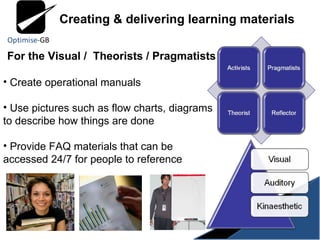
For the Visual /  Theorists / Pragmatists Create operational manuals Use pictures such as flow charts, diagrams to describe how things are done Provide FAQ materials that can be accessed 24/7 for people to reference Creating & delivering learning materials
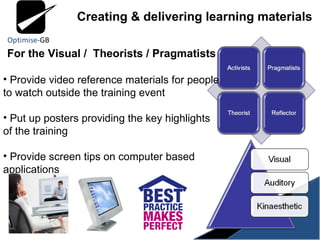
For the Visual /  Theorists / Pragmatists Provide video reference materials for people to watch outside the training event Put up posters providing the key highlights of the training Provide screen tips on computer based applications Creating & delivering learning materials
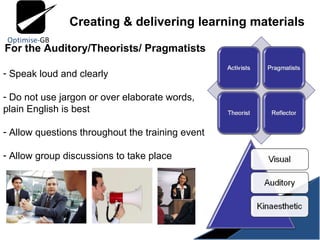
For the Auditory/Theorists/ Pragmatists Speak loud and clearly Do not use jargon or over elaborate words, plain English is best Allow questions throughout the training event Allow group discussions to take place  Creating & delivering learning materials
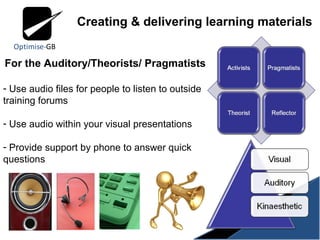
For the Auditory/Theorists/ Pragmatists Use audio files for people to listen to outside training forums Use audio within your visual presentations Provide support by phone to answer quick questions Creating & delivering learning materials
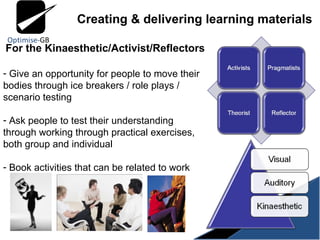
Creating & delivering learning materials For the Kinaesthetic/Activist/Reflectors Give an opportunity for people to move their bodies through ice breakers / role plays / scenario testing Ask people to test their understanding through working through practical exercises, both group and individual Book activities that can be related to work
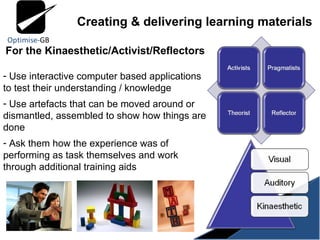
For the Kinaesthetic/Activist/Reflectors Use interactive computer based applications to test their understanding / knowledge Use artefacts that can be moved around or dismantled, assembled to show how things are done Ask them how the experience was of performing as task themselves and work through additional training aids Creating & delivering learning materials
Create a training web site that stores FAQ’s, operational manuals, videos, audio files to cater for all learning styles Schedule in refresher training every three months to ensure that training is a continuous cycle and is embedded in the culture of an organisation Create super users that may be contacted to provide instant support in regards to their training Test peoples knowledge through Computer Bases Training (CBT) or multiple answer questions How to retain knowledge
For solutions Contact Simon Misiewicz through Web:  www.optimise-gb.com Email:  [email_address]  or

Deliver training to suit varying learning styles

  • 1.
    Deliver effective trainingto suit different learning styles
  • 2.
    Why do someteaching methods fail? Teacher speaks in mono tone Their is no interaction with students Materials are word only- black & white Students sit at their desks throughout the learning cycle Training materials are not relevant to everyday life or with work Does this sound familiar to past experiences?
  • 3.
    Knowledge Base VAKlearning styles Visual Observed things, including pictures, diagrams, demonstrations, displays, handouts, films, flip-chart, etc. Reading and writing Short attention span when listening Auditory learning style involves the transfer of information through listening: to the spoken word, of self or others, of sounds and noises. Verbal discussions Reading aloud Kinaesthetic physical experience - touching, feeling, holding, doing, practical hands-on experiences. Interactive tools Trial and error
  • 4.
    Knowledge Base Learningroles Activist Fully involved in new experiences, enjoying "here and now“. Open-minded, not sceptical. Their philosophy is: "I'll try anything once". They tend to act first and consider the consequences afterwards. Days are filled with activity tackling problems by brainstorming. As soon as the excitement from one activity has died down, they are busy looking for the next. They tend to thrive on the challenge of new experiences but are bored by implementation and long-term consolidation. Gregarious people constantly involving them-selves with others but, in so doing, they seek to centre all activity around themselves.
  • 5.
    Knowledge Base Learningroles Pragmatists Keen on trying out new ideas, theories and techniques to see if they work in practice. Positively search out new ideas and take the first opportunity to experiment with applications. People who return from courses brimming with new ideas that they want to try out. They like to get on with things, and act quickly and confidently on ideas that attract them. Impatient with ruminating and open-ended discussion. They are essentially practical, down-to-earth people who like solving problems (often through trial and error). They view problems and difficulties as a "challenge". Their philosophy is: "As long as it works, that's fine." - although they may also be keen to experiment to find better ways to do things.
  • 6.
    Knowledge Base Learningroles Theorists Adapt and integrate observations into complex but logically sound theories. They think through problems in a logical, step-by-step fashion by assimilating disparate facts into coherent, holistic theories. Perfectionists who do not rest easy until things are tidy and fit into a rational scheme. They like to analyse and synthesise. They are keen on asking questions and challenging assumptions. Their philosophy is: "If it's logical then it's good." They attempt to fit everything together into a single jigsaw that encompasses "life, the universe and everything". Detached, analytical and dedicated to rational objectivity rather than anything subjective or ambiguous.
  • 7.
    Knowledge Base Learningroles Reflectors Stand back to ponder experiences and observe them from different perspectives. Collect data, both first-hand and from others. Prefer to think about it thoroughly before coming conclusions. Postpone reaching conclusions for as long as possible to consider all possible angles and implications before making a move. Observing others and take a back seat in meetings and discussions. They listen to others before making their own points. When they act it is part of a wide picture which includes the past as well as the present and others' observations as well as their own.
  • 8.
    For the Visual/ Theorists / Pragmatists Create operational manuals Use pictures such as flow charts, diagrams to describe how things are done Provide FAQ materials that can be accessed 24/7 for people to reference Creating & delivering learning materials
  • 9.
    For the Visual/ Theorists / Pragmatists Provide video reference materials for people to watch outside the training event Put up posters providing the key highlights of the training Provide screen tips on computer based applications Creating & delivering learning materials
  • 10.
    For the Auditory/Theorists/Pragmatists Speak loud and clearly Do not use jargon or over elaborate words, plain English is best Allow questions throughout the training event Allow group discussions to take place Creating & delivering learning materials
  • 11.
    For the Auditory/Theorists/Pragmatists Use audio files for people to listen to outside training forums Use audio within your visual presentations Provide support by phone to answer quick questions Creating & delivering learning materials
  • 12.
    Creating & deliveringlearning materials For the Kinaesthetic/Activist/Reflectors Give an opportunity for people to move their bodies through ice breakers / role plays / scenario testing Ask people to test their understanding through working through practical exercises, both group and individual Book activities that can be related to work
  • 13.
    For the Kinaesthetic/Activist/ReflectorsUse interactive computer based applications to test their understanding / knowledge Use artefacts that can be moved around or dismantled, assembled to show how things are done Ask them how the experience was of performing as task themselves and work through additional training aids Creating & delivering learning materials
  • 14.
    Create a trainingweb site that stores FAQ’s, operational manuals, videos, audio files to cater for all learning styles Schedule in refresher training every three months to ensure that training is a continuous cycle and is embedded in the culture of an organisation Create super users that may be contacted to provide instant support in regards to their training Test peoples knowledge through Computer Bases Training (CBT) or multiple answer questions How to retain knowledge
  • 15.
    For solutions ContactSimon Misiewicz through Web: www.optimise-gb.com Email: [email_address] or