Learning styles and its
application in
designing training
programs
Geethika Nair 14
Harsheen Kaur 15
Janhvi Pant 16
Saasha Jethwani 17
● To train employees effectively, it is important that their different learning styles are taken
into account.
● Each person learns differently and this becomes important in a fast paced corporate
environment where time wasted on ineffective training costs money and slows production.
● When employees are trying to learn a new task mismatches in learning styles and methods
can be discouraging and lead to misattributing the lack of learning to the wrong causes.
● This can be avoided by modelling the training programs as per the employees from the get-
go.
WHY TRAINING NEEDS TO BE BASED ON LEARNING
STYLES
The advantages of adapting training materials to a team’s various learning styles yields many
benefits for the organization as well:
● Reducing the learning time and thus cost for the company
● Getting a realistic appraisal of the strengths and weaknesses of each member of the team
and the organization
● Increasing employee engagement and enthusiasm by tailoring the program to be most
advantageous for them.
HOW IT BENEFITS THE ORGANIZATION
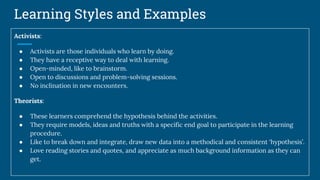
Learning Styles and Examples
Activists:
● Activists are those individuals who learn by doing.
● They have a receptive way to deal with learning.
● Open-minded, like to brainstorm.
● Open to discussions and problem-solving sessions.
● No inclination in new encounters.
Theorists:
● These learners comprehend the hypothesis behind the activities.
● They require models, ideas and truths with a specific end goal to participate in the learning
procedure.
● Like to break down and integrate, draw new data into a methodical and consistent ‘hypothesis’.
● Love reading stories and quotes, and appreciate as much background information as they can
get.
Pragmatists:
● Have the capacity to perceive how to put the learning into practice in their present reality.
● Conceptual ideas and recreations are of constrained utility unless they can see an approach to
put the concepts practically in their lives.
● Experimenting with new ideas, speculations and methods
● Don’t like abstract concepts or games.
Reflectors:
● These individuals learn by watching and contemplating what happened.
● They may abstain from jumping in and prefer to watch from the sidelines.
● They want to remain back and see encounters from various alternate points of view
● Gather information and use the opportunity to work towards a suitable conclusion.
https://youtu.be/5Cf-1zx58CU
Physiological- Mobility, Intake,
Time
Environmental- Sound, Light,
Seating, Temperature
Sociological- Independance,
Authority
Psychological- Analytical,
Impulse, Reflection
Emotional- Motivation,
Structure, Persistence
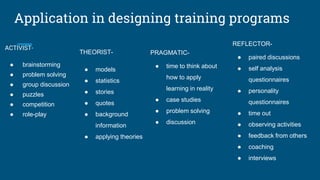
Application in designing training programs
ACTIVIST-
● brainstorming
● problem solving
● group discussion
● puzzles
● competition
● role-play
THEORIST-
● models
● statistics
● stories
● quotes
● background
information
● applying theories
PRAGMATIC-
● time to think about
how to apply
learning in reality
● case studies
● problem solving
● discussion
REFLECTOR-
● paired discussions
● self analysis
questionnaires
● personality
questionnaires
● time out
● observing activities
● feedback from others
● coaching
● interviews
Learning styles and its application in designing training programs

Learning styles and its application in designing training programs

  • 1.
    Learning styles andits application in designing training programs Geethika Nair 14 Harsheen Kaur 15 Janhvi Pant 16 Saasha Jethwani 17
  • 2.
    ● To trainemployees effectively, it is important that their different learning styles are taken into account. ● Each person learns differently and this becomes important in a fast paced corporate environment where time wasted on ineffective training costs money and slows production. ● When employees are trying to learn a new task mismatches in learning styles and methods can be discouraging and lead to misattributing the lack of learning to the wrong causes. ● This can be avoided by modelling the training programs as per the employees from the get- go. WHY TRAINING NEEDS TO BE BASED ON LEARNING STYLES
  • 3.
    The advantages ofadapting training materials to a team’s various learning styles yields many benefits for the organization as well: ● Reducing the learning time and thus cost for the company ● Getting a realistic appraisal of the strengths and weaknesses of each member of the team and the organization ● Increasing employee engagement and enthusiasm by tailoring the program to be most advantageous for them. HOW IT BENEFITS THE ORGANIZATION
  • 4.
    Learning Styles andExamples Activists: ● Activists are those individuals who learn by doing. ● They have a receptive way to deal with learning. ● Open-minded, like to brainstorm. ● Open to discussions and problem-solving sessions. ● No inclination in new encounters. Theorists: ● These learners comprehend the hypothesis behind the activities. ● They require models, ideas and truths with a specific end goal to participate in the learning procedure. ● Like to break down and integrate, draw new data into a methodical and consistent ‘hypothesis’. ● Love reading stories and quotes, and appreciate as much background information as they can get.
  • 5.
    Pragmatists: ● Have thecapacity to perceive how to put the learning into practice in their present reality. ● Conceptual ideas and recreations are of constrained utility unless they can see an approach to put the concepts practically in their lives. ● Experimenting with new ideas, speculations and methods ● Don’t like abstract concepts or games. Reflectors: ● These individuals learn by watching and contemplating what happened. ● They may abstain from jumping in and prefer to watch from the sidelines. ● They want to remain back and see encounters from various alternate points of view ● Gather information and use the opportunity to work towards a suitable conclusion. https://youtu.be/5Cf-1zx58CU
  • 8.
    Physiological- Mobility, Intake, Time Environmental-Sound, Light, Seating, Temperature Sociological- Independance, Authority Psychological- Analytical, Impulse, Reflection Emotional- Motivation, Structure, Persistence
  • 9.
    Application in designingtraining programs ACTIVIST- ● brainstorming ● problem solving ● group discussion ● puzzles ● competition ● role-play THEORIST- ● models ● statistics ● stories ● quotes ● background information ● applying theories PRAGMATIC- ● time to think about how to apply learning in reality ● case studies ● problem solving ● discussion REFLECTOR- ● paired discussions ● self analysis questionnaires ● personality questionnaires ● time out ● observing activities ● feedback from others ● coaching ● interviews