Strategic improvements through the balanced scorecard and programme management Optimise- GB
Knowledge Base Programme management  is the process of managing several related projects with an intention of improving the performance of an organisation. Programmes deliver  outcomes  through benefit realisation and projects deliver  outputs  that contribute towards an outcome Optimise -GB
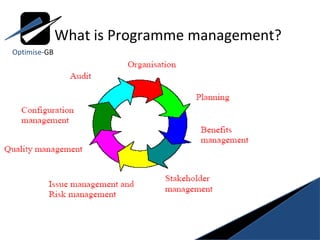
What is Programme management? Optimise- GB
The Balanced scorecard  is a set of measures that gives managers a comprehensive view of the business. The balanced scorecard has advantages of pure financial measures such as ROI, EPS, PE etc as they are often misleading as they do not give a full picture of a given situation nor do they link one measure to another The four quadrants of the scorecard is an integral part to the overall mission of the company Knowledge Base Optimise -GB
What is Programme management? Programme planning  - using a Programme Plan to ensure control Benefits management  - identifying, optimising and tracking benefits Stakeholder management  - ensuring all interested parties are appropriately involved in the programme  Issue management and Risk management  - having strategy for dealing with current and anticipated problems  Quality management  - ensuring that the end products of the programme are fit for purpose  Configuration management  - keeping monitoring information about the programme up-to-date and accurate  Audit  - ensuring that technical, statutory, contract and accounting standards are used Optimise- GB
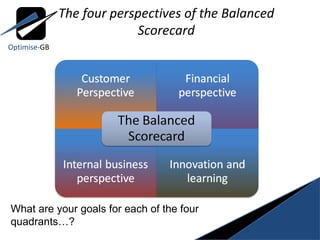
The four perspectives of the Balanced Scorecard What are your goals for each of the four quadrants…? Optimise- GB
What is your mission statement? Who are your customers?  What are your products / Services? What is the state of your business right now in terms of sales, cost, quality, customer satisfaction, market share? What are your strengths, weaknesses, opportunities and threats? Where do you want the business to be in the future? Before we continue ask yourself the  following questions: Optimise -GB
The four perspectives of the Balanced Scorecard How do your customers see you? How do you know? Time factors : What is the lead time of receiving an order to delivering the goods to your customers? Quality factors:  What is the % of errors, returns policy, what are the quality requirements from a customer perspective Cost Factors:  What is the cost of serving your customers and how much profit is made on each one? What are the opportunity costs  of missing a customer order? Market factors : What is the market share, customer  make up and profitability,  repeat  purchases, number of new customers? Optimise- GB Customer Perspective
The four perspectives of the Balanced Scorecard How do your appear to your shareholders? How do you know? Liquidity : Debtor days, Stock Turn, Creditor Days, Gearing ratios, Debt to equity, Interest cover Profitability : Gross Margin %, Operating Profit %, Net Profit %, Return on Trading Assets (ROTA) Investment : Return on investment (ROI), Earnings per share  (EPS)  Sales : Market share, Sales increase %, revenue per  customer Optimise- GB Financial perspective
The four perspectives of the Balanced Scorecard How good are your business processes? How do you know? How are the business processes documented, measured and improved? What is the volume of scrap, waste, defects, rework? What are the competency / capability levels of your staff, technology, procurement strategies, Risk mitigation and quality assurance? What is the quality of your products and services? Optimise- GB Internal business perspective
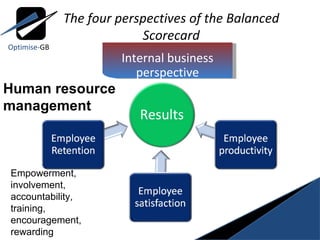
The four perspectives of the Balanced Scorecard Empowerment, involvement, accountability,  training,  encouragement, rewarding Human resource management Optimise- GB Internal business perspective
The four perspectives of the Balanced Scorecard Is technology being used to: Ease administration burdens Speed up business processes Improve quality of output Automate labour intensive work Integrating core systems to improve data flow  Linking with customer / suppliers systems to improve communication Optimise- GB Internal business perspective
The four perspectives of the Balanced Scorecard How is your business improving through innovation? How do you know? Do employees understand the vision of the company? What is the morale of staff?  How many ideas have been generated and acted upon as a group?  Have business risks been mitigated? Is information to make decisions shared freely? Optimise- GB Innovation and learning
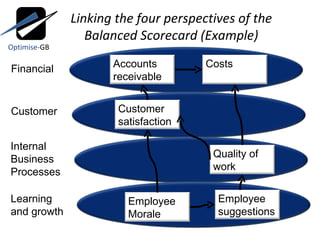
Linking the four perspectives of the Balanced Scorecard (Example) Financial Customer Internal Business Processes Learning and growth Optimise- GB Employee Morale Employee suggestions Quality of work Customer satisfaction Accounts receivable Costs
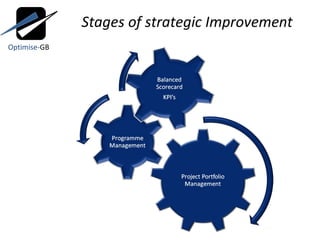
Stages of strategic Improvement Optimise- GB
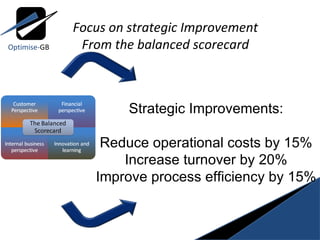
Focus on strategic Improvement From the balanced scorecard Strategic Improvements: Reduce operational costs by 15% Increase turnover by 20% Improve process efficiency by 15% Optimise- GB
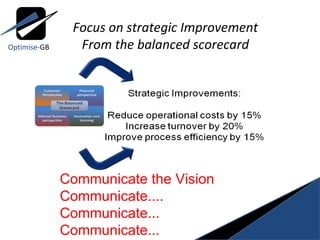
Focus on strategic Improvement From the balanced scorecard Communicate the Vision Communicate.... Communicate... Communicate... Optimise- GB
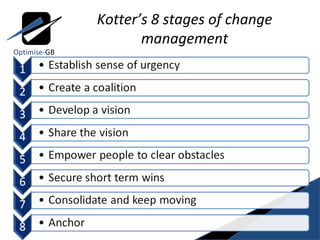
Kotter’s 8 stages of change management Optimise- GB
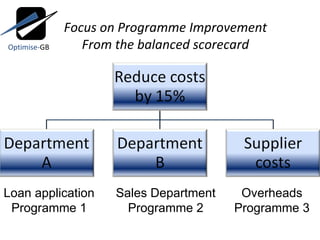
Focus on Programme Improvement From the balanced scorecard Loan application Programme 1 Sales Department Programme 2 Overheads Programme 3 Optimise- GB
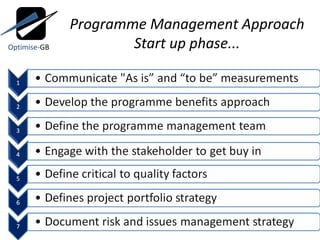
Programme Management Approach Start up phase... Optimise- GB
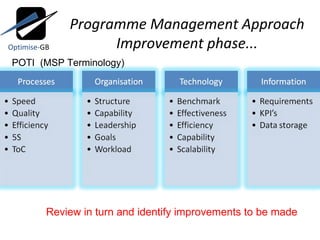
Programme Management Approach Improvement phase... Review in turn and identify improvements to be made POTI  (MSP Terminology) Optimise- GB
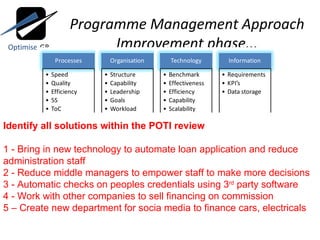
Programme Management Approach Improvement phase... Identify all solutions within the POTI review 1 - Bring in new technology to automate loan application and reduce administration staff 2 - Reduce middle managers to empower staff to make more decisions 3 - Automatic checks on peoples credentials using 3 rd  party software 4 - Work with other companies to sell financing on commission 5 – Create new department for socia media to finance cars, electricals Optimise- GB
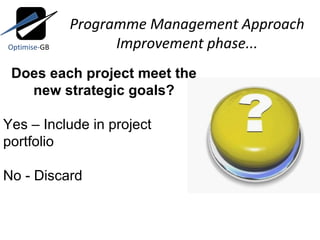
Programme Management Approach Improvement phase... Does each project meet the new strategic goals? Yes – Include in project portfolio No - Discard Optimise- GB
Project  Portfolio Management... Manage each solution as a miniature project.  Do not group or make project too complicated The smaller the project the quicker the benefits realisation Optimise- GB
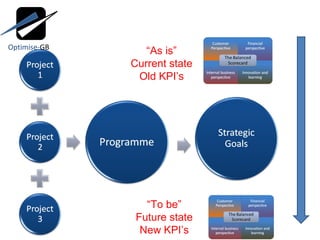
“ As is” Current state Old KPI’s “ To be” Future state New KPI’s Optimise- GB
For other solutions Contact  Simon Misiewicz through  Web:  www.optimise-gb.com Email:  [email_address]  or Optimise- GB

Strategic improvement through the balanced scorecard and programme management

  • 1.
    Strategic improvements throughthe balanced scorecard and programme management Optimise- GB
  • 2.
    Knowledge Base Programmemanagement is the process of managing several related projects with an intention of improving the performance of an organisation. Programmes deliver outcomes through benefit realisation and projects deliver outputs that contribute towards an outcome Optimise -GB
  • 3.
    What is Programmemanagement? Optimise- GB
  • 4.
    The Balanced scorecard is a set of measures that gives managers a comprehensive view of the business. The balanced scorecard has advantages of pure financial measures such as ROI, EPS, PE etc as they are often misleading as they do not give a full picture of a given situation nor do they link one measure to another The four quadrants of the scorecard is an integral part to the overall mission of the company Knowledge Base Optimise -GB
  • 5.
    What is Programmemanagement? Programme planning - using a Programme Plan to ensure control Benefits management - identifying, optimising and tracking benefits Stakeholder management - ensuring all interested parties are appropriately involved in the programme Issue management and Risk management - having strategy for dealing with current and anticipated problems Quality management - ensuring that the end products of the programme are fit for purpose Configuration management - keeping monitoring information about the programme up-to-date and accurate Audit - ensuring that technical, statutory, contract and accounting standards are used Optimise- GB
  • 6.
    The four perspectivesof the Balanced Scorecard What are your goals for each of the four quadrants…? Optimise- GB
  • 7.
    What is yourmission statement? Who are your customers? What are your products / Services? What is the state of your business right now in terms of sales, cost, quality, customer satisfaction, market share? What are your strengths, weaknesses, opportunities and threats? Where do you want the business to be in the future? Before we continue ask yourself the following questions: Optimise -GB
  • 8.
    The four perspectivesof the Balanced Scorecard How do your customers see you? How do you know? Time factors : What is the lead time of receiving an order to delivering the goods to your customers? Quality factors: What is the % of errors, returns policy, what are the quality requirements from a customer perspective Cost Factors: What is the cost of serving your customers and how much profit is made on each one? What are the opportunity costs of missing a customer order? Market factors : What is the market share, customer make up and profitability, repeat purchases, number of new customers? Optimise- GB Customer Perspective
  • 9.
    The four perspectivesof the Balanced Scorecard How do your appear to your shareholders? How do you know? Liquidity : Debtor days, Stock Turn, Creditor Days, Gearing ratios, Debt to equity, Interest cover Profitability : Gross Margin %, Operating Profit %, Net Profit %, Return on Trading Assets (ROTA) Investment : Return on investment (ROI), Earnings per share (EPS) Sales : Market share, Sales increase %, revenue per customer Optimise- GB Financial perspective
  • 10.
    The four perspectivesof the Balanced Scorecard How good are your business processes? How do you know? How are the business processes documented, measured and improved? What is the volume of scrap, waste, defects, rework? What are the competency / capability levels of your staff, technology, procurement strategies, Risk mitigation and quality assurance? What is the quality of your products and services? Optimise- GB Internal business perspective
  • 11.
    The four perspectivesof the Balanced Scorecard Empowerment, involvement, accountability, training, encouragement, rewarding Human resource management Optimise- GB Internal business perspective
  • 12.
    The four perspectivesof the Balanced Scorecard Is technology being used to: Ease administration burdens Speed up business processes Improve quality of output Automate labour intensive work Integrating core systems to improve data flow Linking with customer / suppliers systems to improve communication Optimise- GB Internal business perspective
  • 13.
    The four perspectivesof the Balanced Scorecard How is your business improving through innovation? How do you know? Do employees understand the vision of the company? What is the morale of staff? How many ideas have been generated and acted upon as a group? Have business risks been mitigated? Is information to make decisions shared freely? Optimise- GB Innovation and learning
  • 14.
    Linking the fourperspectives of the Balanced Scorecard (Example) Financial Customer Internal Business Processes Learning and growth Optimise- GB Employee Morale Employee suggestions Quality of work Customer satisfaction Accounts receivable Costs
  • 15.
    Stages of strategicImprovement Optimise- GB
  • 16.
    Focus on strategicImprovement From the balanced scorecard Strategic Improvements: Reduce operational costs by 15% Increase turnover by 20% Improve process efficiency by 15% Optimise- GB
  • 17.
    Focus on strategicImprovement From the balanced scorecard Communicate the Vision Communicate.... Communicate... Communicate... Optimise- GB
  • 18.
    Kotter’s 8 stagesof change management Optimise- GB
  • 19.
    Focus on ProgrammeImprovement From the balanced scorecard Loan application Programme 1 Sales Department Programme 2 Overheads Programme 3 Optimise- GB
  • 20.
    Programme Management ApproachStart up phase... Optimise- GB
  • 21.
    Programme Management ApproachImprovement phase... Review in turn and identify improvements to be made POTI (MSP Terminology) Optimise- GB
  • 22.
    Programme Management ApproachImprovement phase... Identify all solutions within the POTI review 1 - Bring in new technology to automate loan application and reduce administration staff 2 - Reduce middle managers to empower staff to make more decisions 3 - Automatic checks on peoples credentials using 3 rd party software 4 - Work with other companies to sell financing on commission 5 – Create new department for socia media to finance cars, electricals Optimise- GB
  • 23.
    Programme Management ApproachImprovement phase... Does each project meet the new strategic goals? Yes – Include in project portfolio No - Discard Optimise- GB
  • 24.
    Project PortfolioManagement... Manage each solution as a miniature project. Do not group or make project too complicated The smaller the project the quicker the benefits realisation Optimise- GB
  • 25.
    “ As is”Current state Old KPI’s “ To be” Future state New KPI’s Optimise- GB
  • 26.
    For other solutionsContact Simon Misiewicz through Web: www.optimise-gb.com Email: [email_address] or Optimise- GB