Integral Calculus
Copyright © Cengage Learning. All rights reserved.
2
Definite Integral using Indefinite Integral
Topic
3
Indefinite Integral
       
means
f x dx F x F x f x

 

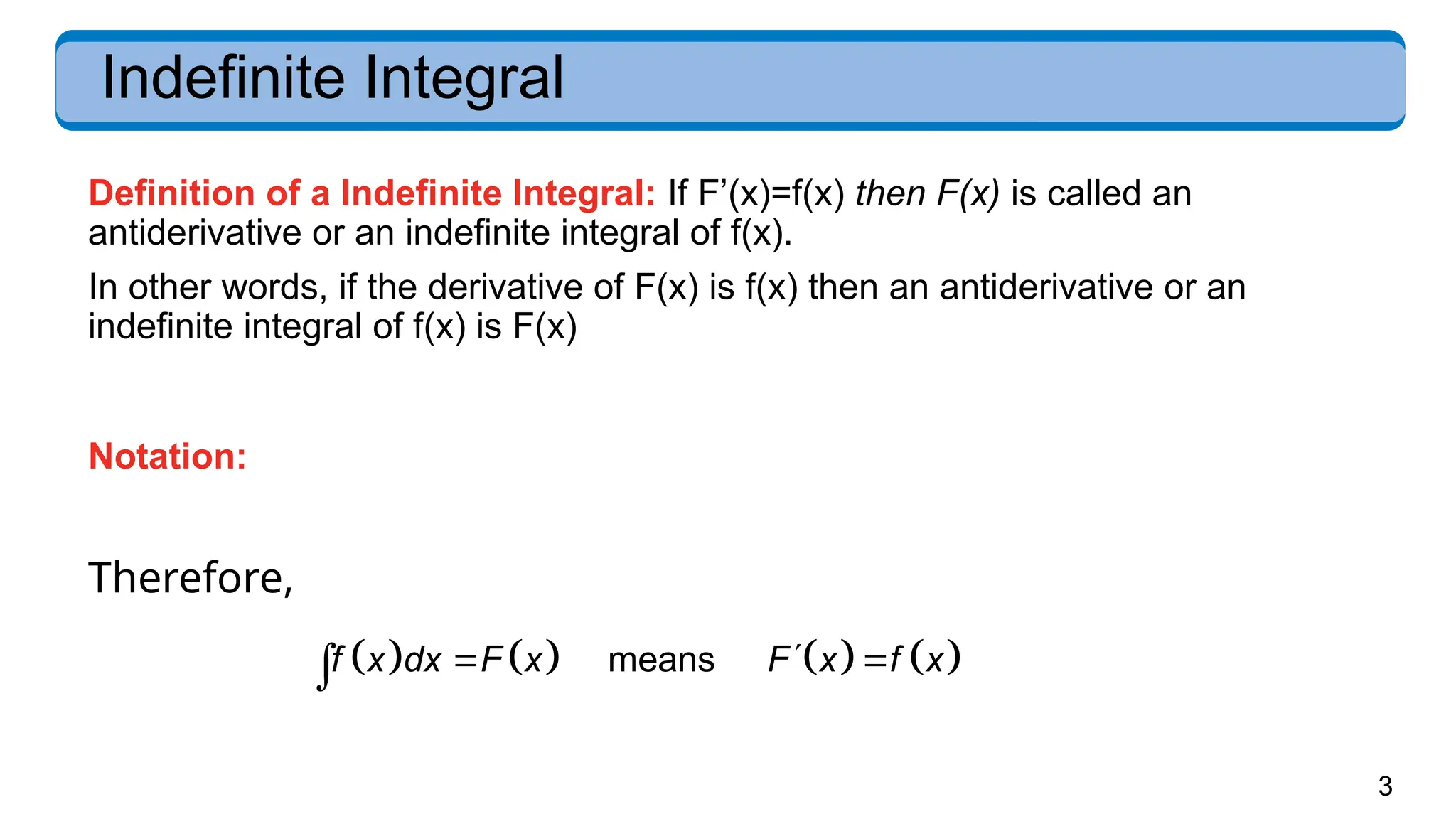
Definition of a Indefinite Integral: If F’(x)=f(x) then F(x) is called an
antiderivative or an indefinite integral of f(x).
In other words, if the derivative of F(x) is f(x) then an antiderivative or an
indefinite integral of f(x) is F(x)
Notation:
Therefore,
4
The Definite Integral: Definition
Definition of a Definite Integral If f is a function defined for a ≤ x ≤ b, we
divide the interval [a, b] into n subintervals of equal width
 .
b a
x
n

 
We let x0(= a), x1, x2, . . . , xn (= b) be the endpoints of these subintervals and
we let x1*, x2*, . . . , xn* be any sample points in these subintervals, so xi* lies
in the ith subinterval [xi −1, xi ]. Then the definite integral of f from a to b is
provided that this limit exists and gives the same value for all possible choices
of sample points. If it does exist, we say that f is integrable on [a, b]. We can
also write the definite integral in the following way
lim
𝑛→∞
∑
𝑖=1
𝑛
𝑓 (𝑥𝑖
∗
)∆𝑥
lim
𝑛→ ∞
[ 𝑓 ( 𝑥1
∗
) ∆ 𝑥 + 𝑓 (𝑥2
∗
) ∆ 𝑥 + 𝑓 (𝑥3
∗
) ∆ 𝑥+⋯ ⋯+ 𝑓 (𝑥𝑛
∗
)∆ 𝑥 ]
5
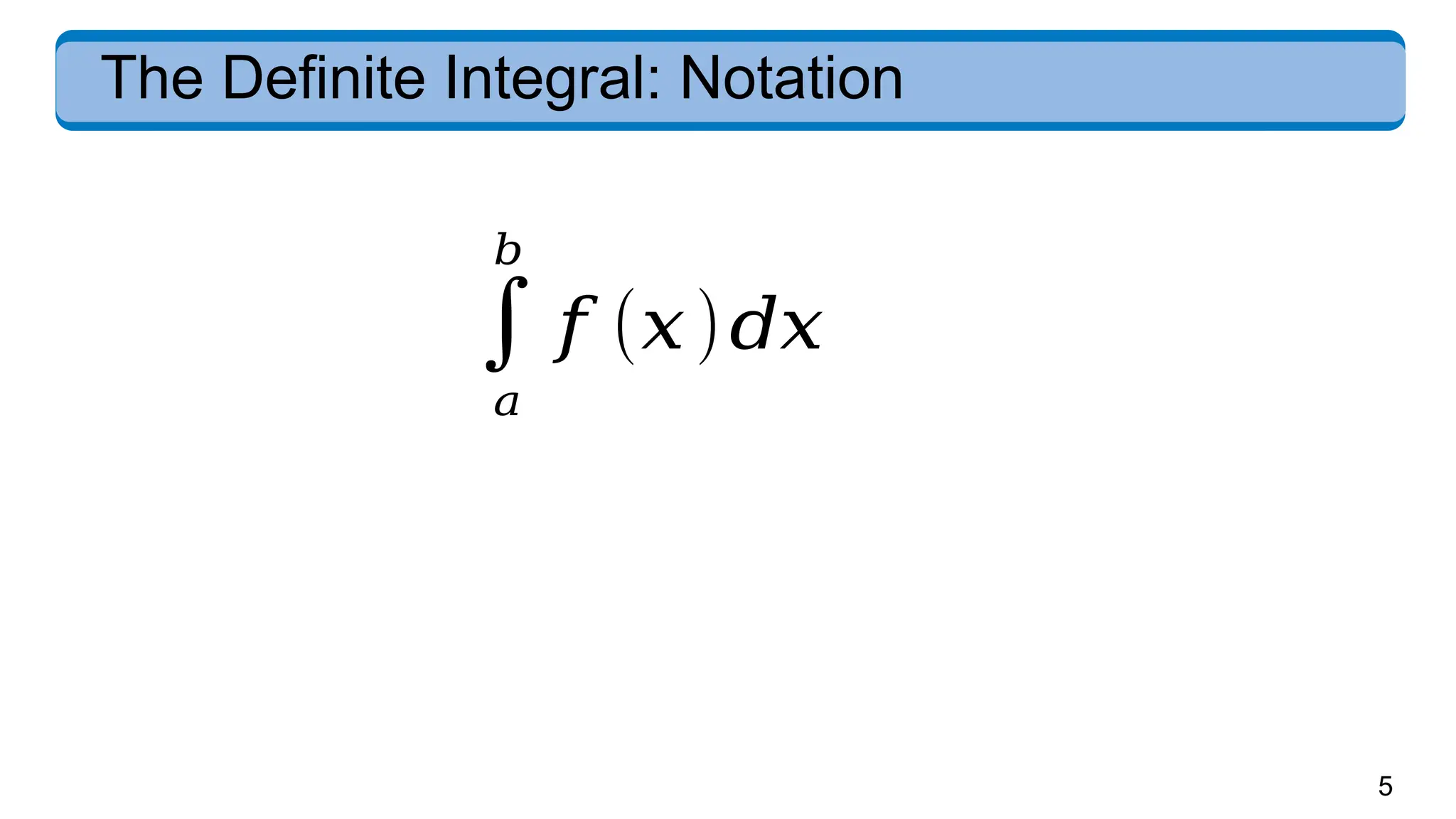
The Definite Integral: Notation
∫
𝑎
𝑏
𝑓 (𝑥)𝑑𝑥
6
The Definite Integral: Note
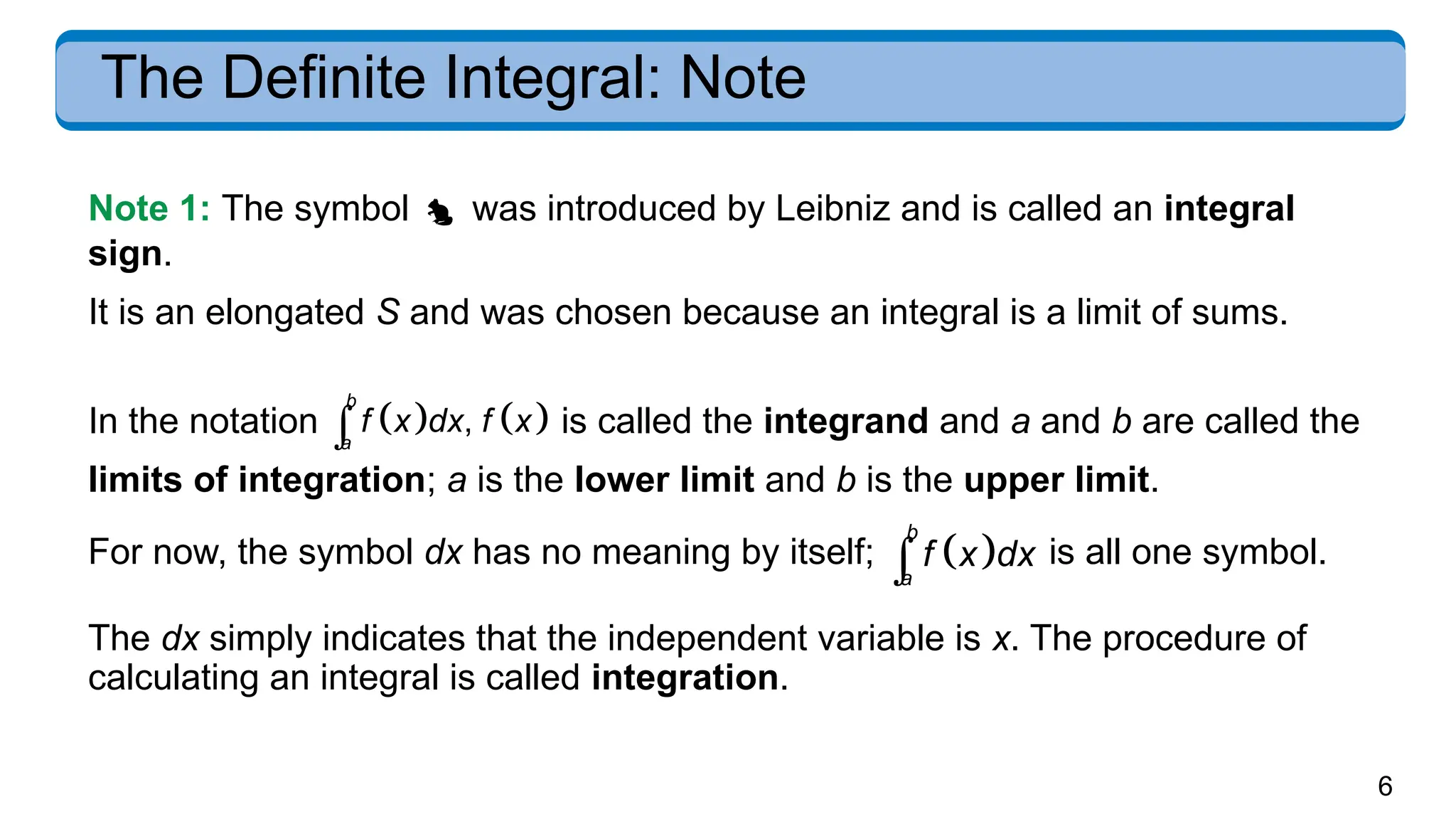
In the notation    
,
b
a
f x dx f x
 is called the integrand and a and b are called the
limits of integration; a is the lower limit and b is the upper limit.
For now, the symbol dx has no meaning by itself;  
b
a
f x dx
 is all one symbol.
The dx simply indicates that the independent variable is x. The procedure of
calculating an integral is called integration.
Note 1: The symbol  was introduced by Leibniz and is called an integral
sign.
It is an elongated S and was chosen because an integral is a limit of sums.
7
The Definite Integral: Note
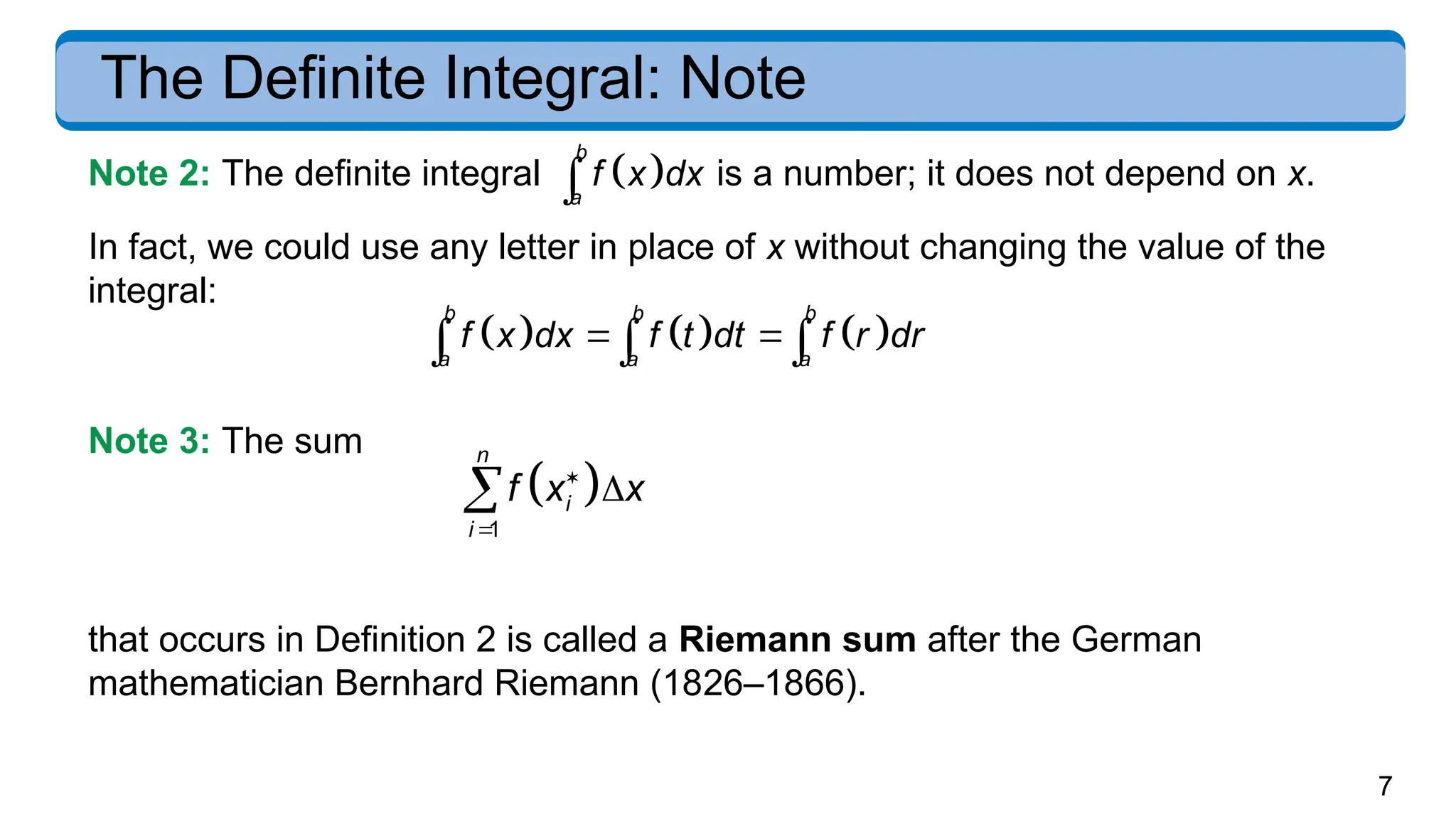
Note 2: The definite integral  
b
a
f x dx
 is a number; it does not depend on x.
In fact, we could use any letter in place of x without changing the value of the
integral:
     
b b b
a a a
f x dx f t dt f r dr
 
  
Note 3: The sum
 
1
n
i
i
f x x




that occurs in Definition 2 is called a Riemann sum after the German
mathematician Bernhard Riemann (1826–1866).
8
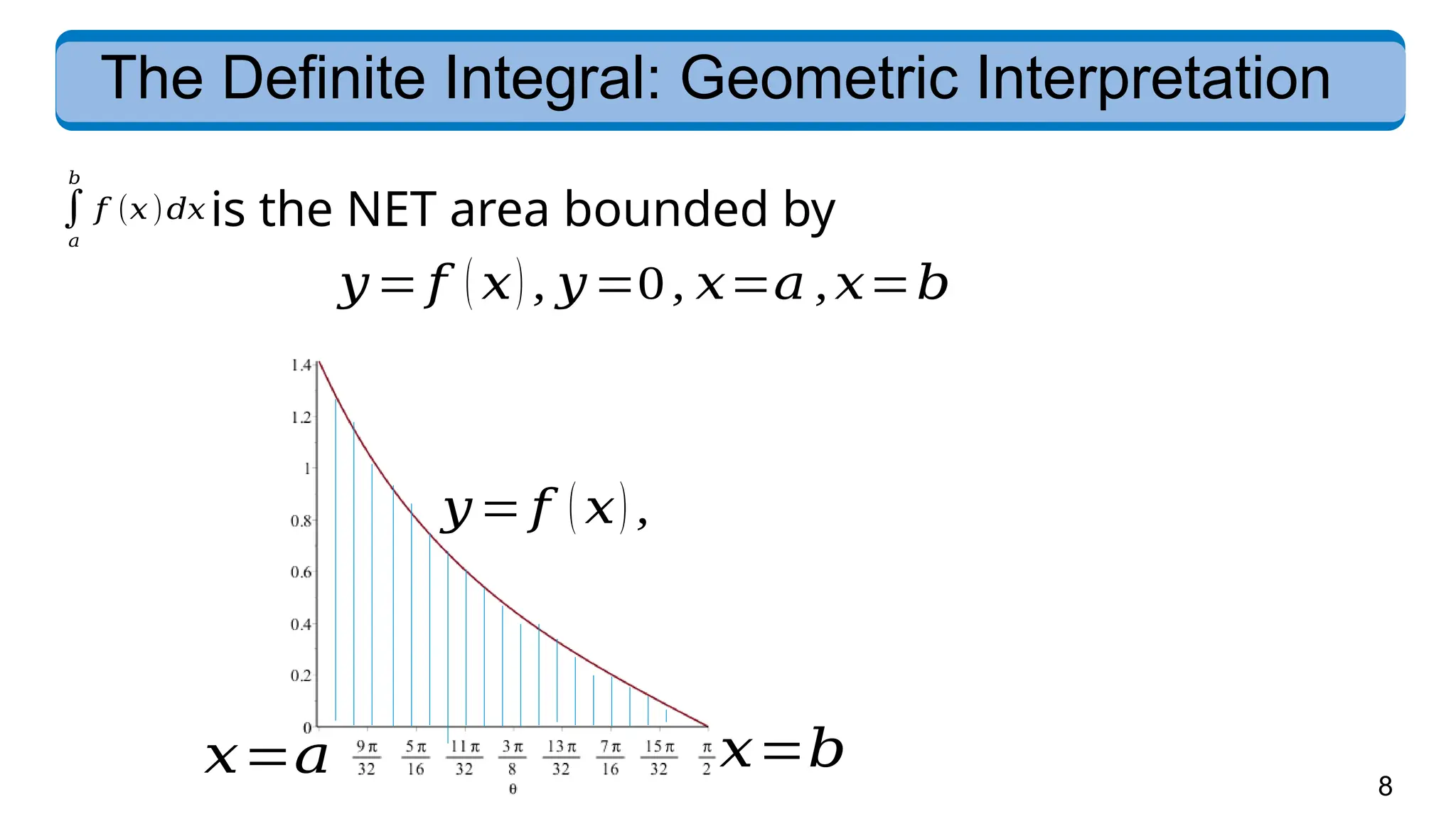
The Definite Integral: Geometric Interpretation
∫
𝑎
𝑏
𝑓 (𝑥)𝑑𝑥 is the NET area bounded by
𝑦= 𝑓 ( 𝑥) , 𝑦=0, 𝑥=𝑎 ,𝑥=𝑏
𝑦= 𝑓 ( 𝑥) ,
𝑥=𝑎 𝑥=𝑏
9
The Fundamental Theorem of Calculus
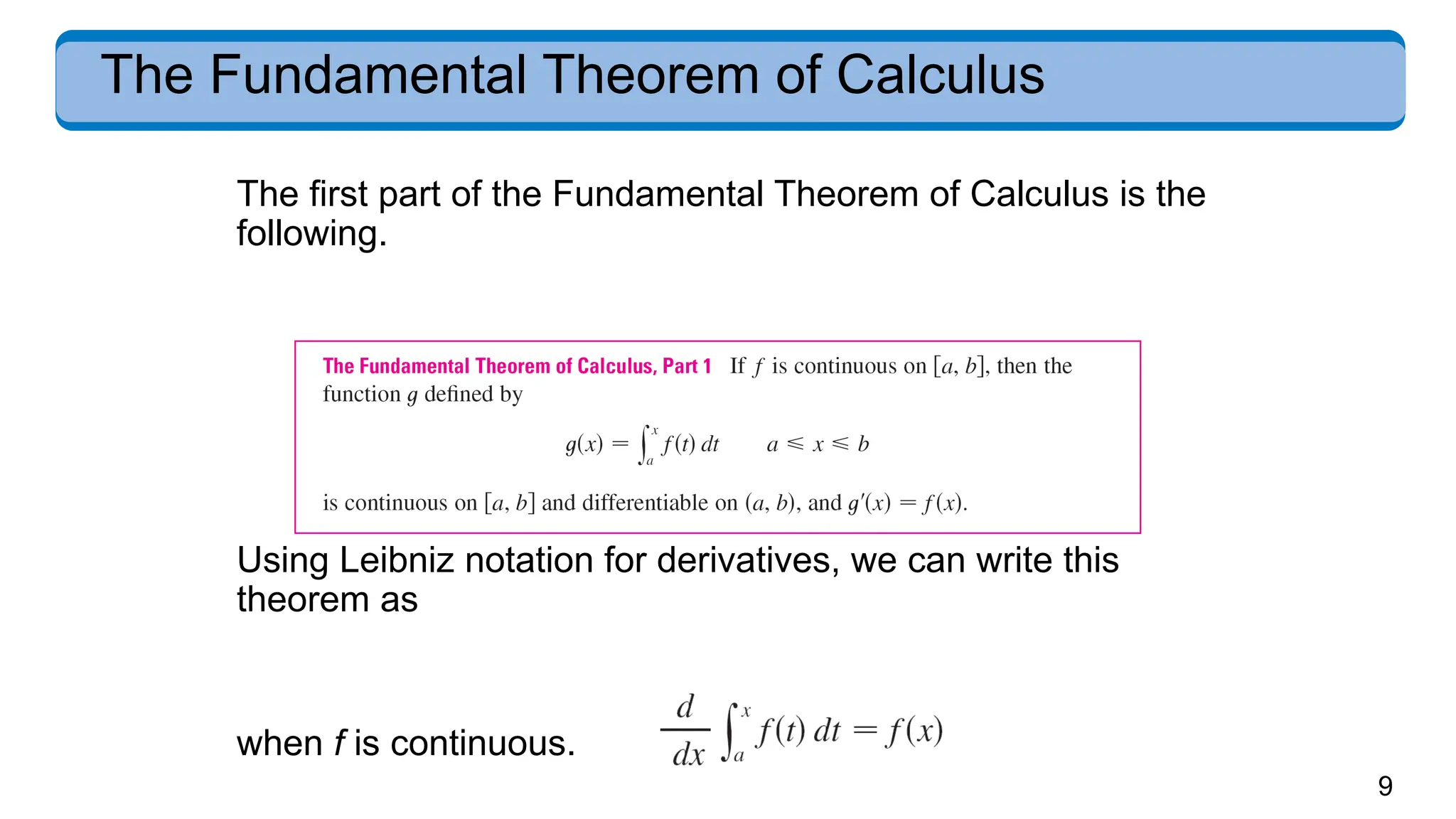
The first part of the Fundamental Theorem of Calculus is the
following.
Using Leibniz notation for derivatives, we can write this
theorem as
when f is continuous.
10
The Fundamental Theorem of Calculus
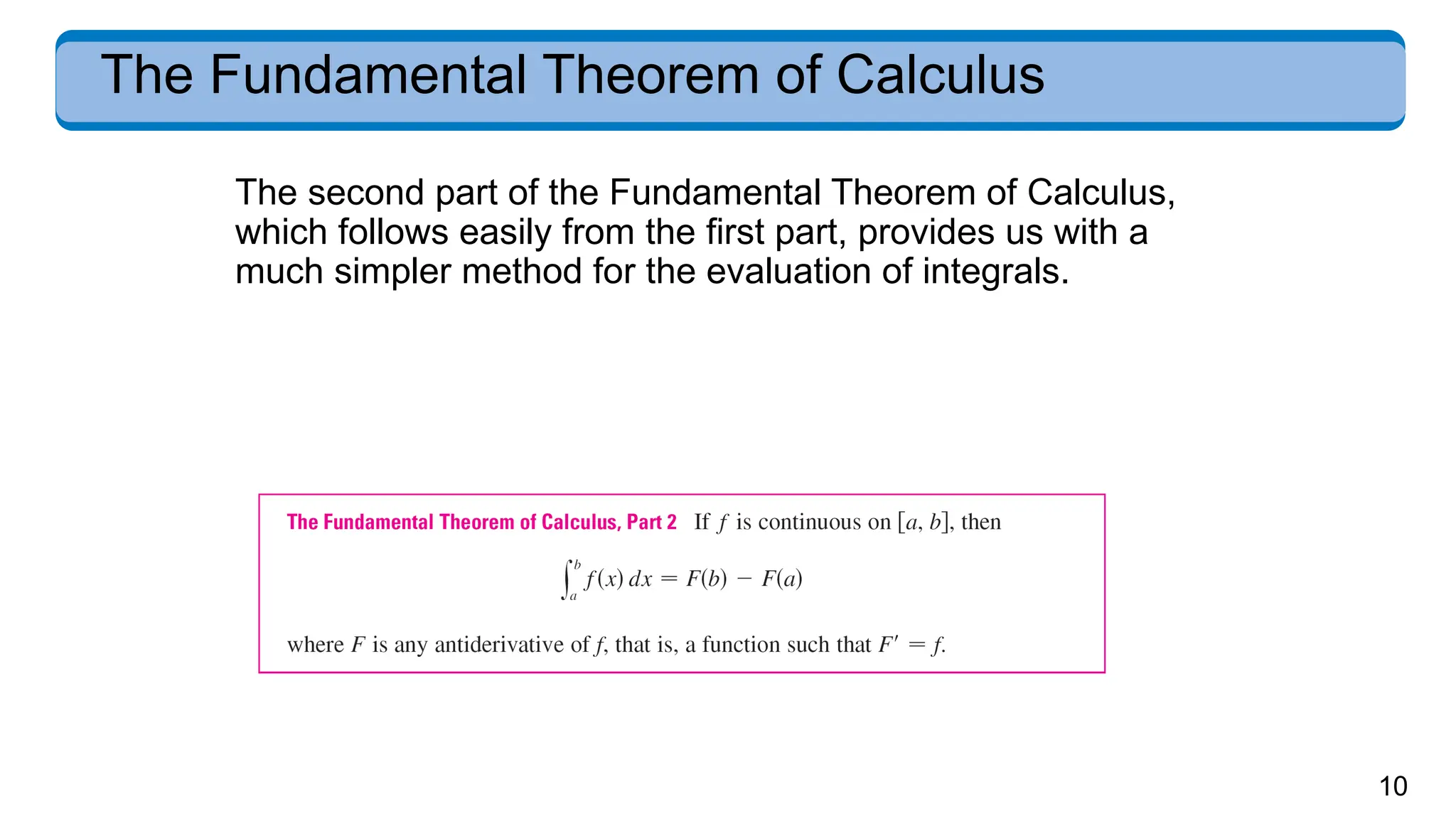
The second part of the Fundamental Theorem of Calculus,
which follows easily from the first part, provides us with a
much simpler method for the evaluation of integrals.
11
The Fundamental Theorem of Calculus: Part 2
Conditions:
• Interval [a,b] is a closed interval
• f is continuous on the closed interval [a,b]
Conclusion:
where F(x) is an antiderivative of f(x)
12
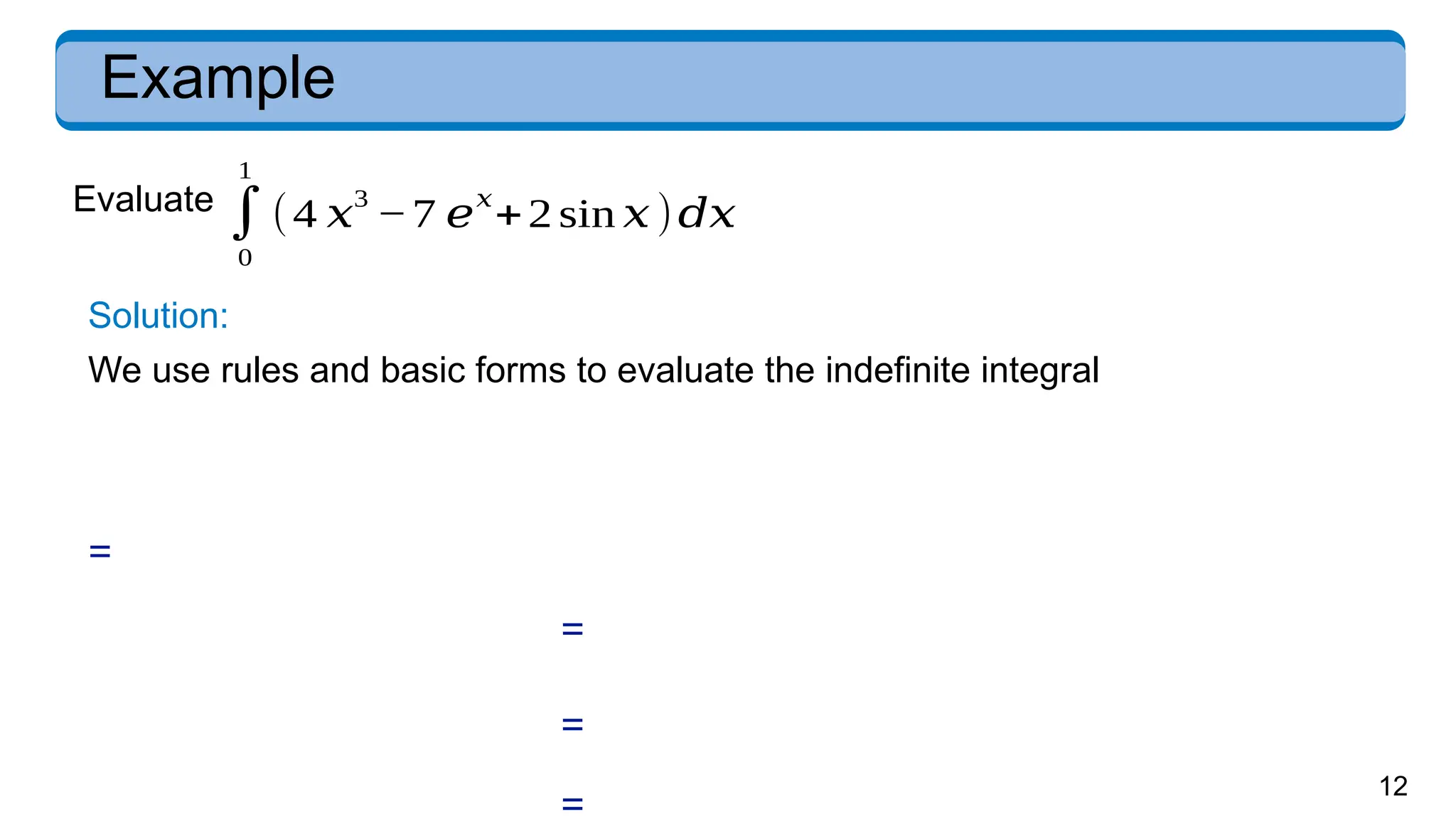
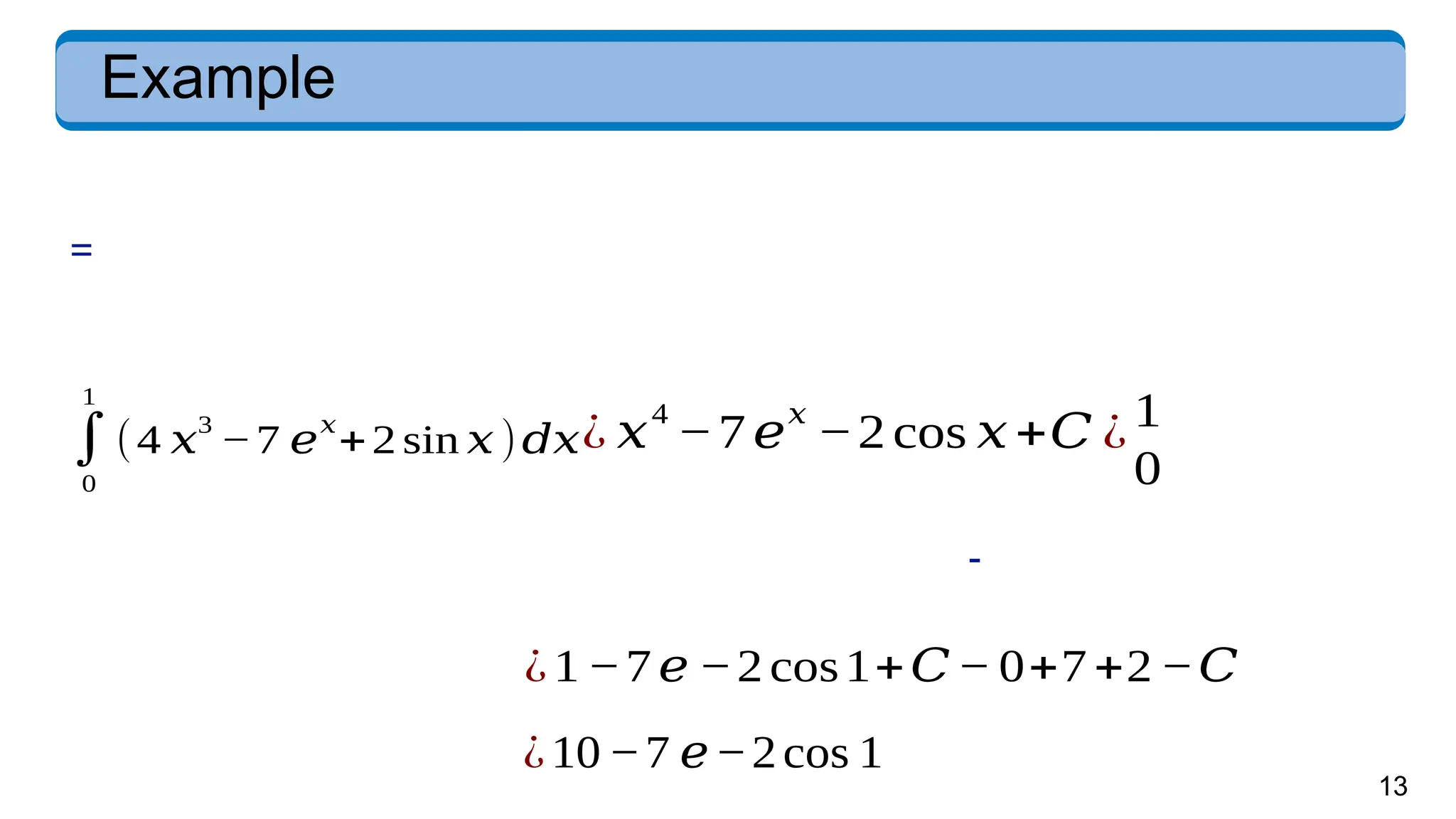
Example
Evaluate
∫
0
1
(4 𝑥
3
−7 𝑒
𝑥
+2 sin 𝑥 )𝑑𝑥
Solution:
We use rules and basic forms to evaluate the indefinite integral
=
=
=
13
Example
=
∫
0
1
(4 𝑥
3
−7 𝑒
𝑥
+2 sin 𝑥 )𝑑𝑥
-
¿1−7𝑒 −2cos1+𝐶− 0+7+2−𝐶
¿10−7 𝑒−2cos 1
¿ 𝑥
4
−7𝑒
𝑥
−2cos 𝑥+𝐶 ¿1
0
14
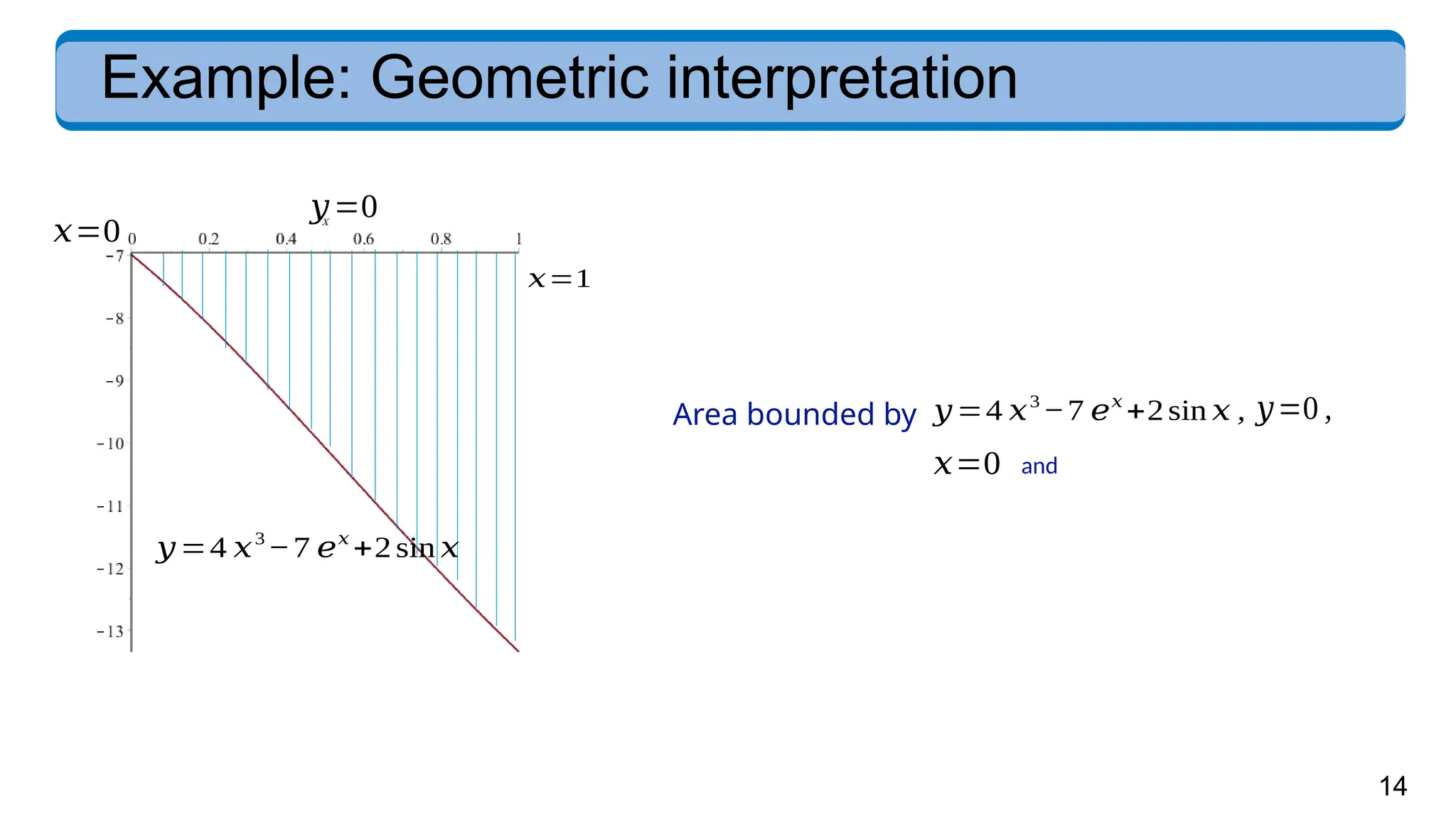
Example: Geometric interpretation
Area bounded by
𝑦=4 𝑥3
−7 𝑒𝑥
+2sin 𝑥
𝑦=4 𝑥3
−7 𝑒𝑥
+2sin 𝑥 , 𝑦=0 ,
𝑥=0 and
𝑥=0
𝑥=1
𝑦=0
15
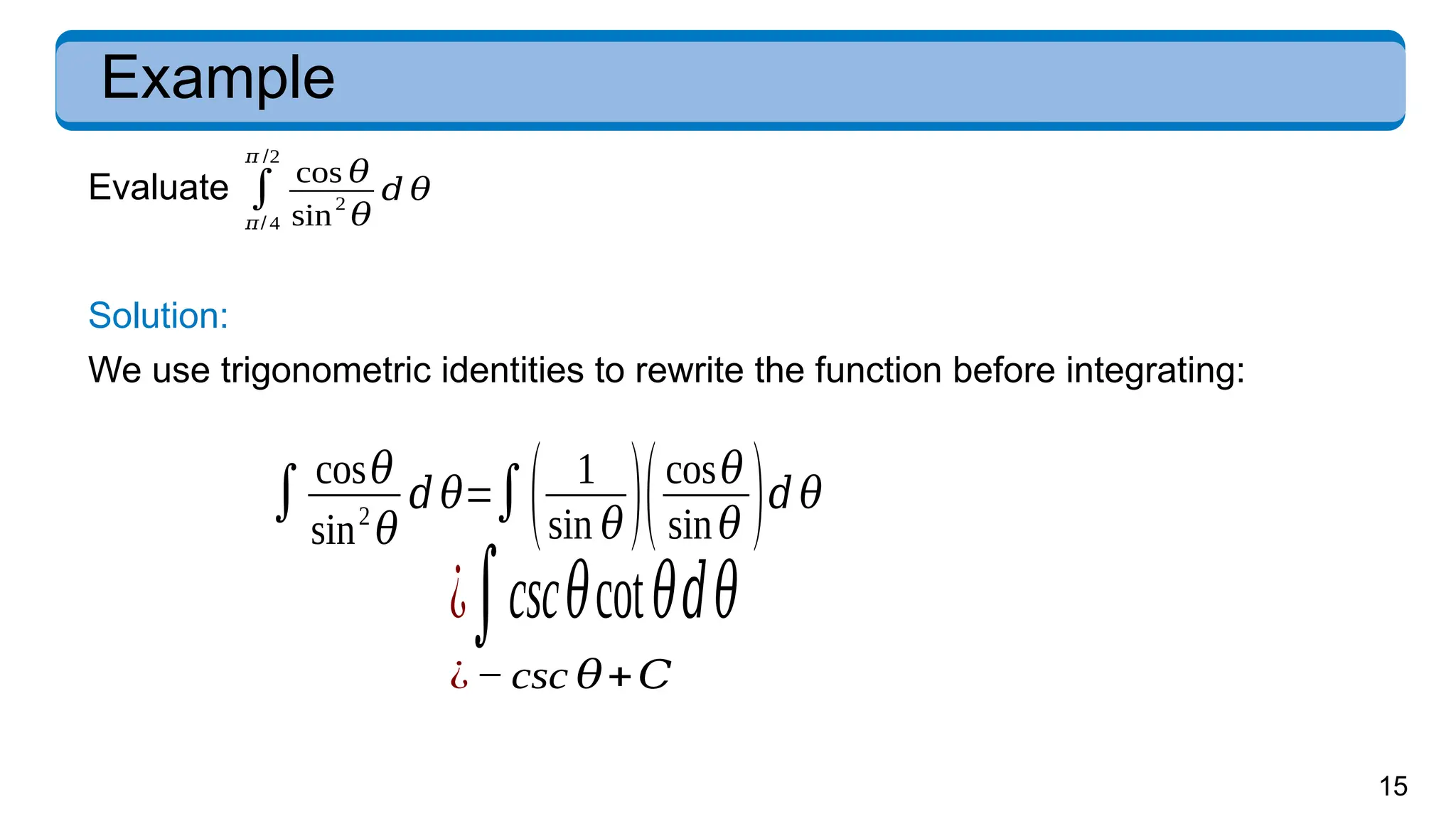
Example
Evaluate
Solution:
We use trigonometric identities to rewrite the function before integrating:
∫ cos𝜃
sin2
𝜃
𝑑 𝜃=∫( 1
sin 𝜃)(cos𝜃
sin𝜃 )𝑑 𝜃
¿∫csc𝜃cot𝜃𝑑𝜃
¿− csc 𝜃+𝐶
∫
𝜋/ 4
𝜋 /2
cos 𝜃
sin2
𝜃
𝑑 𝜃
16
Example
Since,
∫
𝜋/ 4
𝜋 /2
cos 𝜃
sin
2
𝜃
𝑑 𝜃=[−csc 𝜃] 𝜃=𝜋 /2
𝜃=𝜋 /4
Therefore,
¿ − csc (𝜋 /2) −(−csc ( 𝜋 /4 ))
¿−1+√2
17
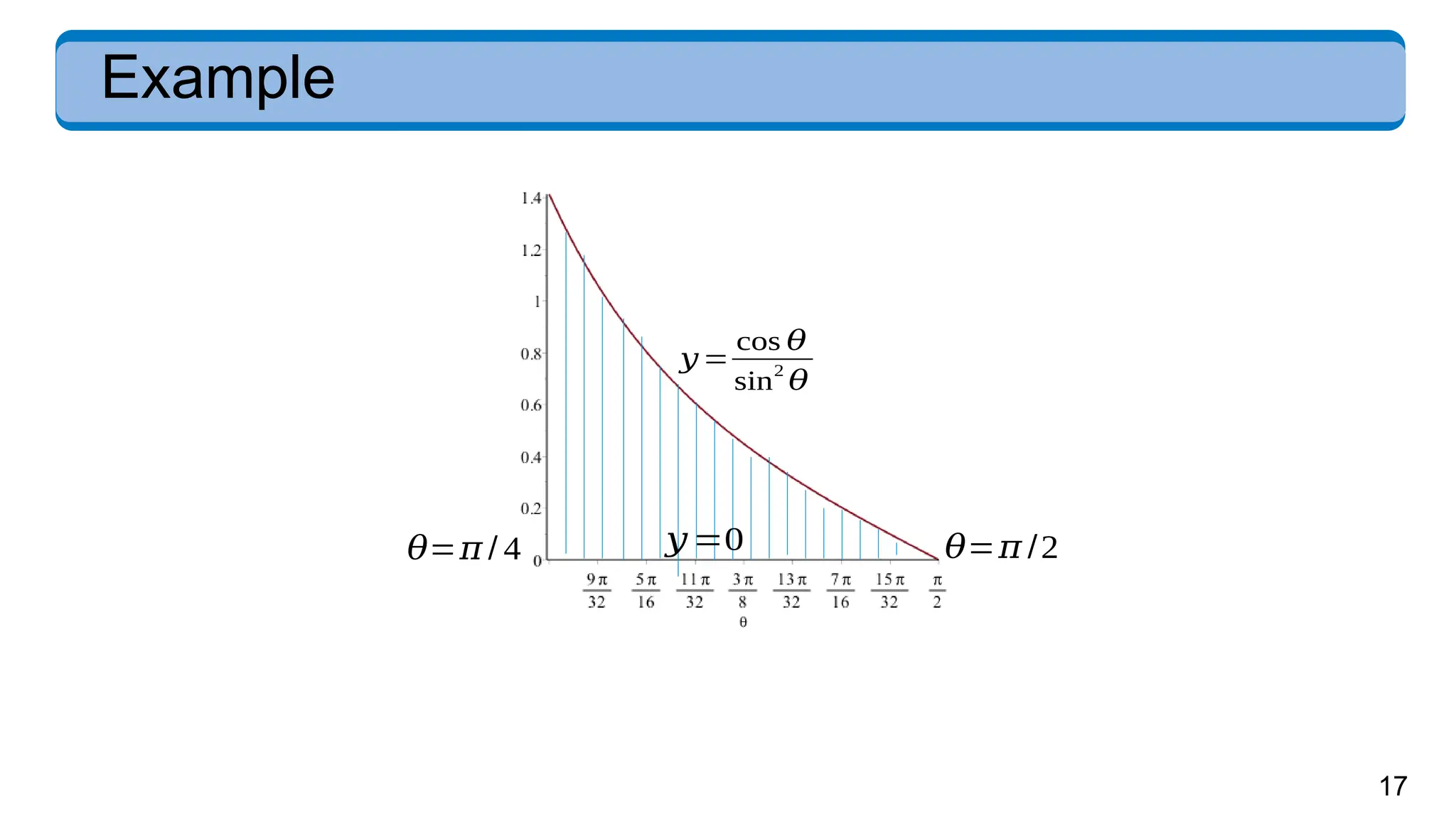
Example
𝑦 =
cos 𝜃
sin
2
𝜃
𝑦 =0
𝜃=𝜋 / 4 𝜃=𝜋 /2
18
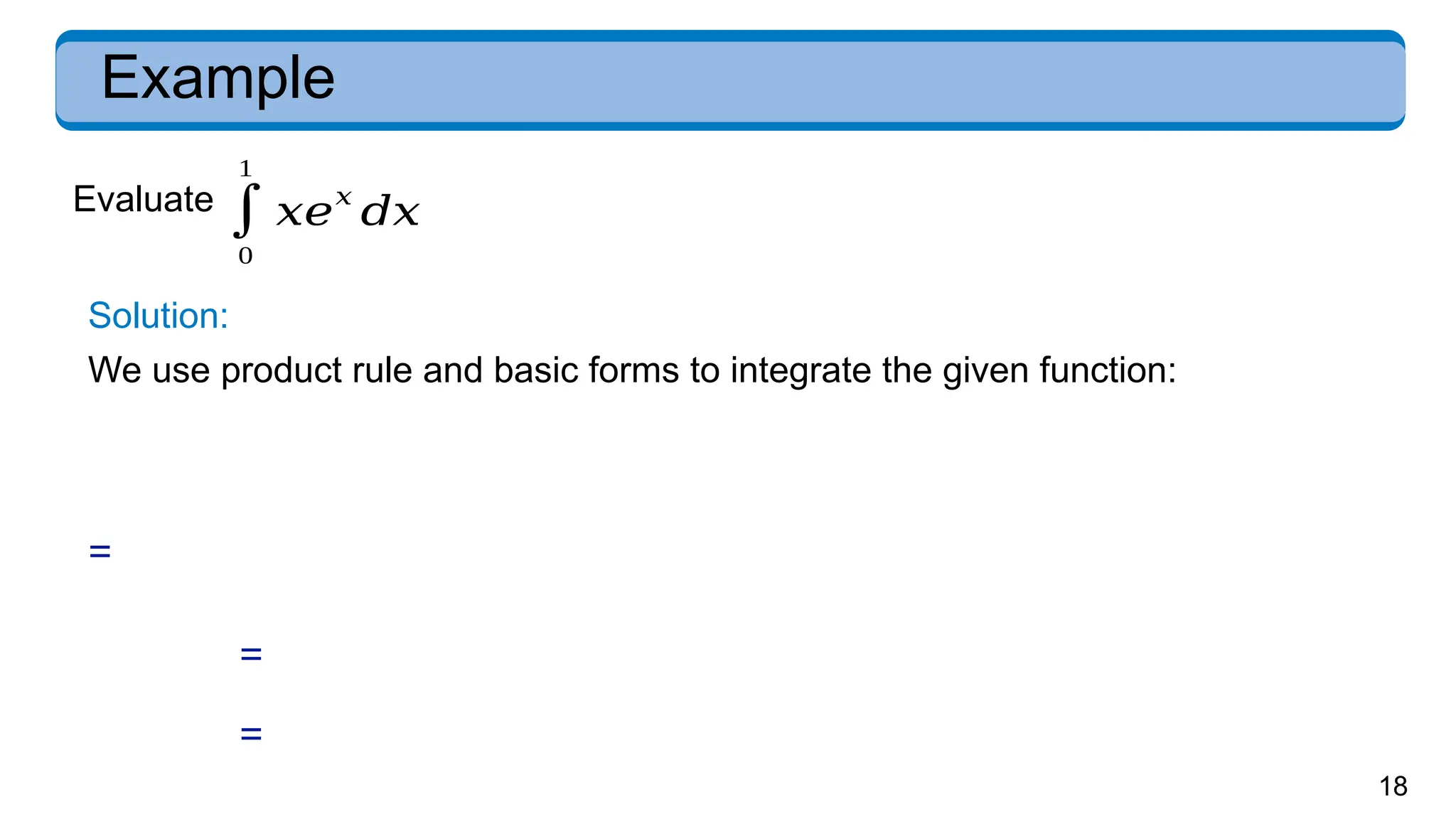
Example
Evaluate
∫
0
1
𝑥𝑒
𝑥
𝑑𝑥
Solution:
We use product rule and basic forms to integrate the given function:
=
=
=
19
Example
=
=
=
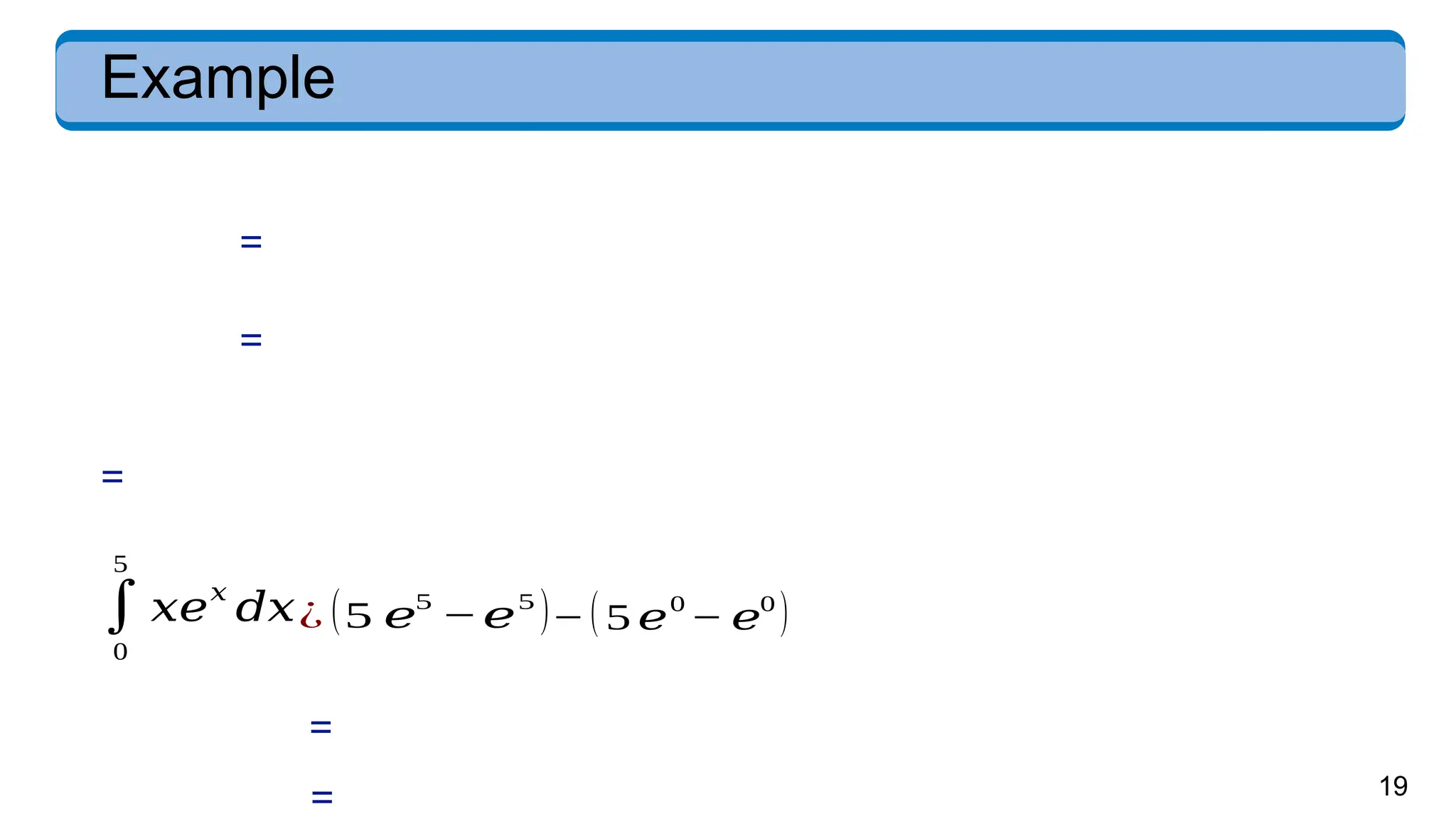
∫
0
5
𝑥𝑒
𝑥
𝑑𝑥¿ (5 𝑒
5
−𝑒
5
)−(5 𝑒0
− 𝑒0
)
=
=
20
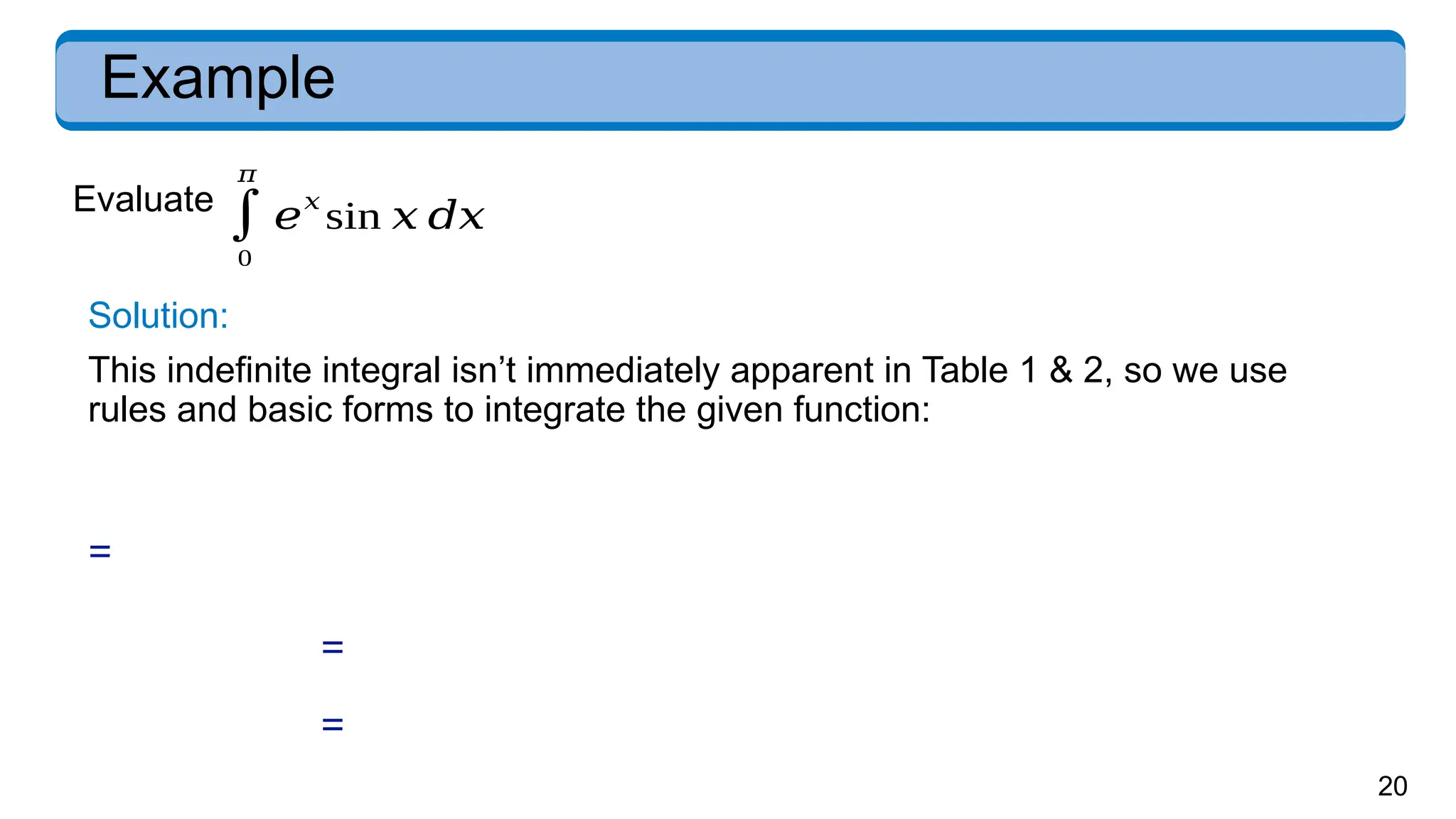
Example
Evaluate
∫
0
𝜋
𝑒
𝑥
sin 𝑥 𝑑𝑥
Solution:
This indefinite integral isn’t immediately apparent in Table 1 & 2, so we use
rules and basic forms to integrate the given function:
=
=
=
21
Example
=
=
=
=
+=
=
22
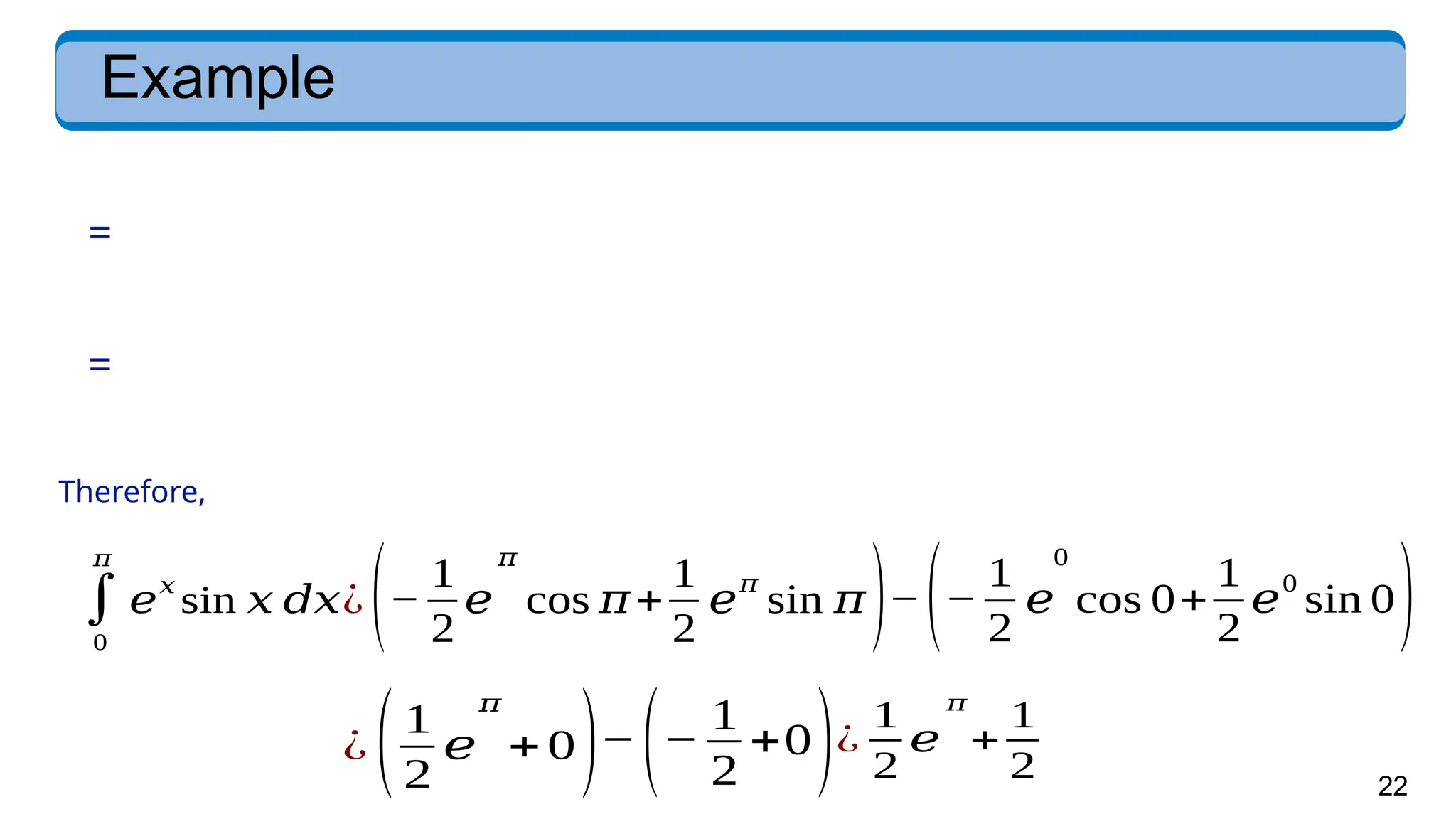
Example
=
=
Therefore,
∫
0
𝜋
𝑒
𝑥
sin 𝑥 𝑑𝑥¿(−
1
2
𝑒
𝜋
cos 𝜋+
1
2
𝑒
𝜋
sin 𝜋)−(−
1
2
𝑒
0
cos 0+
1
2
𝑒
0
sin 0)
¿ (1
2
𝑒
𝜋
+0)−(−
1
2
+0)¿
1
2
𝑒
𝜋
+
1
2
23
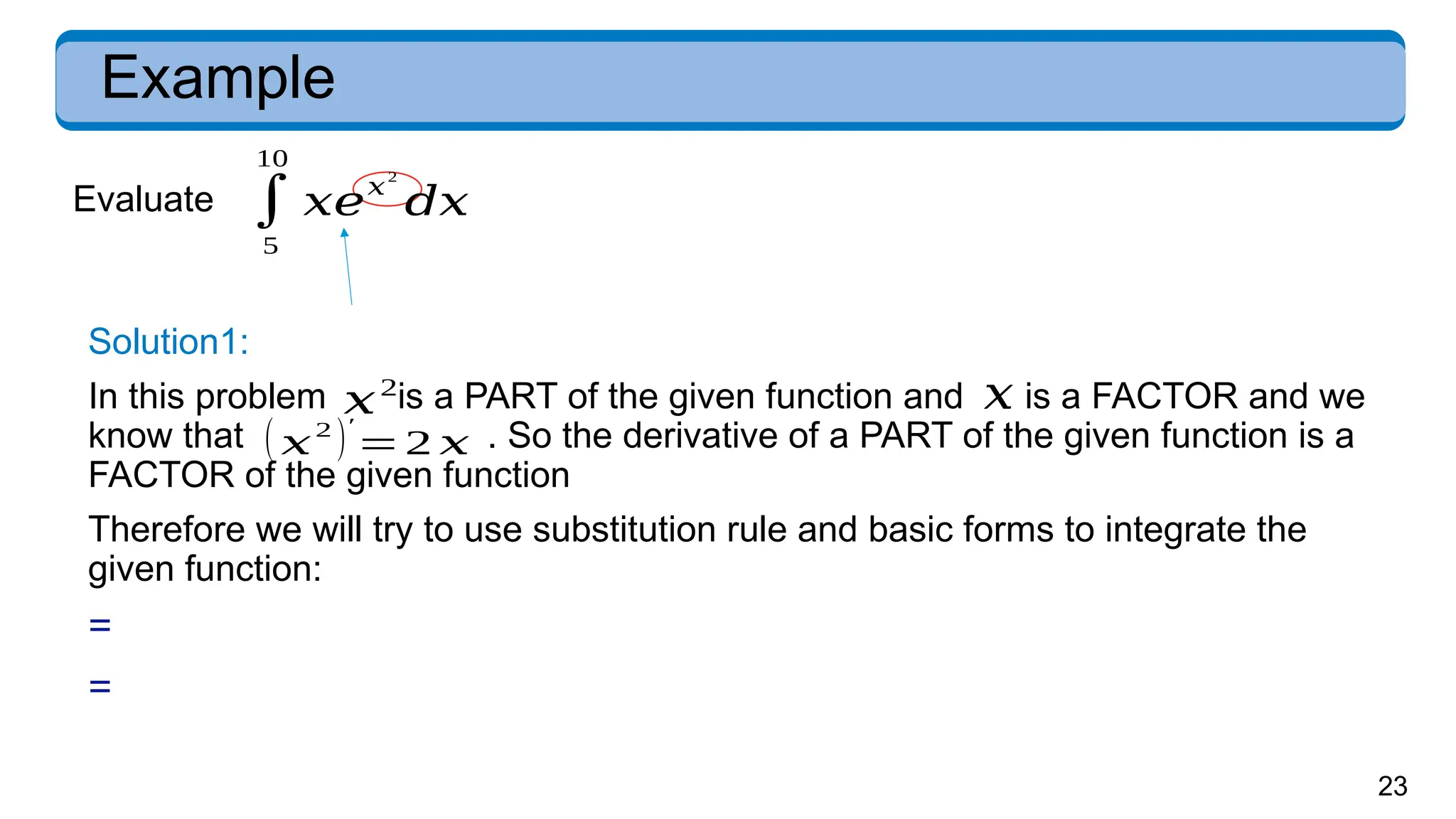
Example
Evaluate
Solution1:
In this problem is a PART of the given function and is a FACTOR and we
know that . So the derivative of a PART of the given function is a
FACTOR of the given function
Therefore we will try to use substitution rule and basic forms to integrate the
given function:
=
=
( 𝑥
2
)′
=2 𝑥
𝑥2
𝑥
∫
5
10
𝑥𝑒𝑥
2
𝑑𝑥
24
Example
=
=
=
=
=
25
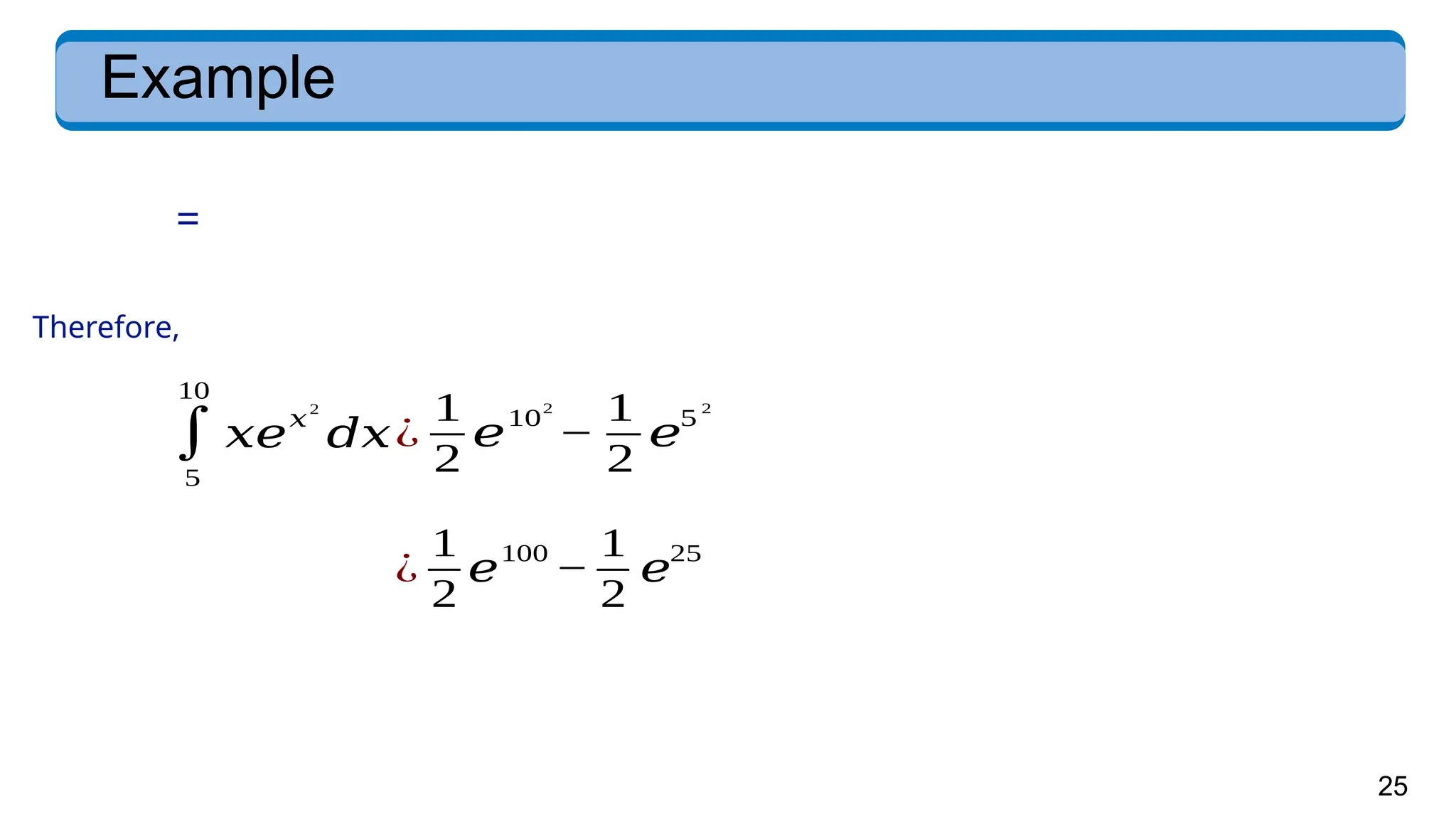
Example
=
∫
5
10
𝑥𝑒𝑥
2
𝑑𝑥
Therefore,
¿
1
2
𝑒
10
2
−
1
2
𝑒
5
2
¿
1
2
𝑒
100
−
1
2
𝑒
25
26
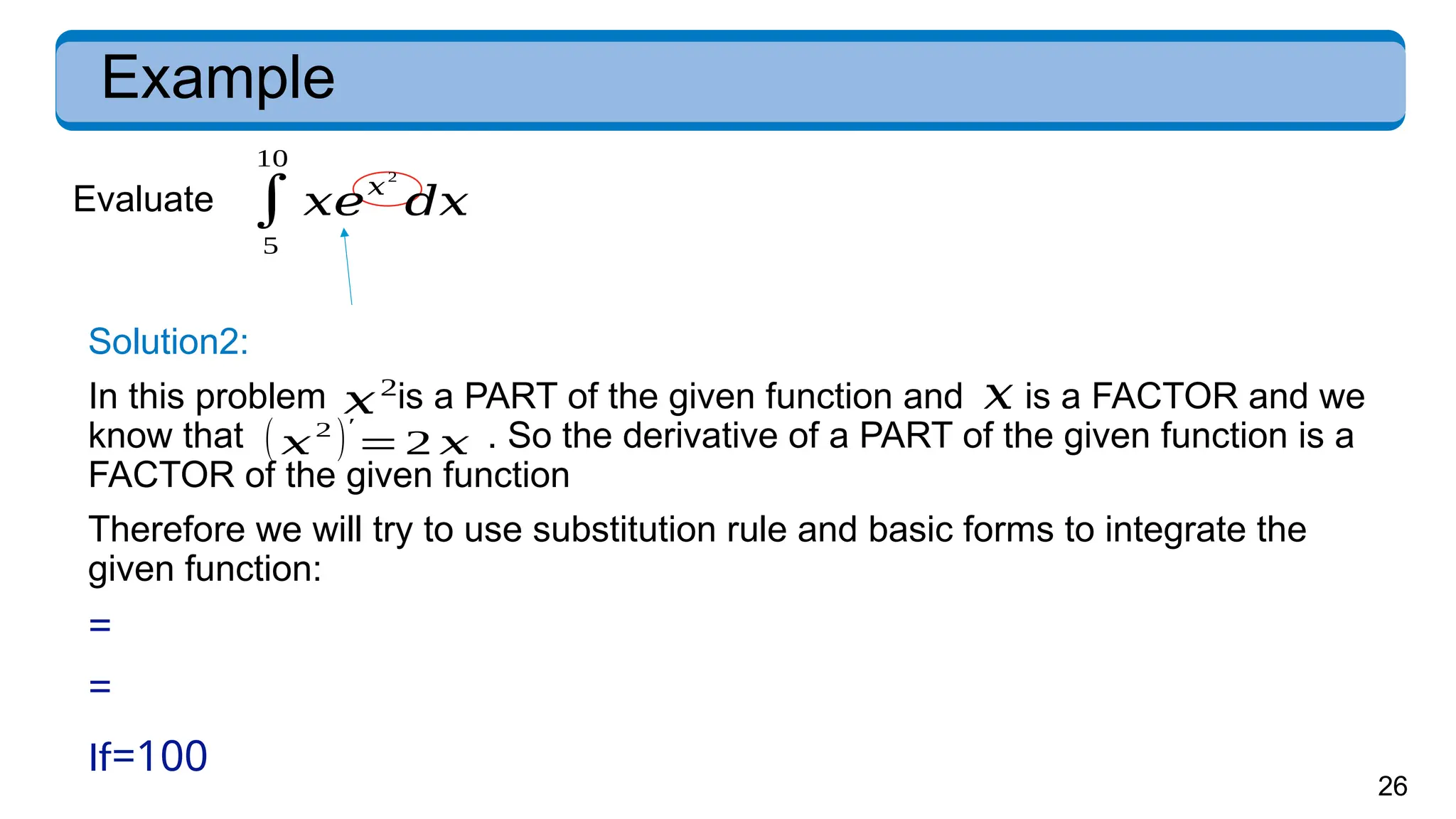
Example
Evaluate
Solution2:
In this problem is a PART of the given function and is a FACTOR and we
know that . So the derivative of a PART of the given function is a
FACTOR of the given function
Therefore we will try to use substitution rule and basic forms to integrate the
given function:
=
=
( 𝑥
2
)′
=2 𝑥
𝑥2
𝑥
∫
5
10
𝑥𝑒𝑥
2
𝑑𝑥
If=100
27
Example
=
=
=
=
=
28
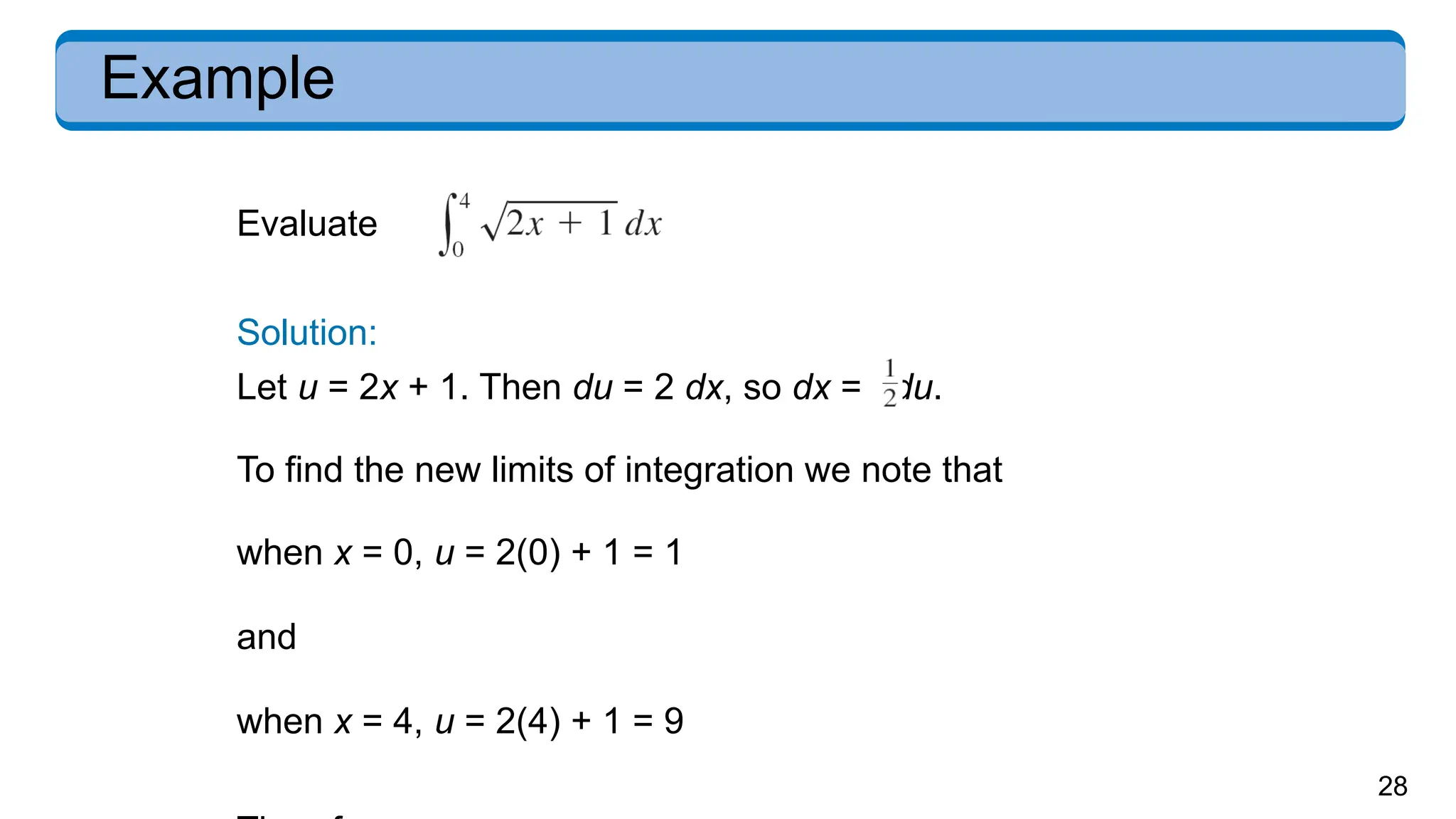
Example
Evaluate .
Solution:
Let u = 2x + 1. Then du = 2 dx, so dx = du.
To find the new limits of integration we note that
when x = 0, u = 2(0) + 1 = 1
and
when x = 4, u = 2(4) + 1 = 9
29
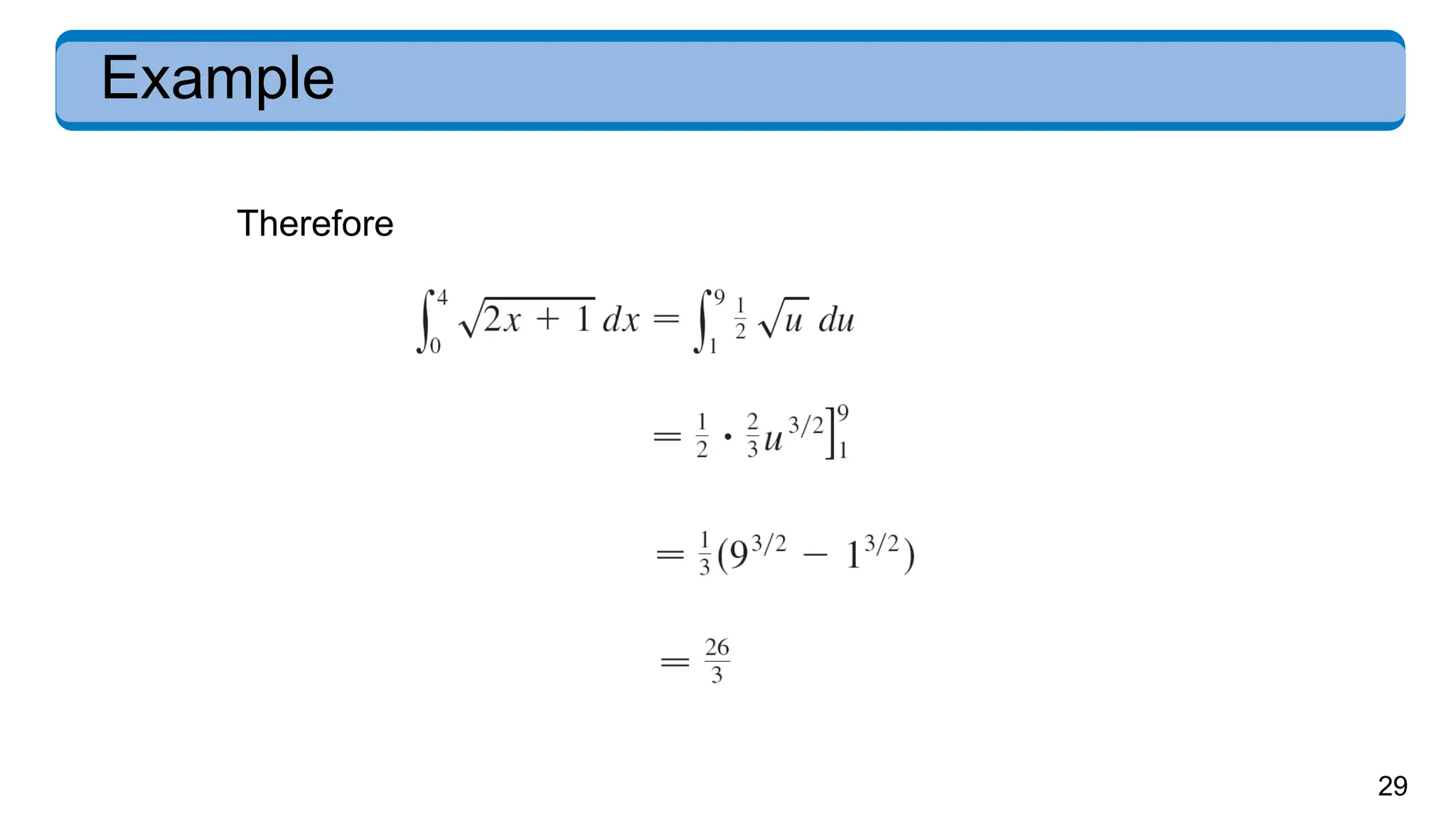
Example
Therefore
30
Example – Solution
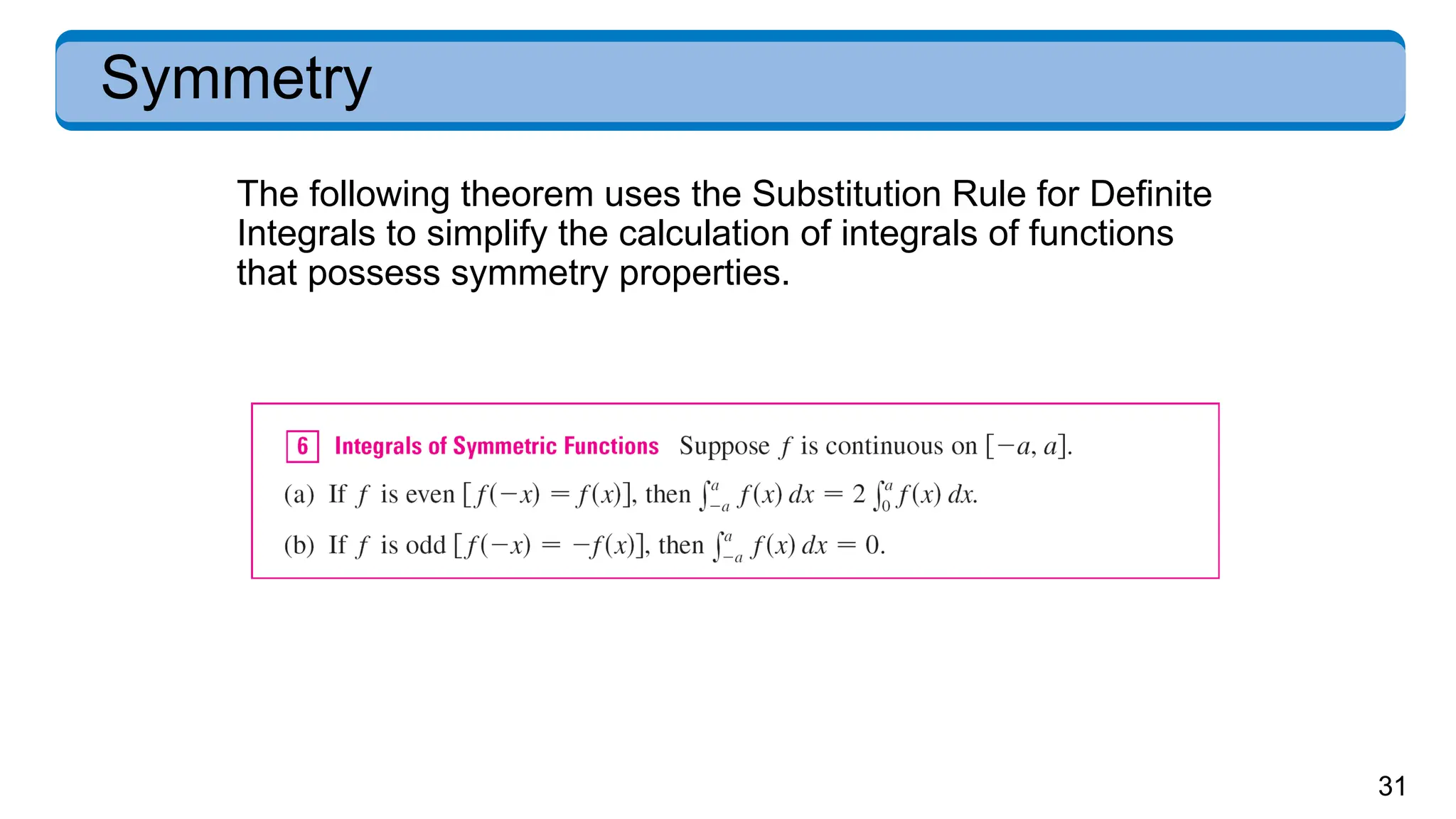
Observe that we do not return to the variable x after
integrating. We simply evaluate the expression in u between
the appropriate values of u.
cont’d
31
Symmetry
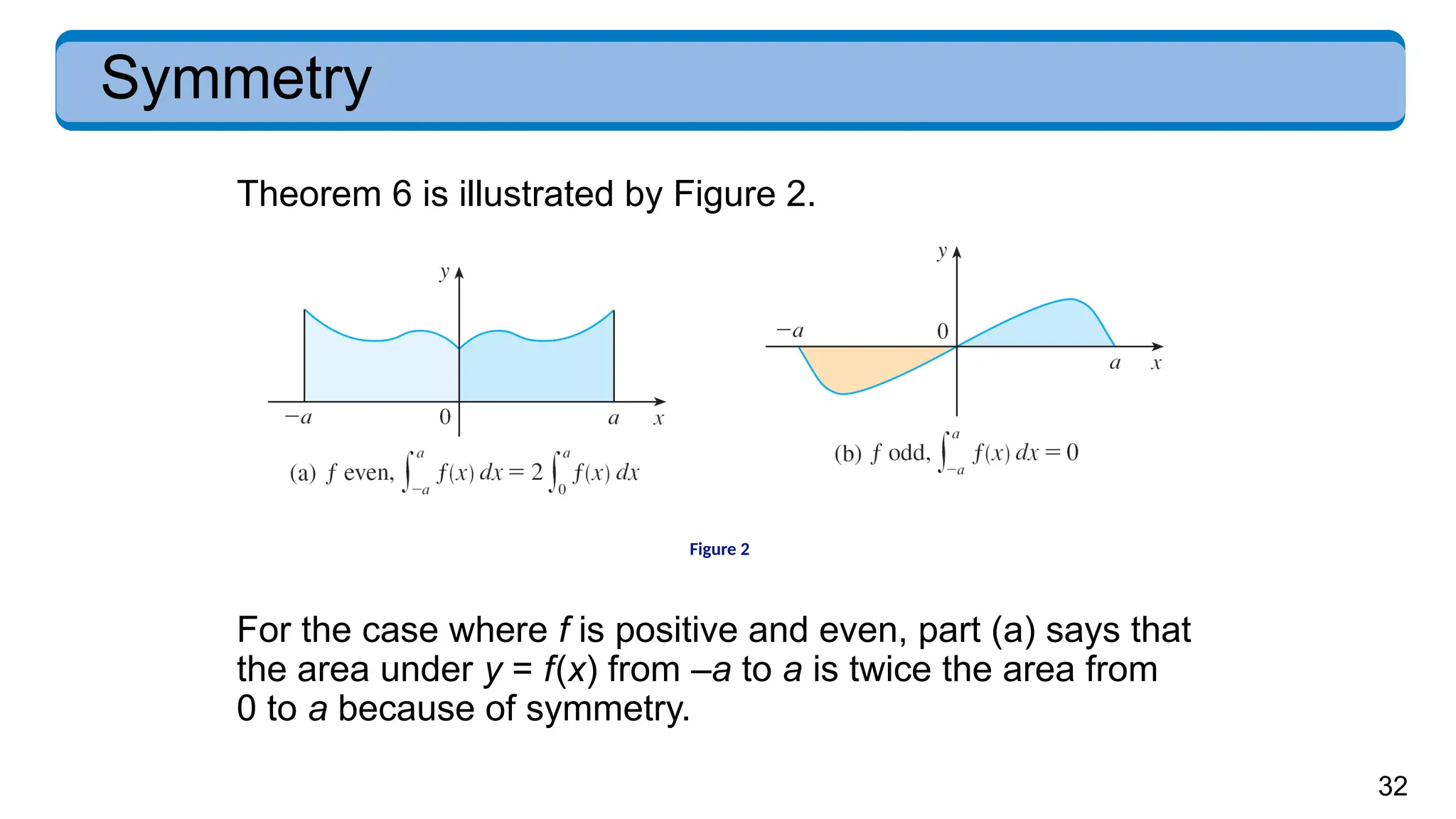
The following theorem uses the Substitution Rule for Definite
Integrals to simplify the calculation of integrals of functions
that possess symmetry properties.
32
Symmetry
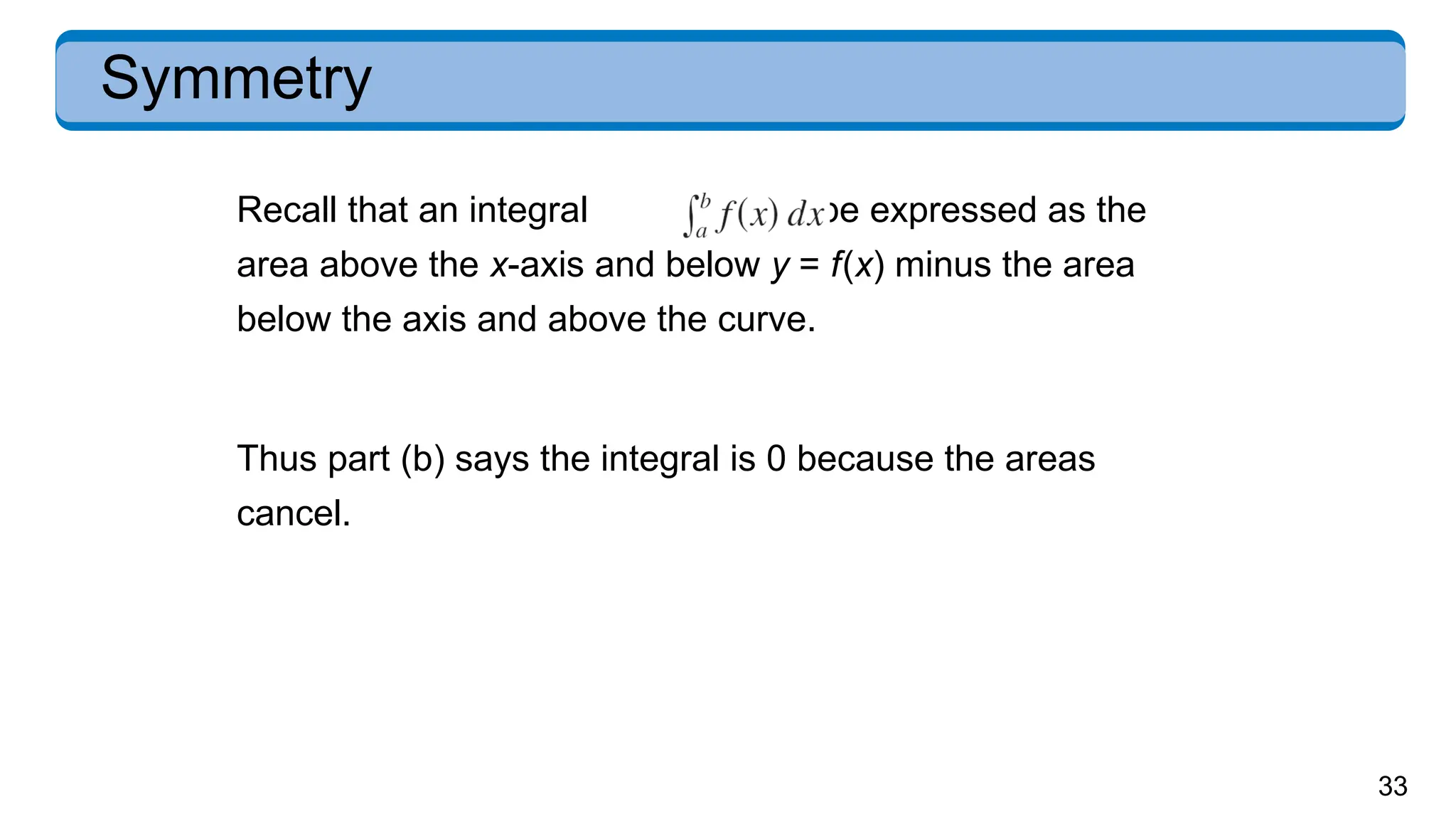
Theorem 6 is illustrated by Figure 2.
For the case where f is positive and even, part (a) says that
the area under y = f(x) from –a to a is twice the area from
0 to a because of symmetry.
Figure 2
33
Symmetry
Recall that an integral can be expressed as the
area above the x-axis and below y = f(x) minus the area
below the axis and above the curve.
Thus part (b) says the integral is 0 because the areas
cancel.
34
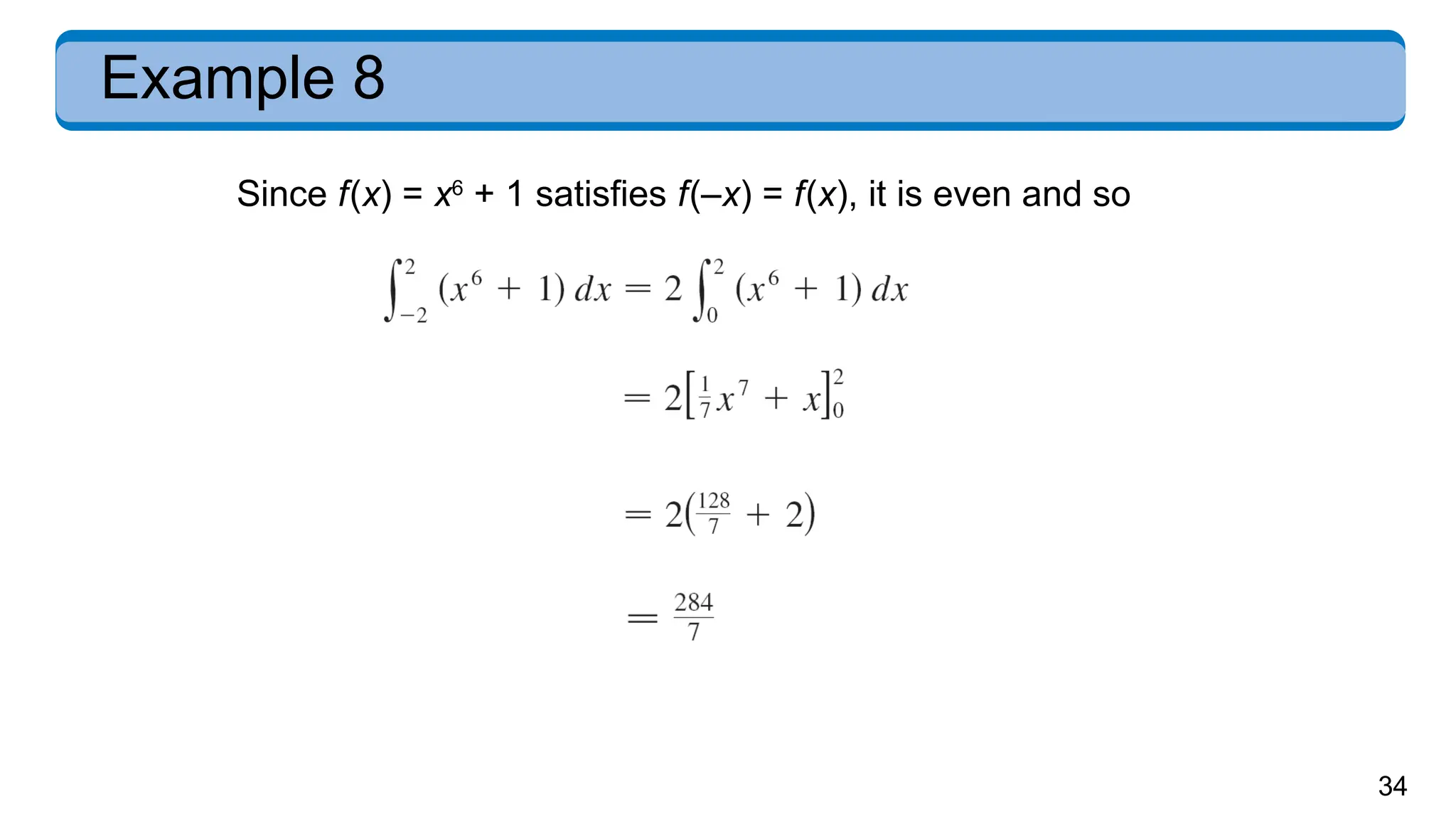
Example 8
Since f(x) = x6
+ 1 satisfies f(–x) = f(x), it is even and so
35
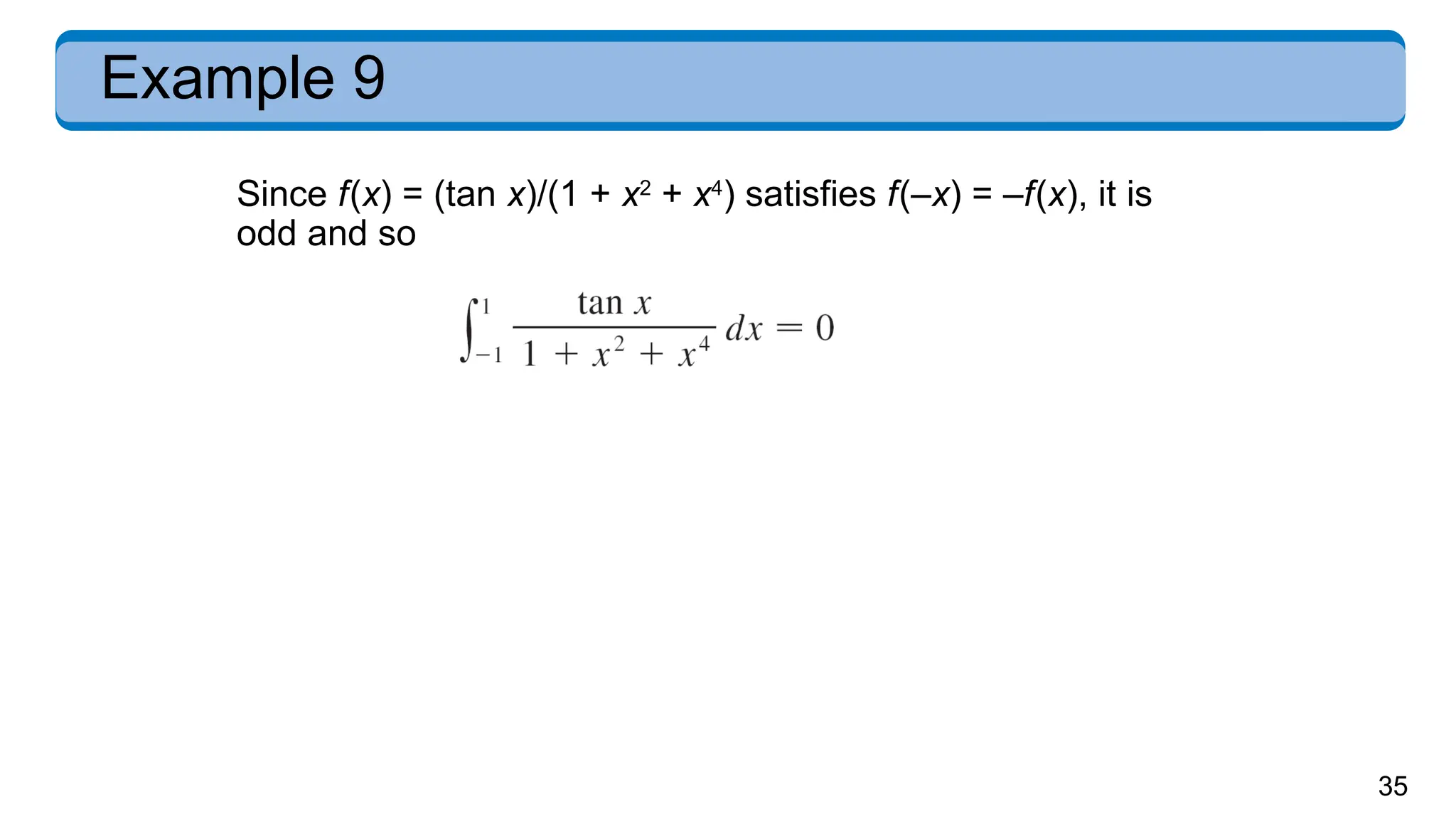
Example 9
Since f(x) = (tan x)/(1 + x2
+ x4
) satisfies f(–x) = –f(x), it is
odd and so

Lecture for Week4 integral calculus.pptx

  • 1.
    Integral Calculus Copyright ©Cengage Learning. All rights reserved.
  • 2.
    2 Definite Integral usingIndefinite Integral Topic
  • 3.
    3 Indefinite Integral        means f x dx F x F x f x     Definition of a Indefinite Integral: If F’(x)=f(x) then F(x) is called an antiderivative or an indefinite integral of f(x). In other words, if the derivative of F(x) is f(x) then an antiderivative or an indefinite integral of f(x) is F(x) Notation: Therefore,
  • 4.
    4 The Definite Integral:Definition Definition of a Definite Integral If f is a function defined for a ≤ x ≤ b, we divide the interval [a, b] into n subintervals of equal width  . b a x n    We let x0(= a), x1, x2, . . . , xn (= b) be the endpoints of these subintervals and we let x1*, x2*, . . . , xn* be any sample points in these subintervals, so xi* lies in the ith subinterval [xi −1, xi ]. Then the definite integral of f from a to b is provided that this limit exists and gives the same value for all possible choices of sample points. If it does exist, we say that f is integrable on [a, b]. We can also write the definite integral in the following way lim 𝑛→∞ ∑ 𝑖=1 𝑛 𝑓 (𝑥𝑖 ∗ )∆𝑥 lim 𝑛→ ∞ [ 𝑓 ( 𝑥1 ∗ ) ∆ 𝑥 + 𝑓 (𝑥2 ∗ ) ∆ 𝑥 + 𝑓 (𝑥3 ∗ ) ∆ 𝑥+⋯ ⋯+ 𝑓 (𝑥𝑛 ∗ )∆ 𝑥 ]
  • 5.
    5 The Definite Integral:Notation ∫ 𝑎 𝑏 𝑓 (𝑥)𝑑𝑥
  • 6.
    6 The Definite Integral:Note In the notation     , b a f x dx f x  is called the integrand and a and b are called the limits of integration; a is the lower limit and b is the upper limit. For now, the symbol dx has no meaning by itself;   b a f x dx  is all one symbol. The dx simply indicates that the independent variable is x. The procedure of calculating an integral is called integration. Note 1: The symbol  was introduced by Leibniz and is called an integral sign. It is an elongated S and was chosen because an integral is a limit of sums.
  • 7.
    7 The Definite Integral:Note Note 2: The definite integral   b a f x dx  is a number; it does not depend on x. In fact, we could use any letter in place of x without changing the value of the integral:       b b b a a a f x dx f t dt f r dr      Note 3: The sum   1 n i i f x x     that occurs in Definition 2 is called a Riemann sum after the German mathematician Bernhard Riemann (1826–1866).
  • 8.
    8 The Definite Integral:Geometric Interpretation ∫ 𝑎 𝑏 𝑓 (𝑥)𝑑𝑥 is the NET area bounded by 𝑦= 𝑓 ( 𝑥) , 𝑦=0, 𝑥=𝑎 ,𝑥=𝑏 𝑦= 𝑓 ( 𝑥) , 𝑥=𝑎 𝑥=𝑏
  • 9.
    9 The Fundamental Theoremof Calculus The first part of the Fundamental Theorem of Calculus is the following. Using Leibniz notation for derivatives, we can write this theorem as when f is continuous.
  • 10.
    10 The Fundamental Theoremof Calculus The second part of the Fundamental Theorem of Calculus, which follows easily from the first part, provides us with a much simpler method for the evaluation of integrals.
  • 11.
    11 The Fundamental Theoremof Calculus: Part 2 Conditions: • Interval [a,b] is a closed interval • f is continuous on the closed interval [a,b] Conclusion: where F(x) is an antiderivative of f(x)
  • 12.
    12 Example Evaluate ∫ 0 1 (4 𝑥 3 −7 𝑒 𝑥 +2sin 𝑥 )𝑑𝑥 Solution: We use rules and basic forms to evaluate the indefinite integral = = =
  • 13.
    13 Example = ∫ 0 1 (4 𝑥 3 −7 𝑒 𝑥 +2sin 𝑥 )𝑑𝑥 - ¿1−7𝑒 −2cos1+𝐶− 0+7+2−𝐶 ¿10−7 𝑒−2cos 1 ¿ 𝑥 4 −7𝑒 𝑥 −2cos 𝑥+𝐶 ¿1 0
  • 14.
    14 Example: Geometric interpretation Areabounded by 𝑦=4 𝑥3 −7 𝑒𝑥 +2sin 𝑥 𝑦=4 𝑥3 −7 𝑒𝑥 +2sin 𝑥 , 𝑦=0 , 𝑥=0 and 𝑥=0 𝑥=1 𝑦=0
  • 15.
    15 Example Evaluate Solution: We use trigonometricidentities to rewrite the function before integrating: ∫ cos𝜃 sin2 𝜃 𝑑 𝜃=∫( 1 sin 𝜃)(cos𝜃 sin𝜃 )𝑑 𝜃 ¿∫csc𝜃cot𝜃𝑑𝜃 ¿− csc 𝜃+𝐶 ∫ 𝜋/ 4 𝜋 /2 cos 𝜃 sin2 𝜃 𝑑 𝜃
  • 16.
    16 Example Since, ∫ 𝜋/ 4 𝜋 /2 cos𝜃 sin 2 𝜃 𝑑 𝜃=[−csc 𝜃] 𝜃=𝜋 /2 𝜃=𝜋 /4 Therefore, ¿ − csc (𝜋 /2) −(−csc ( 𝜋 /4 )) ¿−1+√2
  • 17.
    17 Example 𝑦 = cos 𝜃 sin 2 𝜃 𝑦=0 𝜃=𝜋 / 4 𝜃=𝜋 /2
  • 18.
    18 Example Evaluate ∫ 0 1 𝑥𝑒 𝑥 𝑑𝑥 Solution: We use productrule and basic forms to integrate the given function: = = =
  • 19.
  • 20.
    20 Example Evaluate ∫ 0 𝜋 𝑒 𝑥 sin 𝑥 𝑑𝑥 Solution: Thisindefinite integral isn’t immediately apparent in Table 1 & 2, so we use rules and basic forms to integrate the given function: = = =
  • 21.
  • 22.
    22 Example = = Therefore, ∫ 0 𝜋 𝑒 𝑥 sin 𝑥 𝑑𝑥¿(− 1 2 𝑒 𝜋 cos𝜋+ 1 2 𝑒 𝜋 sin 𝜋)−(− 1 2 𝑒 0 cos 0+ 1 2 𝑒 0 sin 0) ¿ (1 2 𝑒 𝜋 +0)−(− 1 2 +0)¿ 1 2 𝑒 𝜋 + 1 2
  • 23.
    23 Example Evaluate Solution1: In this problemis a PART of the given function and is a FACTOR and we know that . So the derivative of a PART of the given function is a FACTOR of the given function Therefore we will try to use substitution rule and basic forms to integrate the given function: = = ( 𝑥 2 )′ =2 𝑥 𝑥2 𝑥 ∫ 5 10 𝑥𝑒𝑥 2 𝑑𝑥
  • 24.
  • 25.
  • 26.
    26 Example Evaluate Solution2: In this problemis a PART of the given function and is a FACTOR and we know that . So the derivative of a PART of the given function is a FACTOR of the given function Therefore we will try to use substitution rule and basic forms to integrate the given function: = = ( 𝑥 2 )′ =2 𝑥 𝑥2 𝑥 ∫ 5 10 𝑥𝑒𝑥 2 𝑑𝑥 If=100
  • 27.
  • 28.
    28 Example Evaluate . Solution: Let u= 2x + 1. Then du = 2 dx, so dx = du. To find the new limits of integration we note that when x = 0, u = 2(0) + 1 = 1 and when x = 4, u = 2(4) + 1 = 9
  • 29.
  • 30.
    30 Example – Solution Observethat we do not return to the variable x after integrating. We simply evaluate the expression in u between the appropriate values of u. cont’d
  • 31.
    31 Symmetry The following theoremuses the Substitution Rule for Definite Integrals to simplify the calculation of integrals of functions that possess symmetry properties.
  • 32.
    32 Symmetry Theorem 6 isillustrated by Figure 2. For the case where f is positive and even, part (a) says that the area under y = f(x) from –a to a is twice the area from 0 to a because of symmetry. Figure 2
  • 33.
    33 Symmetry Recall that anintegral can be expressed as the area above the x-axis and below y = f(x) minus the area below the axis and above the curve. Thus part (b) says the integral is 0 because the areas cancel.
  • 34.
    34 Example 8 Since f(x)= x6 + 1 satisfies f(–x) = f(x), it is even and so
  • 35.
    35 Example 9 Since f(x)= (tan x)/(1 + x2 + x4 ) satisfies f(–x) = –f(x), it is odd and so