http://www.slideshare.net/mumphrey/writing-conclusions-presentation
1.Make clear the importance of the main idea
2.Give the essay a sense of completeness
3.Leave a final impression on the reader
A conclusion should:
conclusion
You can answer the question, “So
what?”
Show the reader why this essay was
meaningful or useful.
conclusion
Go for it!
State your main point as forcefully and
clearly as you can, preferable with concrete
images.
Don’t repeat what you’ve already said.
They have read it. Show them what it all led
to.
conclusion
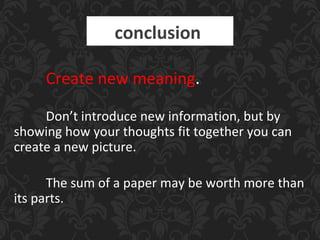
Create new meaning.
Don’t introduce new information, but by
showing how your thoughts fit together you can
create a new picture.
The sum of a paper may be worth more than
its parts.
Echo the Introduction
INTRODUCTION: From the parking lot, I could see the towers of the castle of the
Magic Kingdom standing stately against the blue sky. To the right, the tall peak of
The Matterhorn rose even higher. From the left, I could hear the jungle sounds of
Adventureland. As I entered the gate, Main Street stretched before me with its
quaint shops evoking an old-fashioned small town so charming it could never have
existed. I was entranced. Disneyland may have been built for children, but it brings
out the child in adults.
CONCLUSION: I thought I would spend a few hours at Disneyland, but here I was at
1:00 A.M., closing time, leaving the front gates with the now dark towers of the Magic
Kingdom behind me. I could see tired children, toddling along and struggling to keep
their eyes open as best they could. Others slept in their parents' arms as we waited for
the parking lot tram that would take us to our cars. My forty-year-old feet ached, and I
felt a bit sad to think that in a couple of days I would be leaving California, my vacation
over, to go back to my desk. But then I smiled to think that for at least a day I felt ten
years old again.
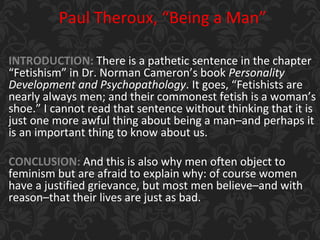
Paul Theroux, “Being a Man”
INTRODUCTION: There is a pathetic sentence in the chapter
“Fetishism” in Dr. Norman Cameron’s book Personality
Development and Psychopathology. It goes, “Fetishists are
nearly always men; and their commonest fetish is a woman’s
shoe.” I cannot read that sentence without thinking that it is
just one more awful thing about being a man–and perhaps it
is an important thing to know about us.
CONCLUSION: And this is also why men often object to
feminism but are afraid to explain why: of course women
have a justified grievance, but most men believe–and with
reason–that their lives are just as bad.
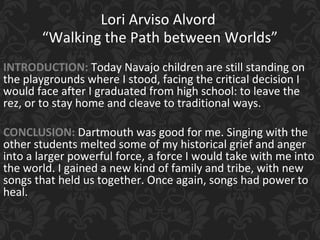
Lori Arviso Alvord
“Walking the Path between Worlds”
INTRODUCTION: Today Navajo children are still standing on
the playgrounds where I stood, facing the critical decision I
would face after I graduated from high school: to leave the
rez, or to stay home and cleave to traditional ways.
CONCLUSION: Dartmouth was good for me. Singing with the
other students melted some of my historical grief and anger
into a larger powerful force, a force I would take with me into
the world. I gained a new kind of family and tribe, with new
songs that held us together. Once again, songs had power to
heal.
Francine Prose
“I Know Why the Caged Bird Cannot Read”
INTRODUCTION: Like most parents who have, against all odds,
preserved a lively and still evolving passion for good books, I find
myself, each September, increasingly appalled by the dismal lists
of texts that my sons are doomed to waste a school year reading.
What I get as compensation is a measure of insight into why our
society has come to admire Montel Williams and Ricki Lake so
much more than Dante and Homer.
CONCLUSION: What results from these educational methods is a
mode of thinking (or, more accurately, of not thinking) that equips
our kids for the future: Future McDonald’s employees. Future
corporate board members. Future special prosecutors. Future
makers of 100-best-books lists who fondly recall what they first
read in high school–and who may not have read anything since.
And so the roster of literary masterpieces we pass along to future
generations will continue its downward shift, and those
lightweight, mediocre high school favorites will continue to rise,
unburdened by gravity, to the top of the list.
Strategies
Challenge the reader
Though serving on a jury is not only a civic
responsibility but also an interesting experience,
many people still view jury duty as a chore that
interrupts their jobs and the routine of their daily
lives. However, juries are part of America's attempt
to be a free and just society. Thus, jury duty
challenges us to be interested and responsible
citizens.
Strategies
LOOK TO THE FUTURE
Without well-qualified teachers, schools are
little more than buildings and equipment. If
higher-paying careers continue to attract the best
and the brightest students, there will not only be a
shortage of teachers, but the teachers available
may not have the best qualifications. Our youth
will suffer. And when youth suffers, the future
suffers.
Strategies
POSE A QUESTION
Campaign advertisements should help us
understand the candidate's qualifications and
positions on the issues. Instead, most tell us what a
boob or knave the opposing candidate is, or they
present general images of the candidate as a family
person or God-fearing American. Do such
advertisements contribute to creating an informed
electorate or a people who choose political leaders
the same way they choose soft drinks and soap?
THE END

Writing conclusions

  • 1.
  • 2.
    1.Make clear theimportance of the main idea 2.Give the essay a sense of completeness 3.Leave a final impression on the reader A conclusion should:
  • 3.
    conclusion You can answerthe question, “So what?” Show the reader why this essay was meaningful or useful.
  • 4.
    conclusion Go for it! Stateyour main point as forcefully and clearly as you can, preferable with concrete images. Don’t repeat what you’ve already said. They have read it. Show them what it all led to.
  • 5.
    conclusion Create new meaning. Don’tintroduce new information, but by showing how your thoughts fit together you can create a new picture. The sum of a paper may be worth more than its parts.
  • 7.
    Echo the Introduction INTRODUCTION:From the parking lot, I could see the towers of the castle of the Magic Kingdom standing stately against the blue sky. To the right, the tall peak of The Matterhorn rose even higher. From the left, I could hear the jungle sounds of Adventureland. As I entered the gate, Main Street stretched before me with its quaint shops evoking an old-fashioned small town so charming it could never have existed. I was entranced. Disneyland may have been built for children, but it brings out the child in adults. CONCLUSION: I thought I would spend a few hours at Disneyland, but here I was at 1:00 A.M., closing time, leaving the front gates with the now dark towers of the Magic Kingdom behind me. I could see tired children, toddling along and struggling to keep their eyes open as best they could. Others slept in their parents' arms as we waited for the parking lot tram that would take us to our cars. My forty-year-old feet ached, and I felt a bit sad to think that in a couple of days I would be leaving California, my vacation over, to go back to my desk. But then I smiled to think that for at least a day I felt ten years old again.
  • 8.
    Paul Theroux, “Beinga Man” INTRODUCTION: There is a pathetic sentence in the chapter “Fetishism” in Dr. Norman Cameron’s book Personality Development and Psychopathology. It goes, “Fetishists are nearly always men; and their commonest fetish is a woman’s shoe.” I cannot read that sentence without thinking that it is just one more awful thing about being a man–and perhaps it is an important thing to know about us. CONCLUSION: And this is also why men often object to feminism but are afraid to explain why: of course women have a justified grievance, but most men believe–and with reason–that their lives are just as bad.
  • 9.
    Lori Arviso Alvord “Walkingthe Path between Worlds” INTRODUCTION: Today Navajo children are still standing on the playgrounds where I stood, facing the critical decision I would face after I graduated from high school: to leave the rez, or to stay home and cleave to traditional ways. CONCLUSION: Dartmouth was good for me. Singing with the other students melted some of my historical grief and anger into a larger powerful force, a force I would take with me into the world. I gained a new kind of family and tribe, with new songs that held us together. Once again, songs had power to heal.
  • 10.
    Francine Prose “I KnowWhy the Caged Bird Cannot Read” INTRODUCTION: Like most parents who have, against all odds, preserved a lively and still evolving passion for good books, I find myself, each September, increasingly appalled by the dismal lists of texts that my sons are doomed to waste a school year reading. What I get as compensation is a measure of insight into why our society has come to admire Montel Williams and Ricki Lake so much more than Dante and Homer. CONCLUSION: What results from these educational methods is a mode of thinking (or, more accurately, of not thinking) that equips our kids for the future: Future McDonald’s employees. Future corporate board members. Future special prosecutors. Future makers of 100-best-books lists who fondly recall what they first read in high school–and who may not have read anything since. And so the roster of literary masterpieces we pass along to future generations will continue its downward shift, and those lightweight, mediocre high school favorites will continue to rise, unburdened by gravity, to the top of the list.
  • 11.
    Strategies Challenge the reader Thoughserving on a jury is not only a civic responsibility but also an interesting experience, many people still view jury duty as a chore that interrupts their jobs and the routine of their daily lives. However, juries are part of America's attempt to be a free and just society. Thus, jury duty challenges us to be interested and responsible citizens.
  • 12.
    Strategies LOOK TO THEFUTURE Without well-qualified teachers, schools are little more than buildings and equipment. If higher-paying careers continue to attract the best and the brightest students, there will not only be a shortage of teachers, but the teachers available may not have the best qualifications. Our youth will suffer. And when youth suffers, the future suffers.
  • 13.
    Strategies POSE A QUESTION Campaignadvertisements should help us understand the candidate's qualifications and positions on the issues. Instead, most tell us what a boob or knave the opposing candidate is, or they present general images of the candidate as a family person or God-fearing American. Do such advertisements contribute to creating an informed electorate or a people who choose political leaders the same way they choose soft drinks and soap?
  • 14.