ZERO
   CONDITIONALS
      FIRST
   CONDITIONALS
      & TIME CLAUSES
Adapted from a presentation by Fernanda González
CONDITIONAL SENTENCES
• Conditional Sentences are also known as
  Conditional Clauses or If Clauses.

• They are used to express that the
  action in the main clause
  (without if) can only take place if a
  certain condition (in the clause
  with if) is fulfilled.
CONDITIONAL SENTENCES
• Most linguists consider three types of
  Conditional Sentences, but some of
  them add one more type: zero
  conditionals.
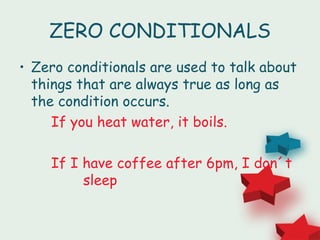
ZERO CONDITIONALS
• Zero conditionals are used to talk about
  things that are always true as long as
  the condition occurs.
     If you heat water, it boils.

    If I have coffee after 6pm, I don´t
         sleep
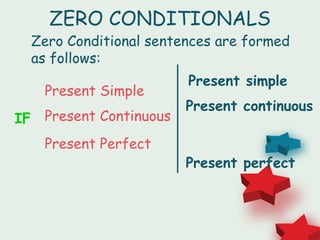
ZERO CONDITIONALS
  Zero Conditional sentences are formed
  as follows:
                        Present simple
    Present Simple
                        Present continuous
IF Present Continuous
    Present Perfect
                        Present perfect
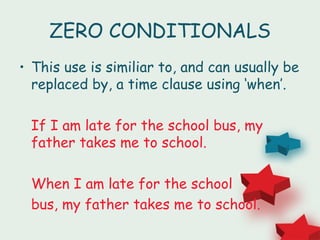
ZERO CONDITIONALS
• This use is similiar to, and can usually be
  replaced by, a time clause using ‘when’.

 If I am late for the school bus, my
 father takes me to school.

 When I am late for the school
 bus, my father takes me to school.
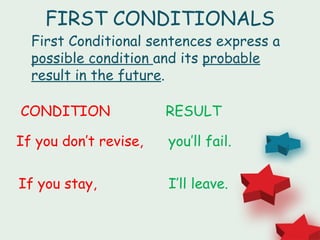
FIRST CONDITIONALS
  First Conditional sentences express a
  possible condition and its probable
  result in the future.

CONDITION              RESULT

If you don’t revise,   you’ll fail.

If you stay,           I’ll leave.
FIRST CONDITIONALS
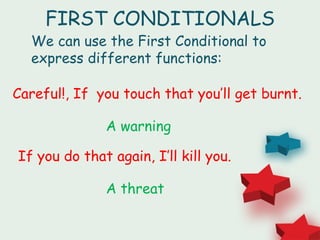
  We can use the First Conditional to
  express different functions:

Careful!, If you touch that you’ll get burnt.

              A warning

If you do that again, I’ll kill you.

              A threat
FIRST CONDITIONALS
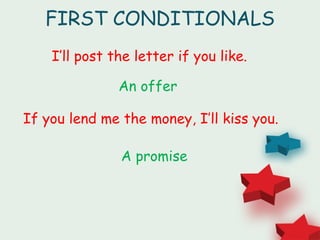
    I’ll post the letter if you like.

               An offer

If you lend me the money, I’ll kiss you.

               A promise
FIRST CONDITIONALS
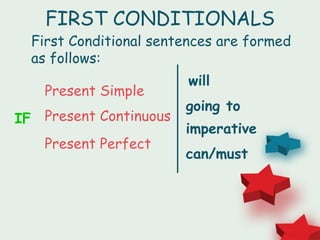
  First Conditional sentences are formed
  as follows:
                        will
    Present Simple
                        going to
IF Present Continuous
                        imperative
    Present Perfect
                        can/must
FIRST CONDITIONALS
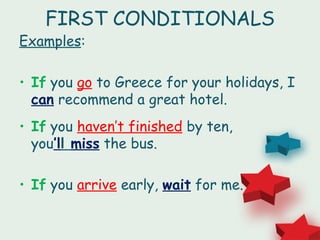
Examples:

• If you go to Greece for your holidays, I
  can recommend a great hotel.
• If you haven’t finished by ten,
  you’ll miss the bus.

• If you arrive early, wait for me.
FIRST CONDITIONALS
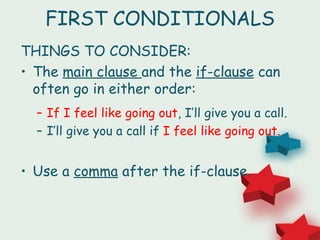
THINGS TO CONSIDER:
• The main clause and the if-clause can
  often go in either order:
  – If I feel like going out, I’ll give you a call.
  – I’ll give you a call if I feel like going out.


• Use a comma after the if-clause.
FIRST CONDITIONALS
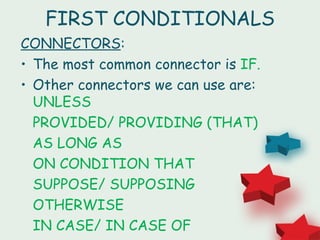
CONNECTORS:
• The most common connector is IF.
• Other connectors we can use are:
  UNLESS
  PROVIDED/ PROVIDING (THAT)
  AS LONG AS
  ON CONDITION THAT
  SUPPOSE/ SUPPOSING
  OTHERWISE
  IN CASE/ IN CASE OF
FIRST CONDITIONALS
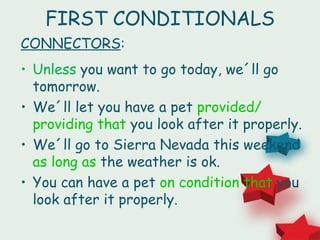
CONNECTORS:
• Unless you want to go today, we´ll go
  tomorrow.
• We´ll let you have a pet provided/
  providing that you look after it properly.
• We´ll go to Sierra Nevada this weekend
  as long as the weather is ok.
• You can have a pet on condition that you
  look after it properly.
FIRST CONDITIONALS
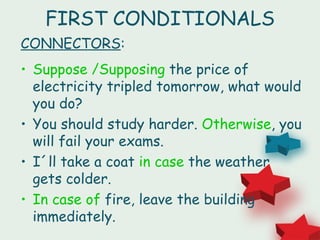
CONNECTORS:
• Suppose /Supposing the price of
  electricity tripled tomorrow, what would
  you do?
• You should study harder. Otherwise, you
  will fail your exams.
• I´ll take a coat in case the weather
  gets colder.
• In case of fire, leave the building
  immediately.
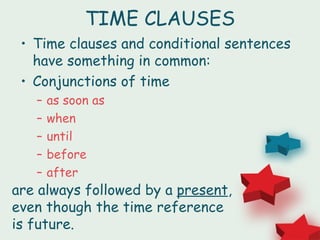
TIME CLAUSES
 • Time clauses and conditional sentences
   have something in common:
 • Conjunctions of time
   –   as soon as
   –   when
   –   until
   –   before
   –   after
are always followed by a present,
even though the time reference
is future.
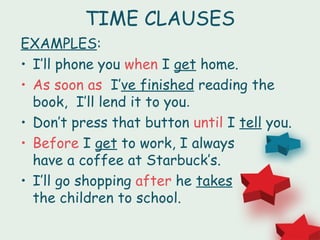
TIME CLAUSES
EXAMPLES:
• I’ll phone you when I get home.
• As soon as I’ve finished reading the
  book, I’ll lend it to you.
• Don’t press that button until I tell you.
• Before I get to work, I always
  have a coffee at Starbuck’s.
• I’ll go shopping after he takes
  the children to school.
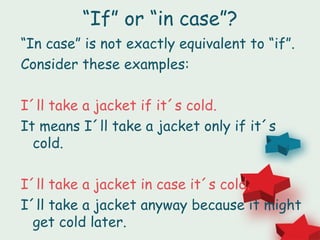
“If” or “in case”?
“In case” is not exactly equivalent to “if”.
Consider these examples:

I´ll take a jacket if it´s cold.
It means I´ll take a jacket only if it´s
  cold.

I´ll take a jacket in case it´s cold.
I´ll take a jacket anyway because it might
  get cold later.
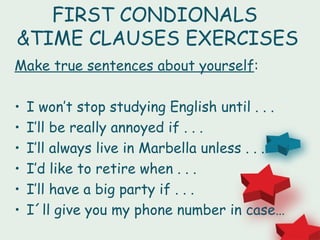
FIRST CONDIONALS
&TIME CLAUSES EXERCISES
Make true sentences about yourself:

•   I won’t stop studying English until . . .
•   I’ll be really annoyed if . . .
•   I’ll always live in Marbella unless . . .
•   I’d like to retire when . . .
•   I’ll have a big party if . . .
•   I´ll give you my phone number in case…

Zero conditionals, first conditionals and time clauses

  • 1.
    ZERO CONDITIONALS FIRST CONDITIONALS & TIME CLAUSES Adapted from a presentation by Fernanda González
  • 2.
    CONDITIONAL SENTENCES • ConditionalSentences are also known as Conditional Clauses or If Clauses. • They are used to express that the action in the main clause (without if) can only take place if a certain condition (in the clause with if) is fulfilled.
  • 3.
    CONDITIONAL SENTENCES • Mostlinguists consider three types of Conditional Sentences, but some of them add one more type: zero conditionals.
  • 4.
    ZERO CONDITIONALS • Zeroconditionals are used to talk about things that are always true as long as the condition occurs. If you heat water, it boils. If I have coffee after 6pm, I don´t sleep
  • 5.
    ZERO CONDITIONALS Zero Conditional sentences are formed as follows: Present simple Present Simple Present continuous IF Present Continuous Present Perfect Present perfect
  • 6.
    ZERO CONDITIONALS • Thisuse is similiar to, and can usually be replaced by, a time clause using ‘when’. If I am late for the school bus, my father takes me to school. When I am late for the school bus, my father takes me to school.
  • 7.
    FIRST CONDITIONALS First Conditional sentences express a possible condition and its probable result in the future. CONDITION RESULT If you don’t revise, you’ll fail. If you stay, I’ll leave.
  • 8.
    FIRST CONDITIONALS We can use the First Conditional to express different functions: Careful!, If you touch that you’ll get burnt. A warning If you do that again, I’ll kill you. A threat
  • 9.
    FIRST CONDITIONALS I’ll post the letter if you like. An offer If you lend me the money, I’ll kiss you. A promise
  • 10.
    FIRST CONDITIONALS First Conditional sentences are formed as follows: will Present Simple going to IF Present Continuous imperative Present Perfect can/must
  • 11.
    FIRST CONDITIONALS Examples: • Ifyou go to Greece for your holidays, I can recommend a great hotel. • If you haven’t finished by ten, you’ll miss the bus. • If you arrive early, wait for me.
  • 12.
    FIRST CONDITIONALS THINGS TOCONSIDER: • The main clause and the if-clause can often go in either order: – If I feel like going out, I’ll give you a call. – I’ll give you a call if I feel like going out. • Use a comma after the if-clause.
  • 13.
    FIRST CONDITIONALS CONNECTORS: • Themost common connector is IF. • Other connectors we can use are: UNLESS PROVIDED/ PROVIDING (THAT) AS LONG AS ON CONDITION THAT SUPPOSE/ SUPPOSING OTHERWISE IN CASE/ IN CASE OF
  • 14.
    FIRST CONDITIONALS CONNECTORS: • Unlessyou want to go today, we´ll go tomorrow. • We´ll let you have a pet provided/ providing that you look after it properly. • We´ll go to Sierra Nevada this weekend as long as the weather is ok. • You can have a pet on condition that you look after it properly.
  • 15.
    FIRST CONDITIONALS CONNECTORS: • Suppose/Supposing the price of electricity tripled tomorrow, what would you do? • You should study harder. Otherwise, you will fail your exams. • I´ll take a coat in case the weather gets colder. • In case of fire, leave the building immediately.
  • 16.
    TIME CLAUSES •Time clauses and conditional sentences have something in common: • Conjunctions of time – as soon as – when – until – before – after are always followed by a present, even though the time reference is future.
  • 17.
    TIME CLAUSES EXAMPLES: • I’llphone you when I get home. • As soon as I’ve finished reading the book, I’ll lend it to you. • Don’t press that button until I tell you. • Before I get to work, I always have a coffee at Starbuck’s. • I’ll go shopping after he takes the children to school.
  • 18.
    “If” or “incase”? “In case” is not exactly equivalent to “if”. Consider these examples: I´ll take a jacket if it´s cold. It means I´ll take a jacket only if it´s cold. I´ll take a jacket in case it´s cold. I´ll take a jacket anyway because it might get cold later.
  • 19.
    FIRST CONDIONALS &TIME CLAUSESEXERCISES Make true sentences about yourself: • I won’t stop studying English until . . . • I’ll be really annoyed if . . . • I’ll always live in Marbella unless . . . • I’d like to retire when . . . • I’ll have a big party if . . . • I´ll give you my phone number in case…