Conditional Clauses Using
Modals and ‘Unless’
www.slideshare.net/pietvanderlaan/conditional-clauses-using-modals-and-unless
Conditional Clauses Using
Modals and ‘Unless’
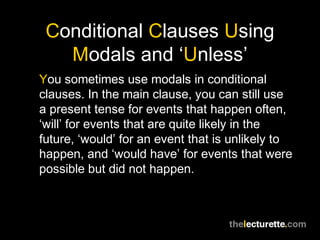
You sometimes use modals in conditional
clauses. In the main clause, you can still use
a present tense for events that happen often,
‘will’ for events that are quite likely in the
future, ‘would’ for an event that is unlikely to
happen, and ‘would have’ for events that were
possible but did not happen.
Conditional Clauses Using
Modals and ‘Unless’
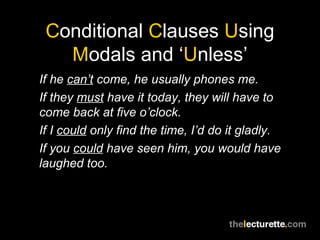
If he can’t come, he usually phones me.
If they must have it today, they will have to
come back at five o’clock.
If I could only find the time, I’d do it gladly.
If you could have seen him, you would have
laughed too.
Conditional Clauses Using
Modals and ‘Unless’
‘Should’ is sometimes used in conditional
clauses to express greater uncertainty.
If any visitors should come, I’ll say you aren’t
here.
Conditional Clauses Using
Modals and ‘Unless’
You can use other modals besides ‘will’,
‘would’ and ‘would have’ in the main clause
with their usual meanings.
She might phone me, if she has time.
You could come, if you wanted to.
If he sees you leave, he may cry.
Conditional Clauses Using
Modals and ‘Unless’
Note: You can have modals in both clauses:
the main clauses and the conditional clause.
If he can’t come, he will phone.
Conditional Clauses Using
Modals and ‘Unless’
In formal English, if the first verb in a
conditional clause is ‘had’, ‘should’, or ‘were’,
you can put the verb at the beginning of the
clause and omit ‘if’. For example, instead of
saying ‘If he should come, I will tell him you
are sick’, it is possible to day ‘should he
come, I will tell him you are sick’.
Conditional Clauses Using
Modals and ‘Unless’
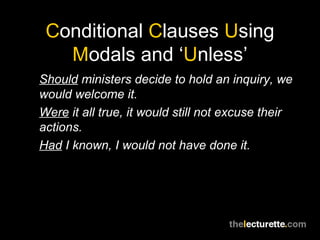
Should ministers decide to hold an inquiry, we
would welcome it.
Were it all true, it would still not excuse their
actions.
Had I known, I would not have done it.
Conditional Clauses Using
Modals and ‘Unless’
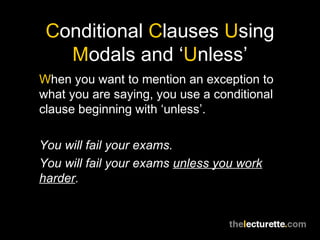
When you want to mention an exception to
what you are saying, you use a conditional
clause beginning with ‘unless’.
You will fail your exams.
You will fail your exams unless you work
harder.
Conditional Clauses Using
Modals and ‘Unless’
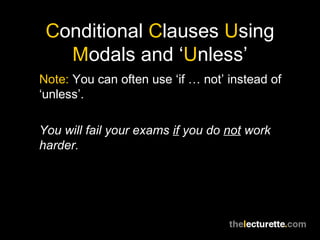
Note: You can often use ‘if … not’ instead of
‘unless’.
You will fail your exams if you do not work
harder.
Conditional Clauses Using
Modals and ‘Unless’
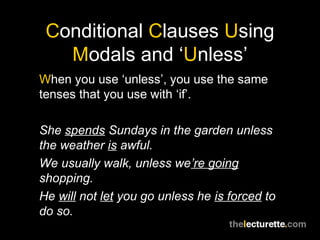
When you use ‘unless’, you use the same
tenses that you use with ‘if’.
She spends Sundays in the garden unless
the weather is awful.
We usually walk, unless we’re going
shopping.
He will not let you go unless he is forced to
do so.
Conditional Clauses Using
Modals and ‘Unless’
‘If’ and ‘unless’ are not the only ways of
beginning conditional clauses. You can also
use ‘as long as’, ‘only if’, ‘provided’, ‘provided
that’, or ‘so long as’. These expressions are
all used to indicate that one thing only
happens or is true if another thing happens or
is true.
Conditional Clauses Using
Modals and ‘Unless’
I will come only if nothing is said to the press.
She was prepared to come, provided that she
could bring her daughter.
Providing they remained at a safe distance,
we would be all right.
Detergent cannot harm a fabric, so long as it
has been properly dissolved.
We were all right as long as we kept our
heads down.
Questions?
Suggestions?
Comments?

Conditional clauses using modals and unless

  • 1.
    Conditional Clauses Using Modalsand ‘Unless’ www.slideshare.net/pietvanderlaan/conditional-clauses-using-modals-and-unless
  • 2.
    Conditional Clauses Using Modalsand ‘Unless’ You sometimes use modals in conditional clauses. In the main clause, you can still use a present tense for events that happen often, ‘will’ for events that are quite likely in the future, ‘would’ for an event that is unlikely to happen, and ‘would have’ for events that were possible but did not happen.
  • 3.
    Conditional Clauses Using Modalsand ‘Unless’ If he can’t come, he usually phones me. If they must have it today, they will have to come back at five o’clock. If I could only find the time, I’d do it gladly. If you could have seen him, you would have laughed too.
  • 4.
    Conditional Clauses Using Modalsand ‘Unless’ ‘Should’ is sometimes used in conditional clauses to express greater uncertainty. If any visitors should come, I’ll say you aren’t here.
  • 5.
    Conditional Clauses Using Modalsand ‘Unless’ You can use other modals besides ‘will’, ‘would’ and ‘would have’ in the main clause with their usual meanings. She might phone me, if she has time. You could come, if you wanted to. If he sees you leave, he may cry.
  • 6.
    Conditional Clauses Using Modalsand ‘Unless’ Note: You can have modals in both clauses: the main clauses and the conditional clause. If he can’t come, he will phone.
  • 7.
    Conditional Clauses Using Modalsand ‘Unless’ In formal English, if the first verb in a conditional clause is ‘had’, ‘should’, or ‘were’, you can put the verb at the beginning of the clause and omit ‘if’. For example, instead of saying ‘If he should come, I will tell him you are sick’, it is possible to day ‘should he come, I will tell him you are sick’.
  • 8.
    Conditional Clauses Using Modalsand ‘Unless’ Should ministers decide to hold an inquiry, we would welcome it. Were it all true, it would still not excuse their actions. Had I known, I would not have done it.
  • 9.
    Conditional Clauses Using Modalsand ‘Unless’ When you want to mention an exception to what you are saying, you use a conditional clause beginning with ‘unless’. You will fail your exams. You will fail your exams unless you work harder.
  • 10.
    Conditional Clauses Using Modalsand ‘Unless’ Note: You can often use ‘if … not’ instead of ‘unless’. You will fail your exams if you do not work harder.
  • 11.
    Conditional Clauses Using Modalsand ‘Unless’ When you use ‘unless’, you use the same tenses that you use with ‘if’. She spends Sundays in the garden unless the weather is awful. We usually walk, unless we’re going shopping. He will not let you go unless he is forced to do so.
  • 12.
    Conditional Clauses Using Modalsand ‘Unless’ ‘If’ and ‘unless’ are not the only ways of beginning conditional clauses. You can also use ‘as long as’, ‘only if’, ‘provided’, ‘provided that’, or ‘so long as’. These expressions are all used to indicate that one thing only happens or is true if another thing happens or is true.
  • 13.
    Conditional Clauses Using Modalsand ‘Unless’ I will come only if nothing is said to the press. She was prepared to come, provided that she could bring her daughter. Providing they remained at a safe distance, we would be all right. Detergent cannot harm a fabric, so long as it has been properly dissolved. We were all right as long as we kept our heads down.
  • 14.