Nordson Test and Inspection
Defect Analysis Workshop
John Travis
X-ray Inspection Criteria & Common Defect Analysis
WHAT IS
THAT!!!!
4
Recognize &
Identify Common
Defects
Today's Mission
Why X-ray Inspect?
 Non-destructive test for optically hidden joints
(e.g. BGA’s, QFN’s, Connectors) & internal
package details (Ball Bonds, Wedge Bonds)
 Field failure analysis
 Process development
 Production quality control
 Set-up changes
 New Product Introduction (NPI)
 Verification for Rework
 High magnification at Oblique Views
 Application Support
 Digital Processing
 Sub Micron/High Power
 High resolution (1.3 MP or more)
 Good separation of similar grey levels within the
x-ray image (65,000 Levels)
 Oblique views around point of analysis (Rotation)
 Ease of use
Suggested Requirements for X-ray Inspection
7
NORMALVIEW What are we seeing Here??
8
OBLIQUEVIEW What Can we see Here??
9
PCB Pad
BGA
Ball
Solder Paste
Pad
PCB
2 x circles on the x-ray
image show BGA
connection are OK
PCB
Solder Paste
BGA
Ball
If open connection, the
circle on X-ray image
will not be seen
X-Ray
“OPEN Connection”
Inspection Logic
Proper BGA Wetting Principles
1. Solder ball is more dense than PCB
pad
2. If proper wetting occurs the lighter
density PCB pad shares its density
with the ball.
3. That being the case, the pad will
show up as a lighter color than the
ball if a homogenous bond is created.
4. If proper wetting does not occur then
the pad will carry it’s own density
properties and will show up as a dark
mass outside the perimeter of the
BGA.
When the two masses do
not share a common
density, the PCB pad is
exposed and an open
solder joint is detected as
indicated in the image on
the left.
BGA Open
 Strength of x-ray inspection is being able to look
for opens, voiding, fractures and generally monitor
production quality.
 Also - able to prove to your customer that the
reflow quality is good - BGAs are often forgiving of
process variations - incl. Pb-free
 Combat the frequently heard phrase from your
customer - “The boards you sent me do not work! It
must be how you soldered the BGA!”
Using XRAY for BGA Inspection
Common BGA Opens
 Cold Profile or Cold spots (visible solder-paste spheres)
 Hot Tears; caused by rapid cool down using lead free
paste
 Head in Pillow
 Exposed Pad on PCB……..Indicative of Profile not quite
hot enough to create an inter-metallic bond. Could also
point to contaminated components.
 Excessive Voiding Cracks or Fractures due to stress.
 Clogged Aperture on stencil
 Bridging
Head in Pillow
Copyright © Dage 2006
Transition from Hot to cold
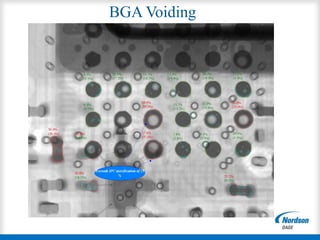
BGA Voiding
Hot Tears or Fissures
21 | 00 Month 2009 | Confidential
Hot Tears or Fissures
Sample
Detector Rotates
X-ray
Tube
principle – Limited Angle CT or PCT
 2D images captured with detector
at an angle
 No sample size limitation as far
as it fits in the X-Ray sample tray-
No need to cut the sample
 Small area of the sample imaged
 Similar reconstruction method to
full µCT – produces a CT model
with 240 CT slices
 No Limitations compared to full
µCT
© NordsonDAGE 2012
23 | 00 Month 2009 | Confidential
Slices of BGA with Hot Tears
24 | 00 Month 2009 | Confidential
25 | | Confidential
a)
b)
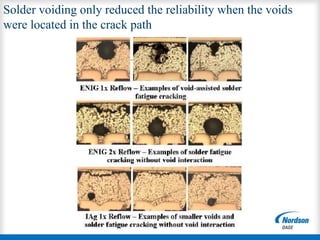
Importance of Identifying Void Location
26 | 00 Month 2009 | Confidential
Solder voiding only reduced the reliability when the voids
were located in the crack path
Types of Common Voids
28 | 00 Month 2009 | Confidential
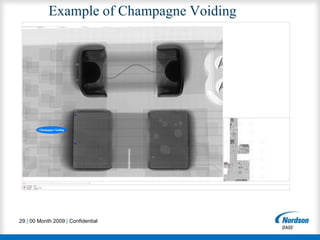
Example of Champagne Voiding
29 | 00 Month 2009 | Confidential
Recommended BGA Inspection Procedure
 Always inspect at an Oblique Angle for Opens
 Check corners – shows lifting or Potato Chipping
 Work your way into the centre.
 This will Most likely to be the last point to reflow if any
substantial ∆T is present
 All terminations should be reasonably circular and
consistent in size
 Voiding, opens (non-reflow), HIP, Partial Wetting
 Inspect whole of BGA after rework – gives confidence in
the process
 Increasing voiding
 Check fillets
 Solder balling
TARGET ACCEPTABLE DEFECT
Inspection Criteria Chip
Components
 Increasing voiding > 20%
 Check fillets
 Insufficient solder
TARGET ACCEPTABLE DEFECT
Inspection criteria (LGA)
 Heel fillet voiding
 Joints reflowed
 Insufficient solder
TARGET ACCEPTABLE DEFECT
Inspection Criteria Gull Wings
 Increasing voiding
 Joints reflowed
 Missing interfaces
TARGET ACCEPTABLE DEFECT
Inspection Criteria BGA
Inspection Criteria – Pin-in-Hole Fill
 Oblique view
 > 75% fill required
 Voiding in hole possible
TARGET ACCEPTABLE DEFECT
LGA (QFN)
Acceptable QFN Solder
38 | 00 Month 2009 | Confidential
Insufficient Solder on QFN
Cracks & Breaks
 Copper tracks or in Solder Joints
 Die cracks:
 Fatigue from thermal cycling
 External stress (dropping)
 See an absence of material in x-ray image (from lower density)
 May need oblique view to see
Cracks & Breaks
Normal
(Top Down)
View
Oblique
View
Cracks In Capacitors
Capacitor Cracks
Fillet Tearing in Lead-Free
Joints
BGA Cracks
49 | 00 Month 2009 | Confidential
These devices were
blowing up!
Dendrites
The standard micro sectioning methods
could not find the problem
Dendrites between Pad and lead-frame on SOT 89
The bond wire is 20 microns diameter
so the dendrites are only a few microns
Dendrites at High Magnification
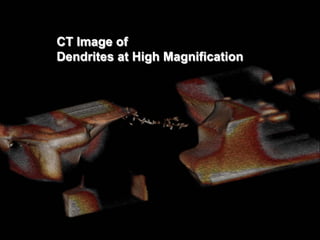
CT Image of
Dendrites at High Magnification
Movie of Dendrites
at High Magnification
55 | 00 Month 2009 | Confidential
Dendrites
57 | 00 Month 2009 | Confidential
58 | 00 Month 2009 | Confidential
Defective Traces
59 | 00 Month 2009 | Confidential
60 | 00 Month 2009 | Confidential
61 | 00 Month 2009 | Confidential
62 | 00 Month 2009 | Confidential
63 | 00 Month 2009 | Confidential
Through Hole Solder
64 | 00 Month 2009 | Confidential
www.yestechinc.com
Thank You!

Defect analysis workshop

  • 1.
    Nordson Test andInspection Defect Analysis Workshop John Travis
  • 2.
    X-ray Inspection Criteria& Common Defect Analysis
  • 3.
  • 4.
  • 5.
    Why X-ray Inspect? Non-destructive test for optically hidden joints (e.g. BGA’s, QFN’s, Connectors) & internal package details (Ball Bonds, Wedge Bonds)  Field failure analysis  Process development  Production quality control  Set-up changes  New Product Introduction (NPI)  Verification for Rework
  • 6.
     High magnificationat Oblique Views  Application Support  Digital Processing  Sub Micron/High Power  High resolution (1.3 MP or more)  Good separation of similar grey levels within the x-ray image (65,000 Levels)  Oblique views around point of analysis (Rotation)  Ease of use Suggested Requirements for X-ray Inspection
  • 7.
    7 NORMALVIEW What arewe seeing Here??
  • 8.
  • 9.
    9 PCB Pad BGA Ball Solder Paste Pad PCB 2x circles on the x-ray image show BGA connection are OK PCB Solder Paste BGA Ball If open connection, the circle on X-ray image will not be seen X-Ray “OPEN Connection” Inspection Logic
  • 10.
    Proper BGA WettingPrinciples 1. Solder ball is more dense than PCB pad 2. If proper wetting occurs the lighter density PCB pad shares its density with the ball. 3. That being the case, the pad will show up as a lighter color than the ball if a homogenous bond is created. 4. If proper wetting does not occur then the pad will carry it’s own density properties and will show up as a dark mass outside the perimeter of the BGA.
  • 11.
    When the twomasses do not share a common density, the PCB pad is exposed and an open solder joint is detected as indicated in the image on the left. BGA Open
  • 12.
     Strength ofx-ray inspection is being able to look for opens, voiding, fractures and generally monitor production quality.  Also - able to prove to your customer that the reflow quality is good - BGAs are often forgiving of process variations - incl. Pb-free  Combat the frequently heard phrase from your customer - “The boards you sent me do not work! It must be how you soldered the BGA!” Using XRAY for BGA Inspection
  • 13.
    Common BGA Opens Cold Profile or Cold spots (visible solder-paste spheres)  Hot Tears; caused by rapid cool down using lead free paste  Head in Pillow  Exposed Pad on PCB……..Indicative of Profile not quite hot enough to create an inter-metallic bond. Could also point to contaminated components.  Excessive Voiding Cracks or Fractures due to stress.  Clogged Aperture on stencil  Bridging
  • 14.
  • 18.
    Copyright © Dage2006 Transition from Hot to cold
  • 19.
  • 20.
    Hot Tears orFissures
  • 21.
    21 | 00Month 2009 | Confidential Hot Tears or Fissures
  • 22.
    Sample Detector Rotates X-ray Tube principle –Limited Angle CT or PCT  2D images captured with detector at an angle  No sample size limitation as far as it fits in the X-Ray sample tray- No need to cut the sample  Small area of the sample imaged  Similar reconstruction method to full µCT – produces a CT model with 240 CT slices  No Limitations compared to full µCT © NordsonDAGE 2012
  • 23.
    23 | 00Month 2009 | Confidential
  • 24.
    Slices of BGAwith Hot Tears 24 | 00 Month 2009 | Confidential
  • 25.
    25 | |Confidential a) b)
  • 26.
    Importance of IdentifyingVoid Location 26 | 00 Month 2009 | Confidential
  • 27.
    Solder voiding onlyreduced the reliability when the voids were located in the crack path
  • 28.
    Types of CommonVoids 28 | 00 Month 2009 | Confidential
  • 29.
    Example of ChampagneVoiding 29 | 00 Month 2009 | Confidential
  • 30.
    Recommended BGA InspectionProcedure  Always inspect at an Oblique Angle for Opens  Check corners – shows lifting or Potato Chipping  Work your way into the centre.  This will Most likely to be the last point to reflow if any substantial ∆T is present  All terminations should be reasonably circular and consistent in size  Voiding, opens (non-reflow), HIP, Partial Wetting  Inspect whole of BGA after rework – gives confidence in the process
  • 31.
     Increasing voiding Check fillets  Solder balling TARGET ACCEPTABLE DEFECT Inspection Criteria Chip Components
  • 32.
     Increasing voiding> 20%  Check fillets  Insufficient solder TARGET ACCEPTABLE DEFECT Inspection criteria (LGA)
  • 33.
     Heel filletvoiding  Joints reflowed  Insufficient solder TARGET ACCEPTABLE DEFECT Inspection Criteria Gull Wings
  • 34.
     Increasing voiding Joints reflowed  Missing interfaces TARGET ACCEPTABLE DEFECT Inspection Criteria BGA
  • 35.
    Inspection Criteria –Pin-in-Hole Fill  Oblique view  > 75% fill required  Voiding in hole possible TARGET ACCEPTABLE DEFECT
  • 36.
  • 38.
    Acceptable QFN Solder 38| 00 Month 2009 | Confidential
  • 39.
  • 40.
    Cracks & Breaks Copper tracks or in Solder Joints  Die cracks:  Fatigue from thermal cycling  External stress (dropping)  See an absence of material in x-ray image (from lower density)  May need oblique view to see
  • 41.
    Cracks & Breaks Normal (TopDown) View Oblique View
  • 42.
  • 43.
  • 44.
    Fillet Tearing inLead-Free Joints
  • 47.
  • 49.
    49 | 00Month 2009 | Confidential These devices were blowing up! Dendrites
  • 50.
    The standard microsectioning methods could not find the problem
  • 51.
    Dendrites between Padand lead-frame on SOT 89 The bond wire is 20 microns diameter so the dendrites are only a few microns
  • 52.
    Dendrites at HighMagnification
  • 53.
    CT Image of Dendritesat High Magnification
  • 54.
    Movie of Dendrites atHigh Magnification
  • 55.
    55 | 00Month 2009 | Confidential Dendrites
  • 57.
    57 | 00Month 2009 | Confidential
  • 58.
    58 | 00Month 2009 | Confidential Defective Traces
  • 59.
    59 | 00Month 2009 | Confidential
  • 60.
    60 | 00Month 2009 | Confidential
  • 61.
    61 | 00Month 2009 | Confidential
  • 62.
    62 | 00Month 2009 | Confidential
  • 63.
    63 | 00Month 2009 | Confidential Through Hole Solder
  • 64.
    64 | 00Month 2009 | Confidential
  • 65.