WHEN YOU NEED TO BE SURE
ASME Sec V
NDT
Rules for
Construction of
Pressure Vessels
2
FROM THE API 510 BODY OF KNOWLEDGE
III.NONDESTRUCTIVE EXAMINATION
ASME Section V, Nondestructive Examination
NOTE: The examination will cover ONLY the main body
of each referenced Article, except as noted.
3
Article 1 SCOPE OF SECTION
V
4
A. Article 1, General Requirements:
The inspector should be familiar with and understand;
1. The Scope of Section V,
2. Rules for use of Section V as a referenced Code,
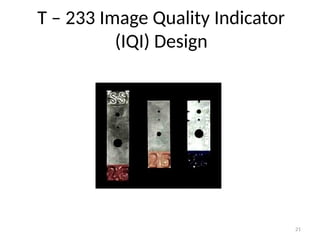
3. Responsibilities of the Owner / User, and of
subcontractors,
4. Calibration,
5. Definitions of "inspection" and examination",
6. Record keeping requirements.
5
(a) Unless otherwise specified by the referencing Code
Section or other referencing documents, this Section of
the Code contains requirements and methods for
nondestructive examination which are Code requirements to
the extent they are specifically referenced and required by
other Code Sections.
T – 110 Scope
Section V Page 12
6
It is the responsibility of the Manufacturer, fabricator, or installer
to ensure that the examination equipment being used conforms
to the requirements of this Code Section.
T – 130 Equipment
7
(a) Nondestructive Examination Personnel shall be qualified
in accordance with the requirements of the referencing
Code Section.
ANSI/ASNT CP-189. SNT-TC-1A, NAS-410
(c) When required by the referencing Code Section, all
nondestructive examinations performed under this Code
Section shall be done to a written procedure.
This procedure shall be demonstrated to the satisfaction of
the Inspector. The procedure or method shall comply with
the applicable requirements of this Section for the particular
examination method….
T – 140 Requirements
8
…Where so required, written procedures shall be made
available to the Inspector on request. At least one copy of each
procedure shall be readily available to the Manufacturer’s
Nondestructive Examination Personnel for their reference and
use.
T – 170 Examinations and Inspections
a)… Throughout this Section of the Code, the word Inspector
means the Authorized Inspector who has been qualified as
required in the various referencing Code Sections.
T – 150 Procedure
9
T – 180 Evaluation
The acceptance standards for these methods shall be as
stated in the referencing Code Section.
T – 170 Examinations and
Inspections
10
Records/Documentation shall be in accordance with the
referencing Code Section and the applicable requirements of
Subsection A and/or B of this Code Section.
The Manufacturer, fabricator, or installer shall be responsible for
all required Records/Documentation.
T – 190 Records / Documentation
11
1. The acceptance standards for radiography, and dye
penetrant testing is found in the ____________________.
2. A written procedure is always needed for any NDE
process when it is required by _____________________.
3. Who shall have the NDE procedure made available to
them?
a. The manufacturer of pressure vessels or piping.
b. The Inspector only has this right.
c. The manufacturer’s NDE personnel and the inspector
upon request.
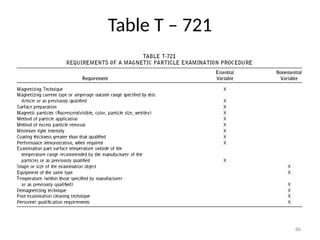
Class Quiz
Article 1
12
1. The acceptance standards for radiography, and dye
penetrant testing is found in the referencing Code
Section.
2. A written procedure is always needed for any NDE
process when it is required by the referencing Code.
3. Who shall have the NDE procedure made available to
them?
c. The manufacturer’s NDE personnel and the inspector
upon request.
Solutions
13
Article 2 Radiographic
Examination
14
B. Article 2, Radiographic Examination:
The inspector should be familiar with and understand;
1. The Scope of Article 2 and general requirements,
2. The rules for radiography as typically applied on
pressure vessels such as, but not limited to:
a. required marking
b. type, selection, number, and placement of IQI’s,
c. allowable density
d. control of backscatter radiation
e. location markers
3. Records
15
T – 210 Scope
Section V Page 21
The radiographic method described in this Article for examination
of materials including castings and welds shall be used together
with Article 1, General Requirements. Definitions of terms used in
this Article are in Mandatory Appendix V of this Article……
16
A lead symbol “B,” with minimum dimensions of 1/2 in. in
height and 1/16 in. in thickness, shall be attached to the back of
each film holder during each exposure to determine if backscatter
radiation is exposing the film.
Alert! Can be a Closed Book question!
T – 223 Backscatter Radiation
17
Either a densitometer or step wedge comparison film shall be
used for judging film density.
T – 225 Monitoring Density
Limitations of Radiographs
18
1. The purpose of the using the Lead Letter B is to determine if
________________ is exposing the film.
2. The Lead Letter B is placed______________________.
a. on the part
b. on the back of the film cassette
c. on the front of the film cassette
3. Film density is measured using a __________________.
a. step wedge comparison block
b. densitometer film
c. Step wedge comparison film or a densitometer.
Class Quiz
19
1. The purpose of the using the Lead Letter B is to determine if
backscatter radiation is exposing the film.
2. The Lead Letter B is placed______________________.
* b. on the back of the film cassette
3. Film density is measured using a __________________.
* c. step wedge comparison film or a densitometer.
Solutions
20
IQIs shall be either the hole type or the wire type. Hole-type IQIs
shall be manufactured and identified in accordance with the
requirements or alternates allowed in SE-1025. Wire-type IQIs
shall be manufactured and identified in accordance with the
requirements or alternates allowed in SE-747, except that the
largest wire number or the identity number may be omitted.
ASME standard IQIs shall consist of those in Table T-233.1 for hole
type and those in Table T-233.2 for wire type.
T – 233 Image Quality Indicator
(IQI) Design
21
T – 233 Image Quality Indicator
(IQI) Design
22
* Questions that come from this table are directed at such things
as looking up the thickness of the IQI based on a Designation
Number or a specific hole diameter such as 1T, 2T, or 4T for a IQI
Designation Number.
It is interesting to note that all the Designation Numbers directly
relate to the thickness of the Hole Type IQI except for three,
numbers 7, 12 and 17 . Let’s have a look.
* These types of questions should be expected on the first half,
Open Book portion of the exam.
Table T-233.1
Hole Type IQI Thickness and Hole
Diameters
23
24
Another feature of the Designation Number is in reference to the
specific hole such as 1T, 2T, or 4T. The T is the thickness of a given
IQI Designation such Number 15 for example. So the 1 x T hole
has a diameter of 0.015” and thus the 2 x T hole = 0.030”, 4 x T =
0.060”.
However this rule does not hold for the smaller IQI Numbers 5
and 7 which are both identical to Number 10. To say it another
way, Numbers 5, 7 and, 10 all have the same diameter of 1T, 2T
and 4T holes. Take a look!
Table T-233.1
Hole Type IQI Thickness and Hole
Diameters
25
26
1. The thickness of a Hole Type IQI Designation #25 is_____ and
the 4T hole diameter is ________.
2. The thickness of a Hole Type IQI Designation #7 is _____ and
the 2T Hole diameter is _______.
Class Quiz
Table T-233.1
27
28
1. The thickness of a Hole Type IQI Designation #25 is 0.025” and
the 4T hole diameter is 0.100”.
2. The thickness of a Hole Type IQI Designation #7 is 0.0075” and
the 2T Hole diameter is 0.020”.
Solutions
29
The alternative and, some think better, Image Quality Indicator
(IQI) it the Wire Type.
Table T-233.2
Wire IQI Designation, Wire
Diameter, and Wire Identity
30
Typical question on the Open Book portion of the exam are what is
the diameter of a given wire size.
For Example:
What is the wire size of a Set A # 4 wire?
Answer: 0.0063” (0.16 mm).
There’s not much tricky here, just read carefully.
Table T-233.2
Wire IQI
31
32
Geometric Unsharpness shall be determined in accordance with:
Ug = Fd /D
T – 274 Geometric Unsharpness
Where:
Ug = geometric unsharpness
F = Source size: the maximum projected dimension of the radiating source (or
effective focal spot) in the plane perpendicular to the distance D from the weld
or object being radiographed, inches.
D = the distance from source of radiation to weld or object being radiographed,
inches.
d = distance from source side of weld or object being radiographed to the film,
inches.
* All that is needed here is to remember what the terms mean.
33
Here is a short definition of Geometric Unsharpness;
Source to film distance, object to film distance, and source size
directly affect the degree of penumbra shadow and geometric
unsharpness of a radiograph. Codes and standards used in industrial
radiography require that geometric unsharpness be limited.
T – 274 Geometric Unsharpness
34
35
Location markers (see Fig. T-275), which are to appear as
radiographic images on the film, shall be placed on the part, not
on the exposure holder / cassette.
Their locations shall be permanently marked on the surface of the
part being radiographed when permitted, or on a map, in a
manner permitting the area of interest on a radiograph to be
accurately traceable to its location on the part, for the required
retention period of the radiograph. Evidence shall also be
provided on the radiograph that the required coverage of the
region being examined has been obtained. Location markers shall
be placed as follows.
T – 275 Location Markers
36
(a) Source-Side Markers. Location markers shall be placed
on the source side when radiographing the following:
(1) flat components or longitudinal joints in cylindrical or
conical components;
(2) curved or spherical components whose concave side
is toward the source and when the “source-to material”
distance is less than the inside radius of the component;
(3) curved or spherical components whose convex side
is toward the source.
Using Fig. T-275 we have these three examples;
T – 275.1 Single-Wall
Viewing
37
38
(b) Film-Side Markers
(1) Location markers shall be placed on the film side
when radiographing either curved or spherical
components whose concave side is toward the source
and when the “source-to-material” distance is greater
than the inside radius.
39
(c) Either Side Markers. Location markers may be placed
on either the source side or film side when radiographing
either curved or spherical components whose concave
side is toward the source and the “source-to-material”
distance equals the inside radius of the component.
40
For double-wall viewing, at least one location marker shall be
placed adjacent to the weld (or on the material in the area of
interest) for each radiograph.
T – 275.2 Double-Wall
Viewing
41
Class Quiz
Geometric Unsharpness / Location Markers
1.The important aspects of controlling Geometric Unsharpness are
determining the size of the radiation source “F” , Distance “D”
from the source of radiation to the part
and,_______________________________________.
2. Location markers are placed on the source side when
Radiographing a curved object whose concave side is toward the
source and when the “source-to material” distance is __________
the inside radius of the component.
42
Solutions
1.The important aspects of controlling Geometric Unsharpness are
determining the size of the radiation source “F” , Distance “D”
from the source of radiation to the part and, the distance “d”
from the source side of the object being radiographed to the film.
2. Location markers are placed on the source side when
Radiographing a curved object whose concave side is toward the
source and when the “source-to material” distance is less than
the inside radius of the component.
43
The designated hole IQI or essential wire shall be as
specified in Table T-276. A thinner or thicker hole-type IQI
may be substituted for any section thickness listed in Table
T-276, provided an equivalent IQI sensitivity is maintained.
See T-283.2.
T – 276.2 Size
44
(a) Welds With Reinforcements. The thickness on which the
IQI is based is the nominal single-wall thickness plus the
estimated weld reinforcement not to exceed the maximum
permitted by the referencing Code Section. Backing rings or
strips shall not be considered as part of the thickness in IQI
selection. The actual measurement of the weld
reinforcement is not required.
T – 276.2 Size
45
(b) Welds Without Reinforcements. The thickness on which
the IQI is based is the nominal single-wall thickness.
Backing rings or strips shall not be considered as part of the
weld thickness in IQI selection.
T – 276.2 Size
46
For the exam you may be required to select the proper IQI
for a radiograph. This is by establishing the part thickness as
previously discussed, the type of shot, “Source Side” or
“Film Side” and apply Table T-276.1
Example: For a film side shot of a part thickness that is
0.500: (12.7 mm) what would be the required Hole Type IQI
Number?
Answer: # 15
Be careful, don’t answer with the wire number when asked
for the hole type designator!
Table T – 276.1
IQI Selection
47
Hole Type #15 - Wire Type # 6
48
(a) Source-Side IQI(s). The IQI(s) shall be placed
on the source side of the part being examined, except
for the condition described in T-277.1(b).
When, due to part or weld configuration or size, it
is not practical to place the IQI(s) on the part or weld,
the IQI(s) may be placed on a separate block. Separate
blocks shall be made of the same or radiographically
similar materials (as defined in SE-1025) and may be
used to facilitate IQI positioning.
T-277.1 Placement of IQIs
49
(b) Film-Side IQI(s). Where inaccessibility prevents hand
placing the IQI(s) on the source side, the IQI(s) shall be
placed on the film side in contact with the part being
examined. A lead letter “F” shall be placed adjacent to or
on the IQI(s), but shall not mask the essential hole where
hole IQIs are used.
(c) IQI Placement for Welds — Hole IQI s. The IQI (s) may
be placed adjacent to or on the weld. The identification
number (s) and, when used, the lead letter “F,” shall not be
in the area of interest, except when geometric configuration
makes it impractical.
(d) IQI Placement for Welds — Wire IQI s. The IQI (s) shall
be placed on the weld so that the length of the wires is
perpendicular to the length of the weld. (across weld)
T-277.1 Placement of IQIs
50
All radiographs shall be free from mechanical, chemical, or
other blemishes to the extent that they do not mask and are
not confused with the image of any discontinuity in the area
of interest of the object being radiographed. Such blemishes
include, but are not limited to:
(a) fogging;
(b) processing defects such as streaks, watermarks,
or chemical stains;
(c) scratches, finger marks, crimps, dirtiness, static
marks, smudges, or tears;
(d) false indications due to defective screens.
T – 281 Quality of Radiographs
51
The transmitted film density through the radiographic image of the
body of the appropriate hole IQI or adjacent to the designated
wire of a wire IQI and the area of interest shall be ** 1.8 minimum
for single film viewing for radiographs made with an X-ray source
and 2.0 minimum for radiographs made with a gamma ray
source.
T – 282.1 Density Limitation
52
If a light image of the “B,” as described in T-223, appears on a
darker background of the radiograph, protection from backscatter
is insufficient and the radiograph shall be considered
unacceptable. A dark image of the “B” on a lighter background is
not cause for rejection.
This seems to be on almost every examination, API 510,
570 and, 653. It can be open or closed book.
T – 284 Excessive Backscatter
53
1. Wire type IQIs are placed____________________.
a. parallel to the weld, i.e. along its length.
b. across the weld, i.e. perpendicular.
2. The transmitted film density through the radiographic image of
the body of the appropriate hole IQI or adjacent to the designated
wire of a wire IQI and the area of interest shall be ___ minimum
with a gamma source.
a. 1.8
b. 2.0
3. Radiography shall be performed with a technique of sufficient
sensitivity to display the designated hole IQI image and the_____,
or the _________ of a wire IQI.
Class Quiz
IQI Placement and Allowable Densities
54
4. If the density of the radiograph anywhere through the area of
interest varies by more than minus 15% or plus 30% from the
density through the body of the hole IQI or adjacent to the
designated wire of a wire IQI, within the minimum/maximum
allowable density ranges specified in T-282.1, then an additional
______________.
a. another radiograph shall be taken with at least 3 IQIs placed in
exceptional areas.
b. IQIs shall be used in each exceptional area or areas and another
radiograph made.
Class Quiz
IQI Placement and Allowable Densities
55
1. Wire type IQIs are placed____________________.
b. across the weld, i.e. perpendicular.
2. The transmitted film density through the radiographic image of
the body of the appropriate hole IQI or adjacent to the designated
wire of a wire IQI and the area of interest shall be ____ minimum
with a gamma source.
b. 2.0
3. Radiography shall be performed with a technique of sufficient
sensitivity to display the designated hole IQI image and the 2T
hole, or the essential wire of a wire IQI.
Solutions
56
4. If the density of the radiograph anywhere through the area of
interest varies by more than minus 15% or plus 30% from the
density through the body of the hole IQI or adjacent to the
designated wire of a wire IQI, within the minimum/maximum
allowable density ranges specified in T-282.1, then an additional
______________.
b. IQIs shall be used in each exceptional area or areas and another
radiograph made.
Solutions
57
Section VIII Appendix 4
Rounded Indications Charts
Acceptance Standard for
Radiographically Determined
Rounded Indications in Welds
58
SE-797 Standard Practice for Measuring Thickness
By Manual Ultrasonic Pulse-Echo Contact Method
59
E. Article 23, Ultrasonic Standards, Section SE–797 only
– Standard practice for measuring thickness by manual
ultrasonic pulse-echo contact method:
The inspector should be familiar with and understand;
1) The Scope of Article 23, Section SE-797,
2) The general rules for applying and using the Ultrasonic
method
3) The specific procedures for Ultrasonic thickness
measurement as contained in paragraph 7.
60
SE-797 Standard Practice for Measuring Thickness By
Manual Ultrasonic Pulse-Echo Contact Method
Scope
This practice provides guidelines for measuring the thickness of materials
using the contact pulse-echo method at temperatures not to exceed **
200°F (93°C).
Thickness Adjustment SE-797 (9.5):
High-temperature materials, up to about 540°C [1000°F], can be measured
with specially designed instruments with high-temperature compensation,
search unit assemblies, and couplants. Normalization of apparent thickness
readings for elevated temperatures is required. A rule of thumb often used
is as follows: The apparent thickness reading obtained from steel walls
having elevated temperatures is high (too thick) by a factor of about 1 % per
55°C [100°F]. Thus, if the instrument was standardized on a piece of similar
material at 20°C [68°F], and if the reading was obtained with a surface
temperature of 460°C [860°F], the apparent reading should be reduced by 8
%.
61
SE-797
Thickness (T), when measured by the pulse-echo
ultrasonic method, is a product of the velocity of sound in
the material and one half the transit time (round trip)
through the material.
T = Vt/2
Where:
T = Thickness
V = Velocity
t = time
62
SE-797
One or more reference blocks are required having known
velocity, or of the same material to be examined, and having
thicknesses accurately measured and in the range of
thicknesses to be measured. It is generally desirable that the
thicknesses be “round numbers” rather than miscellaneous
odd values.
One block should have a thickness value near the maximum
of the range of interest and another block near the
minimum thickness.
63
SE-797
7.2.2.1 Use at ** least two standardization blocks. One should
have a thickness near the maximum of the range to be
measured and the other block near the minimum thickness. For
convenience, it is desirable that the thickness should be
**“round numbers” so that the difference between them also
has a convenient round number” value.
** Repeated many times in SE-797, two blocks, round numbers.
64
65
Liquid Penetrant Testing Section V
66
C. Article 6, Liquid Penetrant Examination, including
Mandatory Appendices II and III:
The inspector should be familiar with and understand:
1. The Scope of Article 6,
2. The general rules for applying and using the liquid
penetrant method such as, but not limited to;
a) procedures
b) contaminants
c) techniques
d) examination
e) interpretation
f) documentation and
g) record keeping
67
T – 600 Scope Page 123
The liquid penetrant examination method is an effective means
for * detecting discontinuities which are open to the surface of
nonporous metals and other materials. Typical discontinuities
detectable by this method are cracks, seams, laps, and porosity. In
principle, a liquid penetrant is applied to the surface to be
examined and allowed to enter……
* Closed book question for certain.
68
Liquid penetrant examination shall be performed in
accordance with a written procedure. Each procedure shall
include at least…………. :
(a) the materials, shapes, or sizes to be examined, and the
extent of the examination;
(b) type (number or letter designation if available) of each
penetrant, penetrant remover, emulsifier, and developer;
(c) processing details for pre-examination cleaning and
drying, including the cleaning materials used and minimum
time allowed for drying;
T – 620 General
69
T – 642 Surface Preparation
(a) In general, satisfactory results may be obtained when
the surface of the part is in the as-welded, as rolled, as-
cast, or as-forged condition. Surface preparation by
grinding, machining, or other methods may be necessary
where surface irregularities could mask indications of
unacceptable discontinuities.
(b) Prior to each liquid penetrant examination, the surface to
be examined and all adjacent areas within * at least 1 in.
shall be dry and free of all dirt, grease, lint, scale,
welding flux, weld spatter, paint, oil, and other…………
* 1 inch is common to all cleaning operations for NDE.
70
Either a color contrast (visible) penetrant or a fluorescent
penetrant shall be used with one of the following three
penetrant processes:
(a) water washable
(b) post-emulsifying
(c) solvent removable
The visible and fluorescent penetrants used in
combination with these three penetrant processes result
in six liquid penetrant techniques.
T – 650 Procedure / Technique
T – 651 Techniques
71
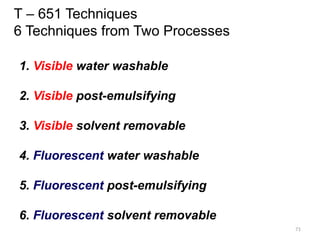
1. Visible water washable
2. Visible post-emulsifying
3. Visible solvent removable
4. Fluorescent water washable
5. Fluorescent post-emulsifying
6. Fluorescent solvent removable
T – 651 Techniques
6 Techniques from Two Processes
72
As a standard technique, the temperature of the penetrant and
the surface of the part to be processed shall not be below * 50°F
nor above 125°F throughout the examination period. Local
heating or cooling is permitted provided the part temperature
remains in the range of 50°F to 125°F during the examination.
* these temperatures can be on the Closed Book portion.
Where it is not practical to comply with these temperature
limitations, other temperatures and times may be used, provided
the procedures are qualified as specified in T-653.
T – 652 Techniques for Standard
Temperatures
73
The penetrant may be applied by any suitable means, such as
dipping, brushing, or spraying. If the penetrant is applied by
spraying using compressed-air-type apparatus, filters shall be
placed on the upstream side near the air inlet to preclude
contamination of the penetrant by oil………...
T – 671 Penetrant Application
74
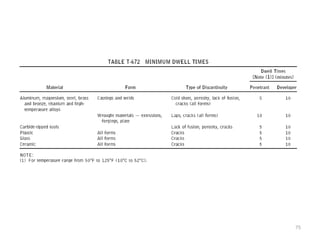
Penetration time is critical. The minimum penetration time shall
be as required in Table T-672 or as qualified by demonstration for
specific applications.
T – 672 Penetration Time
75
76
After the specified penetration time has elapsed, any penetrant
remaining on the surface shall be removed, taking care to
minimize removal of penetrant from discontinuities.
T – 673 Excess Penetrant Removal
77
Excess water washable penetrant shall be removed with a water
spray. The water pressure shall not exceed 50 psi, and the water
temperature shall not exceed 110°F .
T – 673.1 Water Washable Penetrants
78
**** Excess solvent removable penetrant shall be removed by
wiping with a cloth or absorbent paper, repeating the operation
until most traces of penetrant have been removed. The remaining
traces shall be removed by lightly wiping the surface with cloth or
absorbent paper moistened with solvent. To minimize removal of
penetrant from discontinuities, care shall be taken to avoid the
use of excess solvent. Flushing the surface with solvent,
following the application of the penetrant and prior to
developing, is prohibited.
**** Definitely Closed Book
T – 673.3 Solvent Removable Penetrants
79
Final interpretation shall be made within 10 to 60 min after the
requirements of T-675.3 are satisfied. If bleed-out does not alter
the examination results, longer periods are permitted. If the
surface to be examined is large enough to preclude complete
examination within the prescribed or established time, the
examination shall be performed in increments.
T – 676.1 Final Interpretation
80
1. The standard temperature range for dye penetrant tests is
______.
2. After applying the dye penetrant at the standard temperature the
proper dwell time for steel is _____.
3. Prior to applying the developer the part must cleaned of excess
penetrant, this can be done by __________________.
a. spraying solvent on to the part and wiping with a lint free cloth.
b. wiping with a lint free cloth then spraying solvent on to a lint free
cloth and lightly wiping the part.
c. wiping with a lint free cloth, no other method is allowed.
Class Quiz
81
1. The standard temperature range for dye penetrant tests is 50 to
125 o
F.
2. After applying the dye penetrant at the standard temperature the
proper dwell time for steel is 5 min.
3. Prior to applying the developer the part must cleaned of excess
penetrant, this can be done by __________________.
b. wiping with a lint free cloth then spraying solvent on to a lint free
cloth and lightly wiping the part.
Solutions
82
Magnetic Particle Testing Section V
83
D. Article 7, Magnetic Particle Examination (Yoke and
Prod techniques only)
The inspector should be familiar with and understand the
general rules for applying and using the magnetic particle
method such as, but not limited to;
1. The Scope of Article 7,
2. General requirements such as but not limited to
requirements for:
a. procedures
b. techniques (Yoke and Prod only)
c. calibration
d. examination
e. Interpretation
2. Documentation and record keeping
84
T – 720 General
The magnetic particle examination method may be applied to
detect cracks and other discontinuities on or near the surfaces of
ferromagnetic materials. The sensitivity is greatest for surface
discontinuities and diminishes rapidly with increasing depth of
subsurface discontinuities below the surface. Typical types of
discontinuities that can be detected by this method are cracks,
laps, seams,………..
85
T – 720 General
…….., maximum sensitivity will be to linear discontinuities
oriented perpendicular to the lines of flux. For optimum
effectiveness in detecting all types of discontinuities, each area
should be examined at least twice, with the lines of flux during
one examination approximately perpendicular to the lines of
flux during the other.
86
Table T – 721
87
When Procedure qualification is specified, a change of a
requirement in Table T-721 identified as an essential variable
from the specified value, or range of values shall require
requalification of the written procedure……….
T – 721.2 Procedure Qualifications
88
T-752.3 ** Prod spacing shall not exceed 8 in . Shorter spacing
may be used to accommodate the geometric limitations of the
area being examined or to increase the sensitivity, but prod
spacing of less than 3 in are usually not practical due to banding
of the particles around the prods.
** Reported to be on Closed Book
T – 752 Prod Technique
89
T-755.1 Application. ** This method shall only be applied to
detect discontinuities that are open to the surface of the part.
T-755.2 Magnetizing Procedure. For this technique alternating or
direct current electromagnetic yokes, or permanent magnet yokes
shall be used.
Note: For materials 1/4” or less in thickness, alternating current
yokes are superior to direct or permanent magnet yokes of equal
lifting power for the detection of SURFACE discontinuities.
** Closed book for sure.
T – 755 Yoke Technique
90
(a) Prior to use, the magnetizing power of electromagnetic
yokes shall have been checked within the past year. The
magnetizing power of permanent magnetic yokes shall be
checked daily prior to use. The magnetizing power of all
yokes shall be checked whenever the yoke has been
damaged or repaired.
** (b) Each alternating current electromagnetic yoke shall
have a lifting power of at least 10 lb at the maximum pole
spacing that will be used.
**(c) Each direct current or permanent magnetic yoke
shall have a lifting power of at least 40 lb (18.1 kg) at
the maximum pole spacing that will be used.
** On almost every exam both open and closed book.
T – 762 Lifting Power of Yokes
91
T-764.1.1 Pie-Shaped Magnetic Particle Field Indicator. The
indicator, shown in Fig. T-764.1.1 shall be positioned on the
surface to be examined, such that the copper-plated side is away
from the inspected surface. A suitable field strength is indicated
when a clearly defined line………………….
T – 764 Magnetic Field Adequacy and
Direction
92
Fig. T – 764.1.1
93
All examinations shall be conducted with sufficient field overlap
to ensure 100% coverage at the required sensitivity (T-753).
T – 774 Examination Coverage
94
………... A minimum light intensity of 100 fc (1000 Lx) is required
to ensure adequate sensitivity during the examination and
evaluation of indications.
T – 777.1 Visible (Color Contrast) Magnetic
Particles
95
With fluorescent particles, the process is essentially the
same as in T-777.1 . The examination shall be performed
as follows:
(a) It shall be performed in a darkened area.
(b) The examiner shall be in the darkened area for **at least
5 min prior to performing the examination to enable his
eyes to adapt to dark viewing. If the examiner wears
glasses or lenses, they shall not be photosensitive.
(c) The black light shall be allowed to warm up for a
minimum of ** 5 min prior to use or measurement of the
intensity of the ultraviolet light emitted.
** Remember 5 minutes.
T – 777.2 Fluorescent Particles
96
(d) The black light intensity shall be measured with a black
light meter. A minimum of 1000 W/cm2
on the surface of
the part being examined shall be required. The black light
intensity shall be ** verified at least once every 8 hr,
whenever the work station is changed, or whenever the
bulb is changed.
** Here is another known test question
T – 778.2 Fluorescent Particles

97
1. Magnetic particle sensitivity is ______for surface
discontinuities and _______ rapidly with increasing depth
of subsurface discontinuities below the surface.
a. least, increases
b. greatest, decreases
2. The Pie Shaped indicator, shall be positioned on the
surface to be examined, such that the copper-plated side
is ______from the inspected surface.
a. away
b. toward
3. With Dry Particles the magnetizing current shall remain
_____ on while the examination medium is being applied.
a. off
b. on
Class Quiz
98
4. A minimum light intensity of ______is required to ensure
adequate sensitivity during visible (color contrast)
magnetic particle examinations.
a. 1000 fc/100 Lx
b. 1000 fc/1000 Lx
c. 100 fc/1000 Lx
5. Each alternating current electromagnetic yoke shall have
a lifting power of at least ____lb at the maximum pole
spacing that will be used.
a. 20
b. 10
c. 40
Class Quiz
99
1. Magnetic particle sensitivity is ______for surface
discontinuities and _______ rapidly with increasing depth
of subsurface discontinuities below the surface.
b. greatest, decreases
2. The Pie Shaped indicator, shall be positioned on the
surface to be examined, such that the copper-plated side
is ______from the inspected surface.
a. away
3. With Dry Particles the magnetizing current shall remain
_____ on while the examination medium is being applied.
b. on
Solutions
100
4. A minimum light intensity of ______is required to ensure
adequate sensitivity during visible (color contrast)
magnetic particle examinations.
c. 100 fc/1000 Lx
5. Each alternating current electromagnetic yoke shall have
a lifting power of at least ____lb at the maximum pole
spacing that will be used.
b. 10
Solutions

ASME Sec V New - NON destructive testing

  • 1.
    WHEN YOU NEEDTO BE SURE ASME Sec V NDT Rules for Construction of Pressure Vessels
  • 2.
    2 FROM THE API510 BODY OF KNOWLEDGE III.NONDESTRUCTIVE EXAMINATION ASME Section V, Nondestructive Examination NOTE: The examination will cover ONLY the main body of each referenced Article, except as noted.
  • 3.
    3 Article 1 SCOPEOF SECTION V
  • 4.
    4 A. Article 1,General Requirements: The inspector should be familiar with and understand; 1. The Scope of Section V, 2. Rules for use of Section V as a referenced Code, 3. Responsibilities of the Owner / User, and of subcontractors, 4. Calibration, 5. Definitions of "inspection" and examination", 6. Record keeping requirements.
  • 5.
    5 (a) Unless otherwisespecified by the referencing Code Section or other referencing documents, this Section of the Code contains requirements and methods for nondestructive examination which are Code requirements to the extent they are specifically referenced and required by other Code Sections. T – 110 Scope Section V Page 12
  • 6.
    6 It is theresponsibility of the Manufacturer, fabricator, or installer to ensure that the examination equipment being used conforms to the requirements of this Code Section. T – 130 Equipment
  • 7.
    7 (a) Nondestructive ExaminationPersonnel shall be qualified in accordance with the requirements of the referencing Code Section. ANSI/ASNT CP-189. SNT-TC-1A, NAS-410 (c) When required by the referencing Code Section, all nondestructive examinations performed under this Code Section shall be done to a written procedure. This procedure shall be demonstrated to the satisfaction of the Inspector. The procedure or method shall comply with the applicable requirements of this Section for the particular examination method…. T – 140 Requirements
  • 8.
    8 …Where so required,written procedures shall be made available to the Inspector on request. At least one copy of each procedure shall be readily available to the Manufacturer’s Nondestructive Examination Personnel for their reference and use. T – 170 Examinations and Inspections a)… Throughout this Section of the Code, the word Inspector means the Authorized Inspector who has been qualified as required in the various referencing Code Sections. T – 150 Procedure
  • 9.
    9 T – 180Evaluation The acceptance standards for these methods shall be as stated in the referencing Code Section. T – 170 Examinations and Inspections
  • 10.
    10 Records/Documentation shall bein accordance with the referencing Code Section and the applicable requirements of Subsection A and/or B of this Code Section. The Manufacturer, fabricator, or installer shall be responsible for all required Records/Documentation. T – 190 Records / Documentation
  • 11.
    11 1. The acceptancestandards for radiography, and dye penetrant testing is found in the ____________________. 2. A written procedure is always needed for any NDE process when it is required by _____________________. 3. Who shall have the NDE procedure made available to them? a. The manufacturer of pressure vessels or piping. b. The Inspector only has this right. c. The manufacturer’s NDE personnel and the inspector upon request. Class Quiz Article 1
  • 12.
    12 1. The acceptancestandards for radiography, and dye penetrant testing is found in the referencing Code Section. 2. A written procedure is always needed for any NDE process when it is required by the referencing Code. 3. Who shall have the NDE procedure made available to them? c. The manufacturer’s NDE personnel and the inspector upon request. Solutions
  • 13.
  • 14.
    14 B. Article 2,Radiographic Examination: The inspector should be familiar with and understand; 1. The Scope of Article 2 and general requirements, 2. The rules for radiography as typically applied on pressure vessels such as, but not limited to: a. required marking b. type, selection, number, and placement of IQI’s, c. allowable density d. control of backscatter radiation e. location markers 3. Records
  • 15.
    15 T – 210Scope Section V Page 21 The radiographic method described in this Article for examination of materials including castings and welds shall be used together with Article 1, General Requirements. Definitions of terms used in this Article are in Mandatory Appendix V of this Article……
  • 16.
    16 A lead symbol“B,” with minimum dimensions of 1/2 in. in height and 1/16 in. in thickness, shall be attached to the back of each film holder during each exposure to determine if backscatter radiation is exposing the film. Alert! Can be a Closed Book question! T – 223 Backscatter Radiation
  • 17.
    17 Either a densitometeror step wedge comparison film shall be used for judging film density. T – 225 Monitoring Density Limitations of Radiographs
  • 18.
    18 1. The purposeof the using the Lead Letter B is to determine if ________________ is exposing the film. 2. The Lead Letter B is placed______________________. a. on the part b. on the back of the film cassette c. on the front of the film cassette 3. Film density is measured using a __________________. a. step wedge comparison block b. densitometer film c. Step wedge comparison film or a densitometer. Class Quiz
  • 19.
    19 1. The purposeof the using the Lead Letter B is to determine if backscatter radiation is exposing the film. 2. The Lead Letter B is placed______________________. * b. on the back of the film cassette 3. Film density is measured using a __________________. * c. step wedge comparison film or a densitometer. Solutions
  • 20.
    20 IQIs shall beeither the hole type or the wire type. Hole-type IQIs shall be manufactured and identified in accordance with the requirements or alternates allowed in SE-1025. Wire-type IQIs shall be manufactured and identified in accordance with the requirements or alternates allowed in SE-747, except that the largest wire number or the identity number may be omitted. ASME standard IQIs shall consist of those in Table T-233.1 for hole type and those in Table T-233.2 for wire type. T – 233 Image Quality Indicator (IQI) Design
  • 21.
    21 T – 233Image Quality Indicator (IQI) Design
  • 22.
    22 * Questions thatcome from this table are directed at such things as looking up the thickness of the IQI based on a Designation Number or a specific hole diameter such as 1T, 2T, or 4T for a IQI Designation Number. It is interesting to note that all the Designation Numbers directly relate to the thickness of the Hole Type IQI except for three, numbers 7, 12 and 17 . Let’s have a look. * These types of questions should be expected on the first half, Open Book portion of the exam. Table T-233.1 Hole Type IQI Thickness and Hole Diameters
  • 23.
  • 24.
    24 Another feature ofthe Designation Number is in reference to the specific hole such as 1T, 2T, or 4T. The T is the thickness of a given IQI Designation such Number 15 for example. So the 1 x T hole has a diameter of 0.015” and thus the 2 x T hole = 0.030”, 4 x T = 0.060”. However this rule does not hold for the smaller IQI Numbers 5 and 7 which are both identical to Number 10. To say it another way, Numbers 5, 7 and, 10 all have the same diameter of 1T, 2T and 4T holes. Take a look! Table T-233.1 Hole Type IQI Thickness and Hole Diameters
  • 25.
  • 26.
    26 1. The thicknessof a Hole Type IQI Designation #25 is_____ and the 4T hole diameter is ________. 2. The thickness of a Hole Type IQI Designation #7 is _____ and the 2T Hole diameter is _______. Class Quiz Table T-233.1
  • 27.
  • 28.
    28 1. The thicknessof a Hole Type IQI Designation #25 is 0.025” and the 4T hole diameter is 0.100”. 2. The thickness of a Hole Type IQI Designation #7 is 0.0075” and the 2T Hole diameter is 0.020”. Solutions
  • 29.
    29 The alternative and,some think better, Image Quality Indicator (IQI) it the Wire Type. Table T-233.2 Wire IQI Designation, Wire Diameter, and Wire Identity
  • 30.
    30 Typical question onthe Open Book portion of the exam are what is the diameter of a given wire size. For Example: What is the wire size of a Set A # 4 wire? Answer: 0.0063” (0.16 mm). There’s not much tricky here, just read carefully. Table T-233.2 Wire IQI
  • 31.
  • 32.
    32 Geometric Unsharpness shallbe determined in accordance with: Ug = Fd /D T – 274 Geometric Unsharpness Where: Ug = geometric unsharpness F = Source size: the maximum projected dimension of the radiating source (or effective focal spot) in the plane perpendicular to the distance D from the weld or object being radiographed, inches. D = the distance from source of radiation to weld or object being radiographed, inches. d = distance from source side of weld or object being radiographed to the film, inches. * All that is needed here is to remember what the terms mean.
  • 33.
    33 Here is ashort definition of Geometric Unsharpness; Source to film distance, object to film distance, and source size directly affect the degree of penumbra shadow and geometric unsharpness of a radiograph. Codes and standards used in industrial radiography require that geometric unsharpness be limited. T – 274 Geometric Unsharpness
  • 34.
  • 35.
    35 Location markers (seeFig. T-275), which are to appear as radiographic images on the film, shall be placed on the part, not on the exposure holder / cassette. Their locations shall be permanently marked on the surface of the part being radiographed when permitted, or on a map, in a manner permitting the area of interest on a radiograph to be accurately traceable to its location on the part, for the required retention period of the radiograph. Evidence shall also be provided on the radiograph that the required coverage of the region being examined has been obtained. Location markers shall be placed as follows. T – 275 Location Markers
  • 36.
    36 (a) Source-Side Markers.Location markers shall be placed on the source side when radiographing the following: (1) flat components or longitudinal joints in cylindrical or conical components; (2) curved or spherical components whose concave side is toward the source and when the “source-to material” distance is less than the inside radius of the component; (3) curved or spherical components whose convex side is toward the source. Using Fig. T-275 we have these three examples; T – 275.1 Single-Wall Viewing
  • 37.
  • 38.
    38 (b) Film-Side Markers (1)Location markers shall be placed on the film side when radiographing either curved or spherical components whose concave side is toward the source and when the “source-to-material” distance is greater than the inside radius.
  • 39.
    39 (c) Either SideMarkers. Location markers may be placed on either the source side or film side when radiographing either curved or spherical components whose concave side is toward the source and the “source-to-material” distance equals the inside radius of the component.
  • 40.
    40 For double-wall viewing,at least one location marker shall be placed adjacent to the weld (or on the material in the area of interest) for each radiograph. T – 275.2 Double-Wall Viewing
  • 41.
    41 Class Quiz Geometric Unsharpness/ Location Markers 1.The important aspects of controlling Geometric Unsharpness are determining the size of the radiation source “F” , Distance “D” from the source of radiation to the part and,_______________________________________. 2. Location markers are placed on the source side when Radiographing a curved object whose concave side is toward the source and when the “source-to material” distance is __________ the inside radius of the component.
  • 42.
    42 Solutions 1.The important aspectsof controlling Geometric Unsharpness are determining the size of the radiation source “F” , Distance “D” from the source of radiation to the part and, the distance “d” from the source side of the object being radiographed to the film. 2. Location markers are placed on the source side when Radiographing a curved object whose concave side is toward the source and when the “source-to material” distance is less than the inside radius of the component.
  • 43.
    43 The designated holeIQI or essential wire shall be as specified in Table T-276. A thinner or thicker hole-type IQI may be substituted for any section thickness listed in Table T-276, provided an equivalent IQI sensitivity is maintained. See T-283.2. T – 276.2 Size
  • 44.
    44 (a) Welds WithReinforcements. The thickness on which the IQI is based is the nominal single-wall thickness plus the estimated weld reinforcement not to exceed the maximum permitted by the referencing Code Section. Backing rings or strips shall not be considered as part of the thickness in IQI selection. The actual measurement of the weld reinforcement is not required. T – 276.2 Size
  • 45.
    45 (b) Welds WithoutReinforcements. The thickness on which the IQI is based is the nominal single-wall thickness. Backing rings or strips shall not be considered as part of the weld thickness in IQI selection. T – 276.2 Size
  • 46.
    46 For the examyou may be required to select the proper IQI for a radiograph. This is by establishing the part thickness as previously discussed, the type of shot, “Source Side” or “Film Side” and apply Table T-276.1 Example: For a film side shot of a part thickness that is 0.500: (12.7 mm) what would be the required Hole Type IQI Number? Answer: # 15 Be careful, don’t answer with the wire number when asked for the hole type designator! Table T – 276.1 IQI Selection
  • 47.
    47 Hole Type #15- Wire Type # 6
  • 48.
    48 (a) Source-Side IQI(s).The IQI(s) shall be placed on the source side of the part being examined, except for the condition described in T-277.1(b). When, due to part or weld configuration or size, it is not practical to place the IQI(s) on the part or weld, the IQI(s) may be placed on a separate block. Separate blocks shall be made of the same or radiographically similar materials (as defined in SE-1025) and may be used to facilitate IQI positioning. T-277.1 Placement of IQIs
  • 49.
    49 (b) Film-Side IQI(s).Where inaccessibility prevents hand placing the IQI(s) on the source side, the IQI(s) shall be placed on the film side in contact with the part being examined. A lead letter “F” shall be placed adjacent to or on the IQI(s), but shall not mask the essential hole where hole IQIs are used. (c) IQI Placement for Welds — Hole IQI s. The IQI (s) may be placed adjacent to or on the weld. The identification number (s) and, when used, the lead letter “F,” shall not be in the area of interest, except when geometric configuration makes it impractical. (d) IQI Placement for Welds — Wire IQI s. The IQI (s) shall be placed on the weld so that the length of the wires is perpendicular to the length of the weld. (across weld) T-277.1 Placement of IQIs
  • 50.
    50 All radiographs shallbe free from mechanical, chemical, or other blemishes to the extent that they do not mask and are not confused with the image of any discontinuity in the area of interest of the object being radiographed. Such blemishes include, but are not limited to: (a) fogging; (b) processing defects such as streaks, watermarks, or chemical stains; (c) scratches, finger marks, crimps, dirtiness, static marks, smudges, or tears; (d) false indications due to defective screens. T – 281 Quality of Radiographs
  • 51.
    51 The transmitted filmdensity through the radiographic image of the body of the appropriate hole IQI or adjacent to the designated wire of a wire IQI and the area of interest shall be ** 1.8 minimum for single film viewing for radiographs made with an X-ray source and 2.0 minimum for radiographs made with a gamma ray source. T – 282.1 Density Limitation
  • 52.
    52 If a lightimage of the “B,” as described in T-223, appears on a darker background of the radiograph, protection from backscatter is insufficient and the radiograph shall be considered unacceptable. A dark image of the “B” on a lighter background is not cause for rejection. This seems to be on almost every examination, API 510, 570 and, 653. It can be open or closed book. T – 284 Excessive Backscatter
  • 53.
    53 1. Wire typeIQIs are placed____________________. a. parallel to the weld, i.e. along its length. b. across the weld, i.e. perpendicular. 2. The transmitted film density through the radiographic image of the body of the appropriate hole IQI or adjacent to the designated wire of a wire IQI and the area of interest shall be ___ minimum with a gamma source. a. 1.8 b. 2.0 3. Radiography shall be performed with a technique of sufficient sensitivity to display the designated hole IQI image and the_____, or the _________ of a wire IQI. Class Quiz IQI Placement and Allowable Densities
  • 54.
    54 4. If thedensity of the radiograph anywhere through the area of interest varies by more than minus 15% or plus 30% from the density through the body of the hole IQI or adjacent to the designated wire of a wire IQI, within the minimum/maximum allowable density ranges specified in T-282.1, then an additional ______________. a. another radiograph shall be taken with at least 3 IQIs placed in exceptional areas. b. IQIs shall be used in each exceptional area or areas and another radiograph made. Class Quiz IQI Placement and Allowable Densities
  • 55.
    55 1. Wire typeIQIs are placed____________________. b. across the weld, i.e. perpendicular. 2. The transmitted film density through the radiographic image of the body of the appropriate hole IQI or adjacent to the designated wire of a wire IQI and the area of interest shall be ____ minimum with a gamma source. b. 2.0 3. Radiography shall be performed with a technique of sufficient sensitivity to display the designated hole IQI image and the 2T hole, or the essential wire of a wire IQI. Solutions
  • 56.
    56 4. If thedensity of the radiograph anywhere through the area of interest varies by more than minus 15% or plus 30% from the density through the body of the hole IQI or adjacent to the designated wire of a wire IQI, within the minimum/maximum allowable density ranges specified in T-282.1, then an additional ______________. b. IQIs shall be used in each exceptional area or areas and another radiograph made. Solutions
  • 57.
    57 Section VIII Appendix4 Rounded Indications Charts Acceptance Standard for Radiographically Determined Rounded Indications in Welds
  • 58.
    58 SE-797 Standard Practicefor Measuring Thickness By Manual Ultrasonic Pulse-Echo Contact Method
  • 59.
    59 E. Article 23,Ultrasonic Standards, Section SE–797 only – Standard practice for measuring thickness by manual ultrasonic pulse-echo contact method: The inspector should be familiar with and understand; 1) The Scope of Article 23, Section SE-797, 2) The general rules for applying and using the Ultrasonic method 3) The specific procedures for Ultrasonic thickness measurement as contained in paragraph 7.
  • 60.
    60 SE-797 Standard Practicefor Measuring Thickness By Manual Ultrasonic Pulse-Echo Contact Method Scope This practice provides guidelines for measuring the thickness of materials using the contact pulse-echo method at temperatures not to exceed ** 200°F (93°C). Thickness Adjustment SE-797 (9.5): High-temperature materials, up to about 540°C [1000°F], can be measured with specially designed instruments with high-temperature compensation, search unit assemblies, and couplants. Normalization of apparent thickness readings for elevated temperatures is required. A rule of thumb often used is as follows: The apparent thickness reading obtained from steel walls having elevated temperatures is high (too thick) by a factor of about 1 % per 55°C [100°F]. Thus, if the instrument was standardized on a piece of similar material at 20°C [68°F], and if the reading was obtained with a surface temperature of 460°C [860°F], the apparent reading should be reduced by 8 %.
  • 61.
    61 SE-797 Thickness (T), whenmeasured by the pulse-echo ultrasonic method, is a product of the velocity of sound in the material and one half the transit time (round trip) through the material. T = Vt/2 Where: T = Thickness V = Velocity t = time
  • 62.
    62 SE-797 One or morereference blocks are required having known velocity, or of the same material to be examined, and having thicknesses accurately measured and in the range of thicknesses to be measured. It is generally desirable that the thicknesses be “round numbers” rather than miscellaneous odd values. One block should have a thickness value near the maximum of the range of interest and another block near the minimum thickness.
  • 63.
    63 SE-797 7.2.2.1 Use at** least two standardization blocks. One should have a thickness near the maximum of the range to be measured and the other block near the minimum thickness. For convenience, it is desirable that the thickness should be **“round numbers” so that the difference between them also has a convenient round number” value. ** Repeated many times in SE-797, two blocks, round numbers.
  • 64.
  • 65.
  • 66.
    66 C. Article 6,Liquid Penetrant Examination, including Mandatory Appendices II and III: The inspector should be familiar with and understand: 1. The Scope of Article 6, 2. The general rules for applying and using the liquid penetrant method such as, but not limited to; a) procedures b) contaminants c) techniques d) examination e) interpretation f) documentation and g) record keeping
  • 67.
    67 T – 600Scope Page 123 The liquid penetrant examination method is an effective means for * detecting discontinuities which are open to the surface of nonporous metals and other materials. Typical discontinuities detectable by this method are cracks, seams, laps, and porosity. In principle, a liquid penetrant is applied to the surface to be examined and allowed to enter…… * Closed book question for certain.
  • 68.
    68 Liquid penetrant examinationshall be performed in accordance with a written procedure. Each procedure shall include at least…………. : (a) the materials, shapes, or sizes to be examined, and the extent of the examination; (b) type (number or letter designation if available) of each penetrant, penetrant remover, emulsifier, and developer; (c) processing details for pre-examination cleaning and drying, including the cleaning materials used and minimum time allowed for drying; T – 620 General
  • 69.
    69 T – 642Surface Preparation (a) In general, satisfactory results may be obtained when the surface of the part is in the as-welded, as rolled, as- cast, or as-forged condition. Surface preparation by grinding, machining, or other methods may be necessary where surface irregularities could mask indications of unacceptable discontinuities. (b) Prior to each liquid penetrant examination, the surface to be examined and all adjacent areas within * at least 1 in. shall be dry and free of all dirt, grease, lint, scale, welding flux, weld spatter, paint, oil, and other………… * 1 inch is common to all cleaning operations for NDE.
  • 70.
    70 Either a colorcontrast (visible) penetrant or a fluorescent penetrant shall be used with one of the following three penetrant processes: (a) water washable (b) post-emulsifying (c) solvent removable The visible and fluorescent penetrants used in combination with these three penetrant processes result in six liquid penetrant techniques. T – 650 Procedure / Technique T – 651 Techniques
  • 71.
    71 1. Visible waterwashable 2. Visible post-emulsifying 3. Visible solvent removable 4. Fluorescent water washable 5. Fluorescent post-emulsifying 6. Fluorescent solvent removable T – 651 Techniques 6 Techniques from Two Processes
  • 72.
    72 As a standardtechnique, the temperature of the penetrant and the surface of the part to be processed shall not be below * 50°F nor above 125°F throughout the examination period. Local heating or cooling is permitted provided the part temperature remains in the range of 50°F to 125°F during the examination. * these temperatures can be on the Closed Book portion. Where it is not practical to comply with these temperature limitations, other temperatures and times may be used, provided the procedures are qualified as specified in T-653. T – 652 Techniques for Standard Temperatures
  • 73.
    73 The penetrant maybe applied by any suitable means, such as dipping, brushing, or spraying. If the penetrant is applied by spraying using compressed-air-type apparatus, filters shall be placed on the upstream side near the air inlet to preclude contamination of the penetrant by oil………... T – 671 Penetrant Application
  • 74.
    74 Penetration time iscritical. The minimum penetration time shall be as required in Table T-672 or as qualified by demonstration for specific applications. T – 672 Penetration Time
  • 75.
  • 76.
    76 After the specifiedpenetration time has elapsed, any penetrant remaining on the surface shall be removed, taking care to minimize removal of penetrant from discontinuities. T – 673 Excess Penetrant Removal
  • 77.
    77 Excess water washablepenetrant shall be removed with a water spray. The water pressure shall not exceed 50 psi, and the water temperature shall not exceed 110°F . T – 673.1 Water Washable Penetrants
  • 78.
    78 **** Excess solventremovable penetrant shall be removed by wiping with a cloth or absorbent paper, repeating the operation until most traces of penetrant have been removed. The remaining traces shall be removed by lightly wiping the surface with cloth or absorbent paper moistened with solvent. To minimize removal of penetrant from discontinuities, care shall be taken to avoid the use of excess solvent. Flushing the surface with solvent, following the application of the penetrant and prior to developing, is prohibited. **** Definitely Closed Book T – 673.3 Solvent Removable Penetrants
  • 79.
    79 Final interpretation shallbe made within 10 to 60 min after the requirements of T-675.3 are satisfied. If bleed-out does not alter the examination results, longer periods are permitted. If the surface to be examined is large enough to preclude complete examination within the prescribed or established time, the examination shall be performed in increments. T – 676.1 Final Interpretation
  • 80.
    80 1. The standardtemperature range for dye penetrant tests is ______. 2. After applying the dye penetrant at the standard temperature the proper dwell time for steel is _____. 3. Prior to applying the developer the part must cleaned of excess penetrant, this can be done by __________________. a. spraying solvent on to the part and wiping with a lint free cloth. b. wiping with a lint free cloth then spraying solvent on to a lint free cloth and lightly wiping the part. c. wiping with a lint free cloth, no other method is allowed. Class Quiz
  • 81.
    81 1. The standardtemperature range for dye penetrant tests is 50 to 125 o F. 2. After applying the dye penetrant at the standard temperature the proper dwell time for steel is 5 min. 3. Prior to applying the developer the part must cleaned of excess penetrant, this can be done by __________________. b. wiping with a lint free cloth then spraying solvent on to a lint free cloth and lightly wiping the part. Solutions
  • 82.
  • 83.
    83 D. Article 7,Magnetic Particle Examination (Yoke and Prod techniques only) The inspector should be familiar with and understand the general rules for applying and using the magnetic particle method such as, but not limited to; 1. The Scope of Article 7, 2. General requirements such as but not limited to requirements for: a. procedures b. techniques (Yoke and Prod only) c. calibration d. examination e. Interpretation 2. Documentation and record keeping
  • 84.
    84 T – 720General The magnetic particle examination method may be applied to detect cracks and other discontinuities on or near the surfaces of ferromagnetic materials. The sensitivity is greatest for surface discontinuities and diminishes rapidly with increasing depth of subsurface discontinuities below the surface. Typical types of discontinuities that can be detected by this method are cracks, laps, seams,………..
  • 85.
    85 T – 720General …….., maximum sensitivity will be to linear discontinuities oriented perpendicular to the lines of flux. For optimum effectiveness in detecting all types of discontinuities, each area should be examined at least twice, with the lines of flux during one examination approximately perpendicular to the lines of flux during the other.
  • 86.
  • 87.
    87 When Procedure qualificationis specified, a change of a requirement in Table T-721 identified as an essential variable from the specified value, or range of values shall require requalification of the written procedure………. T – 721.2 Procedure Qualifications
  • 88.
    88 T-752.3 ** Prodspacing shall not exceed 8 in . Shorter spacing may be used to accommodate the geometric limitations of the area being examined or to increase the sensitivity, but prod spacing of less than 3 in are usually not practical due to banding of the particles around the prods. ** Reported to be on Closed Book T – 752 Prod Technique
  • 89.
    89 T-755.1 Application. **This method shall only be applied to detect discontinuities that are open to the surface of the part. T-755.2 Magnetizing Procedure. For this technique alternating or direct current electromagnetic yokes, or permanent magnet yokes shall be used. Note: For materials 1/4” or less in thickness, alternating current yokes are superior to direct or permanent magnet yokes of equal lifting power for the detection of SURFACE discontinuities. ** Closed book for sure. T – 755 Yoke Technique
  • 90.
    90 (a) Prior touse, the magnetizing power of electromagnetic yokes shall have been checked within the past year. The magnetizing power of permanent magnetic yokes shall be checked daily prior to use. The magnetizing power of all yokes shall be checked whenever the yoke has been damaged or repaired. ** (b) Each alternating current electromagnetic yoke shall have a lifting power of at least 10 lb at the maximum pole spacing that will be used. **(c) Each direct current or permanent magnetic yoke shall have a lifting power of at least 40 lb (18.1 kg) at the maximum pole spacing that will be used. ** On almost every exam both open and closed book. T – 762 Lifting Power of Yokes
  • 91.
    91 T-764.1.1 Pie-Shaped MagneticParticle Field Indicator. The indicator, shown in Fig. T-764.1.1 shall be positioned on the surface to be examined, such that the copper-plated side is away from the inspected surface. A suitable field strength is indicated when a clearly defined line…………………. T – 764 Magnetic Field Adequacy and Direction
  • 92.
  • 93.
    93 All examinations shallbe conducted with sufficient field overlap to ensure 100% coverage at the required sensitivity (T-753). T – 774 Examination Coverage
  • 94.
    94 ………... A minimumlight intensity of 100 fc (1000 Lx) is required to ensure adequate sensitivity during the examination and evaluation of indications. T – 777.1 Visible (Color Contrast) Magnetic Particles
  • 95.
    95 With fluorescent particles,the process is essentially the same as in T-777.1 . The examination shall be performed as follows: (a) It shall be performed in a darkened area. (b) The examiner shall be in the darkened area for **at least 5 min prior to performing the examination to enable his eyes to adapt to dark viewing. If the examiner wears glasses or lenses, they shall not be photosensitive. (c) The black light shall be allowed to warm up for a minimum of ** 5 min prior to use or measurement of the intensity of the ultraviolet light emitted. ** Remember 5 minutes. T – 777.2 Fluorescent Particles
  • 96.
    96 (d) The blacklight intensity shall be measured with a black light meter. A minimum of 1000 W/cm2 on the surface of the part being examined shall be required. The black light intensity shall be ** verified at least once every 8 hr, whenever the work station is changed, or whenever the bulb is changed. ** Here is another known test question T – 778.2 Fluorescent Particles 
  • 97.
    97 1. Magnetic particlesensitivity is ______for surface discontinuities and _______ rapidly with increasing depth of subsurface discontinuities below the surface. a. least, increases b. greatest, decreases 2. The Pie Shaped indicator, shall be positioned on the surface to be examined, such that the copper-plated side is ______from the inspected surface. a. away b. toward 3. With Dry Particles the magnetizing current shall remain _____ on while the examination medium is being applied. a. off b. on Class Quiz
  • 98.
    98 4. A minimumlight intensity of ______is required to ensure adequate sensitivity during visible (color contrast) magnetic particle examinations. a. 1000 fc/100 Lx b. 1000 fc/1000 Lx c. 100 fc/1000 Lx 5. Each alternating current electromagnetic yoke shall have a lifting power of at least ____lb at the maximum pole spacing that will be used. a. 20 b. 10 c. 40 Class Quiz
  • 99.
    99 1. Magnetic particlesensitivity is ______for surface discontinuities and _______ rapidly with increasing depth of subsurface discontinuities below the surface. b. greatest, decreases 2. The Pie Shaped indicator, shall be positioned on the surface to be examined, such that the copper-plated side is ______from the inspected surface. a. away 3. With Dry Particles the magnetizing current shall remain _____ on while the examination medium is being applied. b. on Solutions
  • 100.
    100 4. A minimumlight intensity of ______is required to ensure adequate sensitivity during visible (color contrast) magnetic particle examinations. c. 100 fc/1000 Lx 5. Each alternating current electromagnetic yoke shall have a lifting power of at least ____lb at the maximum pole spacing that will be used. b. 10 Solutions