STRUCTURALCHANGE
THEORY
STRUCTURAL-CHANGETHEORY
Structural-change theory deals with policies focused on
changing the economic structures of developing
countries from being composed primarily of
subsistence agricultural practices to being a
subsistence agricultural practices to being
a “more modern, more urbanized, and more industrially
diverse manufacturing and service economy ”.
There are two major forms of structural-change
theory:
• W. Lewis’ two-sector surplus model sector
surplus model.
• Hollis Chenery ’s patterns of development
approach
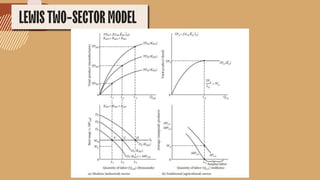
LEWISTWO-SECTORMODEL
Lewis two-sector model is a theory of development in which
surplus labor from the traditional agricultural sector is
transferred to the modern industrial sector, the growth of which
absorbs the surplus labor, promotes industrialization, and
stimulates sustained development.
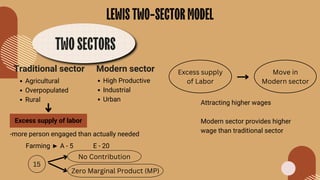
15
No Contribution
Zero Marginal Product (MP)
Excess supply
of Labor
Move in
Modern sector
TWOSECTORS
Agricultural
Overpopulated
Rural
Traditional sector Modern sector
High Productive
Industrial
Urban
LEWISTWO-SECTORMODEL
Excess supply of labor
-more person engaged than actually needed
Farming ► A - 5 E - 20
Attracting higher wages
Modern sector provides higher
wage than traditional sector
LEWISTWO-SECTORMODEL
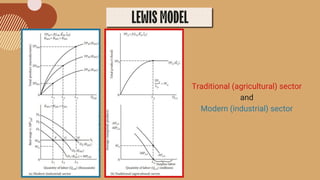
LEWISMODEL
Traditional (agricultural) sector
and
Modern (industrial) sector
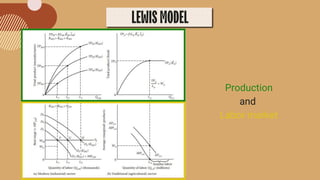
LEWISMODEL
Production
and
Labor market
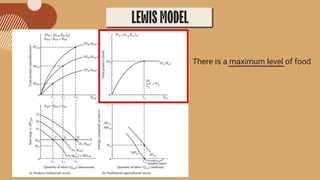
LEWISMODEL
There is a maximum level of food
LEWISMODEL
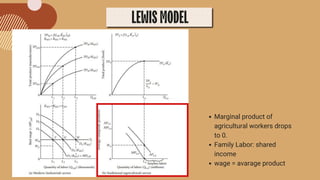
Marginal product of
agricultural workers drops
to 0.
Family Labor: shared
income
wage = avarage product
LEWISMODEL
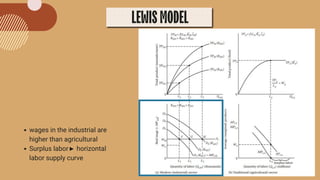
wages in the industrial are
higher than agricultural
Surplus labor► horizontal
labor supply curve
LEWISMODEL
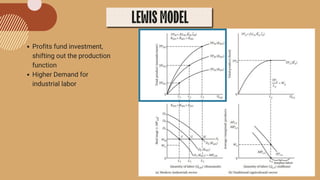
Profits fund investment,
shifting out the production
function
Higher Demand for
industrial labor
PATTERNSOFDEVELOPMENT
The patterns-of-development analysis of structural change focuses on the
sequential process through which the economic, industrial, and institutional
structure of an underdeveloped economy is transformed over time to permit
new industries to replace traditional agriculture as the engine of economic
growth.
According to their approach, all developing countries pass through the same
structural transformations as today’s developed countries did when they were
developing. These transformations include shifts from agriculture to industry
and from rural to urban status as well as increasing literacy rates and life
expectancy.
Chenery’s approach was empirical, based on observation and
statistical analysis of the economic behavior and characteristics of
developing countries. It incorporated elements like the role of
investment in physical and human capital, technological progress,
and structural change in shaping the growth trajectory.
These patterns are sometimes called stylized facts, because it's not
a fact that applies everywhere but applies most of the time in many
circumstances.
The patterns of development approach has been criticized for
lacking a theoretical framework.
THECRITICISMSOFTHESTRUCTURAL-CHANGETHEORY
These models have faced criticism for their emphasis on urban
development at the expense of rural development which can lead to
a substantial rise in inequality between internal regions of a country.
The two-sector surplus model, has been further criticized for its underlying
assumption that predominantly agrarian societies suffer from a surplus of labor.
Actual empirical studies have shown that such labor surpluses are only seasonal
and drawing such labor to urban areas can result in a collapse of the agricultural
sector.
INTERNATIONALDEPENDENCETHEORY
International-dependence
models gained increasing
support, especially among
developing-country
intellectuals, as a result of
growing disenchantment
with both the stages and
structural-change models
These theories view
developing countries as
being economically and
politically dependent on
more powerful, developed
countries which have an
interest in maintaining
their dominant position.
There are three different,
major formulations of
international dependence
theory;
• neocolonial dependence
theory,
• the false-paradigm model
and
• the dualistic-dependence
model.

STRUCTURAL CHANGE THEORY.pdf

  • 1.
  • 2.
    STRUCTURAL-CHANGETHEORY Structural-change theory dealswith policies focused on changing the economic structures of developing countries from being composed primarily of subsistence agricultural practices to being a subsistence agricultural practices to being a “more modern, more urbanized, and more industrially diverse manufacturing and service economy ”. There are two major forms of structural-change theory: • W. Lewis’ two-sector surplus model sector surplus model. • Hollis Chenery ’s patterns of development approach
  • 3.
    LEWISTWO-SECTORMODEL Lewis two-sector modelis a theory of development in which surplus labor from the traditional agricultural sector is transferred to the modern industrial sector, the growth of which absorbs the surplus labor, promotes industrialization, and stimulates sustained development.
  • 4.
    15 No Contribution Zero MarginalProduct (MP) Excess supply of Labor Move in Modern sector TWOSECTORS Agricultural Overpopulated Rural Traditional sector Modern sector High Productive Industrial Urban LEWISTWO-SECTORMODEL Excess supply of labor -more person engaged than actually needed Farming ► A - 5 E - 20 Attracting higher wages Modern sector provides higher wage than traditional sector
  • 5.
  • 6.
  • 7.
  • 8.
    LEWISMODEL There is amaximum level of food
  • 9.
    LEWISMODEL Marginal product of agriculturalworkers drops to 0. Family Labor: shared income wage = avarage product
  • 10.
    LEWISMODEL wages in theindustrial are higher than agricultural Surplus labor► horizontal labor supply curve
  • 11.
    LEWISMODEL Profits fund investment, shiftingout the production function Higher Demand for industrial labor
  • 12.
    PATTERNSOFDEVELOPMENT The patterns-of-development analysisof structural change focuses on the sequential process through which the economic, industrial, and institutional structure of an underdeveloped economy is transformed over time to permit new industries to replace traditional agriculture as the engine of economic growth. According to their approach, all developing countries pass through the same structural transformations as today’s developed countries did when they were developing. These transformations include shifts from agriculture to industry and from rural to urban status as well as increasing literacy rates and life expectancy.
  • 13.
    Chenery’s approach wasempirical, based on observation and statistical analysis of the economic behavior and characteristics of developing countries. It incorporated elements like the role of investment in physical and human capital, technological progress, and structural change in shaping the growth trajectory. These patterns are sometimes called stylized facts, because it's not a fact that applies everywhere but applies most of the time in many circumstances.
  • 14.
    The patterns ofdevelopment approach has been criticized for lacking a theoretical framework. THECRITICISMSOFTHESTRUCTURAL-CHANGETHEORY These models have faced criticism for their emphasis on urban development at the expense of rural development which can lead to a substantial rise in inequality between internal regions of a country. The two-sector surplus model, has been further criticized for its underlying assumption that predominantly agrarian societies suffer from a surplus of labor. Actual empirical studies have shown that such labor surpluses are only seasonal and drawing such labor to urban areas can result in a collapse of the agricultural sector.
  • 15.
    INTERNATIONALDEPENDENCETHEORY International-dependence models gained increasing support,especially among developing-country intellectuals, as a result of growing disenchantment with both the stages and structural-change models These theories view developing countries as being economically and politically dependent on more powerful, developed countries which have an interest in maintaining their dominant position. There are three different, major formulations of international dependence theory; • neocolonial dependence theory, • the false-paradigm model and • the dualistic-dependence model.