CRITICALTHINKING
&
DECISION MAKING
CRITICALTHINKING-
TO DEVELOPCRITICALTHINKING SKILLS -
■ To face each new experience and
■ Problem involving a client’s care with open-mindedness, creativity, confidence and
intellectual wisdom.
■ It is process acquired only through experience, commitment and an active curiosity
towards learning .
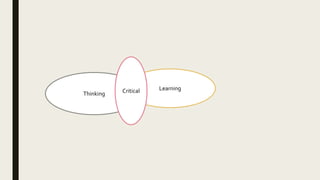
Learning
Thinking Critical
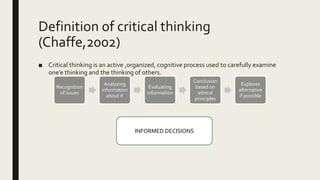
Definition of critical thinking
(Chaffe,2002)
■ Critical thinking is an active ,organized, cognitive process used to carefully examine
one’e thinking and the thinking of others.
Recognition
of issues
Analyzing
information
about it
Evaluating
information
Conclusion
based on
ethical
principles
Explores
alternative
if possible
INFORMED DECISIONS
DECISION MAKING
■ Decision making is a complex ,congrutive process often defined as choosing a
particular course of action.
■ Decision making defined as the process of choosing alternatives to achieve a goal.
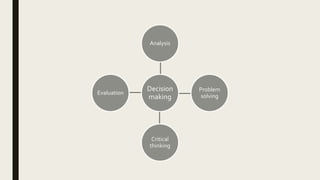
Decision
making
Analysis
Problem
solving
Critical
thinking
Evaluation
Points to be remembered….
 Administrative and managerial functions.
 Achievement of objectives
 Involves – allocation of resources, appointing peoples, investing capital or introducing
new things.
 Selecting the preferred alternatives follows careful weighing of probable
consequences of several possible courses of action.
Manager decision should be
Based on
■ Institutional goal achievement
■ Change of work situation in desirable one.
■ Timely
■ Reality
■ Personnel and material resources
■ Motivational communication
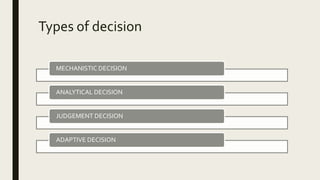
Types of decision
MECHANISTIC DECISION
ANALYTICAL DECISION
JUDGEMENT DECISION
ADAPTIVE DECISION
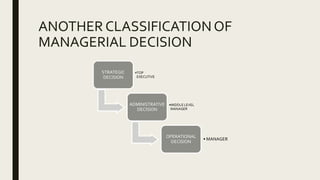
ANOTHER CLASSIFICATIONOF
MANAGERIAL DECISION
STRATEGIC
DECISION
•TOP
EXECUTIVE
ADMINISTRATIVE
DECISION
•MIDDLE LEVEL
MANAGER
OPERATIONAL
DECISION
• MANAGER
DECISION STRATEGIES-
■ A strategy is an artful or clever plan for applying techniques in pursuit of achieving
goal.
■ Before selecting any method of decision ,manager should adopt a decision strategy.
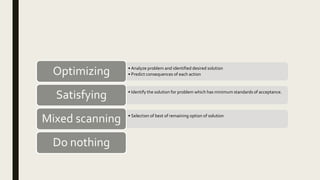
• Analyze problem and identified desired solution
• Predict consequences of each actionOptimizing
• Identify the solution for problem which has minimum standards of acceptance.
Satisfying
• Selection of best of remaining option of solution
Mixed scanning
Do nothing
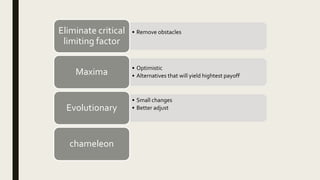
• Remove obstaclesEliminate critical
limiting factor
• Optimistic
• Alternatives that will yield hightest payoffMaxima
• Small changes
• Better adjustEvolutionary
chameleon
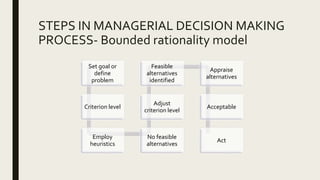
STEPS IN MANAGERIAL DECISION MAKING
PROCESS- Bounded rationality model
Set goal or
define
problem
Criterion level
Employ
heuristics
No feasible
alternatives
Adjust
criterion level
Feasible
alternatives
identified
Appraise
alternatives
Acceptable
Act
■ BT BASAVANTHAPPA ,NURSINGADMINISTRATION , SECOND EDITION, JAYPEE
PUBLICATION -2003
■ POTTER PATRICIA, PERRY ANN, FUNDAMENTALOF NURSING, SEVENTH EDITION,
ELSIVIER MOSBY PUBLICATION- 2010
Decision making and Critical thinking

Decision making and Critical thinking

  • 1.
  • 2.
    CRITICALTHINKING- TO DEVELOPCRITICALTHINKING SKILLS- ■ To face each new experience and ■ Problem involving a client’s care with open-mindedness, creativity, confidence and intellectual wisdom. ■ It is process acquired only through experience, commitment and an active curiosity towards learning .
  • 3.
  • 4.
    Definition of criticalthinking (Chaffe,2002) ■ Critical thinking is an active ,organized, cognitive process used to carefully examine one’e thinking and the thinking of others. Recognition of issues Analyzing information about it Evaluating information Conclusion based on ethical principles Explores alternative if possible INFORMED DECISIONS
  • 6.
    DECISION MAKING ■ Decisionmaking is a complex ,congrutive process often defined as choosing a particular course of action. ■ Decision making defined as the process of choosing alternatives to achieve a goal.
  • 7.
  • 8.
    Points to beremembered….  Administrative and managerial functions.  Achievement of objectives  Involves – allocation of resources, appointing peoples, investing capital or introducing new things.  Selecting the preferred alternatives follows careful weighing of probable consequences of several possible courses of action.
  • 9.
    Manager decision shouldbe Based on ■ Institutional goal achievement ■ Change of work situation in desirable one. ■ Timely ■ Reality ■ Personnel and material resources ■ Motivational communication
  • 10.
    Types of decision MECHANISTICDECISION ANALYTICAL DECISION JUDGEMENT DECISION ADAPTIVE DECISION
  • 11.
  • 12.
    DECISION STRATEGIES- ■ Astrategy is an artful or clever plan for applying techniques in pursuit of achieving goal. ■ Before selecting any method of decision ,manager should adopt a decision strategy.
  • 13.
    • Analyze problemand identified desired solution • Predict consequences of each actionOptimizing • Identify the solution for problem which has minimum standards of acceptance. Satisfying • Selection of best of remaining option of solution Mixed scanning Do nothing
  • 14.
    • Remove obstaclesEliminatecritical limiting factor • Optimistic • Alternatives that will yield hightest payoffMaxima • Small changes • Better adjustEvolutionary chameleon
  • 15.
    STEPS IN MANAGERIALDECISION MAKING PROCESS- Bounded rationality model Set goal or define problem Criterion level Employ heuristics No feasible alternatives Adjust criterion level Feasible alternatives identified Appraise alternatives Acceptable Act
  • 16.
    ■ BT BASAVANTHAPPA,NURSINGADMINISTRATION , SECOND EDITION, JAYPEE PUBLICATION -2003 ■ POTTER PATRICIA, PERRY ANN, FUNDAMENTALOF NURSING, SEVENTH EDITION, ELSIVIER MOSBY PUBLICATION- 2010