Decision Making & Management of Change
Introduction Decision making is fundamental aspect of management because it requires choosing among alternatives course of action to produce desired results.. Decision is required to be taken in all functions of management. Managers scout for problem, make decisions for solving them and monitor the consequences to see whether additional decisions are required.
Characteristic Goal Oriented. Alternative- Search and choice. Analytical-Intellectual. Dynamic Pervasive-Covers every part of an enterprise. Commitment of time, effort and money.>
Classification Basic Decision- One time decision Routine Decision-Repetitive decision. Programmed Decision- Fairly structured and recurs with some frequency. Non-programmed decision-Decision in response to unique situation.>
Types Personal vs. Organizational Decisions Personal decisions  pertain to the manager as an individual rather than to the manager as an individual rather than to organization. Organizational Decisions are those that managers make in their official capacity. PERSPECTIVE MANAGEMENT
Cont……….. Strategic vs. Operational decision. Strategic decisions  tend to influence the long - range plans. It involve the entire organization and not a single department. Operational decisions  are concern with the day-to-day operations of the enterprise. They deal with short-term plans.  PERSPECTIVE MANAGEMENT
Cont…. Problem-Solving vs. Opportunity Decision. Problem solving   decisions  are made to solve existing or anticipated problem. Opportunity decision  is a positive action that takes advantage of potential growth or higher profits PERSPECTIVE MANAGEMENT
Cont… Structured vs. Unstructured Decision. Structured  decisions  are programmed and includes policies, procedures, methods and rules. Unstructured decisions  are non-programmed decisions and are relatively free from limitations imposed by prior decision. PERSPECTIVE MANAGEMENT
Cont…… Crisis vs. research Decisions. A crisis decision is made under pressure and is characterized by surprise, stress, limited time and danger to high priority goals. A research decision does not involve any urgency and executives can take time to arrive at any decision.   PERSPECTIVE MANAGEMENT
Cont… Initiative vs. Referred decision. Ambitious and aggressive managers make  Initiative decisions. Managers who are timid and self-sitters play safe and prefer to remain inactive until a  decision is Referred  to them. PERSPECTIVE MANAGEMENT
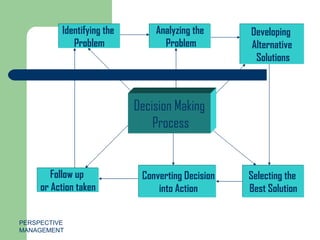
Decision Making Process Awareness of problem. Diagnose and state the problem.-What is the problem? Which problem to solve ? What is the real cause of problem? Develop the alternative. Evaluate the alternative. Select the best alternative-The risk, Economy of effort, Timing, Limitation of resources. Implement and verify the decision.>
PERSPECTIVE MANAGEMENT Decision Making Process Identifying the  Problem Developing  Alternative Solutions Analyzing the Problem Follow up  or Action taken Converting Decision into Action Selecting the  Best Solution
Problem in Group Decision Making Conformity-Group forms certain norms of behaviour and react accordingly. Group Think –This is extreme form of consensus. Members tend to take mediocre decision. Superiority. Risky Shift.-Group makes riskier decision than individual.>>
Decision-Making To decide means to come to some definite conclusion for follow-up action. Decisions are made to achieve goals through suitable follow-up actions. Decision-Making is a Process by which selection of a course of action is take. PERSPECTIVE MANAGEMENT

Decision+making+and+management+of+change

  • 1.
    Decision Making &Management of Change
  • 2.
    Introduction Decision makingis fundamental aspect of management because it requires choosing among alternatives course of action to produce desired results.. Decision is required to be taken in all functions of management. Managers scout for problem, make decisions for solving them and monitor the consequences to see whether additional decisions are required.
  • 3.
    Characteristic Goal Oriented.Alternative- Search and choice. Analytical-Intellectual. Dynamic Pervasive-Covers every part of an enterprise. Commitment of time, effort and money.>
  • 4.
    Classification Basic Decision-One time decision Routine Decision-Repetitive decision. Programmed Decision- Fairly structured and recurs with some frequency. Non-programmed decision-Decision in response to unique situation.>
  • 5.
    Types Personal vs.Organizational Decisions Personal decisions pertain to the manager as an individual rather than to the manager as an individual rather than to organization. Organizational Decisions are those that managers make in their official capacity. PERSPECTIVE MANAGEMENT
  • 6.
    Cont……….. Strategic vs.Operational decision. Strategic decisions tend to influence the long - range plans. It involve the entire organization and not a single department. Operational decisions are concern with the day-to-day operations of the enterprise. They deal with short-term plans. PERSPECTIVE MANAGEMENT
  • 7.
    Cont…. Problem-Solving vs.Opportunity Decision. Problem solving decisions are made to solve existing or anticipated problem. Opportunity decision is a positive action that takes advantage of potential growth or higher profits PERSPECTIVE MANAGEMENT
  • 8.
    Cont… Structured vs.Unstructured Decision. Structured decisions are programmed and includes policies, procedures, methods and rules. Unstructured decisions are non-programmed decisions and are relatively free from limitations imposed by prior decision. PERSPECTIVE MANAGEMENT
  • 9.
    Cont…… Crisis vs.research Decisions. A crisis decision is made under pressure and is characterized by surprise, stress, limited time and danger to high priority goals. A research decision does not involve any urgency and executives can take time to arrive at any decision. PERSPECTIVE MANAGEMENT
  • 10.
    Cont… Initiative vs.Referred decision. Ambitious and aggressive managers make Initiative decisions. Managers who are timid and self-sitters play safe and prefer to remain inactive until a decision is Referred to them. PERSPECTIVE MANAGEMENT
  • 11.
    Decision Making ProcessAwareness of problem. Diagnose and state the problem.-What is the problem? Which problem to solve ? What is the real cause of problem? Develop the alternative. Evaluate the alternative. Select the best alternative-The risk, Economy of effort, Timing, Limitation of resources. Implement and verify the decision.>
  • 12.
    PERSPECTIVE MANAGEMENT DecisionMaking Process Identifying the Problem Developing Alternative Solutions Analyzing the Problem Follow up or Action taken Converting Decision into Action Selecting the Best Solution
  • 13.
    Problem in GroupDecision Making Conformity-Group forms certain norms of behaviour and react accordingly. Group Think –This is extreme form of consensus. Members tend to take mediocre decision. Superiority. Risky Shift.-Group makes riskier decision than individual.>>
  • 14.
    Decision-Making To decidemeans to come to some definite conclusion for follow-up action. Decisions are made to achieve goals through suitable follow-up actions. Decision-Making is a Process by which selection of a course of action is take. PERSPECTIVE MANAGEMENT