INDIVIDUAL AND GROUP
DECISION MAKING
WHAT IS DECISION MAKING?
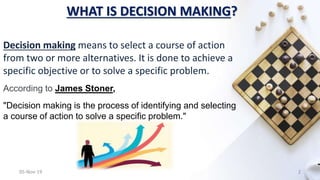
Decision making means to select a course of action
from two or more alternatives. It is done to achieve a
specific objective or to solve a specific problem.
According to James Stoner,
"Decision making is the process of identifying and selecting
a course of action to solve a specific problem."
05-Nov-19 2
COMPONENT OF DECISION MAKING
Decision making in management has three components:
• Objectives or Problem : Decision making is objective
oriented. It is done to achieve an objective or to solve a
problem.
• Alternatives : There are two or more alternatives. Decision
making means to select the best alternative.
• Choice : Decision making involves a choice. It means to
choose the best solution for solving the problem.
“Good decisions come from experience.
Experience comes from making bad decisions.”
-Mark Twain05-Nov-19 3
PROCESS OF DECISION MAKING
1. Identify the decision –
To make a decision, you must first identify the problem
you need to solve or the question you need to answer. Clearly define
your decision.
2.. Gather relevant information –
Once you have identified your decision, it’s time to gather
the information relevant to that choice.
3. Identify the alternatives -
Identify possible solutions to your problem. There is usually
more than one option to consider when trying to meet a goal..
05-Nov-19 4
4.Evaluation of alternatives-
You need to compare each alternative for their positives and negatives.
5.Choose among alternatives-
Identified and clarified what decision needs to be made, gathered all
relevant information, and developed and considered the potential paths to take.
6.Take action-
Develop a plan to make your decision tangible and achievable.
7.Review your decision-
Take an honest look back at your decision. Did you solve the problem? Did you
answer the question? Did you meet your goals?
05-Nov-19 5
TYPES OF DECISION MAKING
1. Personal and Organisational Decision Making
2. Individual and Group Decision Making
3. Policy and Operating Decision Making
4. Planned and Unplanned Decision Making
05-Nov-19 6
Individual Decision Making
When the size of the business unit is small and the decisions to be
taken do not require high , Specific and technical knowledge,
then the decisions for various problem are normally taken by
the managers himself.
Such Decisions are Known as individual decision making
technique.
05-Nov-19 7
Advantage of Individual Decision Making
 You Can take immediate action and fast solution to a
problem or a situation.
 You are solely responsible for the kind of decision whether it
is good or bad.
 You take no argument with your personal opinions.
 You take full accountability for the outcomes of the decision
and its consequences.
 You become efficient with the use of time and effort in
reaching a decision.
05-Nov-19 8
Group Decision Making
Group Decision making techniques means such decisions
which are not taken by a single individual,
but by a group.
05-Nov-19 9
Advantage of Group Decision Making
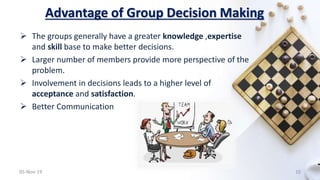
 The groups generally have a greater knowledge ,expertise
and skill base to make better decisions.
 Larger number of members provide more perspective of the
problem.
 Involvement in decisions leads to a higher level of
acceptance and satisfaction.
 Better Communication
05-Nov-19 10
Diff. b/w Individual and Group Decision making
Individual Group
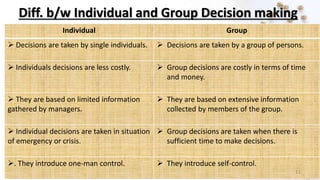
 Decisions are taken by single individuals.  Decisions are taken by a group of persons.
 Individuals decisions are less costly.  Group decisions are costly in terms of time
and money.
 They are based on limited information
gathered by managers.
 They are based on extensive information
collected by members of the group.
 Individual decisions are taken in situation
of emergency or crisis.
 Group decisions are taken when there is
sufficient time to make decisions.
. They introduce one-man control.  They introduce self-control.
11
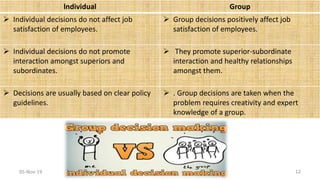
lndividual Group
 Individual decisions do not affect job
satisfaction of employees.
 Group decisions positively affect job
satisfaction of employees.
 Individual decisions do not promote
interaction amongst superiors and
subordinates.
 They promote superior-subordinate
interaction and healthy relationships
amongst them.
 Decisions are usually based on clear policy
guidelines.
 . Group decisions are taken when the
problem requires creativity and expert
knowledge of a group.
05-Nov-19 12
05-Nov-19 13

Decision making

  • 1.
  • 2.
    WHAT IS DECISIONMAKING? Decision making means to select a course of action from two or more alternatives. It is done to achieve a specific objective or to solve a specific problem. According to James Stoner, "Decision making is the process of identifying and selecting a course of action to solve a specific problem." 05-Nov-19 2
  • 3.
    COMPONENT OF DECISIONMAKING Decision making in management has three components: • Objectives or Problem : Decision making is objective oriented. It is done to achieve an objective or to solve a problem. • Alternatives : There are two or more alternatives. Decision making means to select the best alternative. • Choice : Decision making involves a choice. It means to choose the best solution for solving the problem. “Good decisions come from experience. Experience comes from making bad decisions.” -Mark Twain05-Nov-19 3
  • 4.
    PROCESS OF DECISIONMAKING 1. Identify the decision – To make a decision, you must first identify the problem you need to solve or the question you need to answer. Clearly define your decision. 2.. Gather relevant information – Once you have identified your decision, it’s time to gather the information relevant to that choice. 3. Identify the alternatives - Identify possible solutions to your problem. There is usually more than one option to consider when trying to meet a goal.. 05-Nov-19 4
  • 5.
    4.Evaluation of alternatives- Youneed to compare each alternative for their positives and negatives. 5.Choose among alternatives- Identified and clarified what decision needs to be made, gathered all relevant information, and developed and considered the potential paths to take. 6.Take action- Develop a plan to make your decision tangible and achievable. 7.Review your decision- Take an honest look back at your decision. Did you solve the problem? Did you answer the question? Did you meet your goals? 05-Nov-19 5
  • 6.
    TYPES OF DECISIONMAKING 1. Personal and Organisational Decision Making 2. Individual and Group Decision Making 3. Policy and Operating Decision Making 4. Planned and Unplanned Decision Making 05-Nov-19 6
  • 7.
    Individual Decision Making Whenthe size of the business unit is small and the decisions to be taken do not require high , Specific and technical knowledge, then the decisions for various problem are normally taken by the managers himself. Such Decisions are Known as individual decision making technique. 05-Nov-19 7
  • 8.
    Advantage of IndividualDecision Making  You Can take immediate action and fast solution to a problem or a situation.  You are solely responsible for the kind of decision whether it is good or bad.  You take no argument with your personal opinions.  You take full accountability for the outcomes of the decision and its consequences.  You become efficient with the use of time and effort in reaching a decision. 05-Nov-19 8
  • 9.
    Group Decision Making GroupDecision making techniques means such decisions which are not taken by a single individual, but by a group. 05-Nov-19 9
  • 10.
    Advantage of GroupDecision Making  The groups generally have a greater knowledge ,expertise and skill base to make better decisions.  Larger number of members provide more perspective of the problem.  Involvement in decisions leads to a higher level of acceptance and satisfaction.  Better Communication 05-Nov-19 10
  • 11.
    Diff. b/w Individualand Group Decision making Individual Group  Decisions are taken by single individuals.  Decisions are taken by a group of persons.  Individuals decisions are less costly.  Group decisions are costly in terms of time and money.  They are based on limited information gathered by managers.  They are based on extensive information collected by members of the group.  Individual decisions are taken in situation of emergency or crisis.  Group decisions are taken when there is sufficient time to make decisions. . They introduce one-man control.  They introduce self-control. 11
  • 12.
    lndividual Group  Individualdecisions do not affect job satisfaction of employees.  Group decisions positively affect job satisfaction of employees.  Individual decisions do not promote interaction amongst superiors and subordinates.  They promote superior-subordinate interaction and healthy relationships amongst them.  Decisions are usually based on clear policy guidelines.  . Group decisions are taken when the problem requires creativity and expert knowledge of a group. 05-Nov-19 12
  • 13.